

Marketing is one of those disciplines where everyone has an opinion and almost no one agrees on a definition. Ask ten people what marketing is and you will get ten different answers — social media, advertising, brand strategy, sales support, customer experience. All of them are right, and all of them are partial.
The clearest way to understand what marketing actually is — and what a marketing team or function is responsible for — is through the seven core functions that have defined the discipline for decades. They are taught in business education programmes worldwide, embedded in the structure of marketing organisations, and still provide the most complete picture of what marketing does in a company.
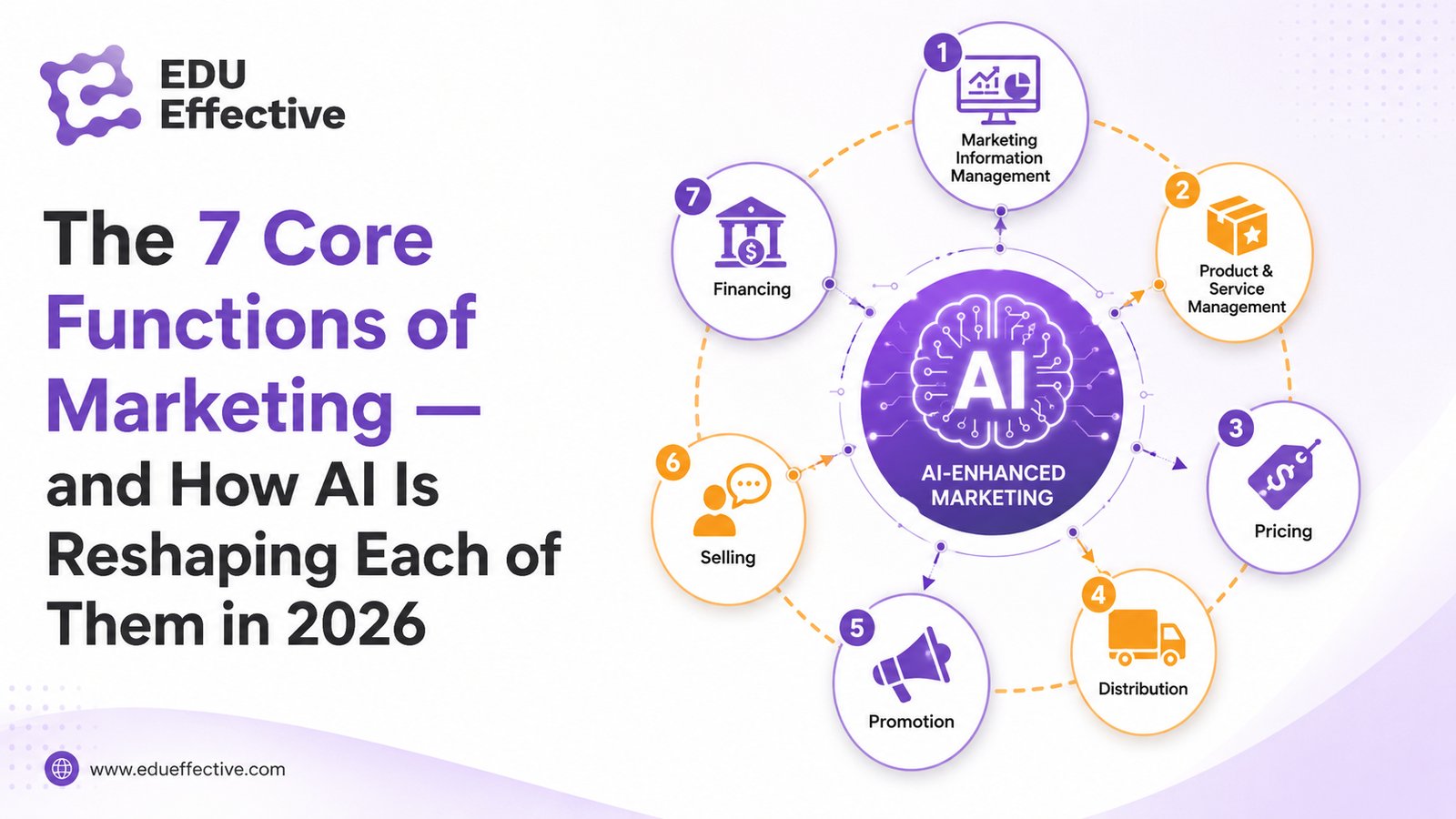
In 2026, each of these seven functions is being reshaped by AI. Understanding both the function itself and how AI is changing it is the most practical orientation available to anyone working in or around marketing.
What the 7 functions of marketing are — and where they come from
The seven functions of marketing framework was developed and standardised by the Marketing Education Resource Centre (MERC) and is widely used in marketing education at secondary and tertiary level. It provides a comprehensive taxonomy of marketing activities that together describe everything a marketing function does to create, communicate, and deliver value to customers.
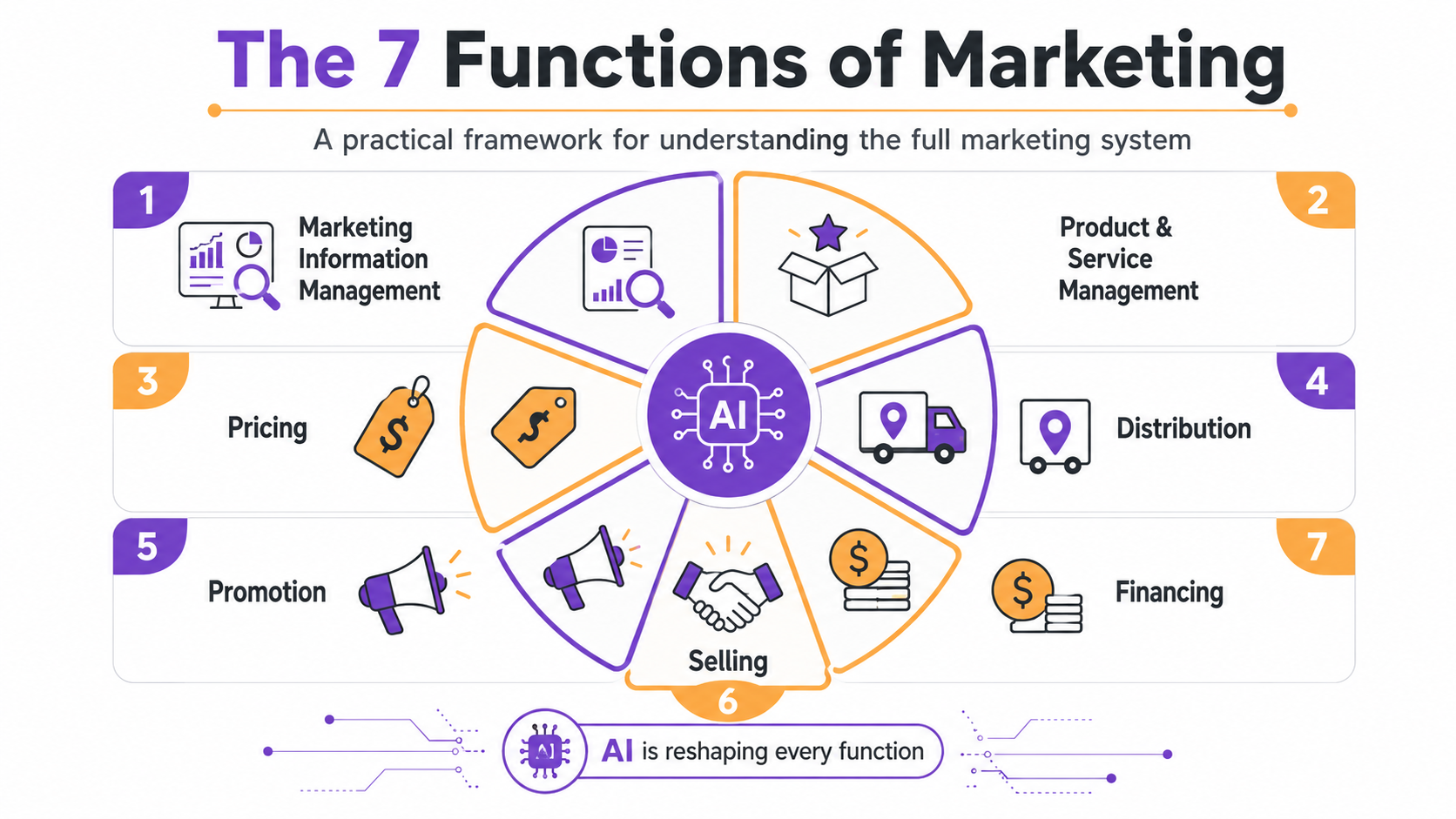
The seven functions are: marketing information management, product and service management, pricing, distribution, promotion, selling, and financing. Taken together, they cover the full lifecycle of getting the right product to the right customer at the right price through the right channels.
1. Marketing information management
Marketing information management (MIM) is the systematic process of collecting, analysing, and applying data to make better marketing decisions. It is the intelligence function of marketing — without it, every other function operates on assumption rather than evidence.
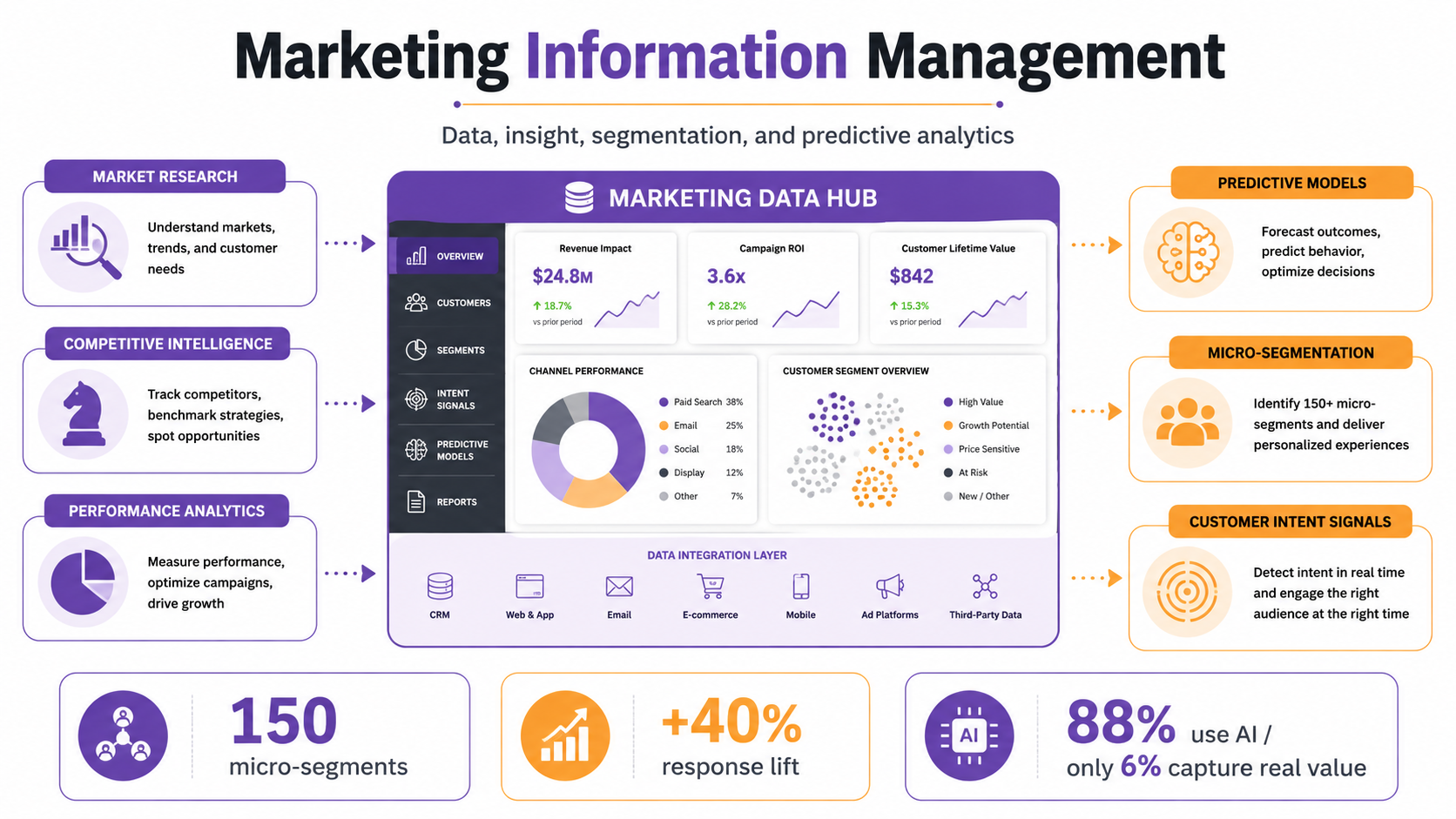
In practice, MIM encompasses market research (understanding customer needs, behaviours, and segments), competitive intelligence (monitoring what competitors are doing and how the market is evolving), and performance analytics (measuring the results of marketing activities to identify what is working).
In 2026, this function has been transformed more dramatically than any other by AI. AI tools now process customer data at a scale and speed that was impractical even three years ago, identifying patterns in behaviour that manual analysis would miss. AI-driven customer segmentation has shifted from broad demographic buckets to fine-grained intent signals — one documented case involved moving from broad audience segments to 150 personalised micro-segments, producing a 40% lift in campaign response rates. Predictive analytics now allows marketing teams to model campaign outcomes before launching, enabling better budget allocation and earlier risk identification. The challenge is not access to data but the capacity to generate genuine insight from it: only 6% of organisations currently extract meaningful bottom-line value from their AI investments, despite 88% using AI in at least one marketing function.
2. Product and service management
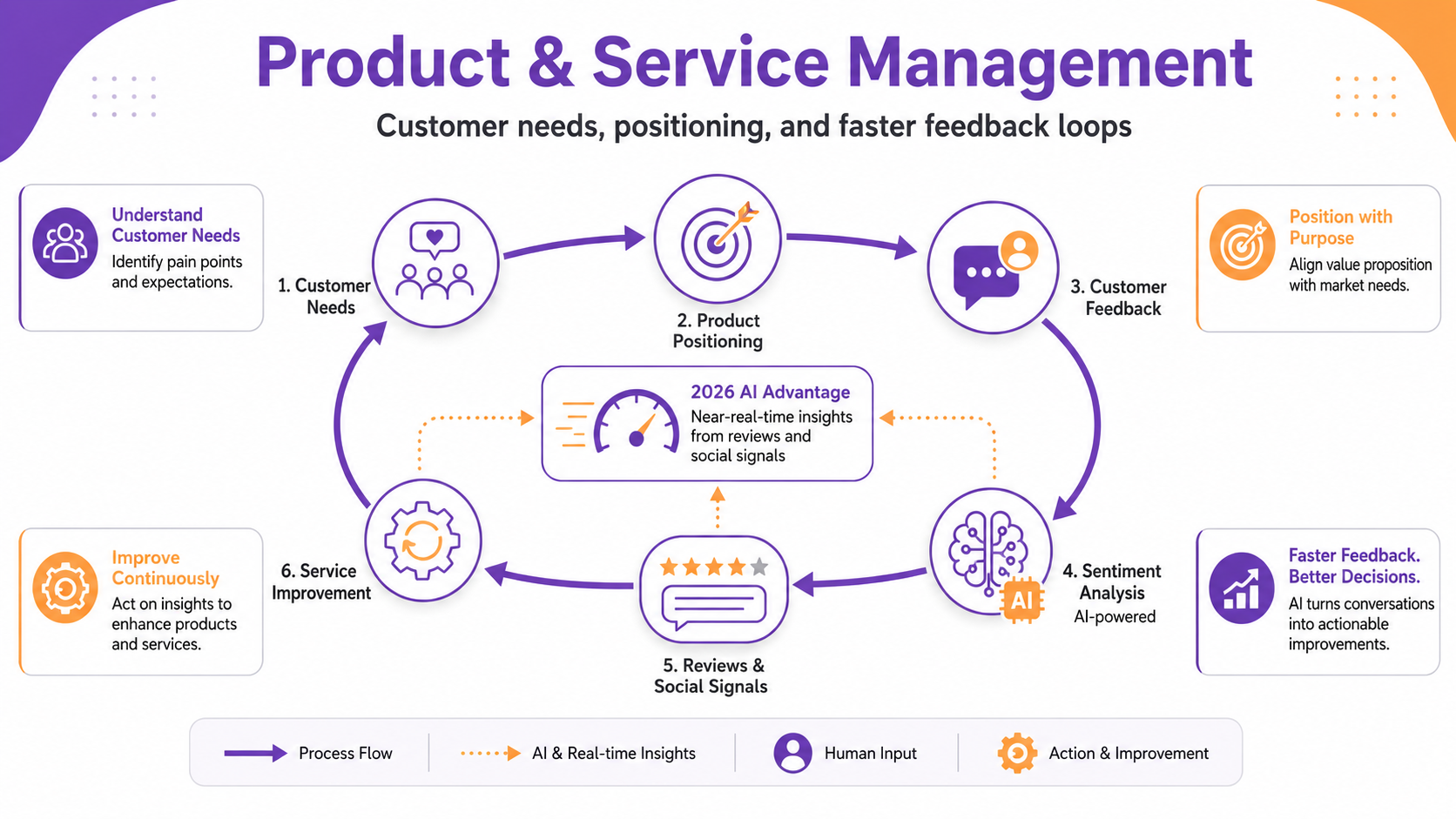
Product and service management covers the marketing team's role in defining, developing, positioning, and maintaining the product or service portfolio. While product development is typically the domain of product or R&D teams, marketing plays a critical role in the research that informs it — identifying customer needs that products must address, defining the positioning and messaging that gives products meaning in the market, and managing the lifecycle of products as markets evolve.
In consumer markets, this includes decisions about product design, naming, packaging, brand architecture, and the value proposition communicated at each stage of the customer journey. In B2B and service contexts, it involves defining service tiers, feature sets, and the experience customers receive.
In 2026, AI has entered product management directly through the acceleration of customer feedback loops. Sentiment analysis across social media, review platforms, and customer service interactions now surfaces product insights in near real-time rather than in quarterly research cycles. This compresses the time between identifying a customer problem and responding to it — which is both an opportunity and a pressure on marketing teams whose processes were built for slower feedback rhythms.
3. Pricing
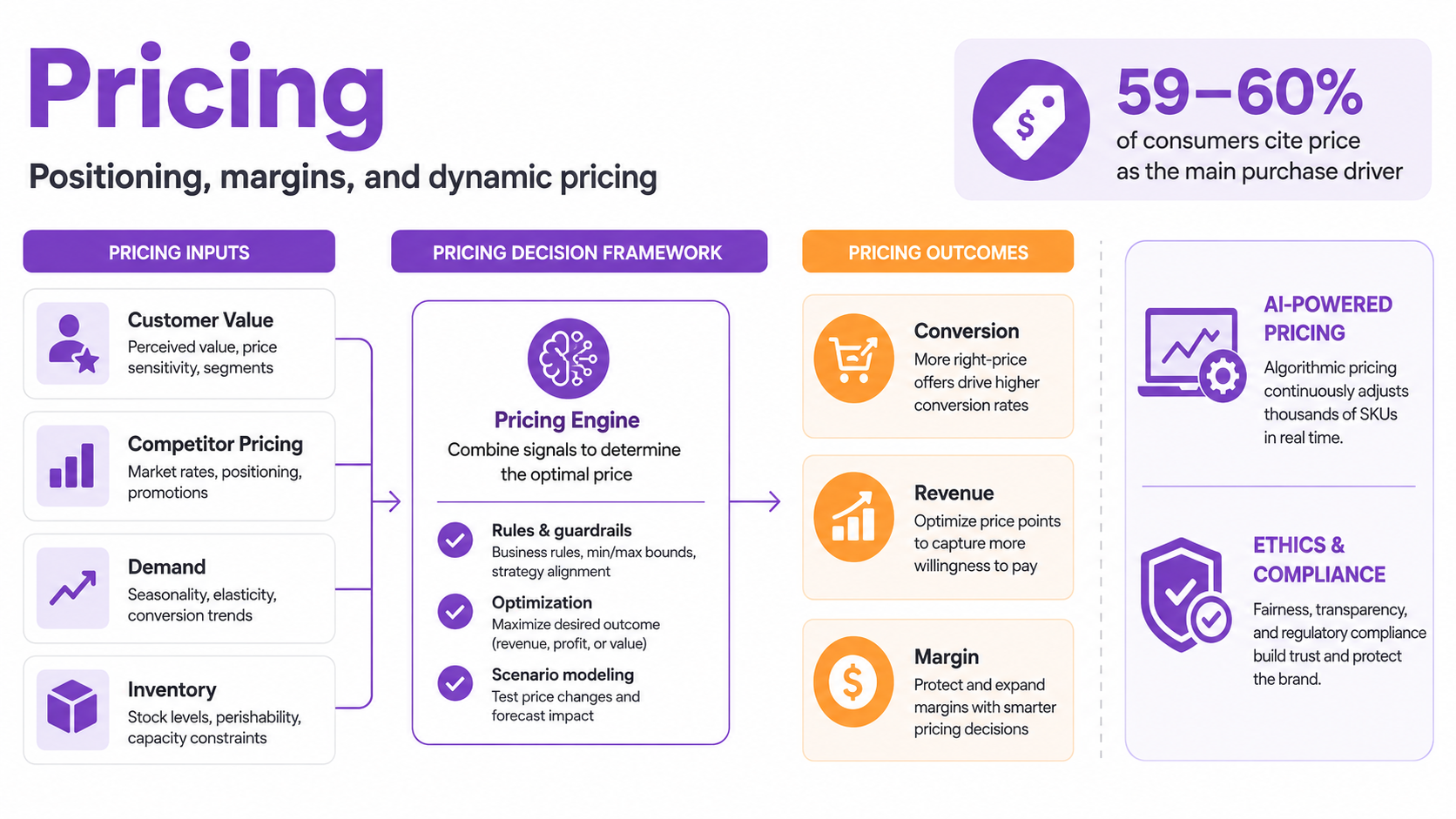
Pricing is one of marketing's most consequential functions and one of its least glamorous. The price of a product communicates its positioning, determines its accessibility to different customer segments, and directly determines margin. Price decisions affect everything from brand perception to competitive dynamics.
Research confirms that 59–60% of consumers identify price as the primary purchase driver. But price sensitivity is not uniform — the same consumer who hunts for the lowest price on commodity goods will pay a significant premium for products where brand, quality, or status are part of the value. Marketing's role in pricing is to understand what customers value, what the competition charges, and what price point maximises both revenue and market position for a given product.
Dynamic pricing — where prices adjust in real-time based on demand, competitor pricing, and inventory — has been normalised by airlines and e-commerce platforms and is spreading into new categories. AI has accelerated this: algorithmic pricing tools now adjust prices across thousands of SKUs continuously, optimising for both conversion and margin. The governance challenge this creates — ensuring that AI-driven pricing stays within ethical and legal parameters — has become a significant concern for marketing and compliance teams in 2026.
4. Distribution
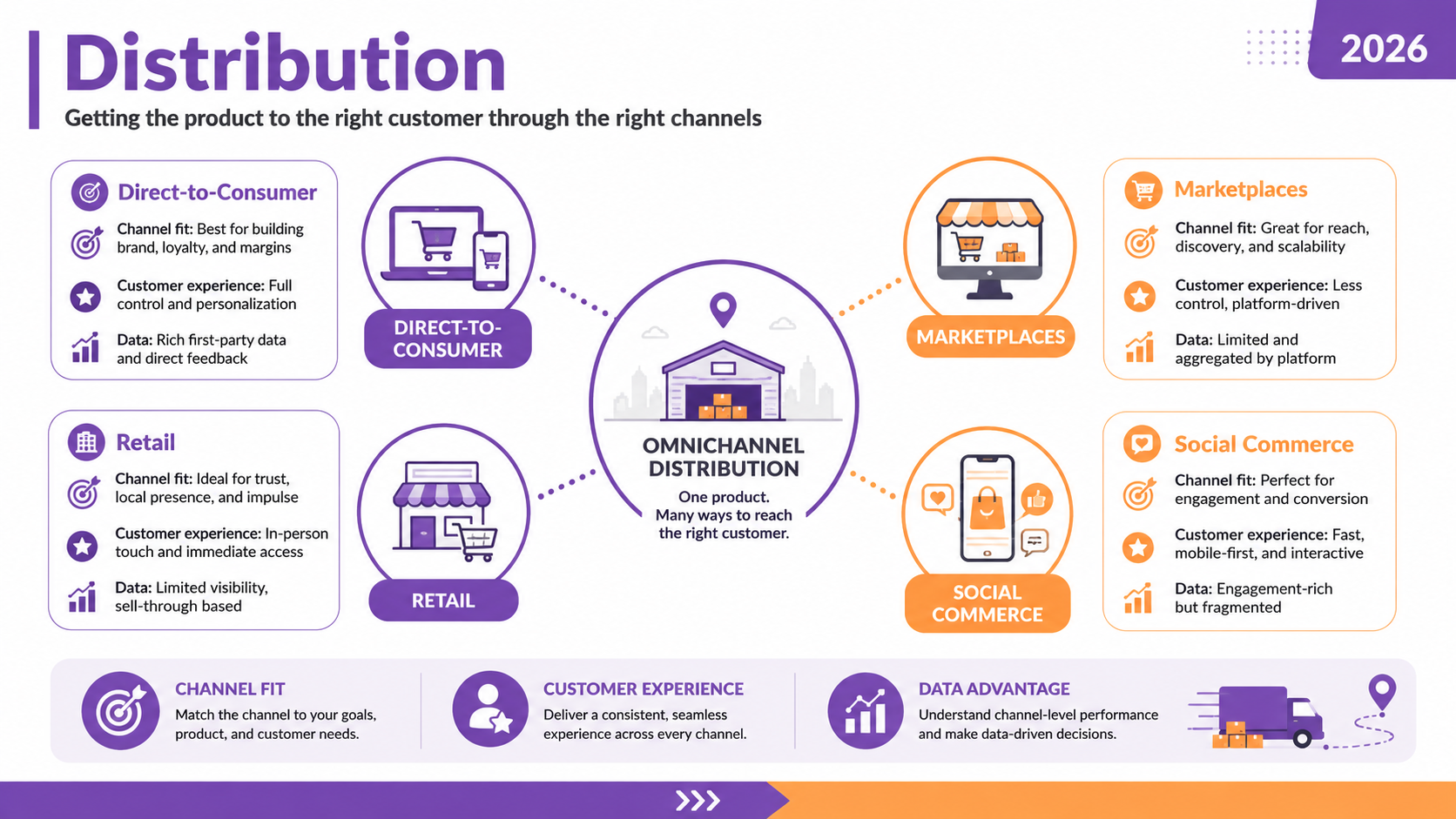
Distribution is the function responsible for ensuring products and services reach customers through the right channels, at the right time, with the right customer experience. It encompasses decisions about which retail channels, e-commerce platforms, delivery mechanisms, and geographic territories a business operates through.
The core strategic question in distribution is channel fit: where does the target customer expect to find and purchase this product? A mismatch between the customer's purchase behaviour and the channels a company uses creates invisible friction that no amount of promotion can compensate for.
In 2026, the distribution landscape continues to fragment. Direct-to-consumer (DTC) channels have matured into a core distribution strategy for consumer brands that want data ownership and margin control. Marketplace distribution through Amazon, regional equivalents, and category-specific platforms remains essential for reach. Social commerce — purchasing directly within TikTok, Instagram, and similar platforms — has grown from experiment to significant channel in several consumer categories. Each distribution channel requires different operational capabilities, different promotional approaches, and generates different data.
5. Promotion
Promotion covers everything a business does to make its target audience aware of its products, understand their value, and choose them over alternatives. It is the most visible of the seven marketing functions — the one most people think of first when they hear the word "marketing."
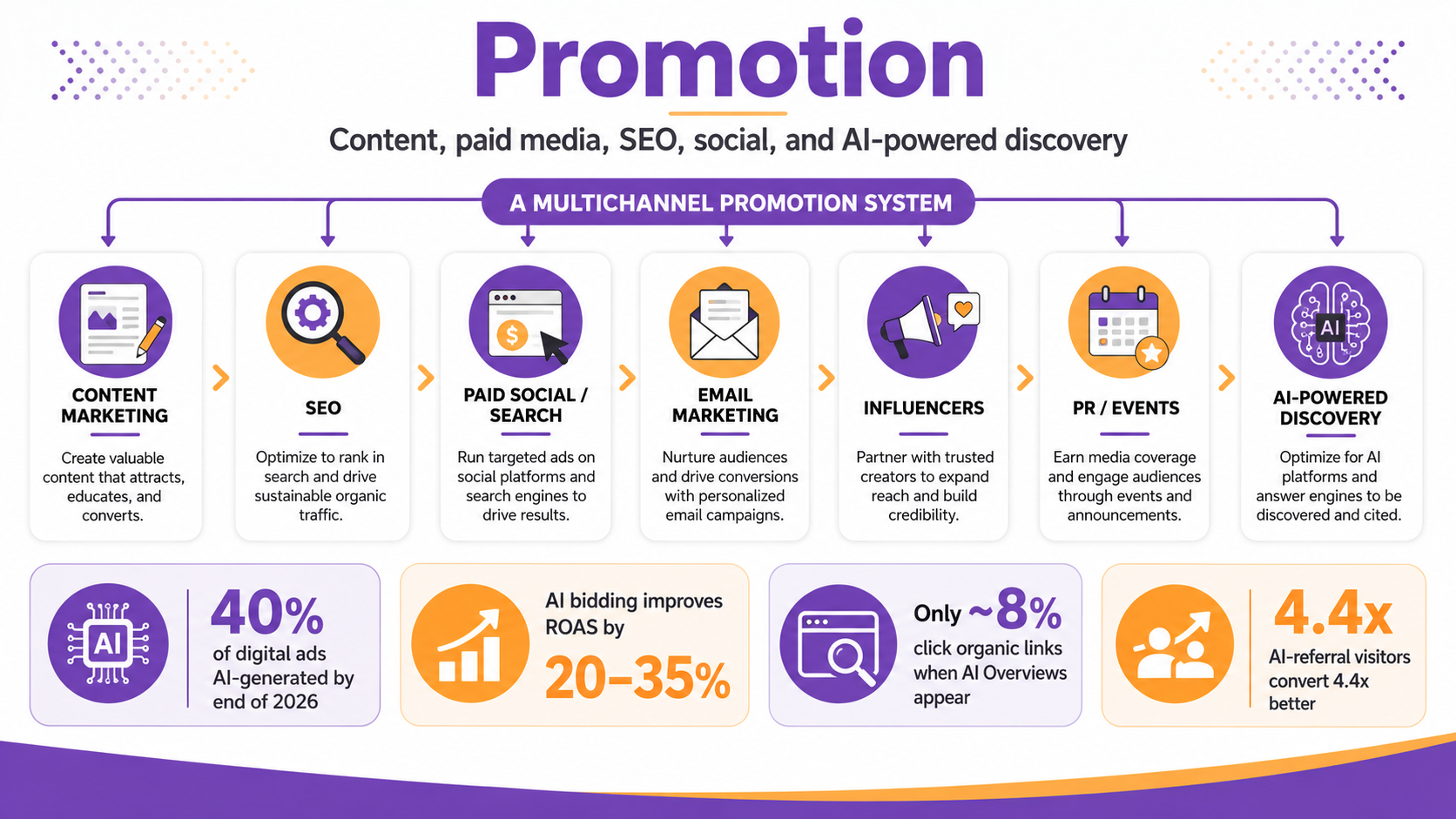
In practice, promotion is a system of coordinated activities across multiple channels: content marketing, search engine optimisation, paid search and social advertising, social media, email, influencer partnerships, public relations, events, and increasingly, presence in AI-powered discovery channels. The media mix that works varies significantly by company size, category, customer segment, and competitive context — there is no universal answer.
What has changed structurally in 2026 is the role of AI in both content creation and media buying. AI now generates or assists in generating a large proportion of digital marketing content — 40% of digital ads are expected to be AI-generated by end of 2026, according to current forecasts. AI-powered bidding in paid media (Google's Smart Bidding, Meta Advantage+) improves campaign ROAS by 20–35% over manual approaches. And the emergence of AI-powered discovery — users finding products and services through ChatGPT, Gemini, and Perplexity rather than through traditional search — has created a new promotional imperative: being present in the sources that AI systems cite, not just in search rankings.
The shift is real. When AI Overviews appear in search results, only around 8% of users click through to organic links. But the visitors who do arrive from AI-referral sources convert at approximately 4.4 times the rate of traditional organic traffic. This changes how promotion effectiveness should be measured and which channels deserve investment.
6. Selling
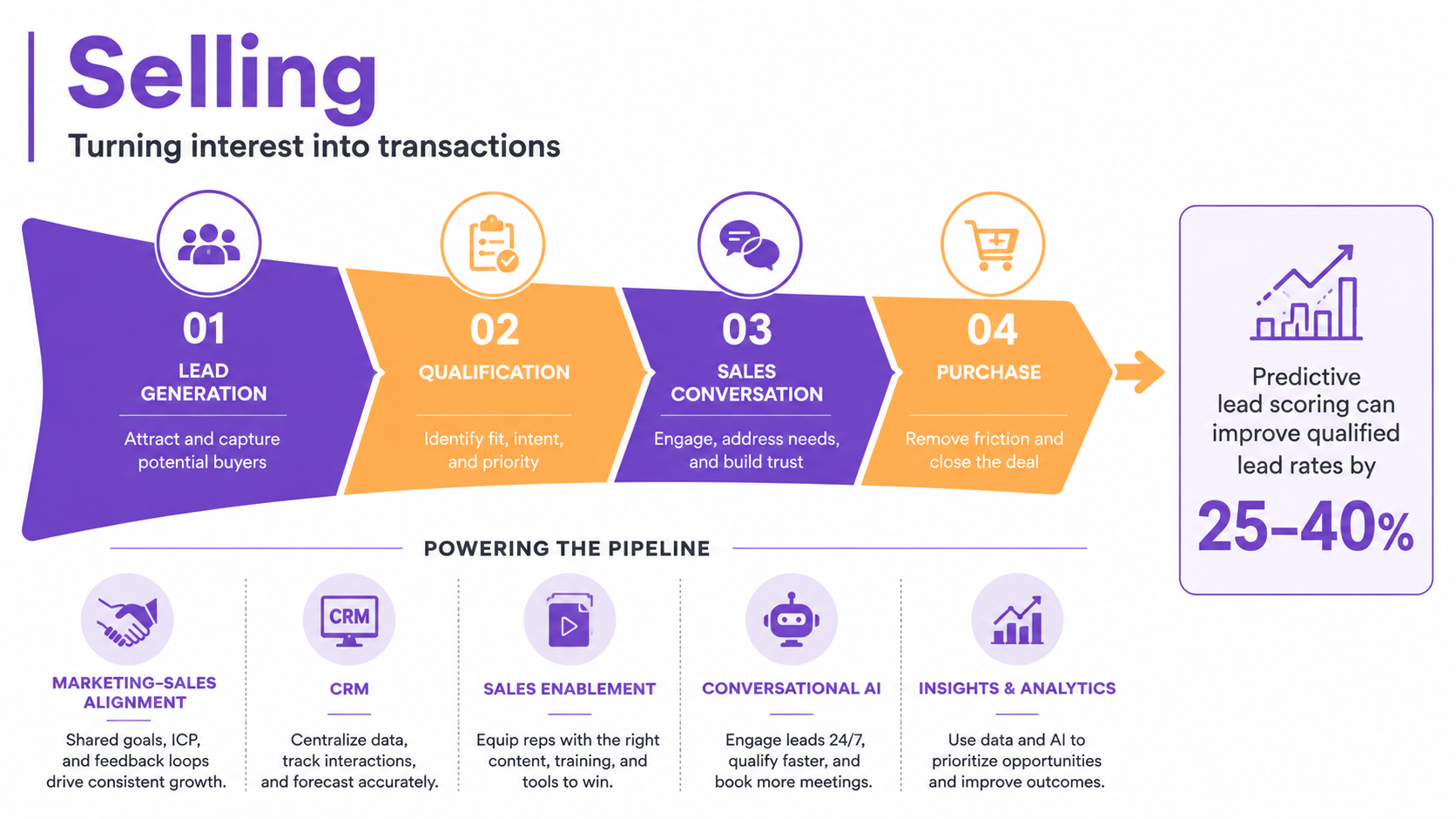
Selling is the function that converts marketing-generated interest into transactions. While selling is often treated as a separate organisational function (the sales team), the marketing function plays a direct role in enabling and supporting it — through lead generation, lead qualification, sales enablement materials, CRM systems, and the design of the customer journey from first contact to purchase decision.
In some business models, marketing and selling collapse into a single function: e-commerce businesses convert visitors directly through the website without a sales team. In B2B companies with long sales cycles, the marketing and sales functions must be tightly coordinated over months of buyer engagement. The alignment — or misalignment — between marketing and sales is one of the most commonly cited sources of commercial underperformance in organisations.
In 2026, AI has substantially automated the early stages of the selling process. AI-powered lead scoring identifies which prospects are most likely to convert, allowing sales teams to concentrate effort where it matters most. Predictive models can boost qualified lead rates by 25–40%. Conversational AI tools now handle initial qualification and information-gathering interactions that previously required human sales representatives, creating faster response times and consistent first impressions at scale.
7. Financing
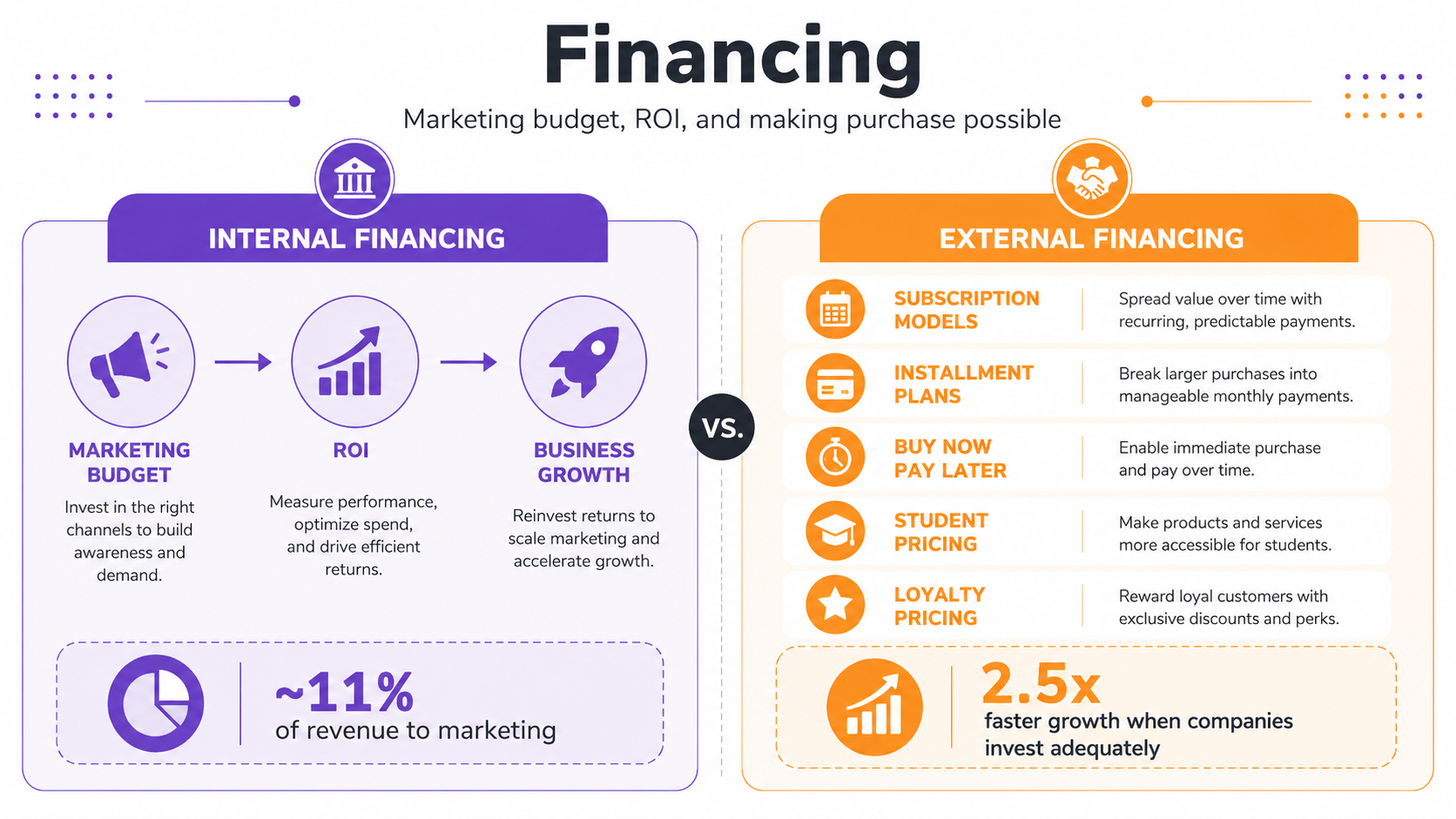
Financing is the marketing function that least fits the popular image of the discipline — but it matters in two distinct ways. The first is internal: marketing must secure budget, justify spend, and demonstrate return on investment to compete for resources within the organisation. The second is external: making it financially possible for customers to purchase — through instalment plans, subscription models, trade financing, or other mechanisms that reduce the upfront cost barrier.
Companies that allocate approximately 11% of their annual revenue to marketing grow 2.5 times faster than those that spend less, according to research cited by ChatterBuzz. Securing that level of investment requires marketing teams to demonstrate that spend generates measurable business outcomes — a discipline that has become more demanding as AI has raised the bar for what "measurable" means.
The external dimension of marketing financing is increasingly important in 2026 as consumer credit access tightens and subscription models proliferate. Buy-now-pay-later integration, subscription tier design, and student or loyalty pricing programmes all sit at the intersection of marketing strategy and financial structure. Marketing teams that understand the financial mechanics of their customer acquisition models are substantially more effective than those that treat budget as someone else's problem.
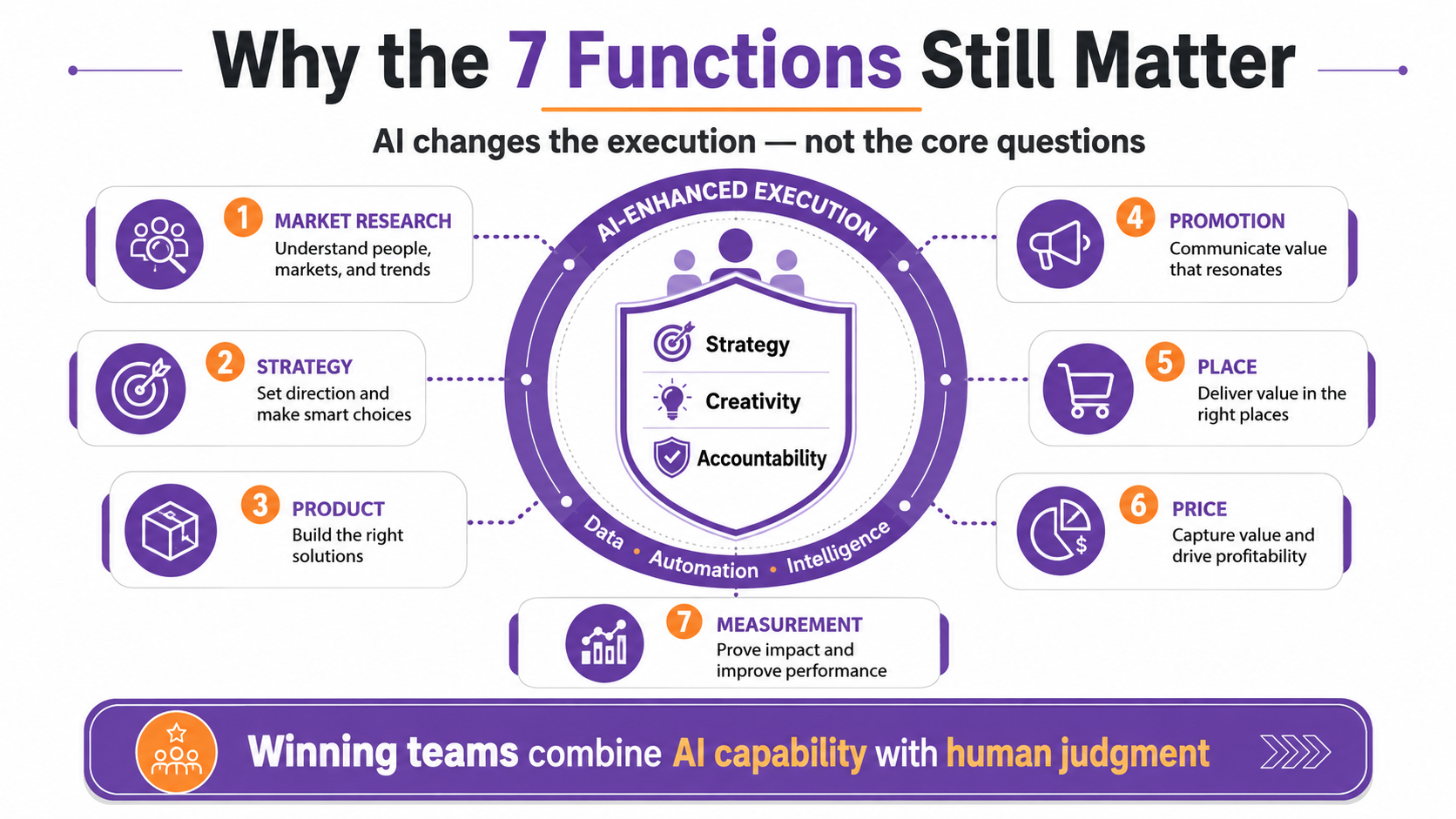
Why the 7 functions still matter in an AI-driven marketing landscape
The functions described above represent the complete taxonomy of what marketing does. AI is changing how each function is executed — accelerating research, automating content production, optimising pricing and distribution, improving lead qualification — but it is not eliminating any of them. The core marketing questions remain the same: who is the customer, what do they value, how do we reach them, what do we charge, how do we deliver, how do we convert, and how do we fund the operation?
What AI demands is a marketing team that understands these functions well enough to make intelligent decisions about where automation adds value and where human judgement remains irreplaceable. The teams winning in 2026 are not the ones using the most AI tools. They are the ones that have restructured their operations around AI capabilities while keeping strategy, creativity, and accountability firmly in human hands.
At EDU Effective, our Effective MBA: Online Marketing programme builds the strategic foundations and practical skills needed to lead marketing functions in a rapidly changing landscape.
Ready to lead marketing functions in 2026?
At EDU Effective, the Effective MBA: Online Marketing develops all seven marketing functions alongside data strategy, AI tools, and the commercial thinking needed to drive real business outcomes. Content draws from practitioners at Google, McKinsey, HubSpot, Meta, and many others — curated for immediate application in your role. Explore the programme →
EDU Effective Business School — professional development for your long-term success.
All five best-selling Effective MBA programs are built on the same educational model — designed for working adults who need learning that fits real professional life:
- Effective MBA: Executive Management & Leadership
- Effective MBA: Applied Artificial Intelligence
- Effective MBA: Coaching, Leadership & Mentoring
- Effective MBA: Mastery in AI
- Effective MBA: Online Marketing
Every programme runs on 15 minutes a day, completes in 10 months or less, is ASIC accredited, and starts from €990.
These are professional programmes, not academic ones — built for working adults to apply what they learn directly in their own business, not to collect a scholarly credential.
Join more than 9,000 students in over 120 countries who are investing in their professional development and career success. Read the experiences of our graduates here.
Apply now — from €990 · Talk to a Study Advisor
Study with NO risk: 14-day money-back guarantee, no questions asked.
Sources
- AudienceScience — The 7 Marketing Functions: Definition, Importance & Tips
audiencescience.com/marketing-functions/ - Brafton — Infographic: The 7 Functions of Marketing
brafton.co.uk/blog/content-marketing/functions-of-marketing/ - Improvado — 7 AI Marketing Trends for 2026: Strategy & Data Insights
improvado.io/blog/ai-marketing-trends - Whitehat SEO — AI in Marketing 2026: Research Report
whitehat-seo.co.uk/blog/ai-in-marketing-2026-research-report - Aprimo — AI-Driven Marketing Strategies to Implement in 2026
aprimo.com/blog/ai-driven-marketing-strategies-to-implement-in-2026 - The Gutenberg — AI in Marketing Trends 2026: What Comes Next for Marketing Teams
thegutenberg.com/blog/ai-in-marketing-trends-2026-what-comes-next-for-marketing-teams/