

Sales organizations spent most of 2024 and 2025 running AI pilots. By 2026, the results are in — and they are more complicated than the vendor marketing suggests.
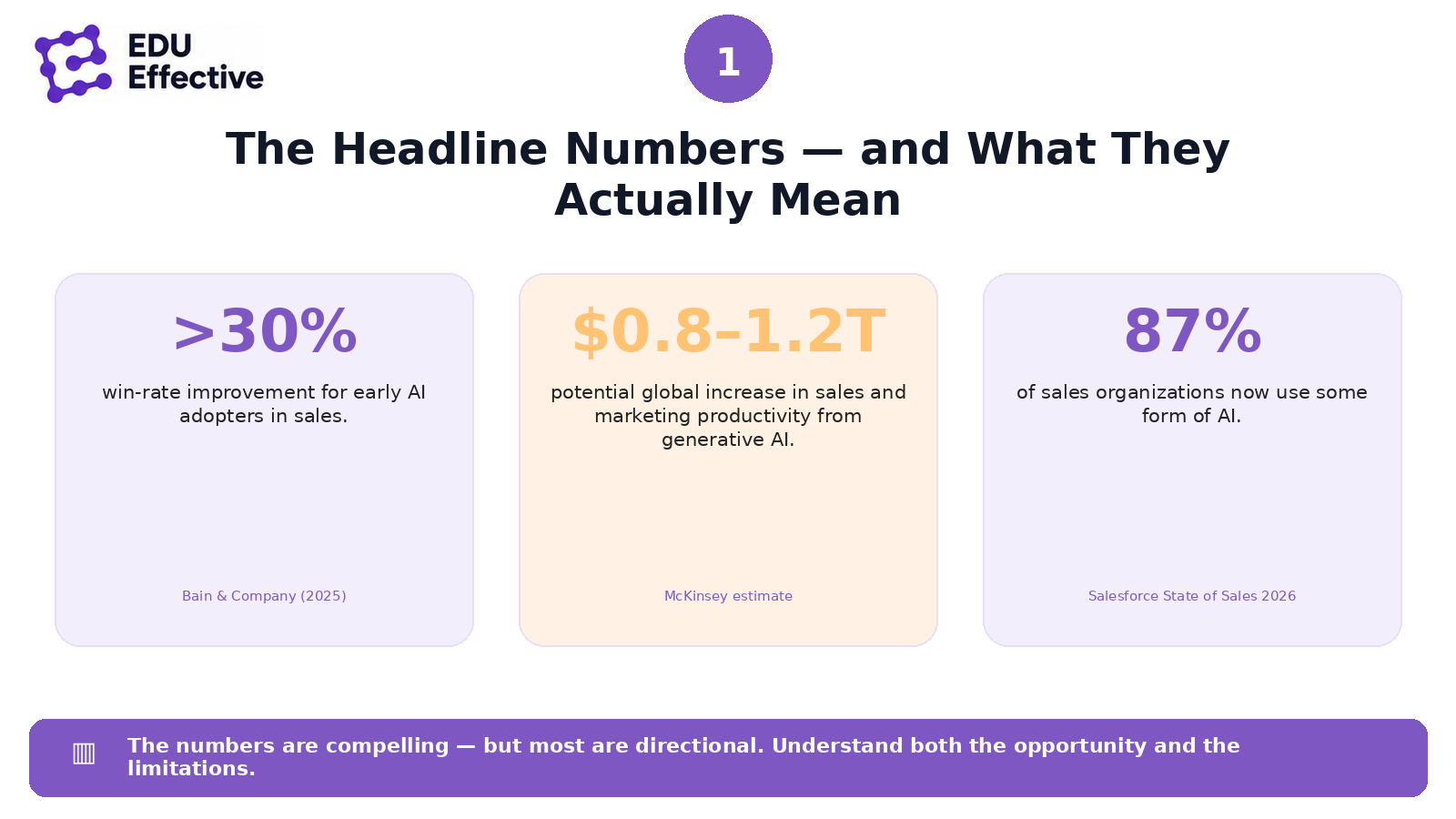
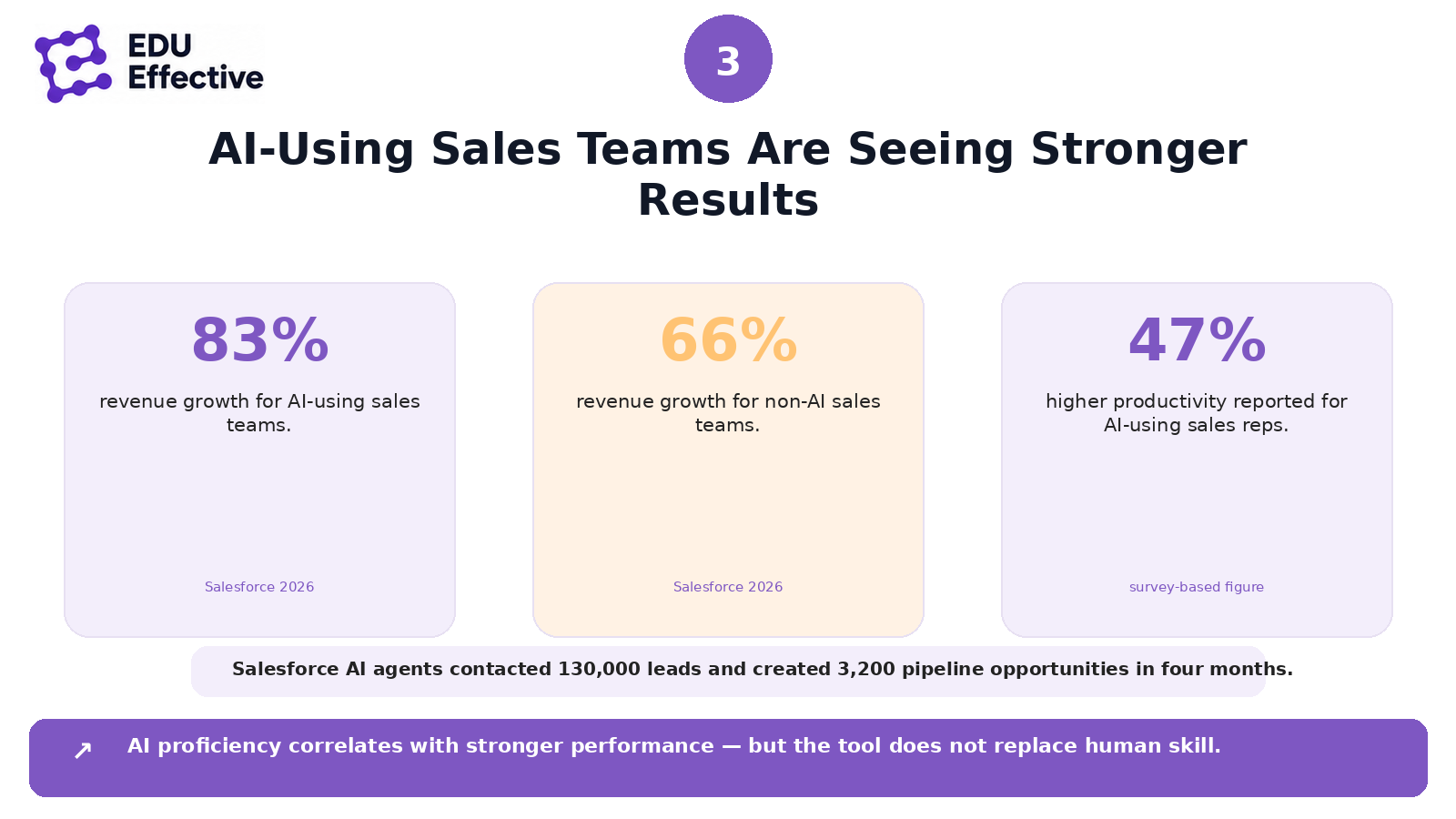
The headline numbers are real. Bain & Company’s September 2025 research found that early AI in sales adopters are seeing over 30% win-rate improvement. McKinsey estimates that generative AI could add $0.8 to $1.2 trillion in sales and marketing productivity globally. Salesforce’s State of Sales 2026 survey of over 4,000 sales professionals found that 87% of sales organizations now use some form of AI, and AI-using teams report revenue growth at 83% versus 66% for non-AI teams.
Those numbers are compelling. They are also, in most cases, directional — correlational, reported by vendors with a commercial stake, and not independent audits of causation. Understanding the real picture of AI sales adoption in 2026 requires holding both sides of the data at once.
Where AI Is Actually Making a Difference
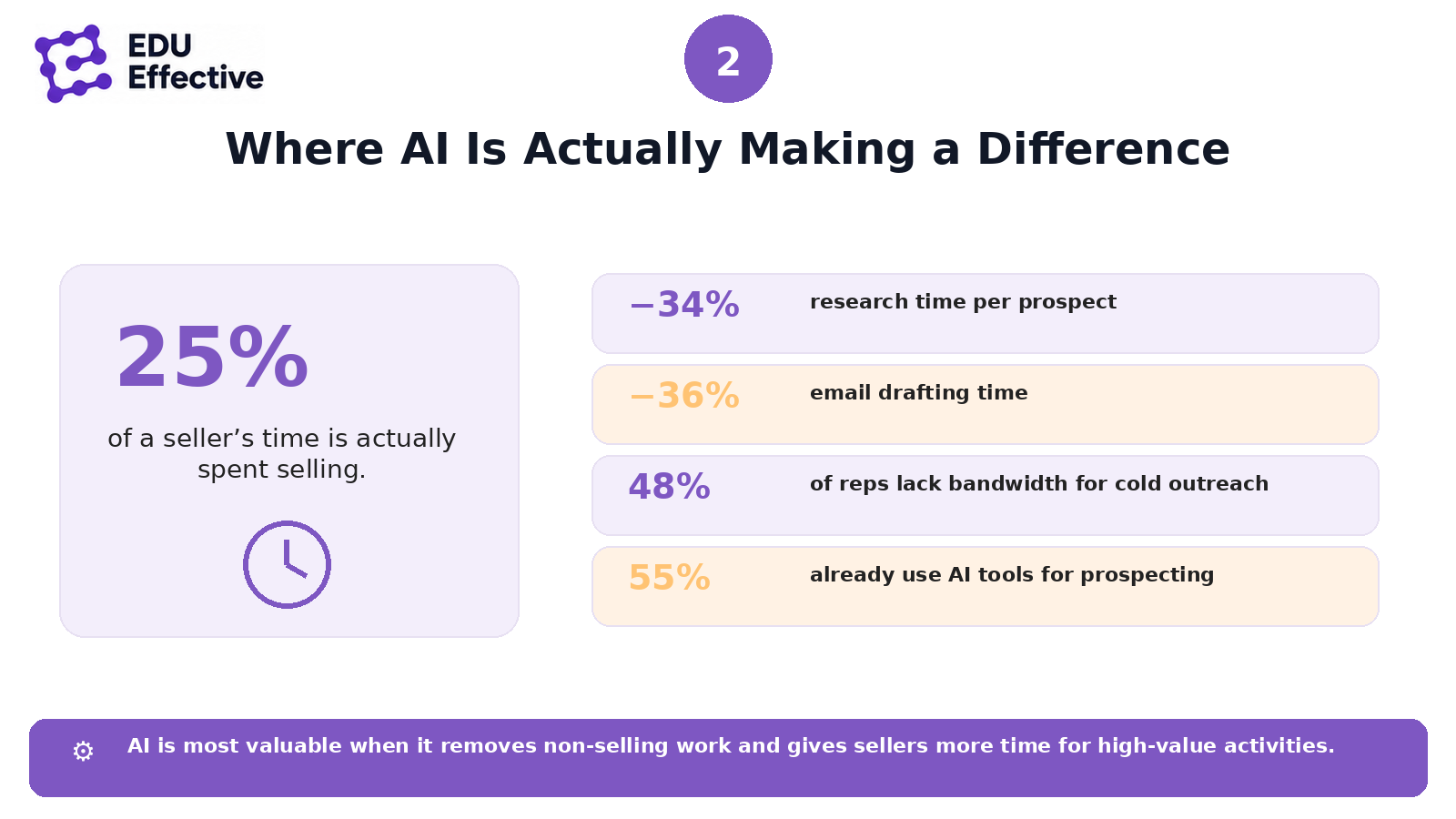
The clearest evidence for AI’s impact on sales is in time reallocation. Bain found that sellers currently spend about 25% of their time actually selling. The remaining 75% goes to research, administrative work, CRM updates, email drafting, internal coordination, and everything else that surrounds the core sales activity.
This is the problem AI is best positioned to solve — and where the evidence is most credible, because it is the least dependent on subjective outcome measures.
Salesforce’s 2026 survey found that sales reps expect research time per prospect to fall 34% and email drafting time to fall 36% as AI agents become embedded in their workflow. The same report found that 48% of reps say they currently lack the bandwidth for adequate cold outreach, and 55% are already using AI tools for prospecting.
Salesforce ran a direct test: their own AI agents contacted 130,000 leads over four months and created 3,200 new pipeline opportunities. That is not a hypothetical projection — it is a documented operational result from a single deployment.
The productivity figure most cited from the 2026 data is that AI-using sales reps are approximately 47% more productive than non-AI-using counterparts. That figure comes with the standard caveats — it is a survey self-report from a vendor’s customer base — but the directional consistency across sources is hard to dismiss entirely.
The Adoption Gap
McKinsey’s State of AI report from November 2025 found that 88% of organizations now use AI in at least one function, up from 78% in 2024. But only 6% are classified as AI high performers — organizations that have integrated AI at scale and are capturing significant value from it.
That gap between broad adoption and deep integration is the defining characteristic of AI sales transformation in 2026. Most organizations have deployed tools. Far fewer have redesigned their processes around those tools.
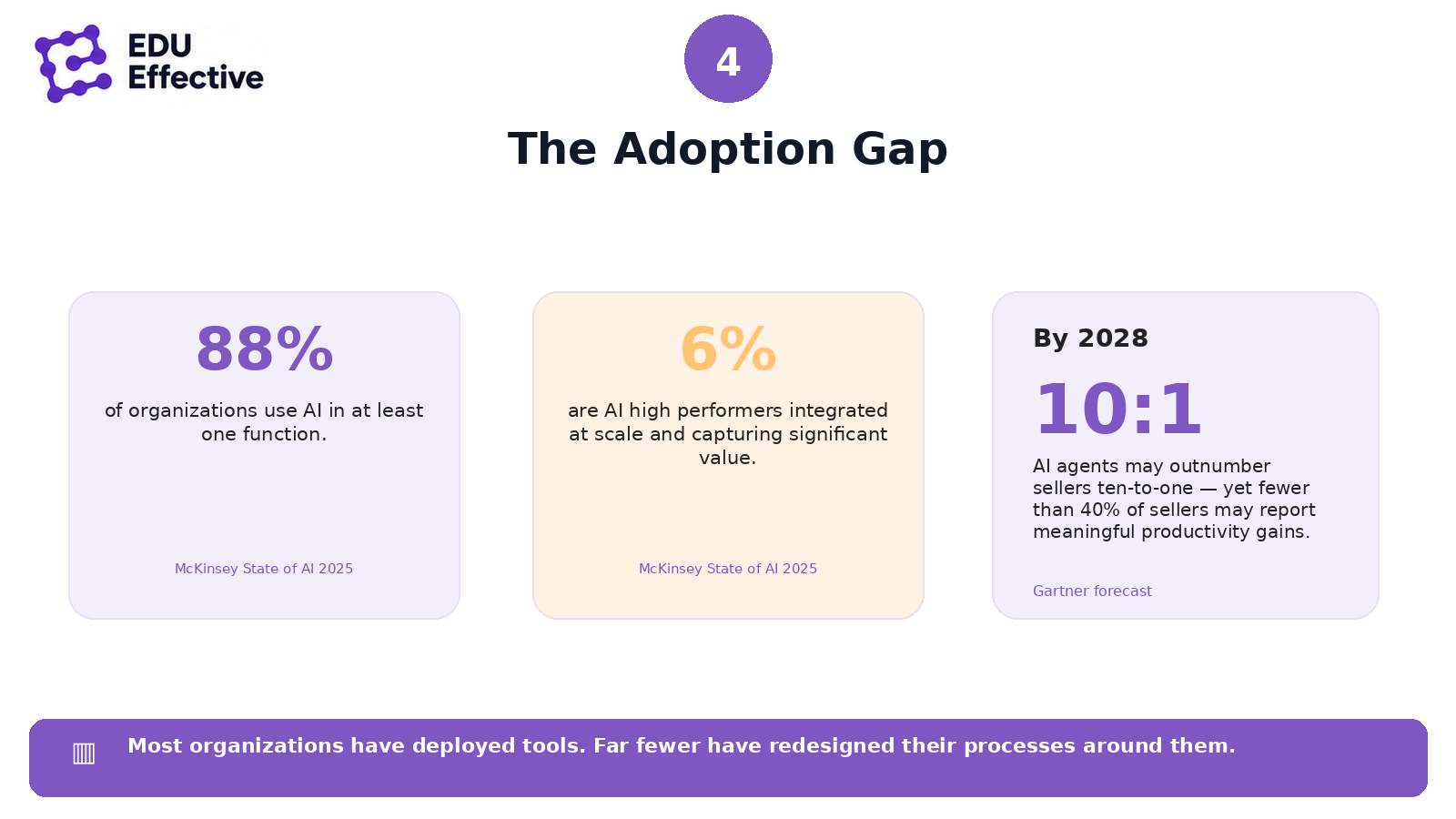
Gartner’s November 2025 forecast is worth noting: by 2028, AI agents will outnumber sellers ten-to-one, and fewer than 40% of sellers will report meaningful productivity gains from those agents. The second half of that prediction is the more important one. Having AI agents available does not automatically produce productivity gains. The organizations that actually capture the value are the ones that train their people to work with the tools effectively and redesign the workflow rather than layering AI on top of existing behavior.
Salesforce’s State of Sales 2026 data illustrates this: top-performing sales reps are 1.7 times more likely to use AI agents for prospecting than underperforming reps. The correlation between AI proficiency and sales performance is real — but it runs in both directions. High performers adopt and master new tools faster. The tool does not produce the performance; the person using it skillfully does.
What the Skeptics Get Right
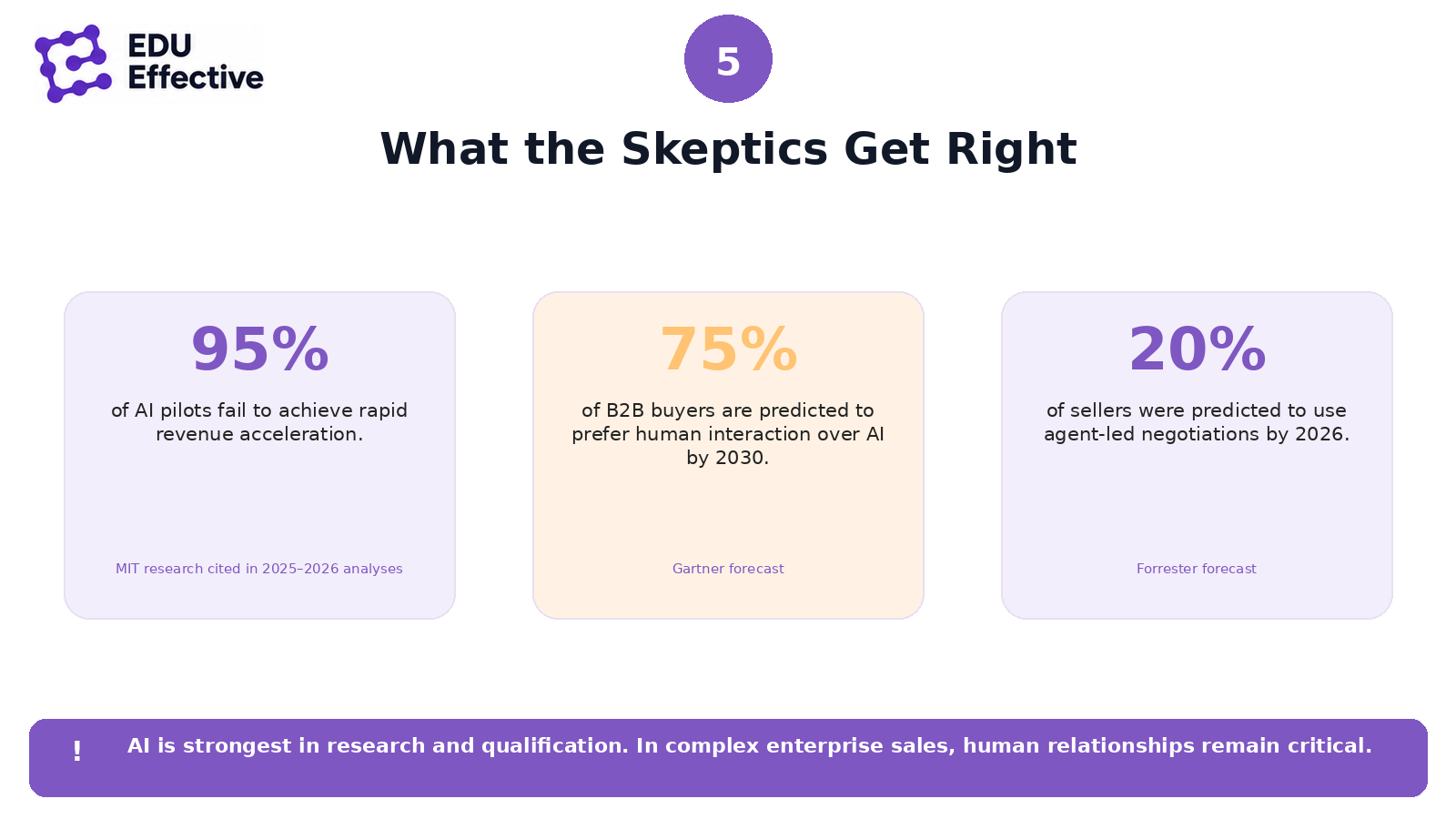
MIT research cited across multiple 2025-2026 analyses found that 95% of AI pilots fail to achieve rapid revenue acceleration. That number needs context — “rapid” is doing significant work — but the underlying finding is consistent with what practitioners describe: AI implementations that succeed over twelve to eighteen months frequently look like failures at the three-month mark.
Gartner’s separate finding adds a longer-term caution: 75% of B2B buyers will prefer human interaction over AI by 2030. This is a prediction, not a current measurement, and predictions about buyer preferences several years out have a mixed track record. But it describes something that practitioners already observe in the field: AI in sales is most effective in the research and qualification phases, and in high-volume, lower-complexity transactions. In complex enterprise sales — where relationships, trust, and nuanced negotiation drive decisions — the human advantage remains significant.
Forrester predicted in October 2025 that 20% of sellers will use agent-led negotiations by 2026. Whether that figure is accurate by year-end remains to be seen. What is clear from current patterns is that the most effective AI sales implementations treat AI as infrastructure for the human seller, not as a replacement for the human judgment that closes complex deals.
The Skills Shift That Accompanies the Tool Shift
The most underappreciated dimension of AI in sales is not the technology. It is what the technology requires of the people using it.
An AI tool that drafts outreach emails is only as effective as the prompts and strategic direction the seller gives it. An AI system that qualifies leads still requires a human who can evaluate the qualification logic and adapt it when the market shifts. AI-generated pipeline analysis is only useful to a manager who understands enough about the underlying data to know when to trust it and when to investigate further.
The skills that become more valuable as AI handles more of the process are judgment, communication, and strategic thinking — the same skills that separate top performers from average performers today, just operating at a different level of leverage.
Salesforce’s finding that 94% of sales leaders with AI agents installed say those agents are critical to meeting 2026 business demands tells you something about where the market is heading. The organizations that position their sales teams to lead that shift — rather than react to it — are investing now in the AI fluency and strategic sales capabilities that let people work effectively alongside the tools.
What Effective Implementation Actually Looks Like
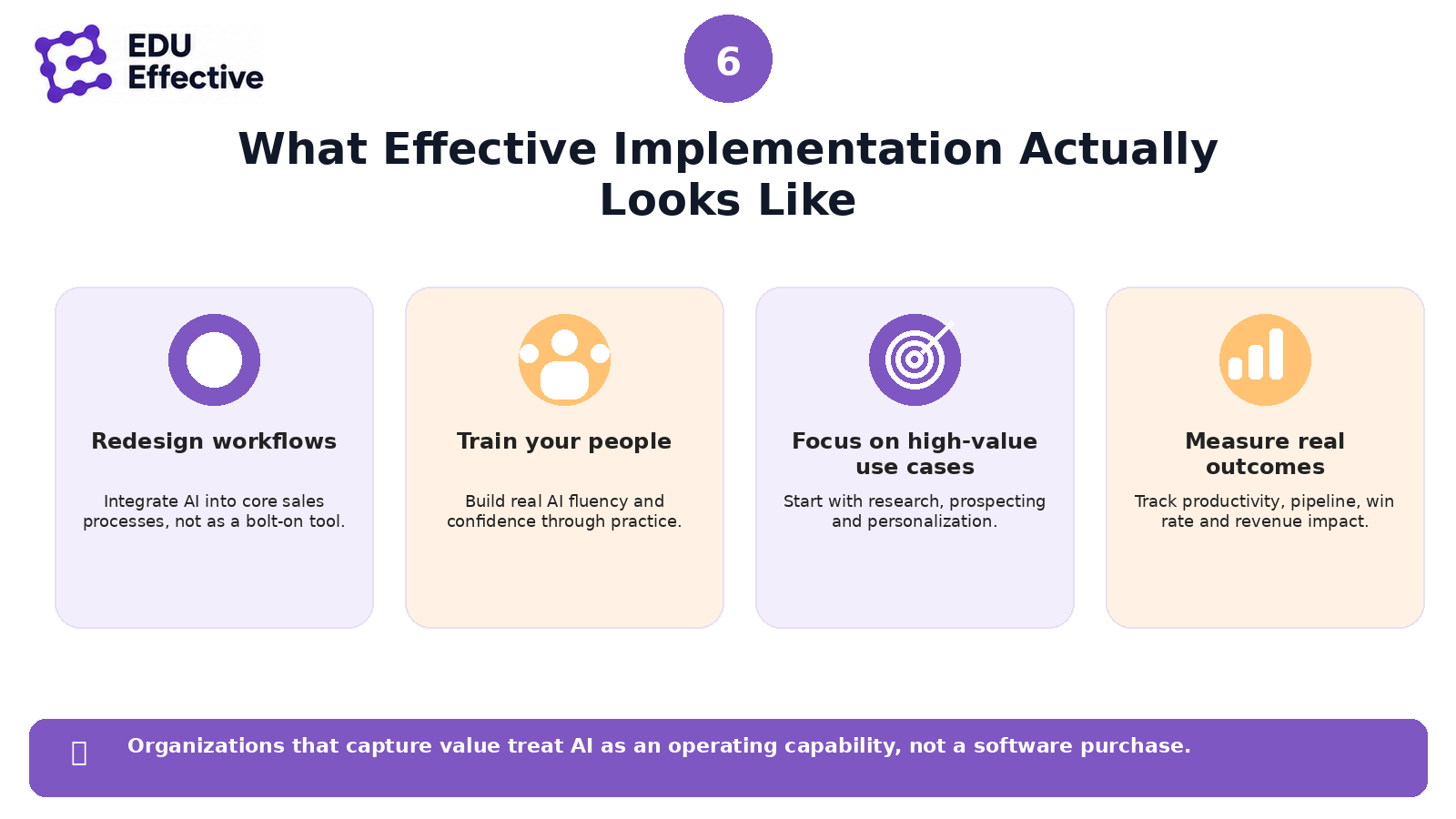
The organizations that are capturing real value from AI sales tools in 2026 share a few consistent characteristics.
They started with the highest-friction parts of the existing process. Where are reps spending the most time on non-selling activity? Where is the most data available to feed AI systems? Where would marginal improvements in efficiency have the biggest downstream impact on revenue? Those are the right starting points — not the most technologically impressive use cases, but the most commercially significant ones.
They measured outcomes rather than activity. Deployment rates and tool usage statistics are easy to optimize for. Win rates, deal velocity, average deal size, and revenue per rep are the metrics that matter. The organizations making real progress track those, not just adoption numbers.
They invested in training the people, not just deploying the tools. McKinsey’s 2026 Workforce in Motion data found that demand for AI fluency has risen eleven-fold since 2022. That figure applies to sales as much as any other function. A sales organization that deploys AI tools without developing the capability of its people to use those tools well will find that the tools underperform relative to expectations — not because the tools are weak, but because the organization hasn’t built the human capability to leverage them.
The Manager’s Role Is Changing
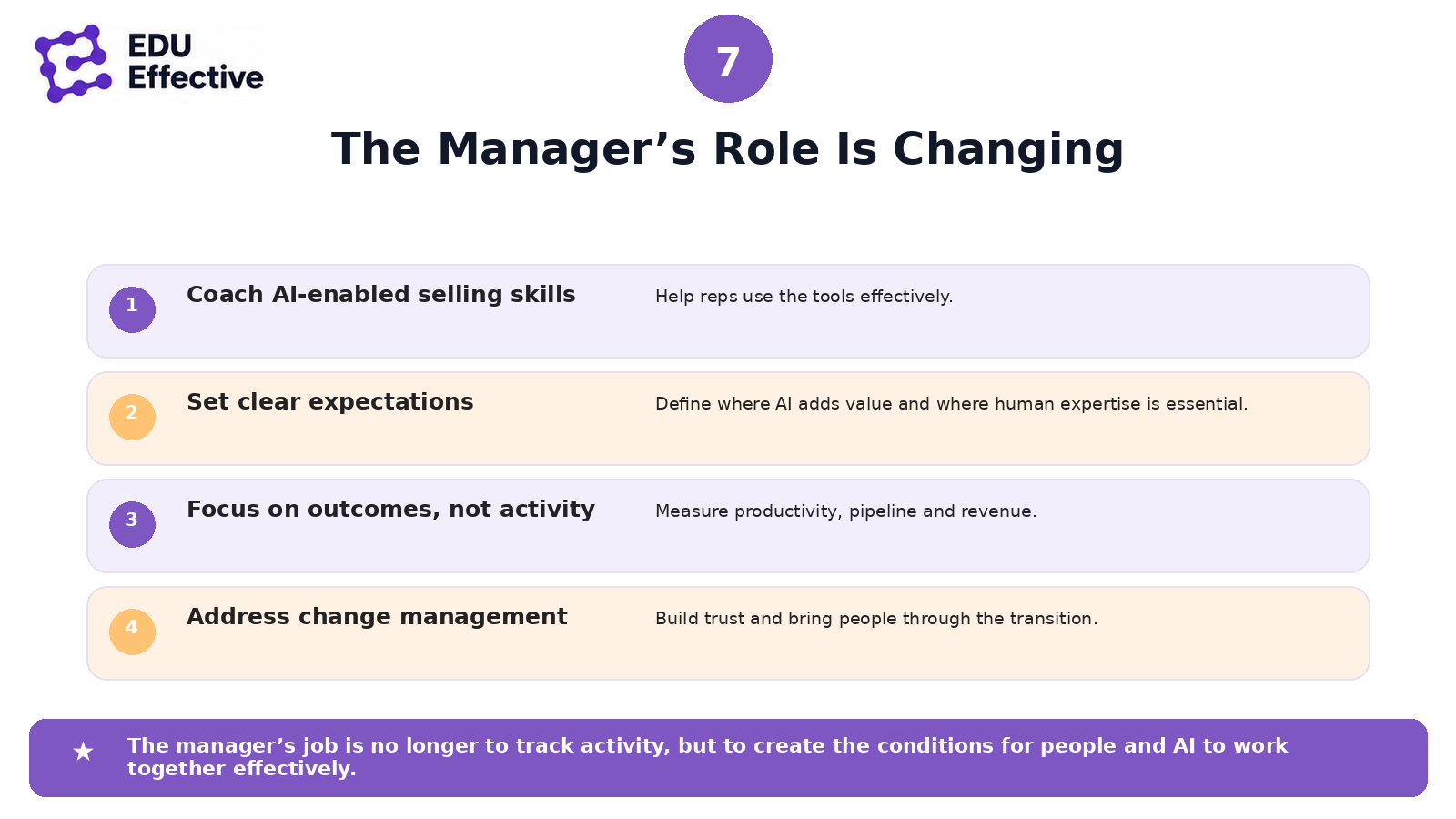
Sales managers are experiencing a version of the transformation that is affecting managers across every function. AI is handling more of what used to be administrative leadership work — pipeline reporting, activity tracking, forecast modeling — which means the manager’s value is increasingly concentrated in the things AI cannot do: coaching, developing people, navigating organizational complexity, and making judgment calls in ambiguous situations.
The data from Salesforce’s 2026 survey on sales team productivity shows that high-performing teams are more likely to use AI not just for prospecting but for manager-facing analytics — giving sales leaders better visibility into pipeline health and individual performance. The manager who can interpret that data, identify the right coaching interventions, and develop the team accordingly is more valuable, not less, in an AI-augmented sales environment.
This is consistent with what Gallup’s research on management consistently finds: the quality of the immediate manager remains the primary driver of team engagement and performance, regardless of the tools available to that team.
Connecting AI Capability to Commercial Results
The $0.8 to $1.2 trillion McKinsey productivity estimate is not going to accrue evenly. It will accrue to organizations and individuals who close the gap between broad AI adoption and deep AI integration — the gap that currently separates the 6% of high performers from the 87% who are using tools without transforming outcomes.
For sales professionals and leaders, the practical implication is clear. AI sales tools are not a differentiator when everyone has access to them. The differentiator is the capability to use them strategically — to understand what they can and cannot do, to redesign workflows around them rather than layering them on top of existing behavior, and to develop the judgment that makes the outputs of AI systems actually useful in commercial conversations.
That capability is built through structured learning and deliberate practice, not through incidental exposure to tools.
How EDU Effective Prepares Sales Leaders for AI-Augmented Selling
EDU Effective Business School builds the strategic and technical foundation that lets sales professionals lead in an AI-augmented environment.
The Effective MBA: Applied Artificial Intelligence covers the operational and strategic deployment of AI tools — including in commercial and revenue-generating functions — alongside the management of human-AI workflows.
The Effective MBA: Executive Management & Leadership builds the commercial judgment, leadership, and analytical capability that AI tools amplify but cannot replace.
All programs are 100% online, designed for working professionals, and built around content from practitioners at organizations including Google, LinkedIn, and Tesla.
AI is changing what good selling requires. The question is whether you’re ahead of that shift or catching up to it. Join EDU Effective Business School and build the AI fluency and commercial capability that the next generation of sales leadership demands.
About EDU Effective Business School
The Effective MBA: Applied Artificial Intelligence is built for managers who need to put AI to work in real operations, not in theory. Runs on 15 minutes a day, completes in 10 months or less and is ASIC accredited.
Sources
- Salesforce — State of Sales 2026 Survey of 4,000+ sales professionals; findings on AI agent adoption, productivity, prospecting, and top-performer behavior. Note: Salesforce surveys primarily its own customer base. https://www.salesforce.com/news/stories/state-of-sales-report-announcement-2026/
- Bain & Company — AI in Sales research Early adopter win-rate improvement data; seller time-on-selling baseline. https://www.bain.com/insights/ai-transforming-productivity-sales-remains-new-frontier-technology-report-2025/
- McKinsey & Company — State of AI 2026 Organizational AI adoption and high-performer data; 3-15% revenue uplift estimates; $0.8-1.2T productivity projection. https://www.mckinsey.com/capabilities/quantumblack/our-insights/the-state-of-ai
- McKinsey Global Institute — Workforce in Motion (September 2026) AI fluency demand trends. https://www.mckinsey.com/mgi/our-research/workforce-in-motion-skills-and-pathways-to-future-jobs-in-the-united-states
- Gartner — Gartner Predicts AI Agents Will Outnumber Sellers 10 to 1 by 2028, Yet Fewer Than 40% of Sellers Will Say Agents Improved Productivity https://www.gartner.com/en/newsroom/press-releases/2026-07-28-gartner-predicts-ai-agents-will-outnumber-sellers-10-to-1-by-2028-yet-fewer-than-40-percent-of-sellers-will-say-agents-improved-productivity
- Forrester — Agent-led negotiations prediction https://www.forrester.com/press-newsroom/forrester-b2b-marketing-sales-product-2026-predictions/