
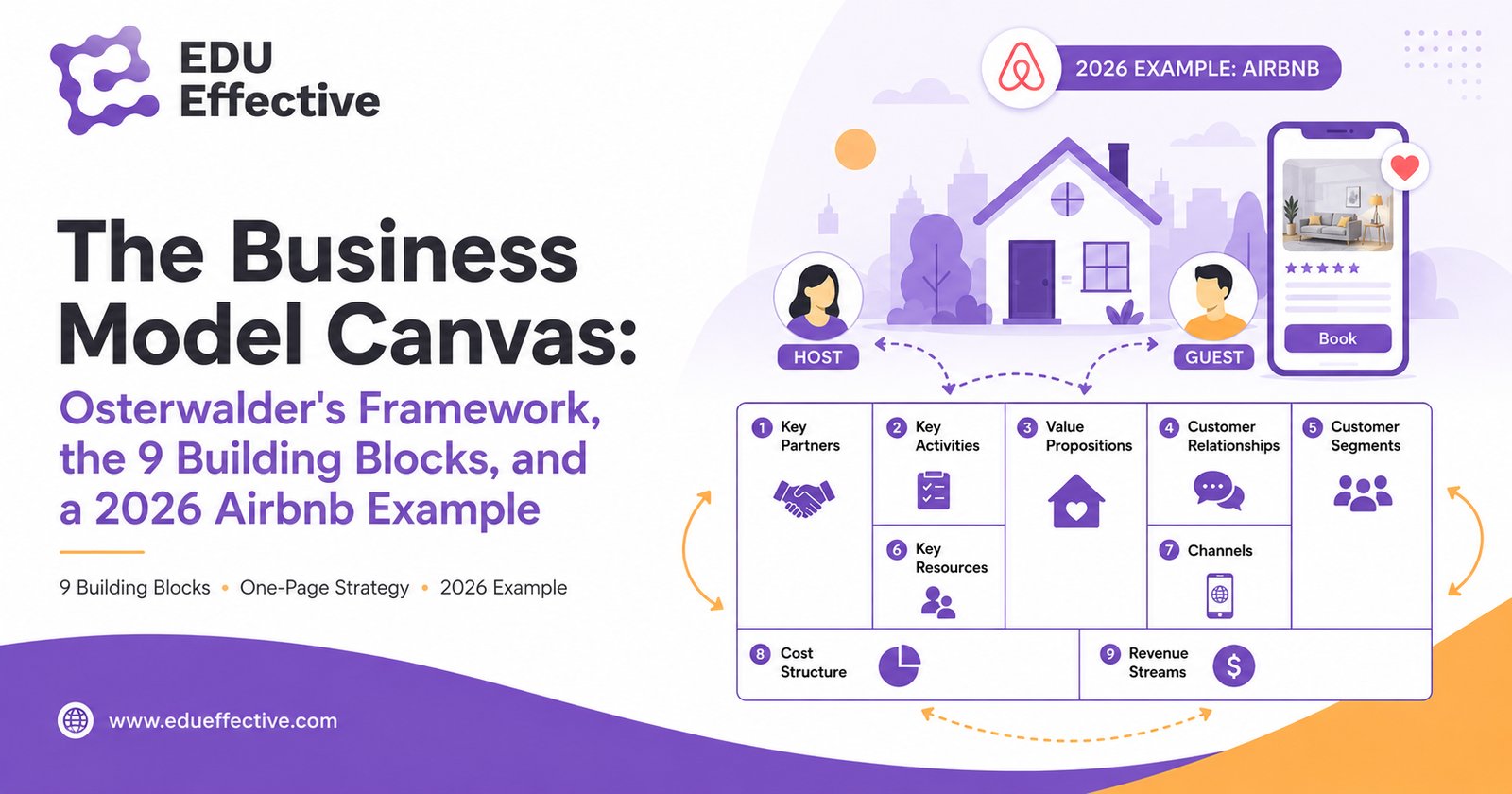

Most business plans share the same fundamental problem: they're too long, too linear, and too focused on the assumptions of the person who wrote them. A 40-page document doesn't make a business model clearer. It makes it easier to hide the weak parts in the middle.
Alexander Osterwalder understood this. In 2010, he and Yves Pigneur published Business Model Generation, introducing the Business Model Canvas as a one-page alternative to the traditional business plan. Sixteen years later, it remains the most widely used business model framework in the world, not because it is fashionable, but because the single-page constraint forces a discipline that longer documents simply do not.
What is the Business Model Canvas?
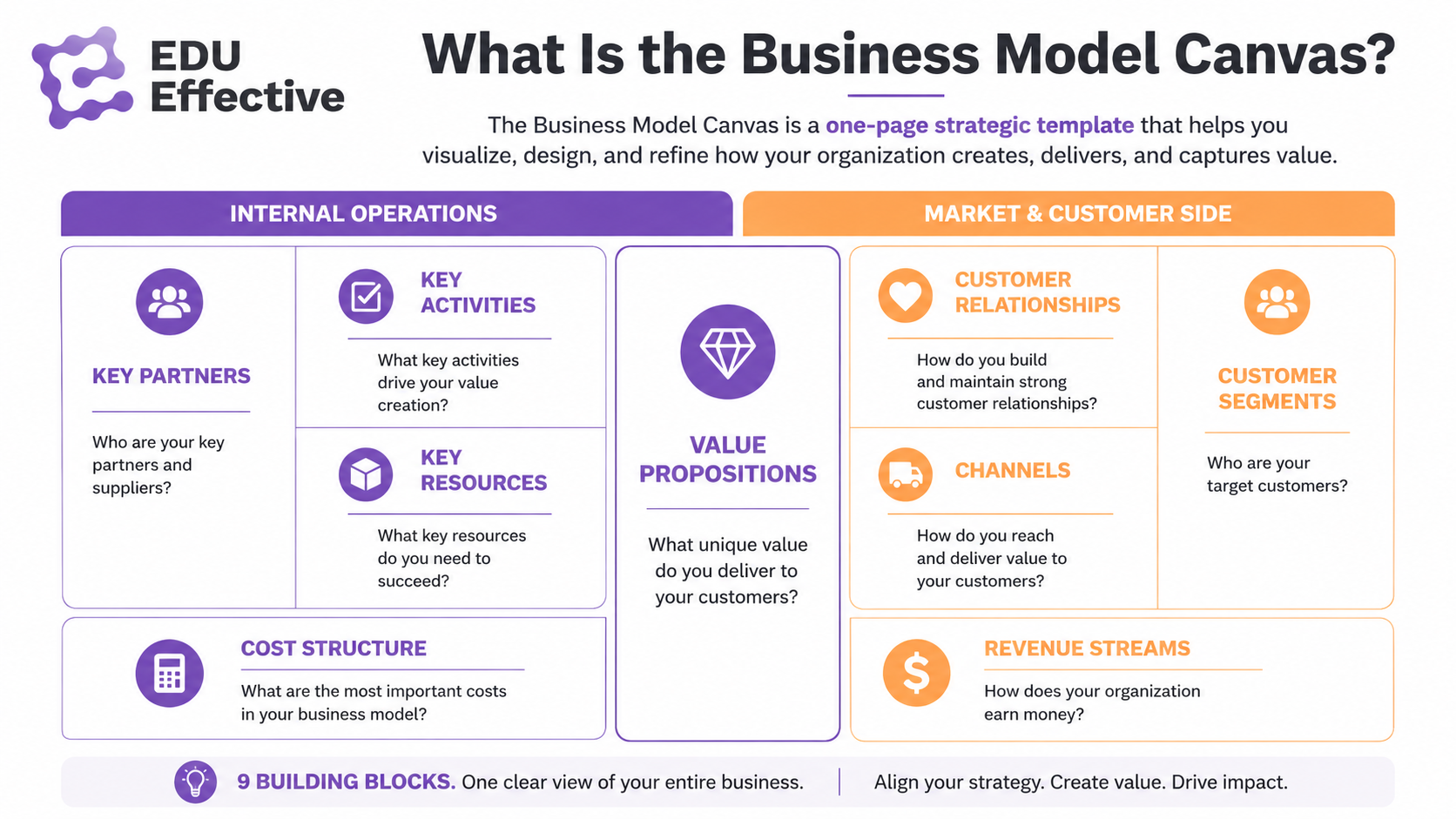
The Business Model Canvas (BMC) is a strategic template that maps an entire business model onto a single page using nine building blocks. It was developed by Alexander Osterwalder, a Swiss entrepreneur and academic who first formalised the concept in his 2004 doctoral thesis, and refined into its current form through Business Model Generation, which has sold over one million copies in 30 languages.
The framework's defining characteristic is its visual structure. Rather than a sequential document, the canvas is a spatial map: the right side focuses on the market and value creation, including customers, channels, relationships, and revenue, while the left side focuses on internal operations, including resources, activities, partners, and costs. The value proposition sits at the centre, connecting the two halves. This layout makes interdependencies immediately visible: a change in a customer segment on the right will visibly require changes to key resources and activities on the left.
Its power comes from two things working together: comprehensiveness, with all nine critical dimensions of a business model in one view, and constraint, because one page forces prioritisation and clarity that prose documents rarely achieve.
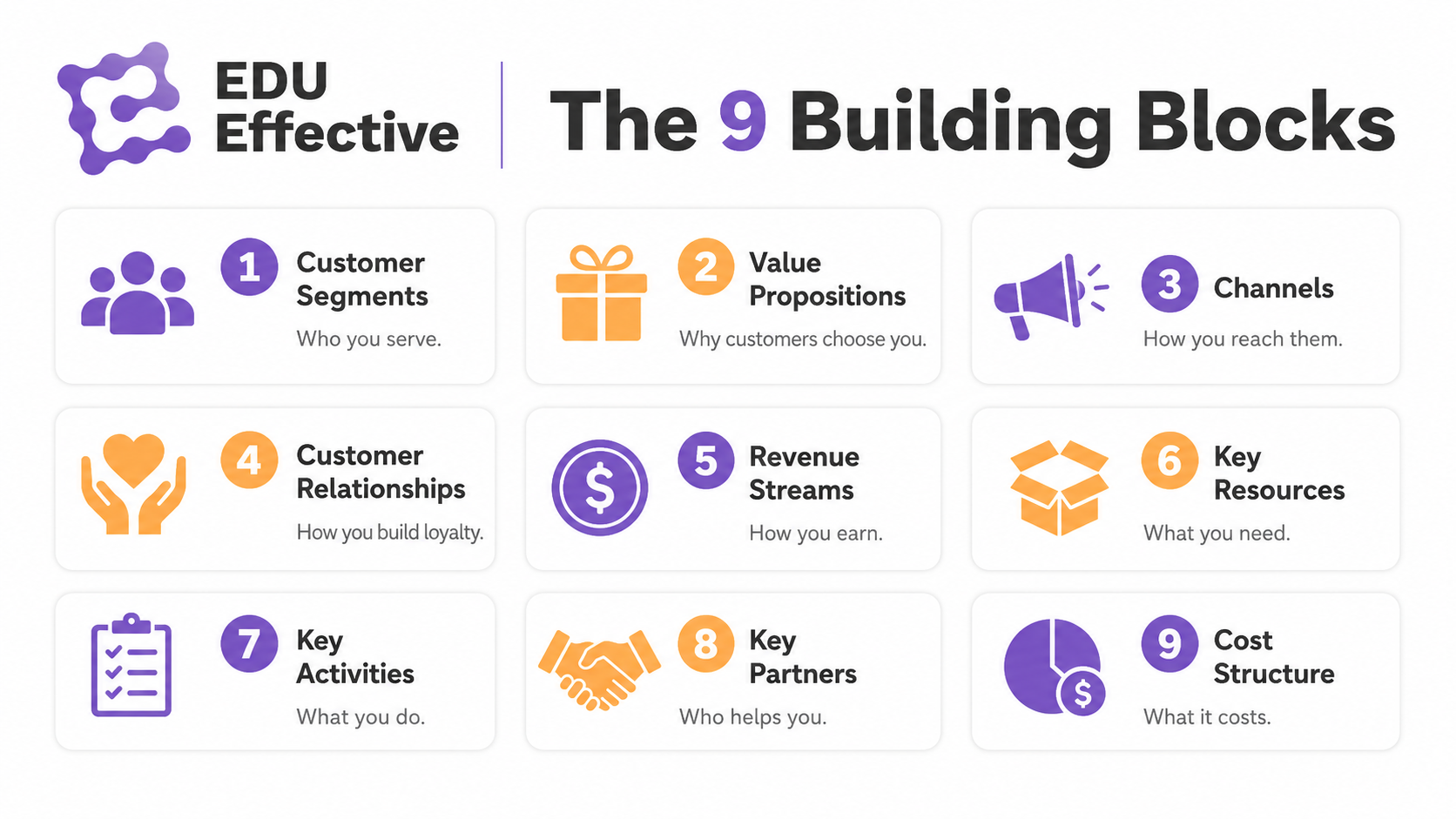
The nine building blocks explained
1. Customer Segments. Who exactly is the business creating value for? A mass market targets broad, undifferentiated customer populations, while a niche market serves a specific, precisely defined group. A segmented market serves multiple groups with different needs that require separate value propositions. A multi-sided platform serves two or more interdependent customer groups, such as a marketplace that needs both buyers and sellers to function. Defining customer segments precisely is the starting point because every other building block flows from understanding who the customer is.
2. Value Propositions. What problem does the business solve for each customer segment, and what makes the solution worth choosing over alternatives? The value proposition is not a list of features. It is the specific bundle of value, such as reduced cost, improved performance, accessibility, customisation, convenience, risk reduction, brand, or design, that causes a particular customer segment to prefer this business over others. The value proposition must be distinct for each customer segment.
3. Channels. How does the business reach its customer segments to deliver its value proposition? Channels cover awareness, evaluation, purchase, delivery, and after-sales support. Direct channels, such as an owned sales force, website, or physical stores, give the company control and margin but require investment. Indirect channels, including distributors, partners, and third-party platforms, sacrifice margin but provide reach without proportional overhead.
4. Customer Relationships. What type of relationship does the business establish with each customer segment, and how does it maintain and grow that relationship? The range runs from fully automated self-service to dedicated personal assistance. Community-based relationships, co-creation, and loyalty programmes occupy the middle ground. The choice must align with the value proposition and the customer's expectations.
5. Revenue Streams. How does the business capture financial value from each customer segment? Transaction revenues come from one-time purchases. Recurring revenues come from subscriptions, licensing, or ongoing service contracts. Usage fees vary with consumption. Other models include asset sale, brokerage commissions, advertising, and freemium conversion. In 2026, AI-driven dynamic pricing models have added a new dimension to revenue stream design for digital businesses.
6. Key Resources. What assets are indispensable for the business model to function? Physical resources include manufacturing equipment, logistics networks, and retail locations. Intellectual resources include patents, brand, proprietary algorithms, and customer data. Human resources are particularly critical in knowledge-intensive businesses, where the right talent is often the scarcest and most valuable asset. Financial resources include credit lines and cash reserves that enable the business to operate and invest.
7. Key Activities. What does the business actually have to do well to deliver its value proposition? Production businesses must excel at manufacturing and quality control. Platform businesses must excel at platform management, community building, and network growth. Service businesses must excel at problem-solving, knowledge management, and continuous innovation. Identifying the truly critical activities, as distinct from all the things a business does, clarifies where operational investment should be concentrated.
8. Key Partners. Which external organisations, suppliers, or partners does the business rely on to function? Partnerships reduce risk, provide access to capabilities the business does not own internally, and enable scale that would be impossible alone. Strategic alliances between non-competitors enable shared resources and market access. In 2026, AI infrastructure partnerships, particularly cloud AI platform relationships with AWS, Google Cloud, and Azure, have become a frequently critical category for digital-native businesses.
9. Cost Structure. What are the most significant costs involved in operating this business model? Cost-driven models minimise expenditure through automation, outsourcing, and lean operations. Value-driven models prioritise premium quality and personalised service over cost reduction. Fixed costs remain constant regardless of volume, while variable costs scale with output. Understanding which costs are fixed and which are variable determines the business's operational leverage and break-even dynamics.
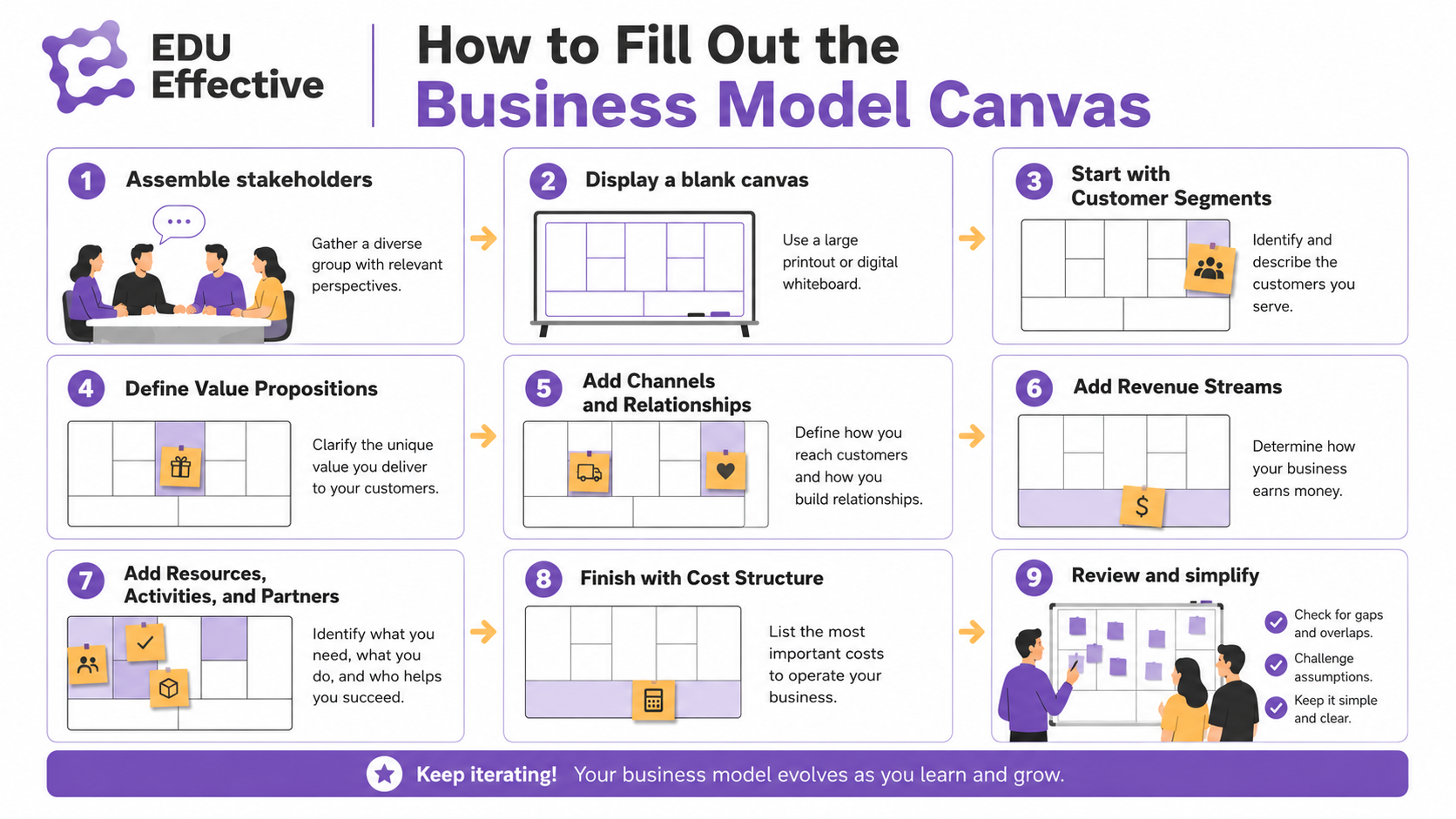
How to fill out the Business Model Canvas: the practical process
The canvas is most valuable when completed as a collaborative exercise rather than as a solo document. Assemble the relevant stakeholders, typically the heads of product, marketing, sales, operations, and finance. Set aside two to three hours. Display a large blank template physically on a whiteboard with sticky notes, or digitally using tools such as Miro, Canva, Strategyzer, or Figma.
Work through the nine blocks in the sequence that builds on each previous answer: Customer Segments first, then Value Propositions, Channels, Customer Relationships, Revenue Streams, Key Resources, Key Activities, Key Partners, and Cost Structure.
Use one sticky note per idea. Keep each entry brief. The goal is a snapshot, not a document. If an answer requires more than two sentences on the canvas, it needs to be simplified before it belongs there. Once complete, the canvas should be legible at a glance. If it requires explanation to be understood, it is too complex.
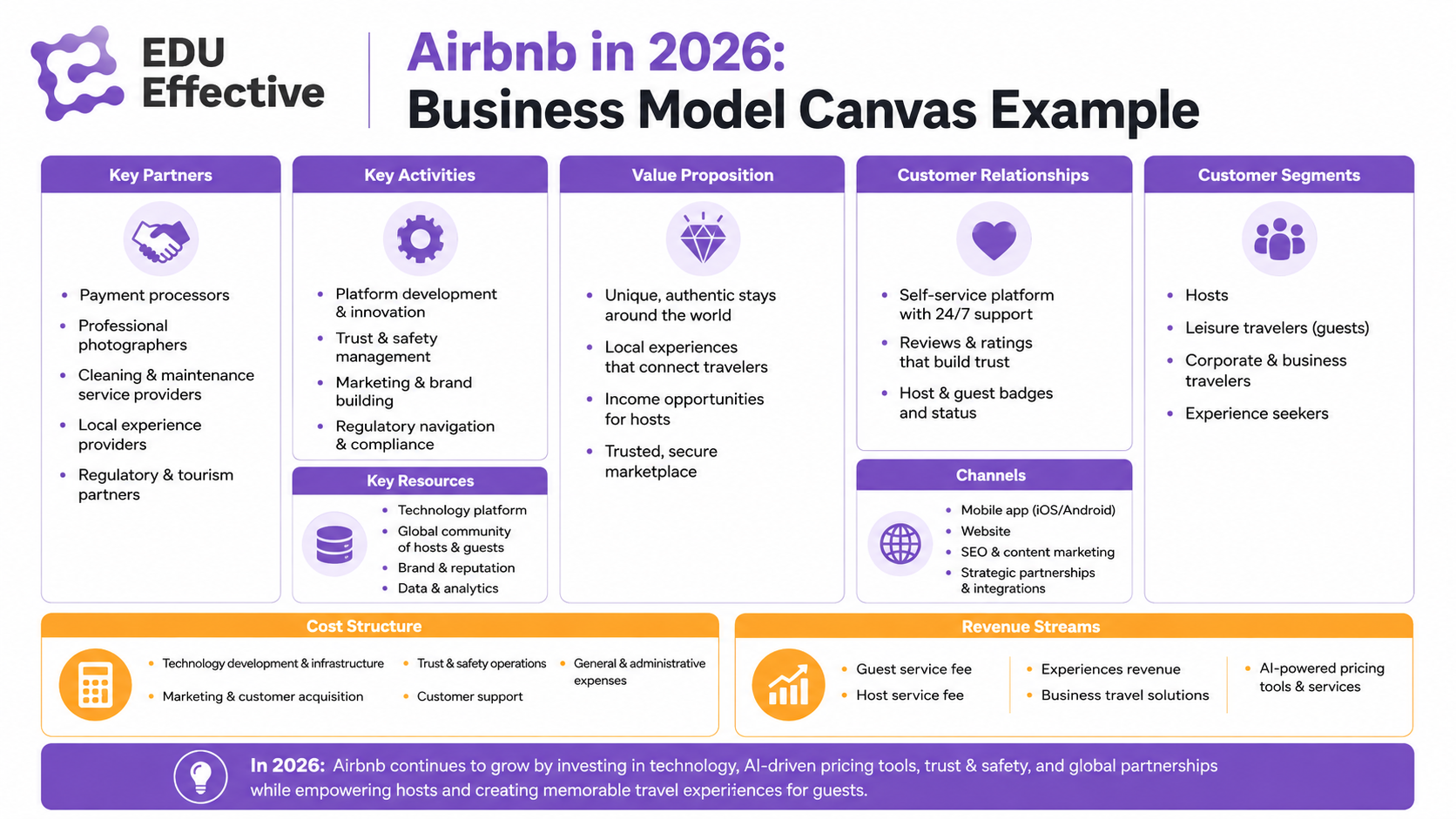
Business Model Canvas example: Airbnb in 2026
Airbnb offers one of the clearest and most instructive examples of the Business Model Canvas in practice, particularly because its model is a two-sided platform that serves two distinct customer segments simultaneously.
Customer Segments: hosts, including property owners or managers who want to earn income from their space, and guests, including travellers seeking accommodation that is more flexible, local, and cost-competitive than hotels. In 2026, Airbnb also serves corporate travel accounts and Airbnb Experiences hosts, each with distinct needs requiring a separate value proposition.
Value Propositions: for guests, access to millions of unique spaces globally at a wide range of price points, with a degree of authenticity and locality hotel chains cannot replicate. For hosts, a low-friction way to generate income from spare space or investment properties, with integrated booking management, pricing support, and guest vetting. For both sides, a trusted marketplace that reduces transaction risk.
Channels and Customer Relationships: the Airbnb app and website are the primary channels, supported by search marketing, organic SEO, word of mouth, social sharing, corporate sales, and partnerships. Relationships are largely self-service and community-driven. The review system builds trust, signals quality, and incentivises good behaviour from both sides, while Superhost status and Guest Favourite badges drive loyalty at scale.
Revenue Streams: Airbnb charges a service fee on each booking, typically 14–16% from guests and a separate host service fee. Experiences bookings generate additional commission revenue, Airbnb for Work adds a B2B layer, and AI-powered dynamic pricing tools offered to hosts represent an emerging monetisation opportunity.
Key Resources, Activities, Partners, and Costs: platform technology enables search, booking, payment, and trust management at global scale. The network of hosts, their inventory, guest reviews, and the Airbnb brand are equally important resources. Core activities include platform development, trust and safety management, host acquisition and support, demand generation, and regulatory navigation. Partners include payment processors, photography partners, regulatory and lobbying organisations, and cleaning or property-management providers. Technology infrastructure, development, marketing, customer acquisition, and trust and safety operations make up the major costs.
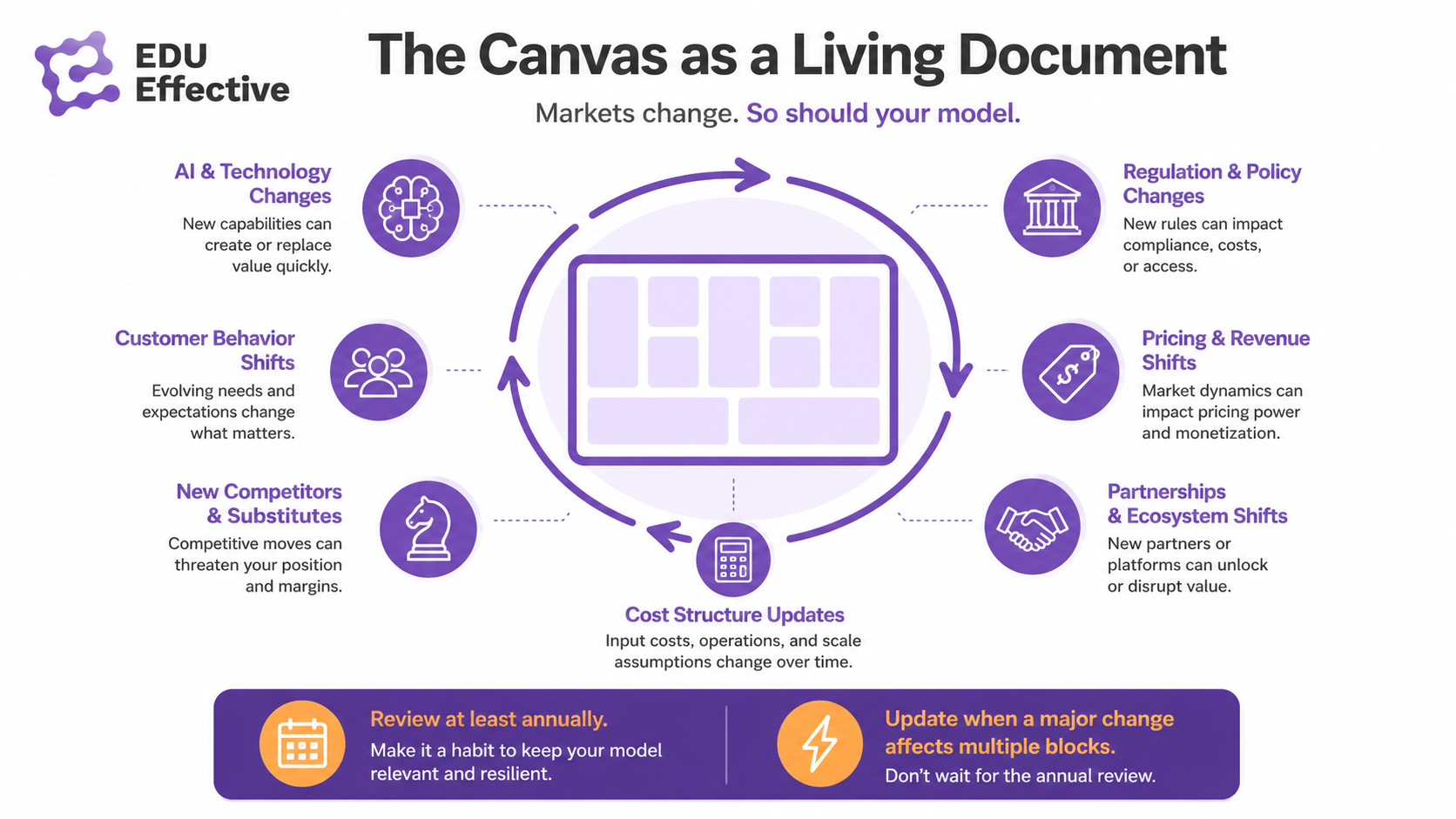
The canvas model as a living document
The most common mistake in applying the Business Model Canvas is treating it as a one-time exercise. A canvas completed in 2023 describes a 2023 business model. In 2026, with AI reshaping key resources and activities across almost every industry, cost structures and key partnerships for technology-dependent businesses have changed substantially. A canvas that is not revisited regularly becomes a historical document, not a strategic tool.
The recommended practice is to review the canvas at least annually and revisit specific blocks whenever a significant market change occurs, such as a new competitor, a regulatory shift, a change in customer behaviour, or a new technology. Because the canvas shows all nine blocks simultaneously, a change in one dimension immediately surfaces its implications for the others.
That is the deeper value of the canvas model over a traditional business plan. A plan is a snapshot. The canvas is a structure for ongoing strategic thinking.
At EDU Effective, our Effective MBA business programs use practical frameworks like the Business Model Canvas to develop strategic thinking skills that apply from day one. Explore our programs →
EDU Effective Business School = professional development for your long-term success.
All best-selling Effective MBA programs are built for working adults: 15 minutes a day, 10 months or less, ASIC accredited, from €990.
These are professional programs, not academic ones, built for working adults to apply what they learn directly in their own business, not to collect a scholarly credential.
Join more than 9,000 students in over 120 countries who are investing in their professional development and career success.
You can read the feedback and experiences of our students and the stories of our graduates here.
The easiest way to start working on your personal development and success today:
Apply now — from €990 · Talk to a Study Advisor
Study with NO risk: 14-day money-back guarantee, no questions asked.
Sources
- Strategyzer — Business Model Canvas Template and Guide https://www.strategyzer.com/canvas
- Business Model Analyst — Airbnb Business Model Canvas Analysis (2026) https://businessmodelanalyst.com/airbnb-business-model/
- Osterwalder, A. & Pigneur, Y. — Business Model Generation, Wiley https://www.wiley.com/en-ie/shop/general-introductory-business-management/business-model-generation-a-handbook-for-visionaries-game-changers-and-challengers-p-9780470876411
- Asana — What Is a Business Model Canvas? A Complete Guide https://asana.com/templates/business-model-canvas
- Miro — Business Model Canvas Template https://miro.com/templates/business-model-canvas/