

Three letters that appear on business cards, in press releases, and in LinkedIn headlines more than almost any other title. CEO. Everyone recognises it. Fewer people can clearly explain what a chief executive officer actually does day to day, how the role differs across company sizes, or where it sits in relation to the other C-suite positions that surround it.
In 2026, with AI reshaping how organisations are managed, new governance pressures around pay transparency, and the gap between startup CEO and Fortune 500 CEO growing wider than ever, the role is worth understanding precisely.
Chief executive officer meaning: the definition
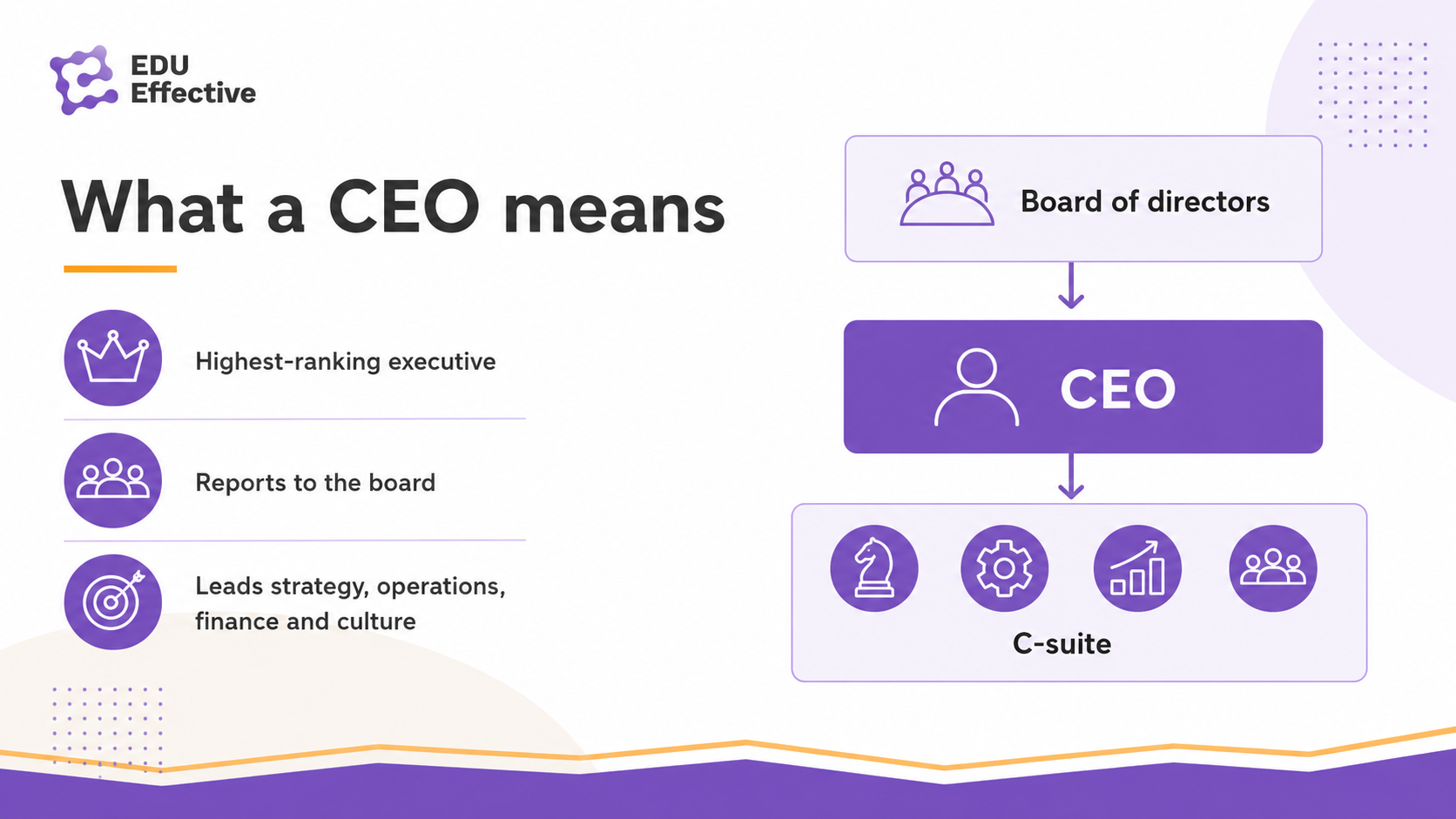
CEO stands for Chief Executive Officer. It is the highest-ranking executive position in an organisation — the person with ultimate accountability for the company's strategy, operations, financial performance, and culture.
The title has a specific legal and corporate governance meaning. In companies with a board of directors, the CEO operates one level below the board and reports directly to it. The board sets the governance framework and approves major strategic decisions; the CEO executes them. In practice, effective CEOs do not simply execute board decisions — they shape the strategic agenda that the board then approves, making the relationship between CEO and board one of the most consequential dynamics in any significant organisation.
In everyday usage, CEO is sometimes used interchangeably with "managing director" (a title more common in the UK and Europe) or "president" (more common in US companies where the president is often a second-tier executive role distinct from the CEO). The specific terminology varies by jurisdiction and corporate structure, but the functional meaning is consistent: the chief executive officer is the top of the management hierarchy.
What a CEO actually does: five core responsibilities
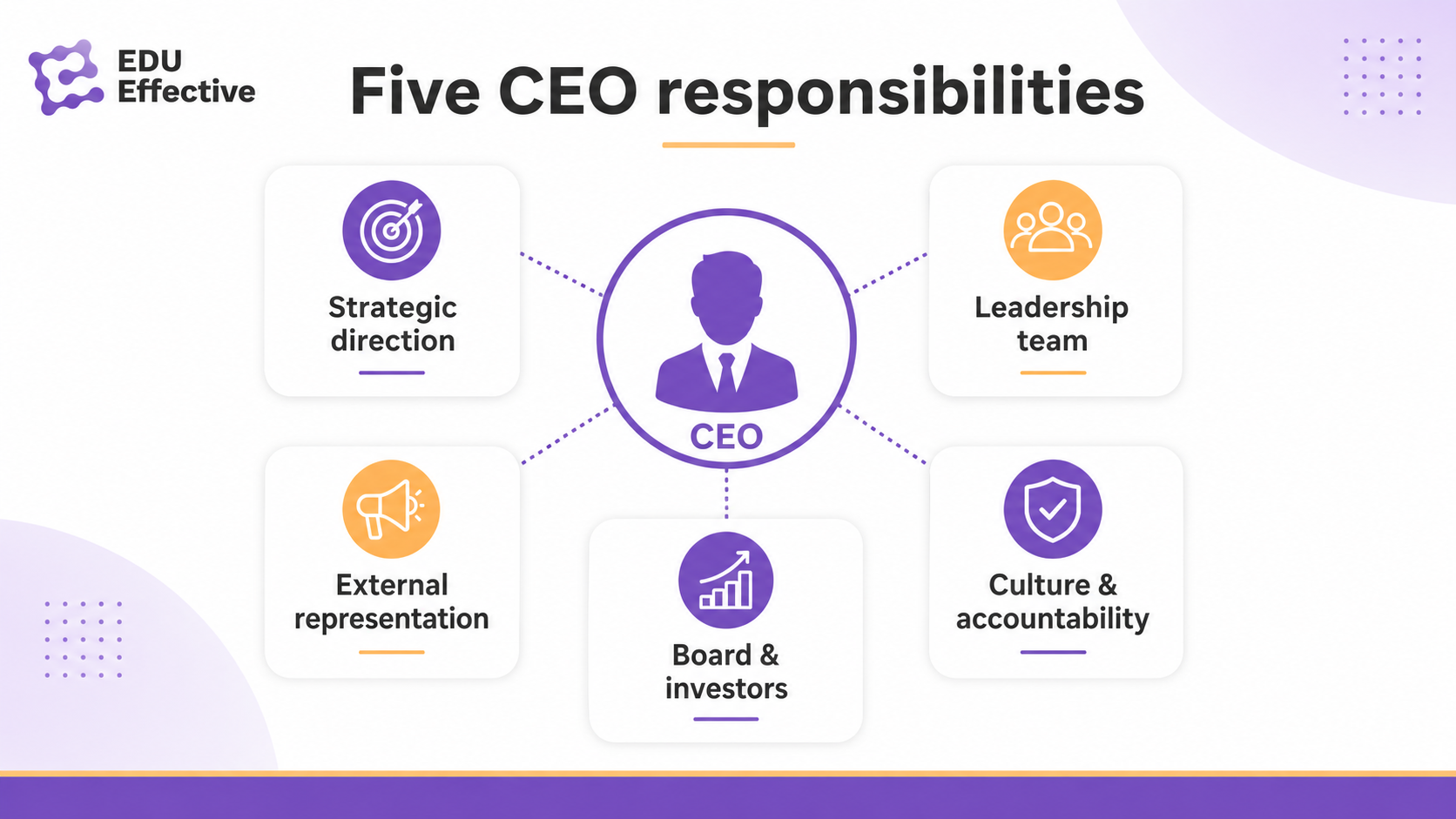
The CEO role defies simple job description because its scope is defined by what the organisation needs at any given moment — not by a fixed list of tasks. That said, five categories of responsibility consistently define the role across company types and sizes.
Setting strategic direction. The CEO is ultimately responsible for deciding where the company is going and ensuring the organisation is aligned around that direction. This includes identifying growth opportunities, making resource allocation decisions (which markets, products, and capabilities to invest in), and defining what the organisation will not do. In 2026, this includes decisions about AI adoption, which have become one of the highest-stakes strategic choices available to most organisations.
Building and managing the leadership team. No CEO can execute strategy personally. Their highest-leverage activity is building the right leadership team — typically the C-suite of CFO, COO, CMO, CTO, and CHRO — and ensuring those executives are operating effectively and accountably. McKinsey research consistently shows that team composition decisions are among the most significant drivers of company performance, and they sit squarely with the CEO.
Managing the board and investors. The CEO is the primary interface between the operational organisation and its governance structures. For publicly listed companies, this includes quarterly earnings calls, investor relations, and managing the expectations of institutional shareholders and activist investors. For private companies, it involves managing relationships with founders, private equity investors, or family shareholders. The ability to communicate strategy and results clearly, and to manage the tension between short-term shareholder expectations and long-term business building, is one of the most demanding aspects of the role.
Representing the company externally. The CEO is the public face of the organisation — in media appearances, industry events, government interactions, major client relationships, and increasingly, on social platforms. How a CEO communicates — with clarity, consistency, and credibility — directly affects brand perception, talent attraction, and stakeholder confidence. This external dimension of the role has expanded considerably in an era when CEO visibility and corporate positioning are closely linked.
Maintaining organisational culture and accountability. Culture is not a separate concern from strategy — it is the mechanism through which strategy is executed at scale. CEOs set the behavioural norms of an organisation through what they reward, what they tolerate, and how they behave themselves. The alignment between stated values and actual behaviour at the CEO level is typically visible throughout an organisation within months.
The C-suite context: how CEO relates to other executive roles
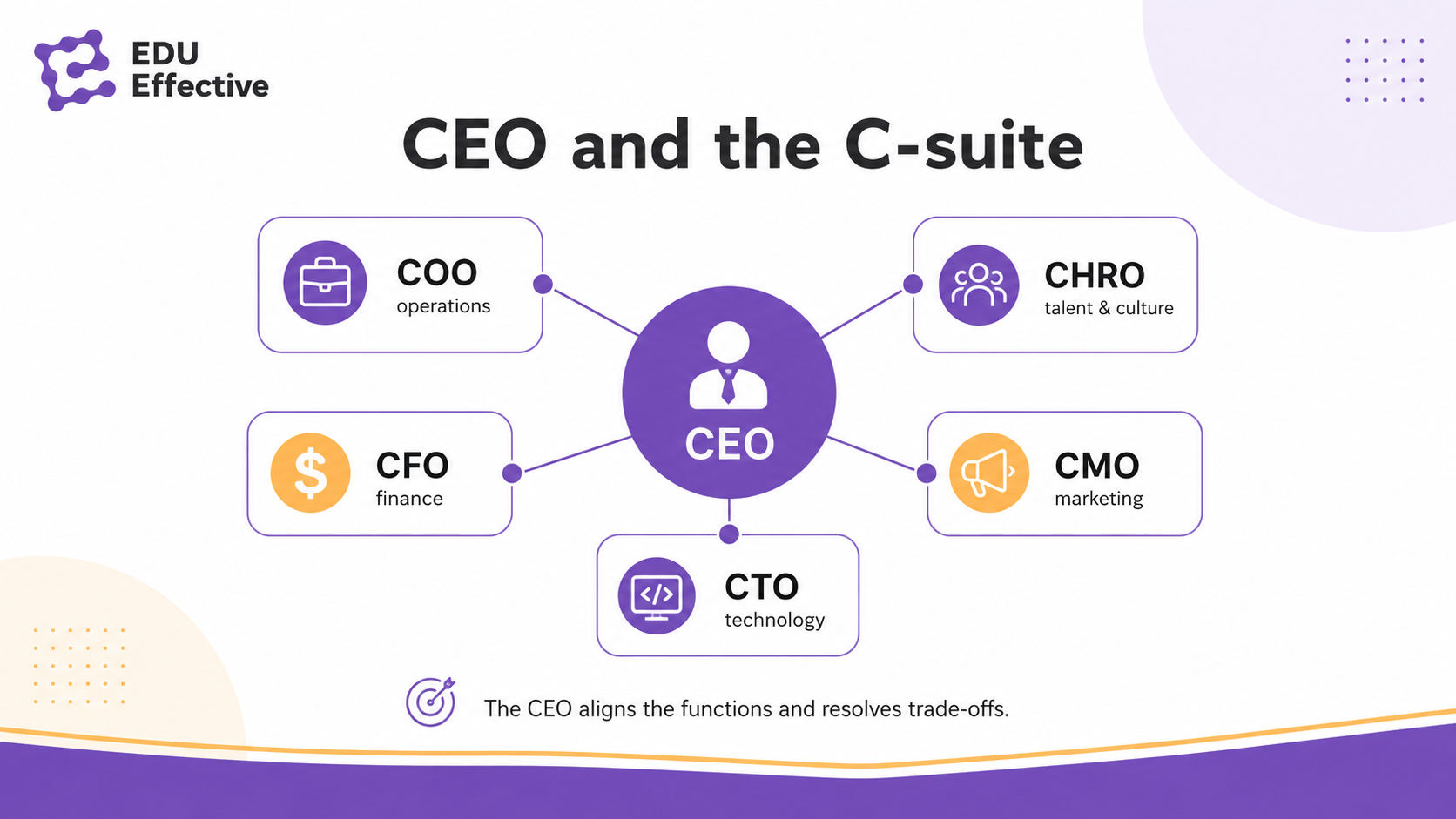
The term "C-suite" refers to the collection of senior executives whose titles begin with "Chief" — the group that collectively manages the major functions of a complex organisation. Understanding how the CEO relates to these roles clarifies both the scope of the CEO's authority and its limits.
Chief Operating Officer (COO) manages the day-to-day operational functions of the business — translating strategy into execution. Not all companies have a COO; in some organisations the CEO assumes direct operational oversight, or operational management is distributed across divisional leaders. Where a COO exists, they typically oversee the machinery of the business while the CEO focuses on direction, external relationships, and long-term positioning.
Chief Financial Officer (CFO) leads the financial function — financial planning and analysis, accounting, treasury, investor relations, and financial risk management. The CFO-CEO relationship is one of the most important partnerships in any organisation, because strategic decisions and financial reality must stay closely connected. The CFO brings the financial discipline that gives strategic ambitions credibility.
Chief Technology Officer (CTO) leads the technical direction of the organisation — particularly important for technology companies or those undergoing significant digital transformation. In 2026, the CTO role has gained stature across sectors as AI strategy has moved from peripheral concern to central boardroom priority.
Chief Marketing Officer (CMO) leads brand, marketing, and customer acquisition strategy. In companies where customer growth is the primary strategic imperative, the CMO-CEO relationship is particularly close.
Chief Human Resources Officer (CHRO) leads talent strategy, culture, and organisational design. The CHRO's importance has grown considerably as talent scarcity, remote and hybrid work models, and AI-driven workforce transformation have elevated people decisions to strategic priority.
The CEO does not manage any of these functions directly — that is the point of having functional leaders. The CEO manages the relationships between these functions, ensures their strategic alignment, and makes the calls when priorities conflict.
What a CEO earns in 2026: the compensation picture
CEO compensation varies more dramatically than almost any other professional role, because it scales with the size and complexity of the organisation being led.
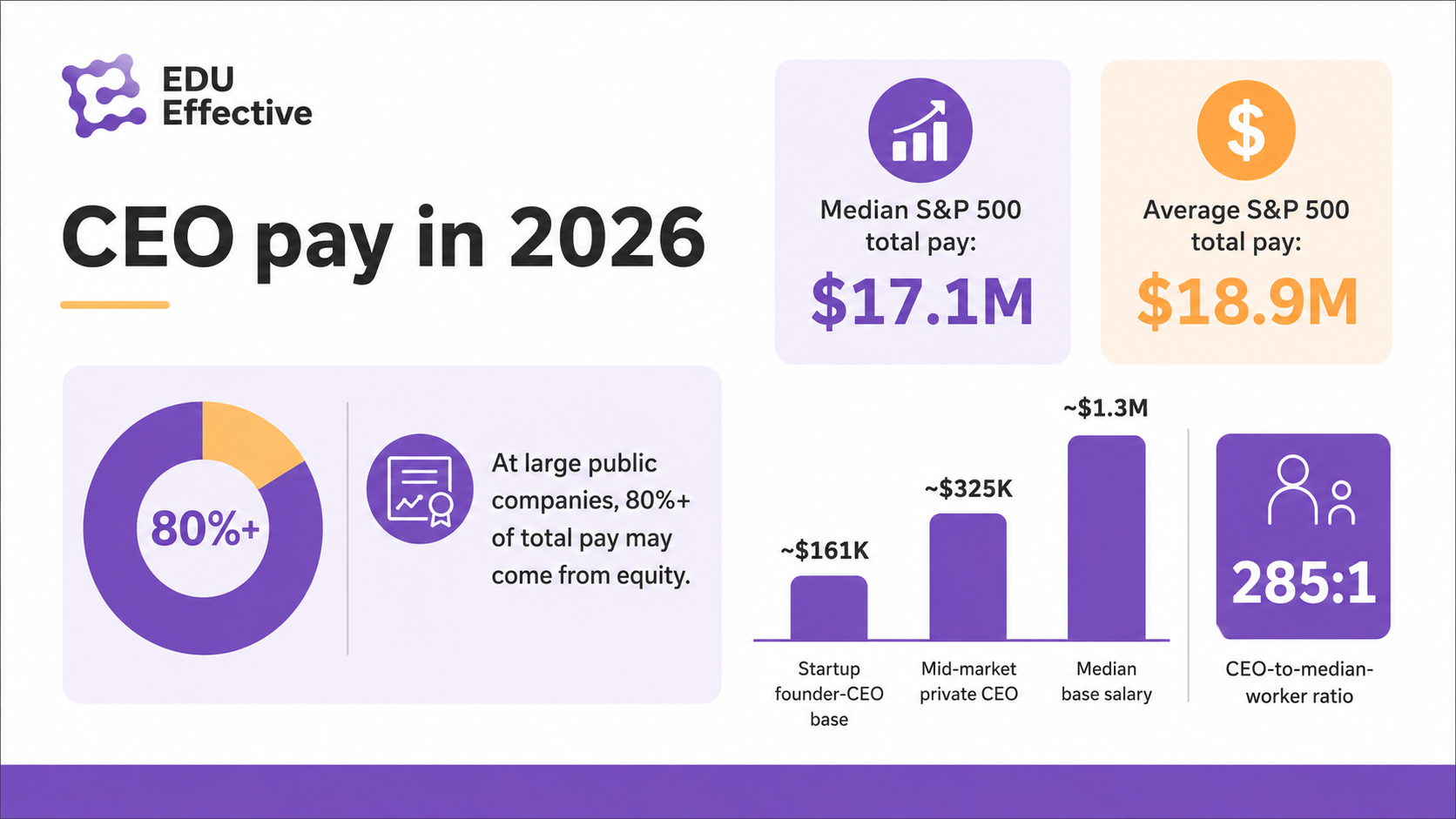
At S&P 500 companies, the median CEO total compensation in 2024 was $17.1 million — a 9.7% increase from the previous year, according to Harvard Law School's Corporate Governance data. Average S&P 500 CEO total compensation in 2024 was $18.9 million, according to AFL-CIO's Executive Paywatch report. This represents a CEO-to-median-worker pay ratio of 285:1.
These headline figures, however, are dominated by equity compensation. Strip out stock awards, performance units, and long-term incentive plans, and the median base salary for a public company CEO sits at approximately $1.3 million. At mid-market private companies, the median CEO total compensation drops to around $325,000. Startup founders who have taken a CEO title average approximately $161,000 in base salary — often significantly below what they could earn in senior corporate roles, with the compensation gap made up by equity stakes in their own company.
The compensation structure at large companies is worth understanding: for S&P 500 CEOs, base salary typically accounts for less than 10% of total compensation. More than 80% comes from equity — stock awards and performance-based long-term incentives — which ties pay to company performance over multi-year periods. This structure has attracted significant scrutiny from governance advocates, but it also means that the largest CEO compensation packages represent meaningful risk for the individual: they pay out only if shareholder value is actually created.
What it takes to become a CEO in 2026
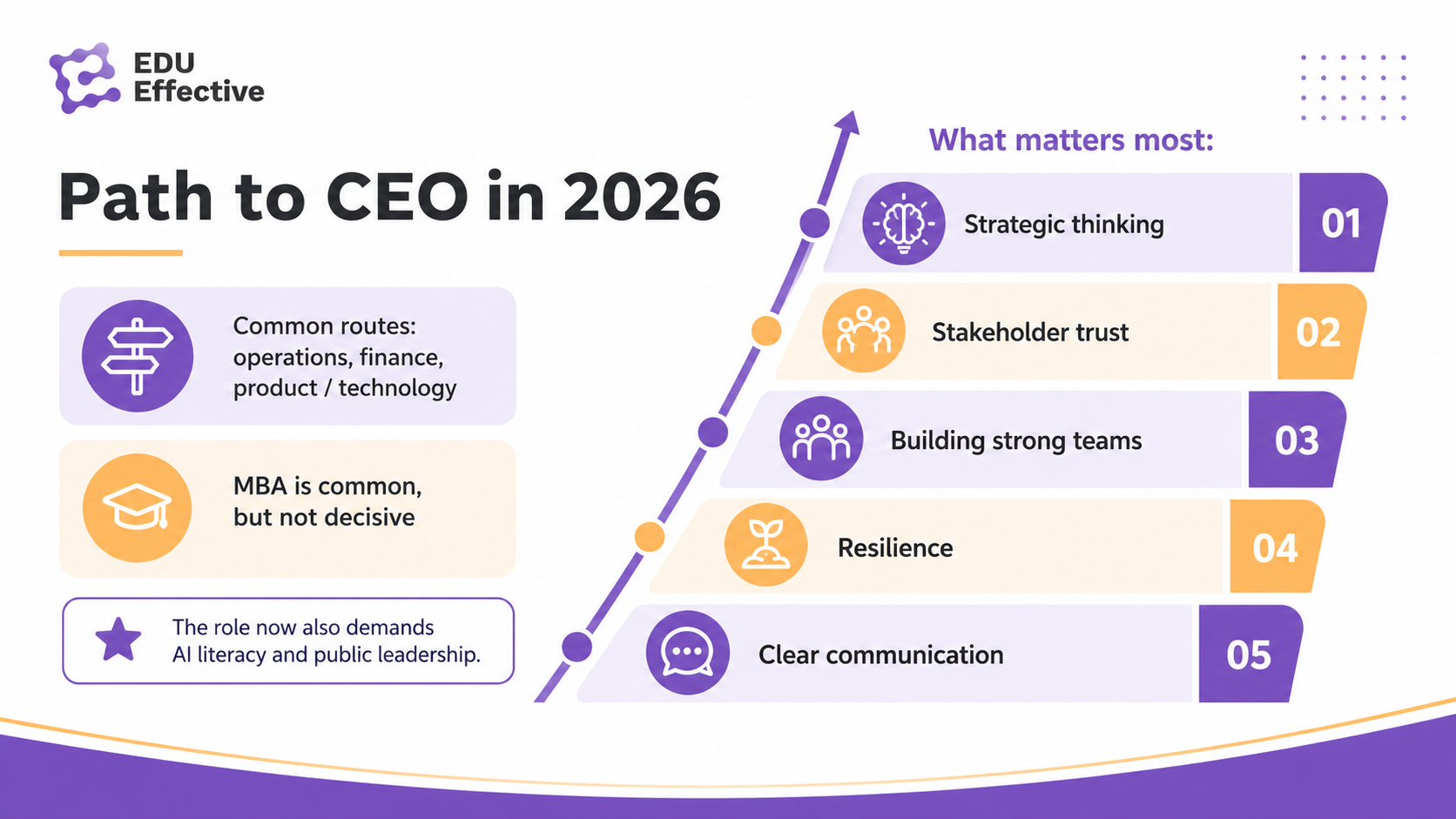
The path to the chief executive role has diversified considerably over the past decade, but some patterns persist. The most common backgrounds for S&P 500 CEOs remain operations and finance — functions that give executives a clear view of the whole organisation. In technology companies, technical and product backgrounds have become increasingly common pathways.
Educational credentials are present but not deterministic. A significant proportion of CEOs hold advanced degrees — MBAs remain the most common postgraduate qualification — but the correlation between specific credentials and CEO success is weaker than the correlation between career experience and demonstrable track record.
What distinguishes executives who reach the CEO level, consistently across research, is less about formal credentials and more about a set of identifiable capacities: strategic thinking that connects short-term decisions to long-term positioning; the ability to build trust with diverse stakeholders; a track record of developing and retaining strong teams; resilience under conditions of uncertainty; and the communication clarity to translate complex situations into decisions and actions.
The role has also changed in 2026. The expectation that a CEO can remain largely internal is diminishing. Public positioning, AI literacy, ESG accountability, and the management of a distributed or hybrid workforce all represent new dimensions of the role that predecessors in the same chair navigated very differently.
At EDU Effective, we build programs for professionals who want to work smarter — not just harder. Explore our programs →
EDU Effective Business School = professional development for your long-term success.
All best-selling Effective MBA programs are built for working adults: 15 minutes a day, 10 months or less, ASIC accredited, from €990.
These are professional programs, not academic ones — built for working adults to apply what they learn directly in their own business, not to collect a scholarly credential.
Join more than 9,000 students in over 120 countries around the world to further your personal development and career success.
Read the feedback and experiences of our students and the stories of our graduates here.
Apply now — from €990 · Talk to a Study Advisor
Study with NO risk: 14-day money-back guarantee, no questions asked.
Sources
- SalaryCube — Average CEO Salary by Company Size: 2026 Compensation Benchmarks https://www.salarycube.com/compensation/what-is-the-average-ceo-salary-by-company-size
- MyPersonalRecruiter — CEO Salary 2026: Average Pay by Industry & Company Size https://mypersonalrecruiter.com/whats-the-salary-of-ceo/
- AFL-CIO Executive Paywatch — CEO Pay in 2024: Average $18.9M https://aflcio.org/paywatch
- Career.com — How Much Does a Chief Executive Officer (CEO) Make? (2025) https://www.career.com/salary-guide/ceo
- Harvard Law School Forum on Corporate Governance — CEO Pay Study 2025 https://corpgov.law.harvard.edu/2025/06/08/ceo-pay-study/