

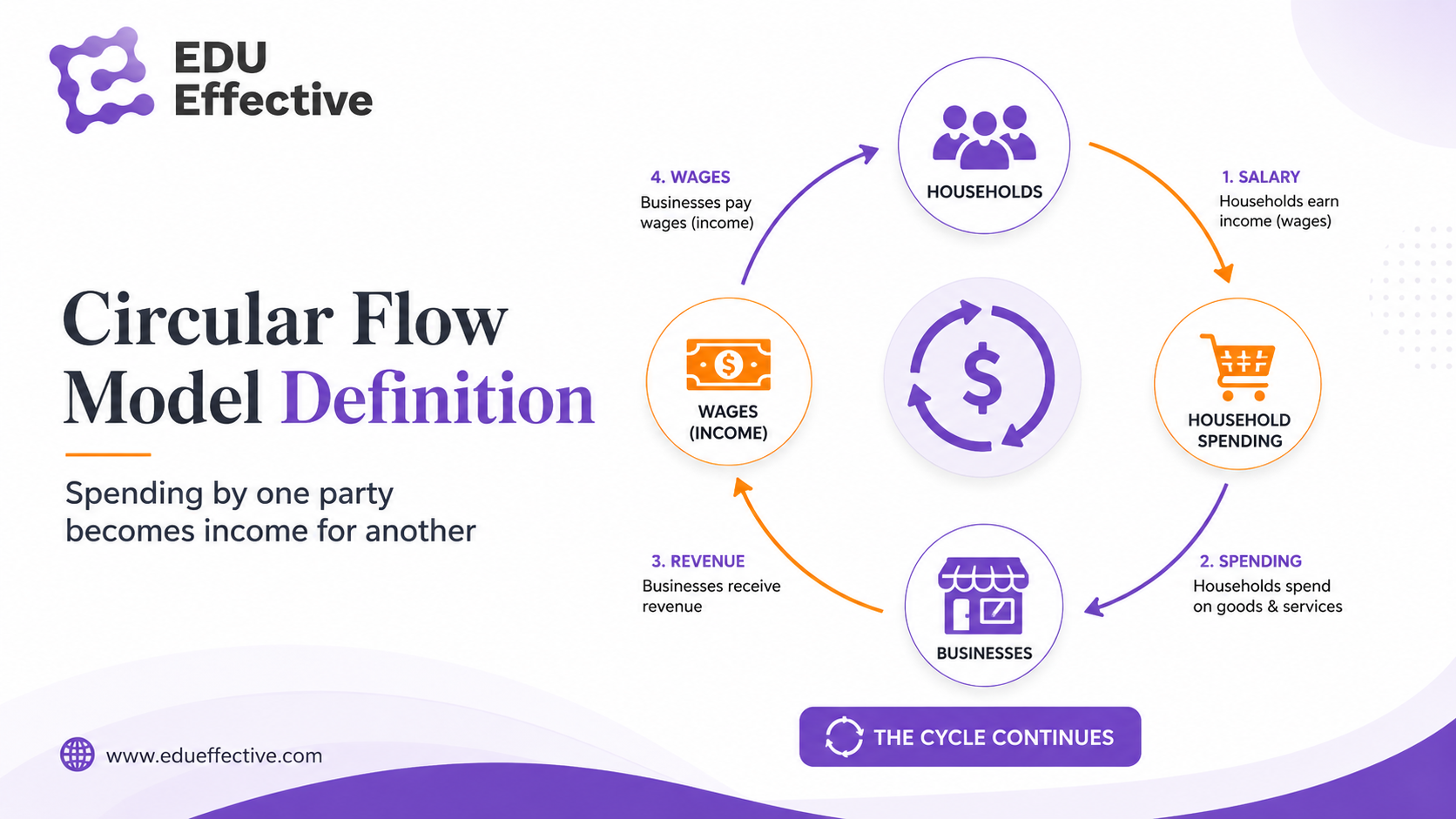
You earn a salary. You spend it on rent, food, transport, subscriptions. The landlord uses your rent to pay their own bills. The supermarket uses your purchase to pay its suppliers and staff. The staff spend their wages elsewhere. The cycle continues indefinitely — with money passing from hand to hand, circulating through the economy like blood through a body.
That loop is not a metaphor. It's the foundation of a model that economists, governments, and business strategists use to understand how economies function, what makes them grow, and what causes them to contract. It's called the circular flow model of economics — and in 2026, with governments navigating AI-driven labour market shifts, unprecedented tariff volatility, and fiscal stimulus debates, the model is as analytically relevant as it has ever been.
Circular flow model definition: the core idea
The circular flow model of the economy is a macroeconomic framework that illustrates the continuous movement of money, goods, services, and resources between the different sectors of an economy. At its most basic, it captures a simple but powerful truth: in a functioning economy, spending by one party becomes income for another, which in turn becomes spending again.
The concept has roots in the work of François Quesnay, an 18th-century French economist who drew an explicit analogy between economic activity and the circulation of blood through the human body. His insight — that the flow of money between economic actors is circular and self-reinforcing — remains the conceptual foundation of the model that appears in every economics textbook today.

The two flows that run simultaneously
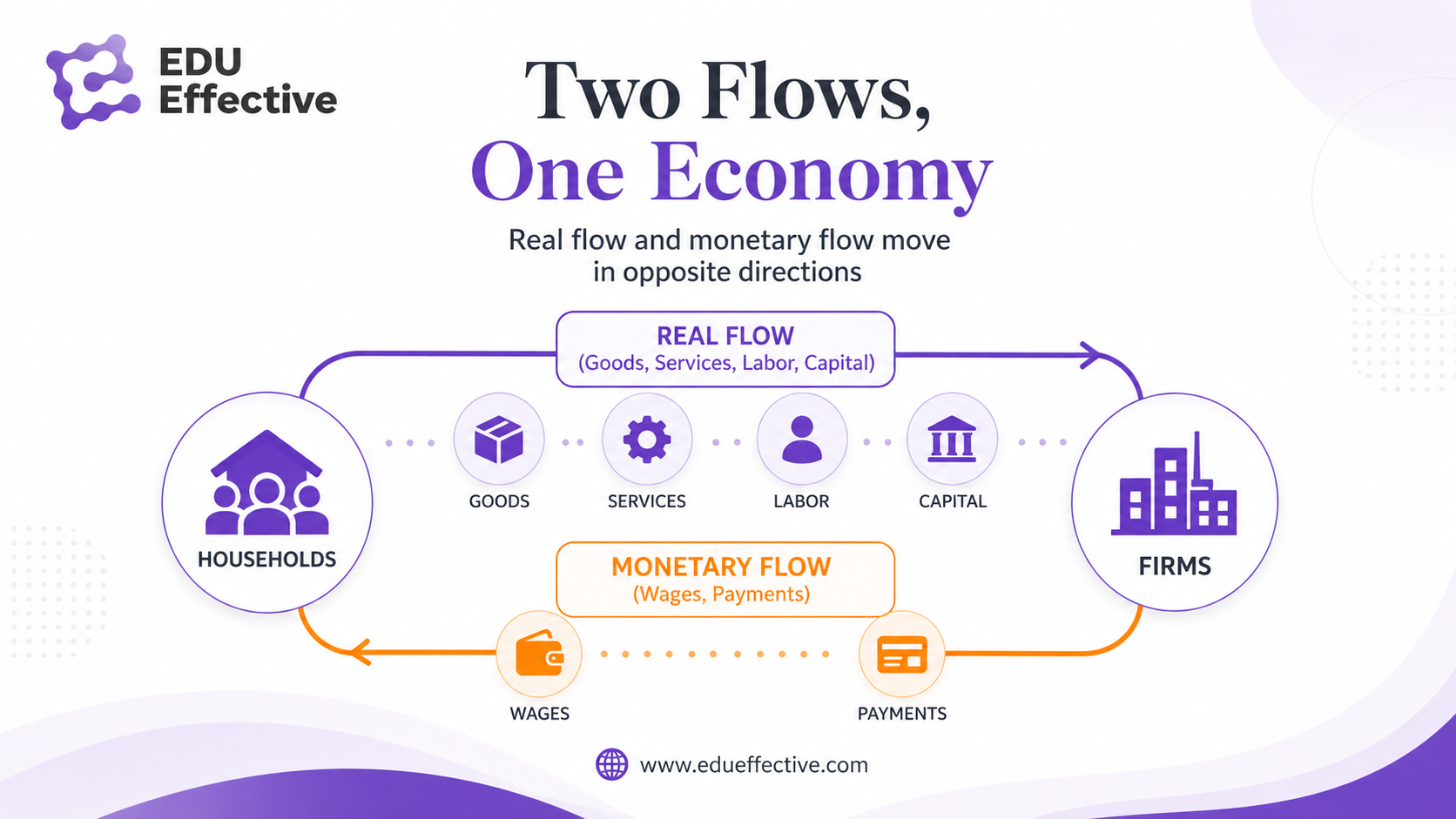
Within the circular flow model of economics, two distinct flows move in opposite directions at the same time.
The real flow — sometimes called the physical flow — moves goods, services, and factors of production between sectors. When a household goes to work, it provides labour to a firm. The firm produces goods and delivers them to the household. These are real exchanges of physical things.
The monetary flow moves in the opposite direction. The firm pays wages to the household for its labour. The household pays money to the firm for the goods and services it purchases. Money circulates in a loop that mirrors and enables the real flow of goods and resources.
Understanding both flows is essential. An economy where the real flow is robust but the monetary flow is disrupted — by a credit crisis, hyperinflation, or severe currency instability — will malfunction even if productive capacity is intact. The flows are interdependent.
The four sectors in the full circular flow model
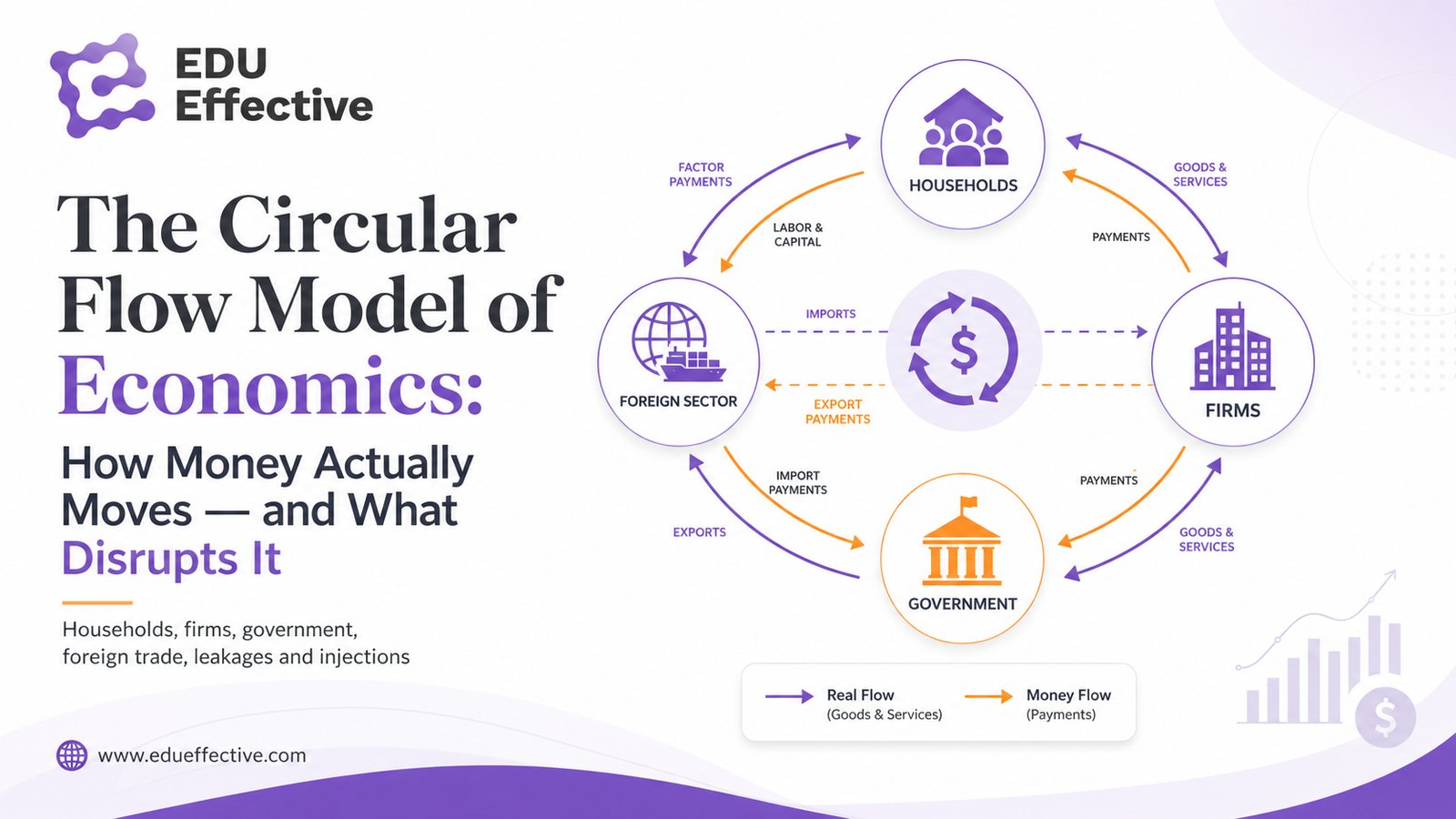
The simplest version of the circular flow model involves just two actors: households and firms. This two-sector model captures the essential logic but omits forces that significantly affect real economies. The complete model includes four sectors.
Households own and supply the factors of production — labour, land, and capital — in exchange for income in the form of wages, rent, and interest. They then spend that income on goods and services produced by firms. Households are simultaneously suppliers of inputs and buyers of outputs.
Firms hire factors of production from households, pay for them, combine them to produce goods and services, and sell those goods and services back to households. Firms are the production engine of the model.
Government collects taxes from both households and firms — a withdrawal of money from the circular flow — and reinjects it through public spending on infrastructure, services, defence, and transfer payments. Government also sets the monetary and fiscal policies that determine interest rates and the overall level of economic stimulus or restraint in the system.
The foreign sector connects the domestic economy to the rest of the world. Exports send money into the domestic circular flow from abroad; imports drain money out to foreign producers. The balance of trade — the difference between exports and imports — directly affects the net contribution of the foreign sector to the domestic flow of income.
Leakages and injections: where the model gets practically useful
The two-sector circular flow — households and firms passing money back and forth indefinitely — would be self-sustaining if it were a closed system. Real economies are not closed systems. Money continuously leaves the circular flow and returns through different channels. These exits and re-entries are the mechanism that makes the model a policy tool, not just a theoretical diagram.
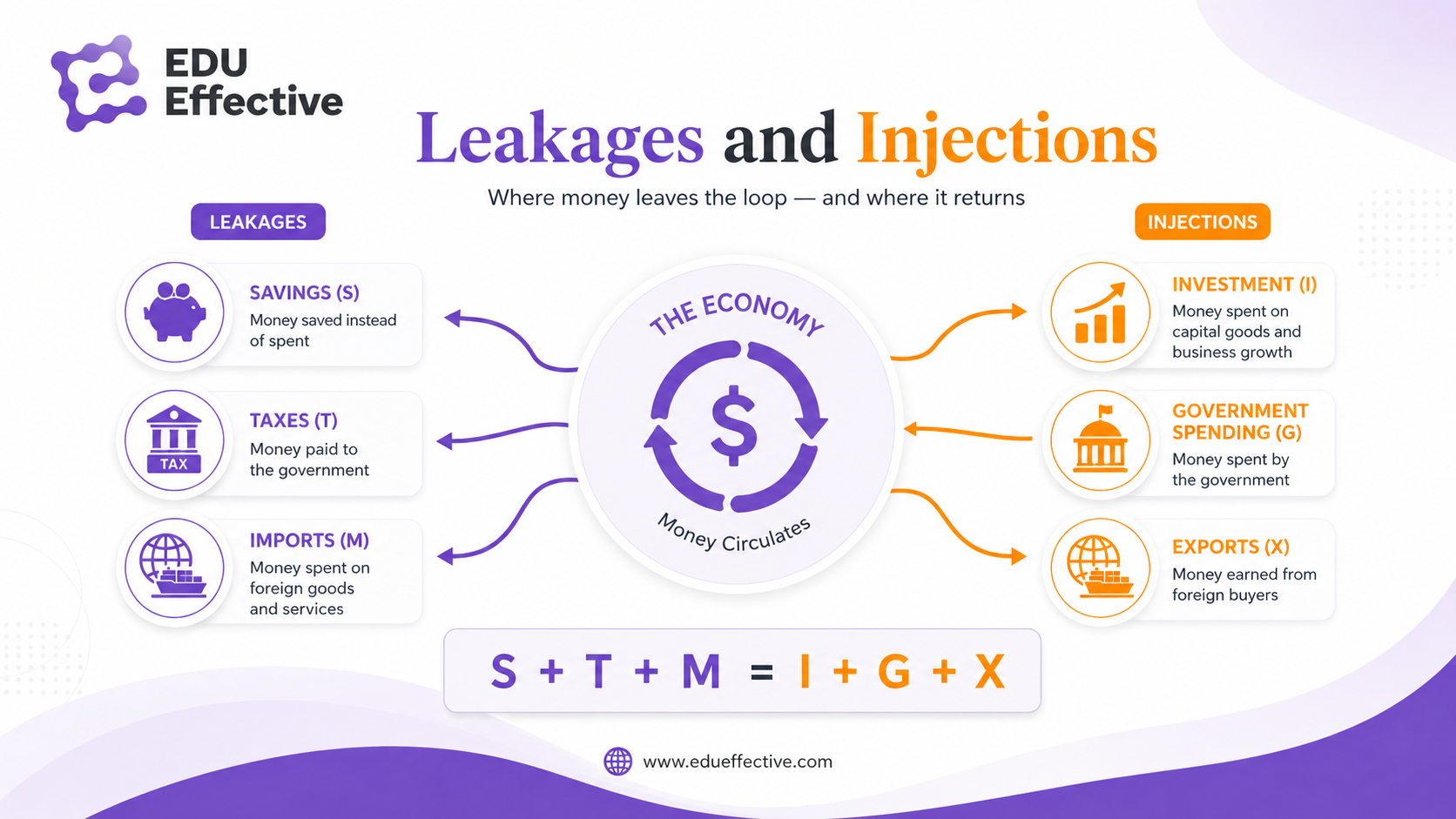
Leakages are withdrawals of money from the circular flow — money that exits the spending loop rather than being passed on to the next actor. The three leakages are savings (income that households set aside rather than spend), taxes (money collected by government), and imports (money spent on goods produced in other countries rather than domestically).
Injections are additions of money into the circular flow from outside the basic household-firm loop. The three injections are investment (firms borrowing or drawing on savings to invest in capital goods), government spending (public expenditure on goods, services, and transfers), and exports (foreign buyers purchasing domestically produced goods, bringing foreign money into the domestic flow).
The equilibrium condition in the full circular flow model is expressed as:
Savings + Taxes + Imports = Investment + Government Spending + Exports
or in shorthand: S + T + M = I + G + X
When leakages exceed injections, money is draining out of the economy faster than it is being replaced. Output contracts, employment falls, incomes decline — a recession. When injections exceed leakages, the opposite occurs: demand rises, production expands, employment grows. If injections consistently outpace leakages by a large margin and production cannot keep up, the result is inflation — too much money chasing too few goods.
What the circular flow model explains in 2026
The model is not just textbook theory. It maps directly onto the economic conditions that businesses and policymakers are navigating right now.
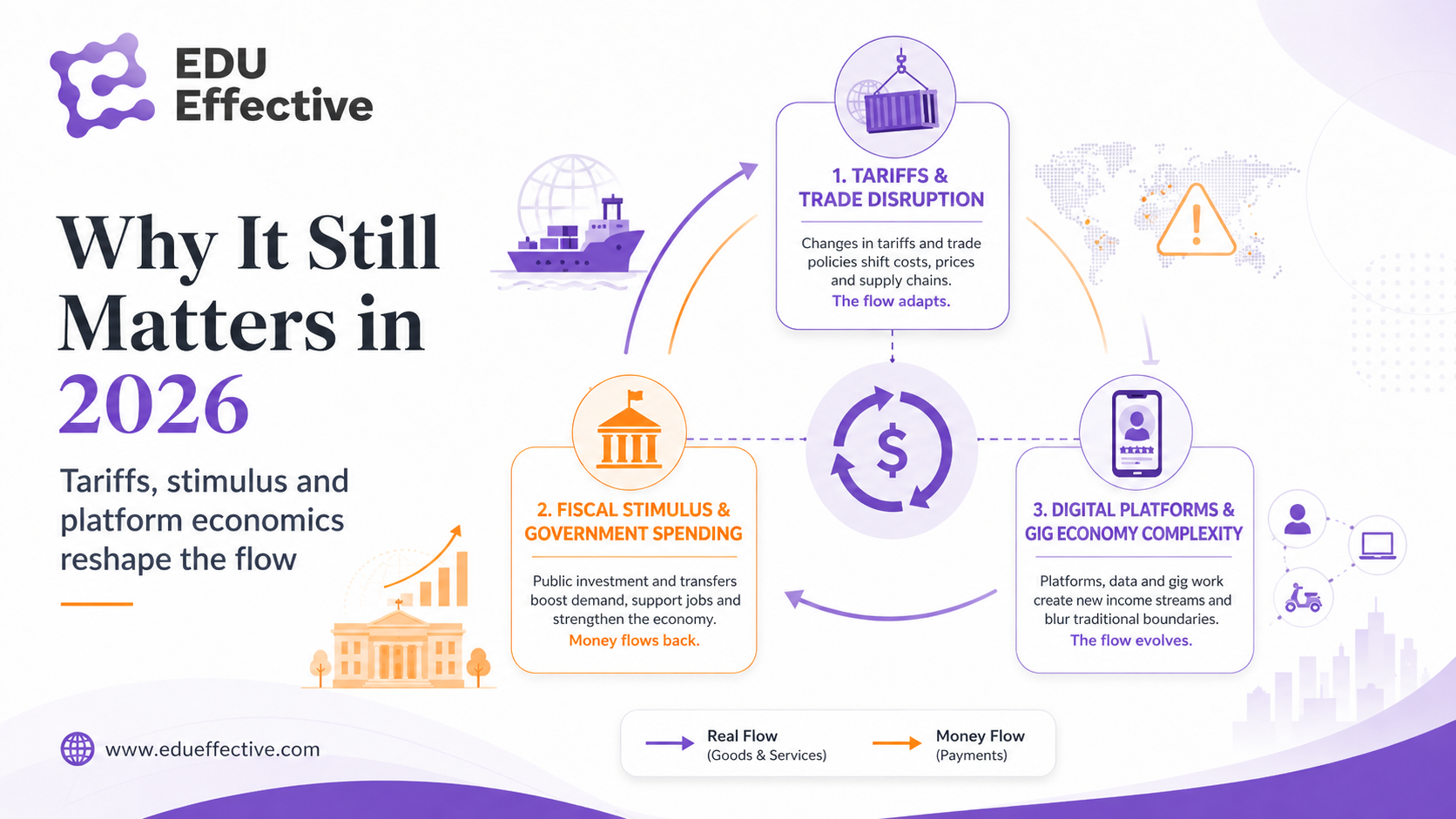
The tariff regimes introduced in 2025 — particularly US import duties on goods from China and other trading partners — function as a direct intervention in the foreign sector of the circular flow. Higher import costs reduce the volume of imports (reducing one leakage), but also increase costs for firms relying on imported inputs, which can compress profits and reduce wages, affecting the household-firm loop. When tariff-driven inflation reduces household purchasing power, overall domestic spending contracts.
The fiscal stimulus responses deployed by governments since the pandemic represent injections — government spending increasing the flow of money into the economy to offset private sector contractions. Whether those injections are offset by equivalent leakages (taxation, reduced private spending) determines whether the net effect is inflationary or stabilising. This is precisely the debate playing out in most major economies in 2026.

The rise of digital platform businesses introduces genuine complexity to the model that its original two-sector version did not anticipate. Gig workers function simultaneously as households (receiving income) and micro-firms (producing services). Platform companies often operate across multiple foreign sectors simultaneously, making import and export flows harder to attribute to a single domestic economy. The model's clean categories become messier at the edges, though the underlying logic of flows, leakages, and injections remains valid.
Why the circular flow chart matters for business professionals
Most people who work in business never formally study macroeconomics. That creates a predictable blind spot: executives who can read a balance sheet with precision but cannot explain why a central bank interest rate decision will affect their company's cost of capital, or why a trade surplus in their export market might shift exchange rates against them.
The circular flow model of economic activity provides the conceptual scaffolding for these connections. A government that raises taxes is increasing a leakage — reducing the spending available to households and the revenue available to firms. A central bank that cuts interest rates is reducing the cost of capital, encouraging firms to invest — an injection. A trade deficit means domestic money is flowing out faster than foreign money is coming in — a net drag on domestic income unless offset by other injections.
None of these relationships requires advanced mathematics to understand. They require the circular flow model — and the habit of thinking in terms of flows rather than static snapshots.
At EDU Effective, we build programs for professionals who want to work smarter — not just harder. Explore our programs →
EDU Effective Business School = professional development for your long-term success.
All best-selling Effective MBA programs are built for working adults: 15 minutes a day, 10 months or less, ASIC accredited, from €990.
These are professional programs, not academic ones — built for working adults to apply what they learn directly in their own business, not to collect a scholarly credential.
Join more than 9,000 students in over 120 countries who are investing in their professional development and career success.
Read the feedback and experiences of our students and the stories of our graduates here.
Apply now — from €990 · Talk to a Study Advisor
Study with NO risk: 14-day money-back guarantee, no questions asked.
Sources
- Peak Frameworks — Circular Flow Model: Definition, Real-World Implications, Leakages, and Injections https://www.peakframeworks.com/post/circular-flow-model
- DyingEconomy — Circular Flow Model and How Digital Platforms Fit In https://www.dyingeconomy.com/circular-flow-model.html
- IBONomics — Leakages and Injections — Unit 1.1 | IB Economics https://www.ibonomics.org/syllabus/what-is-economics-1-1/leakages-and-injections
- AmosWEB — Leakages: Encyclonomic WEB*pedia https://www.amosweb.com/cgi-bin/awb_wpd.pl?key=leakages
- Sparkl — Leakages and Injections: AP Macroeconomics https://www.sparkl.me/learn/collegeboard-ap/macroeconomics/leakages-and-injections/revision-notes/1086