
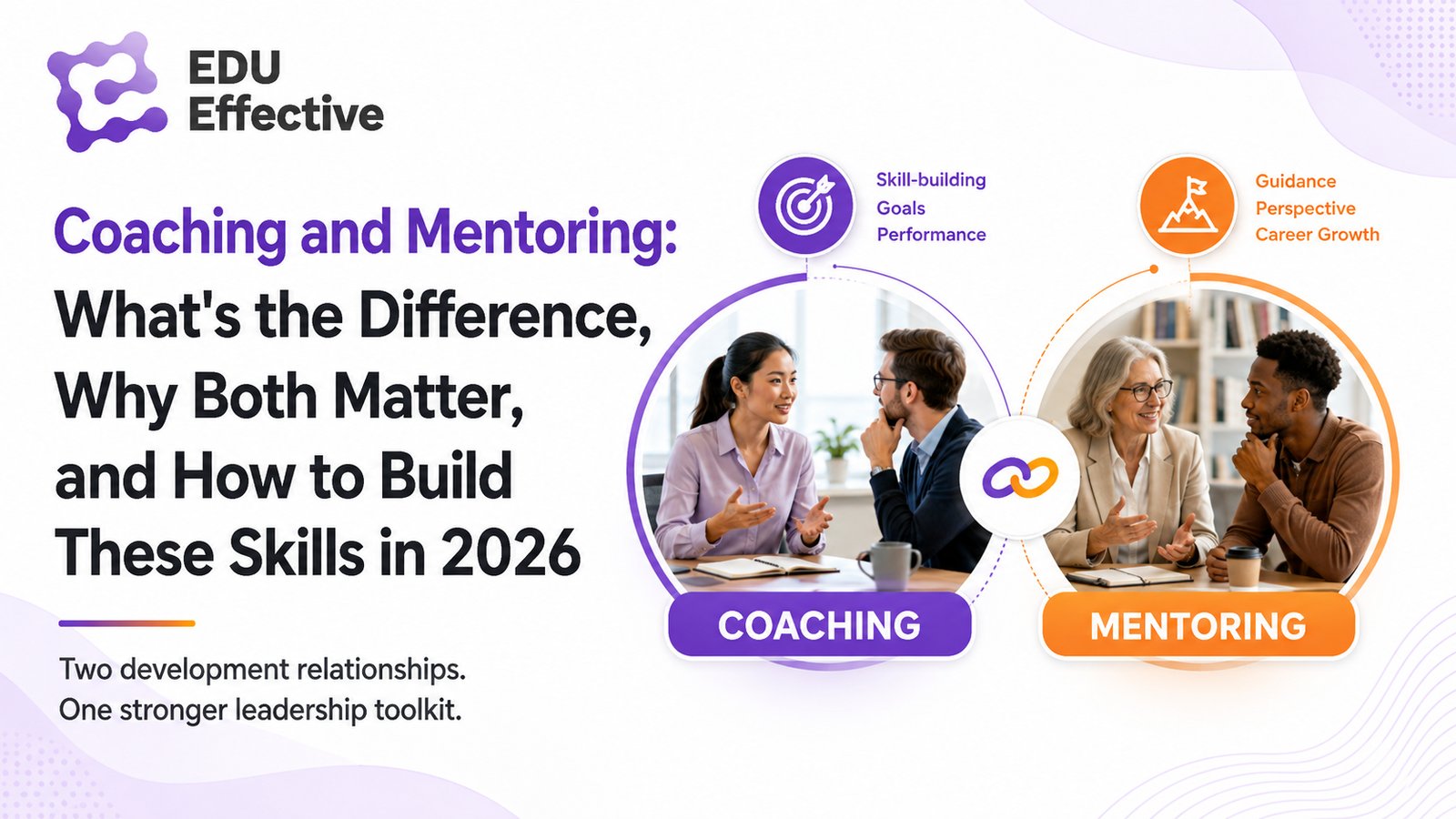

They are often mentioned in the same breath, sometimes used interchangeably, and frequently confused with each other. Coaching and mentoring are both development relationships that improve performance, accelerate careers, and build stronger organisations. But they are not the same thing — and treating them as if they were is one of the most common reasons that workplace development programmes underdeliver.
Understanding the precise difference between coaching and mentoring, knowing when each is appropriate, and knowing what the evidence says about their impact is increasingly important in 2026. As organisations navigate AI-driven workforce transformation, hybrid work, leadership burnout, and mounting pressure to retain skilled talent, structured development relationships are no longer an employee perk. They are a core workforce strategy.
Coaching: definition and what it actually involves
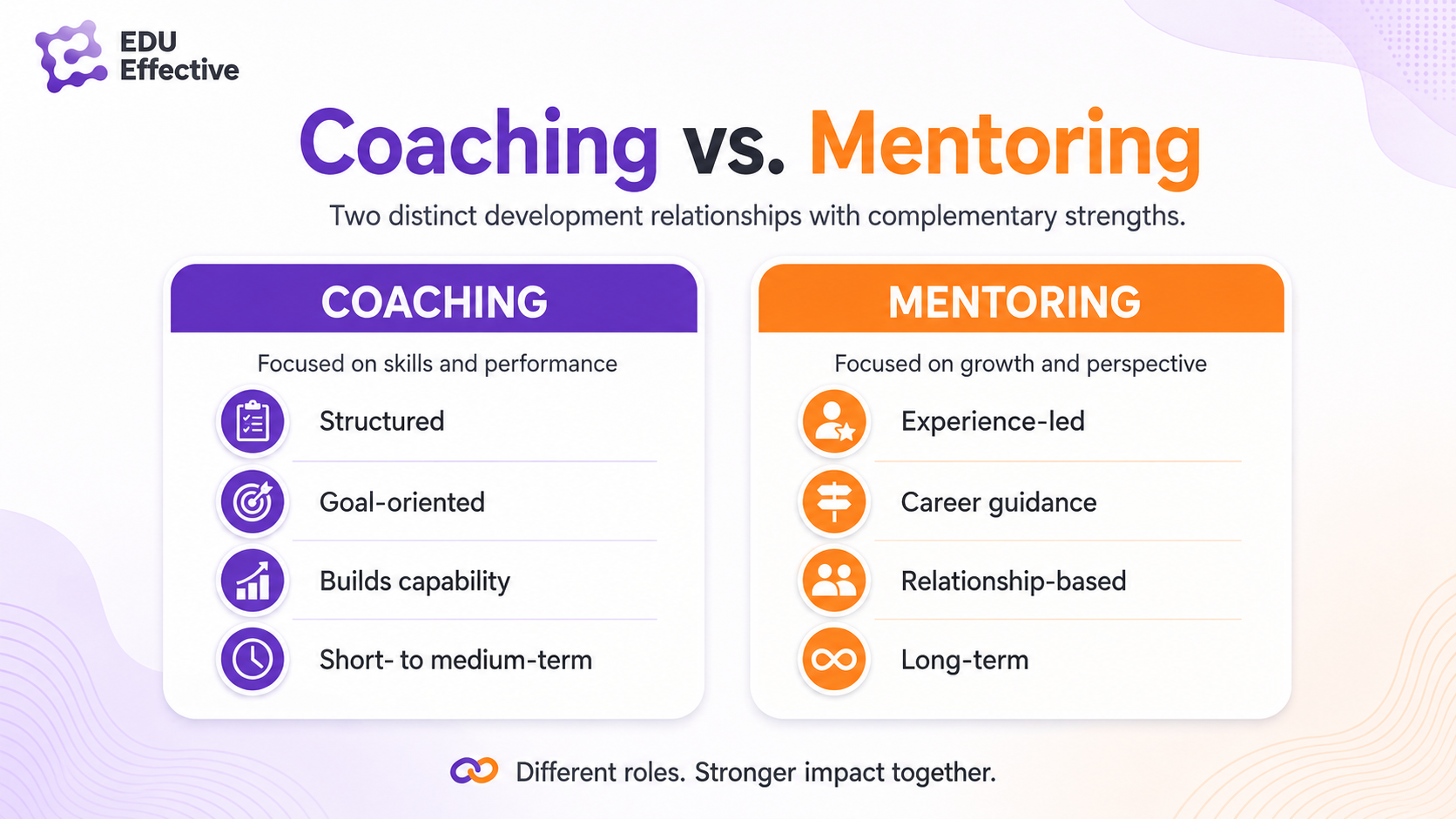
Coaching is a structured, goal-oriented process in which a trained coach helps an individual identify specific objectives, develop the skills or behaviours needed to achieve them, and track progress over a defined timeframe.
The coach is not typically a subject-matter expert in the coachee's field. In fact, the most effective coaching relationships often involve a coach with no direct experience in the coachee's industry. That is intentional: the coach's role is not to provide answers but to ask the right questions — to help the individual identify their own insights, unblock their own thinking, and develop their own capability.
Professional coaches typically hold formal credentials — from the International Coaching Federation (ICF), the European Mentoring and Coaching Council (EMCC), or similar bodies — and are most often external to the organisation, though internal coaching programmes are growing. Sessions are structured and time-bound, with clear objectives agreed at the outset. A coaching engagement might last three to six months, with regular sessions focused on a specific development goal: leadership presence, managing difficult conversations, decision-making under pressure, or similar defined capabilities.
The defining characteristic of coaching is that it is performance-focused and present-to-future oriented. It works with where the individual is now and builds toward where they need to be.
Mentoring: definition and what it actually involves
Mentoring is a longer-term, relationship-based exchange in which a more experienced person — the mentor — shares knowledge, perspective, guidance, and support with a less experienced person — the mentee.
Unlike coaching, mentoring is typically provided by someone with direct experience in the mentee's field, industry, or career path. The mentor draws on their own professional journey to provide context, introduce the mentee to relevant networks, share institutional knowledge, and offer perspective on decisions that formal training or structured coaching cannot replicate.
Mentoring relationships are generally more informal than coaching engagements. They are often longer — months or even years — and the agenda is typically shaped by the mentee's evolving needs rather than predetermined objectives. Mentors are usually internal to the organisation or part of the mentee's professional network, and the relationship is almost always voluntary.
The defining characteristic of mentoring is that it is relationship-based and long-term oriented. It works with career trajectory, organisational navigation, and personal development in a broader sense than the goal-specific focus of coaching.
The five key differences between coaching and mentoring
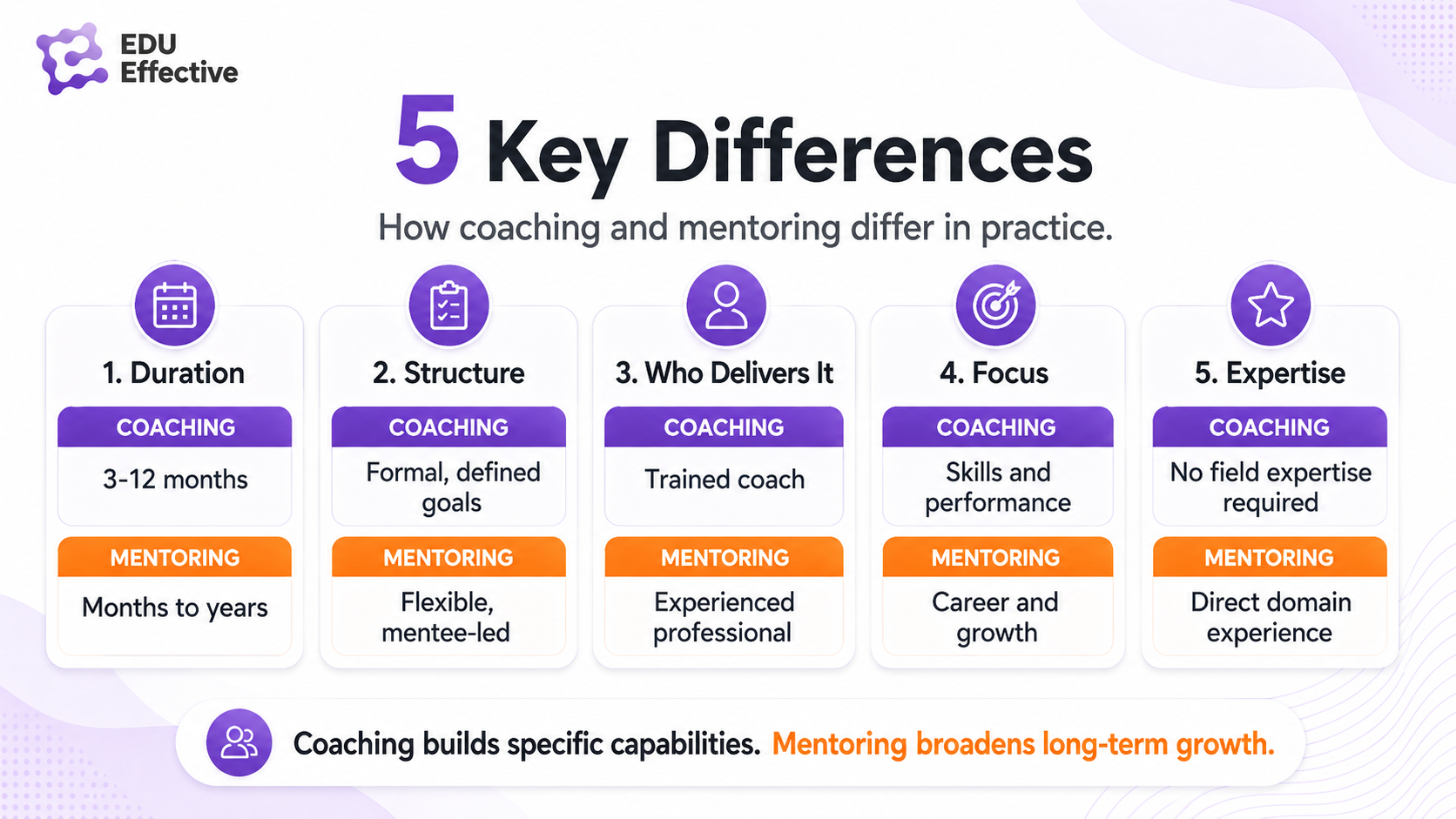
| Dimension | Coaching | Mentoring |
|---|---|---|
| Duration | Short-to-medium term (3–12 months) | Long-term (months to years) |
| Structure | Formal, structured sessions with defined objectives | Informal, flexible, agenda-driven by mentee |
| Who delivers it | Trained coach, often external | Experienced professional, usually internal |
| Focus | Specific skills, behaviours, performance goals | Career development, personal growth, organisational navigation |
| Expertise required | Coach does not need field-specific expertise | Mentor has direct experience in mentee's domain |
The practical implication: coaching is the right intervention when someone has a specific, defined development need in a defined timeframe. Mentoring is the right relationship when someone needs perspective, career guidance, or access to experience and networks that their immediate environment cannot provide.
These are not mutually exclusive. The most effective development programmes in 2026 combine both: using coaching to build specific leadership skills while layering in mentoring to give people perspective and access beyond their immediate role. A new manager might receive coaching on delegation and feedback while being mentored by a senior leader on organisational dynamics and long-term career navigation.
What the evidence says about their impact
The research on coaching and mentoring consistently shows significant positive outcomes — though the mechanisms and the magnitude differ between the two approaches.
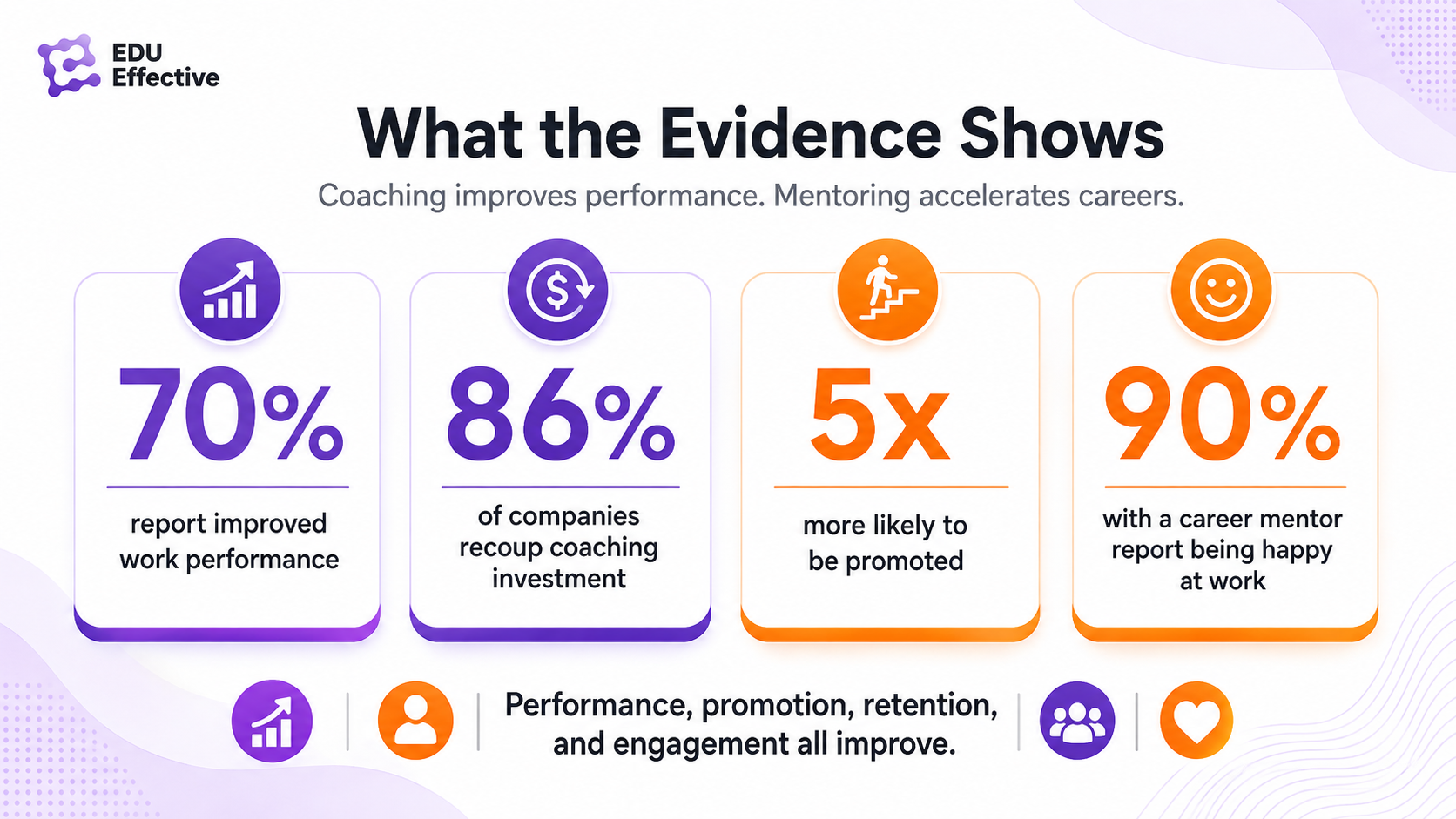
On coaching: 70% of people who receive coaching report improved work performance, according to the Institute of Coaching. Crucially, 86% of companies report that they fully recouped their investment in coaching — a rare finding for any HR or development intervention. Coaching also shows measurable impact on employee engagement, wellbeing, and communication effectiveness alongside the primary performance outcomes.
On mentoring: employees who receive mentoring are promoted five times more often than those who do not. 90% of employees with a career mentor report being happy at work, according to Harvard Business Review data. Mentoring also shows measurable impact on retention — a critical metric in 2026, when organisations report that retaining skilled talent is among their highest strategic priorities.
On the combination: organisations that deploy both coaching and mentoring as structured programmes consistently report stronger leadership pipelines, improved retention rates, and higher employee engagement scores than those relying on either approach alone.
When to choose coaching, when to choose mentoring
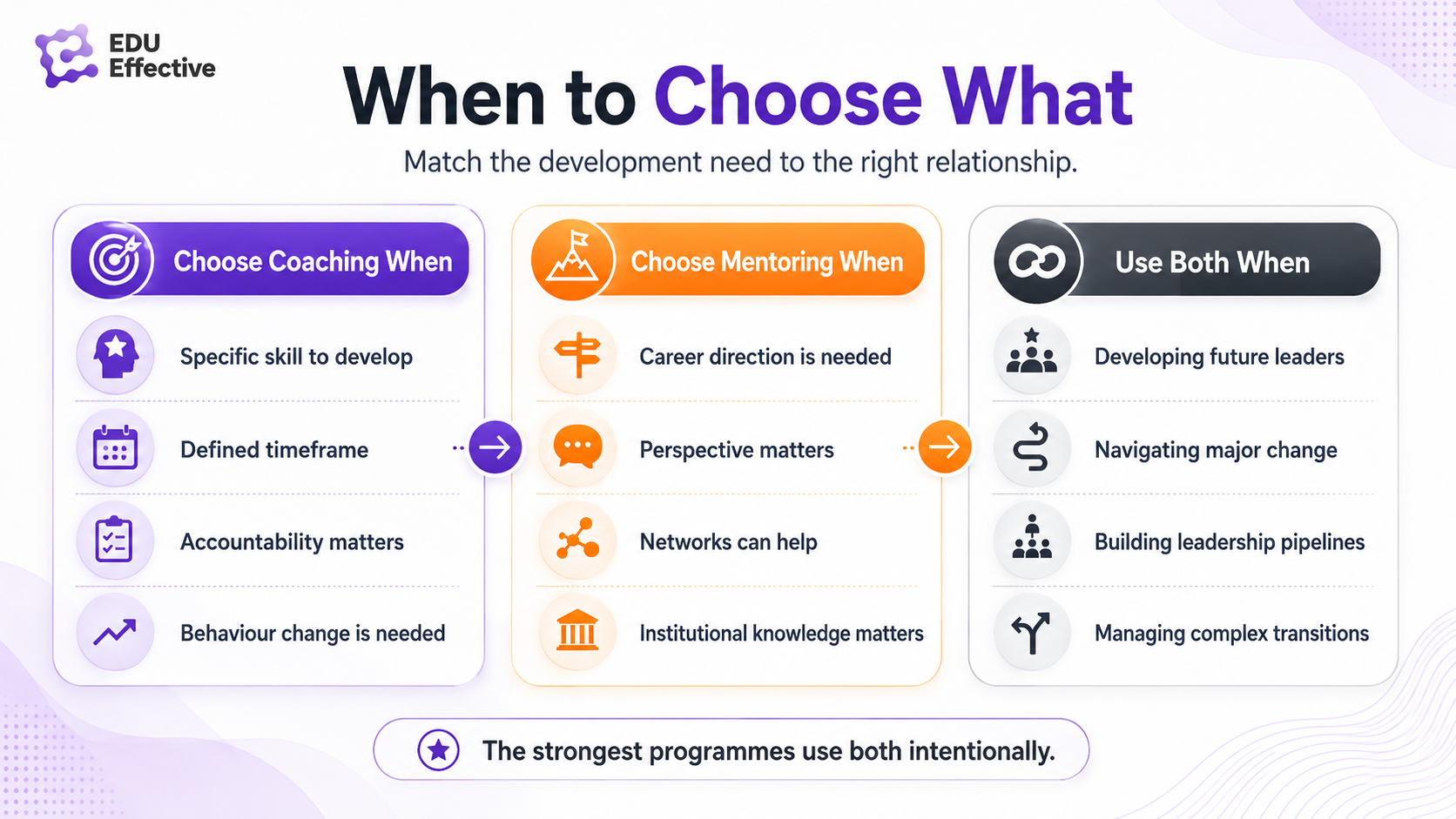
Choose coaching when:
- Someone needs to develop a specific skill within a defined timeframe — managing a team, navigating conflict, presenting to senior stakeholders, or improving decision-making.
- A new leader is transitioning into a significantly more demanding role and needs structured support to build unfamiliar capabilities quickly.
- Performance needs to improve in a targeted, accountable way.
- An organisation is implementing change that requires leaders to behave differently.
Choose mentoring when:
- Someone is considering a significant career transition and needs guidance from someone who has navigated it.
- A high-potential employee needs access to networks, sponsorship, and visibility beyond their current team.
- Succession planning requires institutional knowledge to be transferred.
- Supporting underrepresented groups who need access to guidance and advocacy.
- A cross-functional perspective would benefit the mentee — a marketing professional mentored by a finance leader, for instance, gains depth that makes them better at their own function.
Use both simultaneously when:
- Developing future leaders who need skill-building and perspective.
- During significant organisational change, when employees need structured performance support and sustained relationship-based guidance.
- Building a leadership pipeline where future leaders must navigate both technical capability gaps and cultural complexity.
What makes coaching and mentoring programmes succeed — or fail
The evidence surfaces consistent patterns in what distinguishes effective programmes from those that underdeliver.
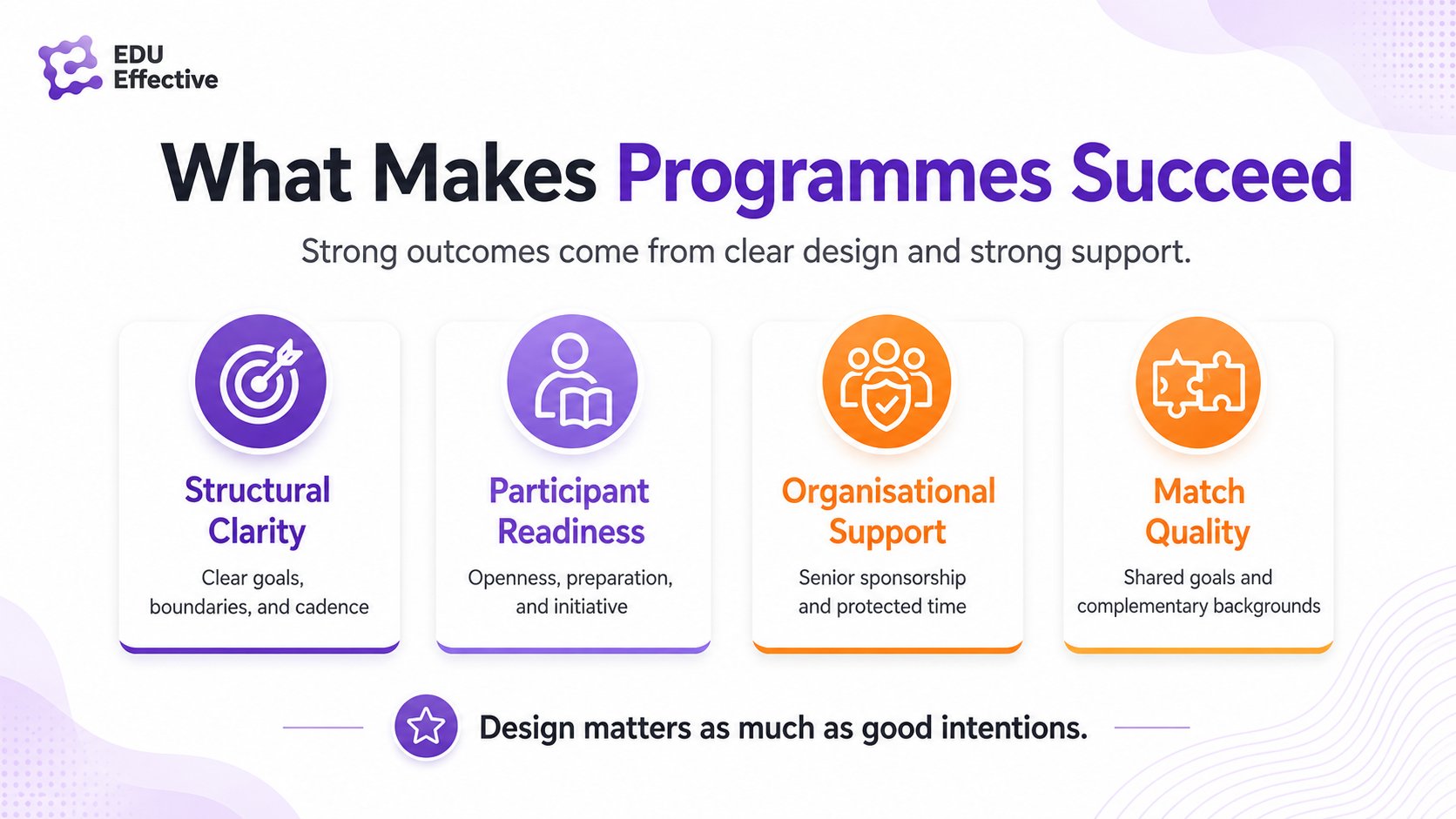
Structural clarity. Both coaching and mentoring work better when expectations, objectives, and boundaries are clearly defined at the outset. Ad hoc arrangements produce inconsistent outcomes. Programmes with clear matching processes, defined check-in cadences, and measurable goals outperform those that simply let relationships form and evolve.
Participant readiness. Neither coaching nor mentoring produces outcomes for participants who are not ready to engage. Coaching requires genuine openness to challenge and feedback. Mentoring requires the mentee to take initiative, prepare for meetings, and act on guidance.
Organisational support. Programmes with visible senior sponsorship, protected time in participants' schedules, and integration with performance and talent management systems produce stronger outcomes than those bolted on to existing workloads.
Match quality. In mentoring especially, the quality of the match between mentor and mentee is the single strongest predictor of programme success. Matching based on shared goals and complementary backgrounds outperforms matching based on hierarchical proximity or scheduling convenience.
The skills behind effective coaching and mentoring
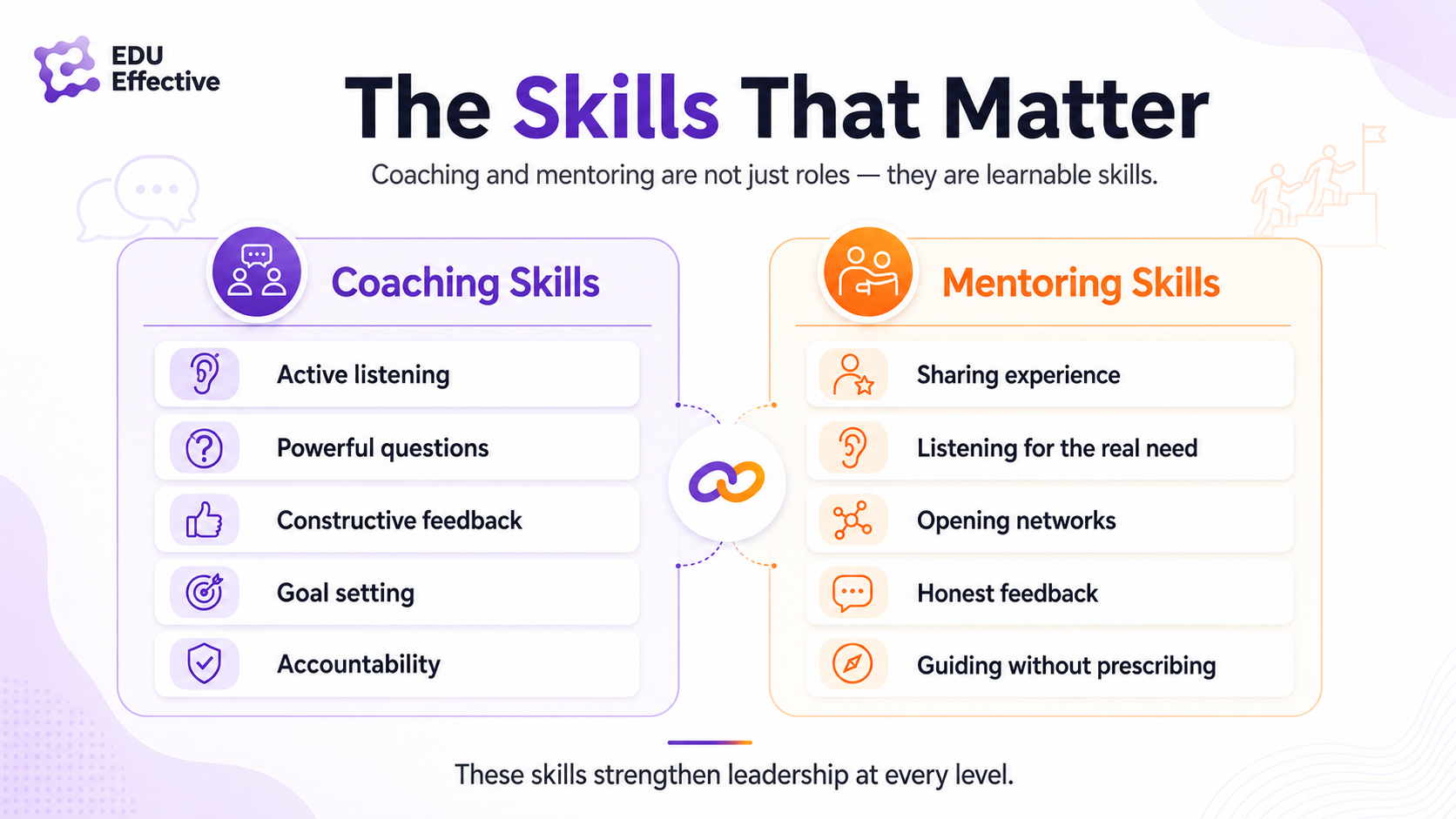
Coaching and mentoring are not just roles — they are skills. And they are skills that can be learned, practised, and systematically developed.
Effective coaches build proficiency in active listening, powerful questioning, giving and receiving feedback, goal-setting frameworks, and holding people accountable with care rather than control. These capabilities matter enormously for anyone in a leadership role — even those who are not operating as formal coaches. The leader who can coach their team in the moment, without a formal engagement, builds far stronger performance culture than one who relies solely on direction and instruction.
Effective mentors develop the ability to share experience without prescribing solutions, to listen for what is really being asked rather than what is literally being said, to make introductions that open doors without creating obligations, and to give honest feedback in a way the mentee can receive and act on. These are also leadership skills — and they compound over a career in ways that technical expertise alone cannot.
In 2026, with organisations navigating AI adoption, hybrid teams, and rapidly shifting skill requirements, the capacity to coach and mentor effectively at every level of leadership is one of the highest-value competencies available to any professional.
Coaching, mentoring, and AI in 2026
One of the most active questions in leadership development is how AI is changing coaching and mentoring practice. The answer is nuanced.
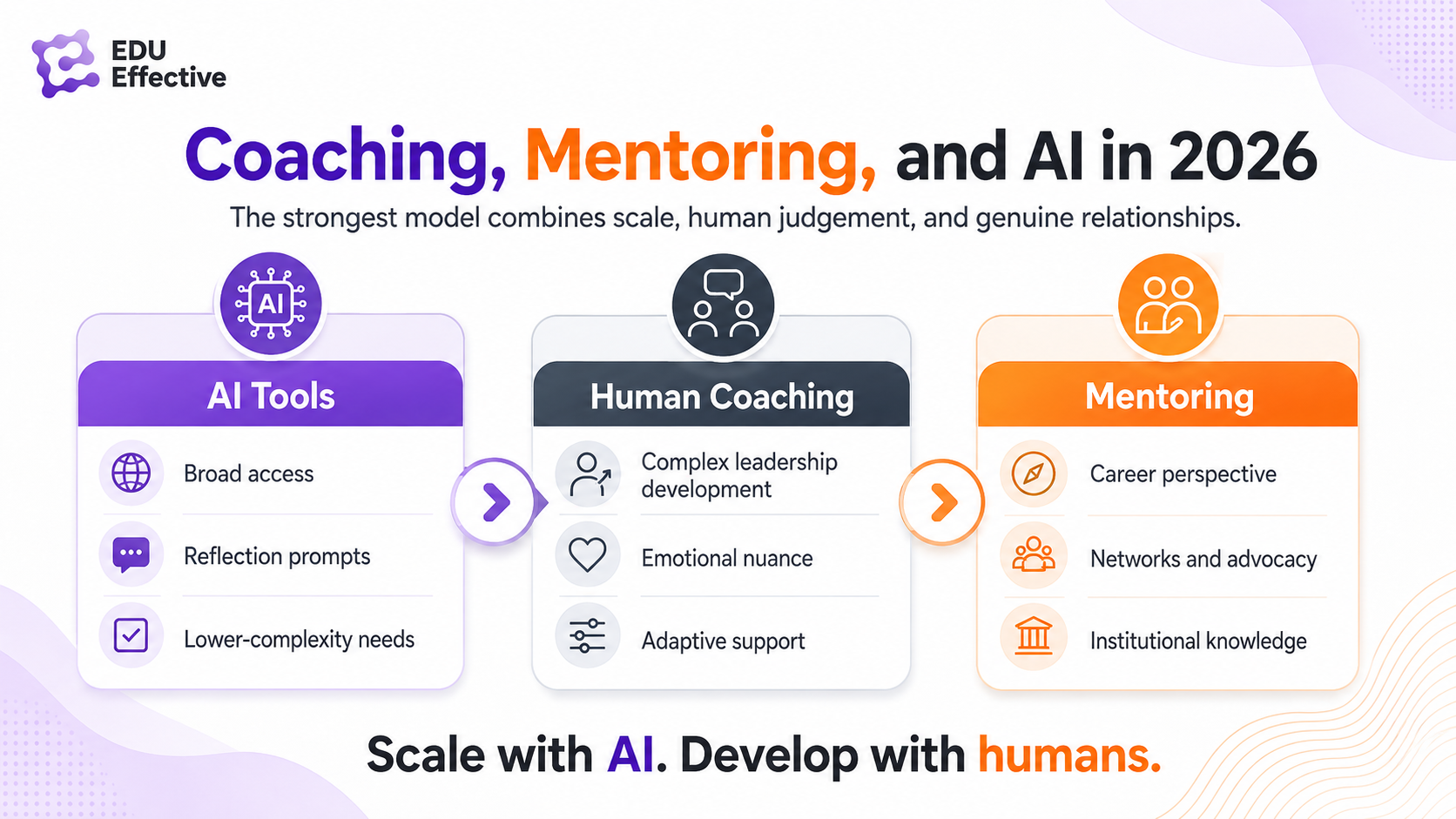
AI coaching tools — conversational applications that provide structured development exercises, behavioural nudges, and performance reflection prompts — have demonstrated genuine value for certain types of developmental support, particularly at scale and for lower-complexity development needs. They extend access to structured development to employees who would not otherwise have access to a professional coach.
What AI coaching tools cannot replicate is the human dimension of both relationships: the coach's ability to read emotional subtext and adapt in the moment; the mentor's ability to share authentic personal experience, introduce the mentee into their network, and advocate for them in rooms the mentee cannot yet access. These relational elements are not supplementary — they are, for many participants, the most valuable parts of coaching and mentoring relationships.
The emerging model in 2026 is a tiered approach: AI tools for broad access and scalability, human coaching for complex leadership development, and mentoring for career development that requires genuine human connection and institutional knowledge transfer. Organisations using all three in coordination are building the strongest development programmes.
Ready to build your coaching and mentoring skills professionally?
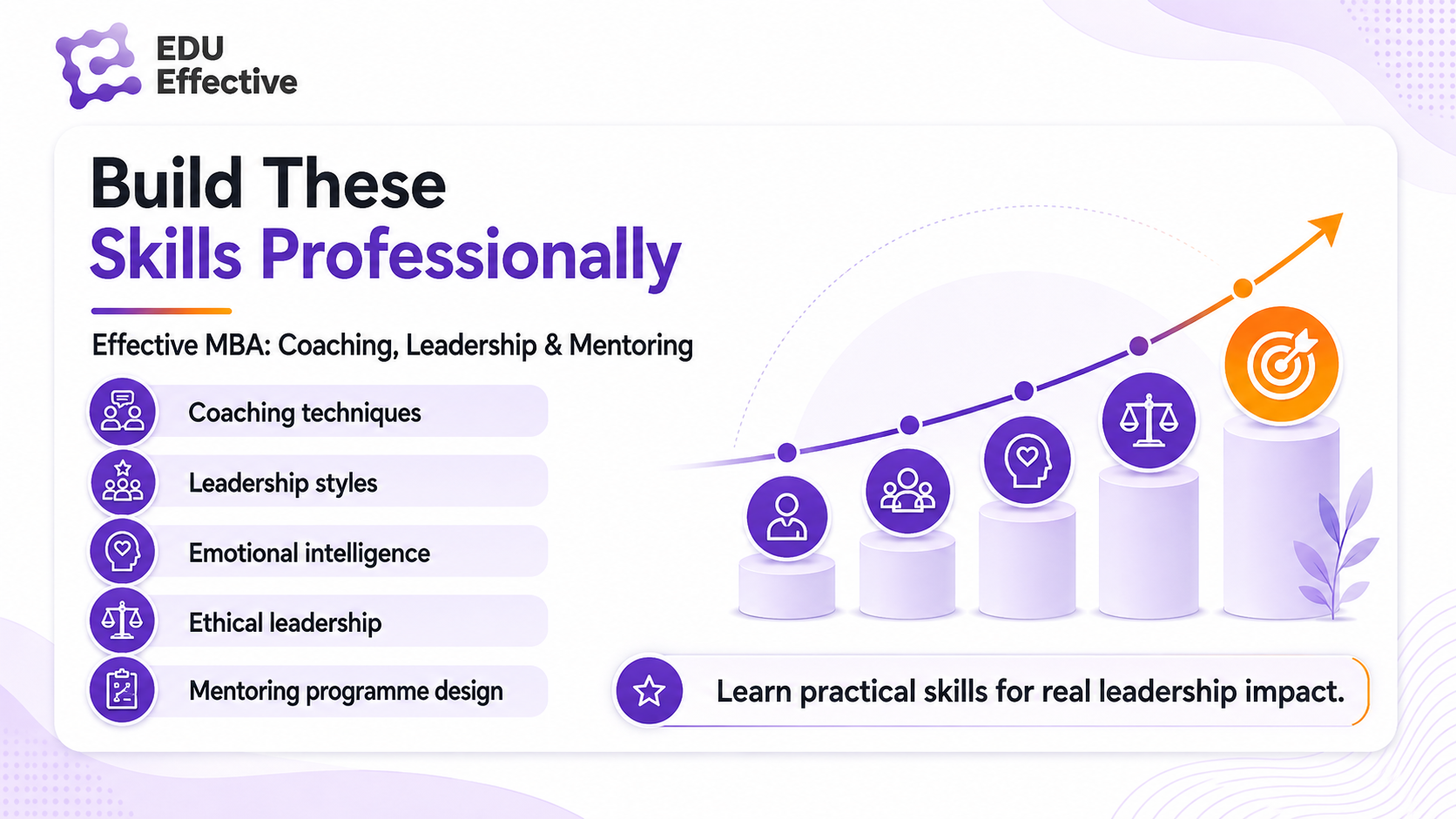
If this article has confirmed that coaching, mentoring, and leadership development are areas you want to invest in seriously — not just read about — the Effective MBA: Coaching, Leadership & Mentoring at EDU Effective is designed precisely for that purpose.
The programme covers coaching techniques that drive continuous improvement, leadership theories and styles from transformational to neuroscience-based, emotional intelligence, ethical and inclusive leadership, and how to design and run mentoring programmes that produce measurable results. Content draws on insights from practitioners at Google, Microsoft, McKinsey, Goldman Sachs, TED, and many others.
EDU Effective Business School — professional development for your long-term success.
All five Effective MBA programs are built on the same educational model — designed specifically for working adults who need learning that fits real professional life:
- Effective MBA: Executive Management & Leadership
- Effective MBA: Applied Artificial Intelligence
- Effective MBA: Coaching, Leadership & Mentoring
- Effective MBA: Mastery in AI
- Effective MBA: Online Marketing
Every programme runs on 15 minutes a day, completes in 10 months or less, is ASIC accredited, and starts from €990.
These are professional programmes, not academic ones — built for working adults to apply what they learn directly in their own business, not to collect a scholarly credential.
Join more than 9,000 students in over 120 countries who are investing in their professional development and career success. Read the feedback and experiences of our graduates here.
Apply now — from €990 · Talk to a Study Advisor
Study with NO risk: 14-day money-back guarantee, no questions asked.
Sources
- Engagedly — Mentoring and Coaching in the Workplace: Examples & Best Practices for 2026
engagedly.com/blog/inspiring-examples-of-coaching-and-mentoring-in-the-workplace/ - Boon Health — Coaching vs Mentoring: Key Differences for HR Leaders (2026)
boon-health.com/learn/resources/coaching-vs-mentoring - Together Platform — Coaching vs Mentoring: What's the Difference?
togetherplatform.com/blog/what-is-the-difference-between-mentorship-and-coaching - Totara — Mentoring vs Coaching: The Key Differences and Benefits
totara.com/articles/mentoring-vs-coaching-the-key-differences-and-benefits/ - Careerminds — Mentoring vs. Coaching: Key Differences, Benefits, and Examples
careerminds.com/blog/mentoring-vs-coaching-key-differences-benefits-and-examples - Indeed UK — Mentoring vs. Coaching: Key Differences and Benefits
uk.indeed.com/career-advice/career-development/mentoring-vs-coaching - AIHR — Coaching vs. Mentoring: 11 Key Differences & Skills Needed
aihr.com/blog/coaching-vs-mentoring/