
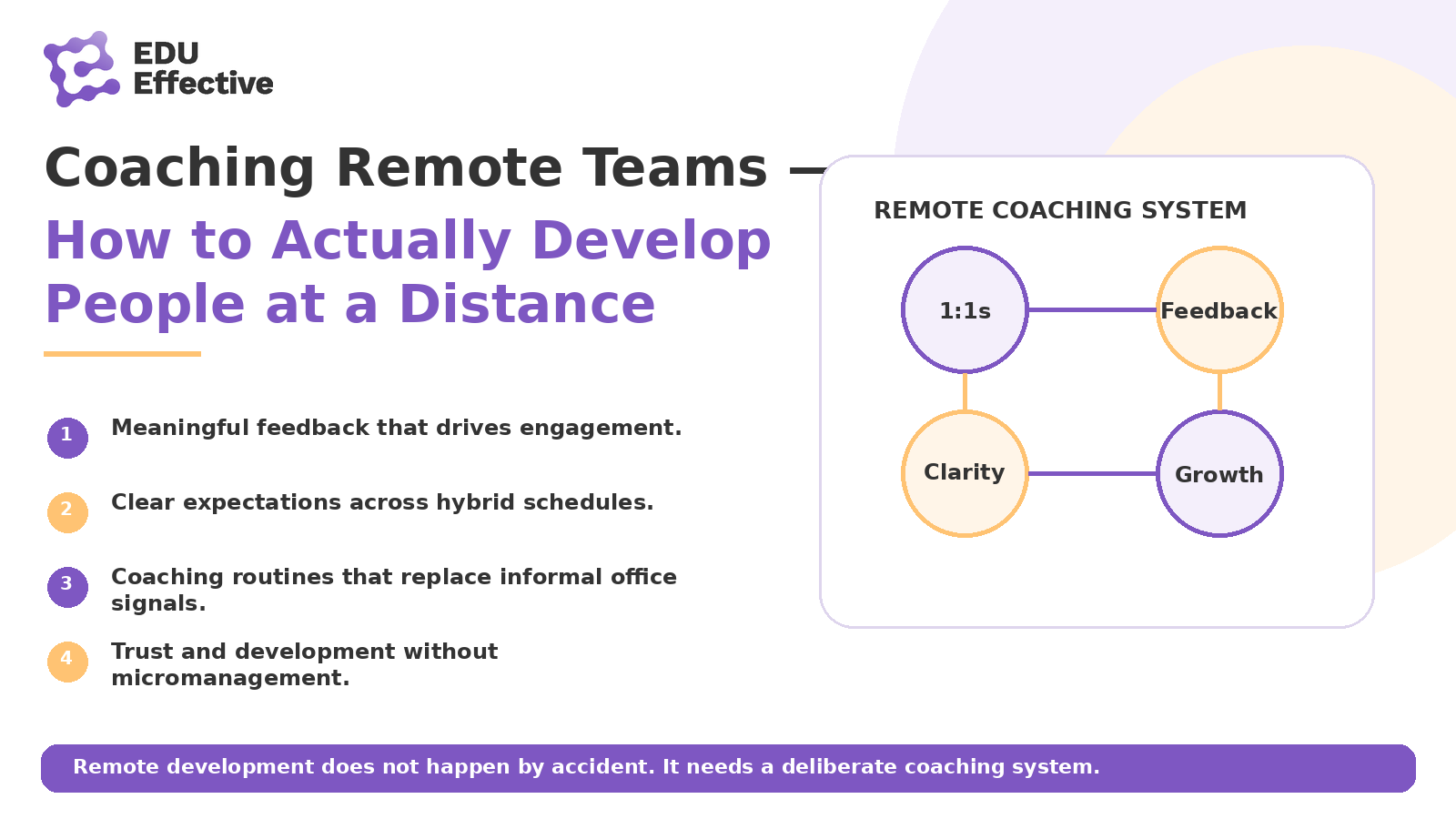

Most managers who lead remote or hybrid teams are doing it without a real framework. They have check-in calls. They send messages. They occasionally get on video. What most of them do not have is a deliberate approach to the kind of work that actually develops people — the ongoing coaching conversations that build capability, address problems early, and maintain the trust that makes a distributed team function as a unit rather than a collection of individuals working in parallel.
The gap matters more than most organizations have acknowledged. Gallup’s analysis of 8,000+ hybrid and remote workers found that employees who strongly agree they received meaningful feedback in the past week are nearly 4 times more likely to be fully engaged — regardless of how many days they work in an office. Only 21% of employees strongly agree they received meaningful feedback from their manager in the past week.
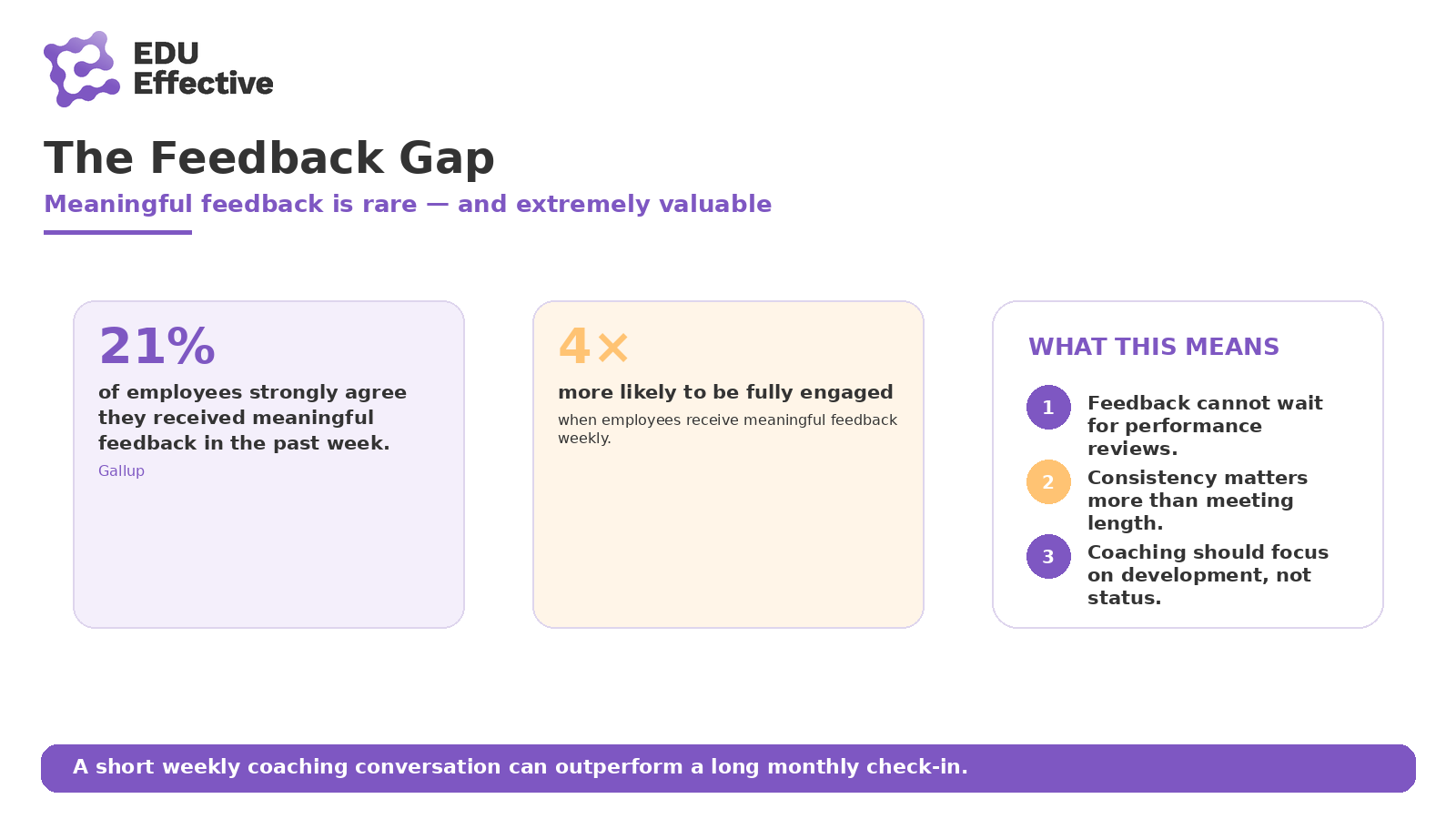
That 21% figure is the starting point for any honest conversation about coaching remote teams. The behaviors that drive engagement and development are not happening consistently, and the distance of remote work makes the gap harder to see and easier to ignore.
What the Remote Work Picture Actually Looks Like in 2026
As of 2026, 52% of remote-capable US employees are working hybrid, 26% are fully remote, and 22% are fully on-site, according to Gallup’s latest tracking. Hybrid workers spend about 46% of their week on-site — roughly 2.3 days — up from 42% in 2022.
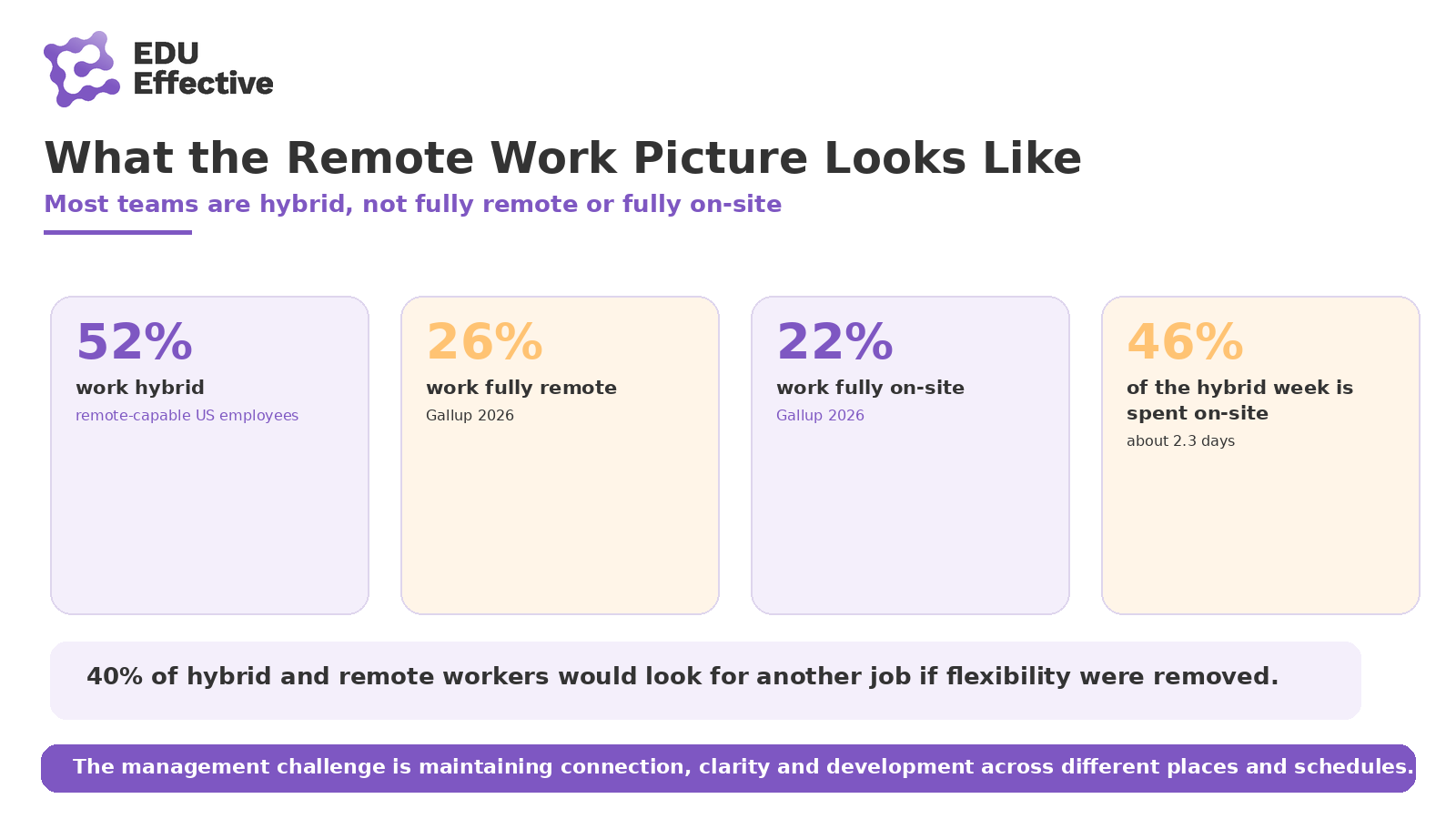
The direction of travel is not toward full remote. Office days have risen for most hybrid workers. Owl Labs’ State of Hybrid Work 2025 found that most hybrid workers now go to the office 3 to 4 days a week, both figures up from 2024. But 40% of hybrid and remote workers say they would look for another job if their flexibility were removed, which means the negotiation between organizations and employees over location and schedule is not over.
What this means for managers is structural: most teams are not fully in-person, and most teams are not fully remote. They are hybrid, with some people in the office on overlapping days and others working from home, often with different schedules. The management challenge is not “how do I manage remote workers” — it is “how do I maintain connection, clarity, and development for a team whose members are in different places at different times.”
That challenge is harder than it looks. Gallup found that clarity of expectations has declined over the past five years among hybrid and remote employees at twice the rate of on-site workers. Employees who strongly agree they know what is expected of them are 47% less likely to experience frequent burnout and 23% less likely to struggle with work-life balance. Clarity is not a soft nice-to-have. It is a management output with measurable consequences.
The Manager Effect Is Larger Than Most People Think
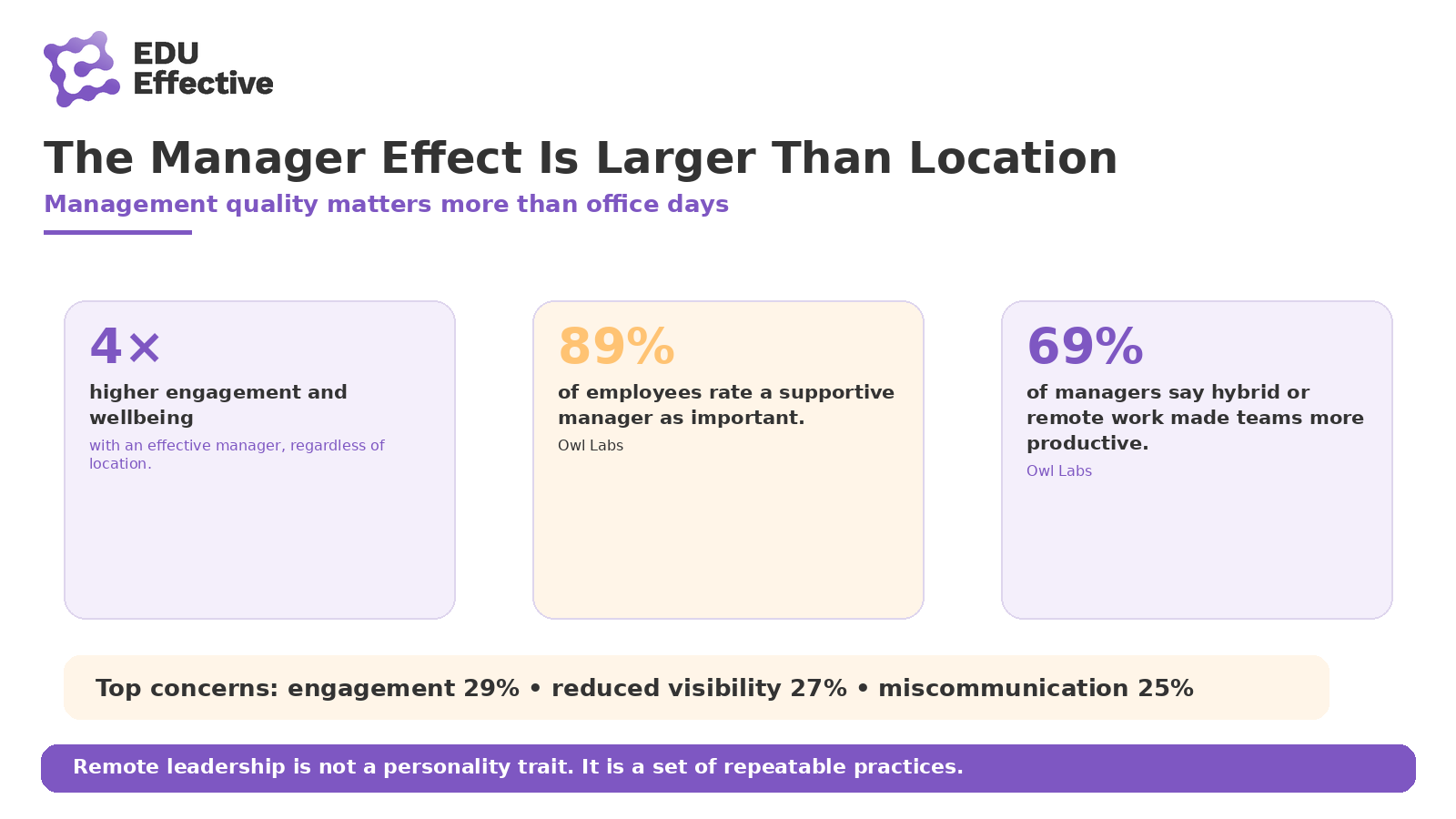
Gallup’s research is direct on this: an effective manager is associated with 4 times higher engagement and wellbeing, regardless of how often employees work remotely. The number of office days does not determine engagement outcomes — the quality of management does.
This finding cuts against two narratives that are both popular and both wrong. The first narrative is that remote work inherently reduces engagement, and the solution is to require more office time. The second narrative is that flexible work arrangements take care of themselves if you trust people to manage their own time. Both miss the actual variable, which is the manager.
Owl Labs found that 89% of employees rate a supportive manager as an important workplace factor. They also found that 69% of managers say hybrid or remote work made their teams more productive, while 29% cite employee engagement as their most pressing concern when managing remote teams, followed by reduced visibility (27%) and miscommunication (25%). Managers see the benefits and feel the gaps simultaneously — the gap being, in most cases, the absence of a deliberate approach to maintaining connection and development at a distance.
What makes an effective remote manager different from an average one is not primarily personality. It is specific practices: more structured check-ins, more deliberate communication about expectations and progress, more proactive attention to whether people are developing rather than just delivering, and more explicit relationship-building that substitutes for the incidental contact that happens naturally in a shared office.
The Collaboration Plan Gap
One of the clearest findings in Gallup’s research is also one of the most overlooked. Teams with a formal hybrid collaboration plan are 66% more likely to be engaged and 29% less likely to experience burnout. In 2024, 48% of hybrid workers said their team had not discussed a collaboration plan at all.
A collaboration plan is not a complex document. It answers a small number of questions: When do we meet, and for what? How do we handle asynchronous communication? What decisions get made together, and which ones can individuals make independently? What norms do we have around availability and response time? When something is not going well, how do we surface it?
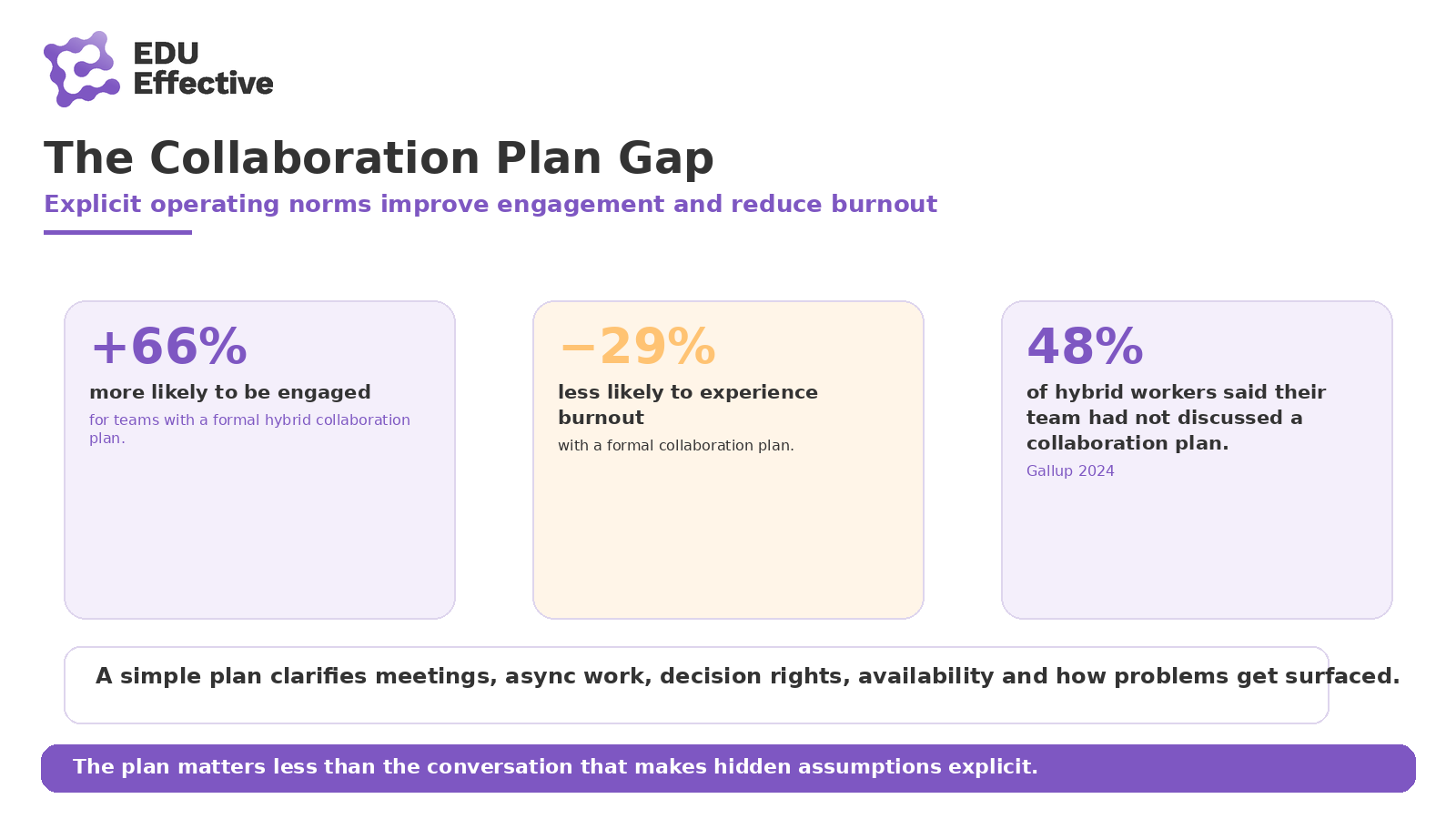
Most teams have never explicitly discussed any of these. They operate on implicit norms that are often inconsistent — what one person assumes is obvious is unknown to another. The inconsistency generates friction, and the friction accumulates in the form of miscommunication, missed expectations, and resentment that is difficult to diagnose because it has no single cause.
The manager’s role in creating a collaboration plan is to facilitate the conversation, not to impose the answers. The plan itself is less important than the act of making the team’s operating norms explicit. Teams that have done this work together report higher trust, better communication, and significantly lower burnout — not because the document solves anything, but because the conversation revealed assumptions that had been generating problems silently.
Gallup also found that only 21% of hybrid workers and 28% of hybrid managers had received any hybrid-specific training in 2024. This is the organizational context in which most remote managers are operating: without a team collaboration plan, without training, and making it up as they go.
Coaching at a Distance: What Works
The core challenge of coaching remote team members is that the informal signals that normally trigger a coaching conversation are absent. In a shared office, a manager notices when someone seems disengaged, is staying late consistently, or is avoiding a colleague. The physical environment generates information that remote work does not. At a distance, problems that are invisible stay invisible until they become serious.
Effective remote coaching requires replacing informal signals with structured ones.
Weekly 1:1s are not optional. They are the primary mechanism through which a remote manager maintains visibility into how a team member is actually doing — not just what they are delivering, but how they are thinking, what they are finding difficult, where they want to grow, and whether something is getting in the way. The purpose of a 1:1 is not status update. Status update is what async tools are for. The purpose is connection, coaching, and early problem detection.
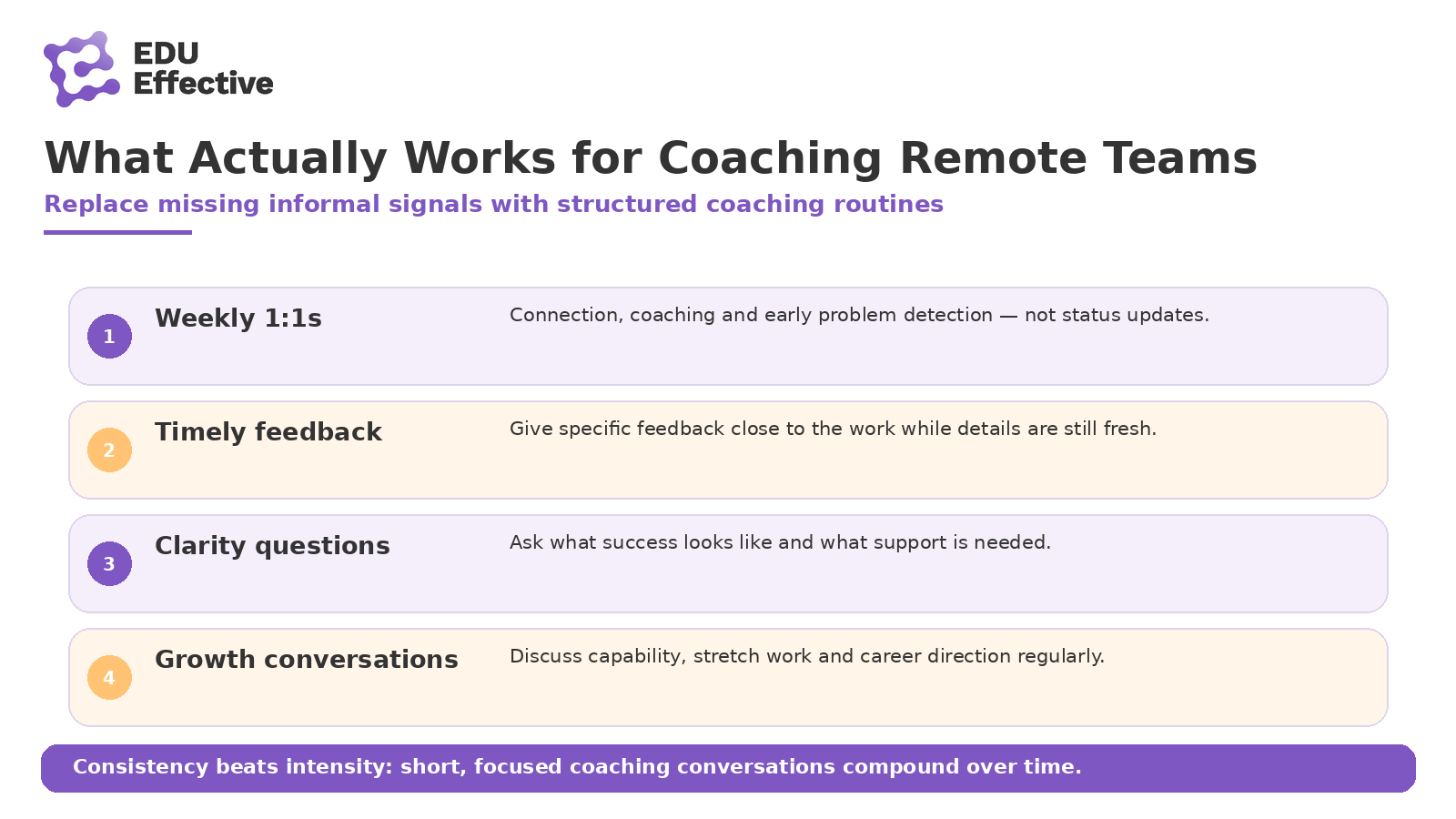
Gallup’s data supports this directly: meaningful feedback conversations — even brief ones — have a disproportionate impact on engagement. Employees receiving weekly meaningful feedback are 4 times more likely to be engaged. The format matters less than the consistency. A 20-minute 1:1 that includes genuine listening and specific, development-focused feedback delivers more coaching value than a monthly hour-long check-in that stays at the surface.
Feedback must be specific and timely. The delay between an event and feedback is longer in remote environments because the event happened asynchronously, was not directly observed, and may be weeks old by the time it surfaces. Remote managers who wait for performance review cycles to give substantive feedback are not coaching — they are documenting. Development conversations need to happen close to the work, when the details are still fresh and the person can act on what they hear.
Clarity is a coaching deliverable. Gallup’s finding that clarity of expectations has declined most sharply among remote workers is a coaching problem. When a manager checks in regularly and asks “do you know what success looks like for this project?” or “what do you need from me to deliver this well?” — those questions are not management overhead. They are the work of keeping a remote team member oriented and motivated in an environment where the orienting signals of shared physical space are absent.
Trust, Visibility, and the Micromanagement Trap
The trust question in remote work is usually framed the wrong way. The debate is typically: does the manager trust the employee to work productively without supervision? Gallup’s 2026 data shows that 54% of managers of remote workers strongly agree they trust their teams to be productive, and 57% of remote employees feel trusted.
But there is a second trust question that matters more for coaching: does the employee trust the manager enough to surface problems early? In a remote environment, an employee who does not trust their manager will manage what the manager sees, not what is actually happening. They will report green when things are yellow. They will not raise the issue they are worried about because they are not sure how it will land. And the manager, seeing a stream of positive updates, will have no signal that something needs attention until it has already become a problem.
The manager behaviors that build that kind of trust — the willingness to be honest about difficulties — are specific. They include asking open questions and listening to the answers rather than jumping to solutions. They include normalizing the acknowledgment of difficulty: “what’s the hardest part of this for you right now?” They include following up on what was said in the previous conversation, which signals that the manager actually heard it and cared. And they include transparency about the manager’s own uncertainty and limitations, which models the kind of honesty that they want from the team.
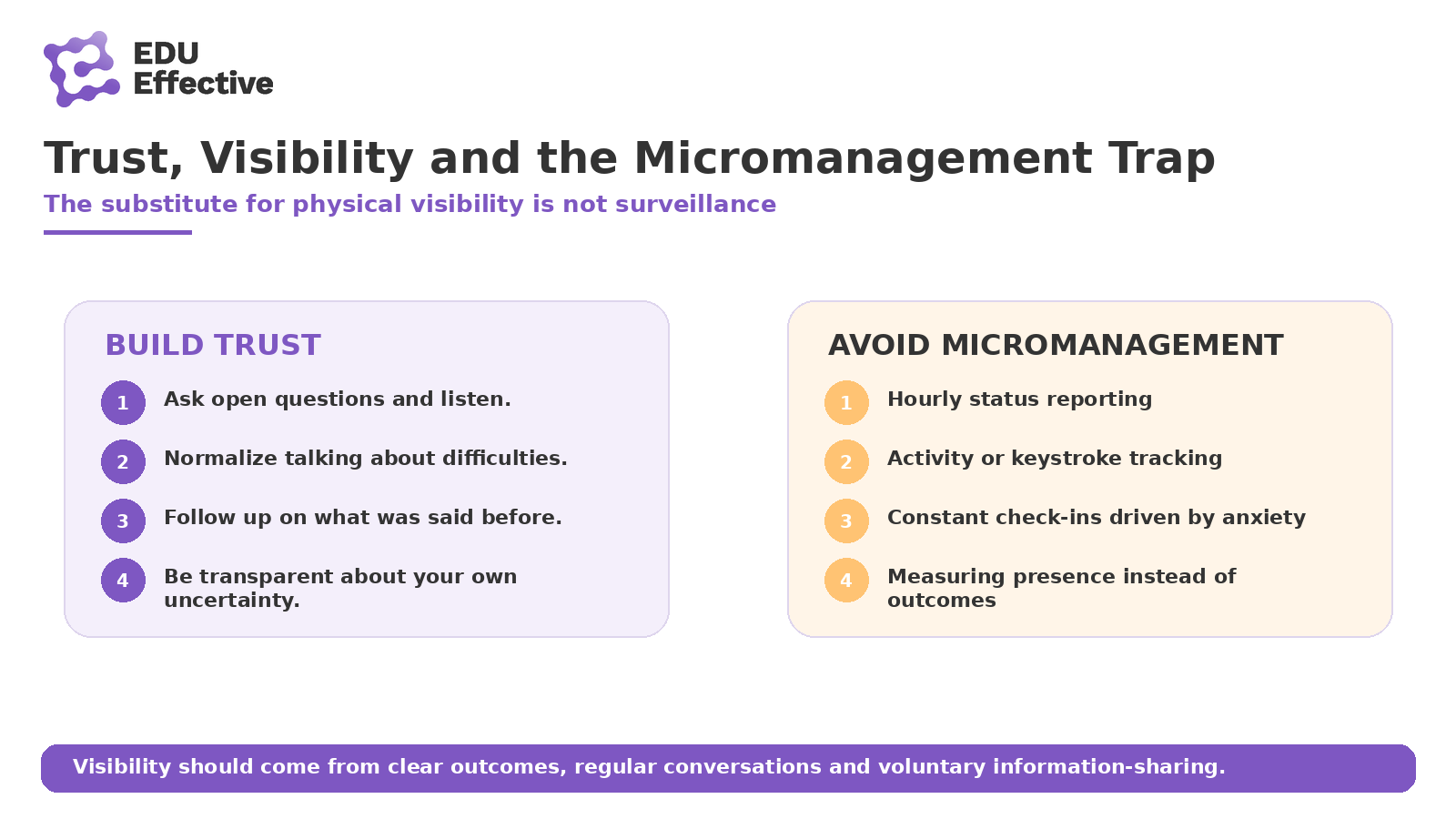
The micromanagement trap runs in the opposite direction. Owl Labs found that reduced visibility into how and when the team works is the second most common concern managers cite in remote environments (27%). The response to that anxiety is often to increase check-in frequency, require more detailed status reporting, or track activity metrics. Each of these erodes trust faster than it generates visibility. The manager who tracks keystrokes or requires hourly updates communicates, at volume, that they do not trust the employee — and gets the corresponding drop in engagement and psychological safety.
The substitute for physical visibility is not surveillance. It is a clear agreement about outcomes, regular conversations about progress and obstacles, and a relationship in which the employee volunteers information rather than waiting to be asked.
Building Development Into a Remote Team
Development in remote teams does not happen by accident. In a shared office, learning can happen through proximity — sitting next to an experienced colleague, overhearing how someone handles a call, picking up organizational knowledge from informal conversation. Remote work eliminates that ambient learning almost entirely.
Remote managers who develop their teams deliberately do it through a small number of consistent practices: assigning stretch work with explicit learning intent (“I want you to lead this client presentation — I’ll debrief with you afterward”); creating structured peer learning moments (team retrospectives, case-based discussions, shared reading); and making career conversations a regular part of 1:1s, not an annual event.
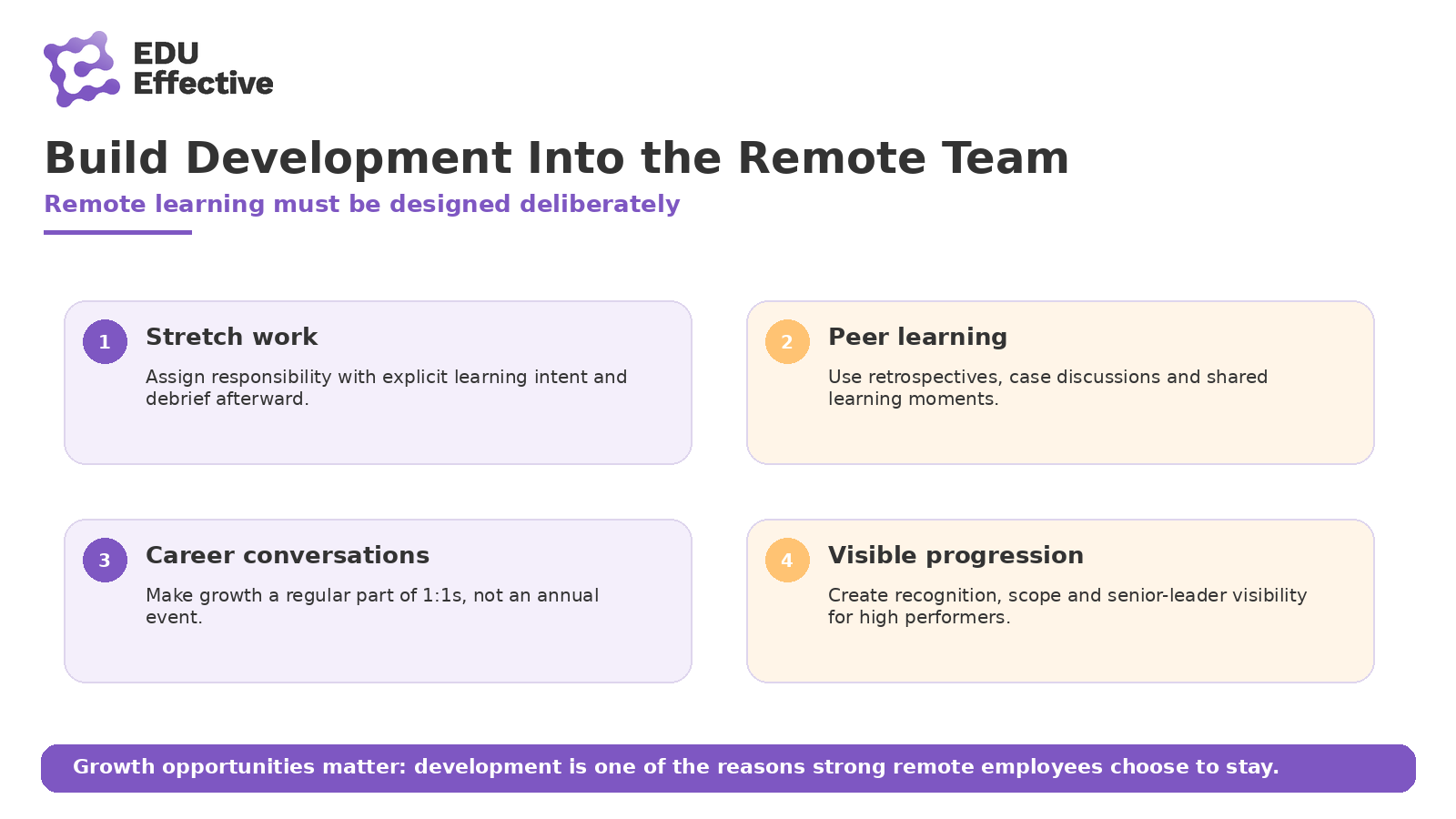
Owl Labs found that lacking growth opportunities is the second most common driver of disengagement, cited by 24% of employees. In a remote environment, the lack of visible growth compounds because the signals that development is happening — public recognition, increased scope, visibility to senior leaders — are less naturally generated. Remote managers who do not actively create those signals leave high performers with few reasons to stay.
Where EDU Effective Comes In
The Effective MBA: Coaching, Leadership & Mentoring program covers the full range of skills that remote managers need: coaching frameworks, feedback models, team dynamics, trust-building, and how to structure development conversations that actually change behavior. It is built for working managers who are doing this in real time, not studying it in theory.
About EDU Effective Business School
The Effective MBA: Coaching, Leadership & Mentoring is built around the conversations that shape team performance. Runs on 15 minutes a day, completes in 10 months or less and is ASIC accredited.
Sources
- Gallup — Hybrid Work and Productivity: What the Data Show (2024-2026) https://www.gallup.com/workplace/713093/hybrid-work-productivity.aspx
- Gallup — Understanding and Managing Remote Workers https://www.gallup.com/workplace/316313/understanding-and-managing-remote-workers.aspx
- Owl Labs — State of Hybrid Work 2025 https://owllabs.com/state-of-hybrid-work/2025