
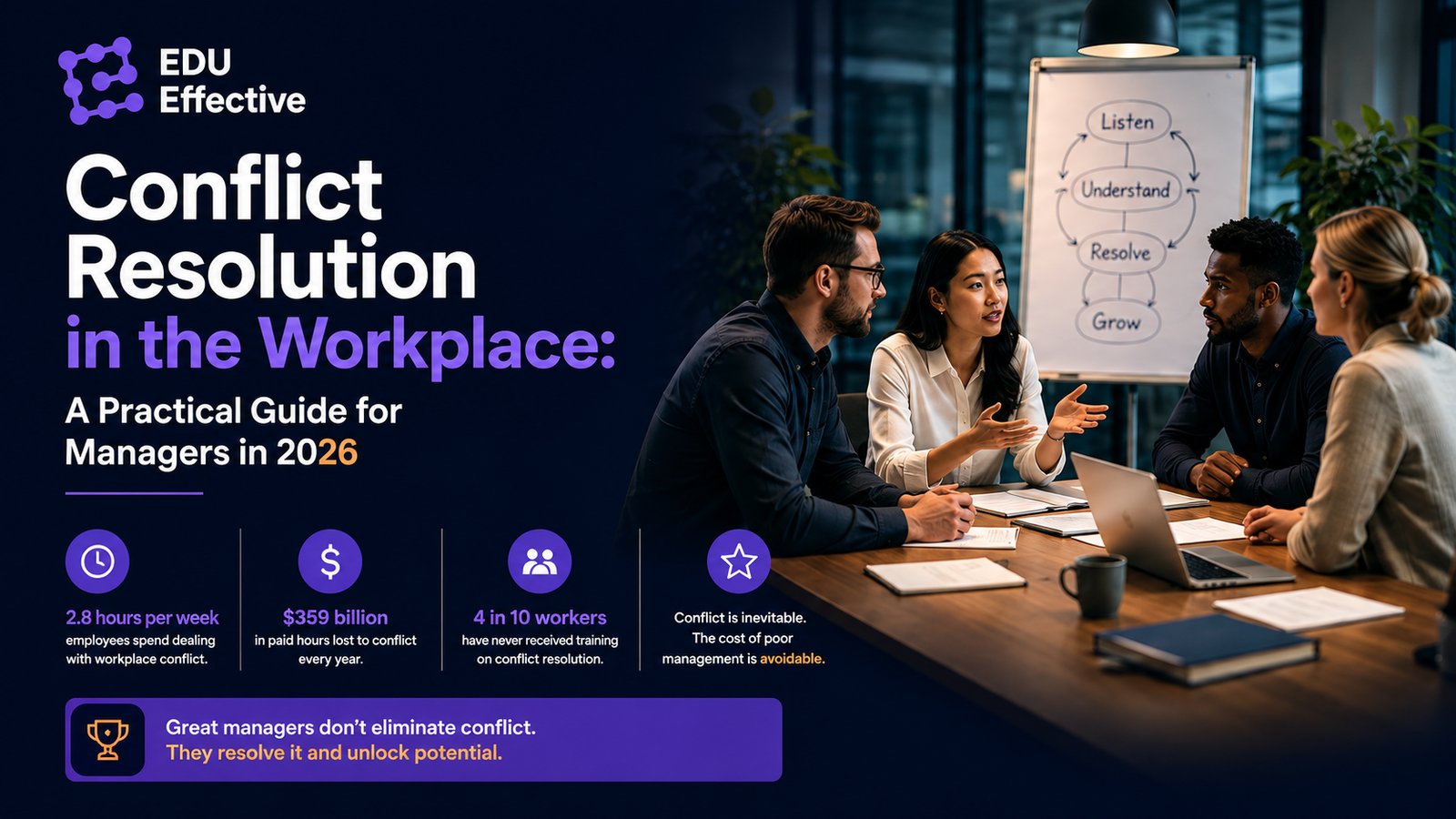

U.S. employees spend an average of 2.8 hours per week dealing with workplace conflict. At average salary rates, that translates to approximately $359 billion in paid hours consumed by disputes annually. This figure originates from the CPP Global Human Capital Report on Workplace Conflict — a study of 5,000 employees across nine countries conducted by the publisher of the Thomas-Kilmann Conflict Mode Instrument — and has since been independently corroborated by SHRM workforce research and cited by Forbes, McKinsey, and multiple HR advisory bodies as the benchmark figure for the cost of unresolved workplace conflict.
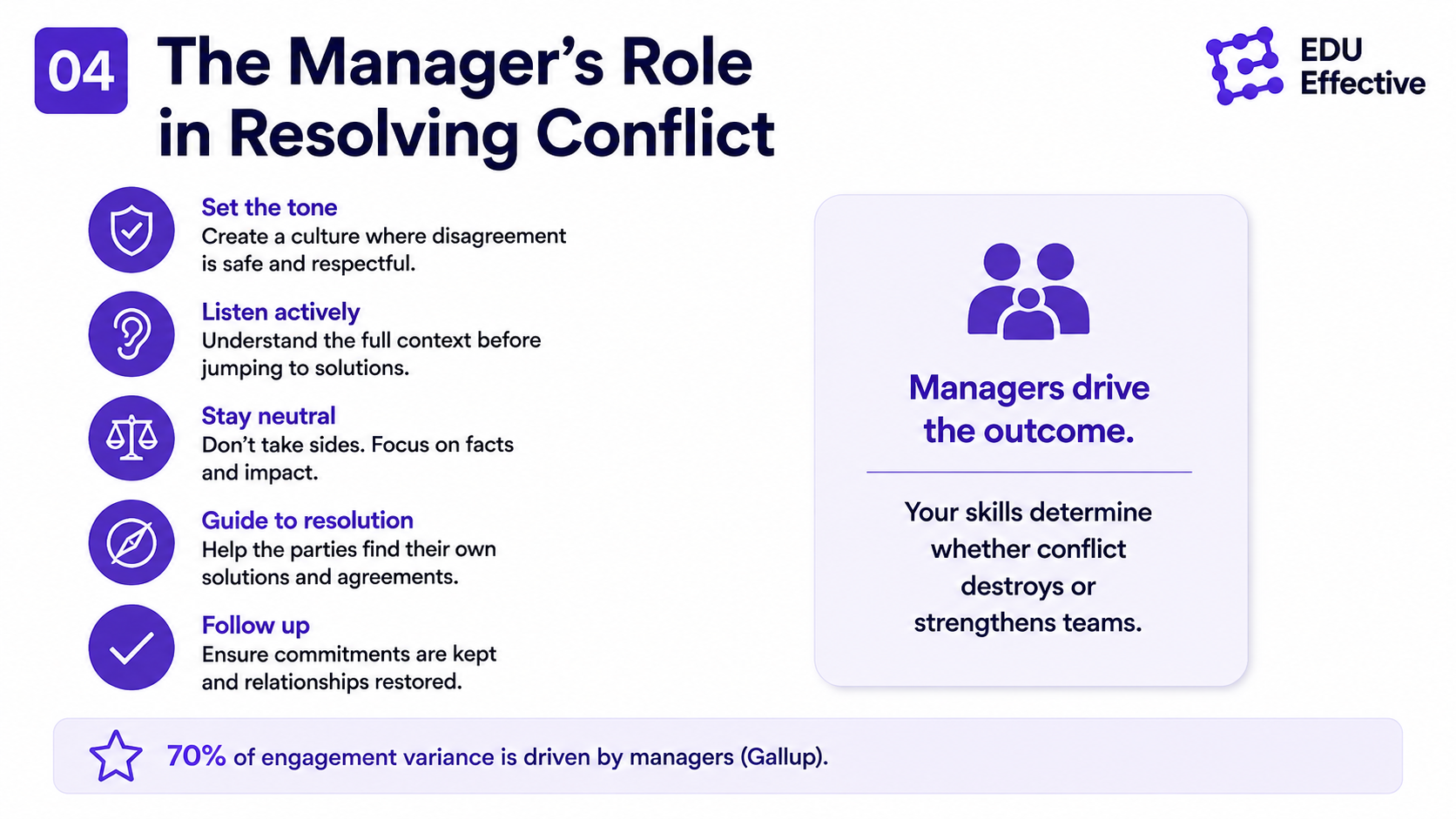
The number is striking. What is more striking is the management capability gap behind it. DDI's research found that 49% of managers fail to demonstrate effective conflict resolution skills — nearly half of the people most directly responsible for resolving disputes in organisations do not have the skills to do it well. And Gallup's State of the American Manager report found that managers account for at least 70% of the variance in employee engagement across business units. Poorly handled conflict is one of the fastest ways to erode that engagement.
This is not primarily a personality problem. Most managers who handle conflict badly are not callous or indifferent — they are untrained. 4 in 10 workers report that they have never received any training on how to handle workplace conflict, according to survey data. The skill gap is structural, and it is addressable.
Why conflict is inevitable — and why that is not the problem
The instinct to treat workplace conflict as a sign that something has gone wrong is understandable but counterproductive. In any environment where people with different perspectives, priorities, and working styles are trying to achieve shared objectives, disagreement is not an anomaly. It is an inherent feature of collaborative work.
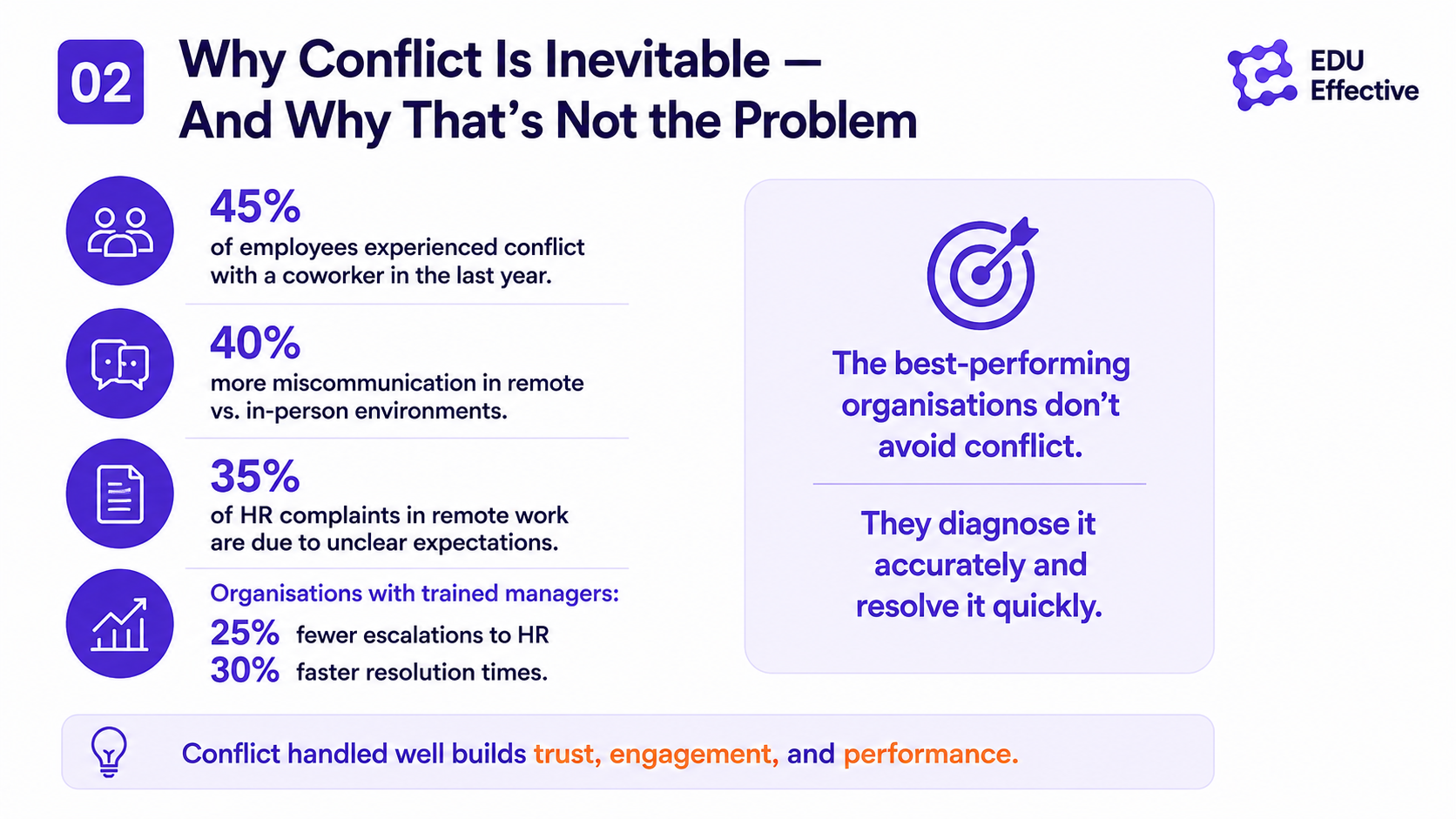
The Gallup data supports this: 45% of employees reported experiencing conflict with a coworker in the last year. In hybrid and remote environments, that figure is compounded by communication channels that strip away tone, context, and the informal social signals that prevent misunderstandings from escalating. Remote miscommunication spikes by approximately 40% compared to in-person settings, according to current research — and unclear expectations account for approximately 35% of HR complaints in remote work contexts.
The organisations that perform best on conflict-related metrics are not those with the least conflict. They are those where conflict is diagnosed accurately and resolved quickly — before it consumes management time, erodes trust, and drives turnover. McKinsey's research found that organisations that train managers in conflict management see 25% fewer escalations to HR and 30% faster resolution times. The investment in manager conflict capability pays back directly in reduced management overhead and improved team performance.
The starting point for building that capability is understanding what types of conflict are actually occurring — because the resolution approach that works for one type consistently fails when applied to another.
The three types of workplace conflict — and why misdiagnosis is the most common failure
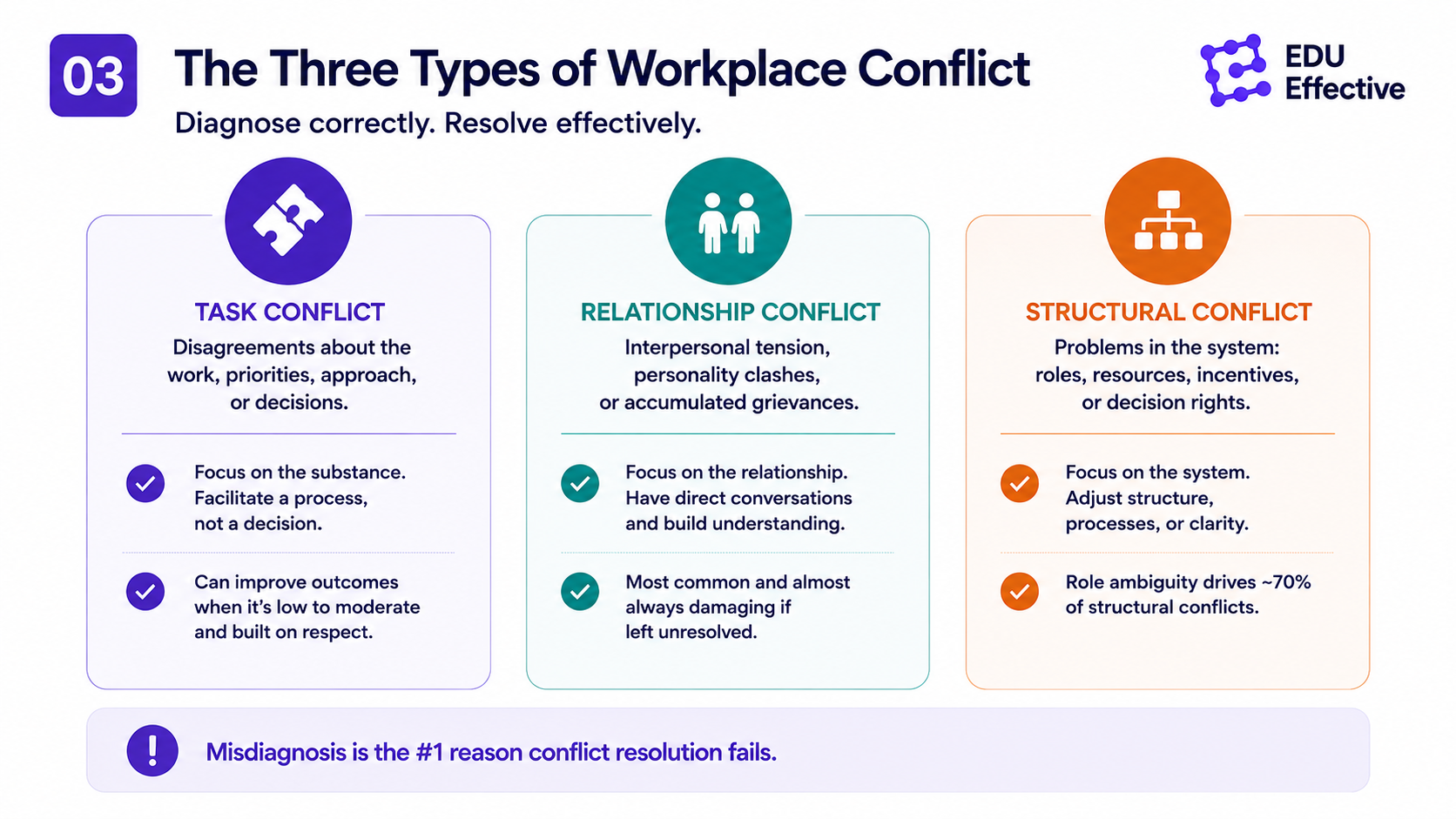
Harvard Business Review research identifies misdiagnosing conflict type as the number one reason resolution efforts fail. Managers frequently apply interpersonal solutions to structural problems, or structural fixes to interpersonal ones — wasting time and occasionally making things worse.
Task conflict arises from disagreements about the work itself — how a project should be approached, which priorities should take precedence, how resources should be allocated, what the right decision is. Task conflict, when it occurs in an environment of mutual respect and psychological safety, can improve decision quality by surfacing perspectives and information that individual thinking would miss. The research on task conflict is nuanced: low-to-moderate task conflict in cognitively demanding work tends to improve outcomes; high task conflict or task conflict in an environment of low trust tends to damage them.
The resolution approach for task conflict focuses on the substance — what does the evidence actually say, what are the criteria for a good decision, how do we structure a process that incorporates relevant perspectives and reaches a clear outcome? The manager's role is to facilitate that process, not to arbitrate it.
Relationship conflict arises from interpersonal tension — personality clashes, communication style mismatches, accumulated grievances, or perceived disrespect. It is almost always damaging to performance and team cohesion, and it does not resolve itself. A Workplace Peace Institute survey found that 73% of professionals identify lack of trust as a major factor in workplace conflicts, with personality conflicts cited by 72% — making relationship conflict the most frequently experienced category.
Applying a task-level solution to a relationship conflict — restructuring a process, clarifying a role, adding a new reporting line — typically fails because it addresses a surface symptom without touching the underlying interpersonal dynamic. Relationship conflict requires direct conversation between the parties involved, usually facilitated by the manager, focused on mutual understanding and specific behavioural commitments rather than general good intentions.
Structural conflict arises from the organisation itself — role ambiguity, overlapping responsibilities, misaligned incentive structures, resource scarcity, or unclear decision rights. Role ambiguity accounts for approximately 70% of structural conflict citations in research. Two team members who are both convinced they are responsible for the same decision, or who are measured on metrics that put them in competition with each other, will generate recurring conflict regardless of how skilled they are as individuals and how well they personally get along.
The resolution approach for structural conflict is redesign, not mediation. If two roles overlap in ways that generate predictable conflict, clarifying the boundaries is the fix — not repeatedly convening conversations between the individuals in those roles. Managers who identify this pattern save significant time by escalating to an organisational design solution rather than treating recurring instances as individual interpersonal failures.
The Thomas-Kilmann model: understanding your default conflict response
Before examining specific resolution strategies, it is useful to understand your own default pattern for handling conflict — because most people have one, and most defaults are not equally effective across all situations.
The Thomas-Kilmann Conflict Mode Instrument (TKI) was developed by organisational psychologists Kenneth Thomas and Ralph Kilmann in 1974, based on their study of how managers and employees actually respond to disagreement in practice. It remains the most widely used conflict assessment framework in organisational settings, with applications in Fortune 500 companies, government agencies, and professional development programmes worldwide. The model maps conflict responses along two dimensions and produces five distinct response modes.
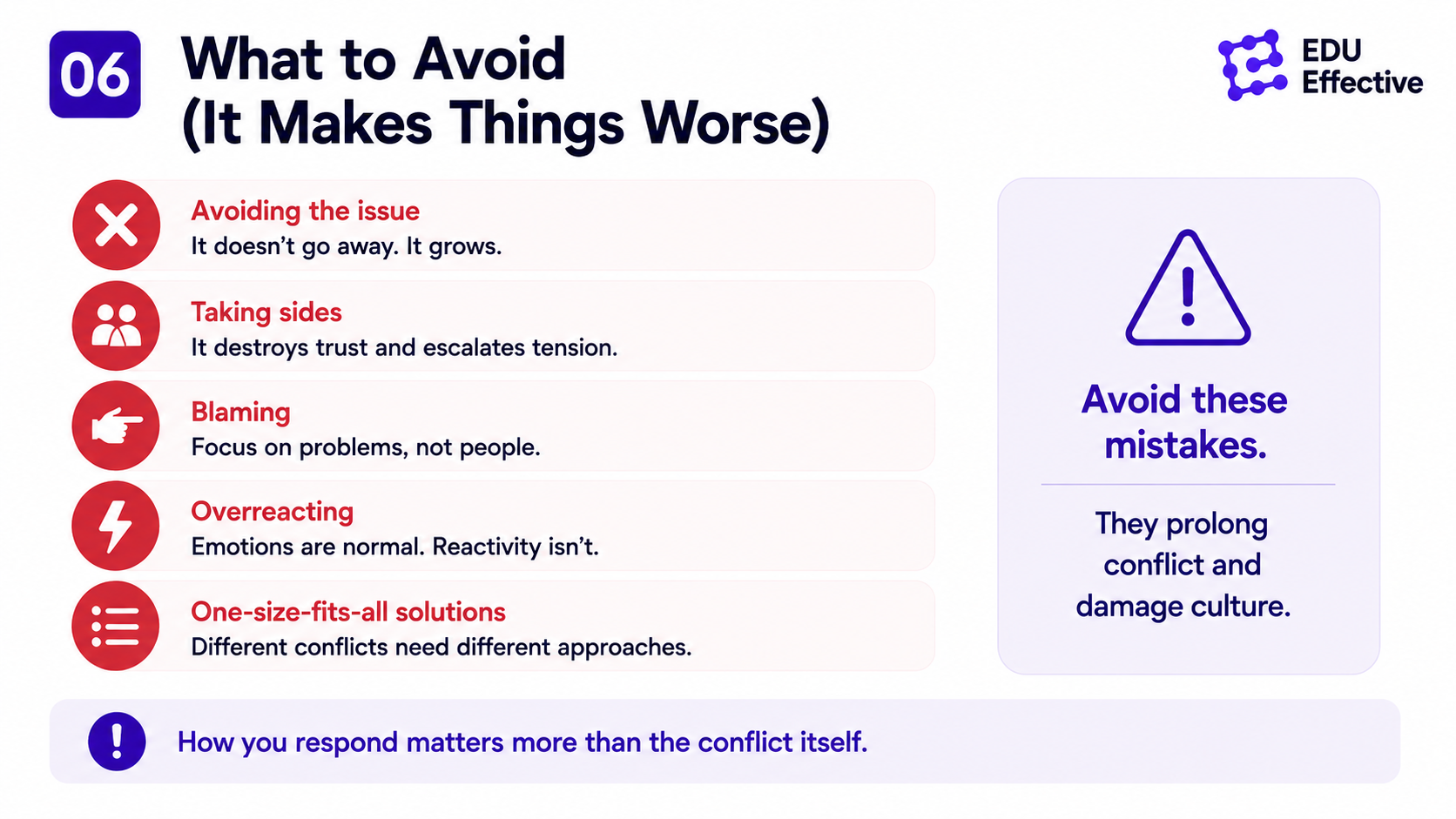
Avoiding — low assertiveness, low cooperation — means withdrawing from the conflict or postponing engagement. It is appropriate when the issue is genuinely minor, when emotions need time to settle before productive conversation is possible, or when you need more information before engaging. It is inappropriate as a default response to significant conflicts, where avoidance allows small issues to become entrenched ones. Research suggests avoidance risks 10–20% productivity losses when applied to conflicts that require resolution.
Accommodating — low assertiveness, high cooperation — means yielding to the other party's position. It is appropriate when you recognise you are wrong, when the issue matters much more to the other person than to you, or when preserving the relationship is more important than the outcome on this particular issue. As a default, it erodes your credibility and fails to resolve the underlying issue.
Competing — high assertiveness, low cooperation — means pursuing your own position regardless of the other party's concerns. It is appropriate in genuine emergencies, when unpopular decisions need to be made and implemented, or when protecting yourself against someone who is exploiting a more cooperative approach. As a default, it damages trust and creates adversarial dynamics that inhibit the honest communication teams need to function well.
Compromising — moderate assertiveness, moderate cooperation — means finding a middle ground that partially satisfies both parties. It is efficient when time is short and a "good enough" solution is acceptable, when both parties are equally powerful and committed to mutually exclusive goals, or as a temporary measure while a more thorough solution is developed. It typically leaves both parties partially dissatisfied and does not explore whether an integrative solution might satisfy both more fully.
Collaborating — high assertiveness, high cooperation — means working with the other party to find a solution that fully addresses both parties' underlying concerns. It is the most time-intensive mode and is most appropriate for important conflicts where both parties' concerns genuinely matter, where the relationship is worth investing in, and where there is time to work through the issue thoroughly. Research consistently identifies collaboration as the approach that produces the most durable resolutions and the strongest relationship outcomes in workplace settings.
Understanding your default mode — and knowing when to move off it deliberately — is the practical starting point for conflict resolution competence. Most managers over-rely on either avoidance or accommodation, both of which feel less confrontational in the short term and both of which allow conflicts to become more expensive over time.
A practical resolution process for managers
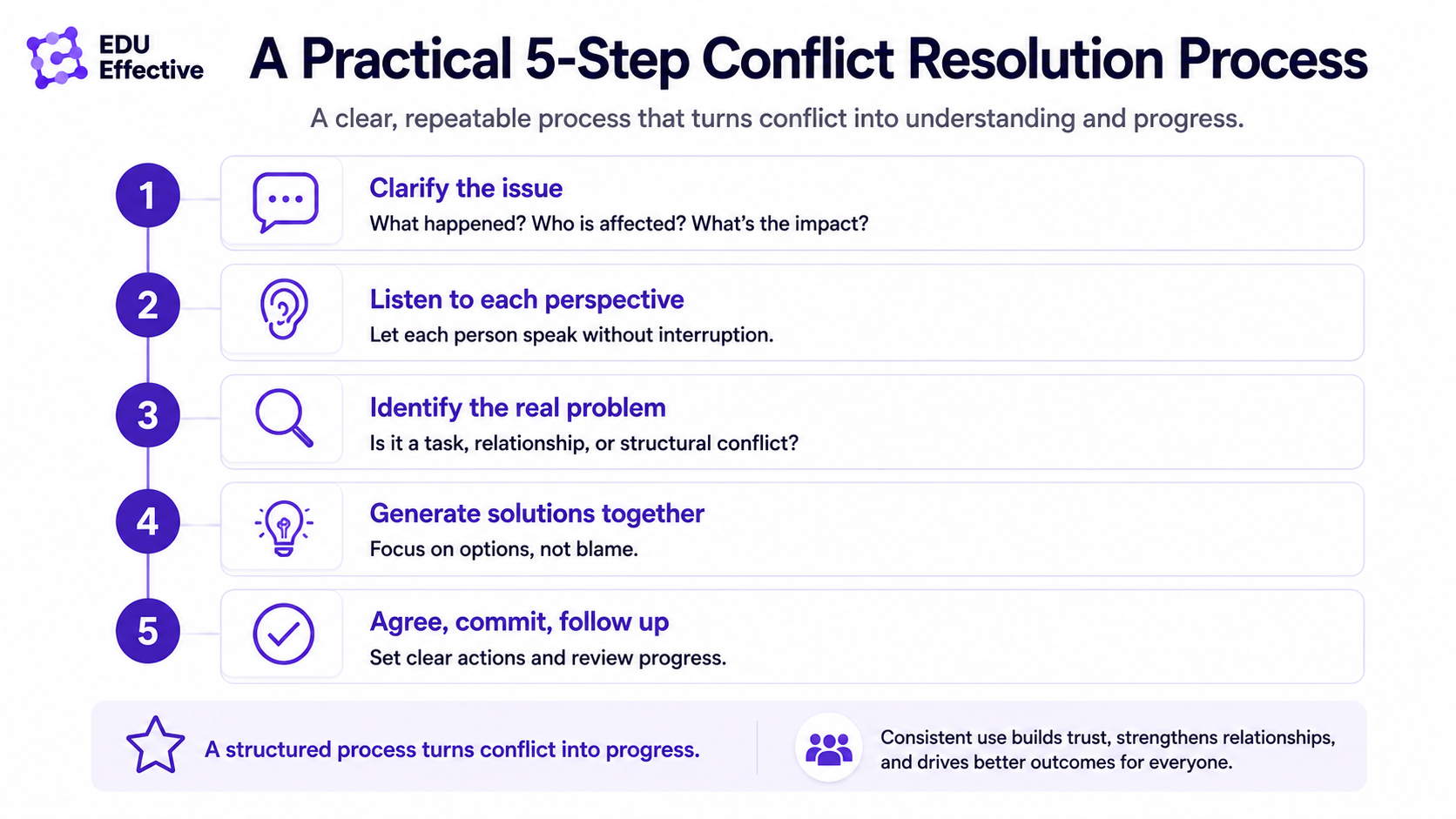
When conflict requires active intervention — which is most conflicts involving relationship or significant task dimensions — the following sequence produces the most consistent results.
Diagnose before intervening. Understand the type of conflict (task, relationship, or structural) and the specific underlying interests of each party before attempting resolution. The most common resolution failure is applying a generic approach before understanding what is actually in dispute. Separate what people say they want from what they actually need — these are frequently different.
Create the conditions for honest conversation. Effective conflict resolution requires psychological safety — the belief that raising concerns, admitting mistakes, and challenging positions will not result in punishment or humiliation. Managers who have built psychological safety in their teams find that conflicts surface earlier, escalate less frequently, and resolve more easily. Managers who have not find that conflicts go underground, emerge later in more damaging forms, and are harder to resolve because trust has already eroded.
Address the conflict directly and specifically. Vague interventions produce vague outcomes. The DESC framework — Describe the situation objectively, Express its impact, Specify what needs to change, state Consequences — provides structure for direct conversations that are clear without being aggressive. Describe what is happening in observable, non-judgmental terms. Explain the impact on the team or work. State specifically what needs to be different. Confirm what follows if the change does or does not happen.
Focus on interests, not positions. Most conflicts at the surface level involve two parties stating incompatible positions — "I need this resource," "I need this resource." The underlying interests that explain those positions are frequently more compatible than the stated positions suggest. A manager who asks "why does this matter to you?" rather than accepting stated positions at face value often discovers that an integrative solution is possible — one that addresses what each party actually needs rather than splitting the distance between what they said they wanted.
Close with specific commitments. Conflict conversations that end with general goodwill but no specific commitments tend to recur. Close every resolution with concrete, agreed actions: who will do what differently, by when, and how you will know the situation has changed. Follow up on those commitments.
Conflict, psychological safety, and performance
The research connection between conflict resolution capability and team performance runs through psychological safety. Google's Project Aristotle — the most comprehensive study of what makes teams perform — found that psychological safety was the single strongest predictor of team effectiveness, above talent composition, leadership quality, and every other variable studied.
Teams where conflict is handled well — where people can raise concerns without fear of retaliation, disagree with the manager without career consequences, and surface problems before they become crises — consistently outperform those where conflict is suppressed. Conflict competence at the manager level is one of the primary mechanisms through which psychological safety is built or destroyed.
The reverse is equally true. Unresolved conflicts do not stay contained. They leak into the team's energy, attention, and willingness to collaborate — consuming the discretionary effort that is the difference between a team that meets its objectives and one that exceeds them. The $359 billion annual figure — derived from the CPP Global Human Capital Report and independently validated against SHRM workforce cost data — is not an abstraction. It is the accumulated cost of avoided conversations, escalated disputes, and the turnover that follows when people conclude that their workplace cannot handle honest disagreement.
Conflict resolution in hybrid and remote environments
Hybrid and remote work has changed the texture of workplace conflict without changing its underlying dynamics. The most significant difference is channel: most conflict in distributed teams surfaces through written communication — Slack messages, email, document comments — where tone is ambiguous, context is absent, and the informal relationship signals that prevent misunderstandings from escalating are stripped away.
The practical implication for managers is clear: move conflict from text to voice or video as quickly as possible. The resolution that would take thirty minutes in a direct conversation can generate three days of escalating written exchanges. Establishing the norm that sensitive or tense topics are addressed in real-time conversation rather than asynchronous text is itself a conflict prevention measure.
Regular one-to-one time between managers and direct reports is the other primary prevention mechanism in distributed teams. Conflicts that surface in weekly one-to-ones when they are small are categorically easier to resolve than conflicts that have been building for weeks and surface only when they have reached HR-level severity.
Ready to develop your conflict resolution capability professionally?
At EDU Effective, our MBA programmes develop the conflict resolution, communication, and management skills that make managers more effective at every stage — from prevention through resolution.
All best-selling Effective MBA programs are built on the same educational model — designed for working adults who need learning that fits real professional life:
- Effective MBA: Executive Management & Leadership
- Effective MBA: Applied Artificial Intelligence
- Effective MBA: Coaching, Leadership & Mentoring
- Effective MBA: Mastery in AI
- Effective MBA: Online Marketing
At EDU Effective, we build programs for professionals who want to work smarter — not just harder. Explore our programs →
EDU Effective Business School = professional development for your long-term success.
All best-selling Effective MBA programs are built for working adults: 15 minutes a day, 10 months or less, ASIC accredited, from €990.
These are professional programs, not academic ones — built for working adults to apply what they learn directly in their own business, not to collect a scholarly credential.
Join more than 9,000 students in over 120 countries around the world to further your personal development and career success.
Read the feedback and experiences of our students and the stories of our graduates here.
Apply now — from €990 · Talk to a Study Advisor
Study with NO risk: 14-day money-back guarantee, no questions asked.
Sources
- DDI — Global Leadership Forecast 2025: Manager Conflict Resolution Skills https://www.ddiworld.com/research/global-leadership-forecast
- Gallup — State of the American Manager: Analytics and Advice for Leaders https://www.gallup.com/services/182138/state-american-manager.aspx
- Gallup — State of the Global Workplace 2026 https://www.gallup.com/workplace/349484/state-of-the-global-workplace.aspx
- McKinsey & Company — The State of Organizations 2026: Aiming higher with a new performance edge https://www.mckinsey.com/capabilities/people-and-organizational-performance/our-insights/webinars-and-podcasts/aiming-higher-with-a-new-performance-edge
- Google re:Work — Project Aristotle: The Five Keys to a Successful Google Team https://rework.withgoogle.com/intl/en/guides/understand-team-effectiveness
- Forbes — Conflict Resolution For Leaders: How To “Fight Right” https://www.forbes.com/sites/forbesbooksauthors/2026/06/30/conflict-resolution-for-leaders-how-to-fight-right