
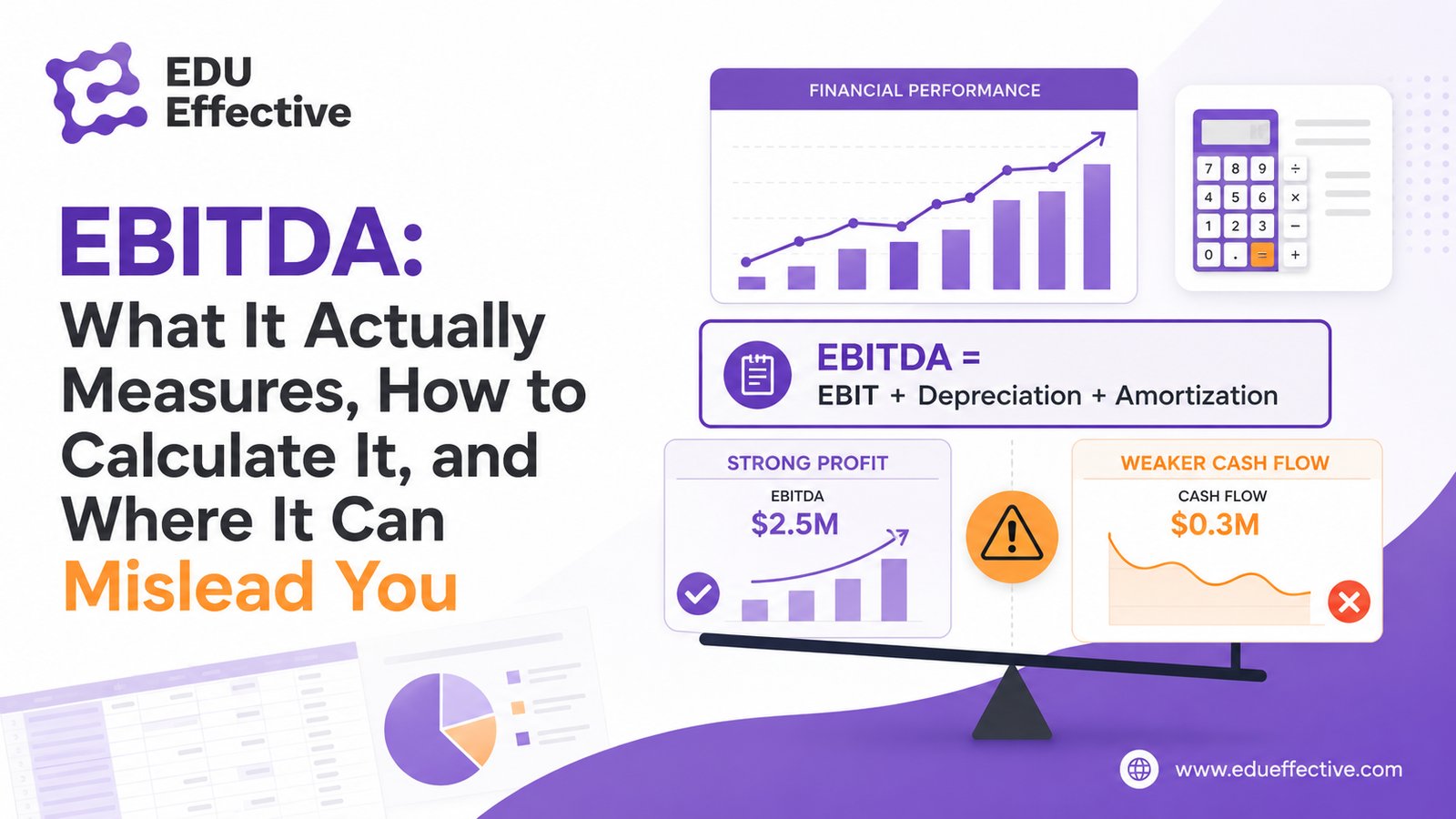

Walk into any conversation about buying, selling, or valuing a business, and EBITDA will come up within the first five minutes. It's used by private equity investors to screen acquisition targets, by banks to assess lending risk, and by CEOs to communicate profitability to their boards. And yet most people who use the term regularly couldn't explain precisely what it strips out — or why that matters.
What EBITDA Actually Is
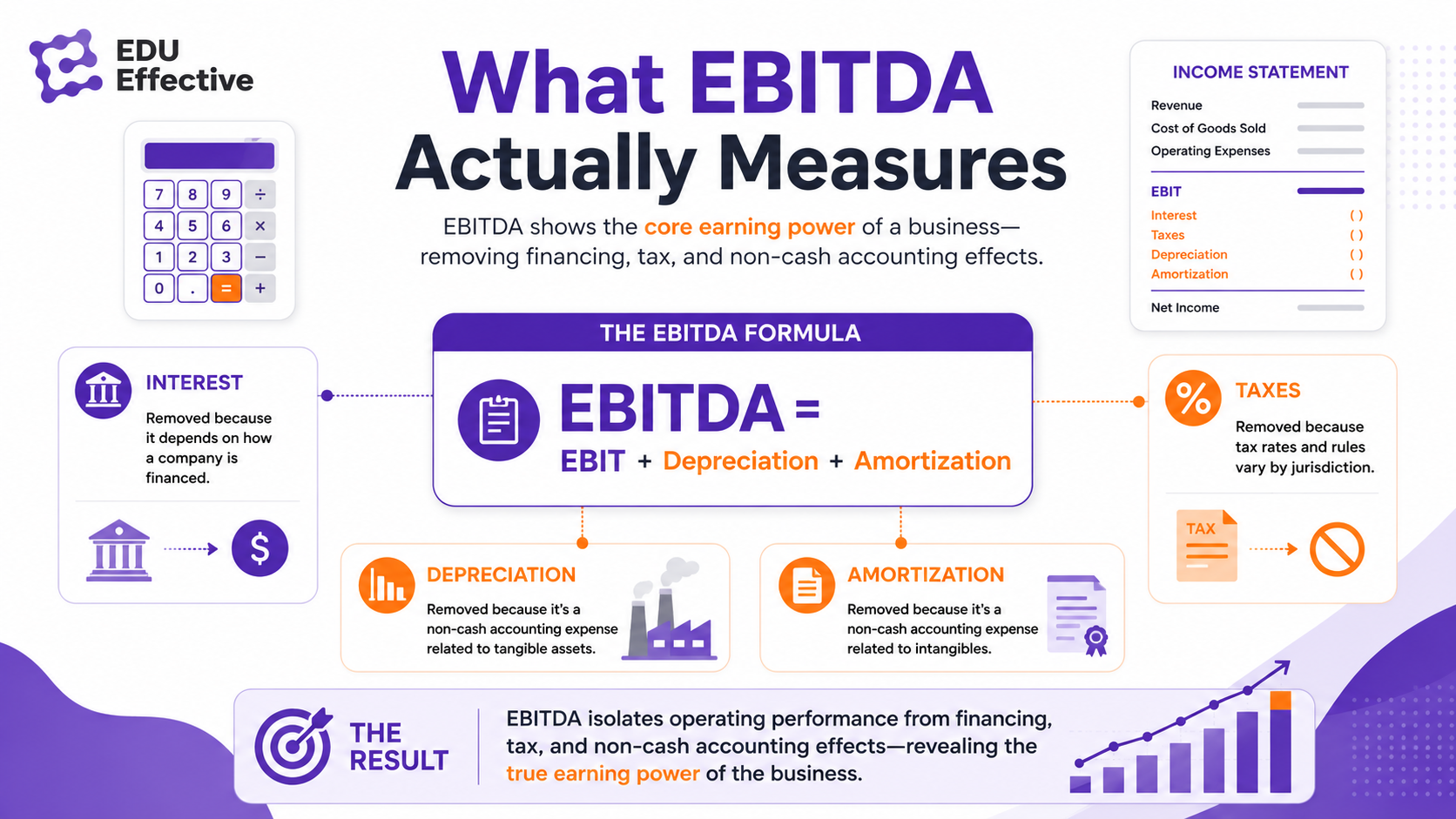
EBITDA stands for Earnings Before Interest, Taxes, Depreciation, and Amortization. The name tells you exactly what it does: it takes a company's operating profit and adds back four categories of expenses to arrive at a figure that represents the raw earning power of the core business.
Here's what each element removes from the picture:
Interest payments depend on how a company is financed — how much debt it carries and at what rate. Two identical businesses with different capital structures will show different net profits, but the same EBITDA. Stripping out interest makes the underlying operations comparable.
Taxes vary by jurisdiction, corporate structure, and tax strategy. They're real costs, but they don't reflect operational performance. EBITDA removes them so you can compare a US company with a German one without the distortion of differing tax codes.
Depreciation and Amortization are non-cash accounting charges that spread the cost of physical assets (depreciation) and intangible assets like patents or acquired software (amortization) over time. A business that invested heavily in machinery five years ago will show higher depreciation today — even if those machines are fully paid off. Adding D&A back reveals how much cash the business is actually generating right now.
The formula itself is straightforward: EBITDA = EBIT + Depreciation + Amortization, where EBIT is earnings before interest and taxes — a figure you'll find directly on most income statements.
Why Investors Use It — and How It Drives Valuation
The practical power of EBITDA isn't in the number itself. It's in the multiple.
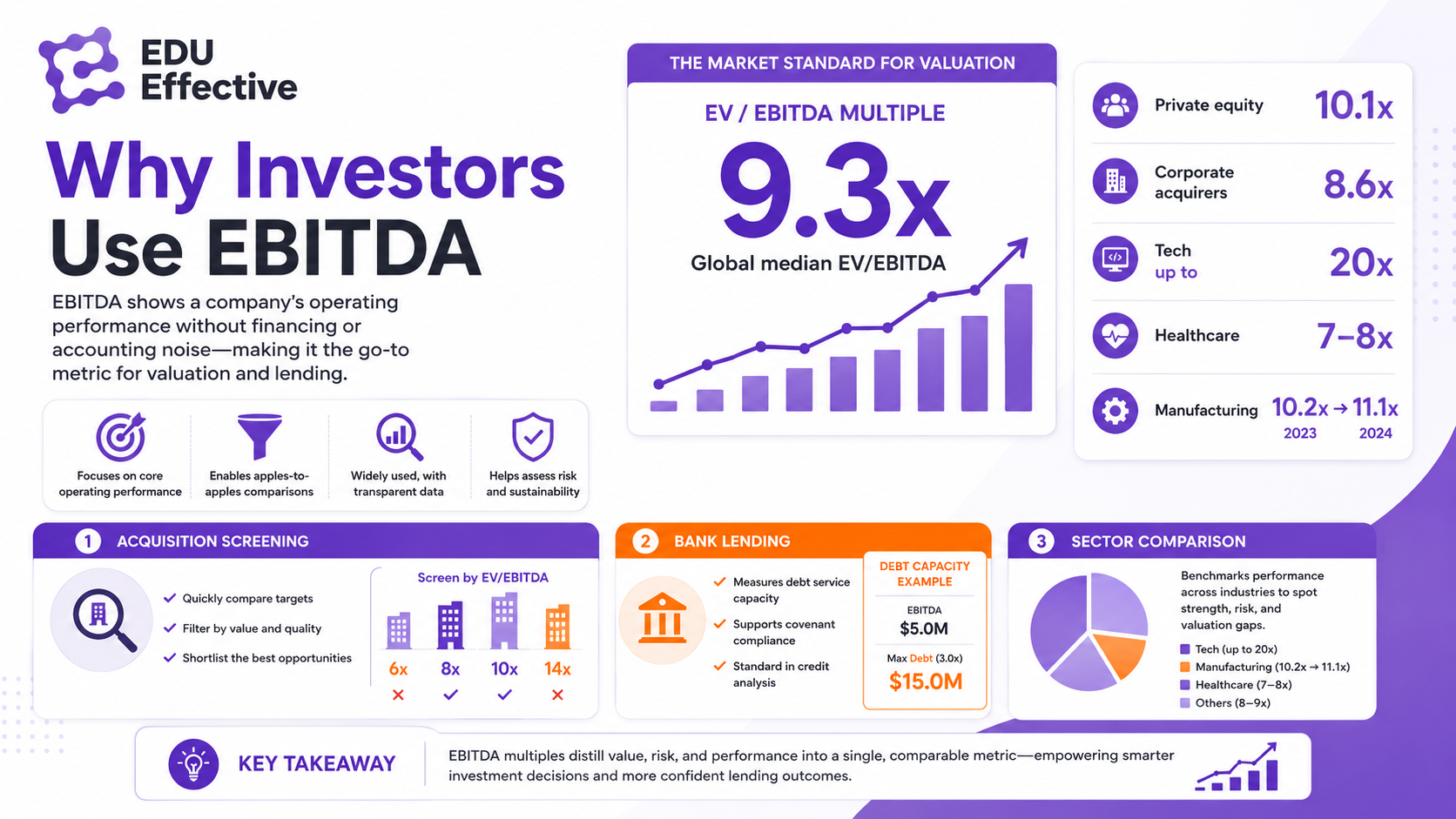
When a private equity firm or strategic acquirer values a company, they typically express that value as a multiple of EBITDA — written as EV/EBITDA, where EV is enterprise value. This multiple varies considerably by sector, deal size, and market conditions, but as of mid-2025, global median EV/EBITDA across all M&A transactions stands at approximately 9.3x. Private equity buyers tend to pay higher multiples than corporate acquirers — around 10.1x versus 8.6x — reflecting the premium they place on financial engineering and exit optionality.
Sector differences are substantial. The information and technology sector has commanded multiples as high as 20x, driven by recurring revenue models and high growth expectations. Healthcare businesses have traded around 7–8x. Manufacturing has shown resilience, with multiples climbing from 10.2x to 11.1x between early 2024 and mid-2025 as investor confidence returned. Food and beverage typically sits at the lower end of the range.
Banks also rely on EBITDA when assessing lending capacity. The debt service coverage ratio — a key metric in any loan application — is derived from EBITDA. A weak EBITDA doesn't just signal operational trouble; it directly reduces your ability to access credit.
How to Read the Result
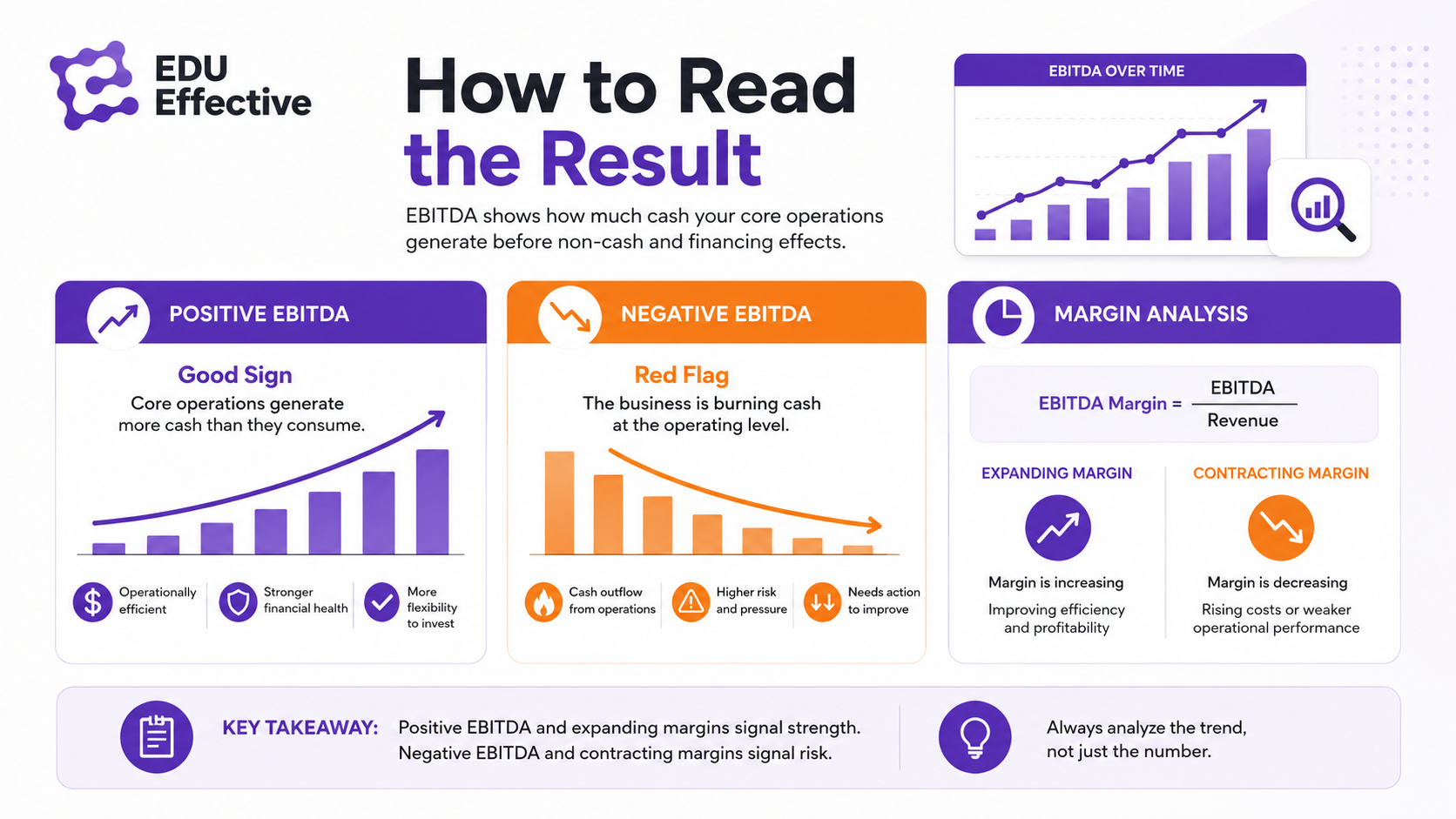
A positive EBITDA indicates that the core operations of the business are generating more cash than they consume — a necessary (though not sufficient) condition for long-term viability. A negative EBITDA means the business is burning through cash at the operational level, before any consideration of debt or tax obligations.
The comparison across periods and across competitors is where EBITDA earns its keep. If your EBITDA margin (EBITDA divided by revenue, expressed as a percentage) is expanding while a competitor's is contracting, that's a meaningful signal about operational trajectory — regardless of how each company has structured its financing.
Where EBITDA Misleads — and This Matters
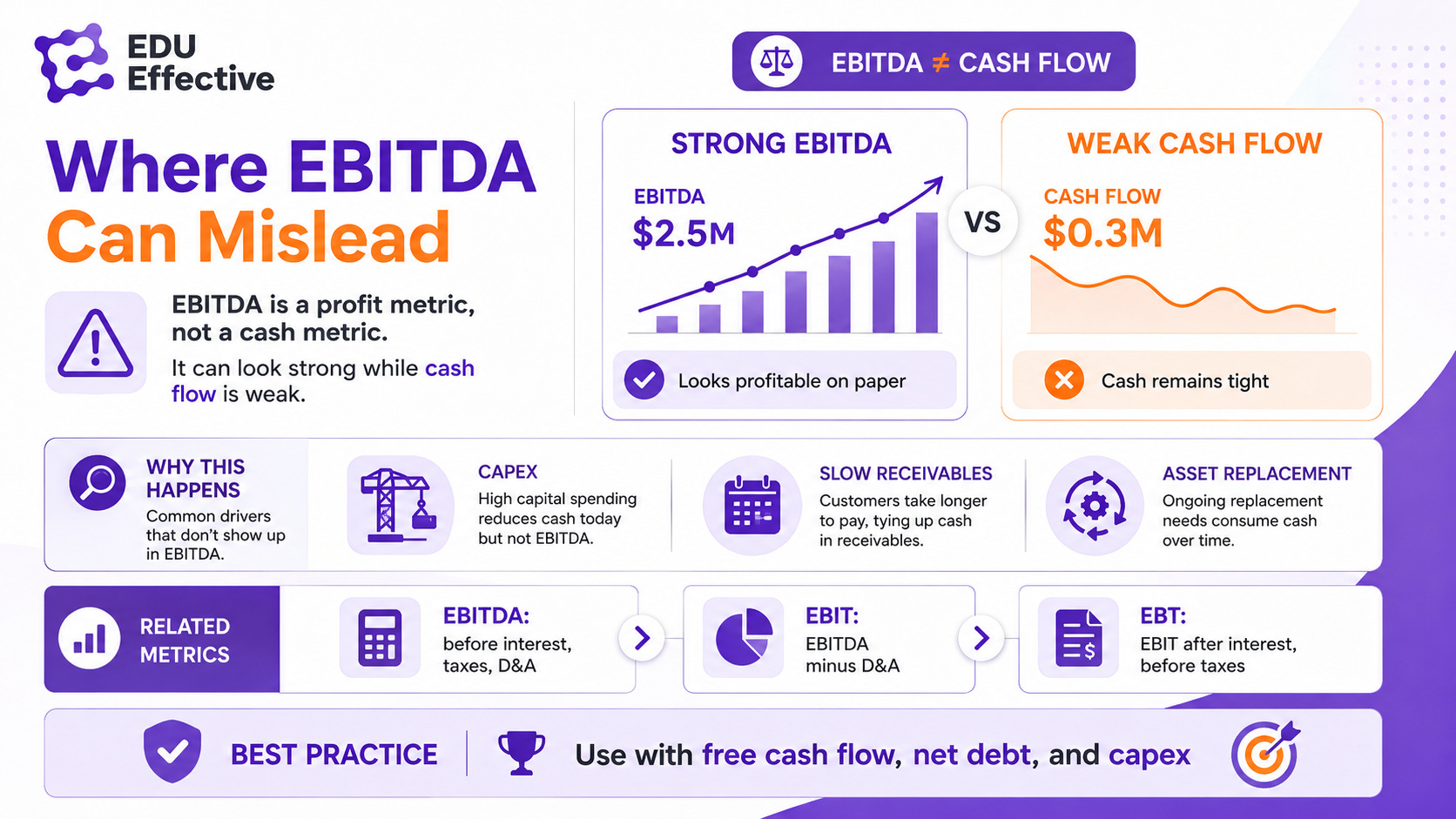
EBITDA is a useful approximation of operating cash flow. It is not cash flow. That distinction matters more than most financial presentations acknowledge.
A company that is investing heavily in capital equipment will show strong EBITDA while simultaneously consuming enormous amounts of cash. A business with high receivables — customers who pay slowly — can report excellent EBITDA while struggling to meet payroll. Depreciation and amortization were added back precisely because they're non-cash, but the assets they represent eventually need replacing. That replacement spending is real, and EBITDA doesn't account for it.
This is why Warren Buffett has famously criticised over-reliance on EBITDA, pointing out that depreciation is very much a real economic cost — the gradual using-up of something valuable. In capital-intensive industries, treating D&A as noise rather than signal is a meaningful analytical error.
The practical implication: use EBITDA as a starting point for comparison and screening, not as a final verdict on financial health. Pair it with free cash flow, net debt levels, and capital expenditure requirements for a complete picture.
EBIT and EBT — the Related Metrics Worth Knowing
EBIT (Earnings Before Interest and Taxes) is simply EBITDA minus depreciation and amortization. It's closer to accounting profit and is used when comparing companies where asset age and investment patterns are relevant rather than something to be stripped out.
EBT (Earnings Before Taxes) goes one step further and includes interest expenses, making it useful for assessing a company's performance after accounting for its specific financing structure — before the tax authority takes its share.
All three exist because no single metric captures every dimension of financial performance. The right choice depends on what question you're trying to answer.
Build the Financial Fluency to Read a Business — Not Just Run One
Finance isn't only for CFOs. Managers, founders, and executives who understand how numbers like EBITDA, EV/EBITDA, and free cash flow connect to business decisions are simply more effective. The Effective MBA: Executive Management & Leadership at EDU Effective covers financial literacy for business leaders — alongside strategy, operations, and decision-making — through microlearning built for working adults.
All best-selling Effective MBA programs run on the same model: 15 minutes a day, 10 months or less, ASIC accredited, from €990. These are professional programs, not academic ones — built for working adults to apply what they learn directly in their own business, not to collect a scholarly credential.
- Effective MBA: Executive Management & Leadership
- Effective MBA: Applied Artificial Intelligence
- Effective MBA: Coaching, Leadership & Mentoring
- Effective MBA: Mastery in AI
- Effective MBA: Online Marketing
Read student reviews and graduate stories here.
Start No Risk · Talk to an Advisor
14-day money-back guarantee, no questions asked.
Questions about studying at EDU Effective? Reach out, or check the FAQ section for more.
Sources
- QuantPillar — 2025–2026 Private Market Valuation Multiples: quantpillar.com
- Equidam — EBITDA Multiples by Industry in 2026: equidam.com
- First Page Sage — EBITDA Multiples by Industry & Company Size: 2025 Report: firstpagesage.com
- CLFI — M&A EV/EBITDA Multiples 2025: PE vs Corporate by Sector: clfi.co.uk
- KM&Co — Private Company M&A Trending Multiples through Q1 2025: kmco.com
- ClearlyAcquired — EBITDA Multiples by Industry: Asset-Heavy Businesses: clearlyacquired.com