

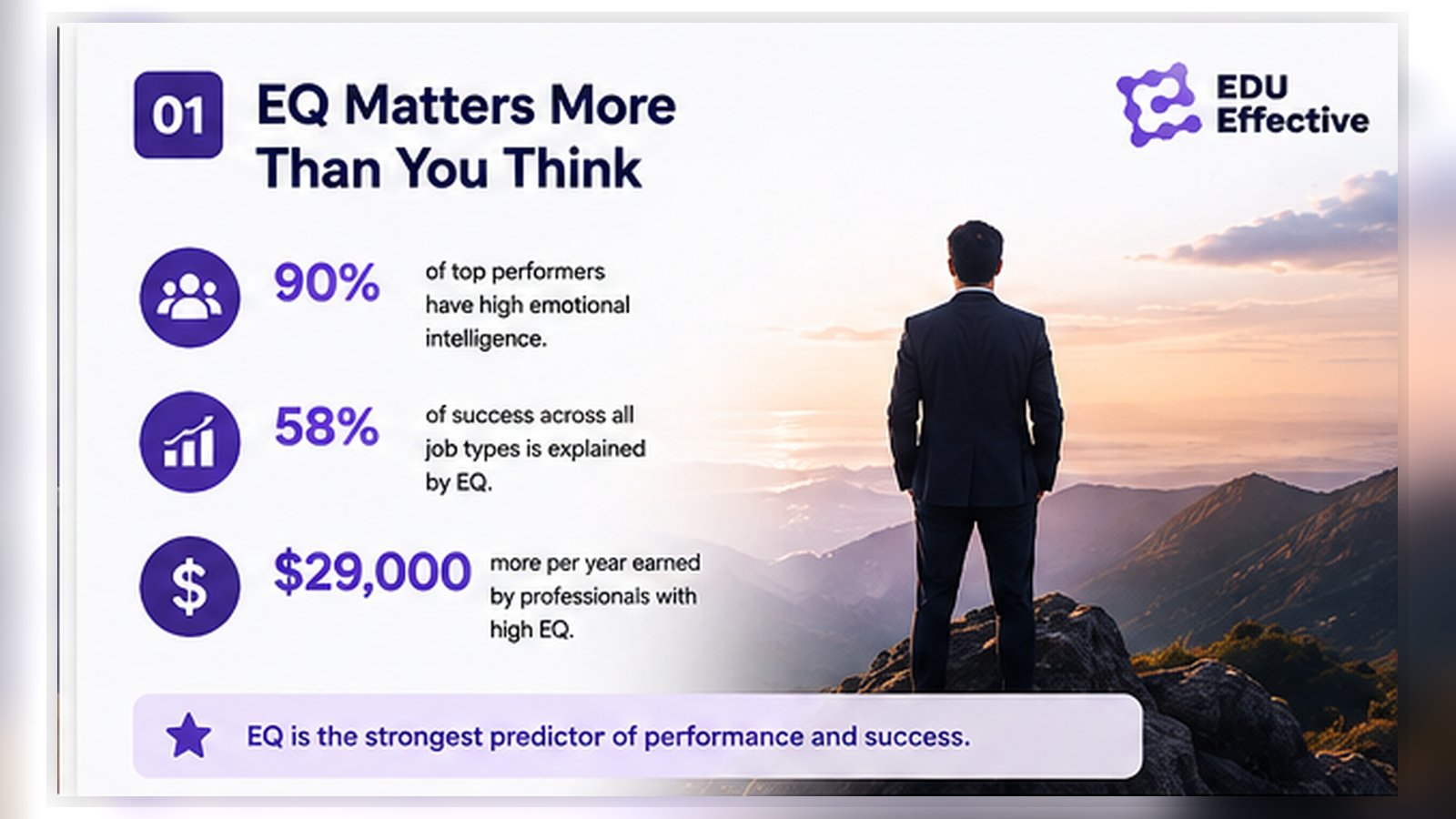
90% of top performers have high emotional intelligence. That figure comes from TalentSmart's analysis of over 500,000 workplace assessments and suggests that EQ, not IQ, is a primary differentiator between good and outstanding professional performance.
Most professionals are selected, hired, and promoted primarily on the basis of technical competence, academic credentials, and cognitive ability. Yet the evidence for emotional intelligence has been accumulating for thirty years. In 2026, as AI rapidly absorbs technical and analytical tasks, the argument for emotional intelligence as a professional advantage has become significantly harder to dismiss.
What emotional intelligence actually is, and what it is not
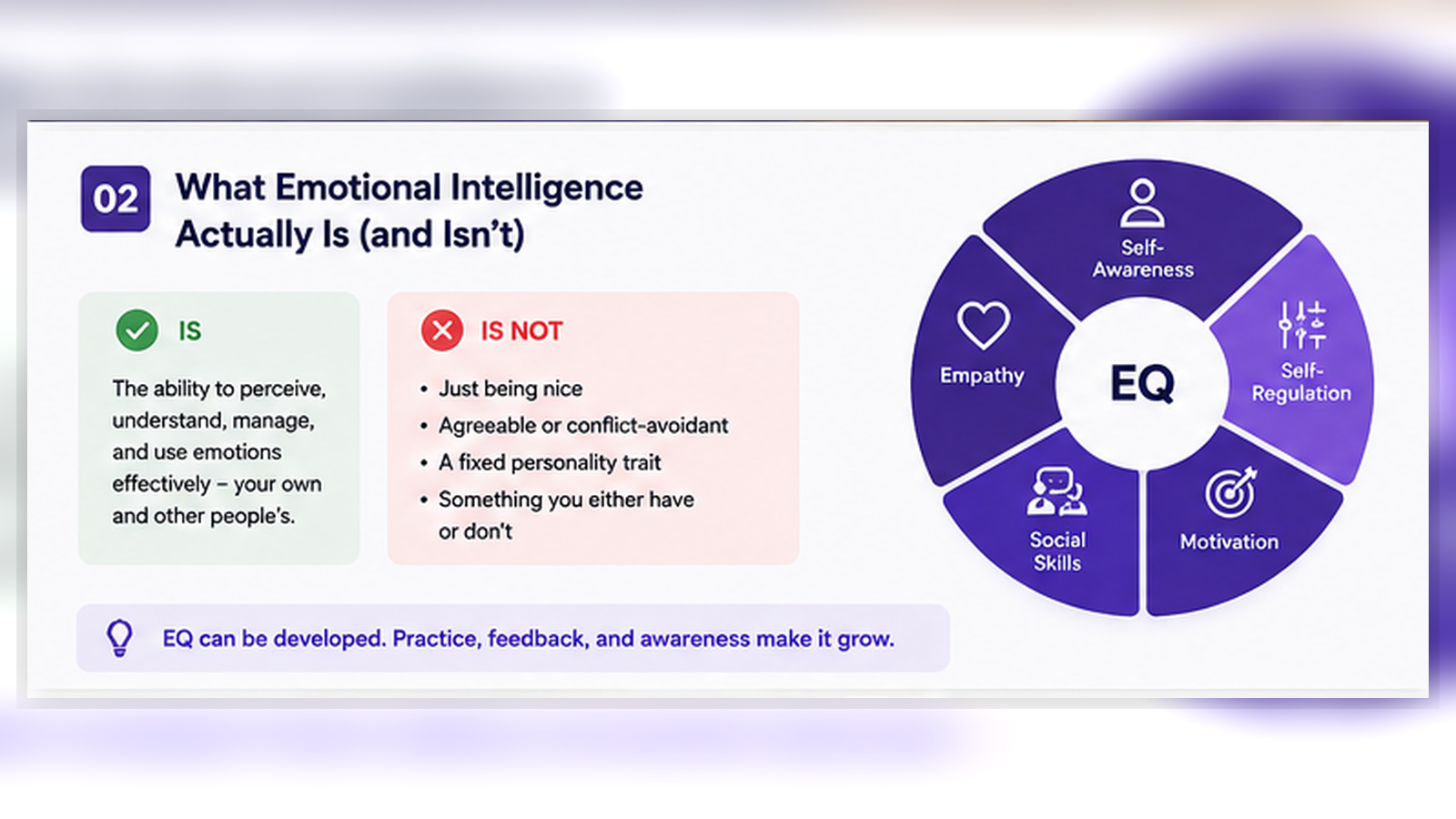
Emotional intelligence is the ability to perceive, understand, manage, and use emotions, your own and other people's, effectively in the context of relationships and decisions.
EQ does not mean being nice, agreeable, or conflict-averse. A leader who avoids difficult conversations to preserve harmony is not demonstrating high emotional intelligence. High-EQ leaders give hard feedback, make unpopular decisions, and hold people accountable with more skill and less collateral damage, not by avoiding the work.
EQ is also not a fixed personality trait. The research is clear: emotional intelligence is a developable skill. Unlike IQ, which is largely stable across adulthood, EQ can be measurably improved through deliberate practice, structured feedback, and specific development methods.
Daniel Goleman defined emotional intelligence through five components: self-awareness, self-regulation, motivation, empathy, and social skills. The Mayer-Salovey-Caruso framework describes four branches: perceiving emotions accurately, using emotions to facilitate thought, understanding how emotions develop and change, and managing emotions in oneself and others. What matters most is developing the capabilities these models describe.
The business case: what emotional intelligence actually predicts
The data on EQ's relationship to professional performance is more consistent than almost any other people-management research area. Emotional intelligence explains 58% of success across all job types in TalentSmart's dataset of 500,000+ assessments. 90% of top performers score high on EQ, compared with only 20% of low performers.
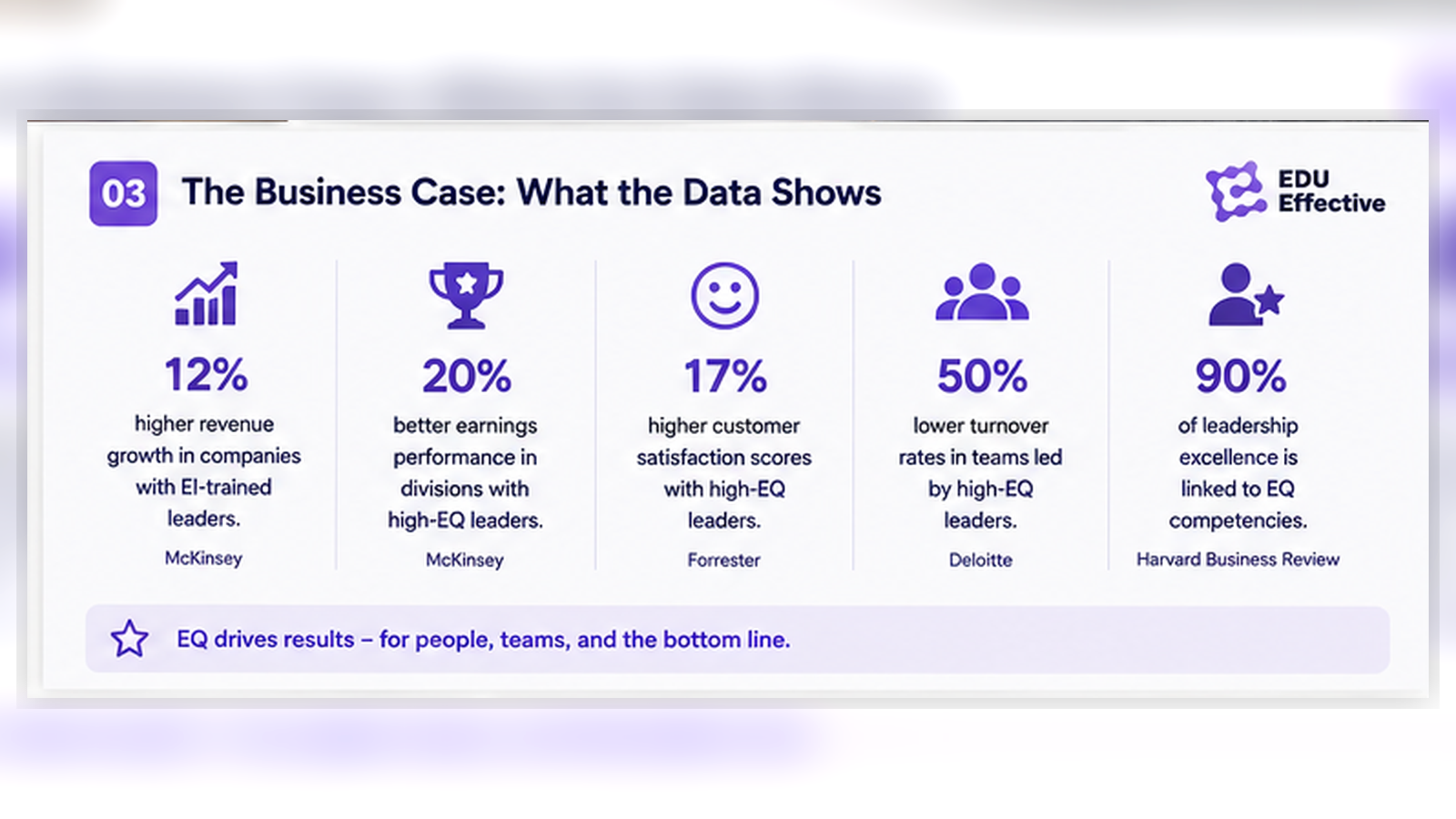
The salary implication is direct: professionals with high emotional intelligence earn an average of $29,000 more per year than those with low EQ, controlling for other variables. McKinsey's analysis of 1,000 firms found that companies with EI-trained leaders see 12% annual revenue growth compared to those without. High-EQ leaders also achieve 17% higher customer satisfaction scores, and their teams report 50% lower turnover rates.
For senior leadership, nearly 90% of competencies that distinguish star performers from average performers are EQ-related rather than cognitive ability-related. A meta-analysis of 200 studies found that high EQ predicts 58% of variance in leadership effectiveness.
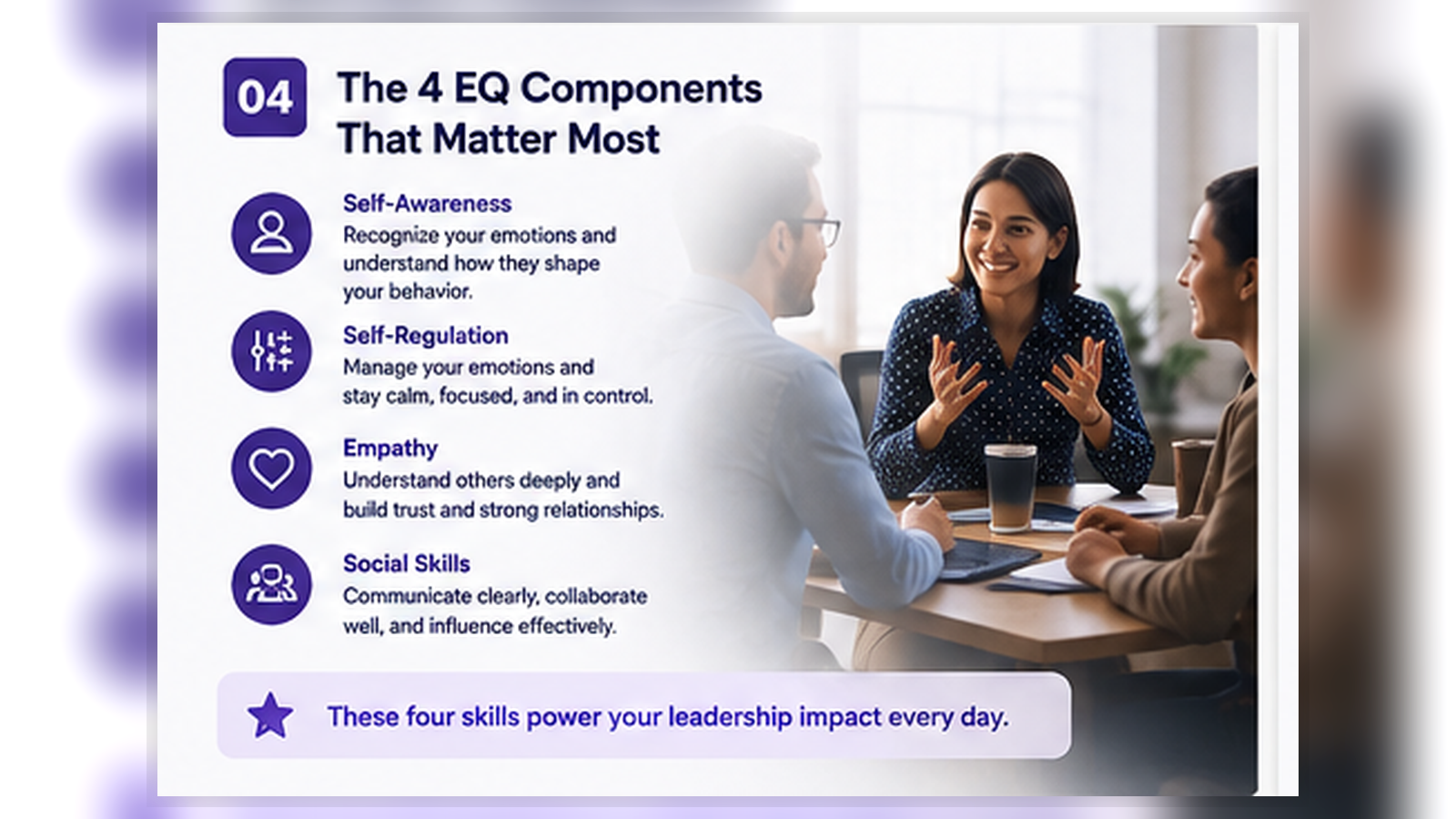
The four EQ components that matter most in practice
Self-awareness
Self-awareness is the ability to recognise your own emotions as they arise, understand how they affect your thinking and behaviour, and identify your patterns of reaction under pressure. It is the foundation for every other EQ capability.
In practice, it means noticing when you become closed to input after being challenged, recognising when impatience shuts down colleagues in meetings, and understanding how an emotional response may be affecting your judgement. The most reliable development method is structured feedback from colleagues, direct reports, and managers who will tell you what they actually observe.
Self-regulation
Self-regulation is the ability to manage emotional responses, not suppressing them, but choosing how to express them and when. Under pressure, it allows a leader to remain composed, think clearly, and communicate constructively rather than reactively.
Sleep deprivation, chronic stress, and poor recovery all reduce regulatory capacity. DDI's research found 71% of leaders operating at elevated stress levels. Mindfulness practice measurably improves self-regulation as a cognitive training method that builds awareness of the gap between stimulus and response.
Empathy
Empathy is the ability to accurately perceive and understand what other people are experiencing emotionally, then factor that understanding into decisions and communication. It is not agreement or sympathy. An empathetic leader delivers difficult news in a way the recipient can receive and act on.
Employees with empathetic leaders report 76% higher engagement and 61% higher creativity. In hybrid and remote environments, reading emotional states through video calls, written communication, and occasional in-person interactions has become a more demanding and valuable leadership skill.
Social skills
Social skills, including relationship building, conflict navigation, influence without authority, and clear communication, are where EQ becomes visible to the people around you. Goldman Sachs's Jacqueline Arthur described relationship skills as the secret sauce in an AI-enabled world, where judgement and trust-building remain scarce and valuable.
Why EQ matters more in 2026: the AI argument
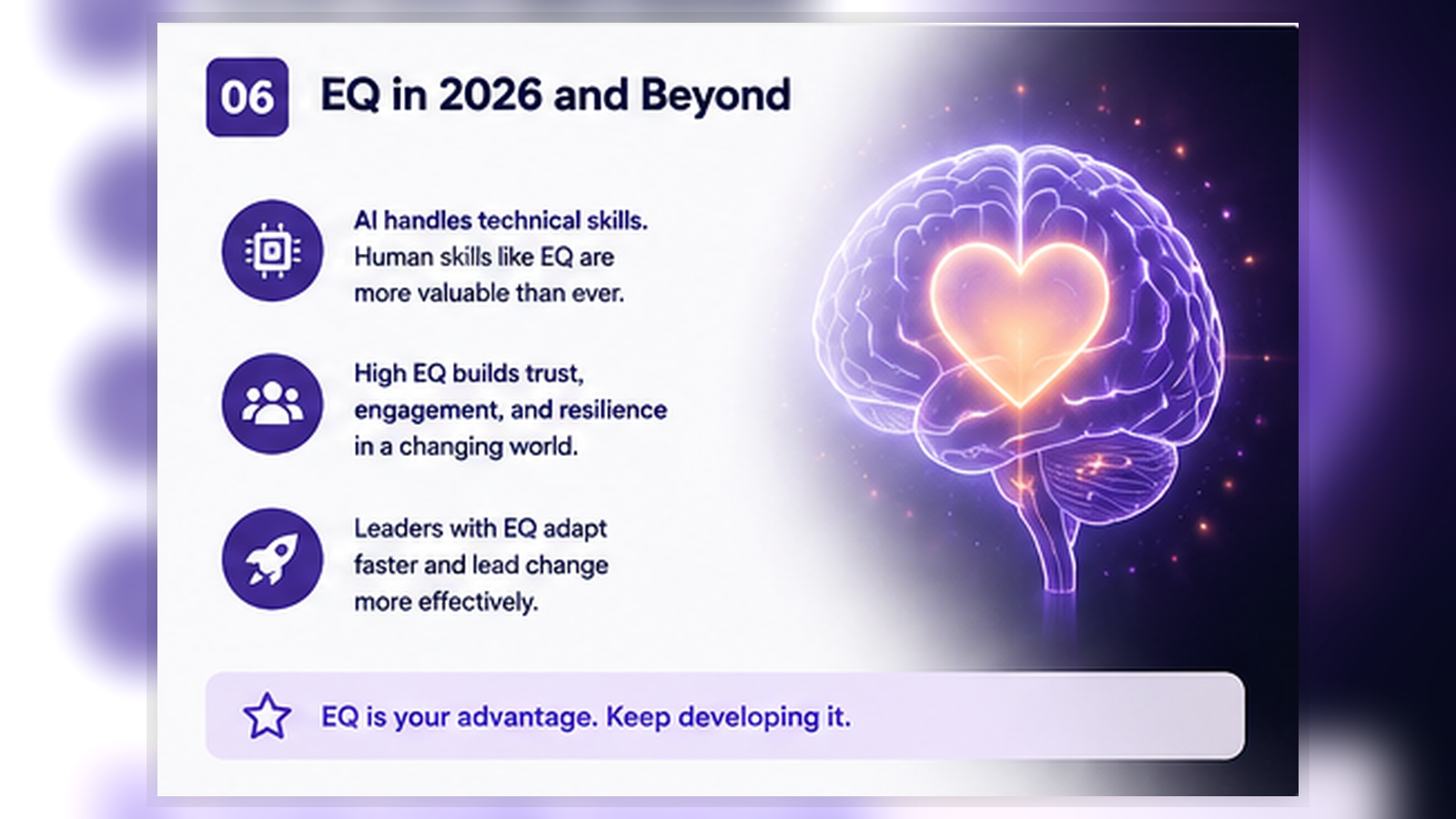
As AI systems absorb a greater share of analytical, administrative, and routine cognitive work, the tasks that remain distinctively human require emotional perception, relationship management, and contextual judgement.
McKinsey projects that demand for social and emotional skills will grow by 26% in the United States and 22% in Europe by 2030. The World Economic Forum likewise identifies emotional intelligence among the skills with the strongest growing demand. AI can simulate empathetic responses, but it cannot replicate the trust built between people who have genuinely navigated difficult situations together.
Only 36% of people worldwide currently demonstrate high emotional intelligence. In an environment where EQ is a high-value professional competency and its prevalence is low, professionals who invest in developing it are operating in relatively uncrowded territory.
How to develop emotional intelligence: what actually works
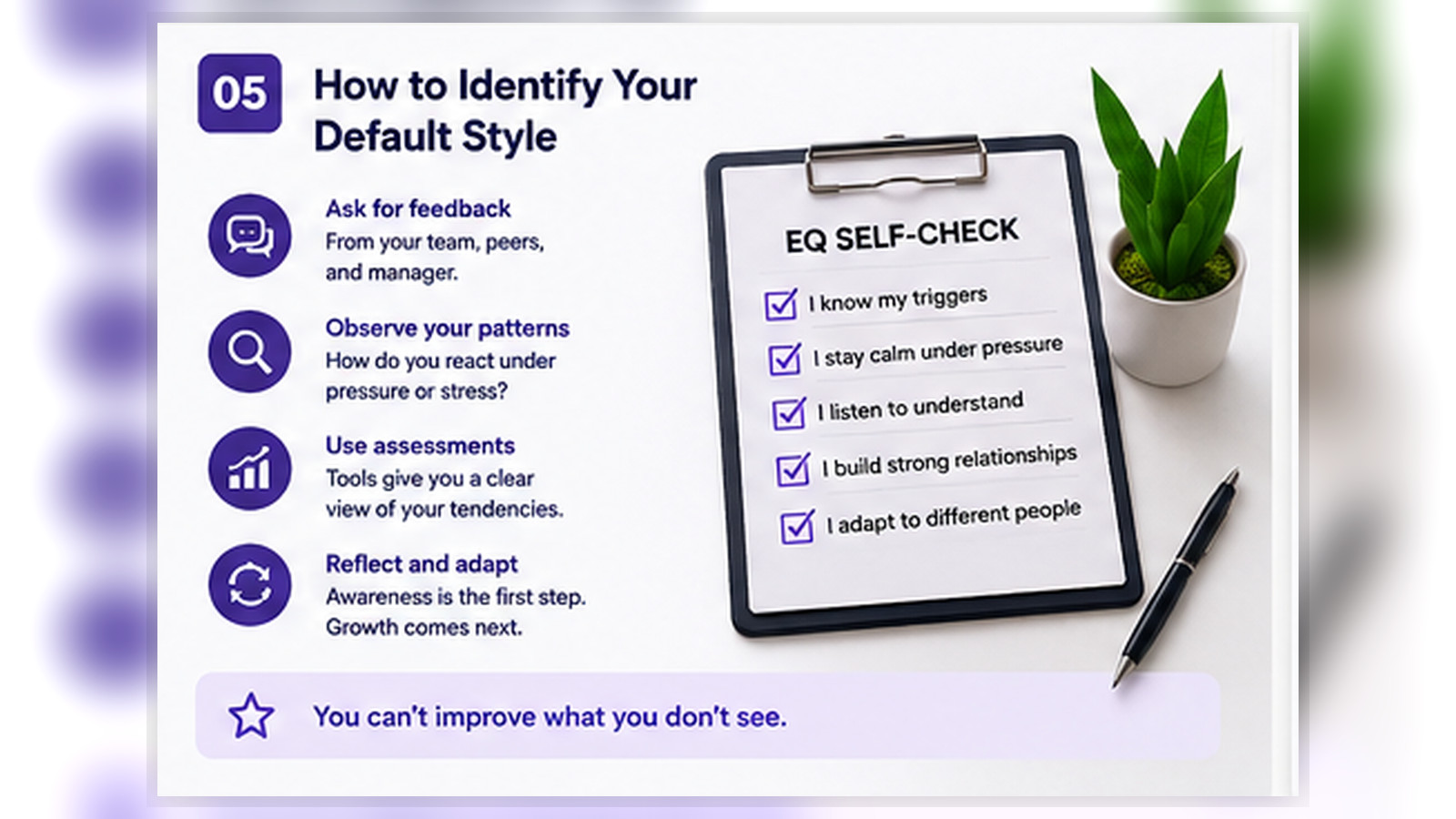
Structured feedback from people who will be honest with you is the most reliable starting point. Deliberate conversations with trusted colleagues, direct reports, and managers should focus on specific patterns of behaviour and their impact, rather than vague traits.
Journalling and structured reflection on emotional responses, what triggered them, what story you told yourself, and whether that story was accurate, builds self-awareness. Ten minutes of consistent reflection produces more useful self-knowledge than occasional deep introspection.
Mindfulness practice has the strongest research support for improving self-regulation. Short daily sessions of ten to fifteen minutes create more awareness of the space between emotional stimulus and behavioural response, allowing for choice.
Practising situations that challenge your default patterns accelerates development. The leader who avoids conflict should seek structured opportunities to practise it; the leader who struggles to demonstrate vulnerability should practise it in lower-stakes situations. EQ is a skill, and skills develop through practice with feedback.
Focused leadership training programmes improve measurable EQ scores by 25% on average, while six-month EI coaching programmes boost EQ-i scores by 18%. Programmes centred on EQ development produce stronger results than general leadership development that treats EQ as one topic among many.
Ready to develop your emotional intelligence professionally?
If this article has made clear that emotional intelligence is a learnable, measurable, and commercially significant capability, the Effective MBA: Coaching, Leadership & Mentoring and the Effective MBA: Executive Management & Leadership at EDU Effective both develop EQ alongside the leadership and management skills that put it into practice.
Both programmes draw on insights from practitioners at Google, Microsoft, McKinsey, Goldman Sachs, and Netflix, alongside faculty from Harvard Business School, Yale, Stanford, Princeton, and Cambridge, selected from a library of more than 24,000 videos curated for working professionals.
At EDU Effective, we build programs for professionals who want to work smarter, not just harder. Explore our programs →
EDU Effective Business School = professional development for your long-term success.
All best-selling Effective MBA programs are built for working adults: 15 minutes a day, 10 months or less, ASIC accredited, from €990.
These are professional programs, not academic ones, built for working adults to apply what they learn directly in their own business, not to collect a scholarly credential.
Join more than 9,000 students in over 120 countries who are investing in their professional development and career success.
Read the feedback and experiences of our students and the stories of our graduates here.
Apply now — €990 · Talk to a Study Advisor
Study with NO risk: 14-day money-back guarantee, no questions asked.
Sources
- TalentSmart — 5 Emotional Intelligence Skills Leaders Need When Emotions Run High https://www.talentsmarteq.com/5-eq-skills-leaders-need-when-emotions-run-high/
- Forbes / Kevin Kruse — Why Goldman Sachs Says EQ Is the Secret Sauce in the AI Era https://www.forbes.com/sites/kevinkruse/2026/04/20/why-the-global-head-of-human-capital-management-at-goldman-sachs-says-eq-is-the-secret-sauce-in-the-ai-era/
- Forbes Business Council — The More AI Advances, The More Emotional Intelligence Matters https://www.forbes.com/councils/forbesbusinesscouncil/2026/05/21/the-more-ai-advances-the-more-emotional-intelligence-matters/
- McKinsey & Company — Redefine AI upskilling as a change imperative https://www.mckinsey.com/capabilities/people-and-organizational-performance/our-insights/the-organization-blog/redefine-ai-upskilling-as-a-change-imperative
- McKinsey & Company — The ‘inside out’ leadership journey: How personal growth creates the path to success https://www.mckinsey.com/capabilities/people-and-organizational-performance/our-insights/the-inside-out-leadership-journey-how-personal-growth-creates-the-path-to-success
- Deloitte — Human Capital Trends: EQ Training and Team Performance https://www2.deloitte.com/us/en/insights/focus/human-capital-trends.html
- DDI — Global Leadership Forecast 2025 https://www.ddiworld.com/research/global-leadership-forecast
- Gallup — State of the Global Workplace 2026 https://www.gallup.com/workplace/349484/state-of-the-global-workplace.aspx
- World Economic Forum — Future of Jobs Report 2025 https://www.weforum.org/publications/the-future-of-jobs-report-2025/
- MHS — Why Human-Led Emotional Intelligence Is AI's Next Premium https://mhs.com/blog/why-human-led-emotional-intelligence-is-ais-next-premium/
- Forrester Research — Customer Satisfaction and High-EQ Leadership https://www.forrester.com/report/forresters-global-customer-satisfaction-rankings-2026/RES199562