
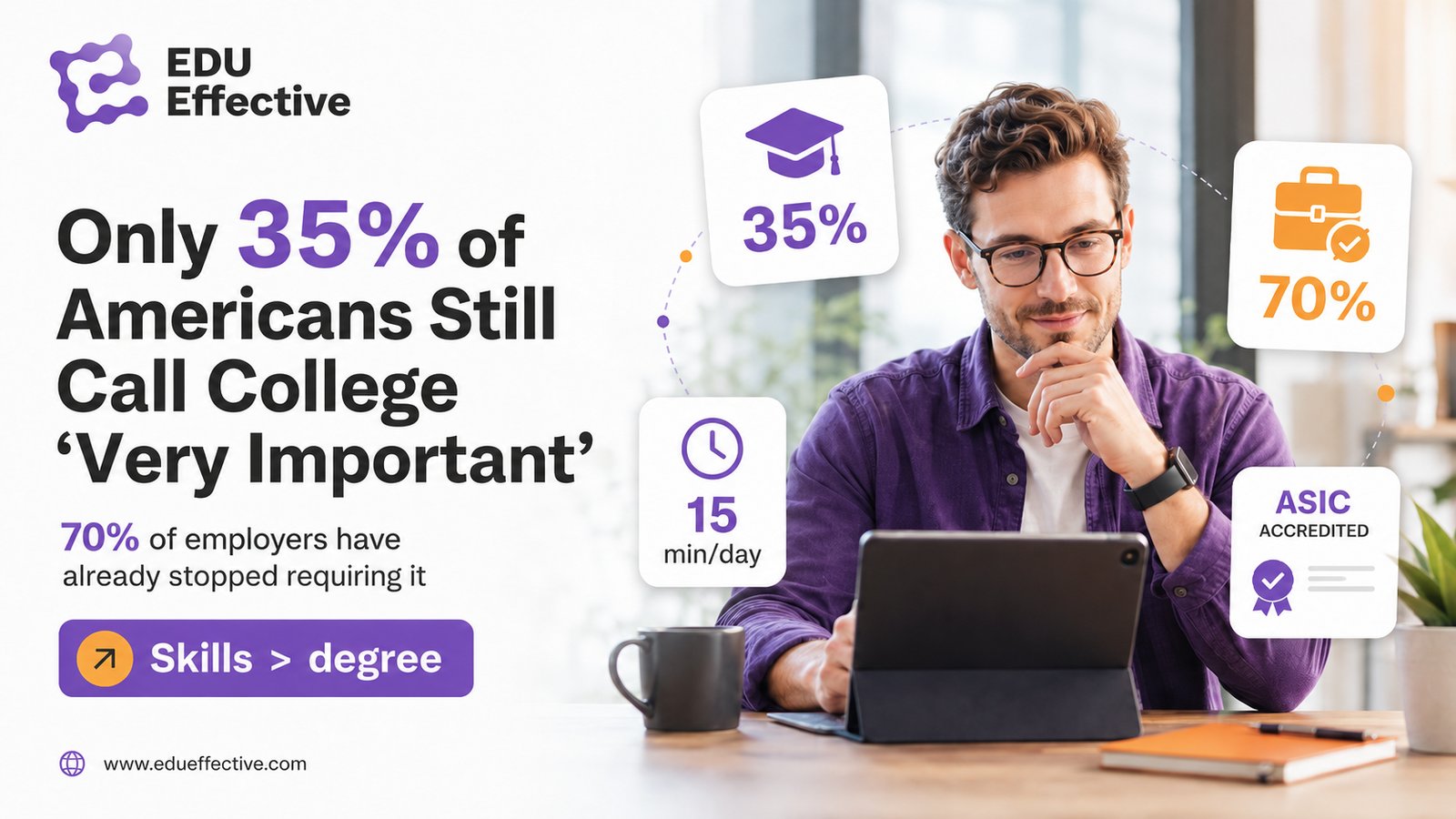

In 2010, 75% of U.S. adults said a college education was "very important" to success. Today, according to Gallup's latest polling, that figure is 35% — a 15-year low, with the decline spanning political affiliations, age groups, and income levels. At almost exactly the same time, NACE's latest employer survey found that 70% of companies now hire based on demonstrated skills. GPA screening, once used by nearly three-quarters of employers, has fallen to just 42%. Two independent surveys, looking at opposite ends of the education-to-career pipeline, describe the same shift: proof of ability is beginning to carry more weight than the credential that once stood in for it.
People have not stopped believing in education. What is changing is what education must prove — and how many years and how much money that proof should cost.
The Credential Is No Longer the Only Proof
NACE's data shows exactly where this change is appearing. Skills-based hiring now shapes 81% of job descriptions, 58% of interview guides, and 87% of interviews themselves. GPA, once the closest thing traditional education offered to a transferable measure of discipline, was used by 73% of employers to screen candidates in 2019. Today, that figure is 42%. Gallup points to similar causes behind the decline in confidence: rising tuition costs, growing awareness of apprenticeships and microcredentials, and labor-market disruption already being driven by artificial intelligence. The degree itself is not being rejected. What is being rejected is one specific, expensive way of proving that a person is capable.
Cost Is the First Barrier People Encounter
EducationDynamics' Modern Learner Report 2026 describes applicants' decisions through the "three Cs": cost, convenience, and career outcomes. Cost is the strongest filter. 66% of prospective students say affordability is a main reason they begin considering a school, while 60% identify tuition and fees as a main reason they do not consider one at all. Adult learners increasingly calculate value as the "total cost of delay, not the price tag." The real cost is not only tuition; it is also the years spent working in a role for which they do not yet have the qualifications to advance.
EDU Effective puts a concrete number on this difference: a traditional MBA often assumes that you will "put your life on hold for two years, perhaps even move to another city, and pay €30,000 or more." By contrast, an Effective MBA can be completed in 10 months or less, is delivered fully online through microlearning, and starts at €990. This is not simply a cheaper version of the same model. It is a different answer to what an effective professional program can look like today.
An Academic Degree Does Not Guarantee the Skills Work Actually Requires
EducationDynamics' higher education landscape report adds an even harder number: underemployment — the share of graduates working in roles that do not require their degree — is highest in fields furthest from immediately applicable content. Underemployment reaches 62.3% among performing arts graduates, 56.5% among liberal arts graduates, and 55.9% among anthropology graduates. The report describes this as a "structural mismatch between fields of study and labor-market demand." It is the specific, measurable version of what Gallup's survey shows more broadly. People are not losing faith in education; they are losing faith that a particular academic degree will reliably lead to a particular outcome.
What Professional Education Does Differently
The Effective MBA is built on the opposite premise: content should be judged by whether it changes what a person can do at work this month — not by how many academic credits were required to complete it. That is why EDU Effective offers high-demand specializations with international ASIC accreditation, each designed around the same practical, workplace-focused model:
- Effective MBA: Executive Management & Leadership
- Effective MBA: Applied Artificial Intelligence
- Effective MBA: Coaching, Leadership & Mentoring
- Effective MBA: Mastery in AI
- Effective MBA: Online Marketing
Every program follows the same model: 15 minutes a day, 75+ hours of required video content, and 40+ additional hours of optional material. The content is continuously updated by experts who work, or have worked, at organizations such as Google, Microsoft, McKinsey, Harvard Business School, and other leading companies and universities worldwide. eTests verify what students have actually learned, not merely what they have watched, while action plans support the transfer of new knowledge and skills into real workplace practice. In simple terms: 10 months or less, ASIC accreditation, tuition from €990, and immediate practical application.
I value the flexibility to study anytime and anywhere, with well-organized, up-to-date learning materials — all at an affordable price.
— Kahwa S., Effective MBA graduate, Uganda
Read more student reviews and graduate stories here.
Why Microlearning Helps You Remember More
The short format is not only about convenience. According to eLearning Industry, microlearning can improve retention by 25% to 60% compared with traditional, longer-form instruction. The mechanism is straightforward: the brain can process and store a short learning block with less loss, while an hour-long lecture often breaks into fragments that are difficult to recall a week later.
According to research published by the Association for Talent Development (ATD) in June 2025, 66% of organizations involved in employee learning now use microlearning, compared with 38% in 2017. In eight years, it has moved from a fringe method to a mainstream standard because short learning blocks reduce cognitive overload and give learners more capacity to retain information — not less.
A peer-reviewed 2025 study in Frontiers in Psychology involving 384 university students found that microlearning also produced statistically significant improvements in soft skills, including leadership, communication, and time management — precisely the capabilities employers are increasingly seeking according to the NACE data above.
The Effective MBA is built around this principle: 10 modules, each divided into thirty 15-minute daily learning blocks. There is no 90-minute lecture that must be completed in one sitting. What students learn today can be applied at work almost immediately — not only after finishing the entire program. Learn more about why microlearning works →
Who This Model Is Really For
- Working professionals who cannot afford to interrupt or complicate their careers and personal lives for two years — exactly the group traditional MBA programs were never designed around.
- People who have calculated the true cost of a traditional degree and concluded that €30,000, major disruption to their working routine, or even two years away from employment is not a realistic option.
- Career changers who need a credible, accredited qualification — and, above all, practical knowledge and immediately usable skills that employers genuinely value — rather than a pile of unaccredited certificates that cannot be independently verified.
- Lifelong learners who may already hold a university degree but now need current, practical skills that a curriculum written ten or more years ago does not cover.
The Shift Has Already Happened
Gallup measured the decline in confidence. NACE measured what employers are doing in response. Neither is a prediction; both describe a shift that is already underway. The only open question is whether the next qualification a person earns will be designed and priced around how people actually work and what they need today — or around an era when two years of study and a six-figure tuition bill were treated as the only legitimate route forward.
Sources
- Gallup — Perceived Importance of College Hits New Low
- NACE — Employer Use of Skills-Based Hiring Practices Grows
- EducationDynamics — 2026 Landscape of Higher Education Report
- EducationDynamics — Modern Learner Report 2026: The New Enrollment Model
- eLearning Industry — Microlearning Statistics, Facts and Trends for 2025
- ATD — New ATD Research Highlights Practical Strategies for Microlearning Success
- Frontiers in Psychology — Impact of Microlearning on Developing Soft Skills of University Students