

Business Skills Series, Part 1 of 4
Most managers are promoted because they are good at their craft. A strong engineer becomes an engineering manager. A top salesperson becomes a sales manager. The assumption — rarely stated, rarely examined — is that operational excellence and financial literacy travel together. They do not.
Running a team means owning a budget. Approving headcount means making a financial argument. Recommending an investment means building a case with numbers someone senior will scrutinize. None of these require a finance degree. All of them require a level of financial literacy that most managers have never been explicitly taught.
What the Data Shows About the Gap
PMI’s Pulse of the Profession 2025 surveyed 2,841 project professionals globally and found that only 18% demonstrate high business acumen proficiency. Eighty-two percent do not. Business acumen, as PMI defines it, includes financial analysis, connecting project outcomes to P&L impact, making credible financial projections, and communicating the business value of work to non-specialist stakeholders.
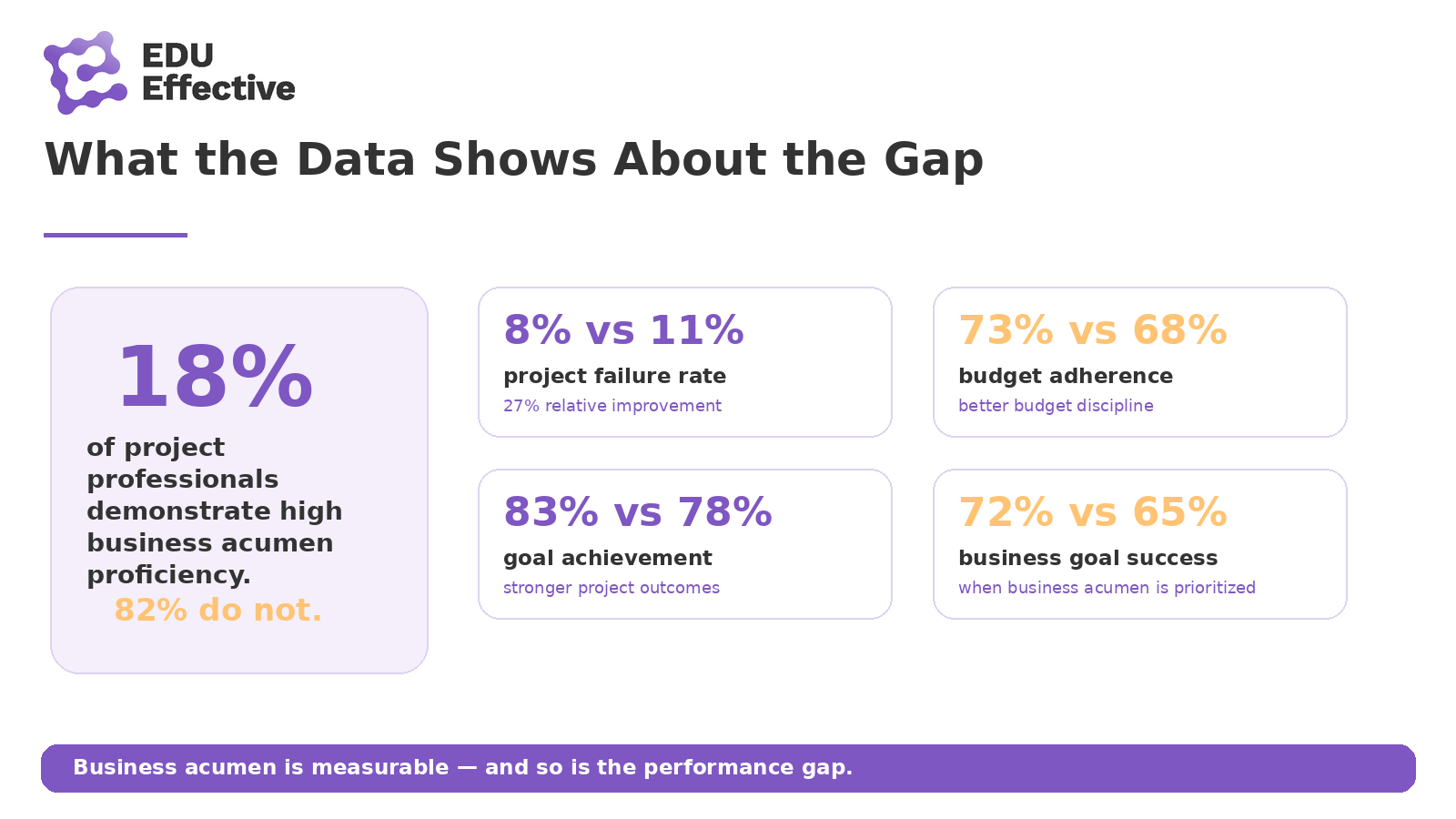
The performance difference between those two groups is measurable. Projects led by high business acumen professionals show an 8% failure rate versus 11% for those with low business acumen — a 27% relative improvement. Budget adherence is 73% versus 68%. Goal achievement is 83% versus 78%. Organizations that prioritize business acumen training achieve 72% business goal success on projects, versus 65% for those that do not.
These are project professionals — people whose explicit role involves budget and scope management. If only 18% of them demonstrate high financial acumen, the proportion among general managers who do not have project management as their primary discipline is not likely to be higher.
The Specific Knowledge That Matters
Financial literacy for managers is not about becoming an accountant. It is about understanding the five to seven financial concepts that recur in every budget conversation, investment decision, and performance review that a manager participates in.
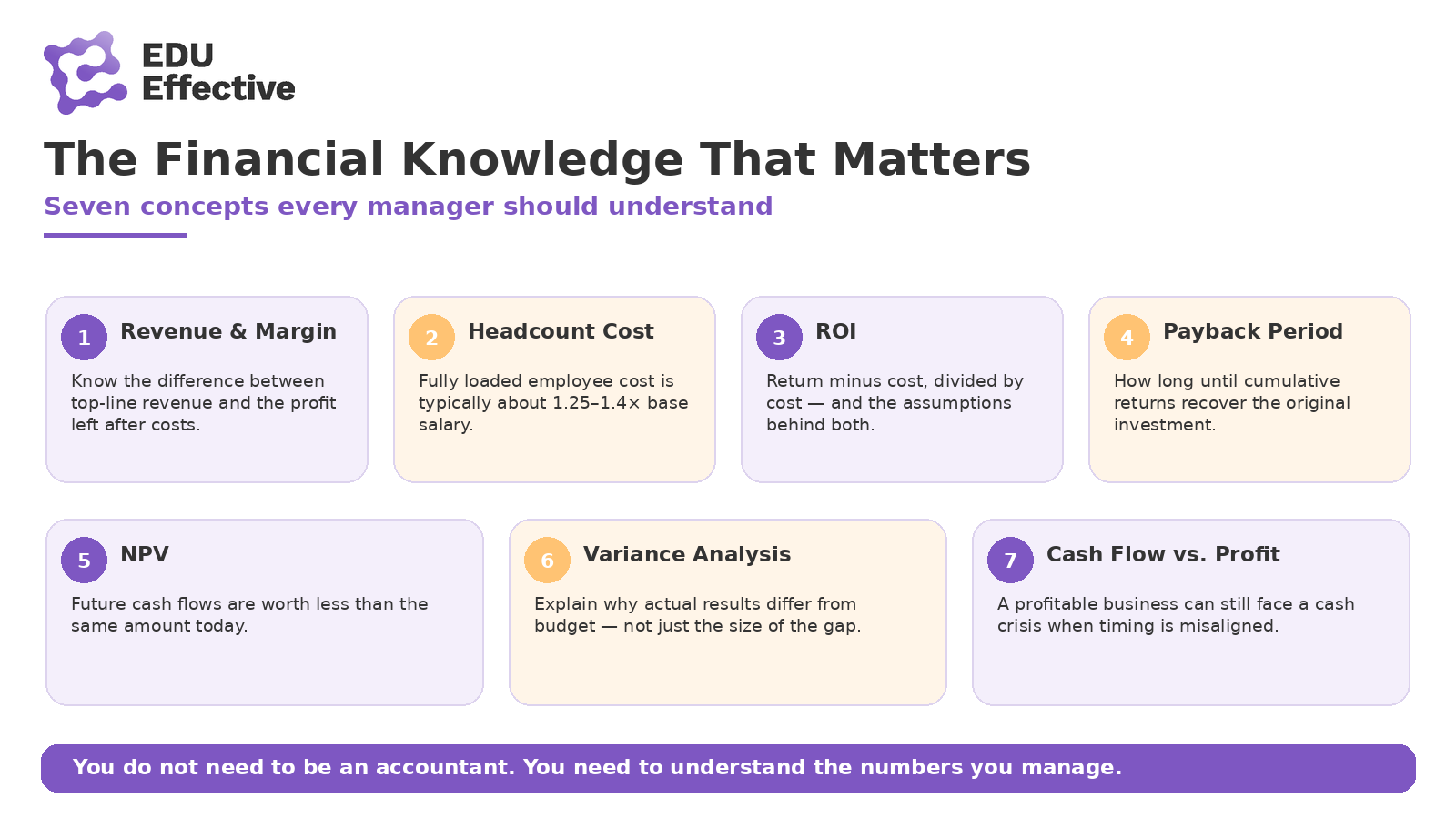
Revenue and margin — the difference between top-line revenue and the profit that remains after costs. A manager who understands gross margin versus operating margin can follow a P&L conversation and recognize when a proposal that looks good on revenue terms is actually eroding profitability.
Headcount and its true cost — salary is the visible number. Employer contributions, benefits, equipment, real estate allocation, training, and management overhead typically bring the fully-loaded cost of an employee to 1.25 to 1.4 times base salary, depending on the role and location. A manager who budgets only for salary is consistently underestimating the cost of their team.
ROI (Return on Investment) — return minus cost, divided by cost, expressed as a percentage. The calculation is simple. The harder skill is knowing what to include in the cost and return estimates, how confident those estimates are, and how long the return horizon is. McKinsey and Oxford’s analysis of over 5,400 large IT projects found they delivered 56% less value than projected — a pattern traceable directly to optimistic estimates in the original financial cases.
Payback period — how long until cumulative returns cover the initial investment. This is the number many budget reviewers ask first, because it quantifies how long the organization carries risk before the investment begins to pay for itself.
NPV (Net Present Value) — the present value of future cash flows, discounted to account for the time value of money. A manager does not need to build NPV models from scratch. They do need to understand that a return of €100,000 three years from now is worth less than €100,000 today, and that discount rates reflect both the cost of capital and the risk of the projection.
Variance analysis — the comparison of actual performance against budget. Every month, every quarter, there is a number that was expected and a number that occurred. A manager who can explain the sources of variance — not just report the gap, but diagnose it — is managing their budget rather than just tracking it.
Cash flow versus profit — a business can be profitable on paper and still face a cash crisis if the timing of receipts and payments is misaligned. For managers running project budgets or working with external clients, understanding when money comes in versus when it is earned is a practical risk management skill.
Why Managers Avoid the Numbers
There is a consistent pattern in how managers who lack financial confidence handle financial situations: they defer. They bring the numbers question to someone in finance. They present projections without explaining the assumptions behind them. They avoid challenging a budget number they suspect is wrong because they’re not sure they can defend the challenge.
The avoidance is rational — nobody wants to look uninformed in front of their manager or their CFO. But the cost accumulates. Decisions that should be made at the team level get escalated unnecessarily. Budget conversations become asymmetric — the person with financial expertise holds all the analytical power. Investments that should be made don’t get approved because the business case isn’t credible. Investments that shouldn’t be made do get approved because nobody in the room had the skills to challenge the projections.
PMI’s research found that organizations allocate only 25% of training hours to business acumen — versus 46% to technical skills. The investment pattern reflects the assumption that financial capability is someone else’s job. The performance data suggests otherwise.
Reading a P&L: What Managers Should Know
The Profit and Loss statement is the document that describes business performance in financial terms. Most managers encounter it regularly and understand parts of it. Fewer can read it systematically.
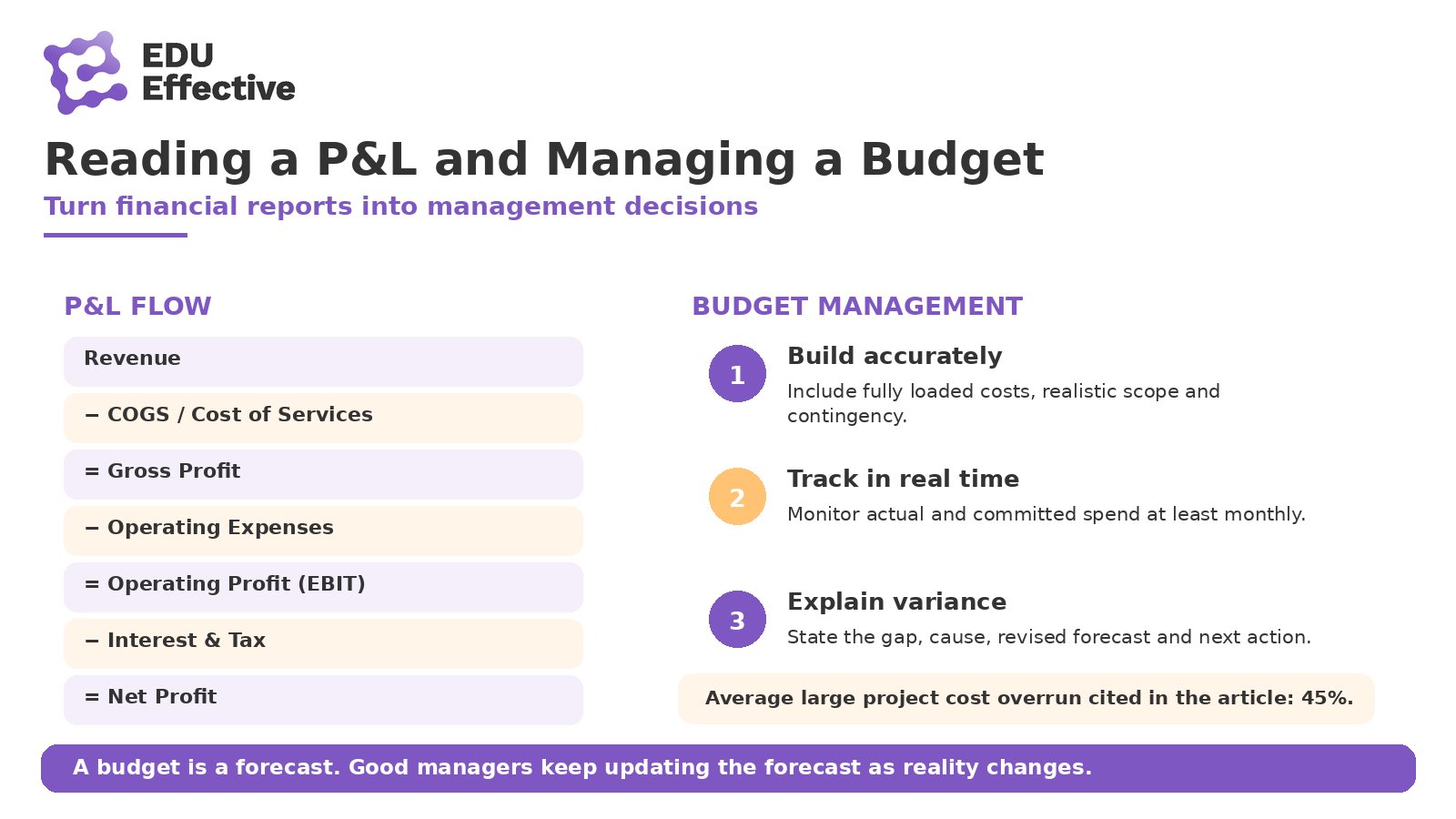
A P&L moves top to bottom: revenue, then cost of goods sold (COGS) or cost of services, giving gross profit and gross margin. Below that, operating expenses — which include salaries, marketing, R&D, and overhead — are subtracted to give operating profit (EBIT). Interest and tax come next, leaving net profit.
For a manager, the useful habit is to track their team’s contribution to each line they can influence. What revenue does their team generate or support? What costs does the team control? What is the margin on the work their team does? These are questions that connect daily decisions to the financial outcomes the organization measures.
Deloitte’s Finance Trends 2026 research found that many organizations are actively working to build financial understanding among non-finance leaders — recognizing that decisions made at the management layer have direct P&L consequences that are not always visible to the people making them. The companies investing in this capability tend to have better budget discipline and fewer expensive surprises in quarterly reviews.
Budget Management as a Management Skill
A budget is a forecast of what will happen, expressed in financial terms. Managing a budget well means three things: building it accurately, tracking it in real time, and explaining variances when reality diverges from forecast.
Building a budget accurately requires the fully-loaded cost awareness described above, a realistic estimate of project scope and timeline (the McKinsey data on cost overruns is instructive here — the average large project runs 45% over budget), and contingency built in for the risks that are known but uncertain. A budget with no contingency is a budget that will be exceeded.
Tracking in real time means knowing the numbers at least monthly, not at quarter-end when it is too late to adjust. It means having a view of committed spend (contracts signed, purchase orders raised) as well as actual spend — because committed spend that has not yet flowed through the books is still a financial obligation.
Explaining variance means being able to say: here is the gap, here is what caused it, here is what has changed in our forecast going forward, and here is what we are doing about it. Four sentences. Decision-makers do not need extensive narrative — they need clarity on whether the situation is under control and what happens next.
Making the Case: When Finance Knowledge Becomes Influence
The moment financial literacy directly converts to organizational influence is the business case conversation. Getting budget for a project, a hire, a new initiative, or a piece of technology requires making a financial argument that a budget holder will approve.
The managers who consistently get their projects funded are not necessarily the ones with the best ideas. They are the ones who can translate their ideas into financial terms — cost, return, timeline, risk — in a way that a non-specialist can evaluate. That is a communication skill built on a financial foundation.
Gartner research found that 63% of executives are more likely to approve investments backed by solid data and analytics. PwC found that 72% prioritize investments that visibly connect to strategic priorities. Neither requires sophisticated financial modeling. Both require a manager who can frame an investment in terms the decision-maker uses.
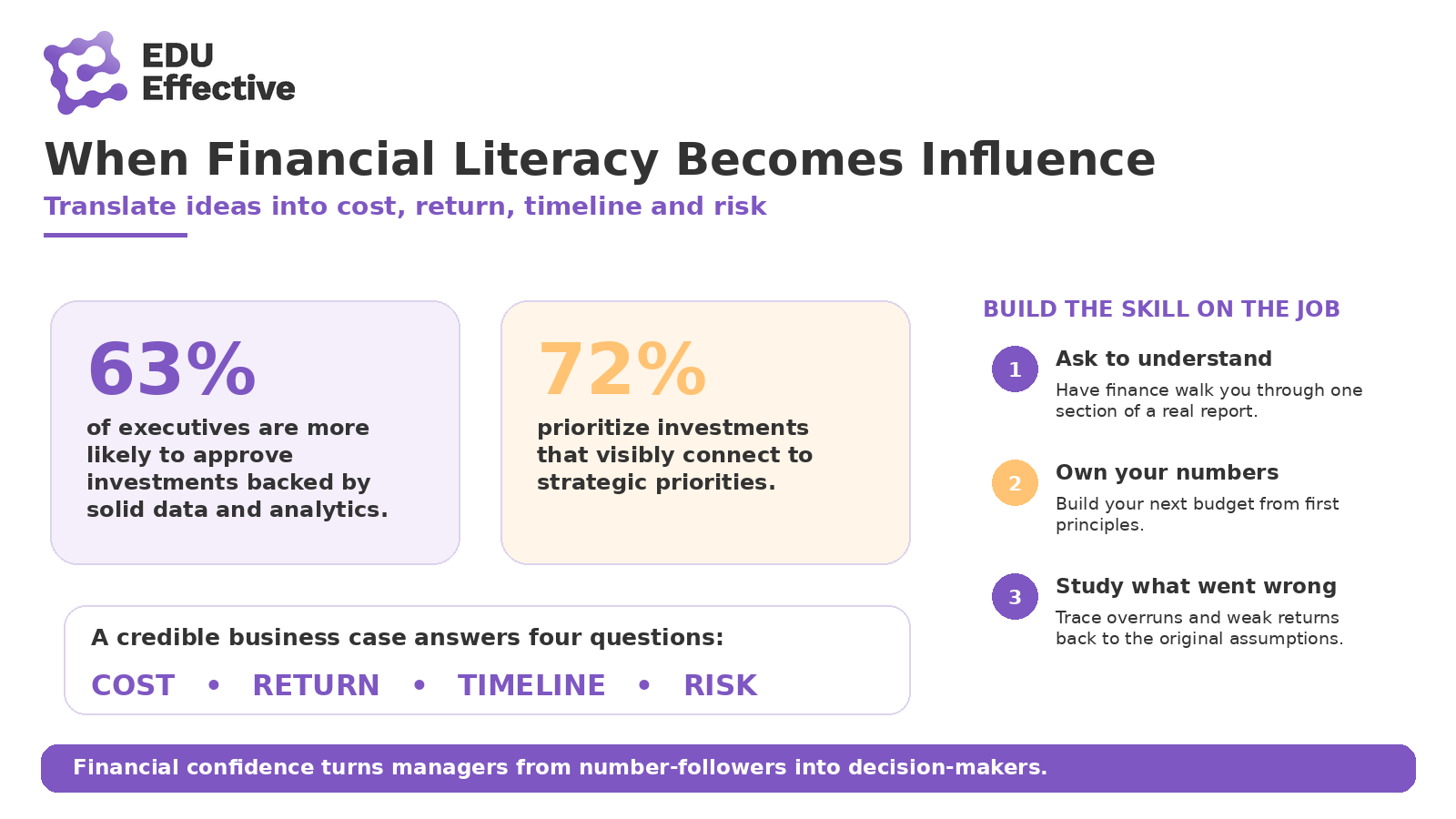
The most common reason a business case fails is not that the idea is bad. It is that the financial case is either not credible (assumptions that cannot survive scrutiny) or not connected to a priority the decision-maker already has. Both failures are preventable with basic financial acumen.
Developing Financial Literacy on the Job
The fastest route to practical financial literacy for a working manager is not a finance course. It is a combination of three things.
First, ask to understand. When finance sends a budget report or a variance analysis, instead of filing it away, ask the finance business partner or CFO to walk through one section. Most finance professionals appreciate the question — they spend a lot of time producing reports that nobody asks about.
Second, own the numbers on your team. Build the next budget yourself, from first principles, instead of delegating it to an administrator or copying last year’s numbers with a percentage adjustment. The process of building a budget from scratch is where the concepts become concrete.
Third, study the decisions that went wrong. When a project overruns, when a hire ends up costing more than projected, when an investment delivers less than the business case promised — trace the financial failure back to its source. The pattern over time teaches more than any case study.
This is the same principle that drives PMI’s finding on business acumen: the managers who develop financial capability do so through deliberate engagement with real financial problems, not through passive exposure to data someone else produced.
About EDU Effective Business School
EDU Effective Business School exists for professionals who want measurable progress inside their own organization. Runs on 15 minutes a day, completes in 10 months or less and is ASIC accredited.
See all five Effective MBA programs · Read student reviews · Apply
Sources
- PMI — Pulse of the Profession 2025: Business Acumen Proficiency Data; Project Performance by Acumen Level; Training Investment Allocation (Survey of 2,841 Project Professionals Globally) https://www.pmi.org/learning/thought-leadership/boosting-business-acumen
- McKinsey & Company / University of Oxford — Large IT Project Analysis: Budget Overrun, Value Delivery, and Cost Overrun per Scheduled Year (5,400+ Projects Analyzed) https://www.mckinsey.com/capabilities/tech-and-ai/our-insights/delivering-large-scale-it-projects-on-time-on-budget-and-on-value
- Gartner — Executive Investment Approval and Data-Backed Decision-Making Research https://www.gartner.com/en/newsroom/press-releases/2026-07-20-gartner-survey-shows-45-percent-of-cfos-say-their-ai-investments-lean-towwards-productivity-while-20-percent-say-these-investments-lean-towards-decision-quality
- PwC — Executive Strategic Alignment and Investment Prioritization Research https://www.pwc.com/gx/en/issues/c-suite-insights/ceo-survey/ai-advantage-starts-with-alignment.html
- Deloitte — Finance Trends 2026: Finance Capability Building in Non-Finance Leaders https://www.deloitte.com/cz-sk/en/services/consulting/research/finance-trends-2026.html