
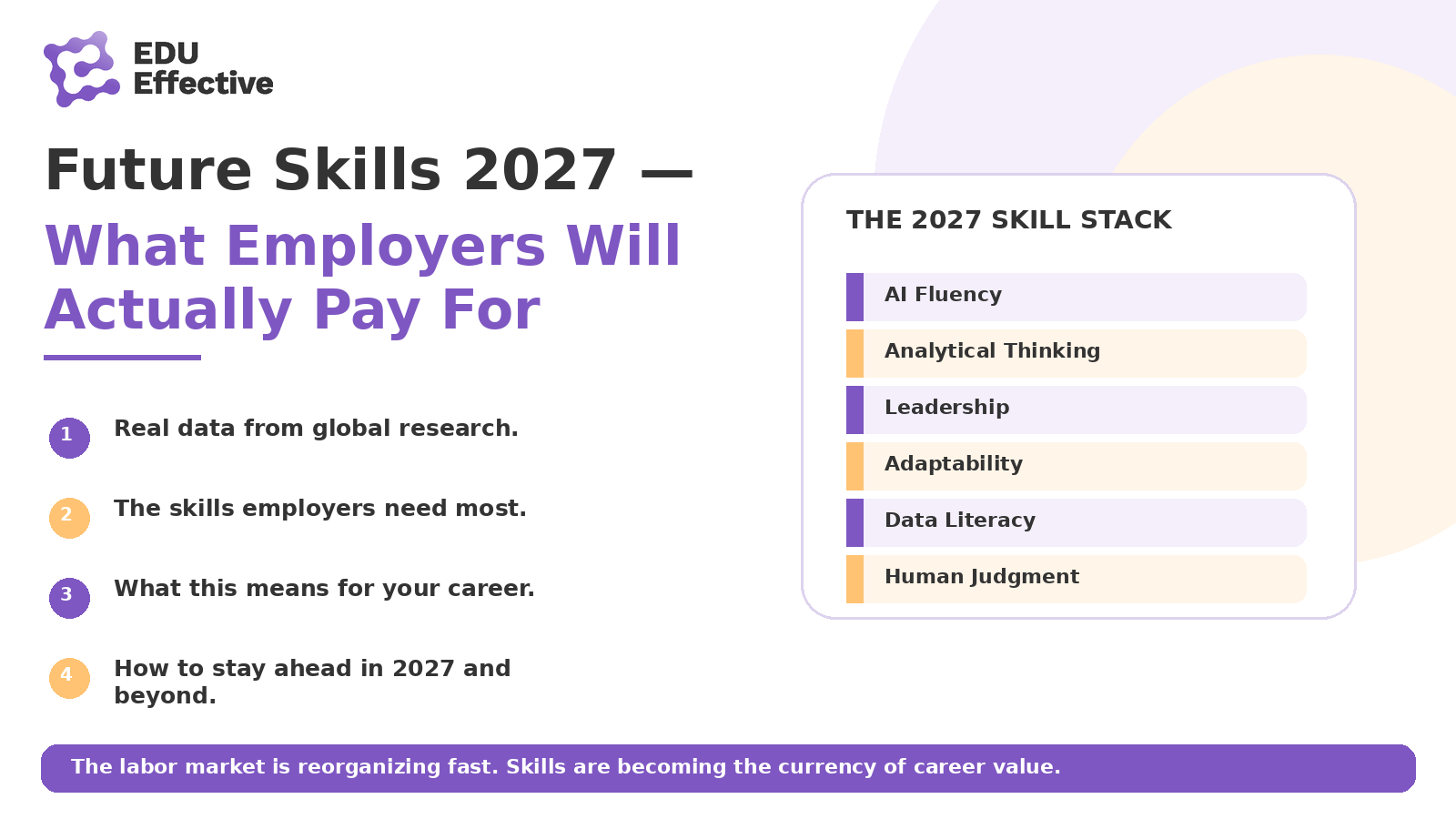

Future of Work Series — Part 1 of 8
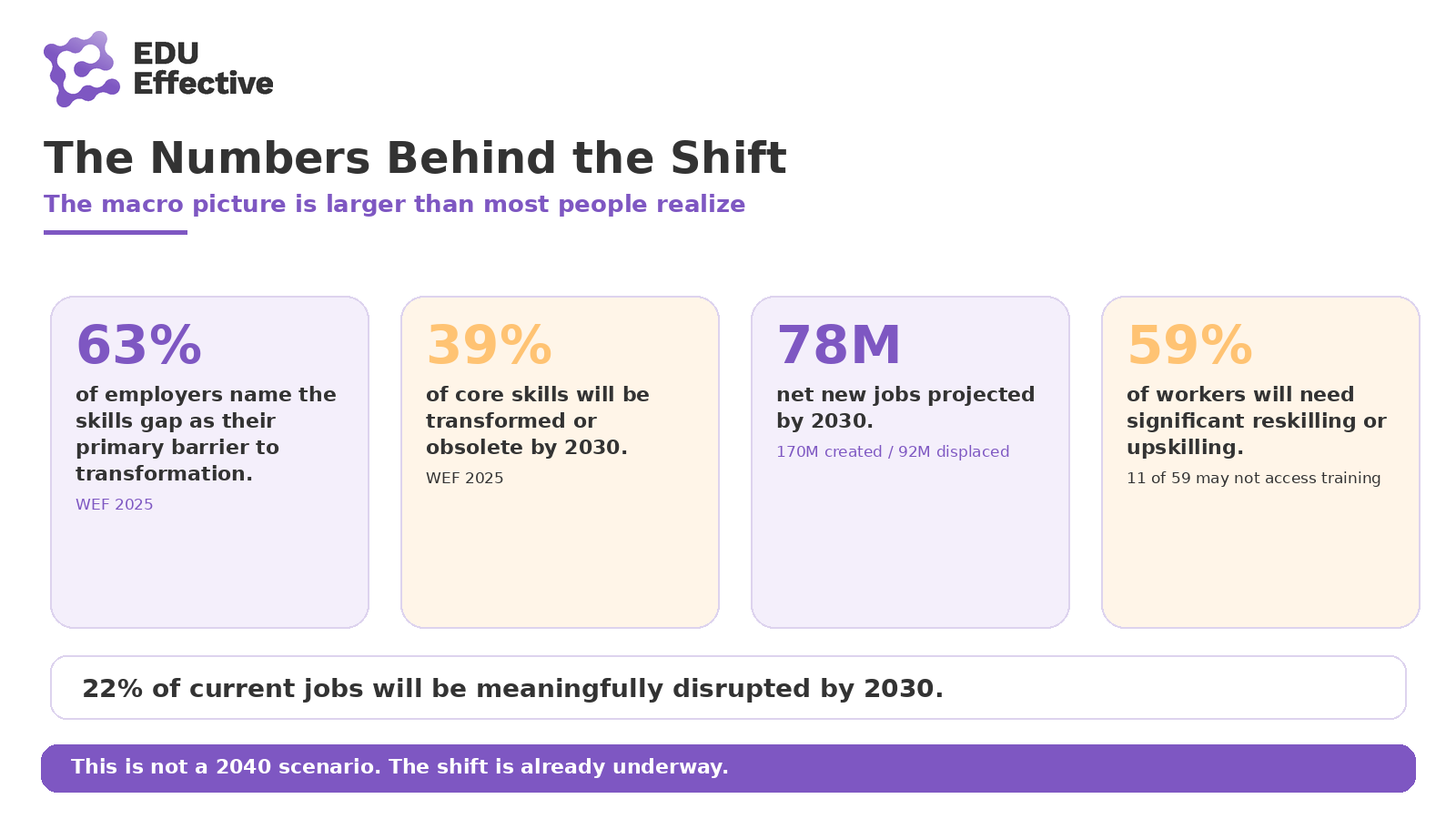
The labor market is not drifting. It is reorganizing fast, and most professionals are underestimating the speed. The World Economic Forum’s Future of Jobs Report — based on surveys across more than 1,000 companies in 22 industries and 55 economies — found that 63% of employers name the skills gap as their primary barrier to business transformation. Not capital, not regulation, not competition. Skills.
By 2030, 39% of the core skills workers currently use will be either transformed or obsolete. That is not a decade from now. That is three years of compounding change from today.
This article maps what employers are actually prioritizing — and paying for — going into 2027. Not the buzzword list that circulates every January, but the specific future skills that show up in hiring data, salary premiums, and workforce investment decisions by organizations operating at scale.
The Numbers Behind the Shift
Start with the macro picture, because it is larger than most people realize.
WEF projects net 78 million new jobs by 2030: 170 million new roles created, 92 million displaced. That net figure sounds reassuring. What it conceals is that 22% of current jobs will be disrupted — meaning meaningfully changed, not eliminated. And of every 100 workers currently employed, 59 will need significant reskilling or upskilling before 2030. Eleven of those 59 are unlikely to access the training they need. That is over 120 million workers globally who are running out of time.
McKinsey’s September 2026 analysis of US workforce transitions adds a ground-level dimension. Demand for AI fluency rose roughly 11-fold since 2022. Demand for adaptability rose fivefold. Demand for resilience, curiosity, and willingness to learn roughly tripled — in just four years. Growing occupations now require an average of 68 distinct skills; declining occupations average 47. The gap between job families that are growing and those that are shrinking is, in large part, a skills gap.
LinkedIn’s 2025 data confirms the same direction from a different angle. AI literacy now appears in job descriptions six times more often than a year earlier. The share of hirers using skills-based hiring data to fill roles has reached 50%. And 62% of US hiring managers report a mismatch between what professionals can do and what companies currently need.
These are not projections about 2040. This is the hiring market in 2025 and 2026, accelerating.
Skill Category 1: AI Fluency — the Floor, Not the Ceiling
AI and big data was the fastest-growing skill cluster in the WEF’s 2025 report. In the top 10 industries surveyed, over 90% of respondents expect AI use to increase. Half of all employers plan to reorient their business around AI-related opportunities. Forty-one percent plan to reduce headcount in AI-automated roles.
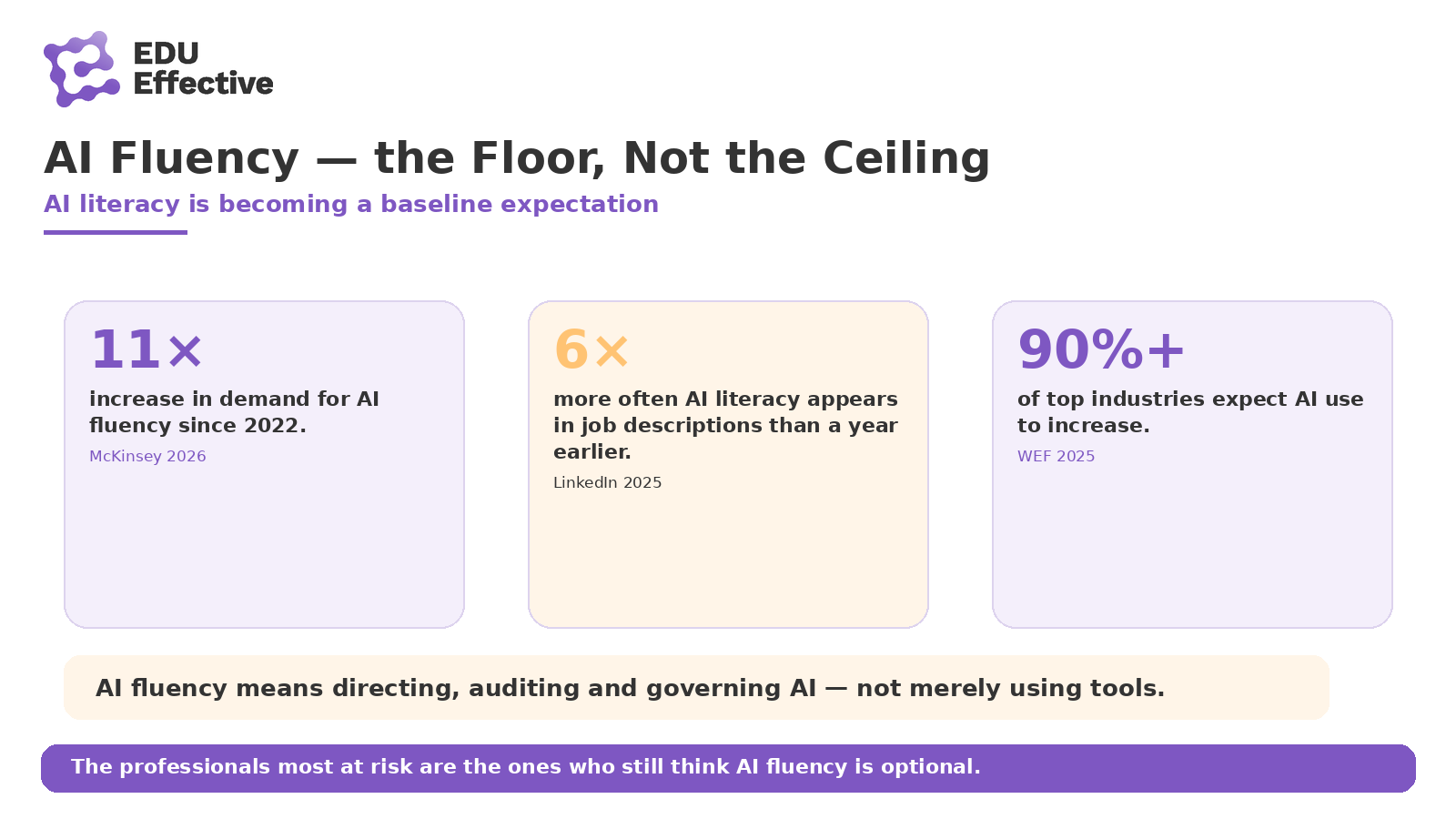
The practical consequence for employed professionals: AI literacy is becoming a baseline expectation, not a differentiator. The question is not whether you use AI tools. It is whether you understand what they are actually doing and can direct, audit, and manage them.
LinkedIn’s global tracking found that AI-skilled members rose approximately 20-fold since 2016, with financial services showing a 40-fold increase in the same period. What changed is not the availability of AI tools — those have existed for years — but employer willingness to act on the skills gap they reveal. Companies that adopted generative AI and reported revenue increases of 10% or more in the past two years account for 51% of businesses surveyed. That number has shifted internal investment decisions significantly.
AI fluency in 2027 means several things at once. It means knowing how large language models work well enough to set useful constraints. It means understanding where AI output needs human judgment — and being that judgment. It means recognizing the governance and risk questions that arise when automated systems operate inside business processes. None of that is a programming skill. It is a management skill, which is why it shows up in demand across roles that have nothing to do with building AI systems.
The professionals most at risk are not the ones with no technical background. They are the ones who think AI fluency is optional.
Skill Category 2: Analytical Thinking — Still the Top Core Skill
The WEF’s 2025 report is direct: analytical thinking is the single most important core skill employers identified, with seven out of ten companies rating it as essential. It has held that position across multiple editions of the report.
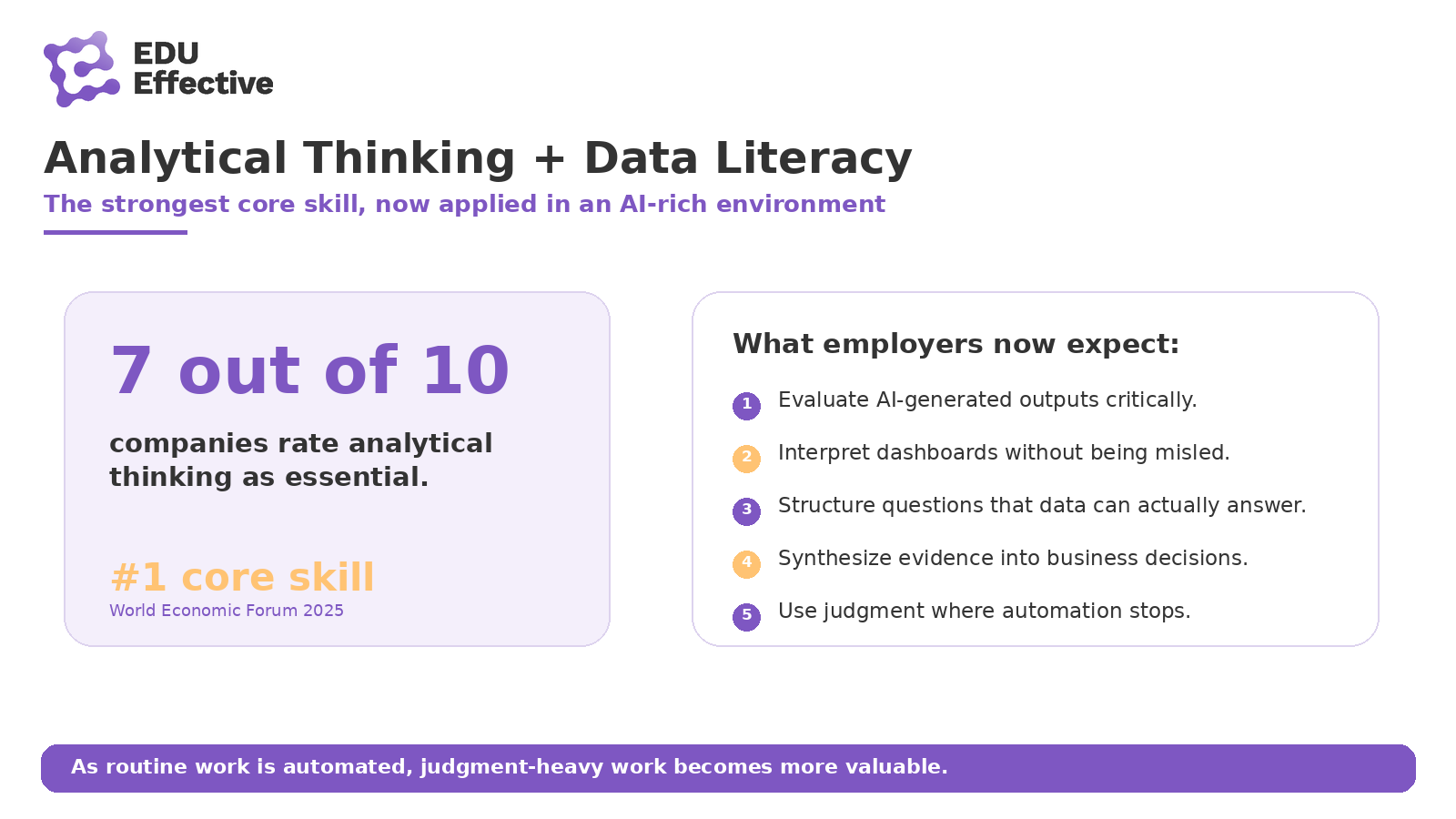
What changes is the context in which analytical thinking gets applied. In 2019, it meant working through complex reports and drawing sound conclusions. In 2027, it means doing that while also managing AI-generated outputs that look sound but may not be. It means applying structured reasoning to decisions where the information volume has expanded enormously but the quality signals have gotten harder to read.
The McKinsey MGI data makes a parallel point: growing occupations require more distinct skills than declining ones, but the common thread in growing roles is the need to handle non-routine cognitive work. Analytical thinking is the engine of non-routine cognition. It cannot be fully automated, and it compounds over time in a way that pure technical skills do not.
This matters specifically for managers and senior professionals. As more transactional and operational tasks get absorbed into AI-assisted workflows, the work that remains is disproportionately judgment-heavy. Evaluation, interpretation, synthesis, strategic prioritization — these are analytical thinking applied at scale. Employers are paying for people who are genuinely good at it, not just people who have the word “analytical” in a CV.
Skill Category 3: Leadership and Adaptability — the Skills That Jumped
In WEF’s tracking since 2023, two clusters show the largest gains in employer priority:
Leadership and social influence rose 22 percentage points in the share of employers identifying it as a core skill. Resilience, flexibility, and agility rose 17 points. AI and big data also rose 17 points.
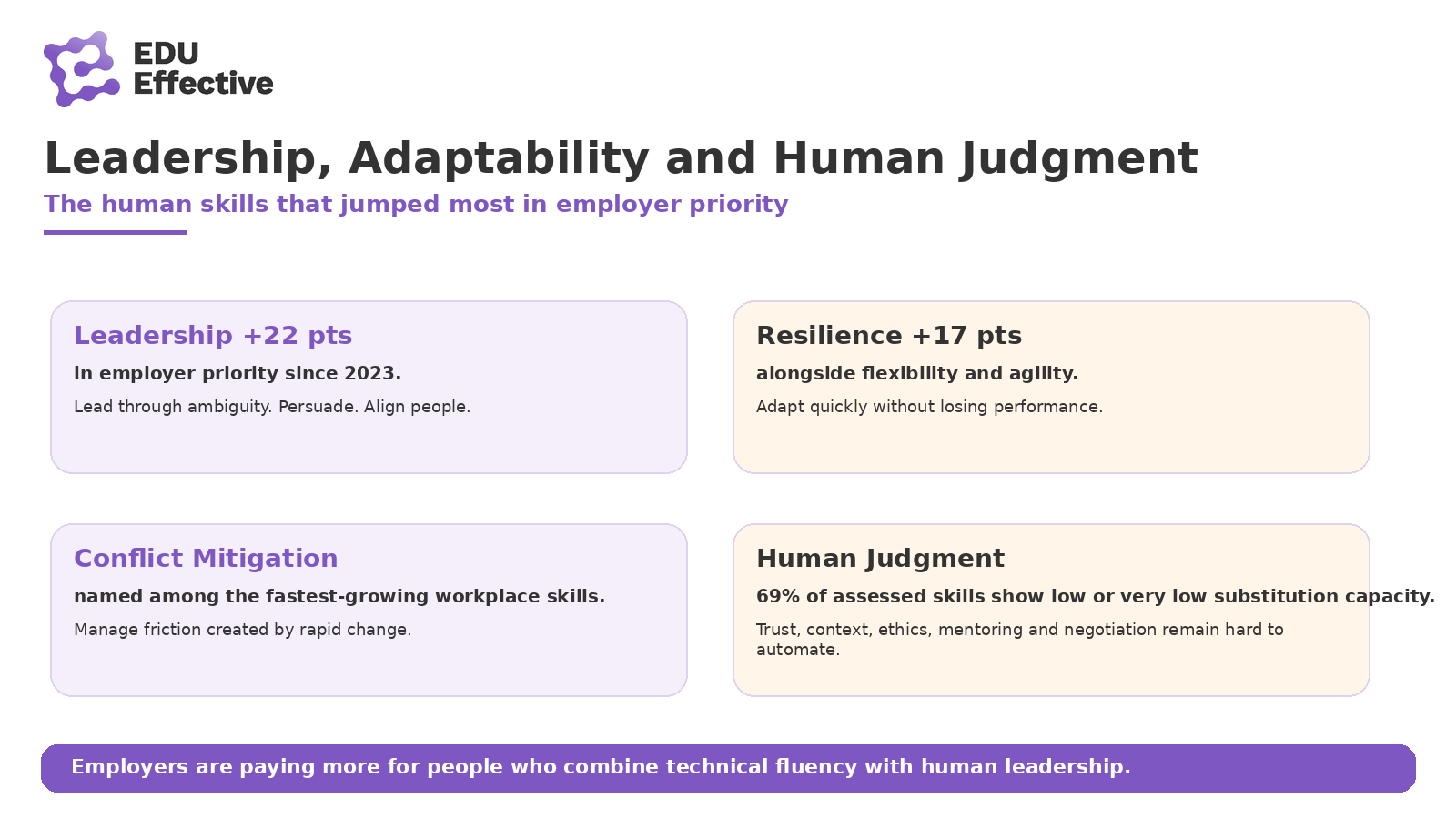
Read those together. Employers are simultaneously prioritizing technical AI fluency and the distinctly human capacity to lead through ambiguity, persuade, and adapt. That is not a contradiction. It reflects what companies actually need when they are reorganizing around AI: people who can bring teams through change, hold competing priorities in tension, and make decisions under uncertainty without freezing.
LinkedIn named conflict mitigation as one of the fastest-growing workplace skills in the US in 2025 — alongside AI literacy. That combination is telling. Organizations deploying AI at scale are generating more internal friction, faster change, and more demand for people who can manage the human dynamics of transformation.
The salary premium data follows accordingly. Roles that blend technical and leadership competencies consistently command higher compensation than either in isolation. A data analytics background plus team leadership is worth more than either alone. An AI implementation background plus change management experience is worth more than either alone. The market is pricing hybrid skill profiles significantly above single-discipline ones.
Skill Category 4: Data Literacy — Not Just for Analysts
Data and analytics has moved from a specialist function to a general business requirement. This is not about becoming a data scientist. It is about being able to read a dashboard without being misled by it, structure a business question that data can actually answer, and evaluate what a model’s output does and does not tell you.
WEF places AI and big data as a top 10 core skill for employers across industries. McKinsey’s workforce data shows that growing occupations — concentrated in management and professional services — require roughly 68 distinct skills, and data interpretation features heavily across most of them. The ability to reason from data is not separable from analytical thinking; it is its current form.
For mid-career professionals, the practical implication is that data literacy is no longer something you can route around by working with analysts who translate for you. Organizations are thinning those translation layers. Decision-makers who cannot read the underlying data are becoming slower and more expensive. The gap between data-literate and data-illiterate managers is widening, and employers are starting to account for it in compensation and promotion decisions.
Skill Category 5: Communication and Human Judgment
The WEF’s GenAI substitution analysis assessed more than 2,800 distinct skills. None showed “very high capacity” for substitution. Sixty-nine percent were rated “very low” or “low” capacity for substitution by current AI.
The skills least substitutable by AI are the ones most dependent on human relationships, context, and judgment. Communication — specifically the kind that navigates ambiguity, builds trust, and lands in the emotional reality of another person — is in that category. So is mentoring, negotiation, ethical reasoning, and the capacity to hold space for uncertainty without projecting false confidence.
This is not a soft skills argument. It is a structural one. AI is very good at producing plausible text that sounds like communication. It is not good at the part of communication that actually changes what someone believes or how they behave. That gap is where human professionals live, and where they are increasingly irreplaceable.
LinkedIn’s fastest-growing skills list for 2025 — conflict mitigation, adaptability, AI literacy — is not three separate things. It is a single portrait: professionals who can operate confidently in ambiguous, rapidly changing environments, bring others along, and work intelligently with AI tools. That combination is what employers in 2027 are actively recruiting for and willing to pay above-market for.
What the Salary Premium Map Actually Looks Like
McKinsey’s 2026 analysis of US workforce transitions found that growing occupations are concentrated in the top two wage quintiles. Roughly 57 to 60% of growing employment is in those top-earning segments, concentrated in healthcare, management, and professional services. Declining employment is concentrated in the bottom two quintiles.
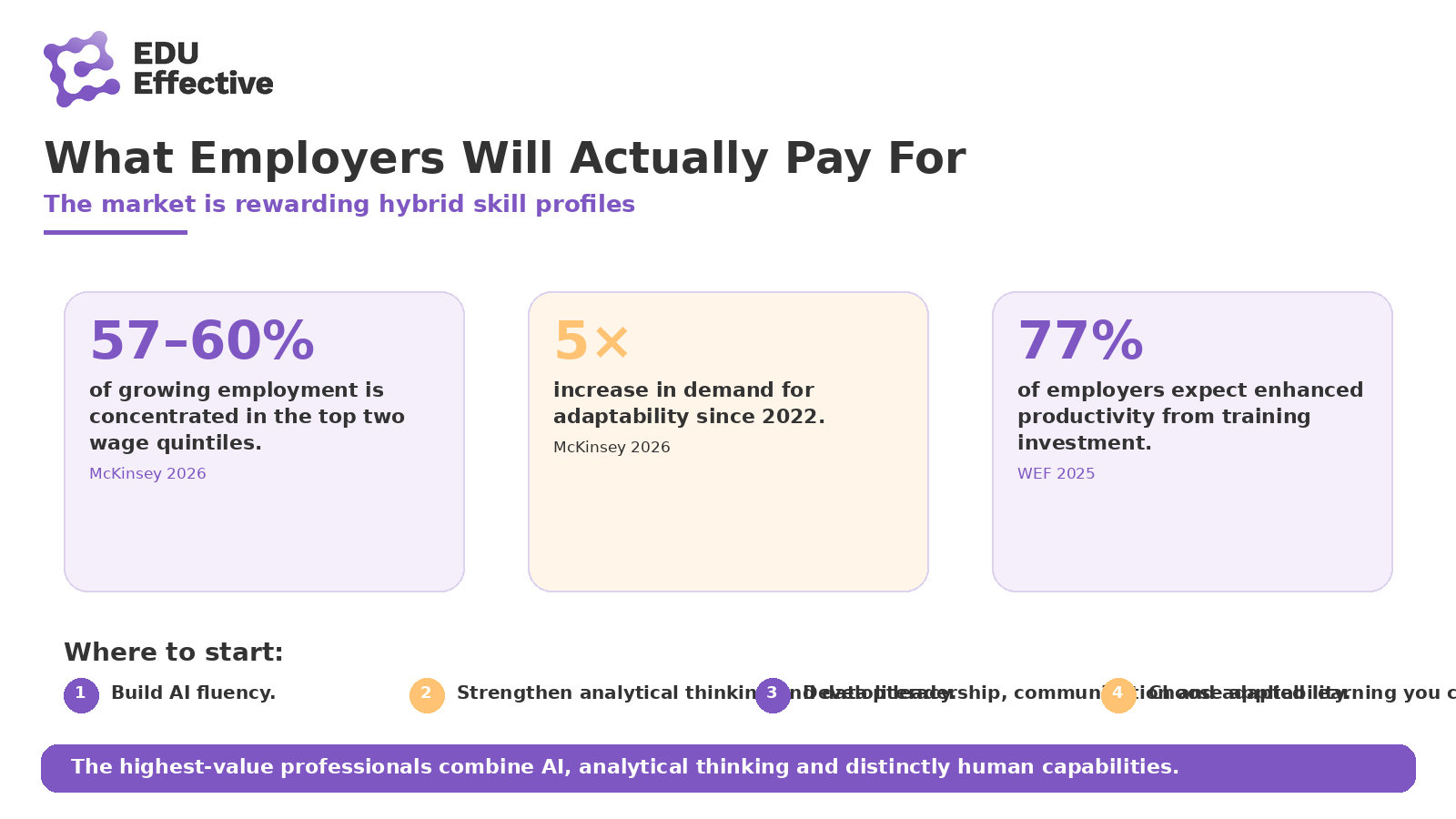
The implication for professionals in the middle of their careers: the trajectory is bifurcating. Jobs that require a combination of technical fluency, analytical thinking, and human leadership competencies are moving toward higher compensation. Jobs that are primarily operational, routine, or easily automated are moving toward displacement or wage stagnation.
Demand for AI fluency rose 11-fold since 2022. Demand for adaptability rose fivefold. These are not marginal trends. They are the result of employer investment decisions being made right now, reflected in what gets funded in training budgets, what shows up in job descriptions, and what hiring managers cite when they reject candidates.
The 11% of workers globally that WEF predicts will need reskilling but are unlikely to get it — that group is not randomly distributed. It is disproportionately concentrated in roles and industries where employers have not yet invested in workforce development, and where individuals have not yet invested in themselves.
Where to Start — Without Going Back to School Full-Time
The answer most professionals hear is that they need to add AI skills, leadership development, and data literacy to their existing job responsibilities. The practical question is how.
Micro-credentialing and structured professional development programs have expanded significantly, largely in response to this demand. The WEF data supports this: employers cited enhanced productivity (77%) and improved competitiveness (70%) as the top expected outcomes of training investment. The ROI case for professional development has gotten cleaner, not harder to make.
What the most effective programs have in common: they combine conceptual frameworks with applied practice, they are built for people who are already working, and they develop skills across the combination that the market is now pricing — not just one dimension in isolation.
Where EDU Effective Comes In
The five programs available through EDU Effective Business School are built specifically for working professionals who need to develop across exactly this skills combination: AI fluency, analytical and leadership capability, data and marketing intelligence, and the coaching and interpersonal skills that underpin high-performance management.
About EDU Effective Business School
EDU Effective Business School offers programs built for professionals who need to learn while they keep working. Runs on 15 minutes a day, completes in 10 months or less and is ASIC accredited.
Browse the programs · What students say · Start your application
Sources
- World Economic Forum — Future of Jobs Report 2025, January 2025 (63% Skills Gap Barrier; 39% of Core Skills Transformed by 2030; 78 Million Net New Jobs; Skills Outlook) https://www.weforum.org/publications/the-future-of-jobs-report-2025/in-full/3-skills-outlook/
- World Economic Forum — Future of Jobs Report 2025 Press Release, January 2025 (78 Million New Job Opportunities by 2030, but Urgent Upskilling Needed) https://www.weforum.org/media/future-of-jobs-report-2025-78-million-new-job-opportunities-by-2030-but-urgent-upskilling-needed-to-prepare-workforces/
- McKinsey Global Institute — Workforce in Motion: Skills and Pathways to Future Jobs in the United States, September 2026 (AI Fluency Demand Up 11-Fold; 68 Skills in Growing Occupations; Wage Quintiles) https://www.mckinsey.com/mgi/our-research/workforce-in-motion-skills-and-pathways-to-future-jobs-in-the-united-states
- LinkedIn — Most In-Demand Skills on the Rise for 2025, via Forbes, March 2025 (AI Literacy 6x in Job Descriptions; Conflict Mitigation Among Fastest-Growing Skills) https://www.forbes.com/sites/carolinecastrillon/2025/03/19/linkedin-reveals-the-most-in-demand-skills-on-the-rise-for-2025/