

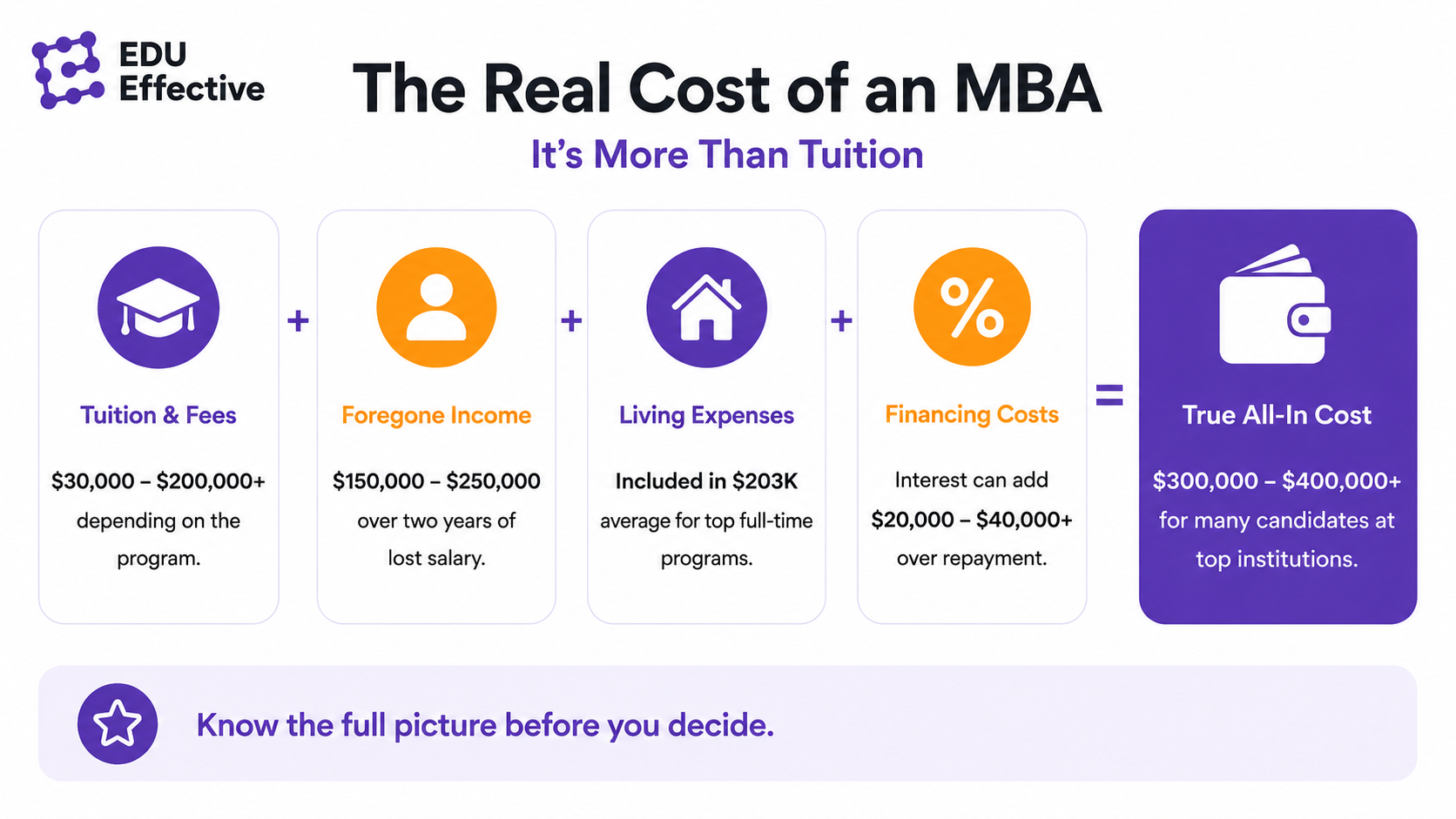
The total cost of a top-ranked full-time MBA programme in 2026 averages $203,000, according to GMAC's MBA.com data. That figure includes tuition, living expenses, healthcare, and additional fees across a two-year programme at a leading business school. Add the salary foregone during two years without income — typically $80,000 to $150,000 for professionals in their early career — and the true economic cost of a full-time MBA at a prestigious institution can exceed $300,000 for many candidates.
That number is not designed to discourage. It is the starting point of an honest cost-benefit analysis — the calculation that determines whether any specific MBA, for any specific person, in any specific situation, produces a positive return.
The honest answer is that it depends entirely on which MBA, for what purpose, at what cost, in what career context. An MBA that costs $203,000 and produces a $60,000 annual salary increase has a different ROI than an MBA that costs €990 and produces the same career outcome. Understanding the full cost picture — and the full return picture — is what makes this calculation possible to do honestly rather than aspirationally.
The full cost of an MBA — what most comparisons understate

Tuition is the most visible cost of an MBA and frequently the one most carefully compared between programmes. It is also, for full-time programmes, often the smaller of two major cost categories.
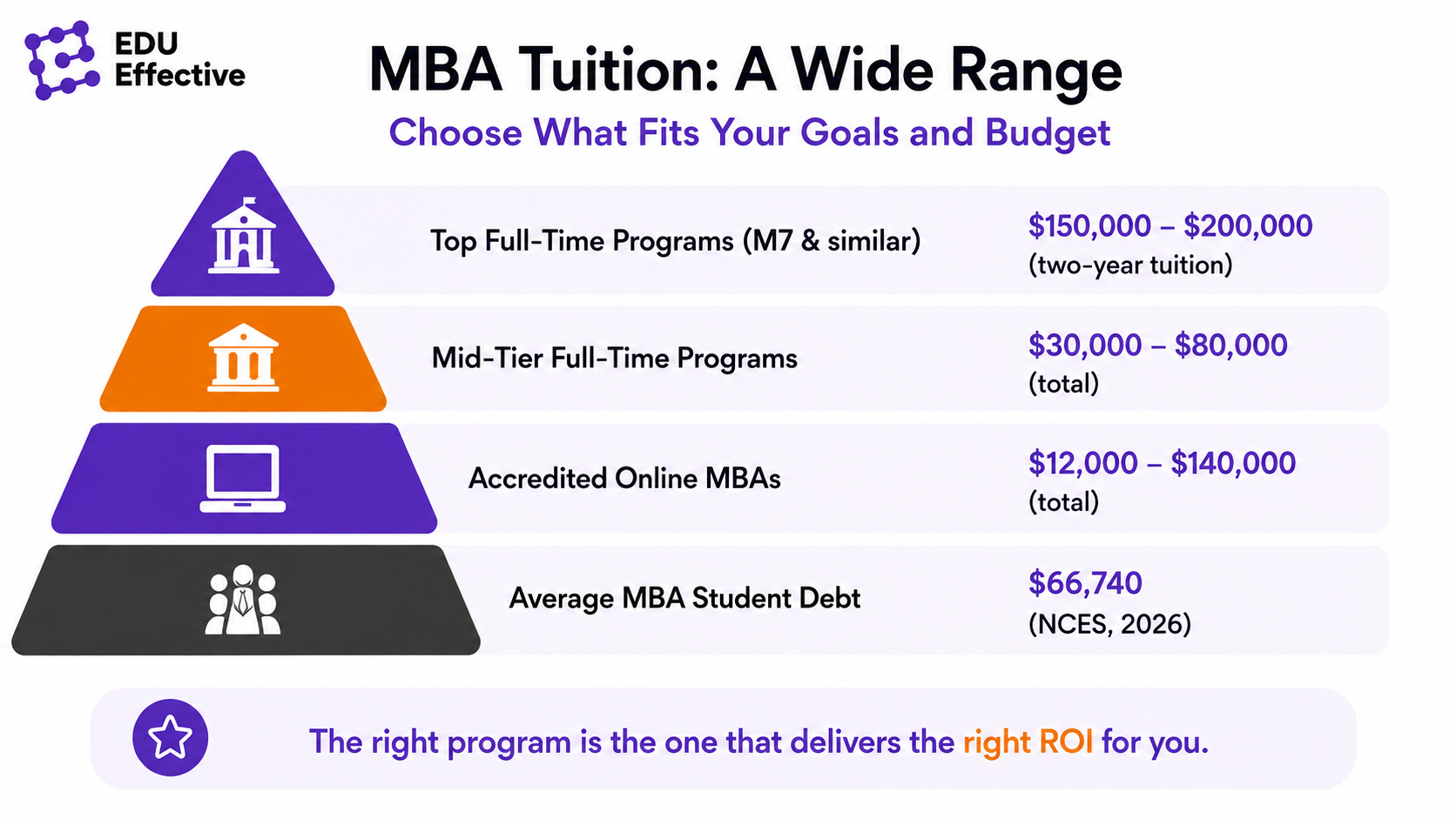
Tuition and fees across the MBA market in 2026 span an enormous range. At the top of the market, programmes at Wharton, Harvard Business School, Stanford GSB, Columbia, and comparable institutions charge tuition of $75,000 to $100,000 per year — producing two-year tuition totals of $150,000 to $200,000. Mid-tier full-time programmes at reputable public universities range from $30,000 to $80,000 total. Accredited online MBA programmes from recognised institutions range from under $12,000 to over $130,000, with the most widely respected options — Carnegie Mellon Tepper, UNC Kenan-Flagler, Indiana Kelley — sitting between $80,000 and $140,000. The average MBA student debt at graduation, according to the National Center for Education Statistics, is $66,740 — though this includes many students at lower-cost programmes, and the figure at elite institutions is substantially higher. M7 programmes (Harvard, Wharton, Stanford, Booth, Kellogg, Stern, Columbia) produce average debt burdens of over $130,000.
Foregone income is the cost that most MBA cost analyses understate and most prospective students underestimate. A professional leaving a job paying $90,000 to $120,000 for two years of full-time study does not just pay tuition — they also forgo two years of salary, two years of employer pension contributions, two years of career progression, and two years of compounding earnings growth. For the typical full-time MBA candidate, foregone income over two years represents $150,000 to $250,000 in total economic cost. This means the true all-in cost of a full-time MBA at a top institution is not $203,000 — it is $300,000 to $400,000 when foregone income is properly included.
Living expenses during a full-time programme add a further layer. Students relocating to New York, Boston, San Francisco, or London for a residential MBA face cost-of-living expenses that bear no resemblance to their pre-MBA housing costs. GMAC's total cost estimate of $203,000 includes living expenses, but the actual figure varies significantly by location.
Financing costs compound the picture further. An MBA funded through student loans does not cost $66,740 — it costs $66,740 plus interest over the repayment period. At a 6% interest rate over a ten-year repayment term, $66,740 in principal becomes approximately $88,000 in total repayment. At the $130,000 debt level typical of M7 programmes, total repayment exceeds $170,000.
What an MBA returns — the income side of the calculation
The return side of the MBA ROI calculation has two components: the immediate salary premium and the long-term career trajectory effect.
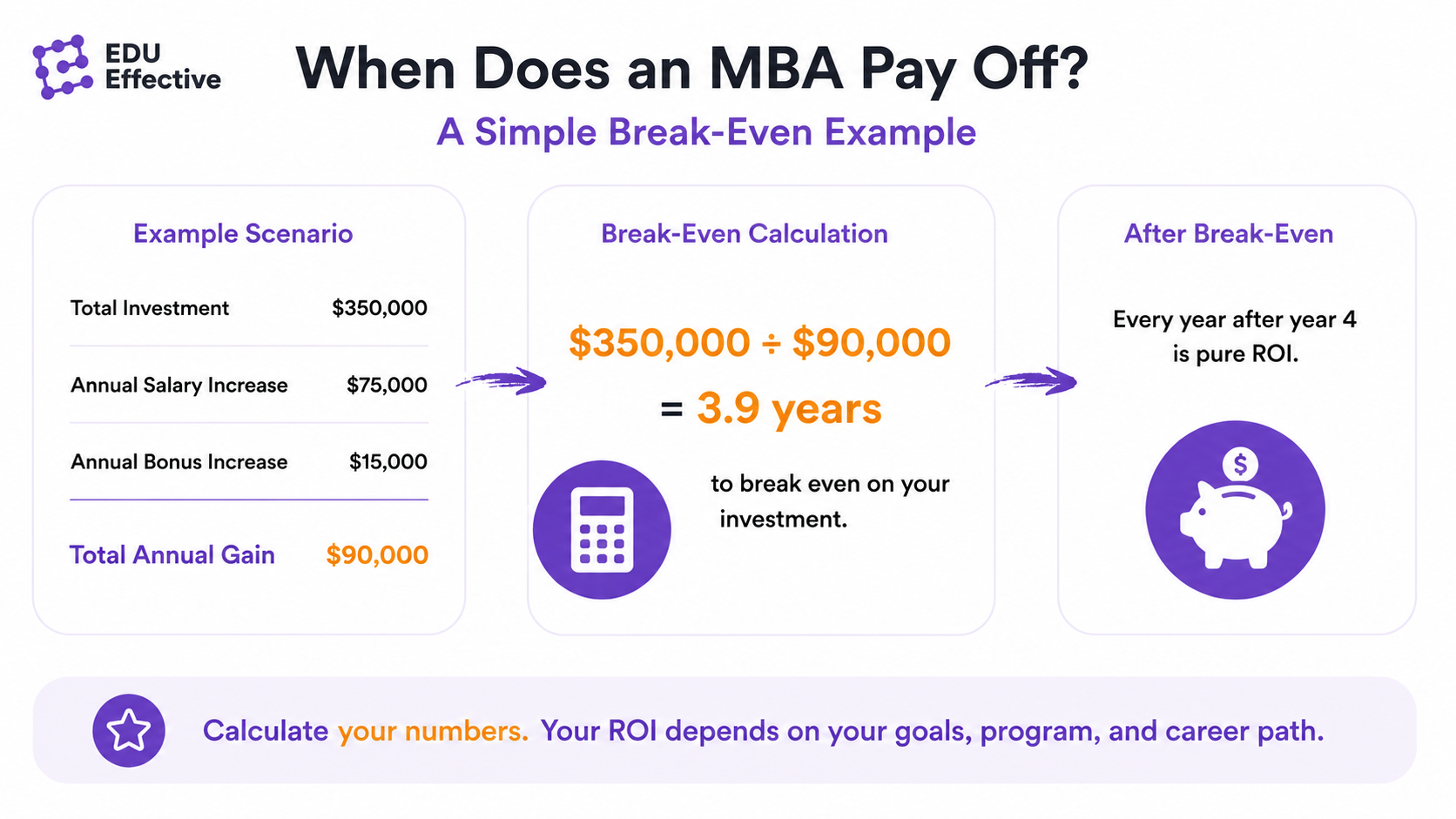
Immediate salary premium. The median starting salary for MBA graduates reached $125,000 in 2025, according to GMAC's Corporate Recruiters Survey — representing approximately 1.67 times the median salary of bachelor's-only holders in comparable roles. The premium varies substantially by industry and institution. In management consulting at McKinsey, BCG, and Bain, first-year MBA associates earn base salaries of $190,000 or higher, plus signing bonuses of $35,000 to $50,000 — a total first-year package often exceeding $225,000. In technology companies like Amazon, Google, and Microsoft, MBA-track roles typically command base salaries of $140,000 to $175,000 plus equity. In financial services at major investment banks and asset managers, MBA-track compensation is broadly comparable to consulting. Outside these premium industries, the immediate salary premium is more modest — many MBA graduates in general management, marketing, and operations roles see first-year salaries of $85,000 to $110,000.
Long-term trajectory effect. The salary premium that matters most over a career is not the starting salary but the trajectory it enables. According to GMAC alumni survey data, the median salary increase for MBA graduates is 80% above pre-MBA earnings within five years of graduation. For career switchers — professionals using the MBA to pivot from a lower-earning field to consulting, finance, or technology — the lifetime earnings differential can be substantial. The estimated average lifetime earnings premium for MBA graduates compared to bachelor's-only professionals, across the full working career, is frequently cited in the range of $1 million to $3 million — though this figure varies enormously by individual circumstances and cannot be attributed entirely to the MBA credential itself.
The ROI calculation — what it actually looks like
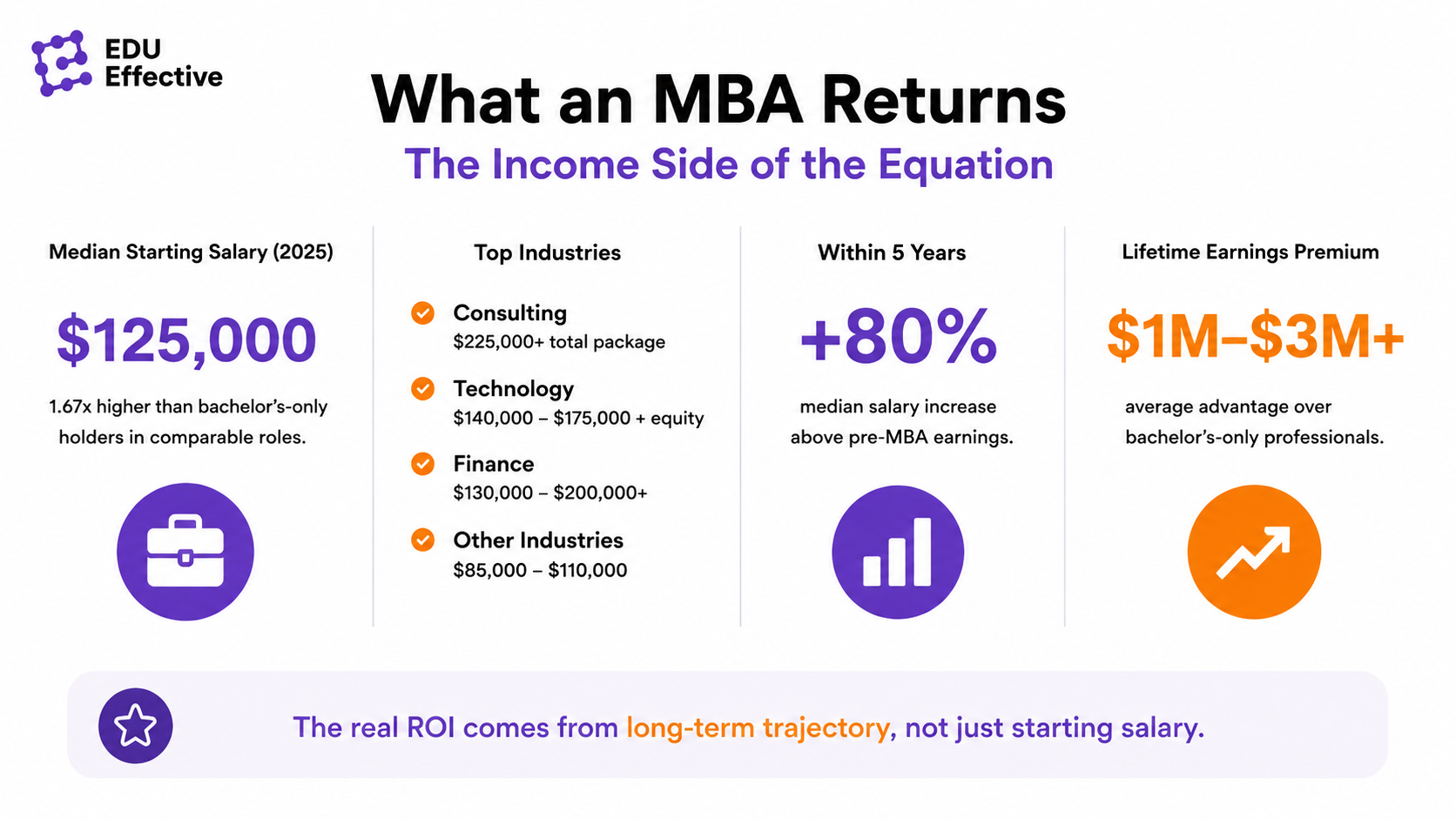
The breakeven analysis for an MBA — the point at which cumulative earnings premium equals total investment — depends on three variables: total cost of the programme, the annual salary increase it produces, and how much of that increase would have occurred without the MBA.
For a full-time MBA at an elite institution with a total cost (including foregone income) of $300,000, producing an annual salary premium of $40,000 above the graduate's likely trajectory without an MBA, breakeven occurs after approximately 7.5 years post-graduation. Add financing costs and the timeline extends further.
For the same $40,000 annual premium at a total programme cost of $80,000 (a mid-tier online MBA completed without leaving employment, so no foregone income), breakeven occurs in two years. The premium cost of a prestigious institution produces a better outcome only if the premium salary it enables exceeds what the lower-cost programme would have produced — which is true in certain specific career paths and false in most others.
For a professional MBA programme costing €990, the breakeven calculation looks different again. If the programme produces even a modest salary increase — a 5% raise on a €50,000 salary represents €2,500 per year — the investment recovers in months rather than years. If it supports a promotion that would otherwise have taken an additional two years, the lifetime value is substantially larger. And if it is one factor among several in building the leadership, AI, or marketing capabilities that support sustained career advancement, the return is compounding rather than one-time.
Where the ROI is strongest — and where it is weakest
The MBA's ROI varies more by career outcome than by programme prestige. The programmes that produce the strongest financial returns are those that unlock specific career paths with substantially higher compensation than the graduate's pre-MBA trajectory — and that are used for exactly that purpose.
Strongest MBA ROI occurs when: the graduate is switching into management consulting at an MBB firm, investment banking, or private equity — where the on-campus recruitment pipeline of a top institution is genuinely necessary for access; the graduate is transitioning careers into a substantially higher-earning field; or the employer funds all or most of the tuition, making the out-of-pocket cost negligible.
Weakest MBA ROI occurs when: the graduate stays in their current field and company in a role they likely would have reached without the credential; the programme is funded primarily through debt at high interest rates; the prestige premium of the institution chosen exceeds what the specific career outcome requires; or the credential's primary function is personal satisfaction rather than a specific career outcome it enables.
The alternative calculation that most MBA ROI analyses ignore is the return available from professional education at a fraction of the cost. A working professional who invests €990 in a professionally accredited programme that develops genuine leadership, AI, and management capabilities — and applies those capabilities directly to their current role — is not choosing between spending €990 and spending €80,000 on the same outcome. They are choosing between different investments in different outcomes. The €990 investment is appropriate for career advancement within the professional's current field and organisation. The €80,000 investment may be appropriate for a specific institutional career pivot that requires it. Conflating the two is the most common error in MBA ROI analysis.
Employer tuition support — the most underutilised cost-reduction lever
One of the most consistent findings in MBA funding research is that employer tuition support is available to more professionals than use it. SHRM's Employee Benefits Survey found that 48% of employers offer tuition assistance for graduate studies. Many more organisations will support professional development that is directly tied to their business priorities, even without a formal tuition assistance programme.
A professional who frames their MBA study as building capabilities the organisation needs — and can demonstrate the specific connection between their programme and current business objectives — frequently finds that financial and scheduling support is available that would not have been offered unprompted. The conversation worth having before paying for any MBA programme out of personal funds is: does my employer have any interest in supporting this, and have I actually asked?
For professional MBA programmes specifically, the cost is typically low enough that employer support is not necessary for the investment to be accessible — but it remains available and worth pursuing, particularly when the programme content maps directly to an organisational priority.
The honest summary: what you are actually buying at each price point
A $200,000 MBA from a top institution buys a specific thing: access to on-campus recruitment pipelines at elite consulting, finance, and technology firms; a peer network of professionals who have passed the same rigorous selection process; and a credential that signals to a specific subset of employers that you cleared a very high bar. For the career paths where those specific things matter, the price can be justified.
A $30,000 to $80,000 online MBA from an accredited university buys an academic credential recognised within the formal education system, developed competence in core business disciplines, and a qualification that many employers will accept as evidence of business education. For professionals who need an academic credential at a manageable cost, this range represents reasonable value.
A €990 professional MBA from EDU Effective buys something different again: immediately applicable business capabilities in leadership, AI, marketing, coaching, or executive management; a professionally accredited credential recognised internationally; content drawn from a library of over 24,000 curated videos from practitioners at Google, McKinsey, Amazon, Goldman Sachs, Netflix, and faculty from Harvard Business School, Yale, Stanford, Princeton, and Cambridge; a format that takes 15 minutes a day and ten months or less; and a 14-day money-back guarantee that removes the risk from the investment entirely.
The right investment is the one that produces the specific outcome you need, at a cost that is proportionate to that outcome. The worst MBA investment is the most expensive one that does not produce the career outcome that justified its cost.
At EDU Effective, the Effective MBA is designed to deliver real business capability and a professionally accredited credential — at a cost that makes the investment decision straightforward. Explore our programs →
At EDU Effective, we build programs for professionals who want to work smarter — not just harder. Explore our programs →
EDU Effective Business School = professional development for your long-term success.
All best-selling Effective MBA programs are built for working adults: 15 minutes a day, 10 months or less, ASIC accredited, from €990.
- Effective MBA: Executive Management & Leadership
- Effective MBA: Applied Artificial Intelligence
- Effective MBA: Coaching, Leadership & Mentoring
- Effective MBA: Mastery in AI
- Effective MBA: Online Marketing
These are professional programs, not academic ones — built for working adults to apply what they learn directly in their own business, not to collect a scholarly credential.
Join more than 9,000 students in over 120 countries who are investing in their professional development and career success.
Read the feedback and experiences of our students and the stories of our graduates here.
Apply now — from €990 · Talk to a Study Advisor
Study with NO risk: 14-day money-back guarantee, no questions asked.
Sources
- GMAC / MBA.com — MBA ROI Calculator: Average Total Cost of Top MBA 2026 ($203,000) https://www.mba.com/business-school-and-careers/salary-and-roi/business-school-roi-calculator
- GMAC — 2025 Corporate Recruiters Survey: MBA Median Starting Salary ($125,000) https://www.gmac.com/market-intelligence-and-research/research-library/employment-outlook/2026-corporate-recruiters-survey-report
- GMAC — Alumni Perspectives Survey: 80% Salary Increase Within Five Years https://www.gmac.com/resources/learners/business-careers/employers-salaries/why-go-to-business-school-employers-salaries-outcomes
- National Center for Education Statistics (NCES) — Average Business School Student Debt: $66,740 https://nces.ed.gov/
- PwC — 2026 Global AI Jobs Barometer: AI Skills Premium https://www.pwc.com/gx/en/news-room/press-releases/2026/pwc-2026-ai-jobs-barometer.html
- SHRM — Employee Benefits Survey: Tuition Assistance https://www.shrm.org/topics-tools/research/employee-benefits-survey
- US Bureau of Labor Statistics — Management Occupations: Median Annual Wage and Employment Data https://www.bls.gov/ooh/management/