
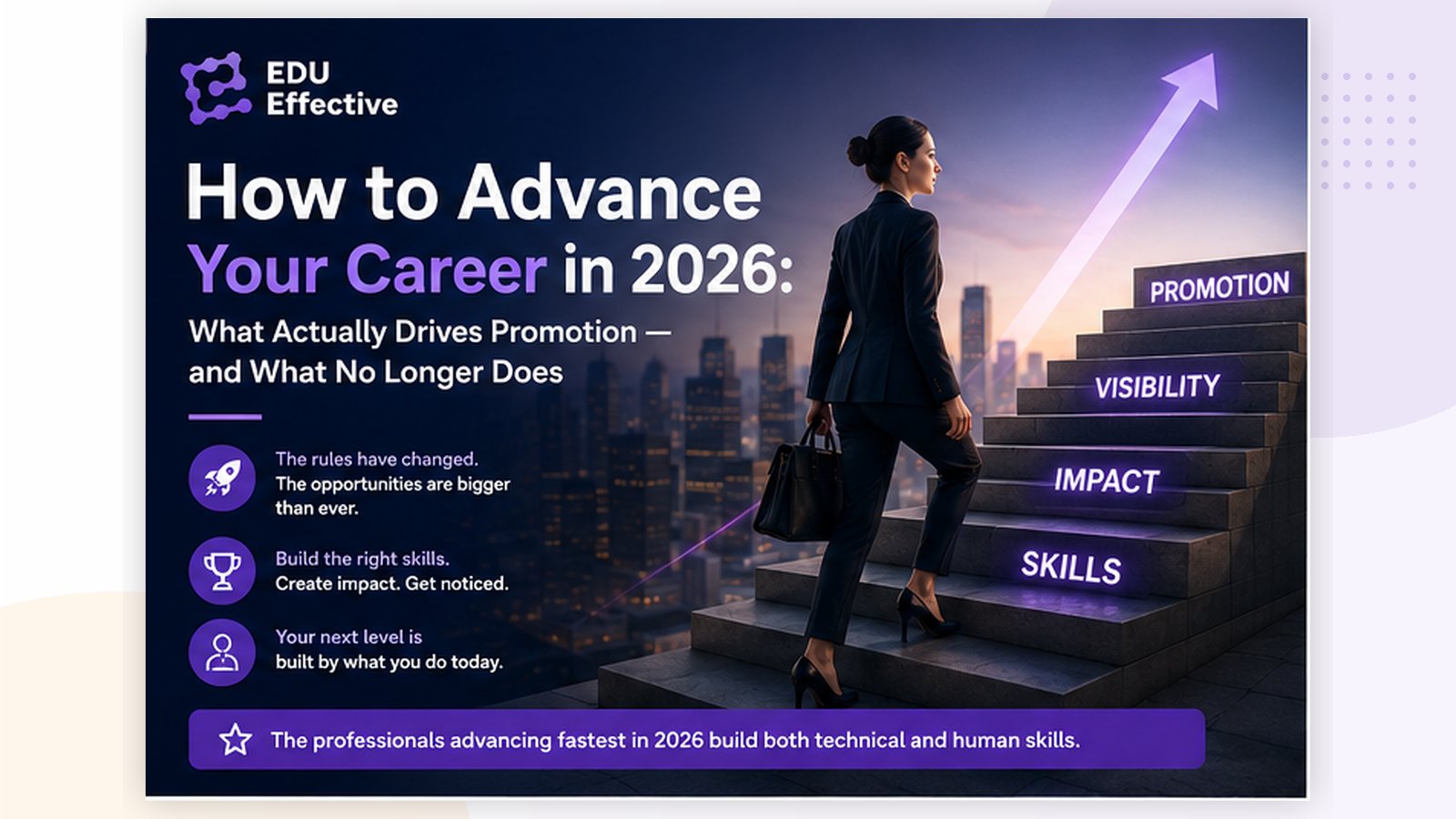

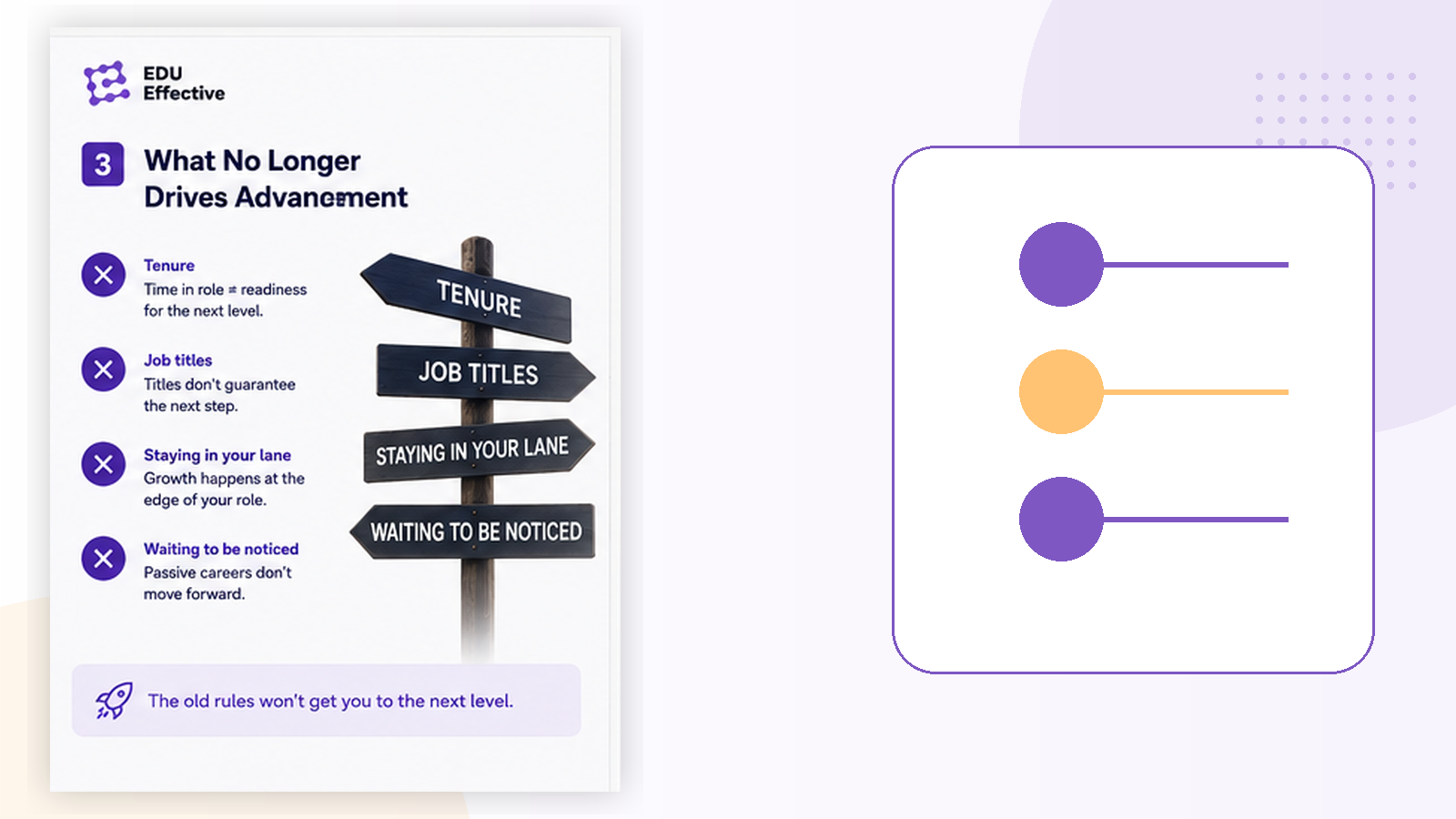
The traditional rules of career advancement have not just evolved — several of them have broken. Tenure no longer guarantees promotion. Job titles no longer predict the next step. And the skills that made someone competitive three years ago may already need significant updating.
PwC's 2026 Global AI Jobs Barometer, which analysed more than one billion job advertisements across 27 countries, found that jobs requiring AI skills are growing almost eight times faster than the overall jobs market — and command a wage premium of 62%. That premium more than doubled from 25% in 2024 to 62% in 2026. In two years, AI fluency has moved from a niche technical advantage to one of the largest skill premiums ever recorded in the labour market.
But the same report contains a finding that is less widely discussed: AI is simultaneously increasing demand for distinctly human skills — judgement, creativity, leadership, and adaptability — particularly at the senior levels where career advancement decisions are actually made. The professionals advancing fastest in 2026 are not those who have replaced human skills with technical ones. They are those who have built both.
Why the rules of career advancement have changed
For most of the 20th century, career advancement followed a reasonably predictable pattern: join an organisation, demonstrate competence in your role, accumulate experience, and progress through a hierarchy at a pace determined by seniority and performance. The system was imperfect — it favoured insiders, rewarded compliance, and moved slowly — but it was legible. You could roughly predict your career trajectory by looking at the people two levels above you.
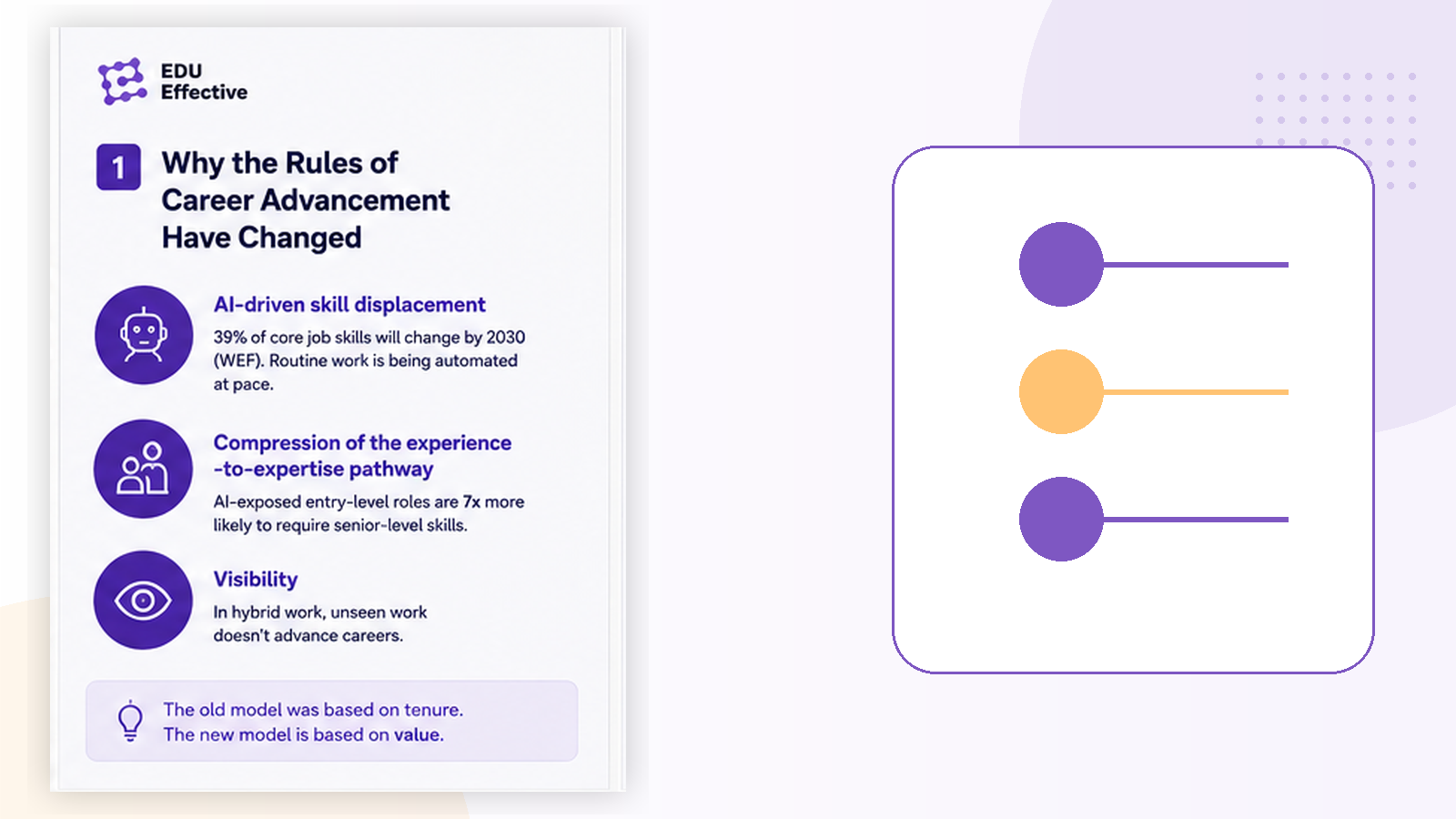
That model has been disrupted by three forces operating simultaneously in 2026.
The first is AI-driven skill displacement. The World Economic Forum projects that 39% of core job skills will change by 2030. Skills that were specialised and valuable five years ago — data entry, basic analysis, routine content creation, standard reporting — are being automated at pace. The professionals who built their career value on these capabilities are facing a structural challenge, not a temporary one.
The second is the compression of the experience-to-expertise pathway. PwC's Barometer found that AI-exposed entry-level roles are now seven times more likely to require skills traditionally associated with senior staff — leadership, stakeholder management, and strategic decision-making. AI is removing the routine apprenticeship work that once served as the on-ramp to senior responsibility. Junior professionals are being asked to demonstrate senior-level judgement earlier, and those who can are advancing faster than any previous cohort.
The third is visibility. In an era of distributed and hybrid work, the assumption that consistent, high-quality work will be noticed by the right people is no longer reliable. Work that is not visible — to senior leaders, to cross-functional peers, to the broader organisation — does not advance careers regardless of its quality. This is not unfair; it is structural. And it requires a deliberate response.
What actually drives promotion in 2026
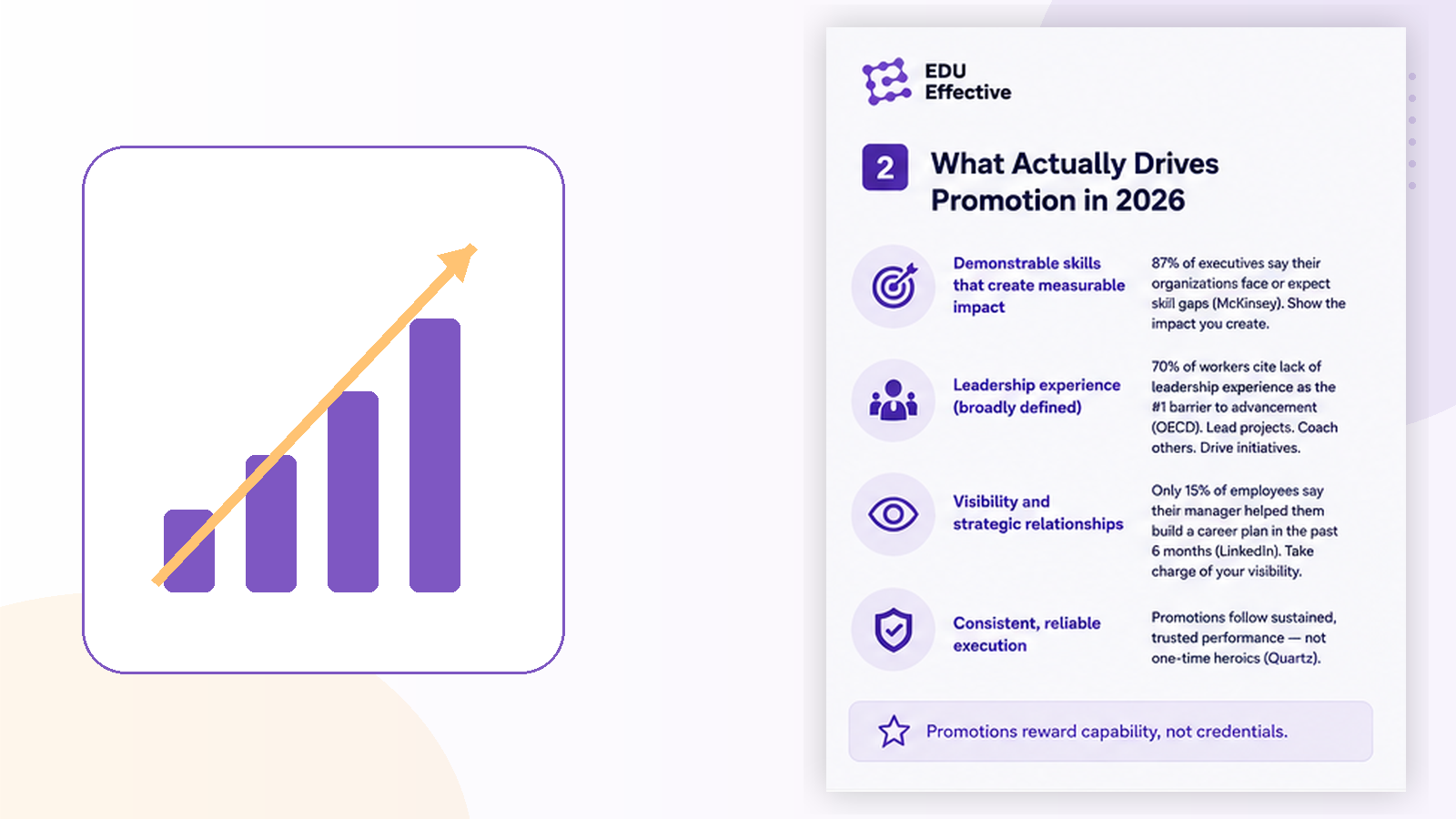
Research from Gartner identifies three factors reshaping promotion criteria: the need for a future-ready workforce, the evolving role of managers, and emerging talent priorities that weight demonstrated competency over credentials. Across these factors, a consistent pattern emerges: promotion decisions in 2026 reward people who demonstrate capability, not those who wait for it to be recognised.
Demonstrable skills that create measurable impact. The shift from seniority-based to skills-based evaluation is well-documented across industries. McKinsey research found that 87% of executives say their organisations either face skill gaps already or expect them to develop within five years — which means the professionals who demonstrably fill those gaps are in high demand. The key word is demonstrably: skills that exist but are not visible, not applied, and not linked to measurable outcomes do not influence promotion decisions.
Leadership experience — broadly defined. 70% of workers cite lack of leadership experience as the primary factor preventing their career advancement, according to OECD data. But leadership experience in 2026 is not limited to managing a team. It includes leading projects, coordinating across functions, presenting to senior stakeholders, driving initiatives beyond your job description, and coaching others. Every one of these activities builds the evidence base that informs a promotion decision — and every one of them can be pursued without a manager's permission.
Visibility and strategic relationships. LinkedIn's 2025 Workplace Learning Report found that only 15% of employees say their manager helped them build a career plan in the past six months. Most professionals are navigating career advancement with limited structured support from the people who observe their work most closely. Waiting for that support to materialise is a passive strategy. The professionals advancing fastest are those who actively manage their visibility — through the quality of their contributions in high-stakes situations, through relationships with senior leaders outside their immediate team, and through the external professional presence that makes them legible to the broader market.
Consistent, reliable execution. Multiple CEOs interviewed by Quartz for their January 2026 career advancement research cited the same pattern: promotions rarely follow dramatic performances. They follow sustained, reliable delivery over time — the kind that builds the trust that decision-makers rely on when choosing who to put in a more demanding role. "The biggest career jumps I've seen never started with bold moves. They started with quiet consistency," noted one business founder in the study. Before changing a title, managers look at behaviour — who completes routine work reliably, who maintains quality under pressure, who can be trusted with more.
The skill categories that command the highest premium in 2026
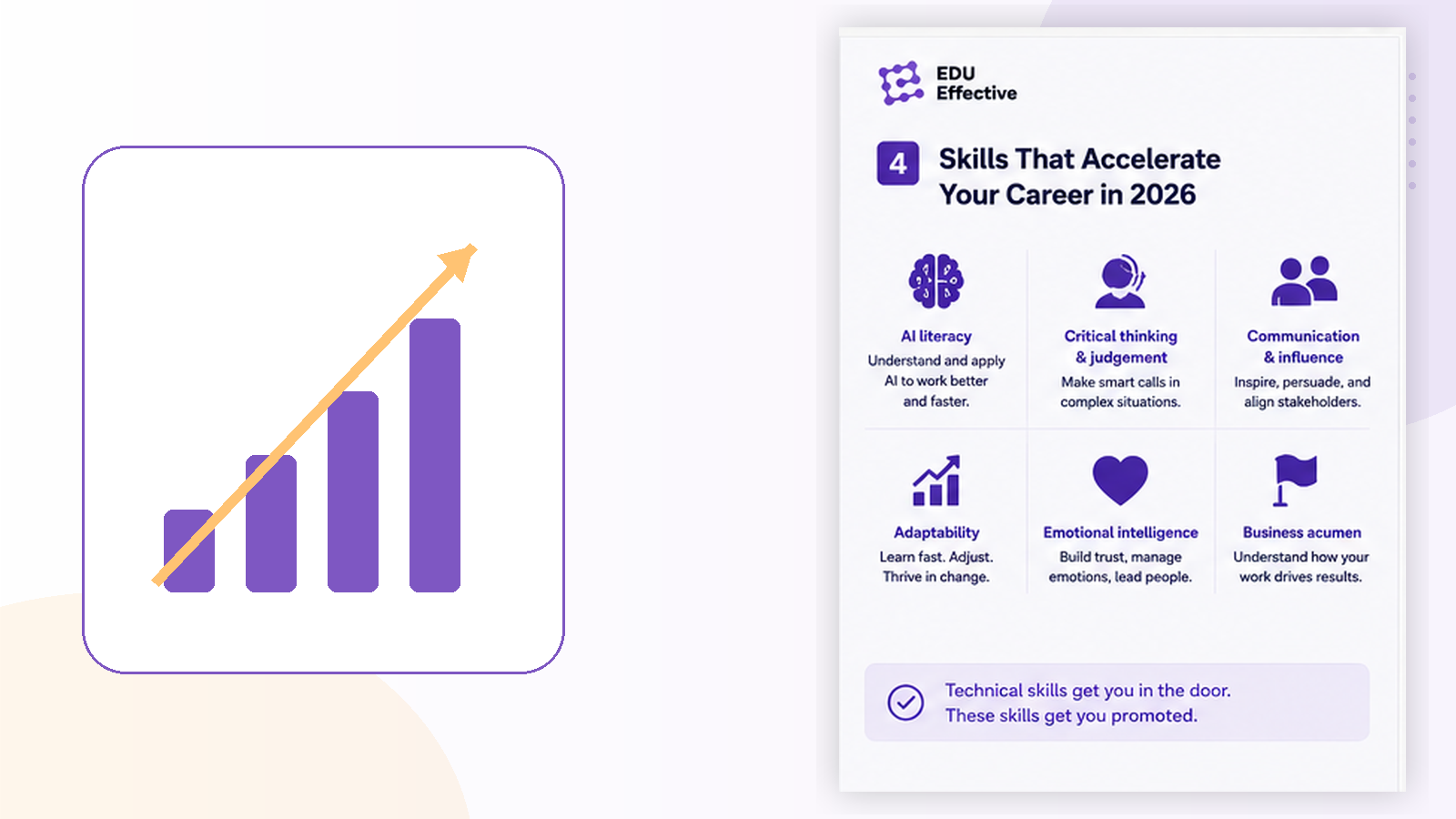
Not all skills are equally valuable for career advancement. The labour market data from PwC, WEF, and LinkedIn consistently identifies the same clusters as the highest-premium combination.
AI and digital fluency. The 62% wage premium for AI skills is the headline number — but it is worth understanding what it means in practice. It is not limited to engineers or data scientists. The premium applies across functions including marketing, finance, HR, and general management. Professionals who can use AI tools intelligently, evaluate AI-generated outputs critically, implement AI in their workflows, and govern AI use responsibly are commanding significantly higher compensation than peers who cannot — in the same roles, at the same seniority levels.
Leadership and management capability. PwC's research explicitly identifies leadership as one of the human skills commanding the highest premium in an AI-augmented labour market. This reflects the structural reality that AI handles more analytical and routine work, leaving the distinctly human capabilities — leading people, building trust, navigating ambiguity, making consequential decisions — as the primary source of differentiated value at senior levels.
Communication and influencing skills. The ability to communicate complex ideas clearly, influence stakeholders who do not report to you, and present with credibility to senior audiences consistently emerges in promotion research as a key differentiator. In hybrid and remote environments, where written communication carries more weight and the signals that create presence in physical spaces are absent, communication quality has become a more visible and more consequential professional capability.
Cross-functional knowledge and strategic thinking. Professionals who understand how their function connects to business outcomes — who can read financial performance, understand competitive dynamics, and make decisions with awareness of their broader implications — are consistently rated as higher-potential candidates for senior roles than those with deep functional expertise but narrow business understanding.
The mentoring and networking multiplier
60% of professionals credit mentorship with accelerating their career growth, according to OECD data. Professionals with a mentor are three times more likely to be promoted within two years, according to SHRM research. These numbers are not surprising — they reflect what mentors provide that technical skills and hard work alone cannot: access to perspective on how organisations actually work, introductions to people who would otherwise be unreachable, honest feedback on blind spots, and advocacy in rooms the mentee cannot yet enter.
The most effective mentoring relationships in 2026 are specific rather than general. Rather than seeking a generic career mentor, the professionals gaining the most from these relationships identify a specific challenge or transition they are navigating — moving from individual contributor to people manager, transitioning into a new function, building credibility in a new organisation — and find someone who has made that specific move.
Strategic networking operates on the same logic. Maintaining genuine professional relationships across an organisation and an industry is not a peripheral career activity — it is infrastructure. The opportunity you cannot see, the role that is not yet posted, the introduction that changes the trajectory of a career: these flow through networks built on genuine professional relationships, not transactional connection requests.
The professional development investment that compounds
The professionals advancing fastest in 2026 share one structural characteristic: they are actively investing in their own development rather than waiting for their organisations to provide it. LinkedIn's data shows only 15% of managers helped their direct reports build career plans recently. The majority of people navigating career growth are doing so without structured support.
This creates a specific opportunity for self-directed professionals. McKinsey research found that fewer than 40% of companies have a clear reskilling strategy — which means most organisations are opening roles their current workforce is not equipped to fill. The individual who has proactively built the skills those roles require is in a structurally advantaged position.
The fastest-returning investment for most professionals is the combination of leadership and management capability with AI fluency — precisely because these are the skill categories commanding the highest premiums and because most professionals have invested in neither systematically. A working professional who spends 15 minutes a day developing leadership, management, coaching, or AI skills over ten months produces a credential, a genuine capability uplift, and a differentiating evidence base for the next promotion conversation — without pausing their career to do it.
What career advancement requires from you — specifically
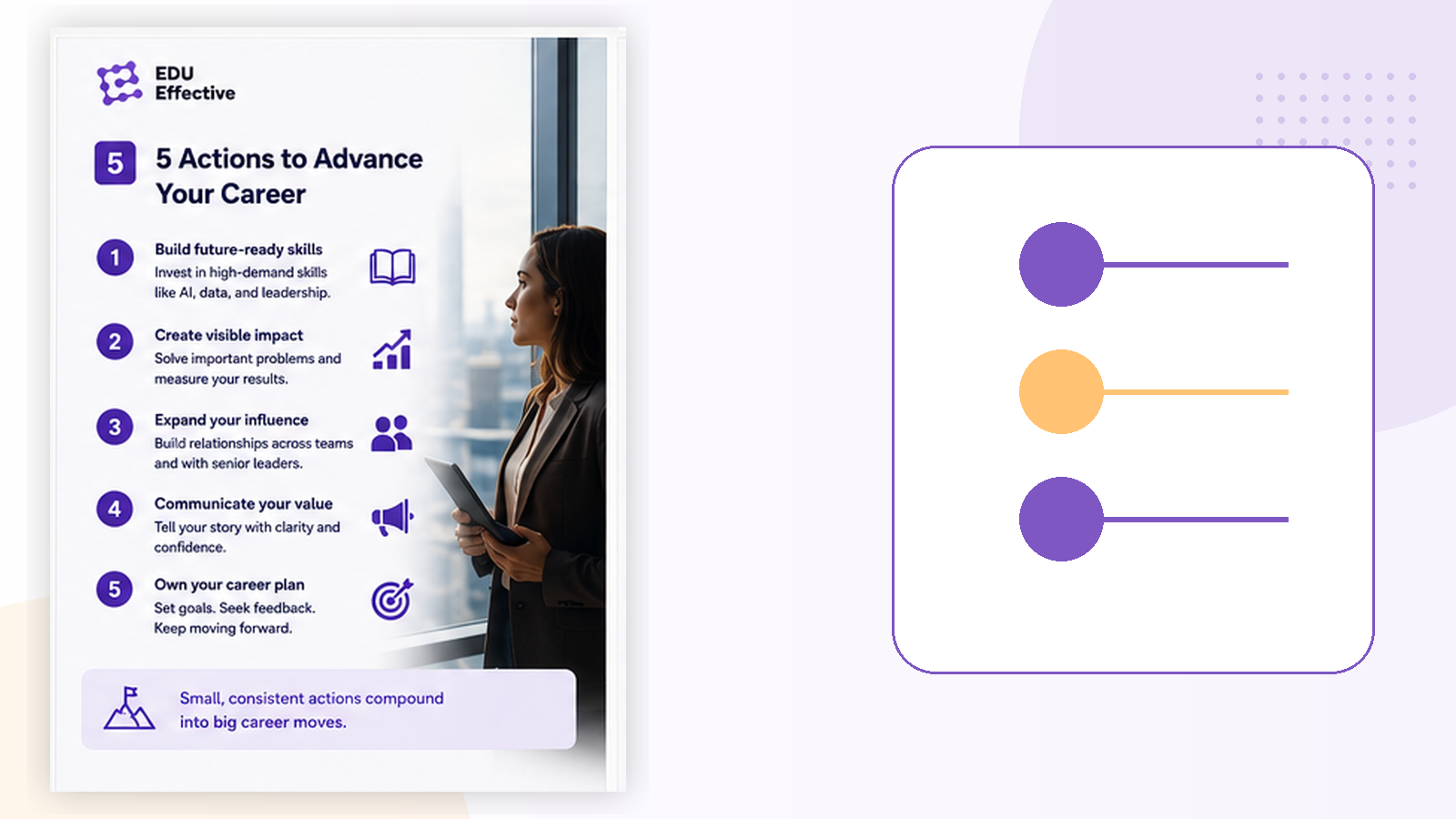
Several practical actions consistently distinguish professionals who advance from those who plateau, regardless of function or industry.
Define where you are going before you plan how to get there. Career advancement without a direction is activity without orientation. The specific role you want in three years determines which skills to build, which relationships to cultivate, and which experiences to seek.
Make your work legible. High-quality work that is not visible does not advance careers. This means communicating your contributions clearly in the language of business outcomes, not just task completion. It means being present in high-visibility situations. It means building relationships beyond your immediate team.
Seek feedback that is honest rather than comfortable. Most professionals receive feedback that is too positive to be useful — from managers who avoid difficult conversations, from colleagues who prioritise harmony. The feedback that accelerates development is specific, addresses real patterns, and comes from people who will tell you what they actually observe.
Invest in the skills that command premiums — not just the ones you already have. The skills that got you to your current level are not necessarily the ones that will advance you to the next. Understanding which capabilities are valued at the level above you — and building them before you need them — is the difference between being ready for a promotion and being a strong candidate for one.
At EDU Effective, our MBA programmes develop the leadership, management, AI, marketing, and coaching capabilities that create the skill premium needed for career advancement — in 15 minutes a day, without pausing your career. Explore our programs →
All five Effective MBA programs are built on the same educational model — designed for working adults who need learning that fits real professional life:
- Effective MBA: Executive Management & Leadership
- Effective MBA: Applied Artificial Intelligence
- Effective MBA: Coaching, Leadership & Mentoring
- Effective MBA: Mastery in AI
- Effective MBA: Online Marketing
At EDU Effective, we build programs for professionals who want to work smarter — not just harder. Explore our programs →
EDU Effective Business School = professional development for your long-term success.
All best-selling Effective MBA programs are built for working adults: 15 minutes a day, 10 months or less, ASIC accredited, from €990.
These are professional programs, not academic ones — built for working adults to apply what they learn directly in their own business, not to collect a scholarly credential.
Join more than 9,000 students in over 120 countries around the world to further your personal development and career success.
Read the feedback and experiences of our students and the stories of our graduates here.
Apply now — from €990 · Talk to a Study Advisor
Study with NO risk: 14-day money-back guarantee, no questions asked.
Sources
- PwC — 2026 Global AI Jobs Barometer (1B+ job ads, 27 countries) https://www.pwc.com/gx/en/news-room/press-releases/2026/pwc-2026-ai-jobs-barometer.html
- PwC — AI Jobs Barometer Full Report https://www.pwc.com/gx/en/1/services/ai/ai-jobs-barometer.html
- World Economic Forum — Future of Jobs Report 2025 https://www.weforum.org/publications/the-future-of-jobs-report-2025/
- McKinsey & Company — Beyond Hiring: How Companies Are Reskilling to Address Talent Gaps https://www.mckinsey.com/capabilities/people-and-organizational-performance/our-insights/beyond-hiring-how-companies-are-reskilling-to-address-talent-gaps
- LinkedIn — 2025 Workplace Learning Report https://learning.linkedin.com/resources/workplace-learning-report
- Gartner — Three Key Challenges Reshaping Promotion Criteria (2026) https://www.gartner.com/en/articles/future-of-work-trends
- Quartz — How to Get Promoted, According to CEOs and Experts (January 2026) https://qz.com/how-to-get-promoted
- DDI — Global Leadership Forecast 2025 https://www.ddiworld.com/research/global-leadership-forecast
- Gallup — State of the Global Workplace 2026 https://www.gallup.com/workplace/349484/state-of-the-global-workplace.aspx