


Most managers think they’re decent listeners. The data says otherwise.
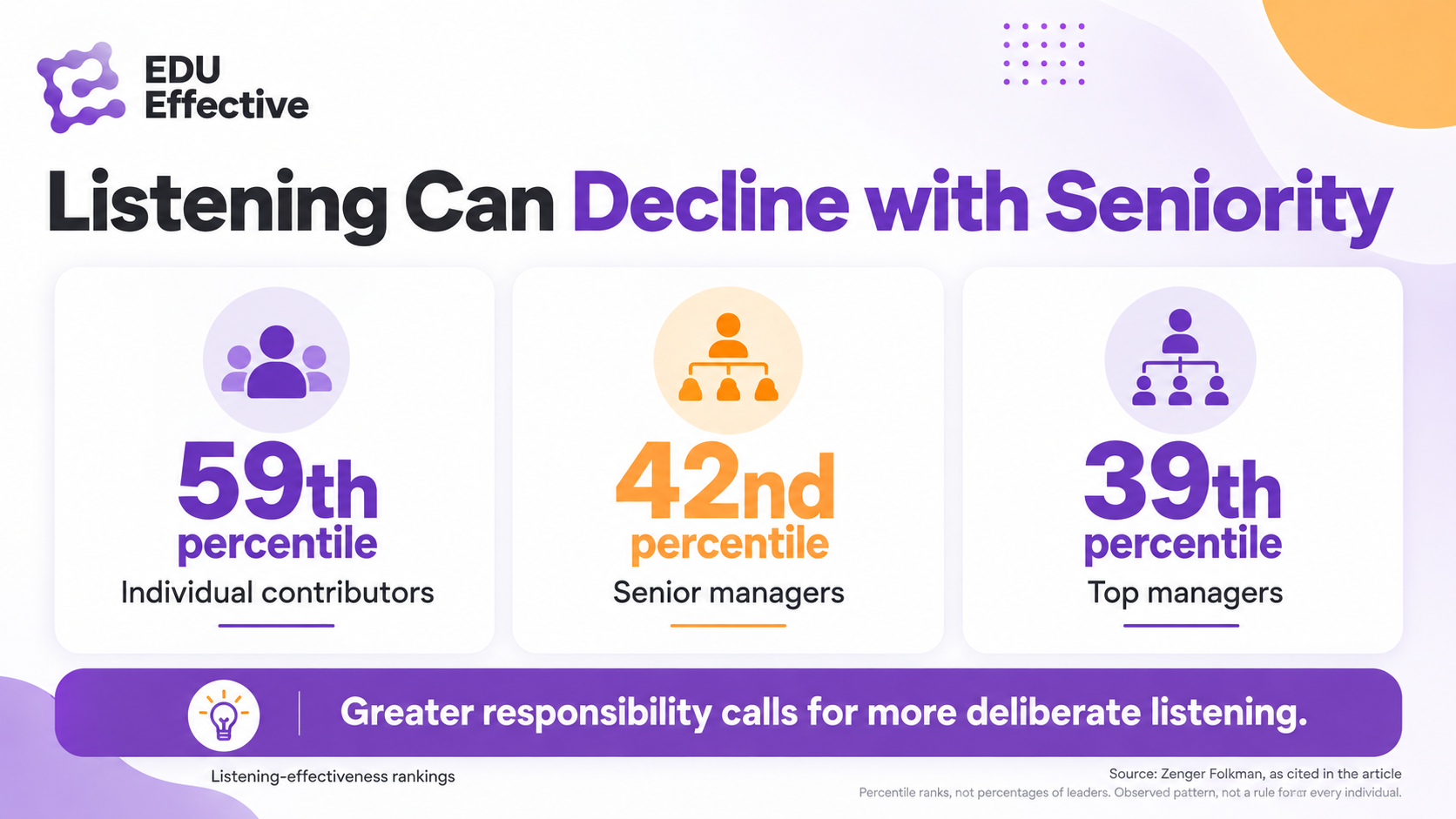
A study covering 4,219 leaders assessed through 360-degree feedback — drawing on a dataset of several hundred thousand leaders built by Zenger Folkman over a decade — found that listening effectiveness declines steadily as leaders move up the organizational hierarchy. Individual contributors score at the 59th percentile. By the time someone reaches a senior management position, that drops to the 42nd percentile. Top managers land at the 39th percentile. The higher the title, the worse the listening.
That’s not a coincidence. Power changes how people listen. Research cited by the Association for Talent Development points to studies from NYU Stern showing that people in positions of authority listen less, take advice less often, and make less accurate judgments than those without power. The promotion that gave you responsibility also, quietly, made you a worse listener — unless you actively worked against that tendency.
This matters because listening is not a soft skill in the “nice to have” sense. It is one of the highest-leverage management behaviors you can develop.
What the Research Says About Listening and Performance
Zenger Folkman’s dataset of 4,219 leaders with an average of nine raters each found a striking gap between the top and bottom of the listening distribution:
Leaders in the top 10% for listening reached the 76th percentile on employee engagement and the 92nd percentile on overall leadership effectiveness. The bottom 10% for listening shows the reverse. These aren’t small differences — they represent the gap between a manager whose team is producing and one whose team is quietly checking out.
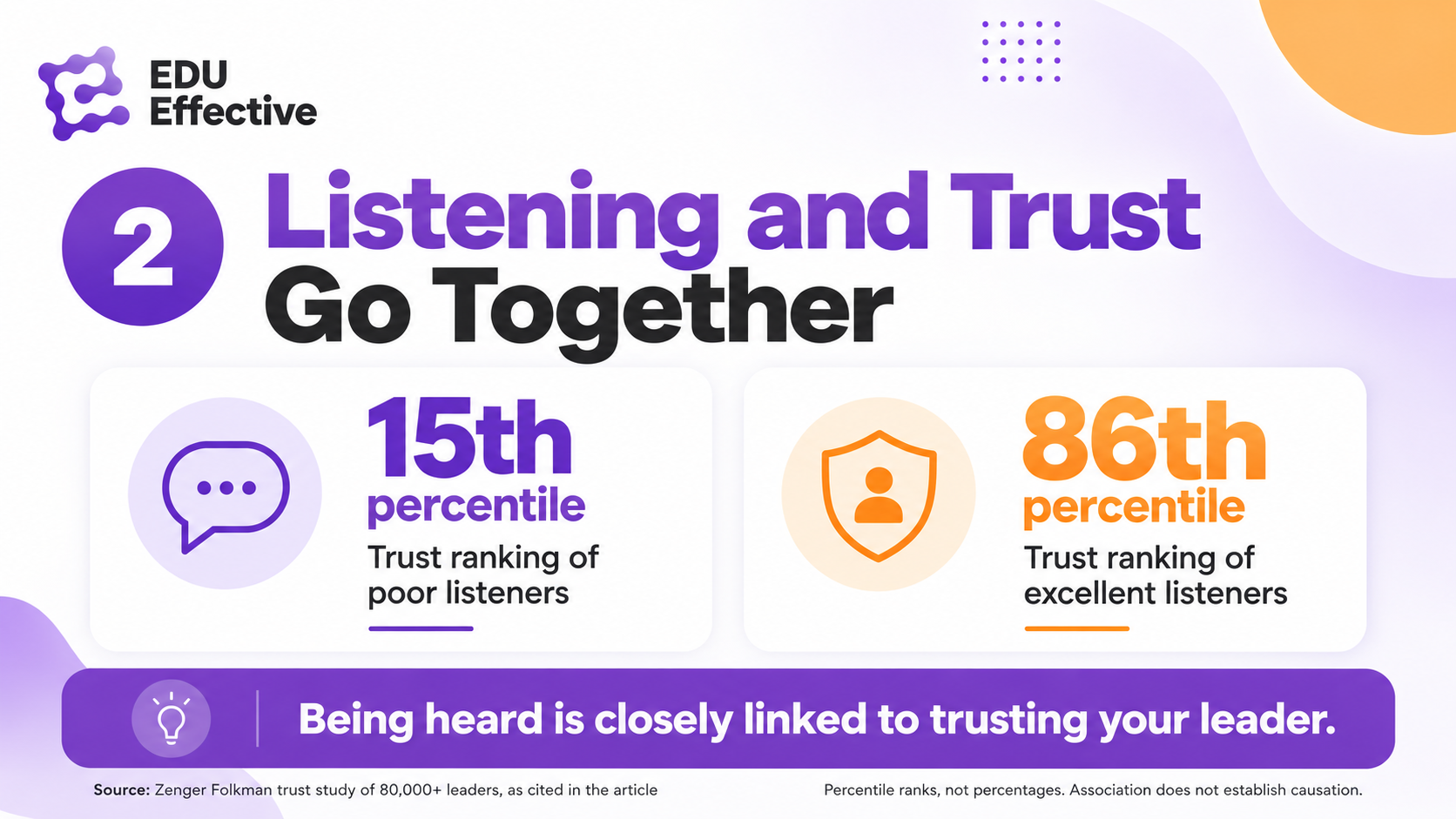
A separate Zenger Folkman trust study — covering over 80,000 leaders — identified the two behaviors most strongly correlated with trust in leadership. Both were tied to listening effectiveness. Leaders rated as poor listeners ranked at the 15th percentile in trust. Leaders who excelled at listening reached the 86th percentile. Trust, that notoriously hard-to-build and easy-to-lose asset, correlates more strongly with listening than with almost any other leadership behavior in the dataset.
Beyond Zenger Folkman’s work, a review of 144 studies published in the Journal of Business and Psychology — covering research from the USA, Israel, Germany, the UK, Japan, and Norway — found a significant and positive association between perceived listening and better relationship quality and job performance. Employees who feel listened to tend to perform better, show stronger organizational commitment, and go beyond their job descriptions. BI Norwegian Business School professors Christina Nerstad and Katrine Adair summarized the finding plainly: being listened to satisfies fundamental psychological needs for belonging, autonomy, and competence.
An American Management Association study found that 59% of respondents believe management does not listen to their concerns. That’s a majority. In most organizations, the default experience of employees is that their managers are not fully hearing them — and they’re probably right, given the listening decline that comes with seniority.
Why Smart People Listen Poorly
Understanding why listening breaks down is the prerequisite to fixing it. Colin Fisher (UCL School of Management) and Jeffrey Yip reviewed 117 academic papers on managerial listening and identified five structural barriers that cause good managers to listen badly.
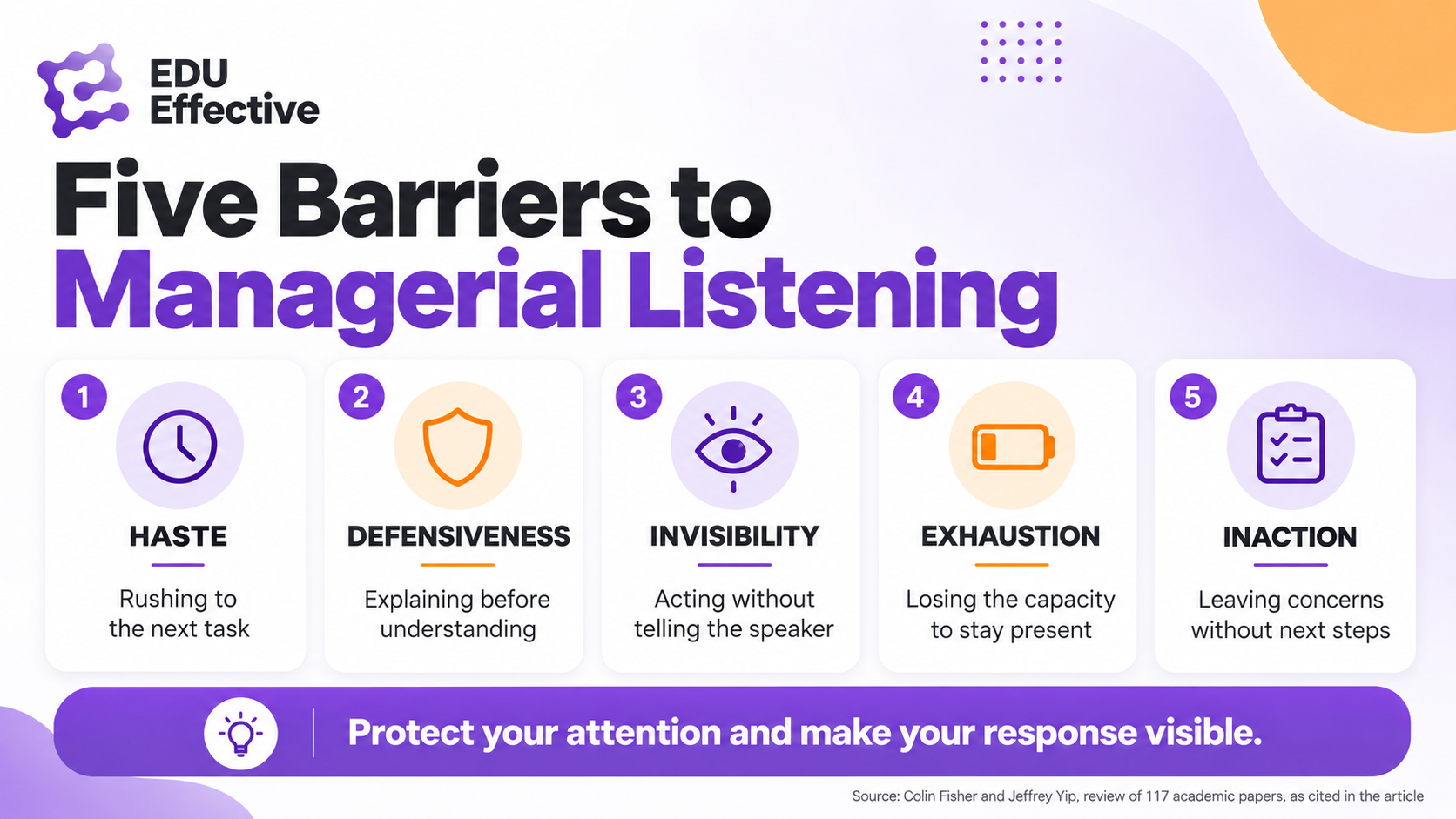
Haste
Managers run back-to-back meetings, respond to messages between them, and rarely build buffer time for genuine conversation. When you’re already thinking about the next thing while someone is talking, you’re physically present but not listening. The fix isn’t time management tips — it’s the intentional decision to create conversations where you’re not watching the clock.
Defensiveness
When someone raises a concern about your decision, your team, or your judgment, the natural response is to explain, defend, or counter. That impulse cuts off listening at exactly the moment it matters most. Defensive listening produces the experience employees describe when they say “talking to my manager feels pointless” — they watch you hear the words and immediately generate reasons they’re wrong.
Invisibility
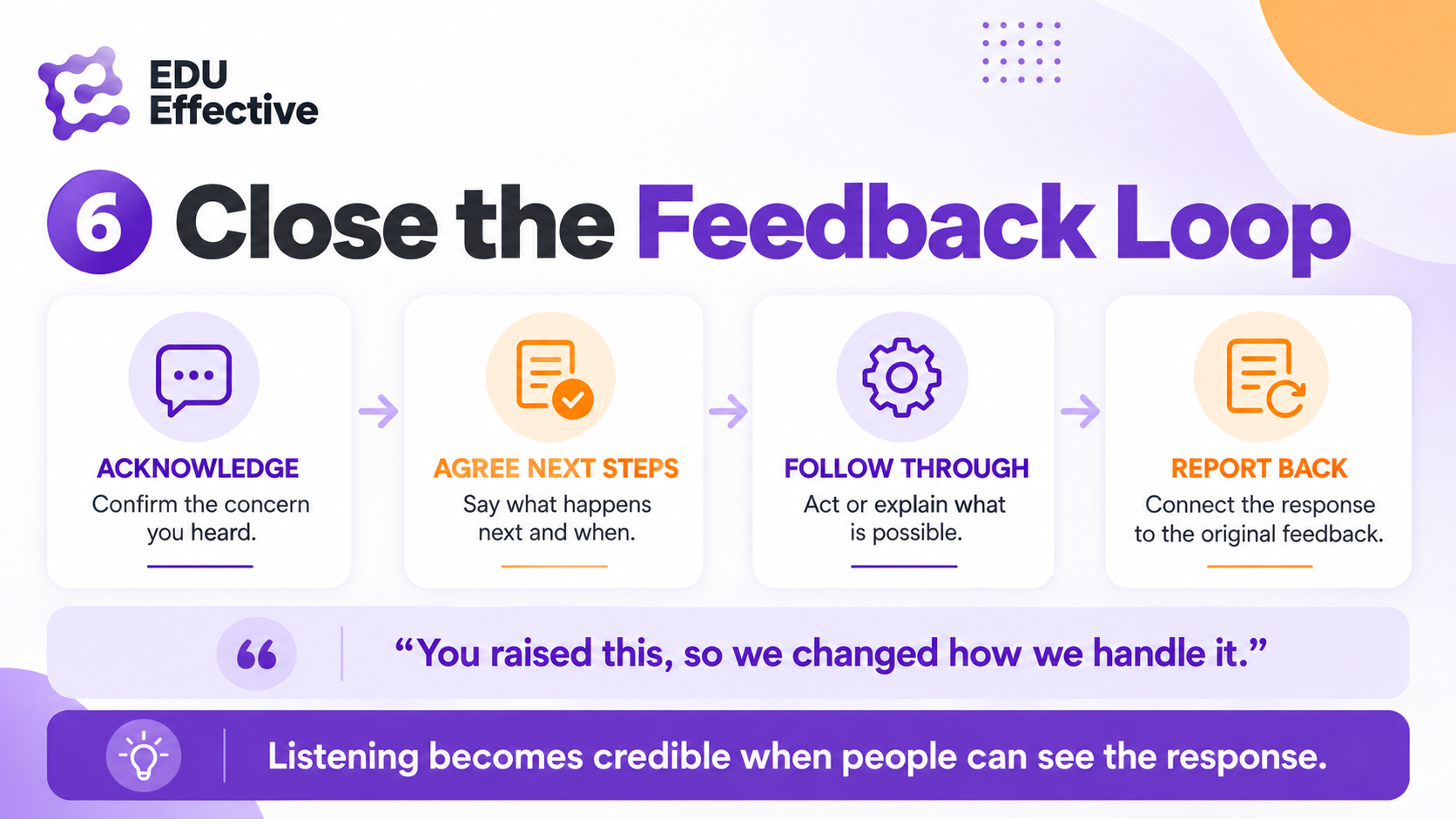
This one is underappreciated. Managers often act on feedback without communicating that they have. They take a concern to heart, make a change, but never connect the change back to the person who raised it. From the employee’s perspective, nothing happened. Fisher and Yip describe this as usually unintentional — managers assume the action speaks for itself. It doesn’t. The visible loop of “you raised this, we changed this because of it” is what builds the belief that speaking up is worth doing.
Exhaustion
Managers who hear many concerns across a day or week can develop what researchers describe as listener fatigue — a diminishing capacity to stay fully present with problems. The research cited by Fisher and Yip from Christopher Rosen links this to mistreating subordinates: managers who are worn down by repeated listening demands sometimes respond with dismissiveness or irritability. Clear boundaries — not every concern needs to be addressed immediately, not every conversation needs to go deep — protect the listening capacity you do have.
Inaction
Fisher and Yip identify this as the most damaging barrier. Slow responses to what employees have shared erode trust faster than almost any other managerial behavior. When someone tells you something important and weeks pass without acknowledgment or next steps, the implicit message is that the listening was performance. Confirming the conversation, setting a timeline, and following through are what turn active listening into actual trust-building.
The Difference Between Hearing and Listening
Active listening is a term that’s used so often it has nearly lost meaning. What it describes, stripped of jargon, is listening that affects the speaker — that changes how they think, not just what they say.
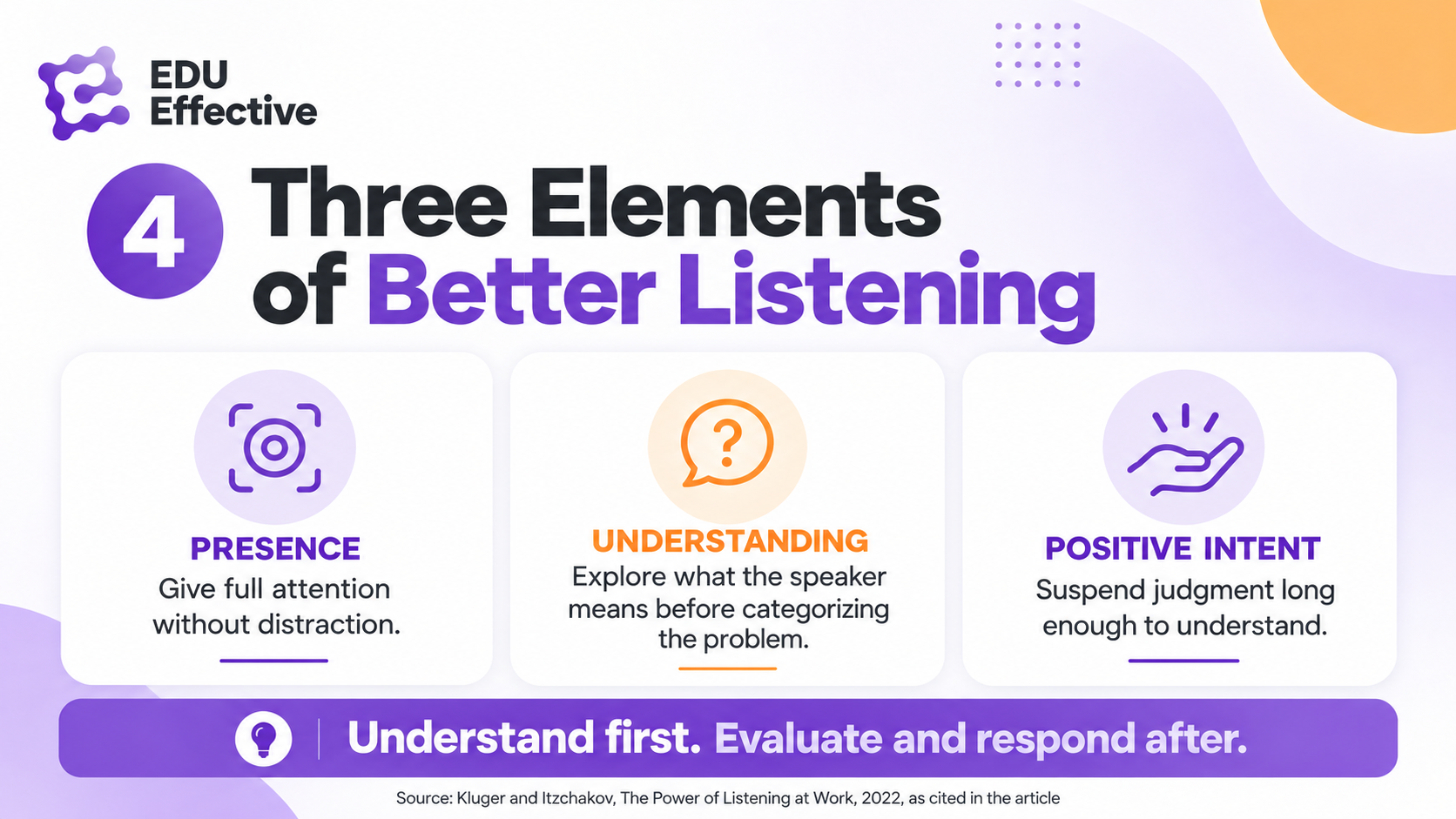
Research from Avraham Kluger (Hebrew University of Jerusalem) and Guy Itzchakov — summarized in their paper “The Power of Listening at Work” in the Annual Review of Organizational Psychology and Organizational Behavior — identifies three elements that distinguish transformative listening from ordinary attention:
Presence. Full attention without distraction — not split between the conversation and your phone, the next meeting, or your internal response to what’s being said. This is harder than it sounds. The default state of a manager’s mind is not restful presence — it’s active processing of what needs to happen next.
Understanding. The attempt to genuinely grasp what the other person means, not to translate their words into categories you already have. Most managerial “listening” is actually pattern-matching: you identify that this person is raising a concern about workload, and you start generating your response to workload concerns before they’ve finished explaining their specific situation.
Positive intent. Listening without a judgment agenda. This doesn’t mean accepting everything uncritically — it means suspending the evaluative reflex long enough to actually understand the position before responding to it.
Kluger and Itzchakov’s research also found something striking about attitude change: people with extreme or opposing views are more likely to adjust them when they feel listened to and are asked open questions. You cannot argue someone into a new position. You can listen them there.
What Good Listeners Actually Do Differently
The Zenger Folkman data on strong listeners goes beyond the aggregate numbers. Leaders rated in the top decile for listening showed specific behavioral patterns that distinguished them from average listeners:
They asked open-ended questions — questions that cannot be answered with yes or no, and that therefore require the speaker to elaborate. This isn’t a technique, it’s a signal: it tells the other person that you want more of their thinking, not just a confirmation of what you already think.
They accepted feedback without defensiveness — a behavior that is both a consequence of good listening and a prerequisite for it. The less defensive you appear, the more honest the information people bring you.
They demonstrated willingness to change based on what they heard. This is visible behavior. When people see that what they say actually influences decisions, the quality of what they share improves. When they don’t see that, they stop sharing.
They gave honest feedback that others accept — a reciprocal outcome. People who feel genuinely listened to are more receptive to feedback from that same person. The trust built through listening is converted into the ability to be heard when you have something important to say.
Five Practices That Actually Improve Listening
The research points to specific behaviors — not dispositions, but behaviors — that move listening from average to strong.
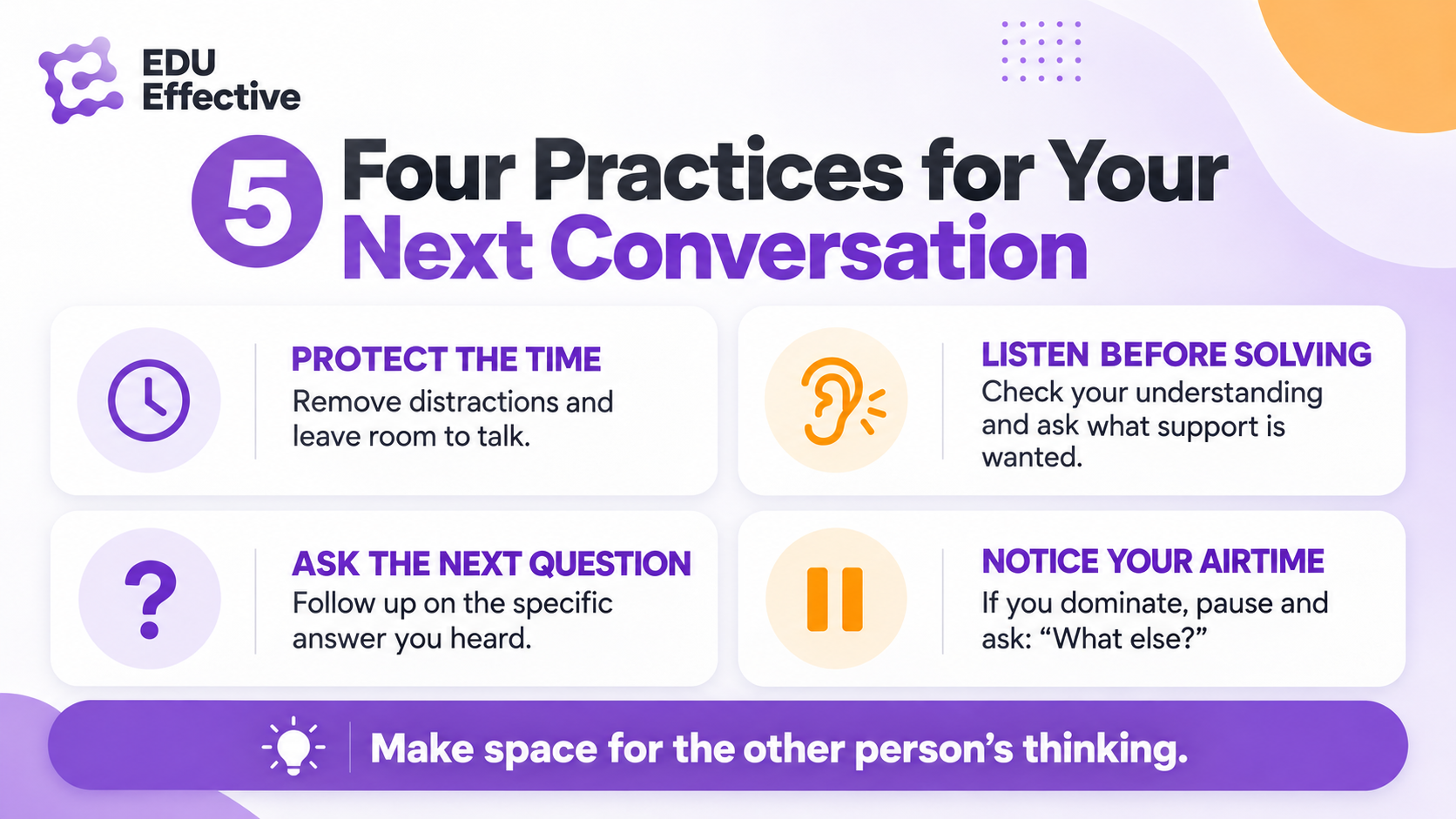
1. Create protected time for listening. The listening that matters most rarely happens in scheduled, back-to-back meetings. It happens in conversations with breathing room. This means deliberately building time into your schedule where you’re not transitioning from something else and rushing to the next thing. Fifteen minutes of focused attention, according to Zenger Folkman’s research, has measurable impact on how people experience being heard.
2. Separate listening from problem-solving. Most managers conflate these. When someone brings you a problem, your instinct is to start solving it. The problem with that is it cuts off the listening at the point where it was becoming useful — the point where the other person was getting to what they actually think and feel about the situation. Before you shift into solution mode, verify that you understand the problem fully, and verify that they want solutions rather than just to be heard.
3. Close the feedback loop explicitly. When someone shares a concern or idea, acknowledge it by name when you act on it. Don’t let the action speak for itself. “You raised this in our last conversation, so I changed the way we’re handling X” is not performative — it’s what converts listening into a practice that people trust and invest in.
4. Ask the second question. The first question you ask is often the obvious one — “how’s the project going?” The second question, the follow-up to whatever they say first, is where real listening begins. It signals that you heard the specific content of their answer and want more of it, not just the surface version.
5. Monitor your silence-to-speaking ratio. Not as a rigid technique, but as a diagnostic. If you’re speaking more than the other person in a conversation that’s supposed to be about their situation, you’re not listening — you’re monologuing. The fix is often as simple as stopping yourself after your first response and asking: “what else?”
The Listening Gap in Organizations
One in four leaders has a measurable listening deficit, according to research cited by the Association for Talent Development. Only 12% of employees believe their employer genuinely listens to and cares about them, according to a study cited by the same organization. And 59% of employees believe management does not listen to their concerns at all.
Those numbers describe the default state of most organizations — not outliers. The default is that most people, most of the time, do not feel heard at work.
The implications are not abstract. The review of 144 studies found that listening affects employee satisfaction, reduces burnout, improves performance, and increases organizational commitment. The Zenger Folkman trust research found that poor listeners sit at the 15th percentile in trust — and leaders without trust have tools but no leverage. You can set strategy, make decisions, and give direction, but if people don’t trust you, the information they bring you is curated, the implementation they provide is minimum viable, and the talent you most want to keep is calculating what it would take to leave.
Listening is the mechanism through which you get honest information about your organization. It is also the mechanism through which your team decides whether you’re worth trusting with it.
Key Takeaways
Listening declines with seniority — senior managers score at the 39th percentile on listening effectiveness versus the 59th for individual contributors, per Zenger Folkman. Leaders in the top 10% for listening reach the 92nd percentile in overall leadership effectiveness. A review of 144 studies confirms that perceived listening is positively associated with job performance, satisfaction, and organizational commitment. The five barriers to managerial listening identified by UCL’s Colin Fisher and Jeffrey Yip — haste, defensiveness, invisibility, exhaustion, and inaction — are structural, not personal failings, and each has a specific remedy. Active listening in the Kluger-Itzchakov framework requires presence, understanding, and positive intent — and the research shows it is one of the few behaviors that genuinely changes how people think, not just what they say. Most organizations are running a significant listening deficit, and the managers who close it are the ones who build the highest-trust, highest-performing teams.
About EDU Effective Business School
The Effective MBA: Coaching, Leadership & Mentoring is built around the conversations that shape team performance. Runs on 15 minutes a day, completes in 10 months or less and is ASIC accredited.
Sources
- Zenger Folkman — The Data Behind Leadership Listening Skills and Performance Outcomes (4,219 leaders, 360-degree feedback) https://zengerfolkman.com/articles/the-data-behind-leadership-listening-skills-and-performance-outcomes
- Zenger Folkman — The Power of Listening Leadership: A Leader’s Secret Weapon for Building Trust (80,000+ leaders) https://zengerfolkman.com/articles/the-power-of-listening-leadership-a-leaders-secret-weapon-for-building-trust
- Kluger, A. N. & Itzchakov, G. — The Power of Listening at Work, Annual Review of Organizational Psychology and Organizational Behavior https://www.annualreviews.org/doi/10.1146/annurev-orgpsych-012420-091013