
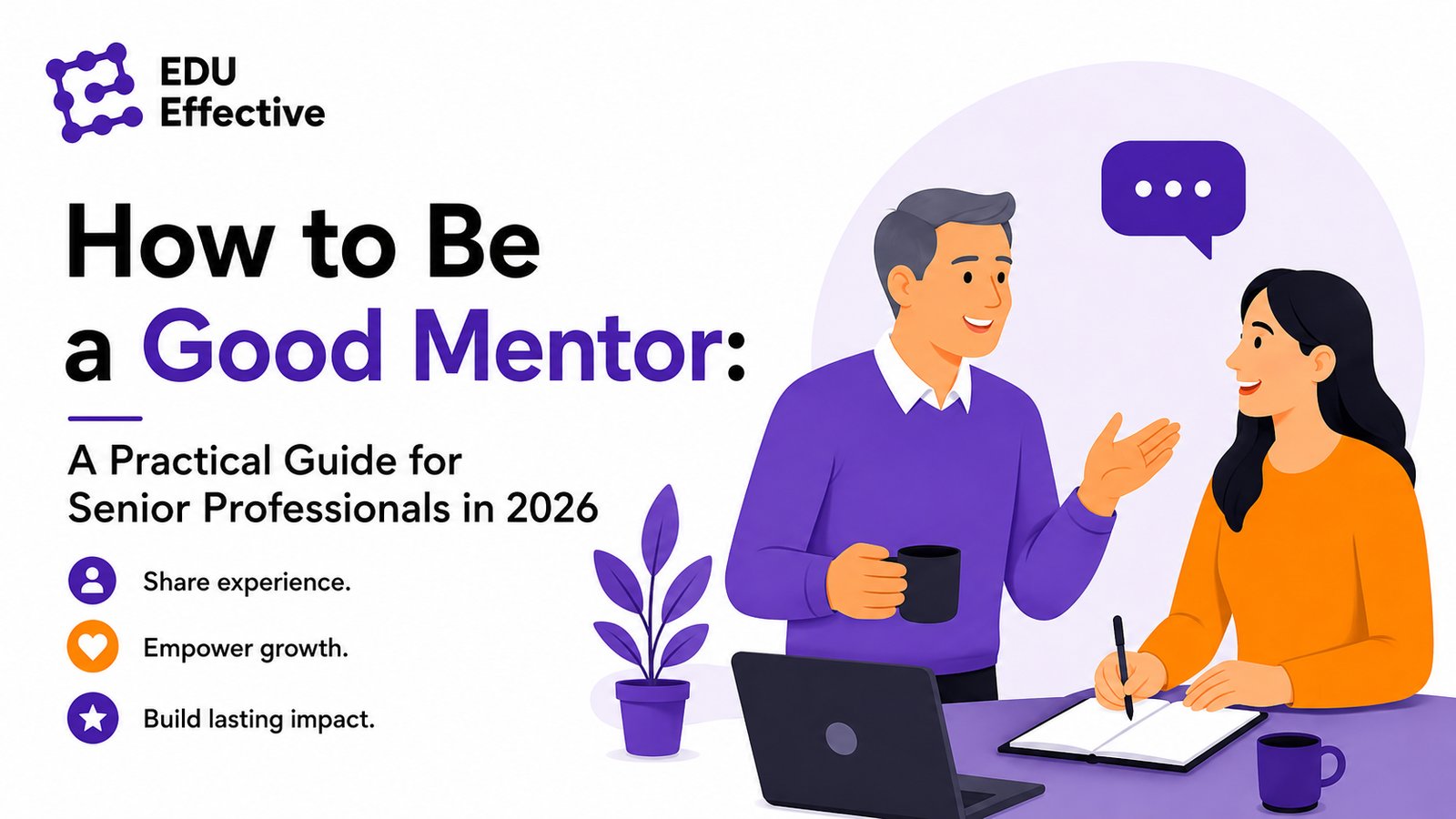

68% of millennials who stay with their employer for five or more years have a mentor — compared to just 32% of those without one, according to Deloitte's Millennial Survey. 91% of workers who have a mentor are satisfied with their jobs — versus 79% of those without one, according to CNBC/SurveyMonkey research. And 84% of Fortune 500 companies operate formal mentoring programmes — with 100% of Fortune 50 companies doing so.
These numbers establish why mentoring matters commercially, not just developmentally. The relationship between a more experienced professional and a less experienced one — in which the senior person shares knowledge, perspective, and support without it being a formal management obligation — produces outcomes that organisations with formal mentoring programmes consistently demonstrate: higher retention, faster advancement, stronger engagement, and greater loyalty. The person being mentored gets experience they could not access any other way. The person doing the mentoring consistently finds that the relationship develops their own thinking, communication, and leadership capability in ways they did not anticipate.
The question this guide addresses is not whether to mentor — the evidence is clear — but how to do it well.
What mentoring is — and how it differs from coaching and managing
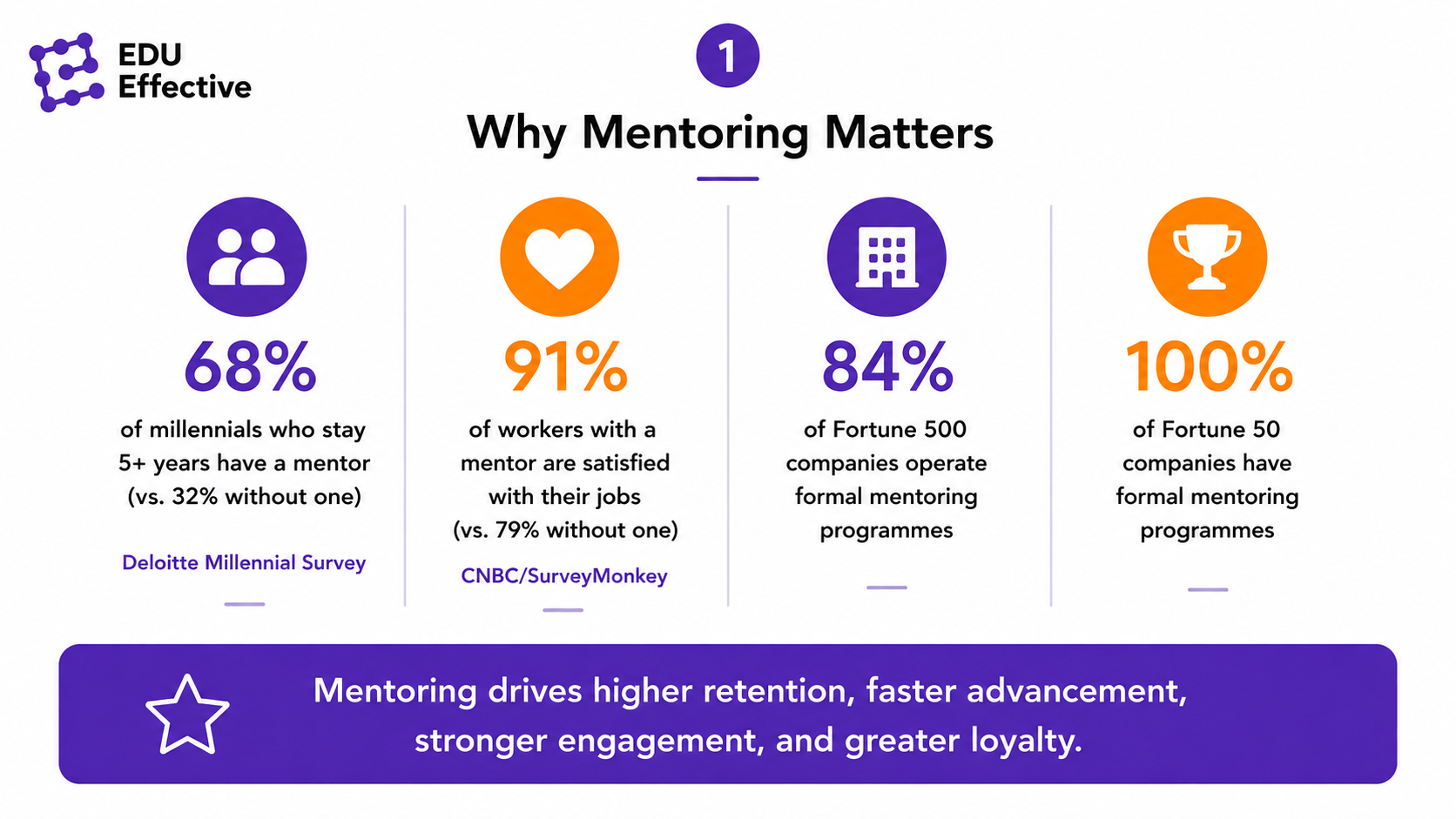
Mentoring is a developmental relationship in which a more experienced person shares their knowledge, experience, perspective, and support to help a less experienced person navigate their career and professional development. The mentor draws primarily on their own lived experience — what they have learned, what they have navigated, what they would do differently. The direction of the relationship is from more experienced to less, even if the exchange produces learning in both directions.
This distinguishes mentoring from coaching, where the coach does not primarily draw on their own experience or advise, but instead uses questions, reflection, and structured frameworks to help the person develop their own thinking. A coach could work effectively with someone in an entirely different field. A mentor's value is specifically their experience in the mentee's domain or context. For a practical comparison of the two approaches, see our coaching vs. mentoring guide.
Mentoring also differs from managing. A manager has formal accountability for a direct report's performance and carries authority that necessarily colours every interaction. A mentor has no formal authority over the mentee — which is precisely what makes the mentoring relationship safe enough to be honest in ways that management relationships often cannot be. The most valuable mentor conversations are frequently the ones in which the mentee can share concerns, doubts, and challenges that they cannot share with their manager without risk.
Understanding these distinctions matters practically because it shapes what effective mentoring looks like in practice. A mentor who manages the relationship like a manager — directing rather than advising, evaluating rather than supporting — undermines the psychological safety that makes mentoring valuable. A mentor who tries to be a coach — withholding their experience and expertise in favour of purely Socratic questioning — fails to deliver the specific value that mentoring can uniquely provide.
What makes a good mentor — the qualities that consistently predict effective mentoring relationships
The research on what mentees value most in mentors is remarkably consistent across studies, industries, and career stages. The qualities that appear most frequently are not the ones most mentors assume matter most.
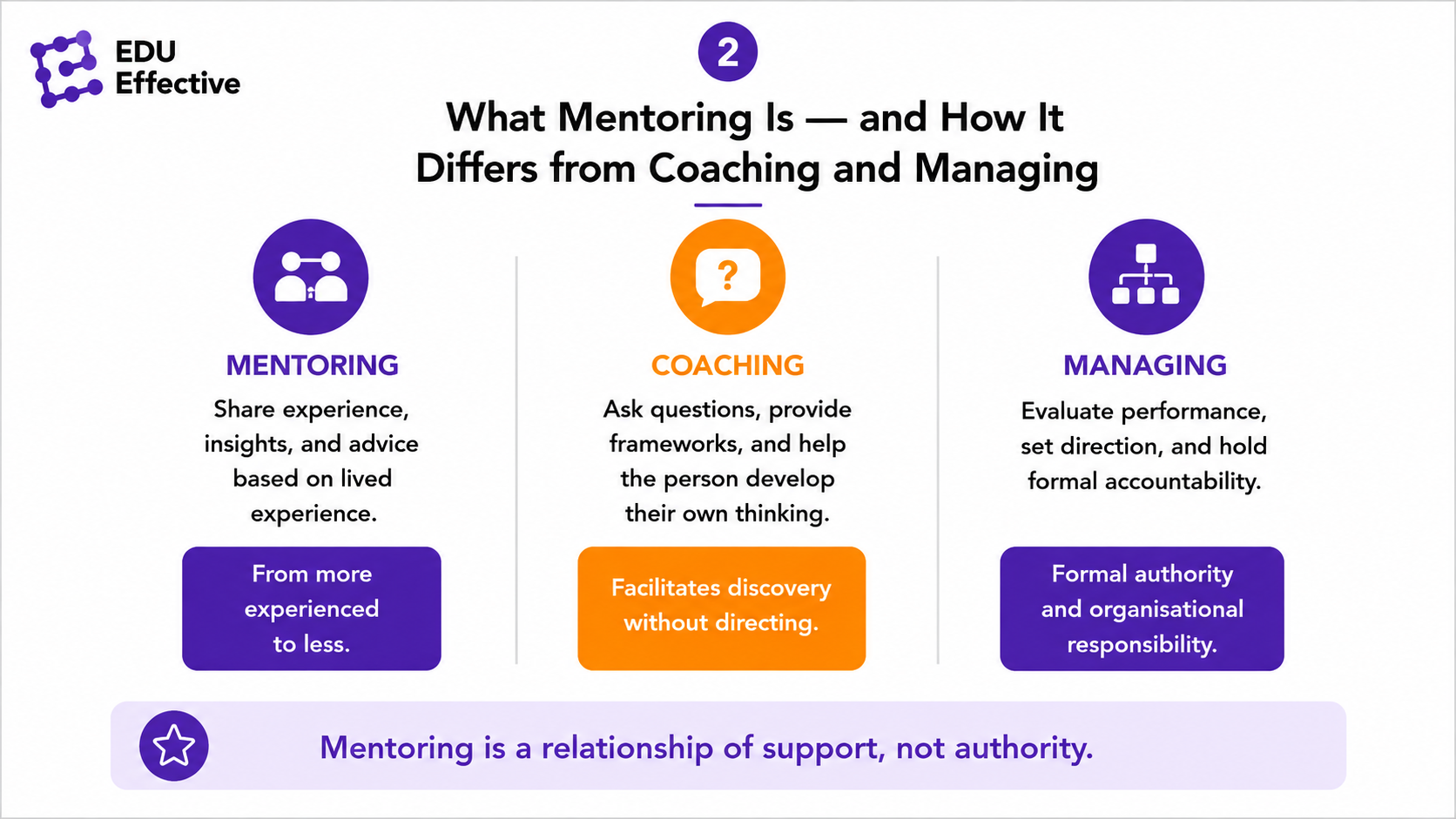
Genuine interest in the mentee's development. The most consistently reported quality of effective mentors is authentic investment in the mentee's growth — not as a performance of generosity but as a genuine orientation toward the other person's success. Mentees are skilled at distinguishing between a mentor who is genuinely interested in them and one who is going through the motions of a relationship they feel obligated to maintain. The former produces transformative relationships; the latter produces polite but shallow ones. 87% of mentors and mentees report feeling empowered by their mentoring relationship — but that figure reflects relationships where genuine engagement was present, not perfunctory ones.
Honesty — including uncomfortable honesty. The most valued thing a mentor can offer is accurate feedback that the mentee cannot get from their own manager without political risk. A mentor who only validates is pleasant but not particularly useful. A mentor who tells their mentee what they genuinely observe — that their communication style is creating friction, that their career strategy has a blind spot, that the way they handled a situation cost them credibility — provides something uniquely valuable. This requires the mentor to have enough of a relationship with the mentee to make honest feedback land as care rather than criticism.
Relevant experience, shared specifically. A mentor's experience is most valuable when it is shared specifically — not as general wisdom ("always be authentic") but as concrete stories from real situations: what happened, what the mentor did, what worked, what did not, and what they would do differently now. Specific stories are more useful than general principles because they allow the mentee to extract the lesson that is relevant to their specific situation, rather than receiving a principle that is too abstract to act on.
Appropriate challenge alongside support. The most effective mentoring relationships combine genuine support — the mentee feels confident the mentor is on their side — with appropriate challenge that pushes the mentee beyond their current thinking. A mentor who provides only support without challenge does not produce growth. A mentor who challenges without support creates anxiety rather than development. The combination — "I believe in you, and I also think you're not fully seeing this" — is the most productive climate for the kind of reflection that mentoring can produce.
Availability and reliability. A mentoring relationship that exists in principle but not in practice — where the mentor is theoretically available but constantly rescheduling, too busy to prepare, or distracted during conversations — produces little. The research on mentoring programme failure consistently identifies mentor availability and reliability as the primary structural failure mode. The most effective mentors treat their mentoring commitments with the same professional seriousness as their client or management commitments.
How to structure effective mentoring conversations
Many senior professionals who agree to mentor someone feel uncertain about how to make the conversations genuinely useful. The absence of a structured role — the mentor is not managing, not coaching in the formal sense, not teaching — can make mentoring conversations drift into pleasant but unfocused exchanges that both parties enjoy but that do not produce the development the mentee needs.
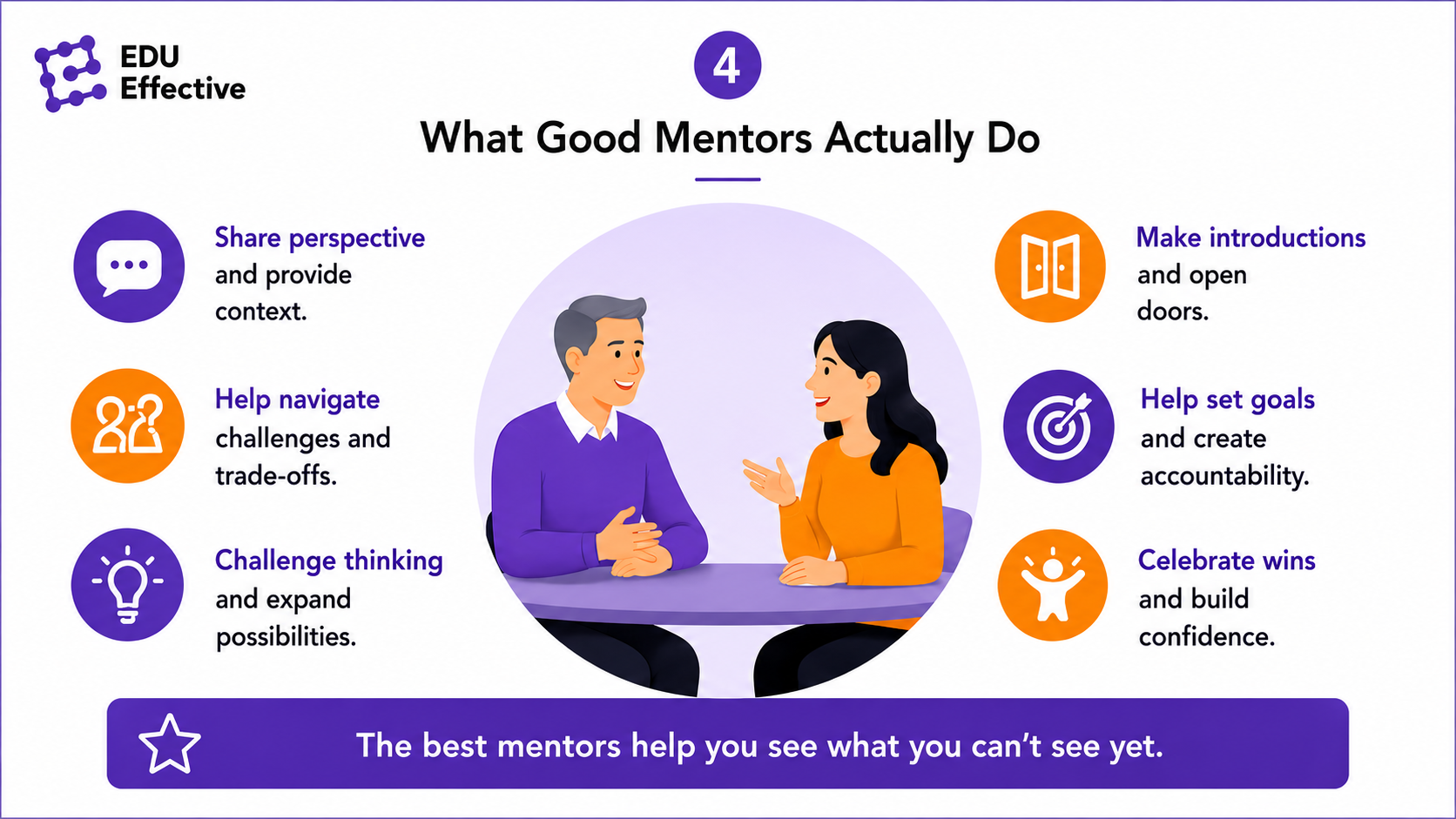
The most effective mentoring conversations are those in which the mentee arrives with a specific question, challenge, or development priority — and the mentor engages with it substantively. This requires establishing an expectation from the start that the mentee is responsible for bringing the agenda. The mentor who asks "what do you want to work on today?" and means it — rather than filling the time with their own stories and observations — creates the conditions for the mentee to drive their own development.
A practical structure for mentoring conversations that many experienced mentors find useful: the mentee shares what they want to discuss and why it matters to them; the mentor asks clarifying questions to understand the situation specifically before responding; the mentor shares their perspective, experience, or advice — including what they personally did in similar situations; the mentee reflects on what resonates and what they will do with it; both parties agree on what the mentee will try before the next conversation.
The agreement on action at the end of each conversation is not bureaucratic — it is the mechanism that converts a good conversation into a developmental experience. A mentee who leaves each conversation with a specific thing to try, observe, or reflect on between sessions is developing; a mentee who leaves each conversation feeling good about the interaction but without a specific next step is not.
The mentoring relationship over time — stages and transitions
Effective mentoring relationships move through recognisable stages, and understanding these stages helps both mentors and mentees make the most of each phase.
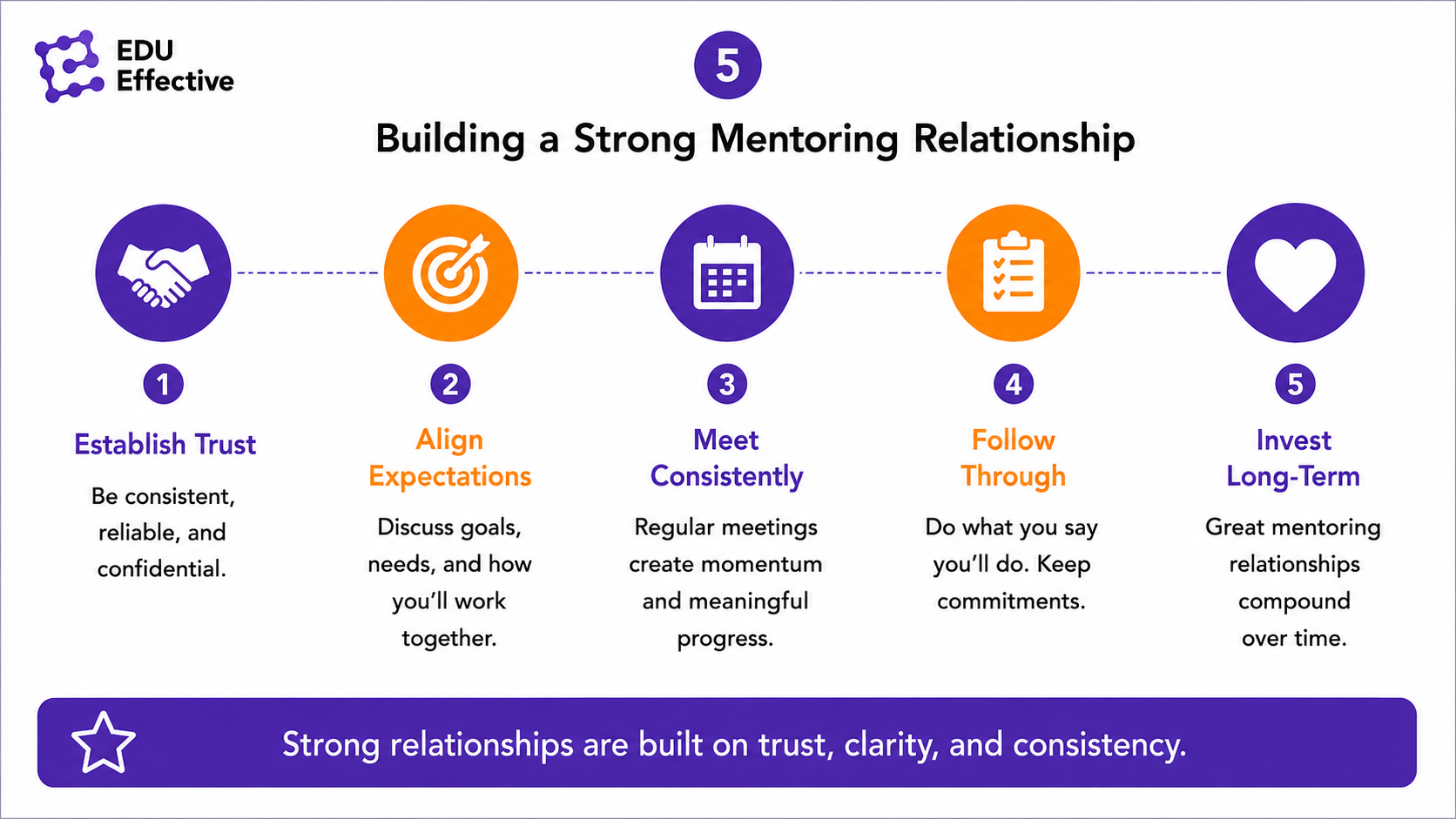
The orientation phase — typically the first one or two conversations — establishes the parameters of the relationship: what the mentee is hoping to develop, what the mentor is able to offer, how frequently they will meet, how they will communicate between sessions, and what confidentiality expectations exist on both sides. Investing in this foundation significantly reduces the most common failure mode of mentoring relationships — the slow decline into infrequent, unfocused conversations that eventually trail off.
The active development phase is where the substantive mentoring work happens. This is typically the longest phase, extending over months, in which the mentor and mentee work through the specific challenges, decisions, and development priorities that the mentee is navigating. The mentor's role shifts across this phase: earlier conversations may involve more direct sharing of experience and perspective; later conversations may involve the mentor asking more questions as the mentee develops greater confidence and capability.
The transition or closure phase — which effective mentoring relationships reach and mark deliberately — is when the mentee has achieved the primary objectives that motivated the relationship, or when both parties recognise that the relationship has run its natural course. The most valuable mentoring relationships do not simply trail off — they have an explicit conversation about what has been accomplished, what the mentee wants to carry forward, and how the relationship might continue in a different form. 89% of those who have been mentored go on to mentor others — which suggests that the most enduring legacy of a good mentoring relationship is the propagation of effective mentoring practice through an organisation.
What mentors gain — the frequently overlooked returns
The commercial framing of mentoring tends to focus almost entirely on what mentees gain. The experience of effective mentors — and the research on what mentoring produces for the senior party — consistently reveals a different and equally valuable set of returns.
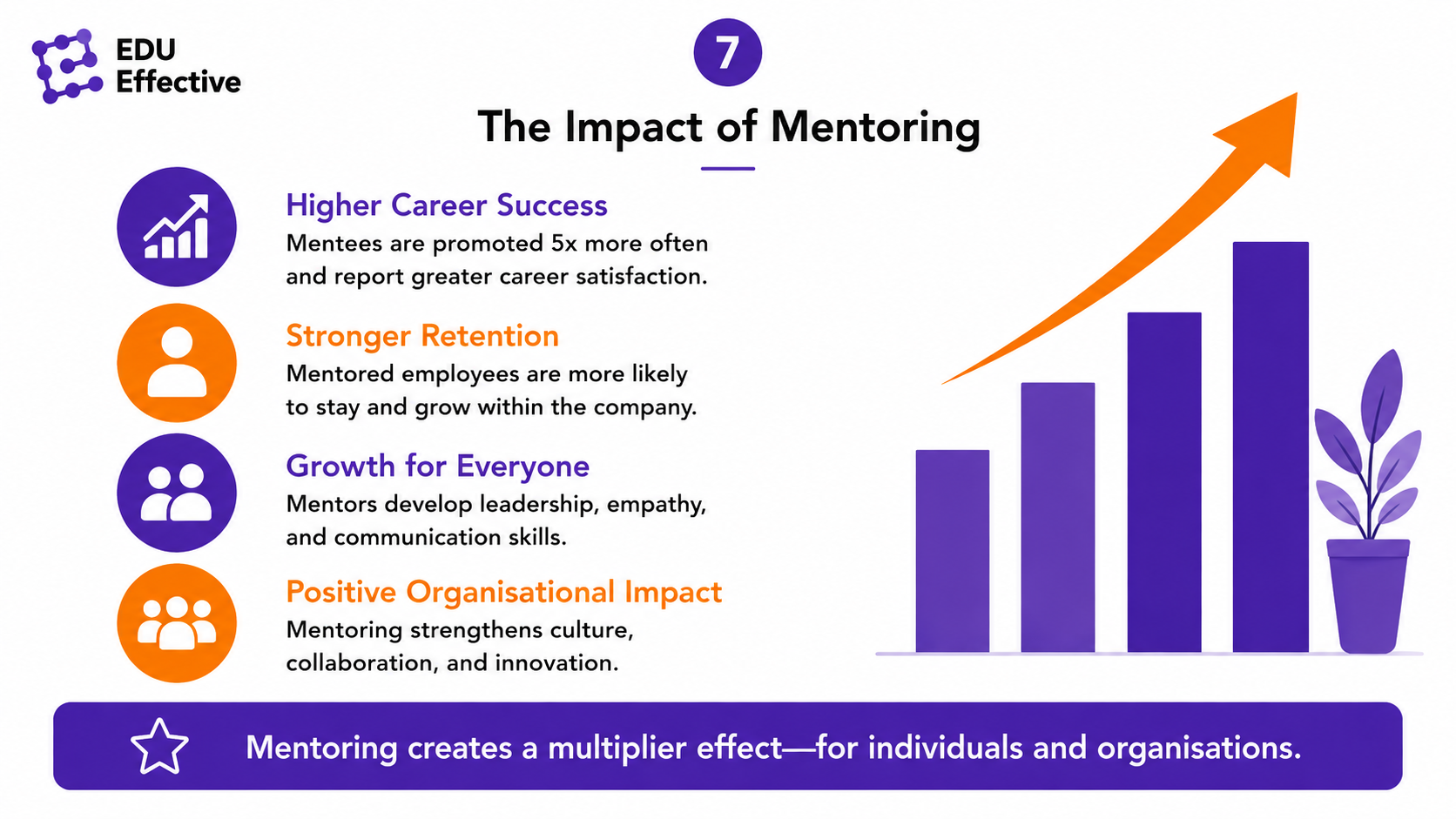
Mentors are promoted six times more often than those not participating in mentoring, according to research aggregated from multiple organisational mentoring studies. This counterintuitive finding reflects what the experience of effective mentors confirms: the work of explaining your thinking clearly to a less experienced person, of distilling what you actually know from what you assumed you knew, and of being genuinely curious about someone else's development sharpens your own thinking and communication in ways that are visible to people around you.
Mentoring develops leadership capability that is difficult to develop any other way. The skills that are most directly exercised in effective mentoring — listening without immediately directing, asking questions that open rather than close, sharing experience in ways that inform without prescribing, holding someone else's development as a genuine priority — are exactly the leadership skills that distinguish the most effective managers and executives. Many senior professionals discover through mentoring that they have been managing when they should have been developing, and directing when they should have been listening.
Mentoring provides perspective. The mentee's questions about career navigation, about how to handle specific situations, about what matters and what does not, frequently prompt mentors to reflect on their own assumptions, priorities, and trajectories in ways they would not have without the relationship. Multiple experienced mentors describe their mentoring relationships as producing clarity about their own next chapter.
Avoiding the most common mentoring mistakes
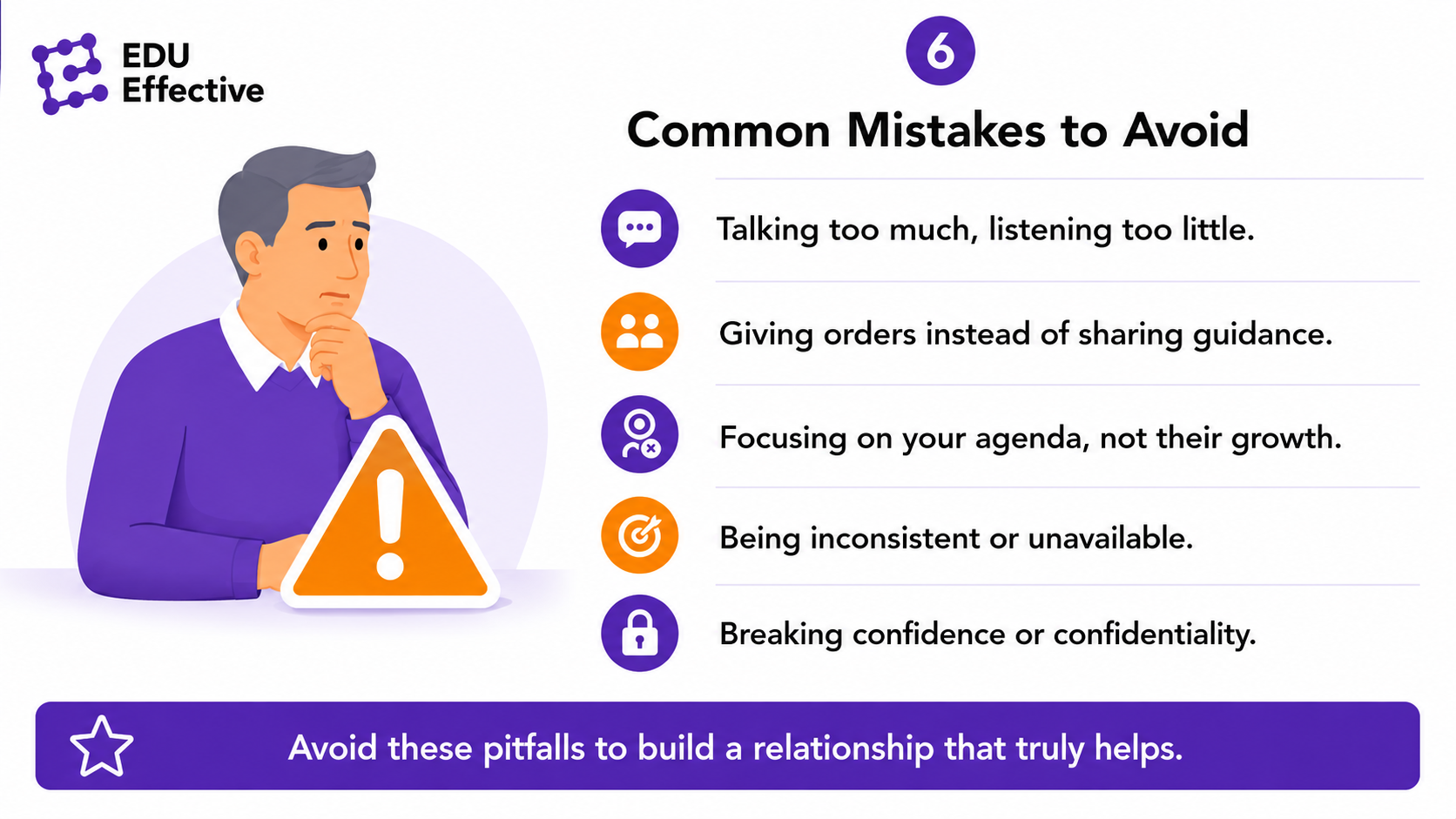
Making it too much about yourself. The most common failure of well-intentioned mentors is turning mentoring conversations into extended personal anecdotes that are interesting but not directly relevant to the mentee's specific situation. The mentee's agenda should drive the conversation; the mentor's experience should serve that agenda, not replace it.
Being so supportive that you are not honest. Senior professionals who have succeeded through relationships and networks are often highly skilled at being encouraging, affirming, and positive. These qualities are valuable in mentoring — up to the point where they prevent honest feedback. A mentor who only tells a mentee what they want to hear is providing emotional comfort rather than developmental support.
Maintaining status differentials that inhibit honesty. The most valuable mentoring conversations are those in which the mentee can be genuinely honest about their challenges, doubts, and failures. A mentor who signals — consciously or unconsciously — that they expect competence, success, and positivity in their mentee creates a climate in which the mentee curates what they share and the relationship becomes a performance rather than a development relationship.
Treating mentoring as a favour rather than a development relationship. When a mentor frames the relationship in terms of their generosity — "I'm giving you my time" — rather than in terms of mutual development, they create an obligation dynamic that inhibits the mentee from pushing back, disagreeing, or saying when something is not working. The most effective mentoring relationships feel like peer relationships in terms of respect and mutual curiosity, even though they are explicitly asymmetric in terms of experience.
Building mentoring capability as a professional skill
The most effective mentors do not arrive at mentoring excellence through good intentions alone. The skills that underpin excellent mentoring — structured listening, question-based development, honest feedback, empathetic challenge — are learnable, and they are the same skills that make excellent leaders, excellent coaches, and excellent managers.
Investing in developing these skills formally — through professional development that addresses both the theory of adult development and the practice of developmental conversations — produces mentors who are measurably more effective than those who approach mentoring based on intuition alone.
At EDU Effective, the Effective MBA: Coaching, Leadership & Mentoring develops the mentoring, coaching, and leadership capabilities that allow senior professionals to contribute most effectively to the development of others — and to their own continued growth in the process. Explore the programme →
EDU Effective Business School — professional development for your long-term success.
All five best-selling Effective MBA programs are built on the same educational model — designed for working adults who need learning that fits real professional life:
Effective MBA: Executive Management & Leadership
Effective MBA: Applied Artificial Intelligence
Effective MBA: Coaching, Leadership & Mentoring
Effective MBA: Online Marketing
Every programme runs on 15 minutes a day, completes in 10 months or less, is ASIC accredited, and starts from €990.
These are professional programmes, not academic ones — built for working adults to apply what they learn directly in their own business, not to collect a scholarly credential.
Join more than 9,000 students in over 120 countries who are investing in their professional development and career success. Read the experiences of our graduates here.
Apply now — from €990 · Talk to a Study Advisor
Study with NO risk: 14-day money-back guarantee, no questions asked.
Sources
Deloitte — Millennial Survey: 68% of Millennials Who Stay 5+ Years Have a Mentor vs. 32% Without
https://www.deloitte.com/us/en/insights/topics/talent/2025-gen-z-millennial-survey.html
CNBC / SurveyMonkey — Workplace Happiness Survey: 91% of Workers with Mentors Satisfied with Jobs vs. 79% Without; Mentees 21–23% More Likely to Be Satisfied
https://www.cnbc.com/2019/07/16/nine-in-10-workers-who-have-a-mentor-say-they-are-happy-in-their-jobs.html
LinkedIn — Workplace Learning Report: 94% of Employees Would Stay Longer If Company Invested in Their Career Development
https://learning.linkedin.com/resources/workplace-learning-report
McKinsey & Company / LeanIn — Women in the Workplace 2025: Mentoring, Sponsorship and Career Progression Data
https://www.mckinsey.com/featured-insights/diversity-and-inclusion/women-in-the-workplace
DDI — Global Leadership Forecast 2024/2025: Mentoring and Gender Diversity in Leadership Data
https://www.ddiworld.com/research/global-leadership-forecast-2025
Gallup — Workforce Research: Mentoring and Employee Engagement Data
https://www.gallup.com/workplace/236927/employee-engagement-drives-growth.aspx
SHRM — Generation Z in the Workplace: Mentoring Expectations and Career Development
https://www.shrm.org/topics-tools/research/