


CEOs who delegate effectively generate 33% more revenue than those who do not — a finding from Gallup's study of 143 CEOs on the Inc. 500 list of America's fastest-growing companies, which remains the most widely cited quantitative benchmark on the commercial impact of delegation. That is not a marginal difference in management style. It is a structural performance gap driven by one of the most consequential and least developed capabilities in management: the ability to transfer responsibility — genuinely, not nominally — to the people best positioned to handle it.
Only 19% of managers report strong delegation skills, according to DDI's Global Leadership Forecast 2025. 40% of leaders are considering leaving their leadership roles due to cognitive overload and unsustainable demands — overload that effective delegation would substantially reduce. And companies that delegate effectively are 1.7 times more likely to outperform their competitors, according to McKinsey research on organisational agility.
The gap between what delegation produces and how widely it is practised is one of the most consistently documented and consistently underaddressed failures in management development. Understanding why managers do not delegate — and what actually makes delegation work — is the starting point for changing both.
Why managers do not delegate — the real reasons
The instinctive explanation for poor delegation is time: "I could do it faster myself." This is often true in the short term, and always false in the medium term. A manager who always does it faster themselves produces a team that never develops, a manager who becomes the bottleneck for every decision, and an organisation that cannot scale beyond the output of one person.
The research on why managers avoid delegation identifies more specific and more tractable barriers.
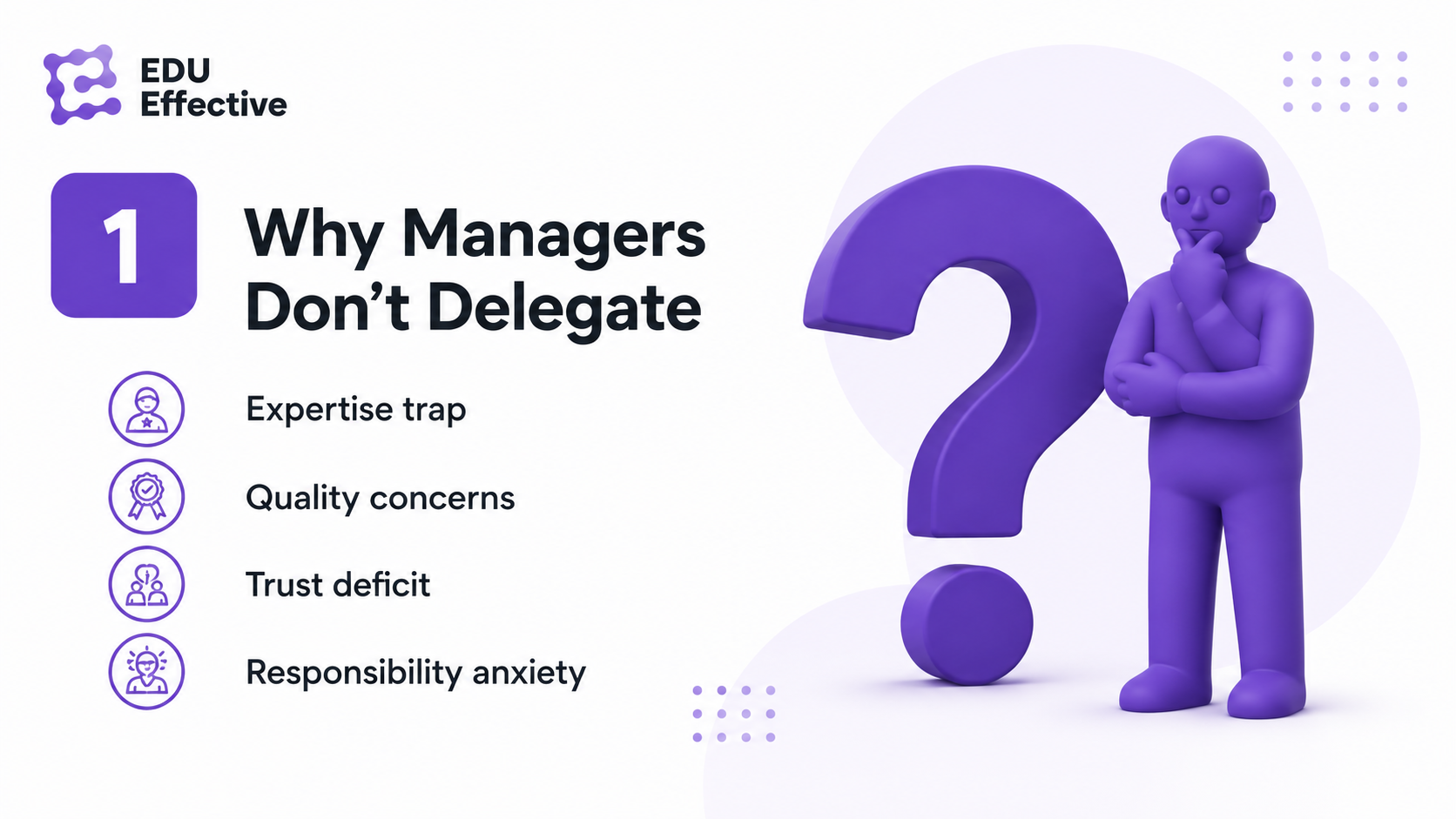
The expertise trap. Most managers are promoted because they are excellent at a specific technical or professional skill. That expertise creates a strong identity as the person who does this thing well — and delegation requires them to allow someone else to do it, potentially less well, in service of a larger organisational objective. Letting go of tasks where personal expertise provides comfort is psychologically harder than it looks from the outside. DDI's data shows this pattern is consistent from first-time managers through to C-suite executives.
The quality concern. "If I delegate this, it won't be done to my standard." This concern is often accurate — initially. A team member doing something for the first time will rarely produce the same quality as a manager who has done it a hundred times. The relevant question is not "will the quality be the same?" but "will the quality be acceptable, and will it improve over time as the person develops?" The 70% rule — if someone else can do it 70% as well as you, delegate it — is a practical threshold for most management situations. Holding everything to a 100% personal-quality standard produces a manager who is indispensable and a team that cannot grow.
The trust deficit. Some managers do not delegate because they do not yet trust their team members sufficiently to be confident in the outcome. This is occasionally a legitimate assessment of genuine capability gaps. More frequently, it reflects insufficient investment in developing team members to the point where trust is warranted — and sometimes, it reflects a management style that has not given team members the opportunity to demonstrate their capability. DDI's 2026 data found that trust in immediate managers has fallen to 29% globally. The irony is direct: managers who do not delegate because they do not trust their teams are contributing to the very trust deficit they cite as the reason not to delegate.
The responsibility anxiety. Delegation transfers responsibility, but the manager retains accountability for outcomes. The manager who delegates and sees the task go wrong still owns that outcome. This accountability without control creates anxiety — particularly for managers in high-stakes environments where visible failure has serious consequences. The resolution is not to avoid delegation but to invest in the selection and preparation that makes delegation more likely to succeed, and to build the oversight structures that allow early course correction without micromanagement.
What effective delegation is — and what it is not
Delegation is the transfer of both responsibility and authority for a specific task or outcome to a team member, with the manager retaining accountability for the result. Both words matter: responsibility without authority is a recipe for frustration; authority without accountability is a recipe for negligence.
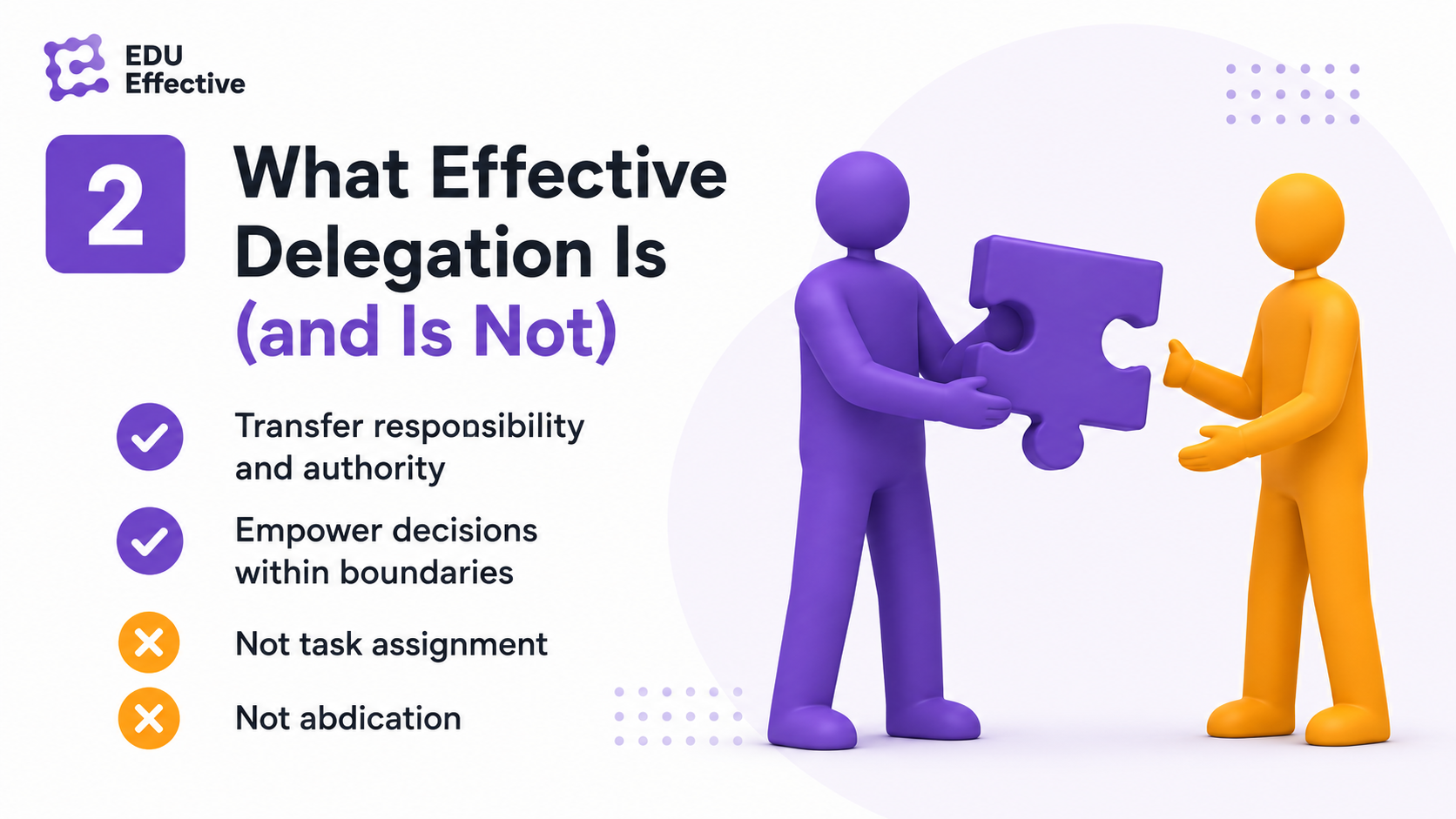
Effective delegation is not task assignment — handing someone a piece of work to complete according to the manager's specifications. Task assignment keeps decision-making with the manager and execution with the team member. It produces compliance, not ownership. Effective delegation transfers genuine decision-making authority within defined parameters: the team member decides how to approach the task, what resources to use, what problems to solve along the way, and what constitutes a good outcome — within boundaries the manager has established.
Effective delegation is also not abdication — handing something off and disappearing. The manager who delegates and then takes no interest in progress, provides no support when the team member encounters obstacles, and reappears only at the deadline to evaluate the outcome is not delegating effectively. They are creating the conditions for the team member to fail and for the manager to blame the delegation rather than the execution.
The space between task assignment and abdication is where effective delegation lives. It requires the manager to be genuinely available for support without being present for every decision — a distinction that requires both clarity about what kind of support is welcome and consistent follow-through on the offer of it.
The Situational Leadership framework: matching delegation to readiness
The most practical framework for determining what and how to delegate comes from Paul Hersey and Ken Blanchard's Situational Leadership model — one of the most widely used leadership frameworks in organisational settings. Its core insight is that the right amount of direction and support for any given task depends on the team member's readiness for that specific task — their combination of competence (can they do it?) and commitment (will they do it?).
Hersey and Blanchard identify four development levels, each corresponding to a different leadership response.
D1 — Low competence, high commitment describes a team member who is enthusiastic about the task but lacks the knowledge or skill to execute it without close guidance. This is the profile of someone new to a role or encountering a genuinely unfamiliar challenge. The appropriate leadership response (S1 — Directing) provides high task direction and close oversight: clear instructions, specific milestones, frequent check-ins, and immediate availability for questions. Delegating to a D1 team member without providing this structure does not develop them — it exposes them to failure in ways that damage both their confidence and the manager's ability to trust them with more.
D2 — Some competence, low commitment describes a team member who has learned enough to understand the difficulty of the task but not yet enough to feel confident executing it independently. Enthusiasm has given way to realistic appraisal of the challenge. The appropriate leadership response (S2 — Coaching) combines task direction with active support and encouragement — the manager still provides significant structure but also invests in understanding what is generating the hesitation and helping the team member work through it.
D3 — High competence, variable commitment describes a team member who has the skills to execute the task well but whose confidence or motivation fluctuates — perhaps because of the stakes involved, a change in context, or factors outside the task itself. The appropriate leadership response (S3 — Supporting) reduces task direction and increases relational support: the manager steps back from telling the team member what to do and focuses instead on the conditions that affect their confidence and engagement.
D4 — High competence, high commitment is the profile of a team member who is fully capable of executing the task independently and motivated to do so. The appropriate leadership response (S4 — Delegating) provides high autonomy within agreed parameters: the manager defines the outcome and constraints clearly, and then genuinely steps back. The team member makes the decisions. The manager is available for support if requested but does not hover.
The practical application is that delegation — genuine, high-autonomy delegation — is the appropriate response to D4 team members on specific tasks, not a blanket approach applied to everyone regardless of their readiness. The same person may be D4 on tasks within their expertise and D1 on tasks outside it. Reading readiness per task, not per person globally, is the diagnostic skill that makes this framework practically useful.
A practical delegation process
Effective delegation follows a consistent sequence regardless of the task or team member involved. The sequence is not complicated. What makes it work is the discipline to follow it rather than taking shortcuts when time is short.
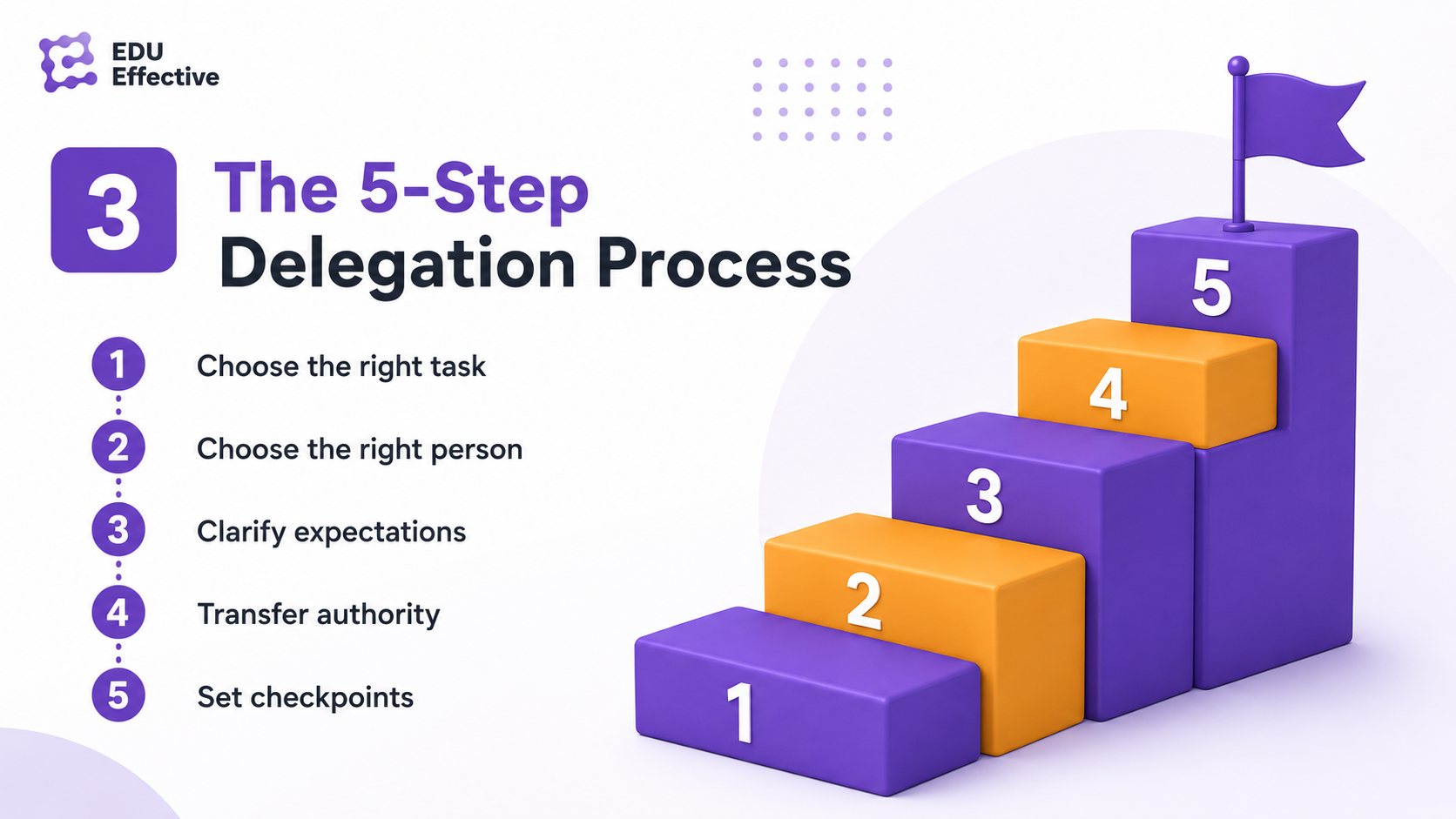
Define the outcome, not the method. The most common delegation failure is specifying how to do the task rather than what the task needs to produce. Method specification keeps decision-making with the manager and prevents the team member from using their own knowledge and judgement to find better approaches. An outcome definition describes what a successful result looks like — the quality standard, the deadline, the criteria for completion — and allows the team member latitude to determine how to get there.
Match the task to the right person. Delegation works best when it produces development — when the task is at the edge of the team member's current capability, stretching it without overwhelming it. A task that is too easy produces no development and is a poor use of delegation. A task that is too difficult produces failure and damages confidence. The assessment of fit is the manager's responsibility, not the team member's.
Communicate authority explicitly. The team member needs to know not just what they are responsible for, but what decisions they can make independently, what resources they can access, and who needs to know that they are acting on behalf of the manager. Ambiguity about authority is one of the most consistent sources of delegation breakdown: the team member hesitates at a decision that should be theirs to make, escalates unnecessarily, or makes a decision that they did not have authority to make and discovers this at the worst possible moment.
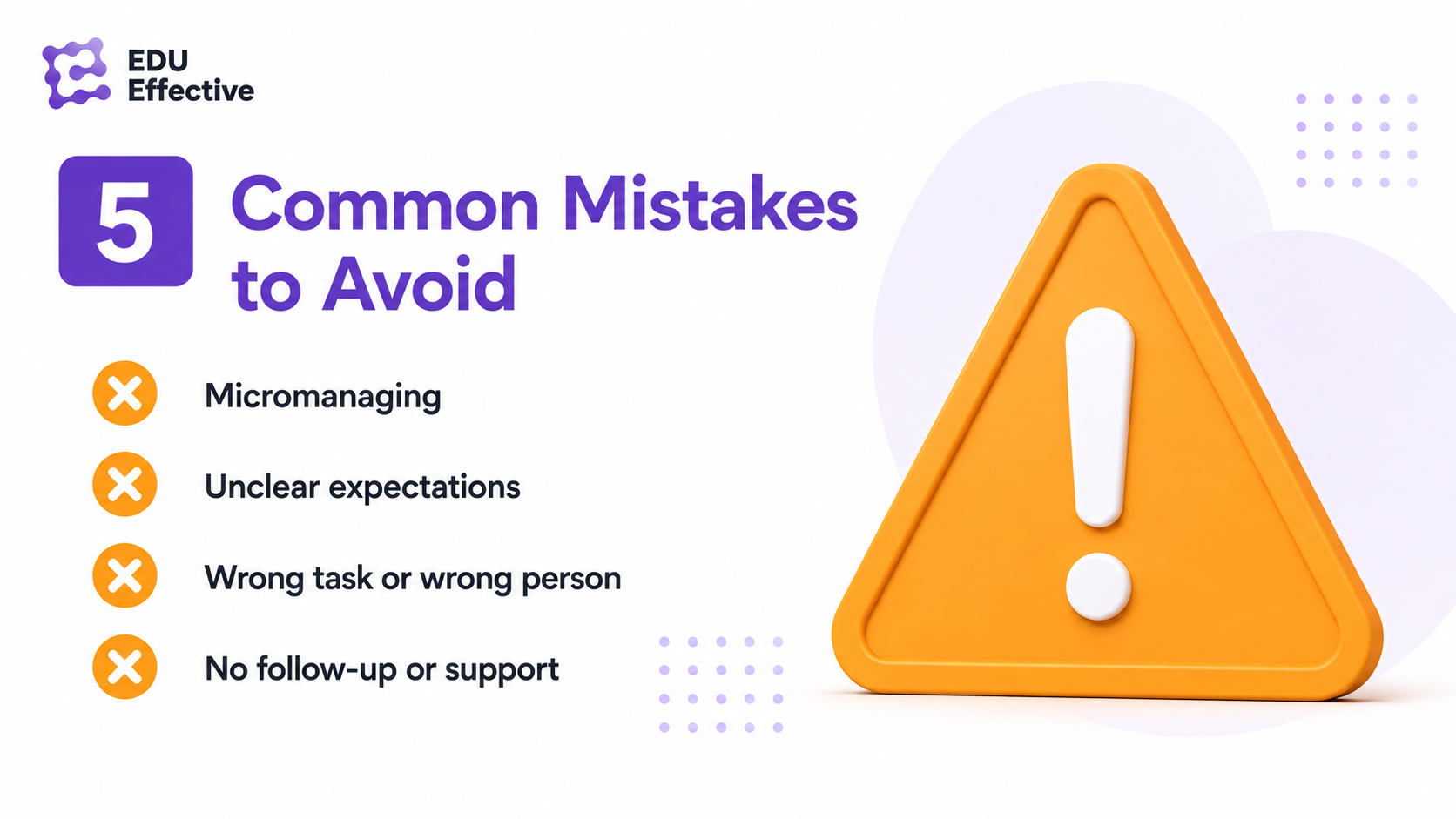
Agree on check-ins, not micromanagement. The difference between oversight and micromanagement is agreement. A check-in schedule agreed at the time of delegation — "let's connect briefly on Tuesday and Thursday while this is in progress" — is a support structure. An unscheduled check-in driven by the manager's anxiety is interference. The agreed check-in gives the manager visibility without undermining the team member's sense of ownership.
Debrief after completion. The learning from a delegated task — what went well, what the team member would do differently, what the manager observed — is the investment that makes the next delegation more effective. Most managers skip the debrief when the task goes well. Debriefing when things go well is as valuable as debriefing when they do not, because it makes explicit what capabilities the team member has demonstrated and what they are now ready for next.
What delegation develops — beyond productivity
The productivity case for delegation is well-documented. The development case is equally important and less frequently made.
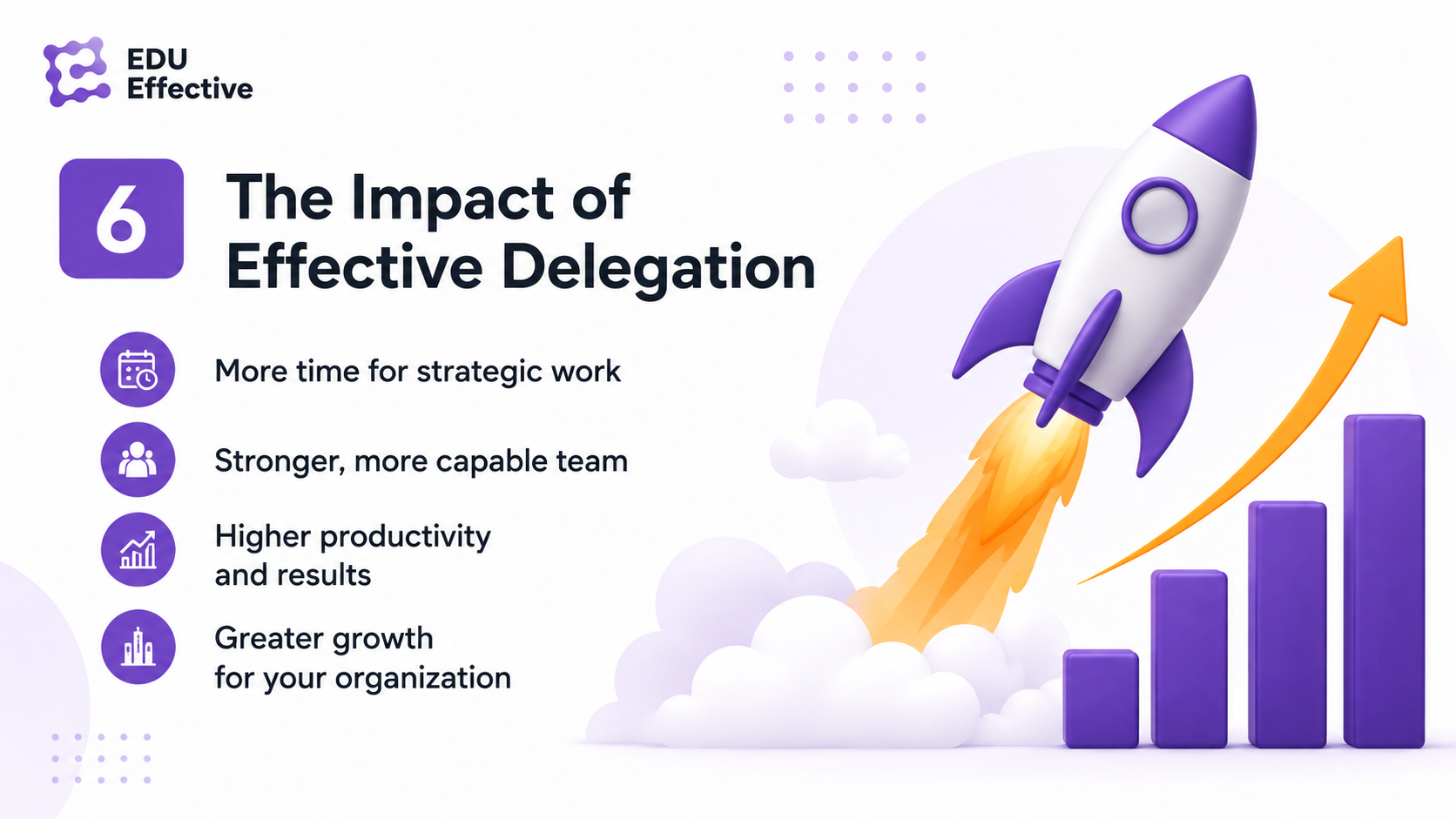
Employees who are micromanaged — who do not experience genuine delegation — are twice as likely to leave their jobs within the next year, according to Gallup research. The experience of being trusted with genuine responsibility, of having authority matched to accountability, and of developing capability through independent execution is motivationally significant in ways that compensation or benefits packages cannot replicate. The 18% engagement score improvement that Gallup finds among teams where managers delegate effectively reflects the motivational impact of genuine autonomy, not just the productivity impact of distributed work.
Delegation is also the primary mechanism through which organisational leadership capacity is built. A manager who never delegates is a manager who will never be able to take on more — because their current responsibilities fully occupy their capacity. A manager who delegates systematically and deliberately creates the team capability that frees their own bandwidth for higher-level work, while building the bench strength the organisation needs for its own succession planning.
DDI's 2026 research identifies developing future talent as one of the top three capabilities organisations need to build in their management layers — and effective delegation is the most direct mechanism for doing it. Every task genuinely delegated to a capable team member is an investment in that person's development, in the team's collective capability, and in the organisation's ability to perform without depending on any single individual.
At EDU Effective, the Effective MBA: Executive Management & Leadership develops delegation skills alongside the full range of management and leadership capabilities — building the practical competence to delegate well, not just the conceptual understanding of why it matters. Explore the programme →
At EDU Effective, we build programs for professionals who want to work smarter — not just harder. Explore our programs →
EDU Effective Business School = professional development for your long-term success.
All best-selling Effective MBA programs are built for working adults: 15 minutes a day, 10 months or less, ASIC accredited, from €990.
- Effective MBA: Executive Management & Leadership
- Effective MBA: Applied Artificial Intelligence
- Effective MBA: Coaching, Leadership & Mentoring
- Effective MBA: Mastery in AI
- Effective MBA: Online Marketing
These are professional programs, not academic ones — built for working adults to apply what they learn directly in their own business, not to collect a scholarly credential.
Join more than 9,000 students in over 120 countries who are investing in their professional development and career success.
Read the feedback and experiences of our students and the stories of our graduates here.
Apply now — from €990 · Talk to a Study Advisor
Study with NO risk: 14-day money-back guarantee, no questions asked.
Sources
- Gallup — Delegating: A Huge Management Skill That Leaders Ignore — 143 CEO Study https://www.gallup.com/workplace/236366/delegating-huge-management-skill-leaders-ignore.aspx
- Gallup — Employee Engagement and Micromanagement: 2x Turnover Risk https://www.gallup.com/workplace/236927/employee-engagement-drives-growth.aspx
- Gallup — State of the Global Workplace 2026 (263,810 respondents, published May 2026) https://www.gallup.com/workplace/349484/state-of-the-global-workplace.aspx
- DDI — Global Leadership Forecast: Delegation Skills and Leadership Pipeline (10,796 leaders, 50 countries) https://www.ddiworld.com/research/global-leadership-forecast-2025
- DDI — How to Delegate Work: Why Leaders Struggle and What to Do (updated June 2026) https://www.ddi.com/blog/how-to-delegate-work
- McKinsey & Company — Decision making: how leaders can get out of the way https://www.mckinsey.com/capabilities/people-and-organization/our-insights/the-organization-blog/decision-making-how-leaders-can-get-out-of-the-way
- American Psychological Association — Workers weather stress, uncertainty, and AI with psychological capital https://www.apa.org/pubs/reports/work-in-america/2026