

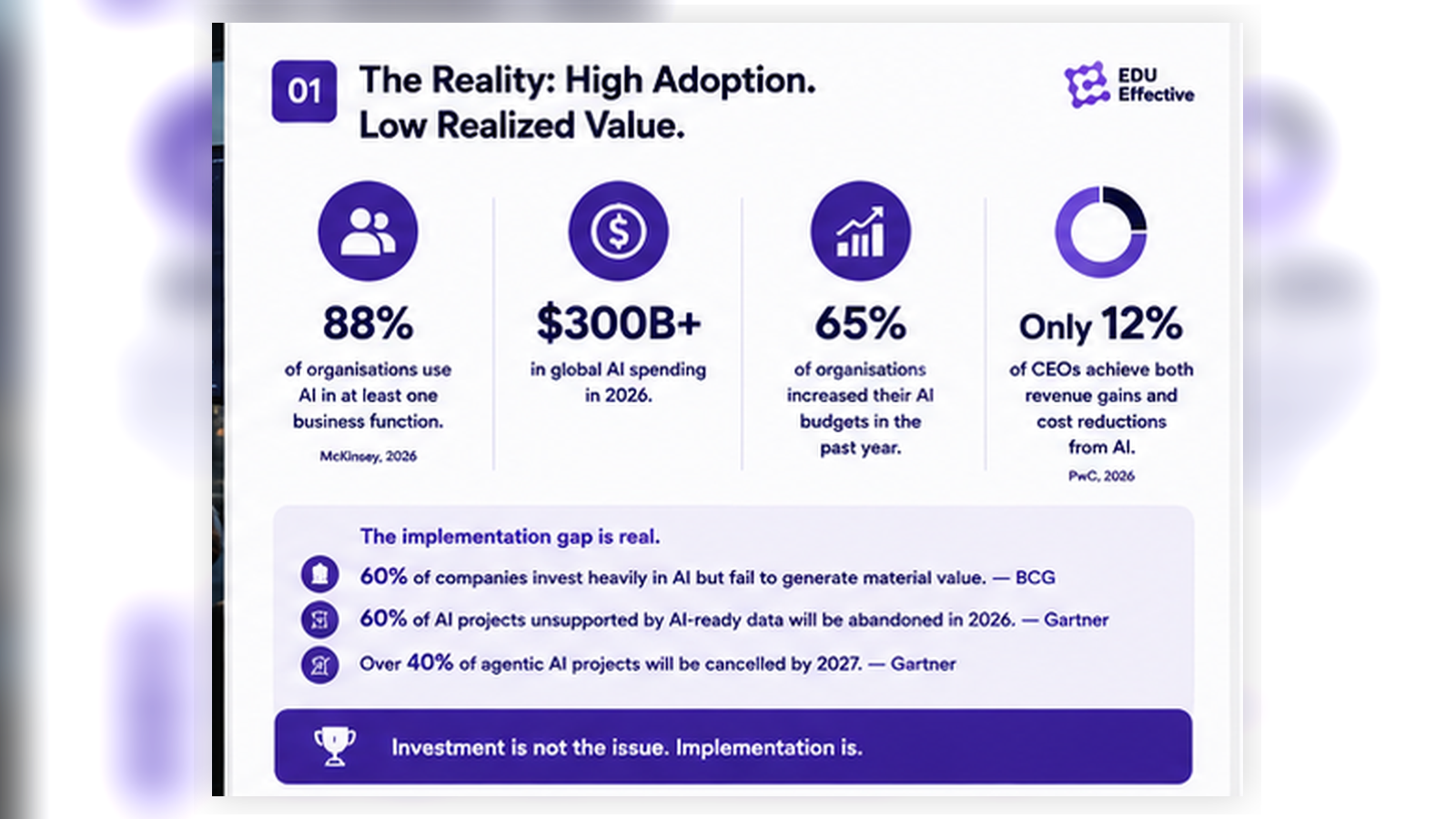
88% of organisations now use AI in at least one business function, according to McKinsey's 2026 State of AI research. Global AI spending surpassed $300 billion in 2026. 65% of organisations increased their AI budgets in the past year. By almost every adoption metric, AI is no longer an emerging technology — it is an operational reality.
And yet: only 12% of CEOs report achieving both revenue gains and cost reductions from AI, according to PwC's 2026 CEO Survey of 4,454 executives. BCG found that 60% of companies globally invest heavily in AI but fail to generate material value from it. Gartner projects that 60% of AI projects unsupported by AI-ready data will be abandoned through 2026 — and that over 40% of agentic AI projects will be cancelled by 2027.
The gap between the scale of AI investment and the scale of AI value delivered is one of the defining business management challenges of 2026. Understanding why implementations stall — and what the organisations extracting genuine value are doing differently — is what separates AI strategy from AI activity.
Why most AI implementations fail: the data is clear
Before examining what works, it is worth being precise about what does not — because the failure patterns are consistent enough across industries and organisation sizes to function as a diagnostic checklist.
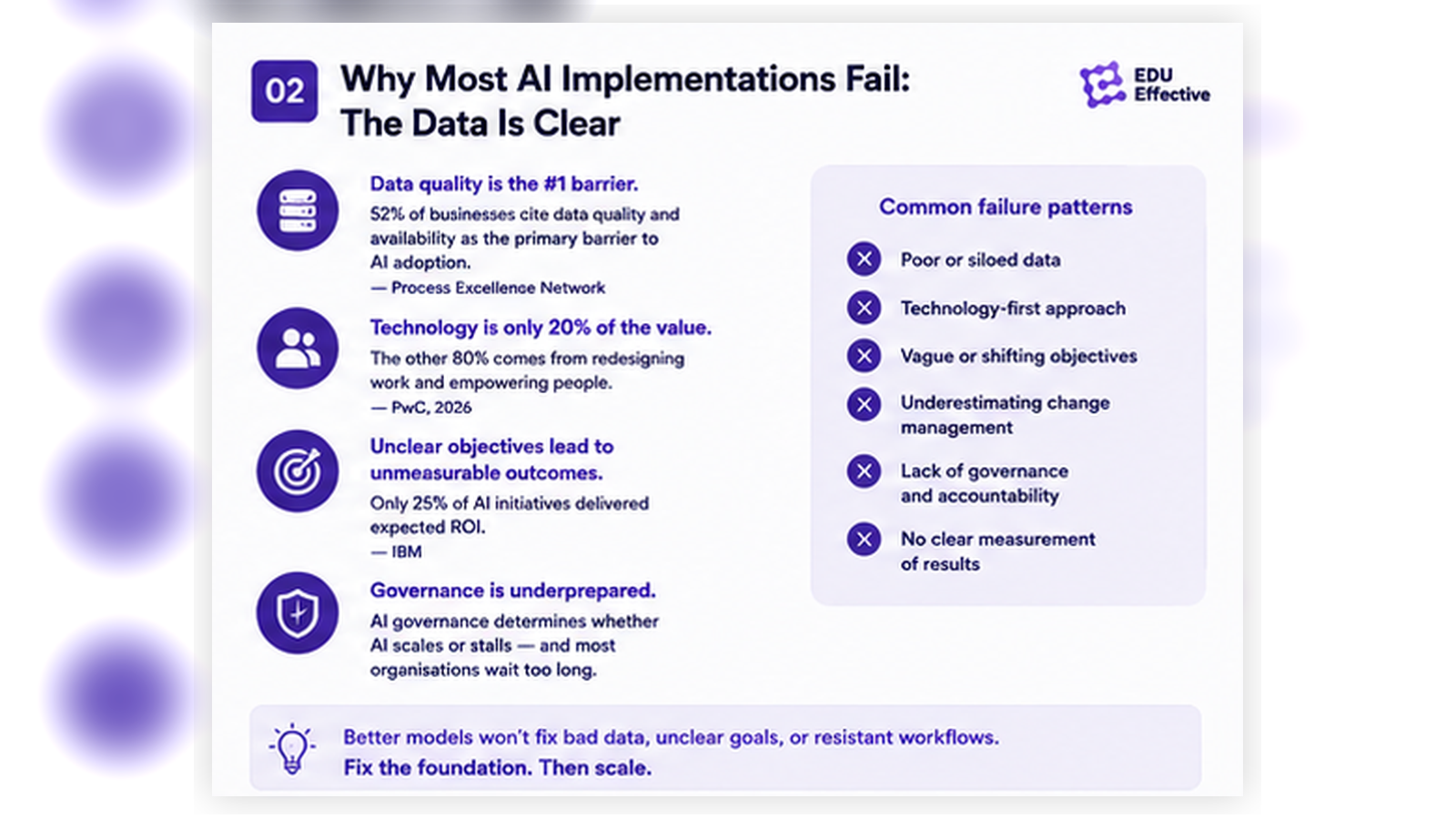
Data quality is the most frequently cited barrier, not technology. 52% of businesses cite data quality and availability as the primary barrier to AI adoption, according to Process Excellence Network research. Gartner's finding that 60% of AI projects unsupported by AI-ready data will be abandoned is not about model quality or tool selection — it is about the underlying data those models are asked to work with. AI systems learn from and operate on data. Inconsistent, incomplete, siloed, or poorly governed data does not produce better outputs when run through a more sophisticated model. It produces sophisticated-looking wrong outputs — which are often worse than no AI output at all, because they carry false confidence.
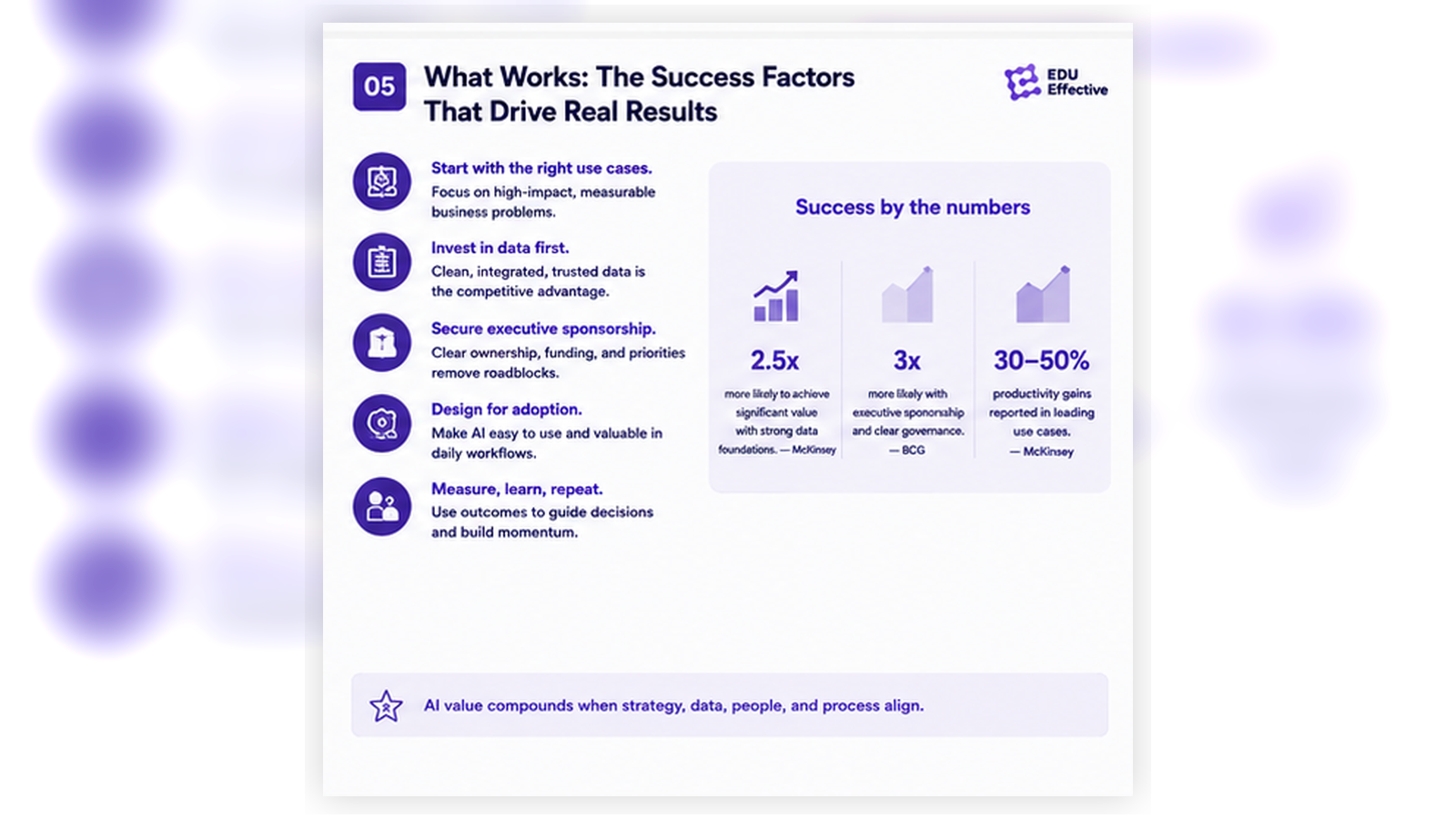
Technology is 20% of the value — people and processes are 80%. PwC's 2026 AI Business Predictions analysis found that technology accounts for approximately 20% of the value an AI initiative delivers. The remaining 80% comes from redesigning work so that AI handles routine tasks and humans focus on strategic priorities. This finding is counterintuitive for organisations that approach AI implementation as a technology procurement exercise rather than a workflow redesign exercise. Buying the tools is the easy part. Changing how people work alongside those tools is the hard part — and most organisations underinvest in it.
Unclear objectives produce unmeasurable outcomes. IBM's research found that only 25% of AI initiatives delivered expected ROI among the CEOs surveyed. The single most common characteristic of failed AI initiatives is the absence of a clear, measurable business objective defined before implementation begins. "We want to use AI more" and "we want to reduce customer service ticket resolution time by 30% within six months" are both AI implementation goals — but only one of them creates accountability, enables measurement, and allows an organisation to distinguish success from activity.
Governance is consistently underprepared. The EU AI Act has been entering its application phases since 2024, imposing specific obligations on organisations using AI in high-risk contexts. Beyond regulatory compliance, AI governance — defining who is accountable for AI outputs, how errors are detected and corrected, what data can be used and how, and how AI decisions can be audited — is the infrastructure that determines whether an AI implementation scales or stalls. Organisations that build governance in from the start deploy faster and sustain deployment longer than those that retrofit it after problems emerge.
The 10-20-70 principle: why implementation is mostly a people challenge
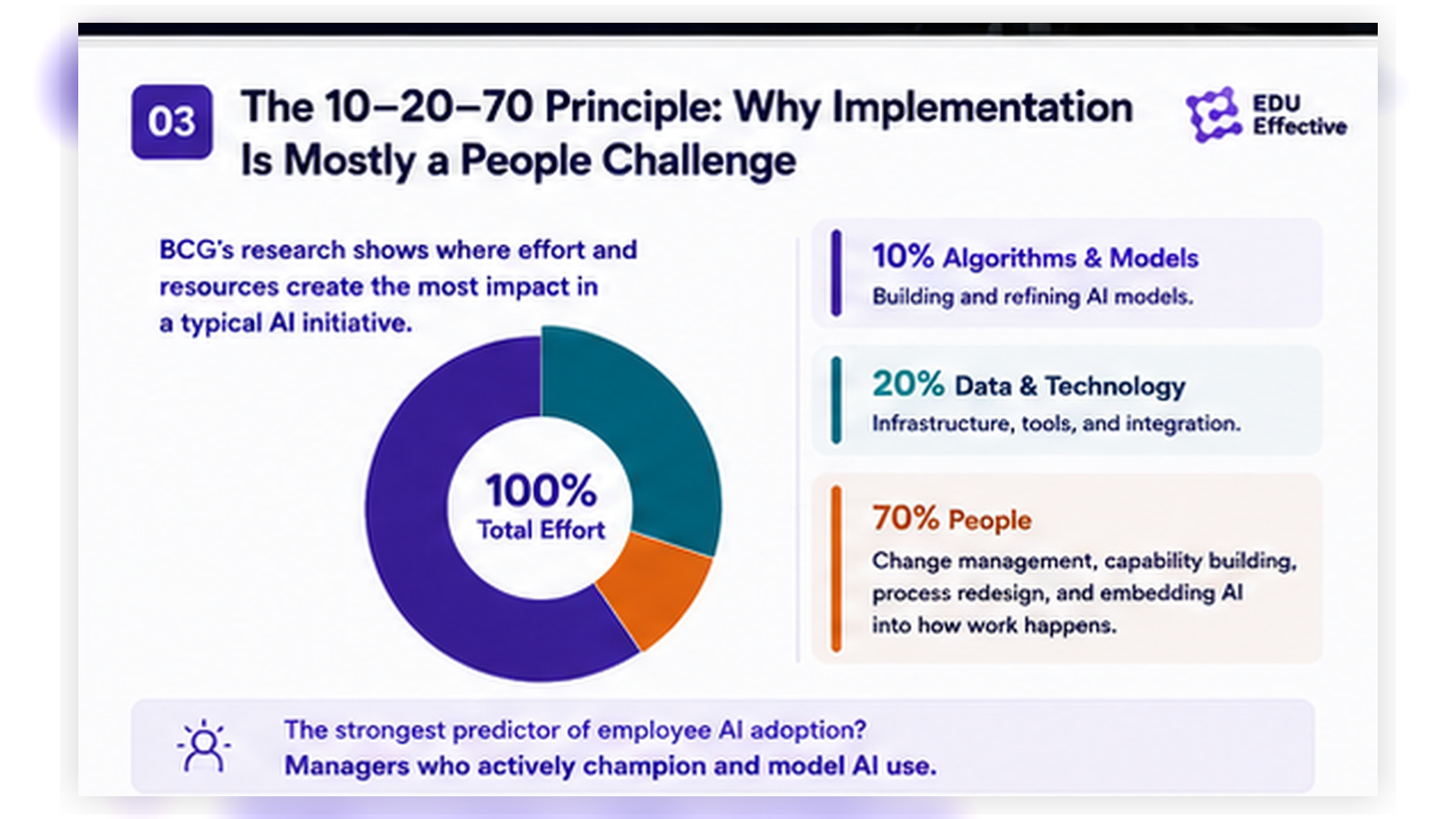
BCG's research on AI implementation effectiveness produced one of the most useful frameworks in the field: the 10-20-70 principle. It holds that in a typical AI initiative, approximately 10% of the effort and resources should go to building algorithms and models, 20% to data and technology infrastructure, and 70% to people — change management, capability building, process redesign, and embedding AI into how work actually happens.
This distribution runs exactly opposite to how most organisations approach AI implementation, where the majority of attention goes to model selection, tool procurement, and technical configuration — and change management is treated as a final step rather than the primary challenge.
The people dimension is not about persuading employees to accept AI. It is about building the understanding, skills, and processes that allow people to work effectively alongside AI systems — to know when to trust AI outputs, when to question them, and how to use them to augment rather than bypass human judgement. McKinsey research consistently shows that the strongest predictor of employee AI adoption is not tool quality but whether their direct manager actively champions and models AI use. Without that management layer, AI tools sit unused regardless of their technical quality.
A practical implementation framework: the four phases
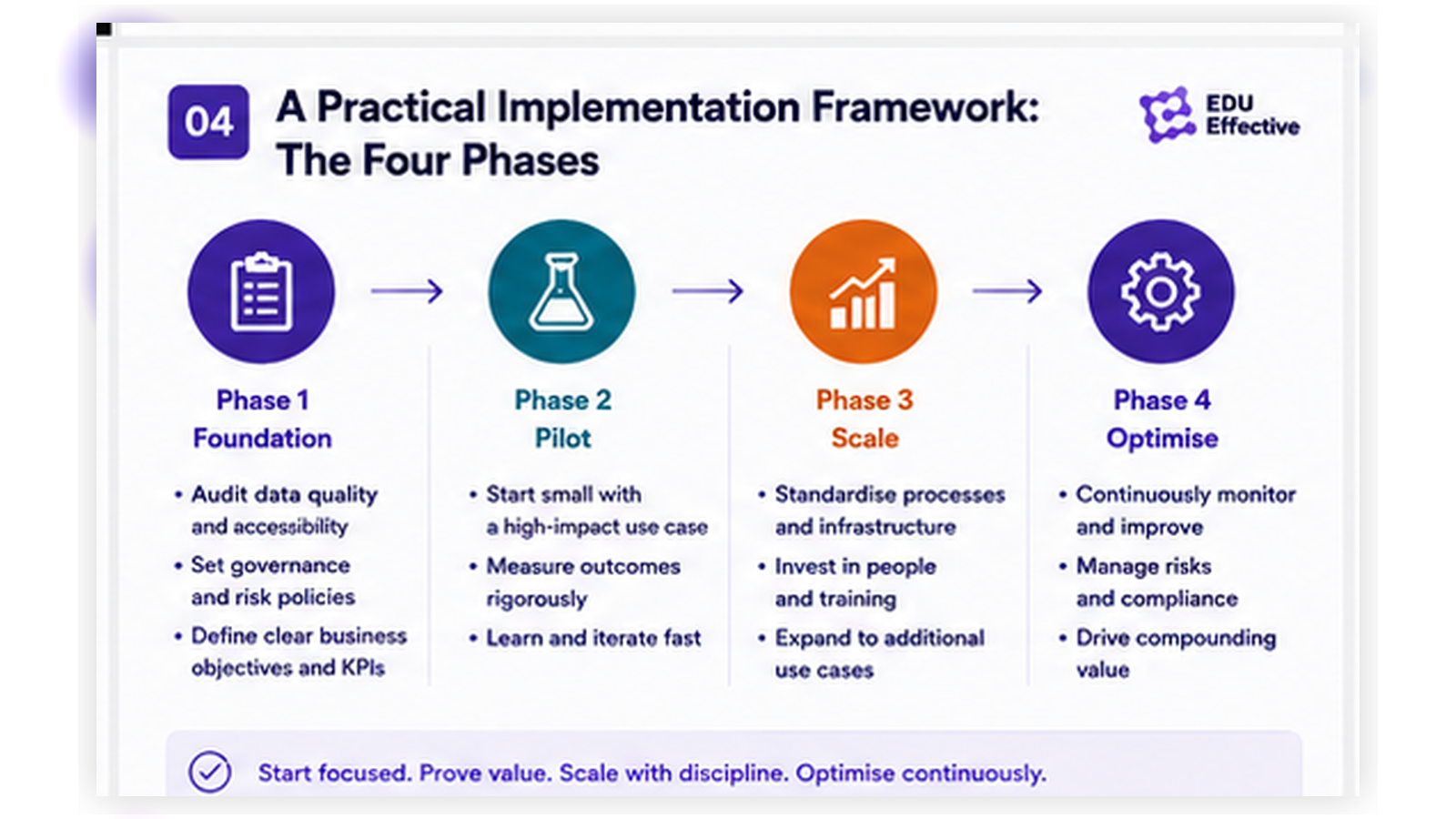
Organisations that consistently extract value from AI share a recognisable implementation structure. The phases vary in timing depending on scope and organisational complexity, but the sequence is consistent.
Phase 1: Foundation (months 1-3 for focused initiatives; months 1-6 for enterprise programmes)
The foundation phase addresses two questions before any AI is deployed: what business problem are we solving, and is our data capable of supporting an AI solution to that problem?
Use case identification and prioritisation comes first. Identify ten to fifteen potential AI use cases across the organisation. Evaluate each against four criteria: business value (what measurable outcome does this produce and how significant is it?), data readiness (does the relevant data exist, is it accessible, and is it of sufficient quality?), technical feasibility (is the required capability available at reasonable cost?), and implementation complexity (what process change and capability building does this require?). The cases that score highest across all four criteria — not just on business value — are the right starting points.
Data readiness assessment runs in parallel. Map what data you have, where it lives, who owns it, how consistent it is across sources, and what governance structures exist around it. The gap between what an AI implementation needs and what your data currently provides is the most common source of implementation delay and failure. Addressing it before deployment — rather than discovering it during deployment — saves significantly more time than it costs.
Phase 2: Pilot (months 3-6)
Pilots serve a specific purpose: generating real evidence about whether a use case works in your specific context, with your specific data and workflows, before committing to enterprise-wide deployment. A pilot is not a proof of concept in a controlled environment — it is a production-equivalent test with defined success criteria, real users, and real measurement.
The most common pilot mistake is defining success as "the technology works" rather than "the business outcome improved." A customer service AI that successfully handles 40% of tickets is not a successful pilot if ticket resolution quality falls, customer satisfaction declines, and service agents cannot effectively manage the 60% that escalate to them. Defining the full operational context — not just the AI component — before the pilot begins determines whether you learn what you need to learn from it.
Phase 3: Scale (months 6-18)
Scaling a successful pilot to broader deployment is where most of BCG's 80% people investment is required. Process redesign — changing how work flows through the AI-augmented system rather than simply adding AI to existing processes — is the primary task. Training and capability building for the people working alongside the AI is the second. Change management that addresses the concerns, resistance, and adjustment needs of affected teams is the third.
The sequencing matters. Organisations that attempt enterprise-wide deployment before the people and process changes are in place typically experience rapid adoption followed by rapid abandonment — as users encounter friction, produce poor results, and revert to previous methods. Starting smaller, demonstrating success, and expanding through visible wins builds the organisational confidence that sustains adoption.
Phase 4: Institutionalise (ongoing)
AI implementation does not have an end date. AI capabilities are evolving faster than any point in the history of enterprise technology, which means that what constitutes best practice in AI-augmented workflows changes on timescales measured in months rather than years. Organisations that treat AI implementation as a project with a completion date find their implementations becoming obsolete. Those that treat it as an ongoing capability — with continuous measurement, continuous learning, and continuous adaptation — sustain competitive advantage.
Institutionalisation means building AI literacy and ongoing development into standard professional development processes. It means creating feedback mechanisms that surface problems with AI outputs before they compound. It means keeping governance frameworks current with regulatory developments. And it means maintaining leadership attention on AI performance — not as a periodic review but as an ongoing operational priority.
Use case prioritisation: where AI delivers the most consistent value
Not all AI use cases are equally mature or equally likely to deliver measurable value in 2026. Current deployment data provides a useful map.
Customer service automation is the most widely deployed AI application in production — used by 56% of organisations that have AI in production, according to McKinsey's 2026 survey. Natural language processing-based systems that handle routine customer queries, triage complex cases, and provide agents with real-time information and suggested responses have well-established ROI across industries. The combination of high volume, repetitive tasks, and clear success metrics (resolution time, customer satisfaction, escalation rate) makes this a strong starting point for organisations with customer-facing operations.
IT operations and infrastructure management is the second most common deployment at 51% — AI systems that monitor network performance, detect anomalies, predict failures before they occur, and automate routine maintenance tasks. The data environment in IT operations tends to be more standardised and better governed than in many business functions, which improves implementation reliability.
Marketing and content personalisation at 48% — AI systems that generate, adapt, and optimise marketing content, personalise customer communications at scale, and optimise campaign performance in real time — have demonstrated strong ROI across e-commerce, financial services, and B2B marketing. 87% of marketers now use generative AI in at least one workflow, according to Salesforce's State of Marketing 2026.
Finance and risk management — AI applications in fraud detection, credit scoring, financial forecasting, and regulatory compliance monitoring are particularly well-developed in financial services. The data environments in finance tend to be relatively structured, making AI implementation more reliable than in functions with less standardised data.
The governance imperative: what the EU AI Act requires of business managers
AI governance is not a compliance checkbox — it is the operational framework that determines whether an AI system can be trusted, corrected, and scaled.
The EU AI Act classifies AI systems by risk level and imposes specific obligations on organisations deploying AI in high-risk contexts — including HR and recruitment decisions, credit scoring, healthcare diagnosis, law enforcement, and critical infrastructure management. For high-risk applications, organisations must conduct conformity assessments, maintain technical documentation, implement human oversight mechanisms, and ensure transparency to affected individuals.
But the governance requirements that matter most for most business managers go beyond regulatory compliance. They include: who is accountable when an AI system produces an incorrect or harmful output; how errors are detected, reported, and corrected; what data can be used in AI systems and how that data is protected; how AI-assisted decisions can be audited; and how AI systems are monitored for performance degradation over time.
Building governance infrastructure before problems emerge is consistently less costly than retrofitting it after. The organisations that have implemented AI governance most effectively treat it not as a constraint on AI deployment but as the foundation that makes scale possible — because without governance, every AI failure becomes a crisis rather than a correctable operational issue.
What managers need to know — regardless of technical background
The clearest finding from PwC's 2026 research is that technology accounts for 20% of AI value and people and process redesign accounts for 80%. This means that the management skills required to implement AI successfully — use case identification and prioritisation, change management, workforce capability building, outcome measurement, governance oversight — are management skills, not technical skills.
The managers who implement AI most effectively in 2026 are not those with the deepest technical knowledge of machine learning or model architecture. They are those who can ask the right questions of technical teams, translate AI capabilities into business outcomes, manage the human dimensions of significant workflow change, and maintain accountability for results rather than activities.
AI literacy — understanding what AI systems can and cannot do, how to evaluate their outputs critically, how to identify where AI adds value and where it creates risk — is the professional capability that underlies all of this. It does not require learning to code. It requires developing the conceptual understanding that allows a manager to make intelligent decisions about AI rather than delegating those decisions entirely to technical teams.
At EDU Effective, the Effective MBA: Applied Artificial Intelligence is designed specifically for this purpose — building the AI literacy, implementation knowledge, and management capabilities that allow professionals to lead AI initiatives effectively, without coding. Explore the programme →
EDU Effective Business School — professional development for your long-term success.
All five Effective MBA programs are built on the same educational model — designed for working adults who need learning that fits real professional life:
- Effective MBA: Executive Management & Leadership
- Effective MBA: Applied Artificial Intelligence
- Effective MBA: Coaching, Leadership & Mentoring
- Effective MBA: Mastery in AI
- Effective MBA: Online Marketing
Every programme runs on 15 minutes a day, completes in 10 months or less, is ASIC accredited, and starts from €990.
These are professional programmes, not academic ones — built for working adults to apply what they learn directly in their own business, not to collect a scholarly credential.
Join more than 9,000 students in over 120 countries who are investing in their professional development and career success. Read the experiences of our graduates here.
Apply now — from €990 · Talk to a Study Advisor
Study with NO risk: 14-day money-back guarantee, no questions asked.
Sources
- McKinsey & Company — The State of AI 2025: How Organisations Are Rewiring to Capture Value https://www.mckinsey.com/capabilities/quantumblack/our-insights/the-state-of-ai
- PwC — 2026 AI Business Predictions https://www.pwc.com/us/en/tech-effect/ai-analytics/ai-predictions.html
- PwC — 2026 Global CEO Survey https://www.pwc.com/gx/en/news-room/press-releases/2026/pwc-2026-global-ceo-survey.html
- BCG — AI at Work: Strategy Matters More Than Tools https://www.bcg.com/publications/2026/ai-at-work-why-strategy-matters-more-than-tools
- Gartner — Lack of AI-Ready Data Puts AI Projects at Risk https://www.gartner.com/en/newsroom/press-releases/2025-02-26-lack-of-ai-ready-data-puts-ai-projects-at-risk
- Gartner — Gartner Predicts Over 40% of Agentic AI Projects Will Be Canceled by End of 2027 https://www.gartner.com/en/newsroom/press-releases/2025-06-25-gartner-predicts-over-40-percent-of-agentic-ai-projects-will-be-canceled-by-end-of-2027
- IBM Institute for Business Value — Rewiring the C-suite: The fast track to 2030 https://www.ibm.com/thought-leadership/institute-business-value/en-us/c-suite-study/ceo
- Deloitte — State of AI in the Enterprise 2026 https://www2.deloitte.com/us/en/insights/focus/cognitive-technologies/state-of-ai-and-intelligent-automation-in-business-survey.html
- IDC — Worldwide AI Spending Guide 2026 https://www.idc.com/getdoc.jsp?containerId=IDC_P33198
- Salesforce — State of Marketing Report 2026 https://www.salesforce.com/resources/research-reports/state-of-marketing/