

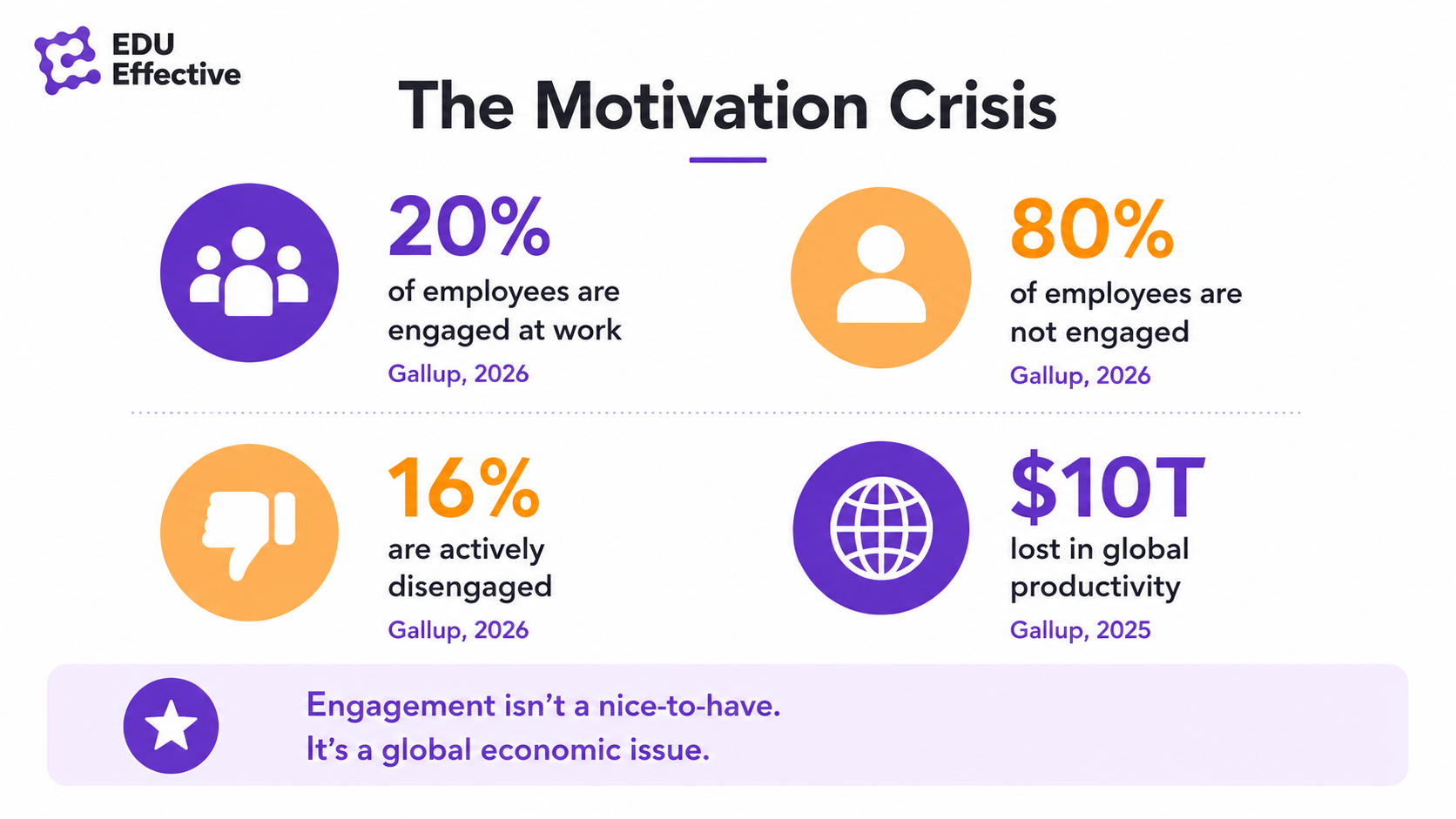
Global employee engagement fell to 20% in 2026 — down from its peak of 23% in 2022, and declining for the second consecutive year, according to Gallup's State of the Global Workplace 2026 report, the largest ongoing study of workforce engagement in existence. That means eight out of every ten employees worldwide are not engaged at work. 16% are actively disengaged — working in ways that actively undermine their teams and organisations.
Gallup estimates that low engagement cost the global economy approximately $10 trillion in lost productivity in 2025. That number is not a rounding error. It is the accumulated cost of a workforce that is present but not invested, completing tasks but not applying discretionary effort, staying employed but not contributing at the level of capability they possess.
The question every manager needs to answer is not whether employee motivation matters — the data settles that beyond serious dispute. The question is what actually drives it, and why so many well-intentioned management approaches produce disappointing results.
Why most conventional motivation approaches underperform
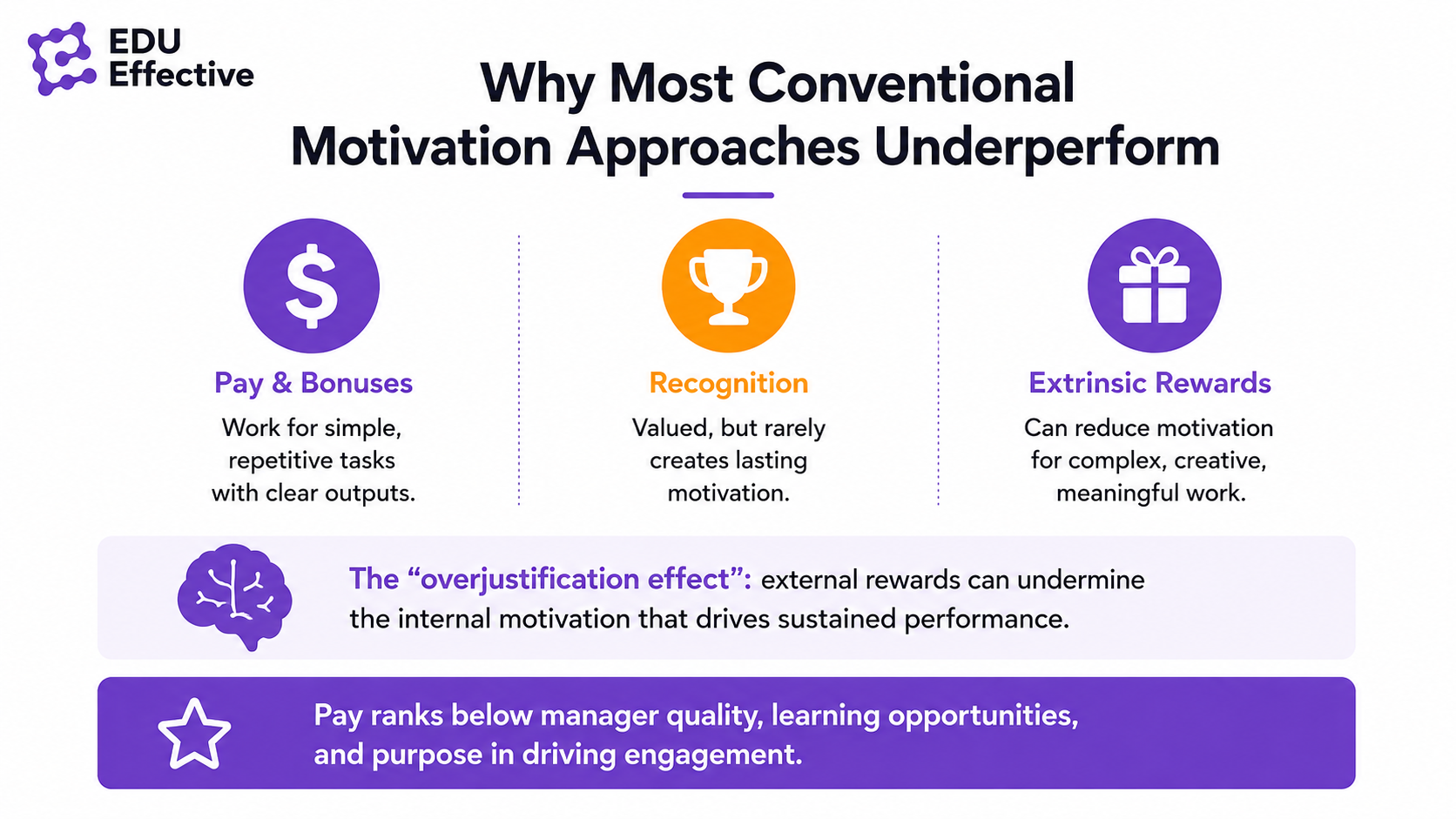
The management instinct for motivating employees typically reaches for one of three tools: pay increases, bonuses and incentives, or public recognition. These tools are not without value — but the research on what actually drives sustained motivation and engagement tells a more complicated story than most managers expect.
The assumption underlying most extrinsic motivation strategies is that people work harder when the external reward for doing so is higher. This is true in a limited range of contexts — for simple, repetitive tasks with clear outcomes, where effort directly produces measurable output, higher pay does produce higher performance. But for the complex, interdependent, judgement-intensive work that most professionals do, the relationship between extrinsic reward and motivation is much weaker and can actually be counterproductive.
Psychologists Edward Deci and Richard Ryan's research on motivation — developed over more than four decades and now among the most replicated findings in behavioural science — demonstrated a specific and surprising phenomenon: providing external rewards for activities people already find intrinsically motivating can reduce their motivation rather than increase it. By making the external reward the reason for the activity, the reward undermines the internal sense of choice and ownership that was sustaining the motivation in the first place. Deci and Ryan called this the "overjustification effect."
The practical implication is that money and recognition, while necessary and valued by employees, are not what primarily determines whether people show up to work energised and invested. Gallup's research consistently shows that pay is ranked below manager quality, learning opportunities, and sense of purpose as drivers of engagement and voluntary turnover decisions. The manager who believes that a pay rise will solve a motivation problem is usually addressing a symptom rather than a cause.
The research consensus on what actually drives motivation
The most robust framework for understanding employee motivation in professional contexts is Self-Determination Theory (SDT), developed by Deci and Ryan and now comprehensively validated across thousands of studies in workplace settings. SDT identifies three core psychological needs that, when met, consistently produce high autonomous motivation, and when not met, produce the passive compliance or active disengagement that characterises most low-engagement workplaces.
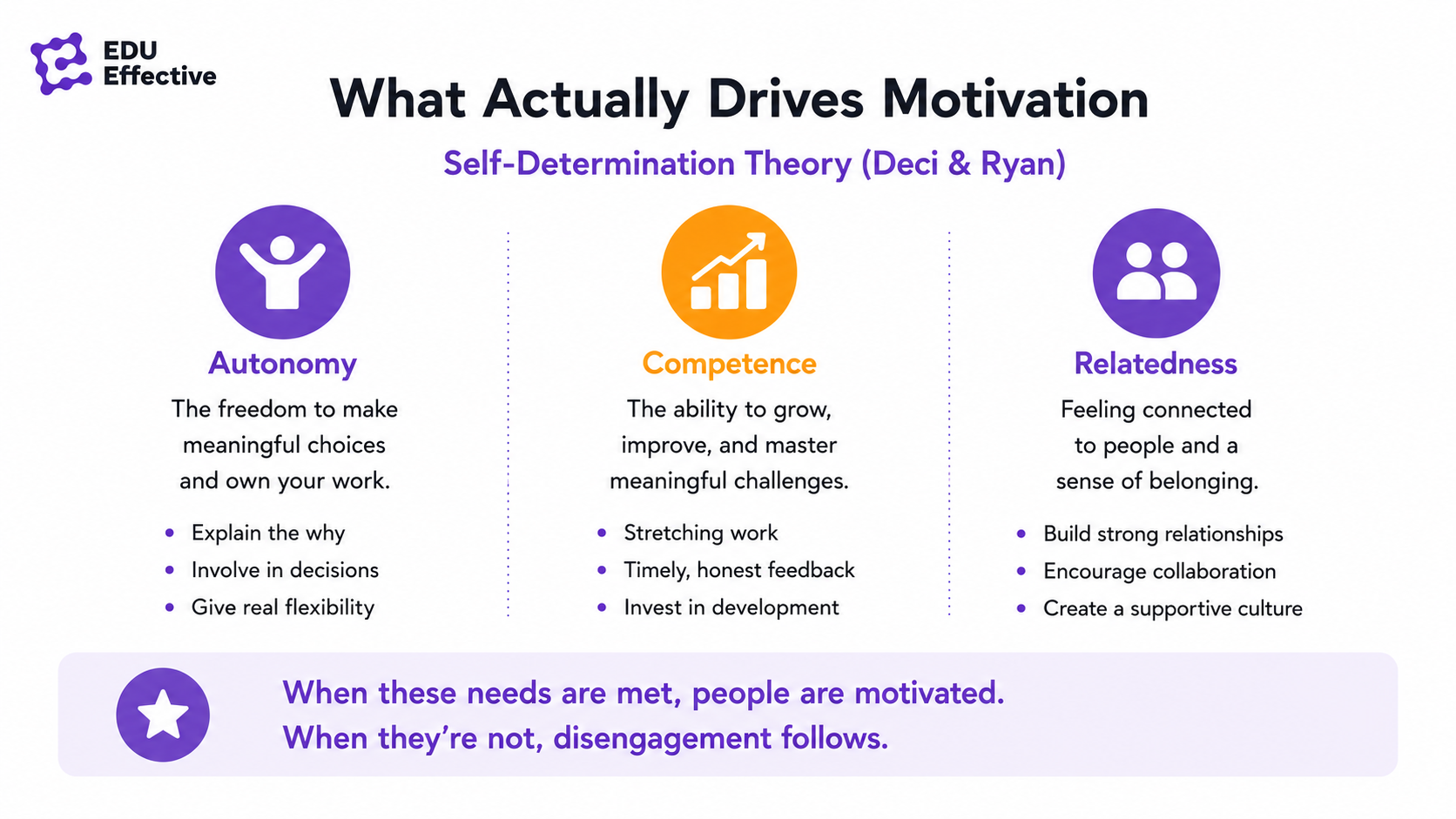
Autonomy is the experience of having genuine choice and ownership over how work is done. Not necessarily freedom to ignore organisational constraints — but the sense that within those constraints, the professional is making real decisions rather than simply executing prescribed instructions. Autonomous motivation — doing work because it feels like a genuine expression of values and interest — is consistently associated with higher performance, greater creativity, stronger persistence, and better wellbeing than controlled motivation, where work is done to satisfy external demands.
In management terms, autonomy is supported by explaining the why behind decisions and objectives rather than just the what, by involving employees in decisions that affect their work, by giving people latitude to determine how they approach problems within agreed parameters, and by resisting the micromanagement impulse that treats detailed oversight as quality assurance. McKinsey's research found that employees with high autonomy are three times more likely to remain with their organisation than those with low autonomy — a retention effect larger than that produced by pay or flexible working arrangements.
Competence is the experience of growing capability and mastery — the sense of becoming better at things that matter. Humans have a deep motivational response to competence development: the state of learning and improving at something genuinely challenging is intrinsically rewarding in a way that routine task completion is not. This is why challenging work, when appropriately supported, produces higher motivation than easy work — and why the sense of stagnation is one of the most reliable predictors of disengagement and voluntary turnover.
In management terms, competence is supported by assigning work that genuinely stretches capability — neither so routine that it produces boredom nor so overwhelming that it produces anxiety — by providing timely, specific, and honest feedback that helps people understand how they are doing and what would help them improve, and by investing in professional development that creates visible growth pathways. The 68% of employees who say skill-building opportunities make them more motivated, and the 94% who say they would stay longer if companies invested in their career development, are expressing the same underlying need: work that enables them to become more capable.
Relatedness is the sense of genuine connection to colleagues, to the organisation, and to a purpose beyond individual task completion. This need has become more salient in the post-pandemic professional environment, where remote and hybrid work has systematically reduced the ambient social connection that office environments provided without deliberate effort. Gallup's 2026 data shows a specific and concerning pattern: managers report higher engagement than individual contributors but simultaneously report sharply higher stress, anger, sadness, and loneliness. The people most invested in their organisations are also experiencing the most severe wellbeing challenges — which is a direct warning signal about the sustainability of the engagement patterns Gallup is measuring.
Relatedness in a management context is supported by genuine interpersonal interest — knowing something real about team members as people, not just as performers — by creating team environments where people feel seen and valued rather than merely productive, and by connecting work to a purpose that extends beyond this quarter's targets.
The manager variable: why individual managers explain most of the engagement gap
Gallup's 2026 data reveals a specific and alarming pattern: manager engagement has fallen from 31% in 2022 to just 22% in 2025 — declining at nearly three times the rate of individual contributor engagement. Managers have lost what Gallup calls the "engagement premium" they historically held over their teams. In best-practice organisations, however, manager engagement reaches 79% — nearly four times the global average. The gap between those organisations and everyone else explains most of the trillion-dollar productivity differential that engagement controls.
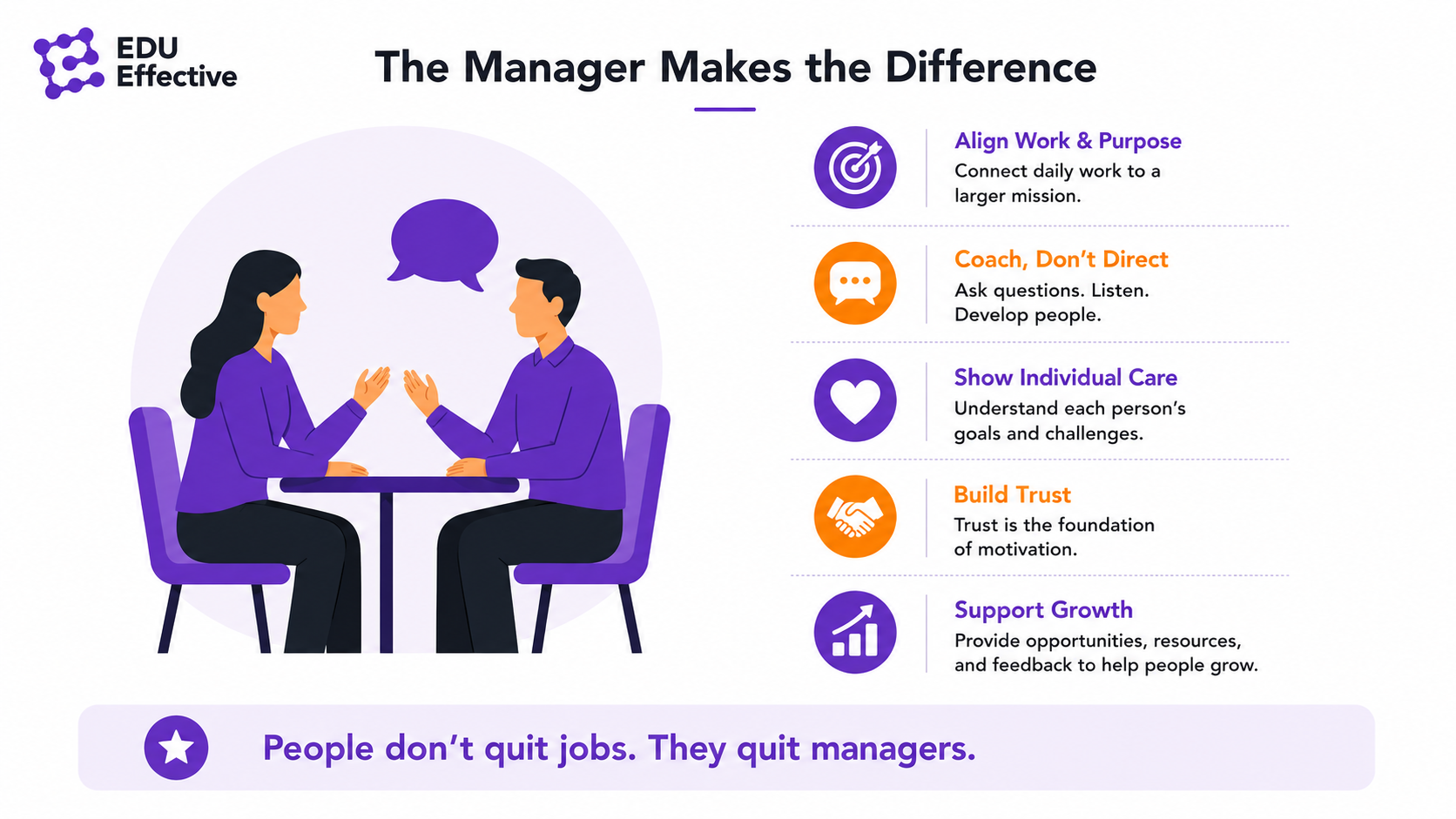
Gallup's most consistently cited finding in twenty-five years of engagement research is that managers account for at least 70% of the variance in team engagement across business units. The same organisation, with the same pay structures, the same benefits, and the same business challenges, produces dramatically different engagement outcomes depending on who is leading each team.
This finding has a specific implication for how organisations should think about motivation. The engagement gap is not primarily a compensation problem, a benefits problem, or a culture problem — at the team level, it is a management quality problem. And management quality, unlike organisational culture or pay benchmarks, is something individual managers can directly influence through their own behaviour.
The specific behaviours that Gallup research links most reliably to team engagement are: having frequent, meaningful conversations with each team member about their work and development (not just status updates); recognising good work specifically and promptly; creating an environment where people can raise concerns without fear of negative consequences; clearly communicating expectations and the reasoning behind them; and demonstrating genuine interest in each team member's long-term career development, not just their performance in their current role.
None of these behaviours requires budget approval. All of them require the kind of deliberate, human-centred management that produces high engagement regardless of what the organisation provides structurally.
Recognition: the most cost-effective motivation lever most managers underuse
Of all the motivation levers available to managers, recognition is simultaneously the most cost-effective and the most consistently underused. Gallup and Workhuman's research found that meaningful recognition — specific, timely, and tied to what the person actually did and why it mattered — is one of the highest-ROI management behaviours available, producing measurable improvements in engagement, retention, and performance at essentially zero financial cost.
The key word is "meaningful." Generic recognition — "great job this week" — has minimal motivational effect. Recognition that names the specific behaviour, explains its impact, and comes from someone whose opinion the recipient values produces lasting motivational effects. The SBI (Situation-Behaviour-Impact) structure used in effective feedback conversations applies equally to recognition: "In Tuesday's client presentation [Situation], you pre-emptively addressed the budget objection before the client raised it [Behaviour]. That changed the dynamic of the entire meeting — we left with a signed letter of intent rather than a follow-up call [Impact]."
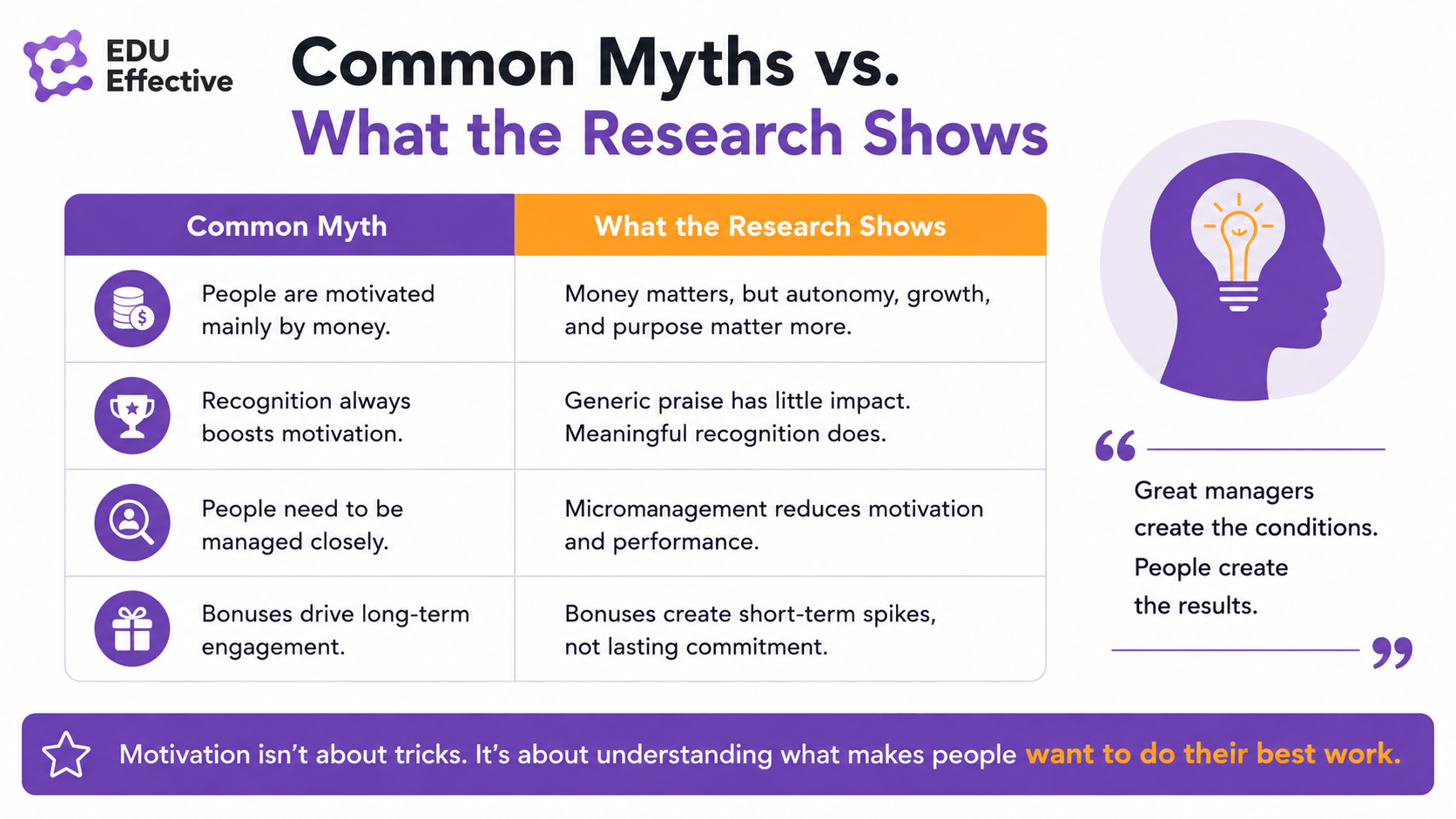
79% of employees say they would work harder if recognised. But only one in three report having received recognition or praise for good work in the past seven days, according to Gallup's data. The gap between the motivational power of recognition and its actual frequency in most organisations is one of the most actionable findings in engagement research for working managers.
Purpose and meaning: the engagement driver that AI is intensifying
In 2026, the relationship between purpose and motivation has a new dimension. As AI increasingly handles the routine, analytical, and administrative work that once absorbed professional time, the work that remains is more concentrated in the distinctly human capabilities — judgement, creativity, relationship management, leadership, and complex problem-solving. These are inherently more meaningful activities than the tasks AI is absorbing. The professionals who understand this transition are experiencing it as an expansion of the meaningful portion of their work.
But the same transition is also generating anxiety — about job security, about the pace of change, about whether skills built over years remain relevant. Gallup's 2026 data shows that employee wellbeing has declined alongside engagement, with economic uncertainty and AI-related anxiety contributing to a workforce that is more stressed and less connected than at any point in the recent measurement history.
The motivational implication for managers is specific: in periods of significant uncertainty, the quality of communication about what is happening and why is itself a motivational factor. Employees who understand the direction their organisation is heading, who trust that their manager is being honest with them, and who feel their contribution to that direction is clearly seen and valued — these employees are more resilient in uncertainty than those who experience the same changes with less information and less connection.
What motivated teams look like — and what managers can do this week
Motivation is not a state that is produced once and then maintained. It is an ongoing condition that requires continuous management attention — through the quality of conversations, the consistency of recognition, the genuineness of interest in each person's development, and the clarity of communication about expectations and direction.
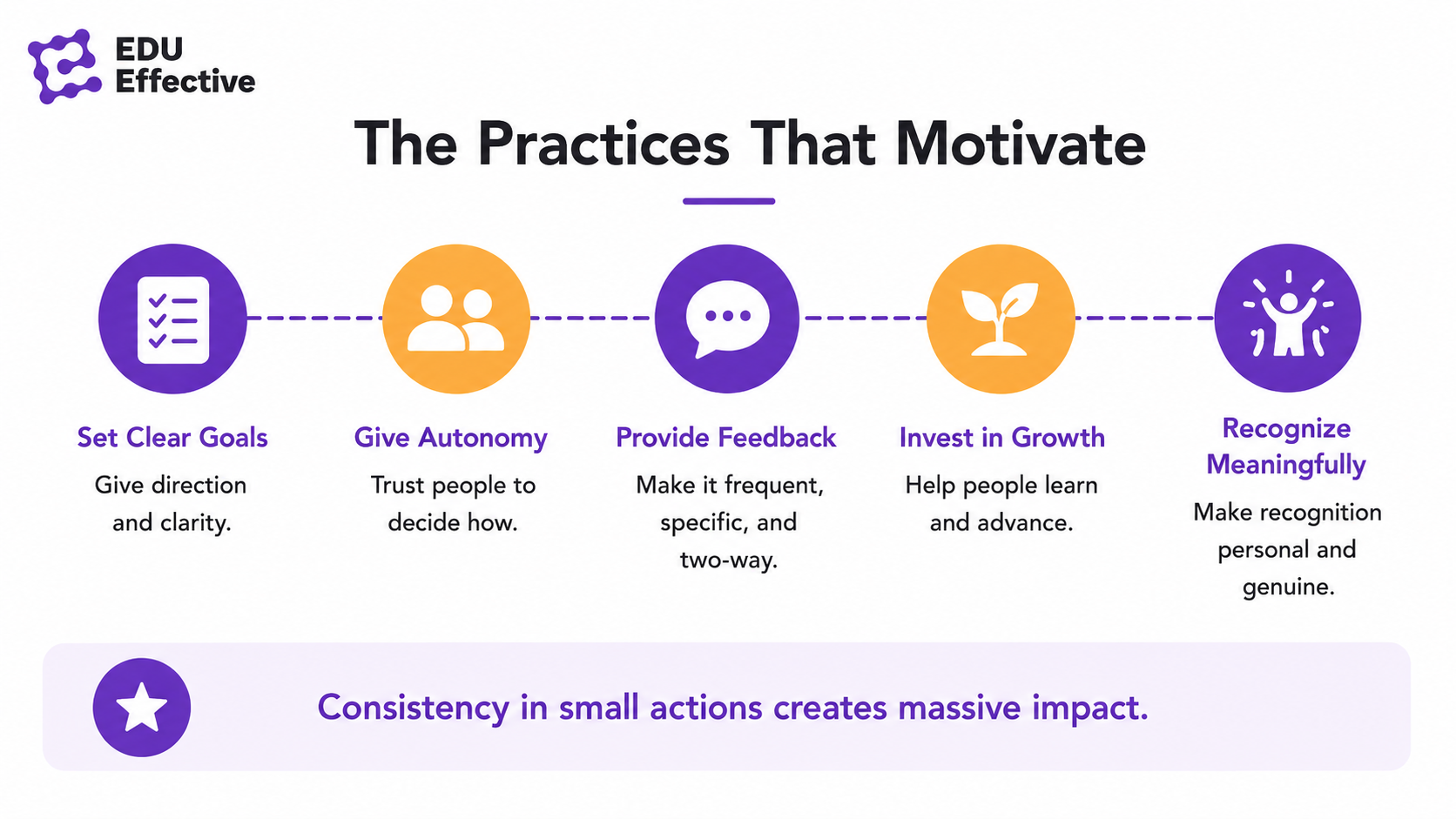
The practical starting point for any manager who wants to improve their team's motivation is not a new incentive structure or a team offsite. It is three specific behaviours, applied consistently:
1. Have a genuine one-to-one conversation with each team member this week — not a task update, but a conversation that includes how they are doing, what they find most engaging about their current work, and what is getting in their way. The information this surfaces is both intrinsically motivating (people are motivated when someone in authority is genuinely interested in their experience) and instrumentally valuable (it tells you what you can do differently to remove obstacles and increase engagement).
2. Deliver one piece of specific, timely, positive recognition this week — using the Situation-Behaviour-Impact structure. Not to a team, but to an individual, privately or publicly depending on the person's preference. The motivational effect of specific recognition is real and immediate, and it costs nothing.
3. Have one conversation about development — what the person is working on, what they want to build, and what opportunities exist to stretch their capability in the direction they care about. The 94% of employees who say they would stay longer if companies invested in their development are telling managers something specific: that career growth is not a benefit to be provided once a year in a performance review, but a motivation that requires ongoing attention.
At EDU Effective, the Effective MBA: Executive Management & Leadership and the Effective MBA: Coaching, Leadership & Mentoring both develop the management and coaching capabilities that drive team engagement — not as theory, but as practised skills applied directly to your team's real situations. Explore our programs →
EDU Effective Business School — professional development for your long-term success.
All five Effective MBA programs are built on the same educational model — designed for working adults who need learning that fits real professional life:
- Effective MBA: Executive Management & Leadership
- Effective MBA: Applied Artificial Intelligence
- Effective MBA: Coaching, Leadership & Mentoring
- Effective MBA: Mastery in AI
- Effective MBA: Online Marketing
Every programme runs on 15 minutes a day, completes in 10 months or less, is ASIC accredited, and starts from €990.
These are professional programmes, not academic ones — built for working adults to apply what they learn directly in their own business, not to collect a scholarly credential.
Join more than 9,000 students in over 120 countries who are investing in their professional development and career success. Read the experiences of our graduates here.
Apply now — from €990 · Talk to a Study Advisor
Study with NO risk: 14-day money-back guarantee, no questions asked.
Sources
- Gallup — State of the Global Workplace 2026 (263,810 respondents) https://www.gallup.com/workplace/349484/state-of-the-global-workplace.aspx
- Gallup — Manager Impact: 70% of Team Engagement Variance https://www.gallup.com/workplace/236927/employee-engagement-drives-growth.aspx
- Gallup / Workhuman — The Human-Centered Workplace: Recognition Research https://www.workhuman.com/blog/benefits-of-employee-recognition/
- McKinsey & Company — Human Skills Will Matter More Than Ever in the Age of AI (January 2026) https://www.mckinsey.com/mgi/media-center/human-skills-will-matter-more-than-ever-in-the-age-of-ai
- Deci, E. L., & Ryan, R. M. — Self-Determination Theory: Autonomy, Competence and Relatedness (APA) https://www.apa.org/research-practice/conduct-research/self-determination-theory
- Deloitte — Global Human Capital Trends 2026 https://www2.deloitte.com/us/en/insights/focus/human-capital-trends.html
- PwC — 2026 Global AI Jobs Barometer: Workforce Engagement and Skills https://www.pwc.com/gx/en/news-room/press-releases/2026/pwc-2026-ai-jobs-barometer.html