


The single most common reason professionals do not pursue an MBA is not cost and not ambition — it is time. Work-life balance has surpassed pay as the top priority for professionals globally, according to Randstad's 2025 Workmonitor research of 27,000 workers across 35 countries. Adding a two or three year academic commitment on top of a demanding job, a family, and a life that already has more in it than hours is not a small ask.
And yet the professional case for building business capabilities — leadership, strategy, AI fluency, marketing, financial literacy — has never been stronger. PwC's 2026 Global AI Jobs Barometer found that roles requiring AI skills command a 62% wage premium. The World Economic Forum projects 39% of core job skills will change by 2030. GMAC's 2026 Prospective Students Survey found that interest in part-time MBA formats has grown from 5% to 8% of prospective students since 2019 — a 60% increase driven almost entirely by working professionals who want the qualification without the career disruption.
The question is not whether to invest in business education. It is how to do it without dismantling the life you have built.
The real challenge of studying while working — and why most approaches fail
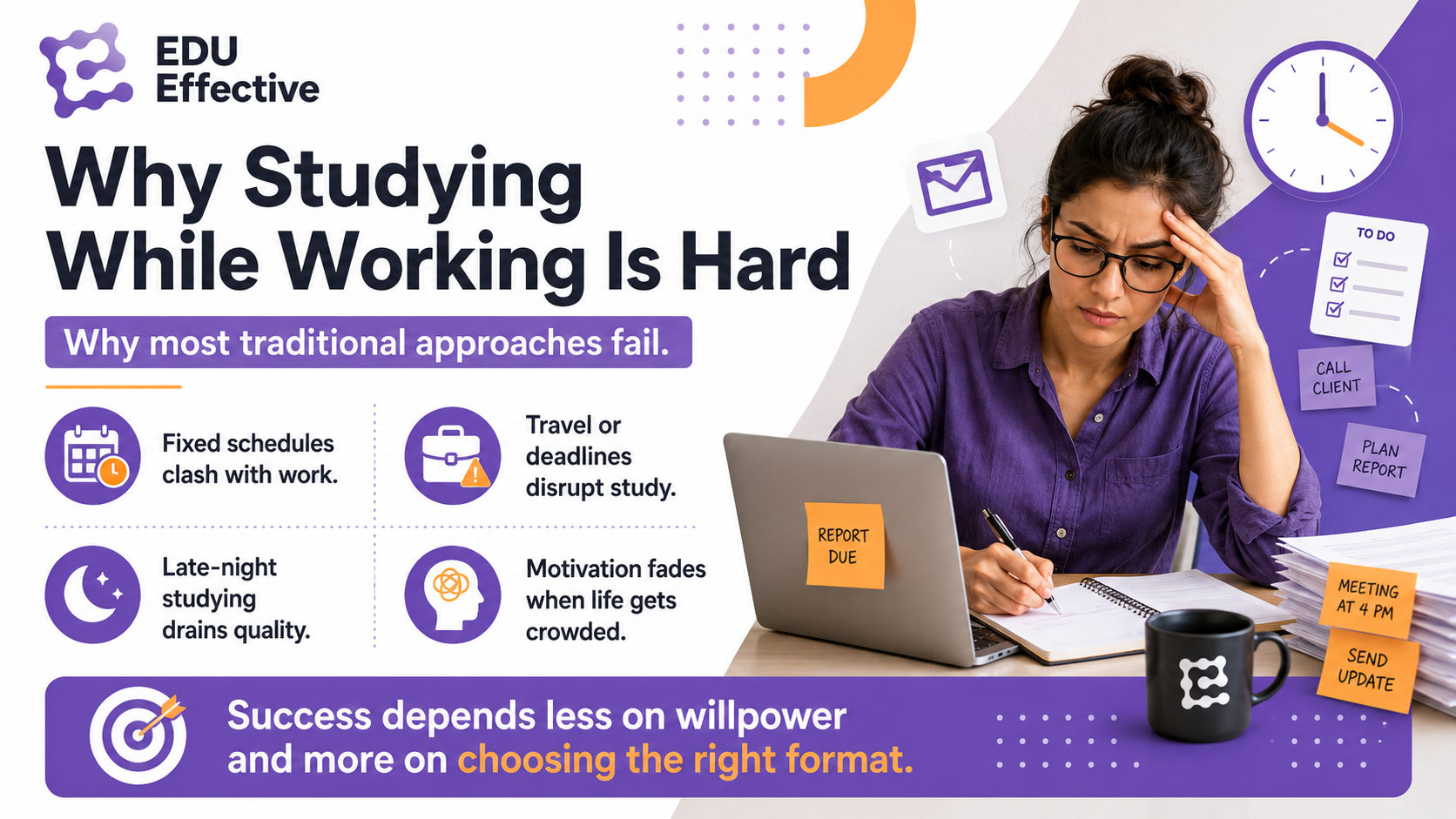
Before examining what works, it is worth being honest about why studying while working is harder than most people anticipate — and why the format of the programme matters as much as the content.
The typical part-time MBA model assumes a specific kind of student: one who can attend evening and weekend classes on a fixed schedule, commute to a campus, complete substantial weekly assignments while managing a full-time role, and sustain this for two to three years. This model was designed for an era when remote work was unusual, when the alternative was full-time study, and when the primary competition for student time was a single job rather than the hybrid of professional and personal demands that characterises most working adults' lives in 2026.
The failure modes are predictable. Three weeks into a traditional part-time programme, the fixed class schedule collides with a work deadline. A travel obligation takes out an entire module. The sustained cognitive demand of studying after a full working day produces diminishing quality. And the underlying motivation that seemed clear at enrolment becomes harder to maintain when the daily reality is two hours of coursework at 10pm after an exhausting day.
The professionals who successfully complete business education while working are not those with more willpower than average. They are those who have chosen a format that is genuinely compatible with their lives rather than one that requires their lives to fit around it.
What actually determines success when studying alongside work
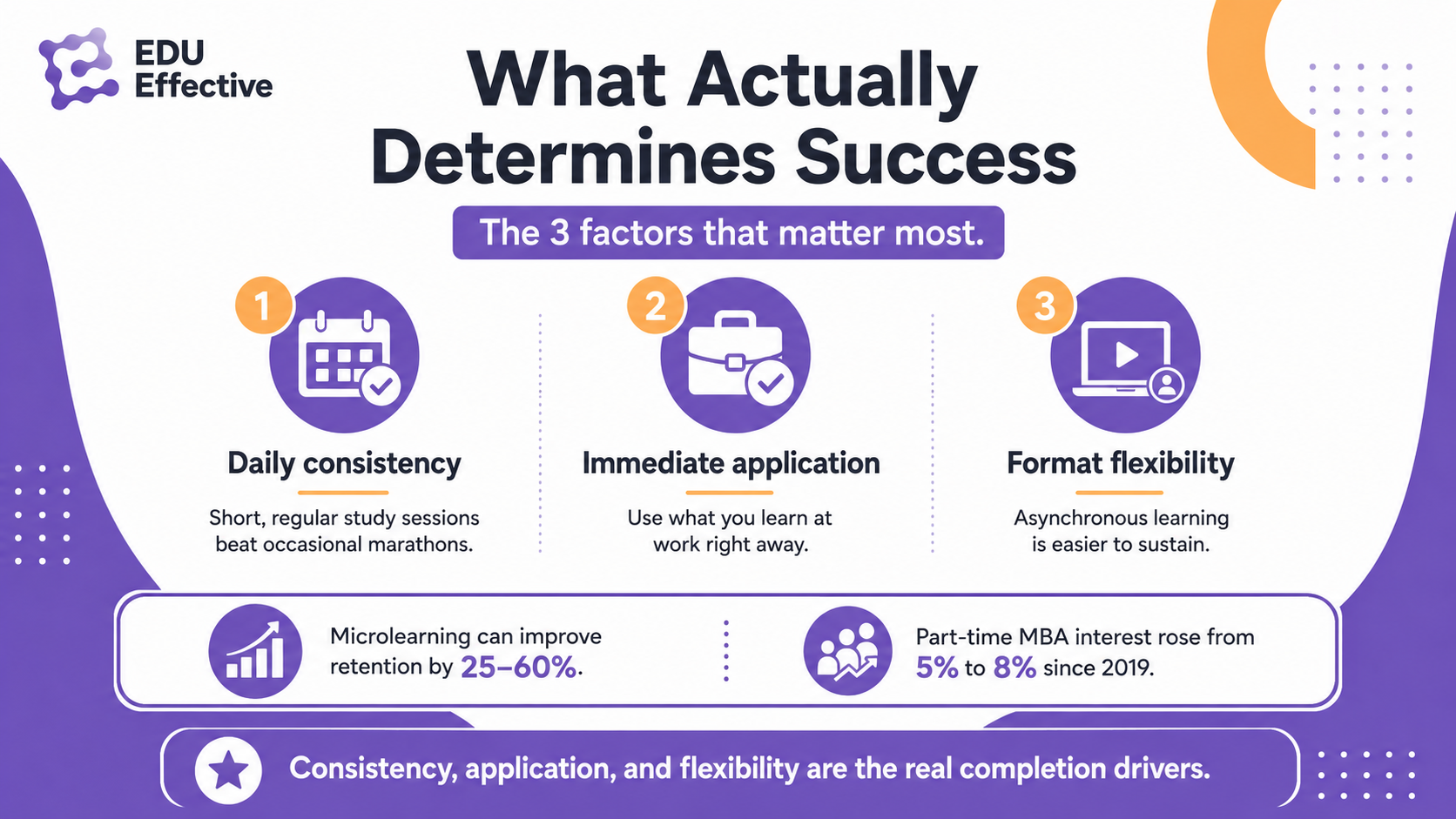
Research on adult learner completion rates and satisfaction consistently identifies the same factors as determinants of success. Understanding them before choosing a programme is the most reliable way to avoid the dropout and regret that follow a poorly matched choice.
Daily consistency beats weekly intensity. The microlearning research is unambiguous: learning delivered in short, focused, regularly repeated sessions produces 25-60% better retention than equivalent content delivered in longer, less frequent blocks, according to IBM and Deloitte research. A professional who spends 15 minutes studying each working day for ten months accumulates more retained knowledge than one who attends a three-hour evening class each week for two years. The daily habit is more sustainable, more compatible with a working life, and more effective at encoding knowledge that is actually usable.
Immediate application accelerates both learning and motivation. One of the most consistent findings in adult learning research is that knowledge applied to real situations shortly after acquisition is retained far more reliably than knowledge accumulated for future application. Working professionals who can apply what they studied on Monday to a real situation on Wednesday — a leadership conversation, a marketing decision, an AI tool deployment — learn faster than those accumulating knowledge for a distant graduation date. This is the structural advantage that studying alongside a current job provides over studying full-time: the laboratory for applying new knowledge is immediately available.
Format flexibility is not a luxury — it is a completion requirement. GMAC data shows that 19% of prospective MBA students are prevented from enrolling by debt, and a significant additional share cite scheduling inflexibility as the reason they do not complete programmes they begin. A programme that requires attendance at fixed times on a fixed schedule will produce a predictable collision with the realities of working life. Asynchronous delivery — content available at any time, on any device, completed when the student's schedule permits — is not a compromise on the educational experience. It is a prerequisite for sustained engagement across a working life.
The three main options for studying while working — what each actually involves
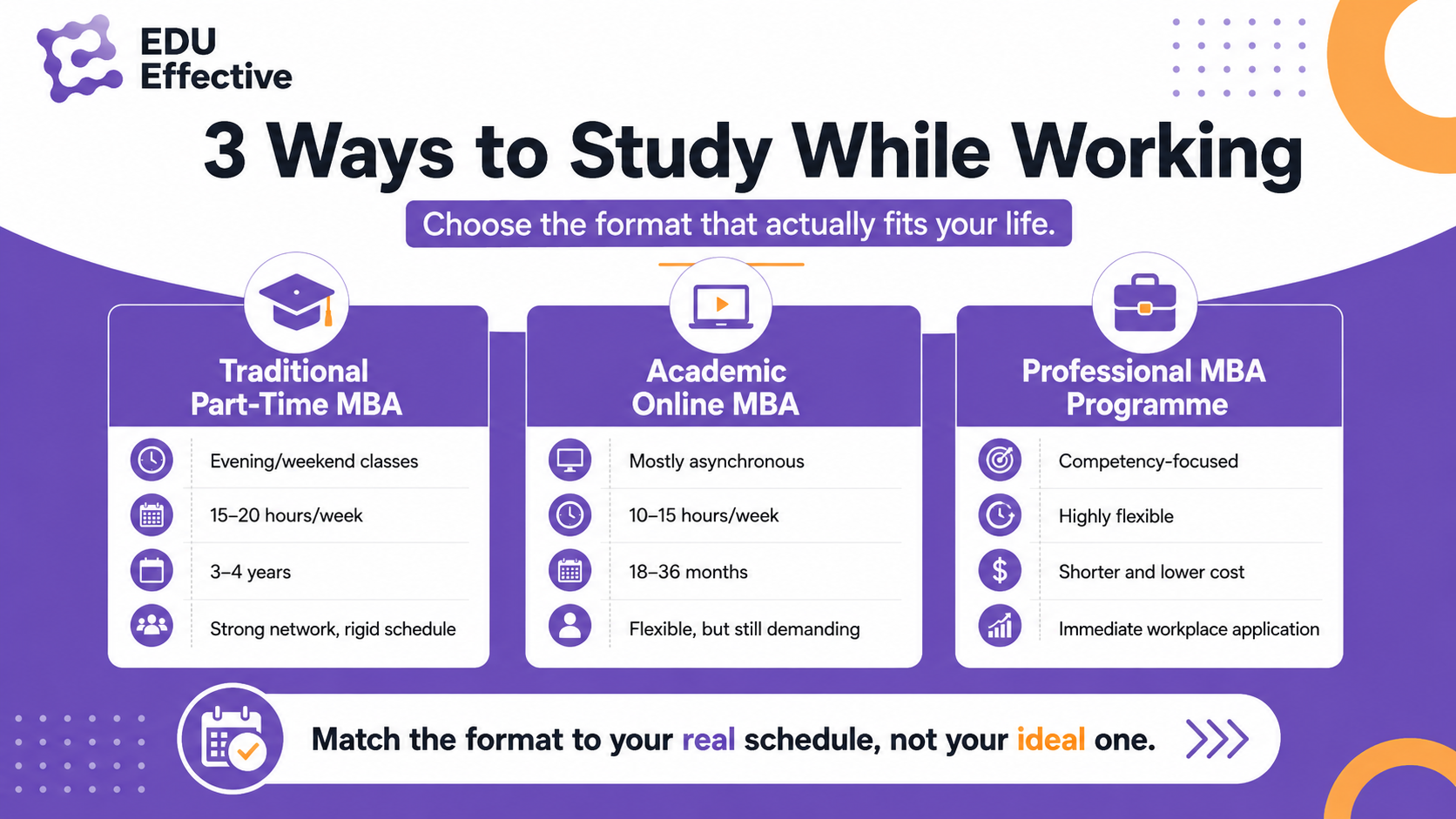
Traditional part-time MBA — the same academic content as a full-time programme, delivered over three to four years through evening and weekend classes at a physical campus or scheduled online sessions. Cost is typically comparable to or slightly lower than full-time programmes — often €20,000 to €60,000. Time commitment is typically 15 to 20 hours per week across classes, assignments, and study. The advantages are the institutional credential and the peer network built through shared in-person or cohort experience. The disadvantages are schedule rigidity, the sustained three-to-four year commitment, and the cost — which requires either significant personal financial outlay or employer tuition assistance.
Academic online MBA — a full academic qualification delivered entirely online, typically asynchronous, from an accredited university. Time to completion ranges from 18 months to three years depending on pace. Cost in 2026 ranges from under €10,000 to over €100,000 depending on institution. The most affordable accredited online MBAs — from AACSB or AMBA-accredited institutions — typically cost €10,000 to €30,000. Online MBA graduates from accredited programmes report median salary increases of 30 to 50% within three years. The advantages over traditional part-time are schedule flexibility and lower cost in many cases. The disadvantages are the still-significant time commitment (10 to 15 hours per week for 18 to 36 months) and the cost relative to professional programme alternatives.
Professional MBA programme — a distinct category focused on competency development and professional accreditation rather than an academic credential within the university system. Designed specifically for working professionals who need to build specific business capabilities — leadership, AI, marketing, coaching, strategy — and who value immediate application over credential accumulation. Typically lower cost, shorter duration, and higher flexibility than academic options. EDU Effective's Effective MBA programmes are in this category: 15 minutes a day, ten months or less, ASIC-accredited, starting from €990. The advantages are format compatibility with working life, immediate applicability of content, and cost. The primary difference from academic MBAs is the type of accreditation and credential — professionally accredited rather than academically accredited.
The honest guidance for choosing between these three is straightforward: what outcome are you trying to produce, and which format is genuinely compatible with your life? If you are targeting a role at a specific firm that screens for an academic MBA from a recognised institution — choose the academic route that best fits your budget and schedule. If you are developing business capabilities to advance in your current field or organisation — the professional route delivers those capabilities more efficiently, at lower cost, and in a format that working life can sustain.
How to make studying alongside work sustainable
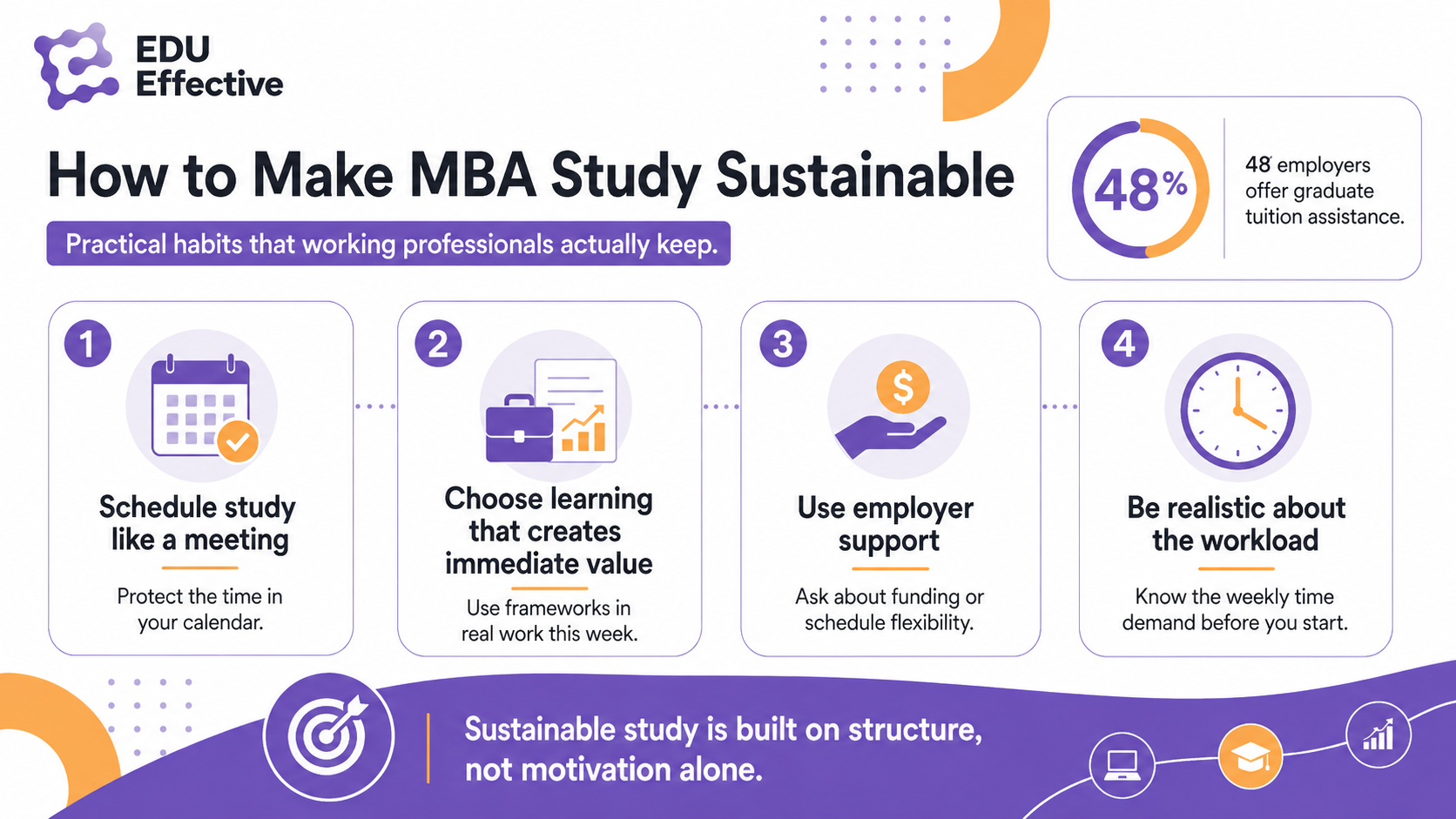
Regardless of which format you choose, the practical challenge is the same: building a learning habit that survives contact with the rest of your life. The following patterns consistently distinguish professionals who complete business education while working from those who begin and abandon it.
Treat study time as a non-negotiable commitment. The study block that gets cancelled when something more urgent appears is the study block that eventually disappears entirely. Booking specific daily or weekly slots in your calendar and treating them with the same seriousness you give to a meeting with an important client or manager changes the psychological status of the commitment from "aspiration" to "obligation." Most professionals who successfully study alongside work report that the consistency of the habit matters more than the amount of time per session.
Start with what matters most and move to the next thing. The programmes that produce the most sustainable engagement are those structured so that each completed unit produces something immediately useful — a new insight, a tool, a framework that applies to this week's work. The motivation to continue is not primarily willpower: it is the experience of the learning producing visible value in your work. This is why programmes structured around daily application — where each block connects directly to real professional situations — sustain engagement better than those where the application is deferred to a distant graduation.
Use your employer's investment in your development. 48% of employers offered tuition assistance for graduate studies in the most recent SHRM Employee Benefits Survey. Many more are willing to support professional development that is directly relevant to current business needs, even without a formal tuition assistance programme. A professional who frames their MBA study as building the specific capabilities their organisation needs — and who can demonstrate the connection between their study and their employer's strategic priorities — frequently finds that financial and scheduling support is available that would not have been offered unprompted.
Be realistic about the time commitment before you start. The most common cause of dropout in part-time MBA programmes is the gap between the time commitment assumed at enrolment and the time commitment experienced in practice. A programme requiring 15 hours per week for three years is a very different reality from a programme requiring 15 minutes per day for ten months — even if both are described as "flexible." Understanding precisely what a programme requires each week, across the full duration, and assessing that against your actual current commitments, is the most important pre-enrolment step most people skip.
The immediate application advantage — and why working students outperform
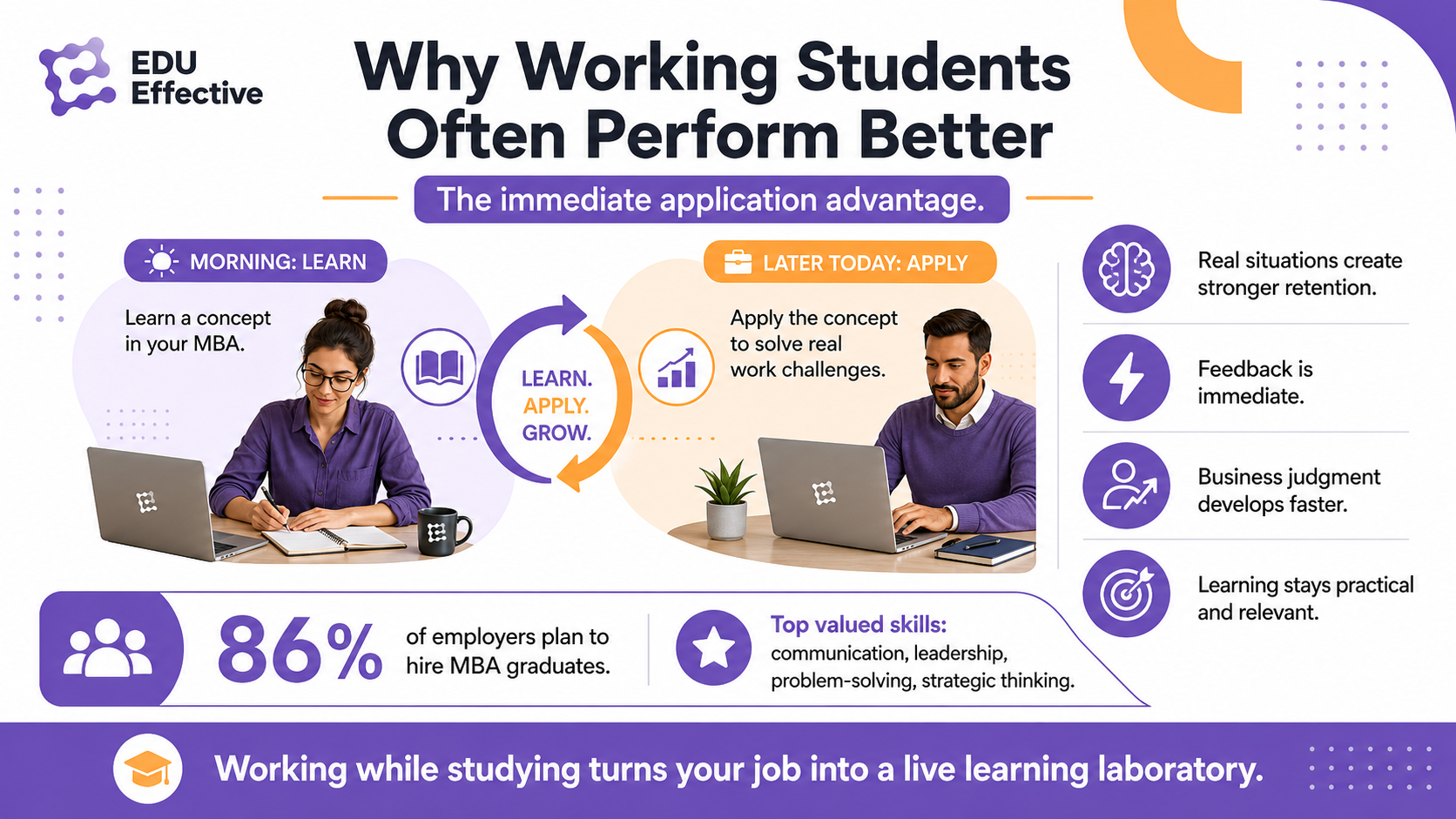
One of the most consistent findings in MBA programme research is that working students who can apply what they learn to their current roles often outperform full-time students in the development of practical business judgement — precisely because they have an immediate test environment for every concept they study.
A full-time MBA student who learns about performance management theory applies it hypothetically through case studies. A working professional who studies performance management at 7am and has a performance conversation with a team member at 10am applies it in reality. The feedback loop is immediate, the stakes are real, and the retention is substantially higher.
GMAC's 2025 Corporate Recruiters Survey found that 86% of employers plan to hire MBA graduates — but the competencies they consistently cite as most valuable are communication, leadership, problem-solving, and strategic thinking: capabilities that develop through application, not through academic exposure alone. The working student who has been applying their MBA learning to real professional situations for ten months arrives at graduation with a different kind of capability than one who has been studying full-time and will apply it later. Both are valuable. They are not identical.
At EDU Effective, the Effective MBA is designed from the ground up for professionals who are working while studying — not as a compromise on a full-time model, but as a programme deliberately built for the realities of a working life. 15 minutes a day, ten months or less, content applied immediately to your current role. Explore our programs →
EDU Effective Business School = professional development for your long-term success.
All best-selling Effective MBA programs are built for working adults: 15 minutes a day, 10 months or less, ASIC accredited, from €990.
- Effective MBA: Executive Management & Leadership
- Effective MBA: Applied Artificial Intelligence
- Effective MBA: Coaching, Leadership & Mentoring
- Effective MBA: Mastery in AI
- Effective MBA: Online Marketing
These are professional programs, not academic ones — built for working adults to apply what they learn directly in their own business, not to collect a scholarly credential.
Join more than 9,000 students in over 120 countries who are investing in their professional development and career success.
Read the feedback and experiences of our students and the stories of our graduates here.
Apply now — from €990 · Talk to a Study Advisor
Study with NO risk: 14-day money-back guarantee, no questions asked.
Sources
- Randstad — Workmonitor 2026: The Great Workforce Adaptation (27,062 workers, 1,225 employers, 35 markets) https://www.randstad.com/workmonitor/
- PwC — 2026 Global AI Jobs Barometer https://www.pwc.com/gx/en/news-room/press-releases/2026/pwc-2026-ai-jobs-barometer.html
- World Economic Forum — Future of Jobs Report https://www.weforum.org/publications/the-future-of-jobs-report-2025/
- GMAC — 2026 Prospective Students Survey: Part-Time MBA Interest Growth https://www.gmac.com/market-intelligence-and-research/research-library/admissions-and-application-trends/2026-gmac-prospective-students-survey-report
- GMAC — Corporate Recruiters Survey: MBA Hiring and Employability https://www.gmac.com/market-intelligence-and-research/research-library/employment-outlook/2026-corporate-recruiters-survey-report
- GMAC — Enrolled Students Survey: Salary Increase After MBA https://www.gmac.com/resources/learners/business-careers/employers-salaries/why-go-to-business-school-employers-salaries-outcomes
- Deloitte — Human Capital Trends: Learning Retention Research https://www2.deloitte.com/us/en/insights/focus/human-capital-trends.html
- SHRM — Employee Benefits Survey: Tuition Assistance https://www.shrm.org/topics-tools/research/employee-benefits-survey
- US Bureau of Labor Statistics — Management Occupations: Median Annual Wage https://www.bls.gov/ooh/management/