

AI in finance has moved from experiment to mainstream faster than most organizations planned for. The question is no longer whether to use it. It’s whether you’re using it well.
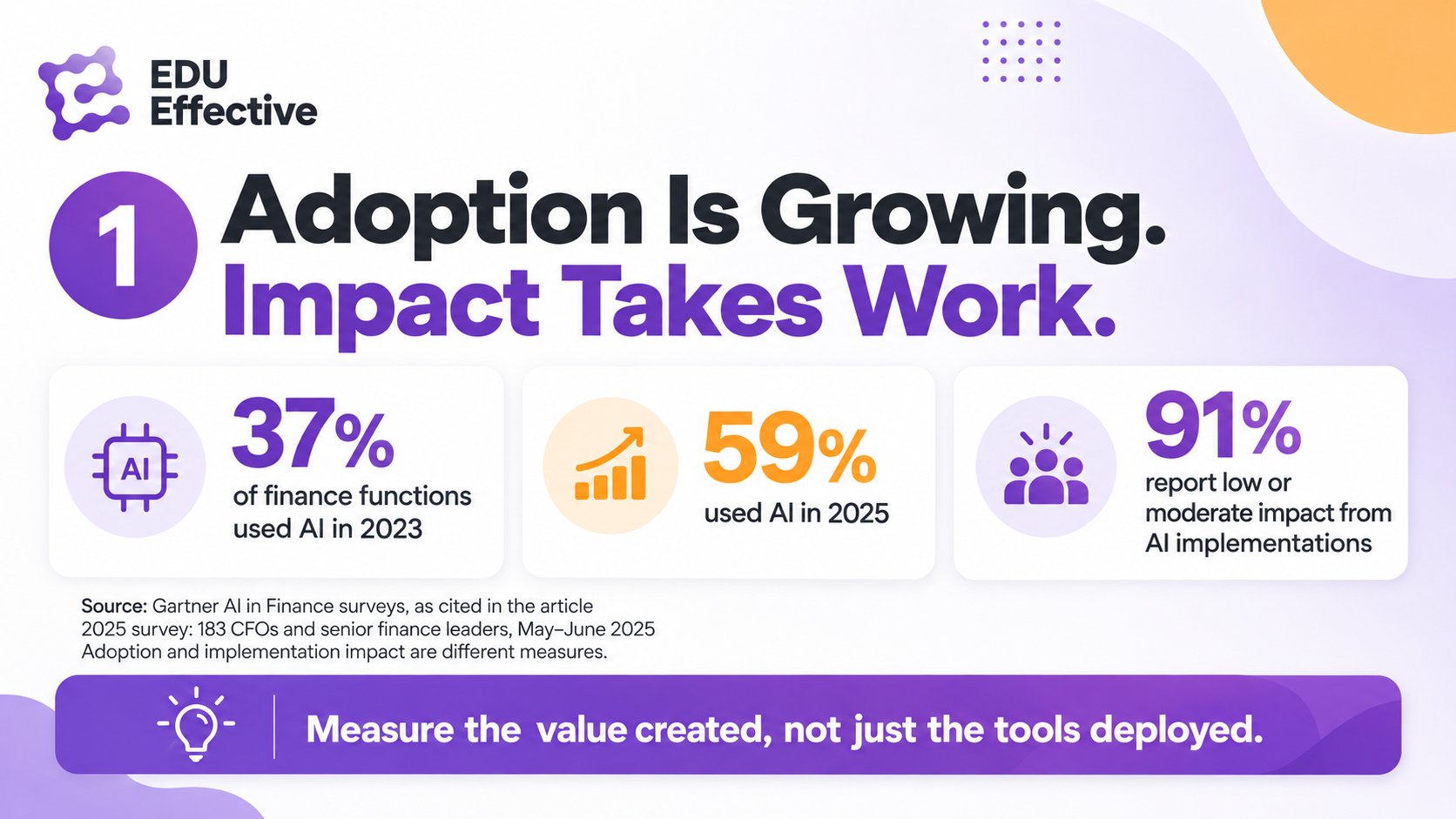
Gartner’s AI in Finance Survey — covering 183 CFOs and senior finance leaders, fielded May through June 2025 — found that 59% of finance functions are now using AI. That’s up from 37% in 2023, a jump of more than 20 percentage points in two years. For context: in 2023, HR, legal, and procurement functions were twice as likely as finance to be using or scaling AI. By 2024, that gap had nearly closed. Finance has caught up fast.
What hasn’t caught up at the same pace is the quality of what finance teams are doing with these tools. 91% of Gartner respondents report low or moderate impact from their AI implementations. Organizations further along in adoption are nearly three times as likely to see high impact — which means the gap between finance teams getting real value from AI and those running underpowered pilots is widening, not narrowing.
For managers who work with financial data, oversee budgets, or make decisions informed by financial analysis, understanding what AI can and can’t do in a finance context is now a practical necessity.
What AI Is Actually Being Used For in Finance
The Gartner data identifies the most common AI use cases in finance functions among organizations that have adopted it:
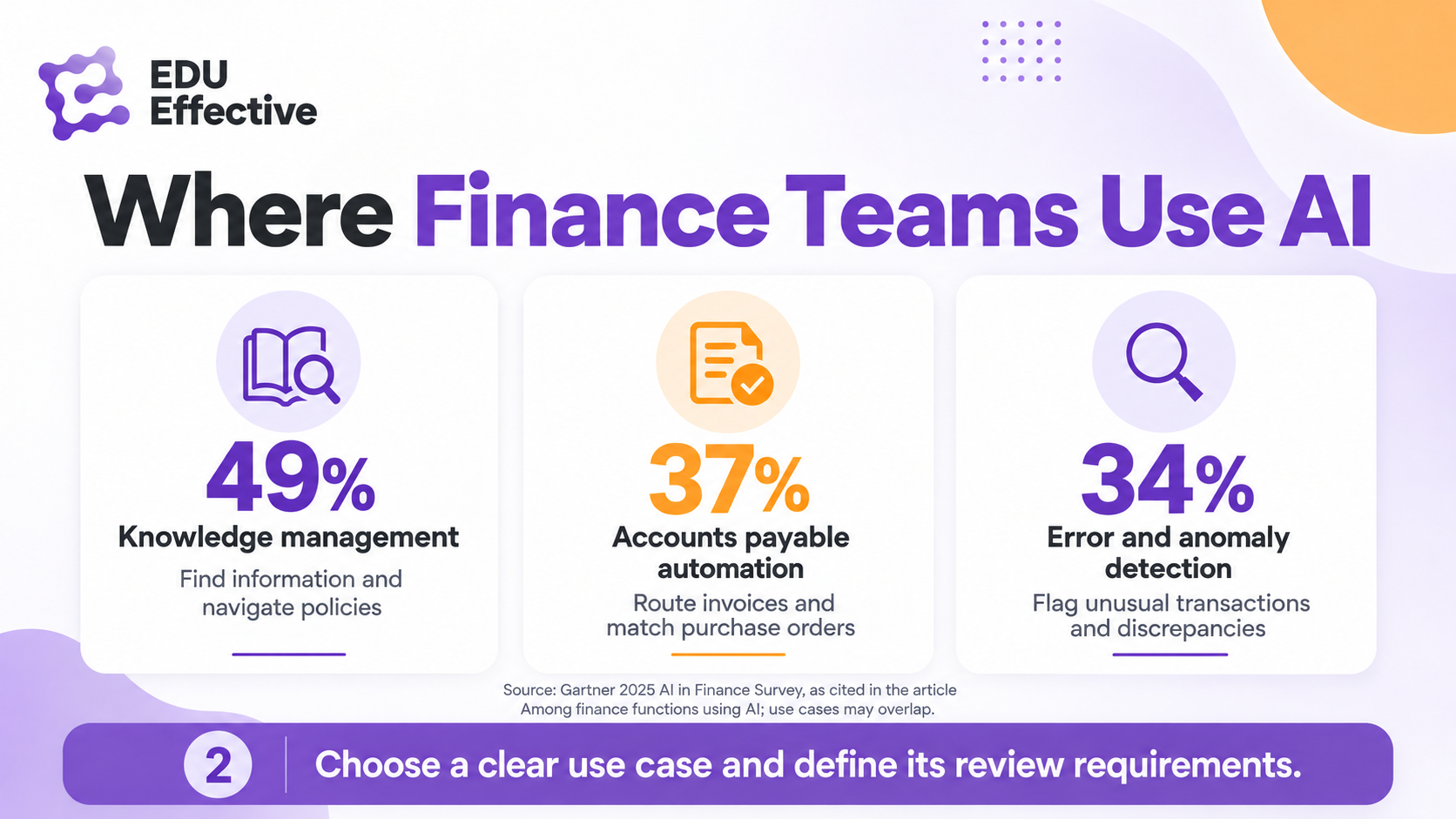
Knowledge management leads at 49% — teams using AI to surface information, answer procedural questions, and navigate policy documentation. This is the most accessible starting point and the lowest-risk application.
Accounts payable process automation at 37% — routing invoices, matching purchase orders, flagging discrepancies, and processing payments without manual intervention. This is where AI replaces or augments rule-based processing work that finance teams have historically done by hand.
Error and anomaly detection at 34% — identifying unusual transactions, statistical outliers in reported figures, and patterns that suggest errors or fraud. This is one of the areas where AI adds genuine analytical capacity that humans can’t replicate at scale: a system monitoring thousands of transactions continuously finds anomalies that a quarterly review process will miss.
Analytics — forecasting and results analysis at 28% in the 2024 Gartner data — using AI to generate financial projections, analyze variance between actual and forecast results, and model scenarios under different assumptions.
Wolters Kluwer’s survey of 392 finance leaders (May 2025, conducted at the CCH Tagetik inTouch25 conference on corporate performance management) adds useful texture on where organizations expect AI to matter next. 67% of respondents said economic volatility would be what drives them to use AI in FP&A (financial planning and analysis) for the first time. 85% said AI skills would be important when recruiting for finance roles. And the time savings expectations are concrete: 42% expect AI to save 10% of working time over the next 12 months — roughly 26 working days per person — and 24% expect to save 20% or about 52 working days.
Financial Forecasting: Where AI Changes the Calculus
Financial forecasting is where the value proposition of AI is clearest — and where the risks are most consequential if it goes wrong.
Traditional forecasting approaches — spreadsheet models updated by finance teams, drawing on historical data and analyst judgment — are labor-intensive and have well-documented limitations. They tend to rely on recent patterns, they’re slow to incorporate new variables, and they reflect the cognitive biases of whoever built the model.
AI-based forecasting approaches work differently. They can process larger data sets, incorporate more variables simultaneously, update in near real-time as new data arrives, and identify non-obvious correlations in historical data. The MindBridge 2025 CFO AI Adoption Survey (senior finance leaders across North America) found that 55% of organizations cite better forecasting and decision-making as their primary AI objective in finance — more than any other use case. 83% report measurable efficiency improvements, and 77% report cost savings of at least 5%, with 10% reporting savings above 30%.
Gartner estimates that poor decision-making leaks 3–8% of EBITDA annually. Finance teams that close that gap through better forecasting accuracy — even partially — generate returns that dwarf the investment in AI tooling.
The practical applications for managers who work with forecasts but aren’t finance specialists:
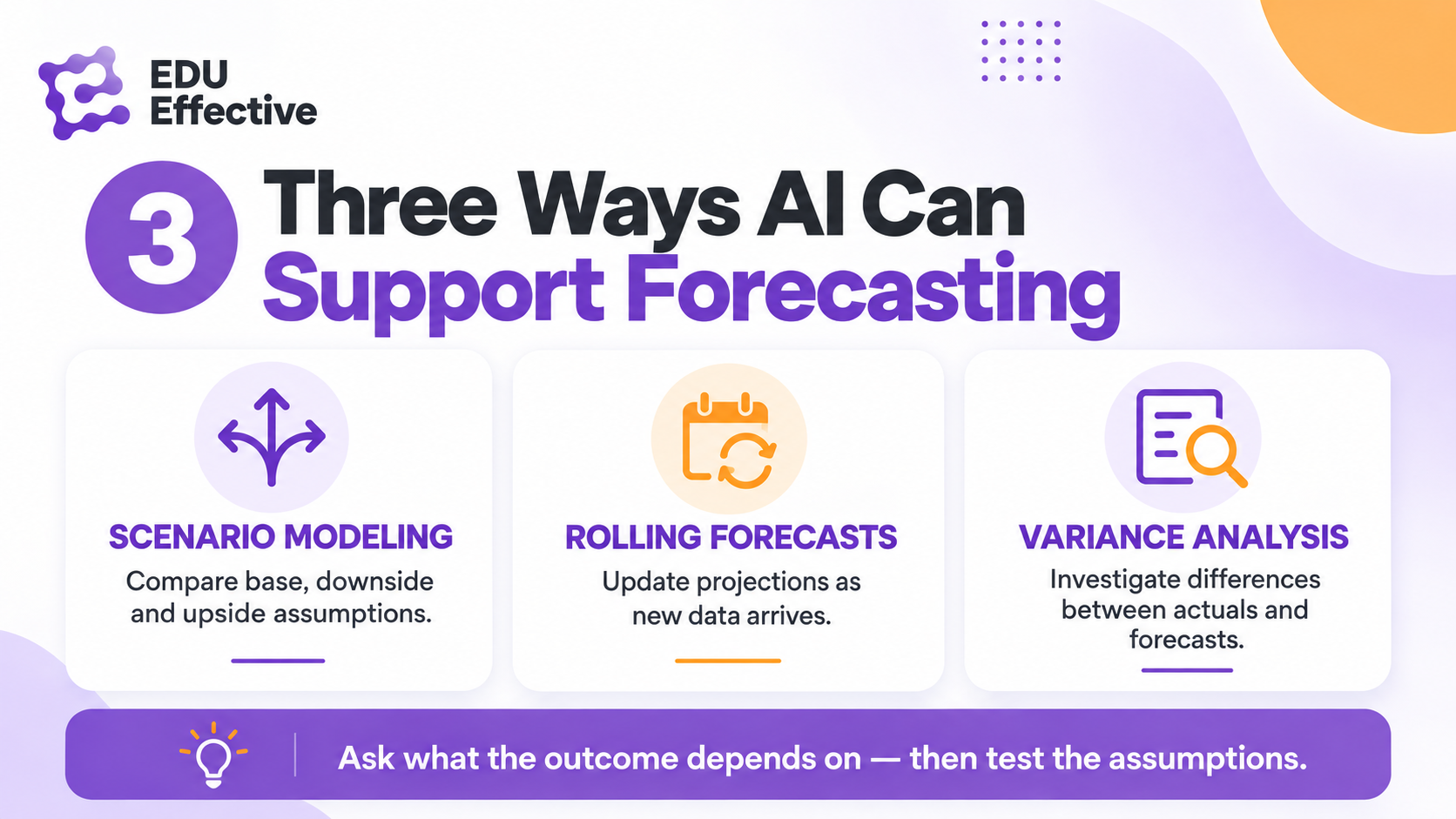
Scenario modeling. Rather than producing one forecast, AI can rapidly generate multiple scenarios with different assumptions — a base case, a downside case, an upside case — and show the sensitivity of the outcome to each input variable. This changes the conversation from “what is the number?” to “what does the outcome depend on?” — a more honest framing for most strategic decisions.
Rolling forecasts. Static annual plans become outdated the moment the assumptions they’re based on change. AI-enabled forecasting makes it practical to run forecasts on a rolling basis — updating them monthly or quarterly as new data arrives — rather than defending a plan made ten months ago against current reality.
Variance analysis. When actual results differ from forecast, AI can identify the drivers of variance faster and more precisely than manual analysis. This shortens the cycle between “results are in” and “we understand why we missed” from days to hours.
Anomaly Detection and Fraud: Where AI Has No Human Equivalent
The most defensible use case for AI in financial analysis — the one where it adds capability that humans genuinely cannot replicate — is anomaly detection at scale.
A finance team reviewing transactions manually can check a sample. An AI system monitoring all transactions continuously can flag every statistical outlier, every pattern inconsistent with historical behavior, every transaction that matches known fraud signatures. The difference is not marginal — it’s categorical.
Intelligent process automation in accounts payable and receivable produces similar advantages: AI catches duplicate invoices, inconsistent vendor data, and processing errors that manual review misses at volume. Gartner’s 2024 data showed 44% of adopting finance functions using intelligent process automation as a primary AI application — the most common use case in that year’s survey.
For managers outside the finance function, the practical implication is that AI-enabled anomaly detection changes what governance looks like. Internal controls that previously relied on sampling and periodic review can shift toward continuous monitoring. That’s not just a productivity gain — it changes the risk profile of the organization’s financial reporting.
What AI Cannot Do in Finance — and Where the Risks Are
The 91% of Gartner respondents who report low or moderate impact from their AI implementations are not failing because the technology doesn’t work. They’re failing because of four structural problems that no AI tool resolves on its own.
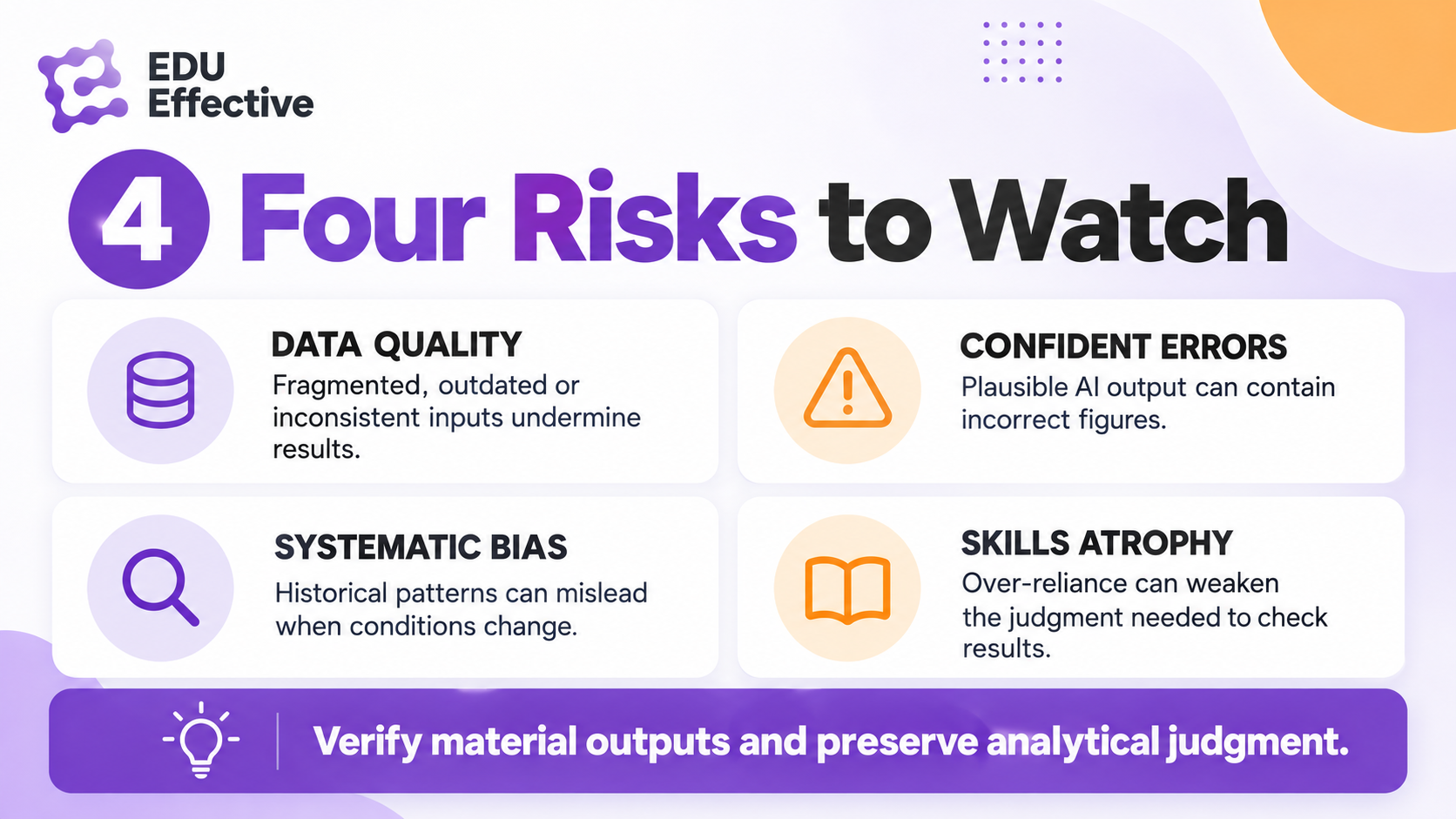
Data quality. Gartner identifies inadequate data quality or availability as the primary barrier to effective AI in finance, alongside low data literacy. AI models produce outputs that are only as good as the data they’re trained on. Finance teams with fragmented systems, inconsistent data definitions across business units, and manual data entry processes feed AI tools with inputs that produce unreliable outputs. The Wolters Kluwer survey found 44% of finance leaders citing data readiness as the main driver — or constraint — of AI adoption.
Hallucination and confident errors. AI systems produce plausible-sounding outputs with apparent confidence even when those outputs are wrong. In financial analysis, where numbers are used to make real decisions, a confidently stated but incorrect figure is more dangerous than an obviously uncertain estimate. Finance professionals working with AI-generated analysis need to treat AI outputs as a starting point for verification, not a final answer — particularly for figures that will appear in financial statements, regulatory filings, or board presentations. Professional accountability for signed-off work remains with the human, regardless of how the analysis was produced.
Systematic bias. AI models can reflect biases in their training data, produce consistent errors across similar inputs, and fail to account for structural changes in the environment that aren’t yet visible in historical data. A forecasting model trained on pre-pandemic data will produce systematically biased outputs in a post-pandemic environment unless it’s been explicitly updated and tested. Random errors are discoverable. Systematic errors — producing consistently wrong results in a consistent direction — are harder to detect and more consequential when they reach decisions.
Skills atrophy. The most underappreciated risk is what happens to the analytical judgment of finance professionals who use AI as a shortcut rather than a productivity multiplier on top of their existing skills. LearnSignal’s CFO Guide notes the concern directly: early-career finance professionals who rely on AI before developing core analytical capabilities may not build the judgment to recognize when AI outputs are wrong. Organizations that value long-term analytical quality need to think carefully about where AI augments experienced judgment versus where it substitutes for the development of it.
The Governance Gap
Agentic AI — AI systems that take actions autonomously rather than just generating analysis for human review — is the next frontier in finance. Wolters Kluwer found that only 6% of finance leaders currently use it, but 38% plan to adopt it within the next 12 months. By 2026, the survey projects that 44% of finance teams will be using agentic AI — an increase the report describes as more than 600% in one year.
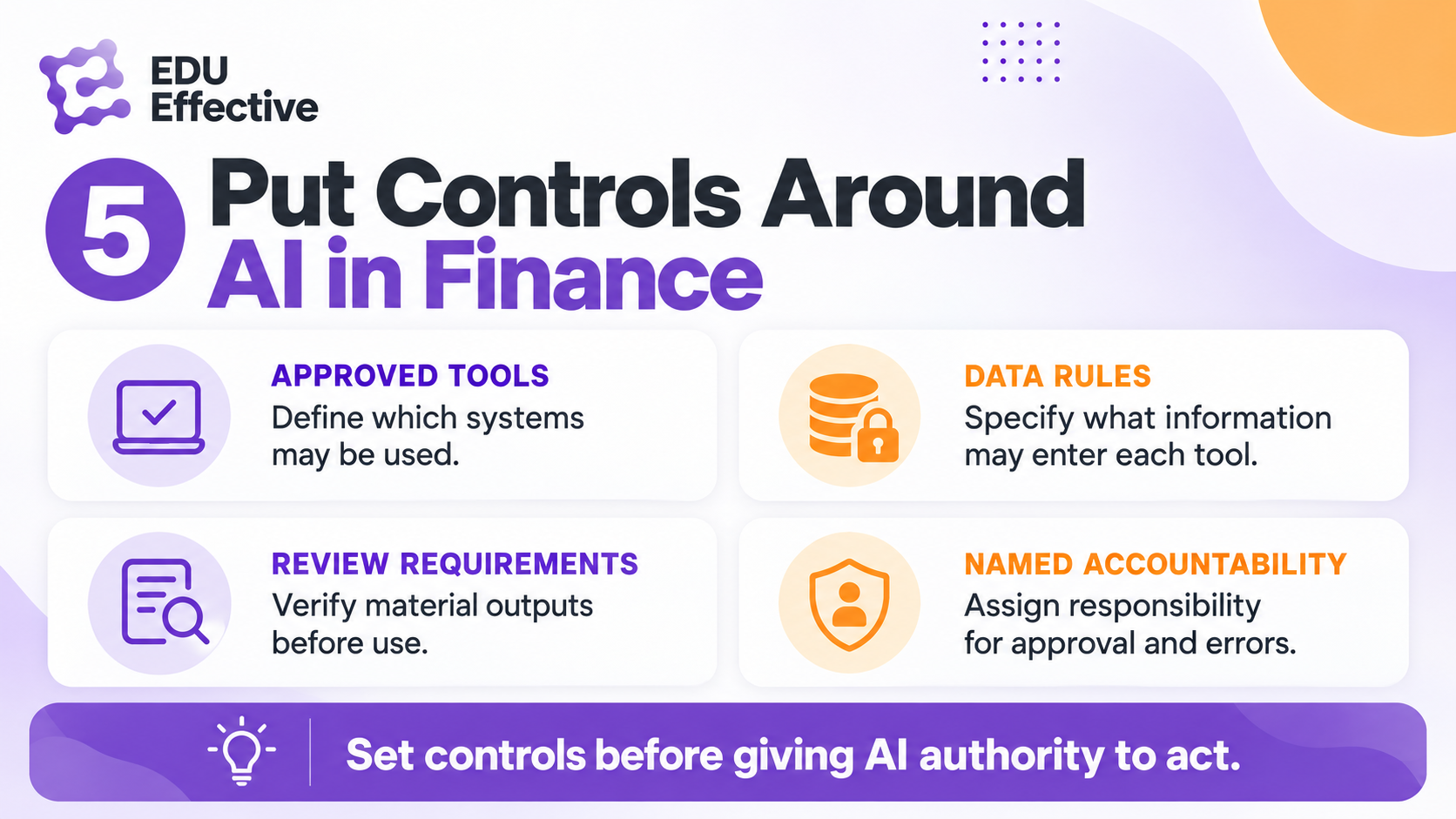
That rate of adoption creates a governance challenge that most organizations are not ready for. AI systems that schedule payments, approve invoices, execute transactions, or generate regulatory reports without human review in every step require governance structures that most finance functions haven’t built yet: clear approval for which AI tools are permitted, a data classification policy governing what information enters external AI systems, documented review requirements for AI-generated outputs in material financial work, and named accountability for AI-related errors.
The audit and governance questions boards are beginning to ask — which AI tools are approved, what data rules apply, how is AI-assisted content reviewed, how would AI errors in filed documents be handled — are becoming standard, not exceptional. Finance teams that have thought through these questions are in a different position than those that haven’t.
A Practical Framework for Managers
For managers who work with financial analysis without being finance specialists, the practical questions around AI in finance are less technical than they are managerial.
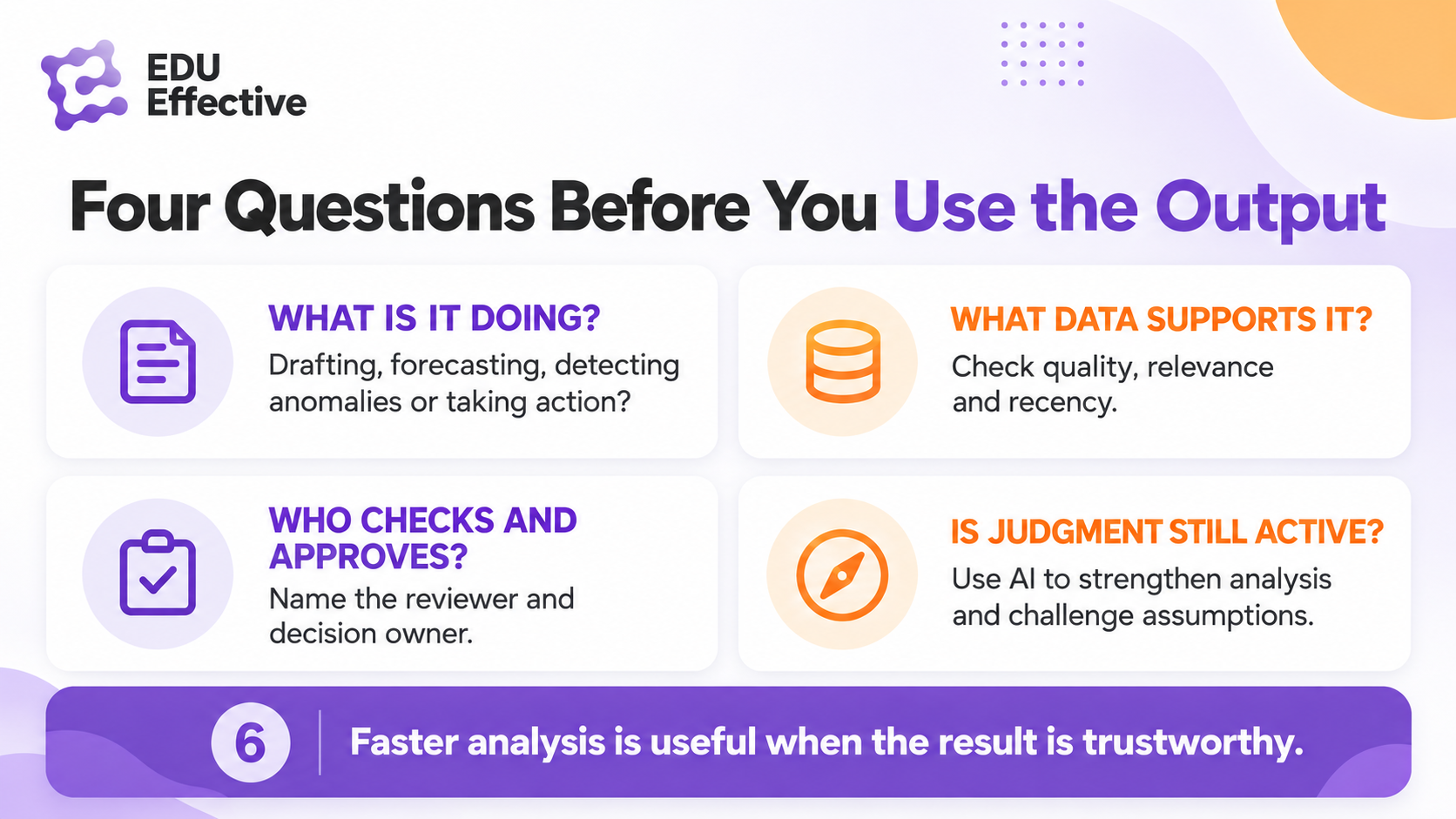
What is the AI tool actually doing? Knowledge management and drafting are low-risk applications where AI errors are caught in review. Anomaly detection is a high-value application where AI catches things humans miss. Generating numbers that flow directly into financial statements is a high-risk application that requires robust verification. Knowing which category applies changes how much review a given output deserves.
What data is the tool trained on, and how current is it? A forecasting model built on three-year-old data from a different macroeconomic environment is not a reliable guide to next year’s performance. Understanding the vintage and quality of the underlying data is basic due diligence.
Who is accountable when it’s wrong? AI tools don’t sign financial statements, approve budgets, or carry legal accountability for errors. The manager or finance professional who uses AI-generated analysis and presents it as their own work remains responsible for its accuracy. That accountability doesn’t transfer to the tool.
Is the AI augmenting the analysis or replacing the thinking? The most value-creating applications of AI in financial analysis amplify good analytical judgment — faster scenario modeling, broader anomaly detection, more frequent forecasting. The least valuable applications replace judgment with pattern-matching, which produces exactly the systematic errors that are hardest to catch.
Key Takeaways
59% of finance functions now use AI, per Gartner’s 2025 survey of 183 CFOs — up from 37% in 2023. The leading use cases are knowledge management (49%), process automation (37%), and anomaly detection (34%). 91% of adopters report low or moderate impact, but organizations further along are nearly three times as likely to see high impact. Wolters Kluwer’s 2025 survey of 392 finance leaders projects a 600%+ increase in agentic AI adoption in finance within 12 months. The primary barriers — poor data quality and low data literacy — are organizational problems that AI tools don’t solve. Gartner estimates that poor decision-making costs organizations 3–8% of EBITDA annually, which defines the economic case for getting AI in financial analysis right. The risk that remains underappreciated: confidently wrong outputs, systematic model bias, and the skills atrophy that comes from using AI before building the judgment to evaluate its outputs.
About EDU Effective Business School
The Effective MBA: Applied Artificial Intelligence turns AI capability into decisions a manager can defend. Runs on 15 minutes a day, completes in 10 months or less and is ASIC accredited, with tuition from €990.
Sources
- Gartner — 2025 AI in Finance Survey (183 CFOs and senior finance leaders, May-June 2025) https://www.gartner.com/en/newsroom/press-releases/2025-11-18-gartner-survey-shows-finance-ai-adoption-remains-steady-in-2025
- Gartner — Finance AI Adoption 2024 (121 finance leaders, June 2024) https://the-cfo.io/2024/09/11/58-of-finance-functions-using-ai-in-2024-gartner-research/
- Wolters Kluwer — Agentic AI Adoption in Finance Survey 2025 (392 finance leaders, May 2025) https://www.wolterskluwer.com/en/news/pr-2025-wolters-kluwer-survey-increasing-adoption-agentic-ai
- MindBridge — 2025 CFO AI Adoption Survey (senior finance leaders, North America, July 2025) https://www.mindbridge.ai/news/adapt-or-fall-behind-majority-of-cfos-say-ai-will-be-essential-to-finance-competitiveness-by-2030/
- LearnSignal — The Risks of AI in Finance: What Every CFO Needs to Know https://www.learnsignal.com/blog/risks-of-ai-in-finance-cfo-guide/