
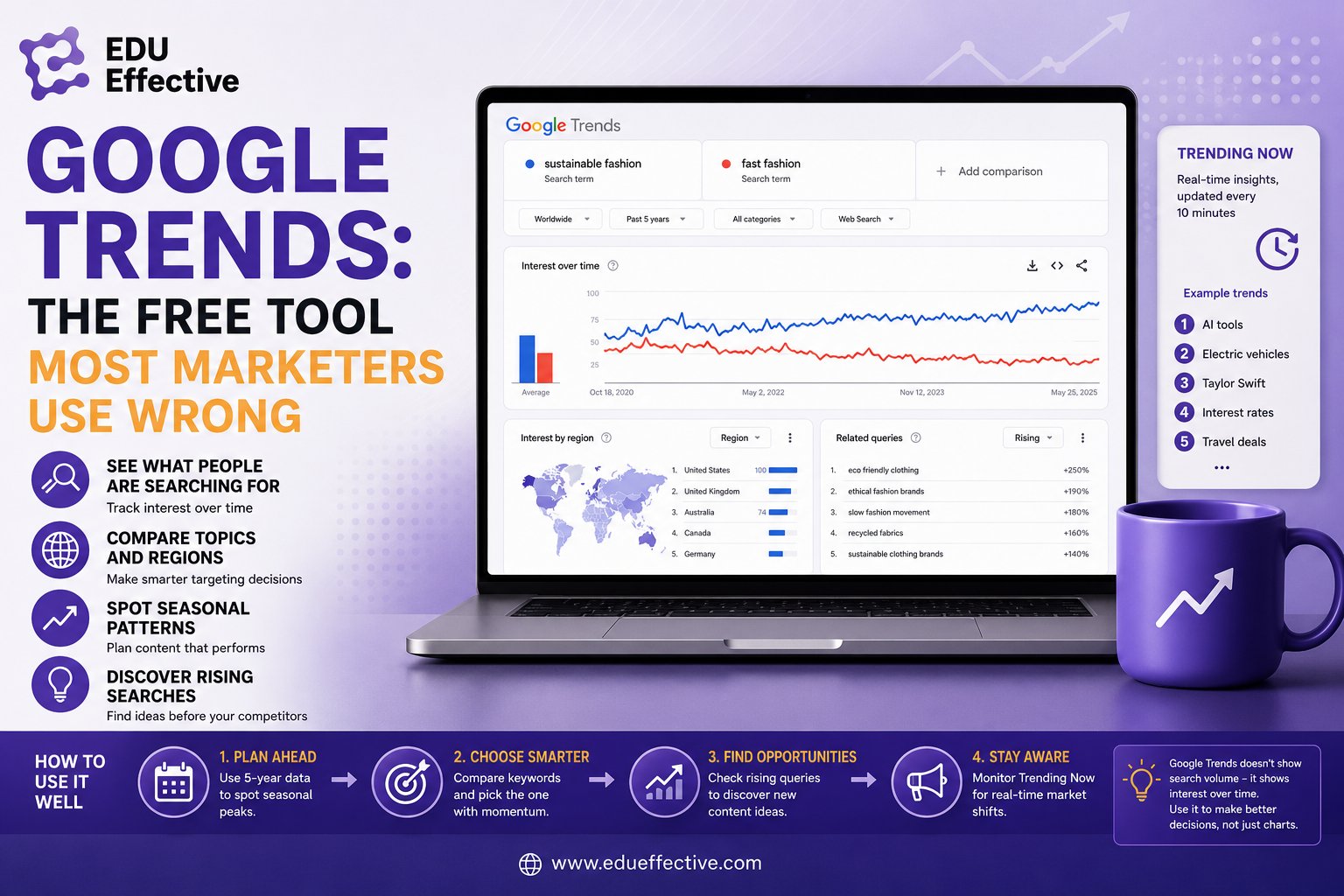

Most marketers know Google Trends exists. Far fewer use it in a way that actually changes what they publish or when they publish it. It gets opened, a keyword gets typed in, the wavy line appears — and then nothing useful happens because nobody is quite sure what the number means or what to do with it.
This guide fixes that. Here's what Google Trends actually measures, how its key features work in 2026, and the specific ways it should be shaping your content and SEO strategy right now.
What Google Trends Measures — and What It Doesn't
Google Trends doesn't show absolute search volume. That's the most important thing to understand about it, and the thing most first-time users get wrong.
What it shows is relative search interest — a normalised score from 0 to 100 representing how popular a search term is compared to its own peak over your chosen time period and geography. A score of 100 means peak popularity for that term in that context. A score of 50 means half as popular as the peak. Zero means insufficient data to show.
This design choice is deliberate and actually makes the tool more useful than raw volume numbers for certain tasks. You can compare two terms on equal footing regardless of their absolute scale, track whether interest in a topic is rising or falling over time, and spot seasonal patterns across years. What you can't do is use it to decide whether a keyword gets 1,000 or 100,000 searches per month — for that, you need a dedicated keyword research tool.
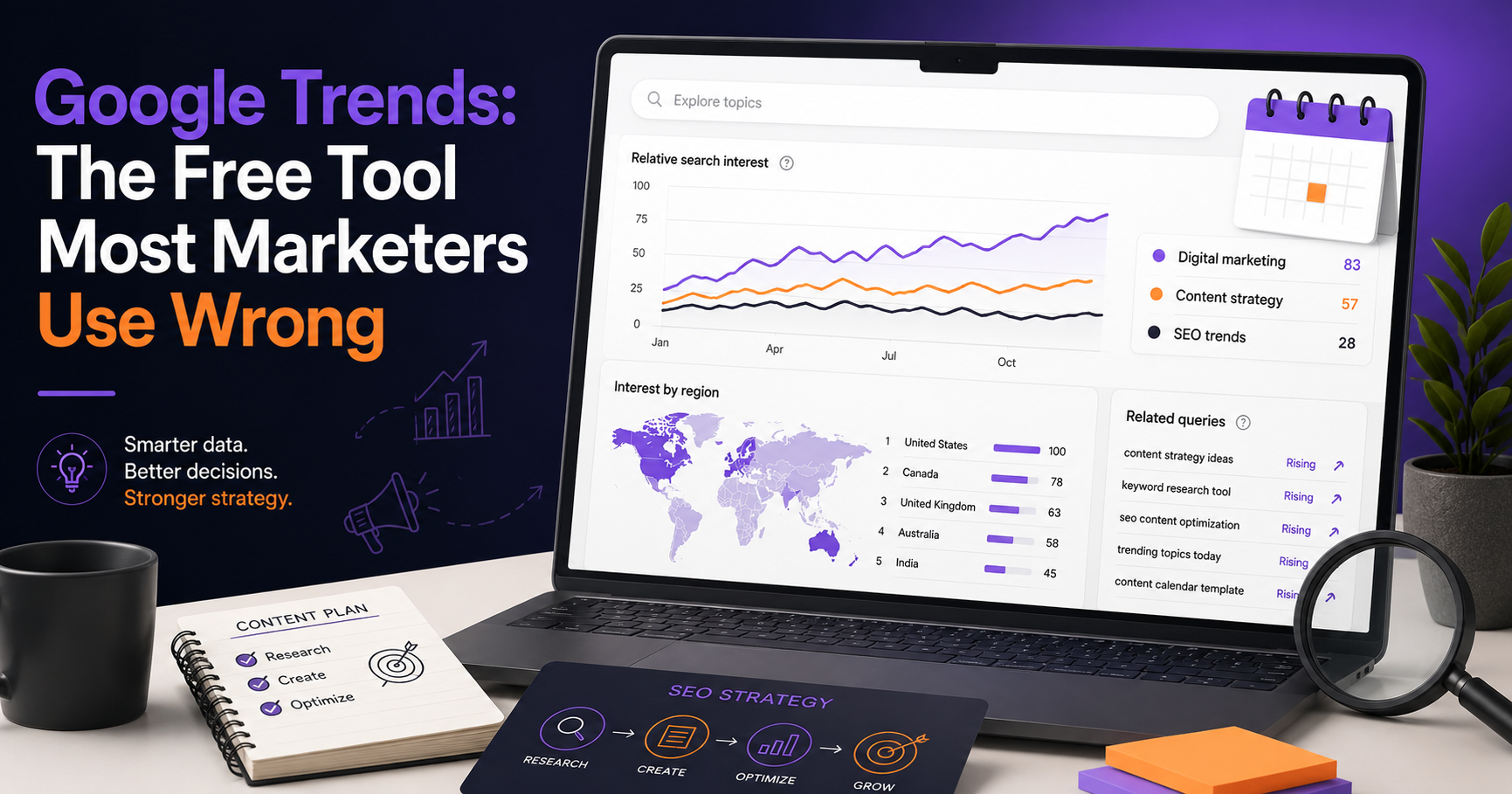
Five Things Google Trends Does Particularly Well
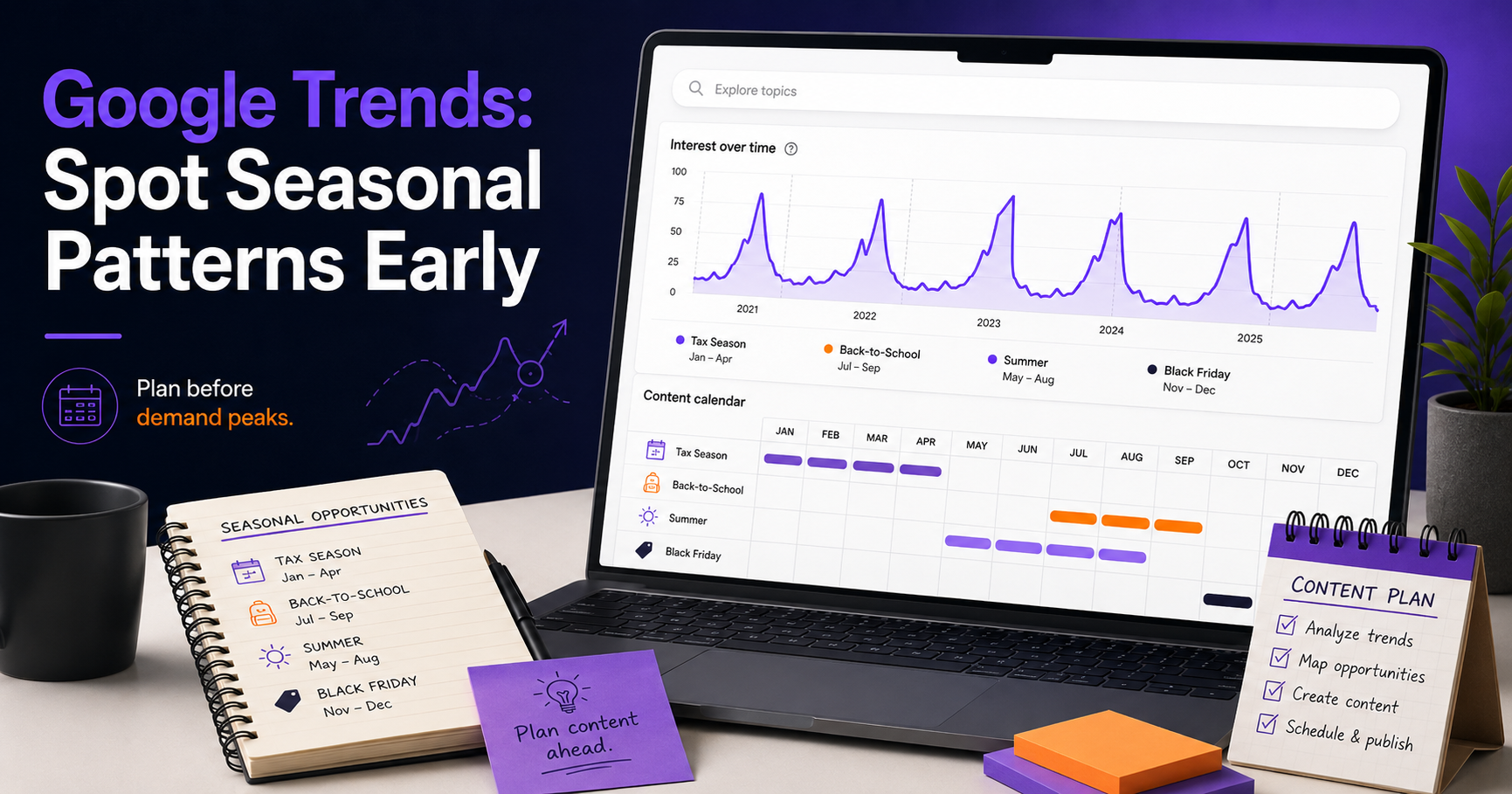
Spotting seasonal patterns. Set your time range to five years and search for any cyclical topic — tax filing, back to school, summer recipes, Black Friday — and you'll see the annual rhythm immediately. This is how you plan content calendars that anticipate demand rather than chase it. Publishing a guide to tax deductions in February will outperform publishing the same guide in April, every time.
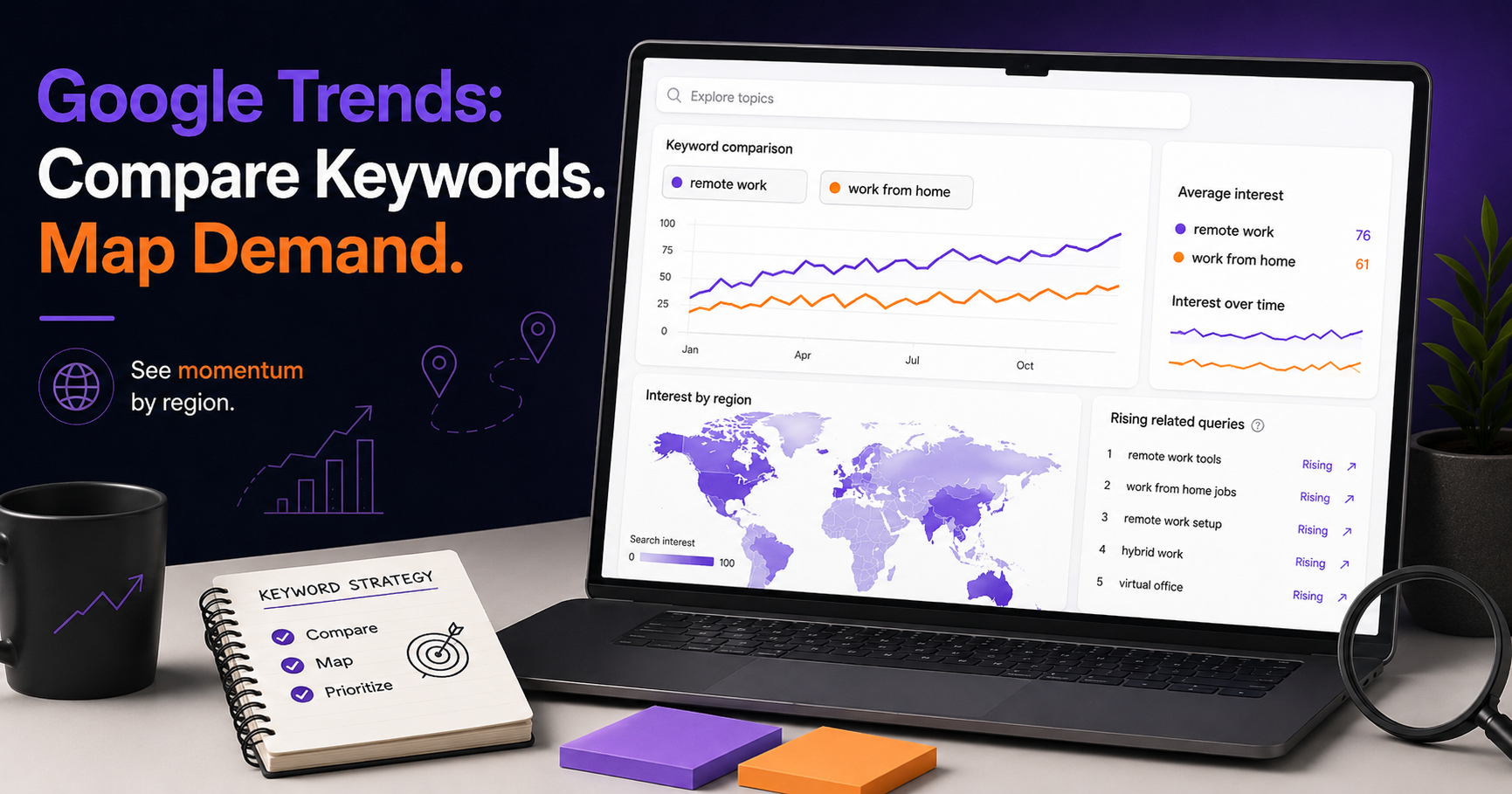
Comparing keyword variants. If you're trying to choose between "remote work" and "work from home" as your primary keyword target, Google Trends will show you which term has stronger momentum in your target geography. This matters because both terms might have similar search volume in a keyword tool, but one could be growing while the other stagnates — and you want to build content around the rising term.
Geographic intelligence. The regional breakdown shows you where interest in a topic is strongest. If you're a UK business and your product has unexpectedly high interest in Scotland but low interest in the South East, that's information that should influence your paid media targeting, your PR outreach, and potentially your product localisation decisions.
Finding related queries. The "Related queries" section at the bottom of any Trends search is underused. It shows you terms that are rising in searches alongside your primary term. These rising queries are often the best candidates for new content — they capture emerging intent before competitors have started writing about them.
Validating topic timing. Before investing significant time in a long-form piece on a topic, check whether interest in that topic is currently rising, flat, or declining. A topic with falling interest over the past twelve months requires a different justification than one showing a consistent upward trajectory. You're not necessarily wrong to write about declining topics — but you should make that choice deliberately.
How Google Trends Fits Into an AI-First Search Landscape
The context for using Google Trends has shifted considerably since 2024. Google's AI Overviews — which generate direct answers at the top of search results — grew from triggering on 6.49% of queries in January 2025 to 13.14% by March, a 72% increase in two months. Generic informational queries are increasingly answered on the results page without the user clicking through to any website.
This creates a specific strategic implication for content. Topics where AI Overviews are likely to dominate — simple definitions, basic how-to queries, well-settled facts — are becoming harder to drive organic traffic from. Topics that are complex, developing, or require genuine expertise are gaining relative value precisely because AI systems struggle to synthesise nuanced, emerging information reliably.
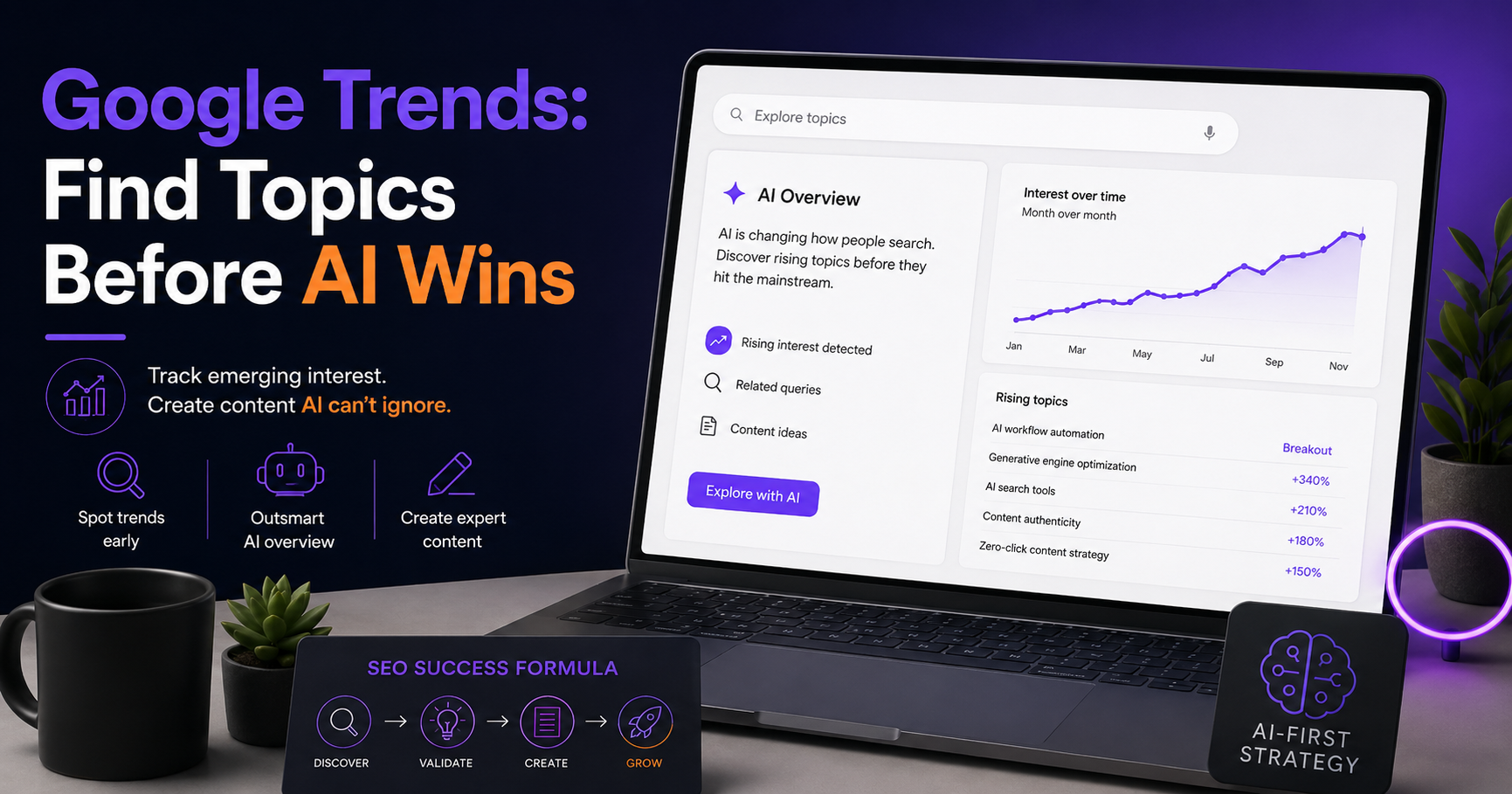
Google Trends is a direct signal for identifying these developing topics. A term showing consistent month-over-month growth in Trends is a term where the search landscape is still forming — where original, expert analysis can establish a position before the topic becomes competitive. This is the most strategically valuable way to use the tool in 2026.
Three Practical Workflows Worth Adopting
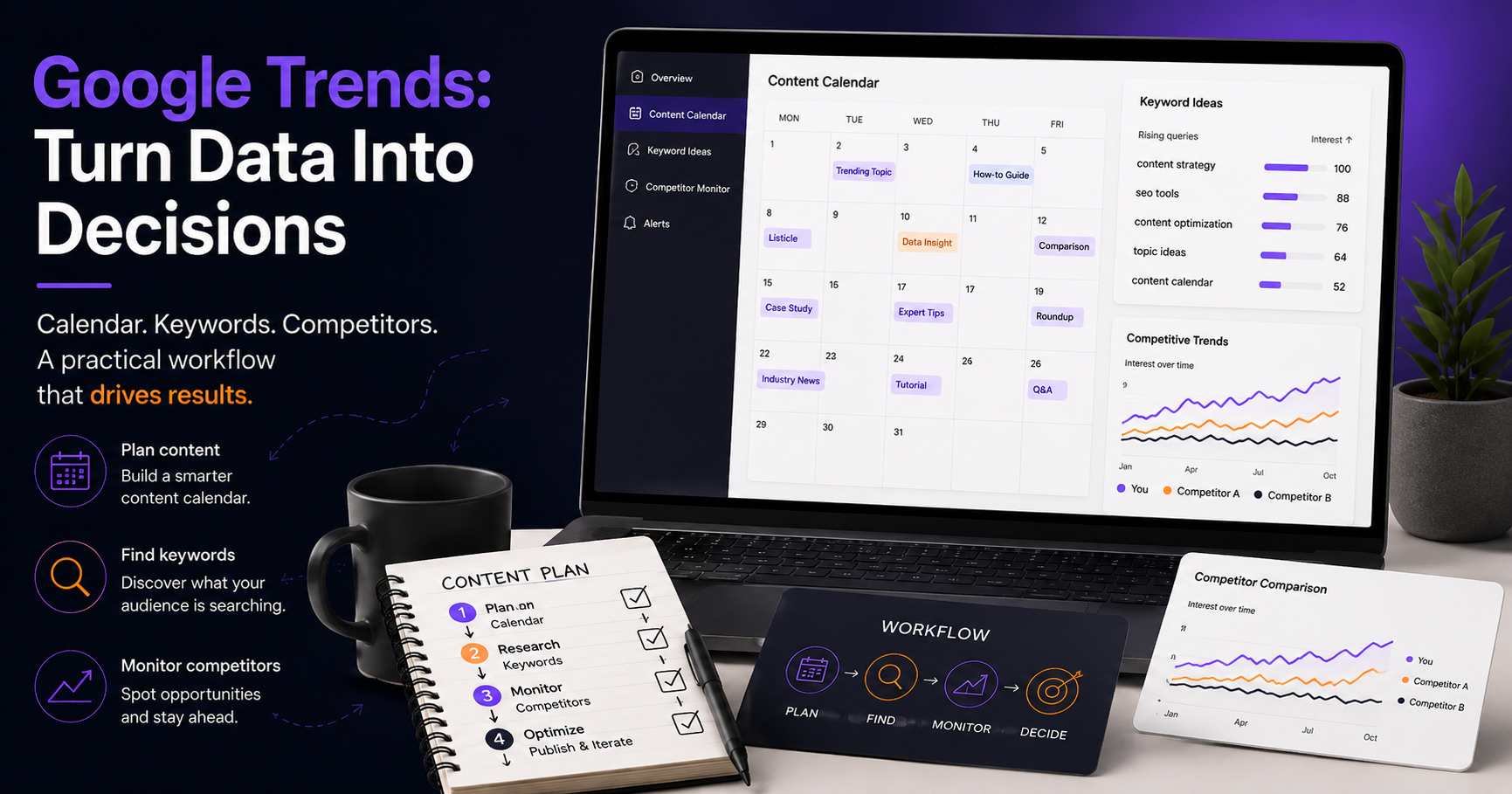
Content calendar planning. Each quarter, search your core topic areas in Trends with a five-year view. Note the seasonal peaks and schedule your major content pushes to land four to six weeks before the anticipated peak — enough time for Google to index and rank the content before search volume spikes.
Keyword selection. When a keyword research tool gives you two or three terms with similar volume, use Trends to break the tie. The term with rising momentum over the past twelve months is the better long-term investment.
Competitive topic monitoring. Search your competitors' brand names or flagship product categories in Trends alongside your own. Interest trends over time are a reasonable proxy for market momentum that financial reports or social media metrics often obscure.
What Google Trends Won't Do
It won't replace keyword research tools — it lacks absolute volume data. It won't tell you whether a topic is commercially valuable, only whether people are searching for it. And it reflects search behaviour on Google specifically, which means trends on platforms like TikTok, YouTube, or Reddit may not appear until they migrate to search traffic — sometimes with a significant lag.
Used within those limits, it's one of the most genuinely useful free tools available to any marketing or content team. The question is whether you're using it to make decisions or just to generate charts.
At EDU Effective, our Effective MBA: Online Marketing program provides professionals with the analytical foundations they need to make more informed decisions across all channels.
EDU Effective Business School = professional development for your long-term success
All best-selling Effective MBA programs: Effective MBA: Executive Management & Leadership, Applied Artificial Intelligence, Coaching, Leadership & Mentoring, Mastery in AI, or Online Marketing, are based on the same educational model, which is beneficial for working adults: 15 minutes a day, 10 months or less, ASIC accredited, from €990.
These are professional programs, not academic ones — built for working adults to apply what they learn directly in their own business, not to collect a scholarly credential.
Join more than 9,000 students in over 120 countries around the world to further your personal development and career success.
You can read the feedback and experiences of our students and the stories of our graduates here.
The easiest way to start working on your personal development and success today:
Apply now — from €990 · Talk to a Study Advisor
Study with NO risk: 14-day money-back guarantee, no questions asked.
Sources
- Yotpo — Google Trends For SEO In 2026: The Velocity Playbook
- Search Atlas — How to Use Google Trends for Your Content Strategy in 2025
- Boomcycle Digital Marketing — SEO Trends in 2025: It's an AI-First Search World
- Userp.io — Google Search Trends 2025: How To Find and Use Them
- Saffron Edge — Google SEO Updates 2024–2026
- Google Trends (official tool)