
More than 500 hours of video get uploaded to YouTube every single minute. Add LinkedIn Learning's 24,000+ courses, over 233,000 TEDx talks, and a stack of e-books and audiobooks nobody could get through in ten lifetimes, and the real problem with online learning isn't a shortage of material. It's the opposite — so much of it that finding the 15 minutes actually worth your time can take longer than the 15 minutes themselves.
That's the exact gap the Effective MBA's content process is built to close.
Here's the short version, in just over a minute:
How EDU Effective filters YouTube, LinkedIn Learning, TEDx and e-book content down to one 15-minute Effective MBA lesson.
Three Filters, Not One Opinion
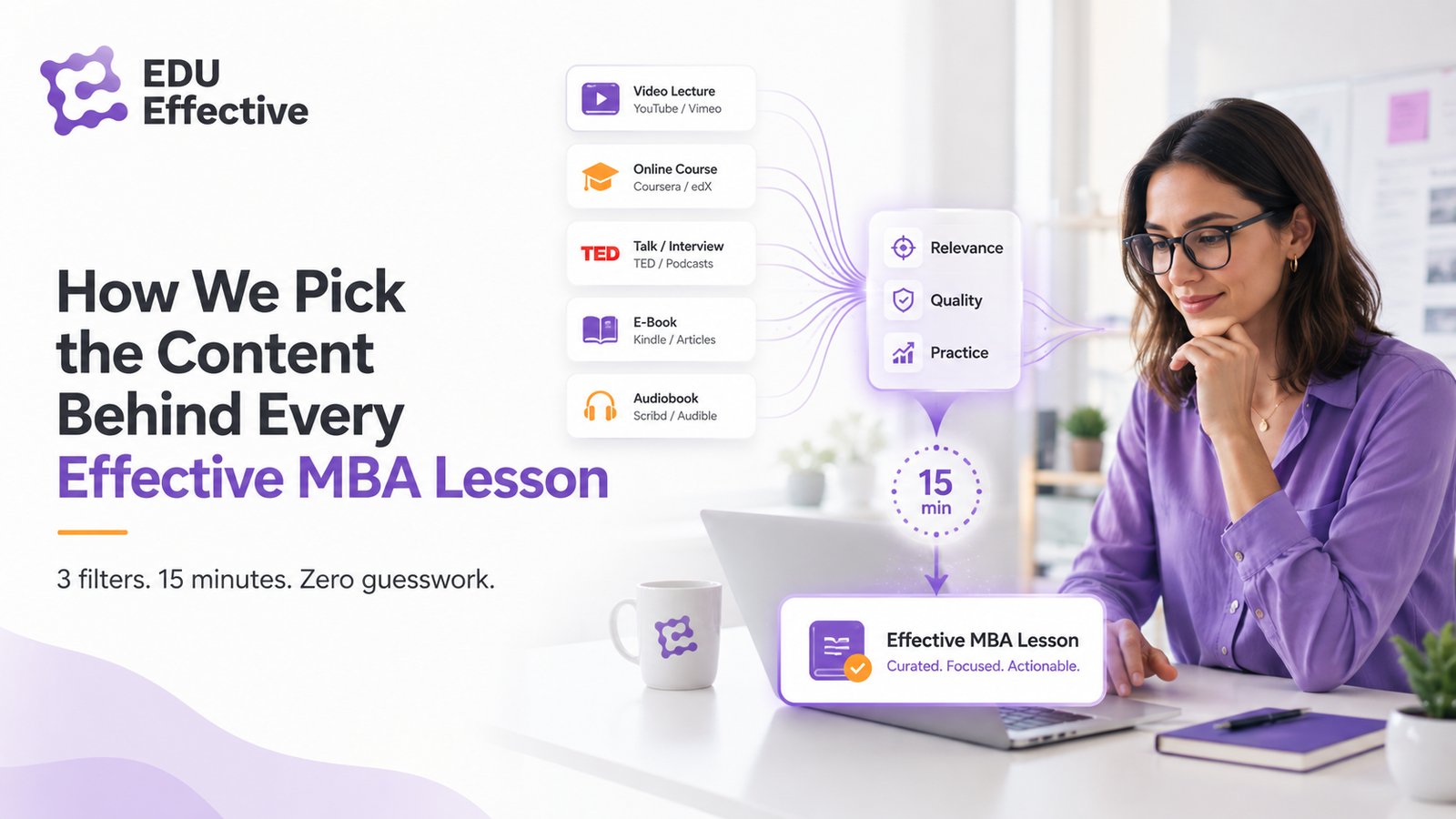
Every piece of source material — a YouTube lecture, a LinkedIn Learning course, a TEDx talk, an e-book chapter — goes through the same three checks before it earns a place in a lesson:
- Relevance — does this match what a working professional needs right now, not five years ago.
- Quality — is the source credible, current, and taught by someone who has actually done the job.
- Practice — can a student use this at work tomorrow, not just discuss it in theory.
Content that doesn't clear all three doesn't make it into a program, no matter how polished it looks on screen.
Why Curate Instead of Create From Scratch
Building original video lectures from zero is the traditional academic model — and it's also the slowest, most expensive way to keep content current. LinkedIn Learning's 2025 Workplace Learning Report makes a similar case for the industry as a whole: the priority is shifting from how much content a library holds to how well it's filtered and matched to the person who needs it — what the report calls the shift from the author role to "the librarian role." The Association for Talent Development (ATD) treats content curation the same way: a distinct professional competency, not a shortcut.
Effective MBA runs on that librarian model. A dedicated content team, not one instructor's syllabus, reviews sources across YouTube, LinkedIn Learning, TEDx, e-books and audiobooks, then keeps only what survives the three filters above.
Why 15 Minutes Is the Unit, Not an Hour
Every filtered piece of content gets compressed into a 15-minute daily block, not because shorter is trendier, but because the evidence behind spaced, bite-sized learning is specific: eLearning Industry's 2025 research roundup puts the retention gain from microlearning at 25% to 60% compared with other learning methods. Fifteen minutes is the length that fits a commute or a coffee break and still holds up against that research.
What Comes Out the Other End
The result isn't a general MBA education — it's a professional program built for immediate use: a certificate carrying international ASIC accreditation, ten modules built around one 15-minute block a day, and content the team has already tested against relevance and practice, not novelty. It's a professional degree, not an academic one, built for people who need the material to work on a Monday morning, not in a seminar.
Curious about how that compares to the traditional MBA model? We've addressed the most common assumptions head-on in our piece on 7 myths about the Effective MBA — and what's actually true.
Judge It By the Lesson, Not the Process
None of this filtering is visible from the student side — which is the point. The fastest way to see whether it works is to open a lesson, not read about the method behind it.