
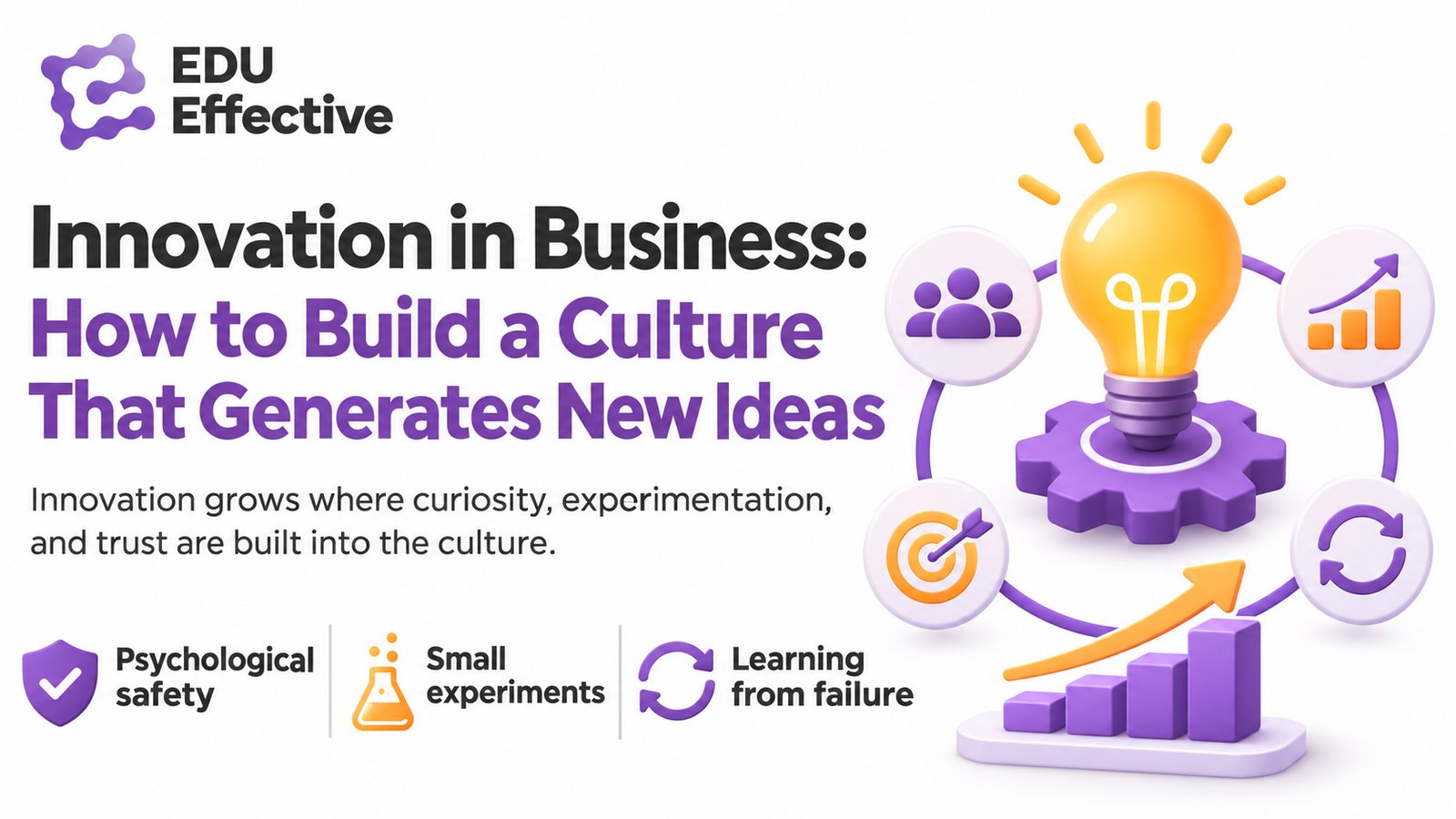

Most organizations say they want innovation. Very few have built the conditions that actually produce it.
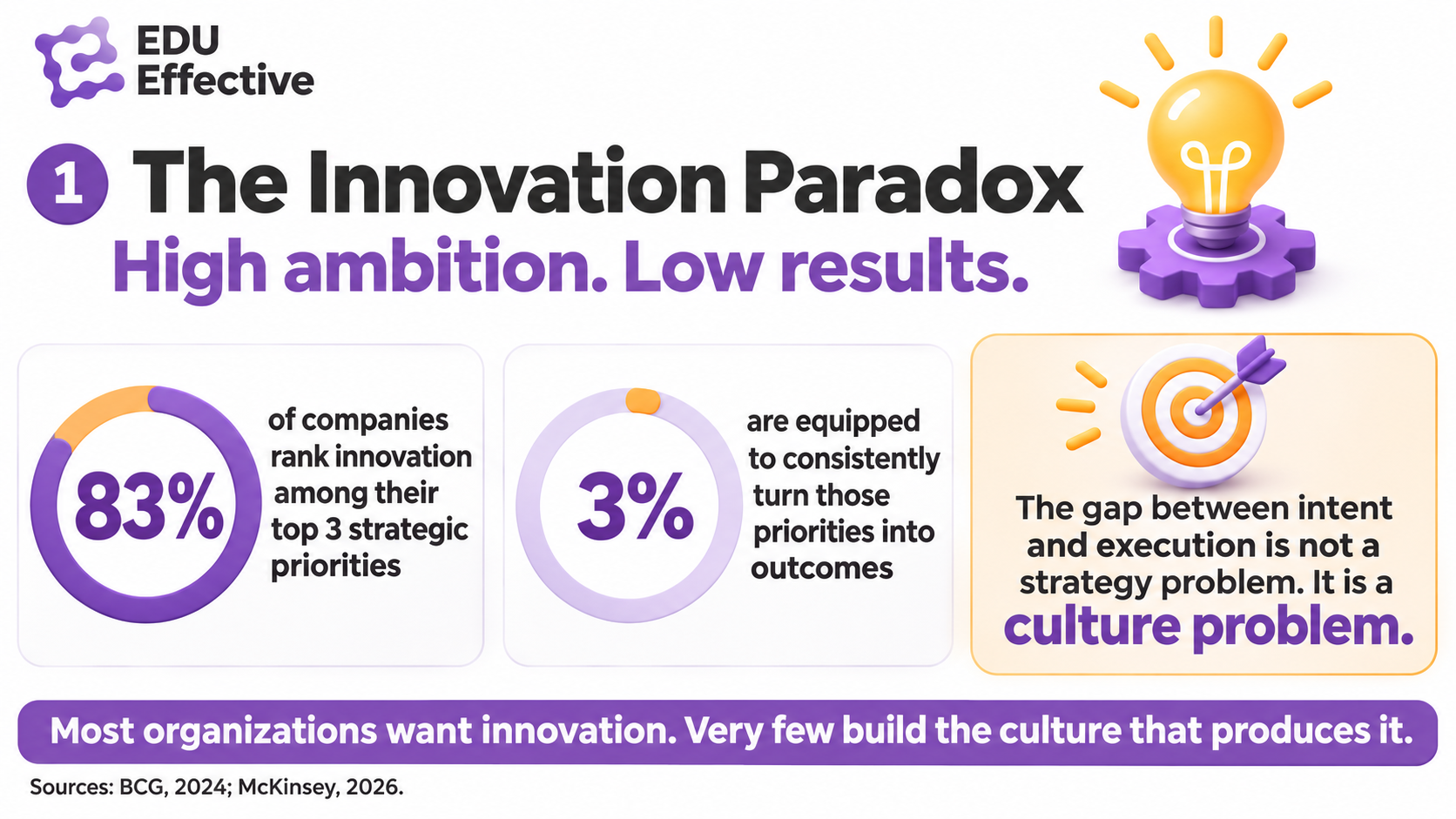
BCG's annual Most Innovative Companies research — tracking companies since 2005 — found that roughly 83% of companies rank innovation among their top three strategic priorities. Only 3% are equipped to consistently turn those priorities into outcomes. A separate McKinsey study asked more than 8,000 C-suite executives across five years about their innovation barriers: 80–90% described innovation as a top priority, but only 6% were satisfied with their own performance. That figure has held nearly flat for a decade.
The gap between intent and execution is not a strategy problem. It is a culture problem.
What Top Innovators Actually Do Differently
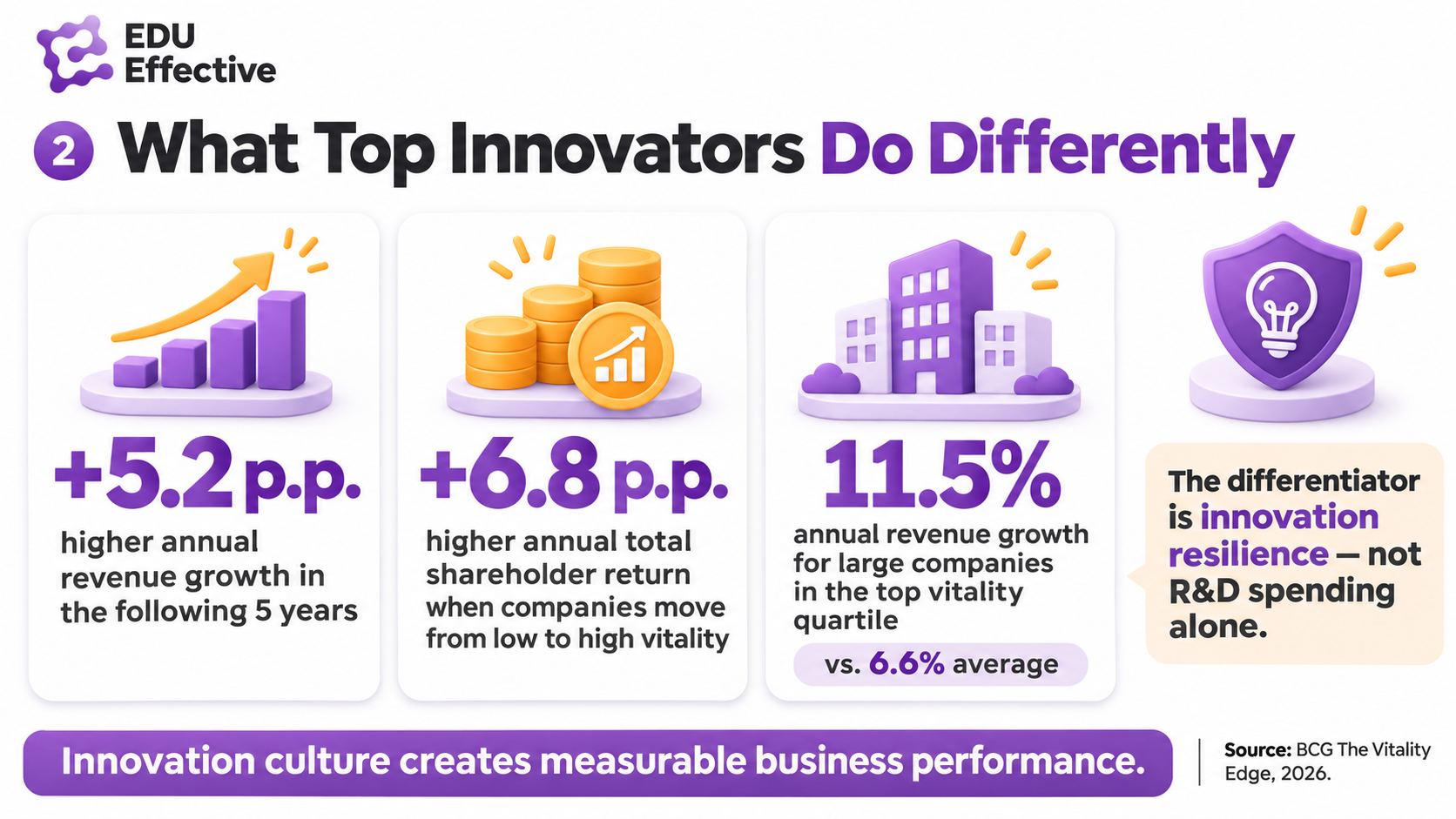
BCG's The Vitality Edge report (July 2026) evaluated more than 3,500 companies over five years, integrating approximately 10 million data points. The financial pattern is consistent: companies above the median vitality score achieved 5.2 percentage points of additional annual revenue growth in the five years that followed, compared to less vital competitors. Companies that moved from low vitality to high gained an extra 6.8 percentage points of annual total shareholder return.
Among the largest companies (over $25 billion in revenue), those in the top vitality quartile grew revenues at 11.5% per year over five years. The average for all large companies was 6.6%.
The 2025 report's central finding — which the 2026 data continues to support — challenges a common assumption: R&D spending alone is not the differentiator. Despite high and sustained investment, the analysis found no consistent link between R&D budget and shareholder return. What differentiated the top performers was innovation resilience — the ability to keep generating and commercializing new ideas through adversity. During the pandemic, 43% of transformation programs launched in that period achieved value-positive growth. During comparable periods of global economic stability, only 28% did.
The BCG CEO Innovation Agenda 2026 adds another layer: between 2024 and 2026, the share of innovation budgets directed at the core business increased by 12 percentage points. Investment in adjacent and transformational projects fell. That retreat toward the familiar is precisely the pattern that separates companies that fall behind from those that do not.
The Organizational Precondition: Psychological Safety
Innovation requires people to do something that runs against most organizational incentive structures: propose ideas that might fail, challenge existing approaches, and admit uncertainty in front of colleagues and managers.
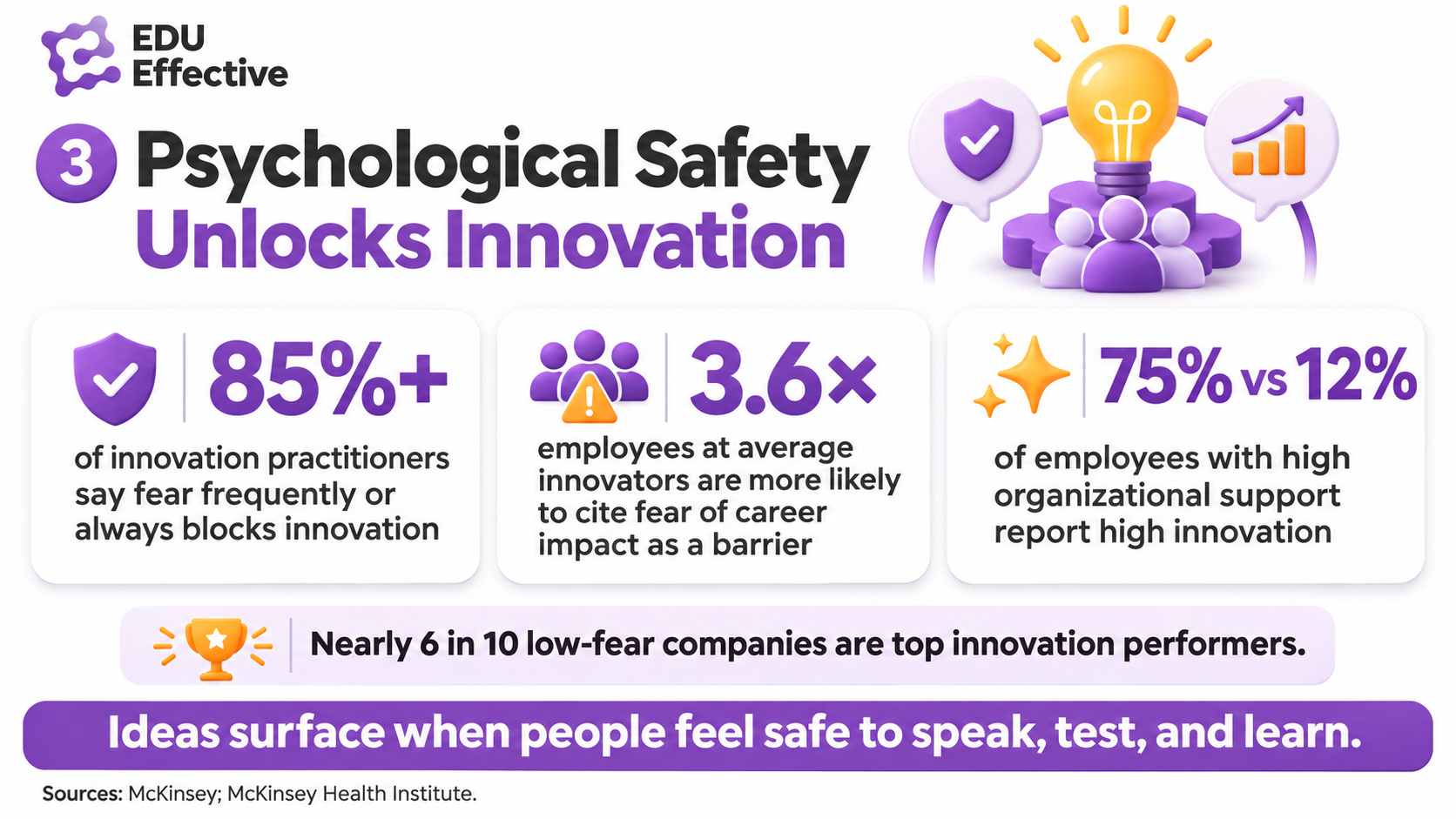
McKinsey's research on fear in innovation — drawing on surveys across thousands of practitioners — found that more than 85% of innovation practitioners report that fear frequently or always blocks innovation in their organizations. Only a quarter of organizations understand this fear. Fewer than 11% do anything about it.
The data on what that fear costs is direct: employees at average innovators are 3.6 times more likely than those at leading innovators to cite fear of career impact as a barrier. Among companies with low-fear environments, nearly six in ten are top innovation performers. Among companies with high-fear environments, only one in ten is.
Google's Project Aristotle studied more than 180 teams examining over 250 variables. No single demographic or structural characteristic predicted team performance. What differentiated high-performing teams was behavioral: psychological safety — the shared belief that the team is safe for interpersonal risk-taking. Amy Edmondson of Harvard Business School, whose original research preceded Google's by two decades, found consistently that teams with higher psychological safety show more learning behavior, report more errors (which allows them to be fixed), and produce better outcomes.
The McKinsey Health Institute survey of approximately 30,000 employees across 30 countries quantified the organizational impact: 75% of employees who reported high organizational support also reported high innovation, compared to 12% of those with low support — a 6.2-fold difference.
Deloitte's 2026 Human Capital Trends research (9,000+ leaders, 89 countries) adds the current context: 34% of organizations identify culture as a direct barrier to their AI transformation goals. 65% believe their culture must change significantly in relation to AI. Only 5% of firms are making meaningful progress. The same cultural conditions that block AI adoption are the conditions that block innovation broadly — because both require the same underlying behaviors: willingness to experiment, tolerance of ambiguity, and openness to being wrong.
Four Structural Practices That Build an Innovation Culture
1. Separate Idea Generation From Evaluation. The most common reason good ideas die early is that generation and evaluation happen simultaneously. Someone proposes an idea; the room immediately identifies problems; the proposer retreats; others become less likely to speak next time.
McKinsey's research on leading innovators found that they prioritize innovation as part of company values three times more often than average innovators, use storytelling to advocate for innovation 4.5 times more often, and use symbols to signal innovation as a priority 11 times more often. None of these behaviors involve evaluating ideas faster. They involve creating conditions in which ideas surface at all.
IDEO, the design firm whose design thinking methodology has shaped how dozens of organizations approach innovation, built its entire process around deferring judgment to preserve the generative phase. The practical implication for managers: when your team brings ideas, your first response should consistently be curious rather than evaluative. "Tell me more about that" produces different outcomes than "here are the problems with that."
2. Create Low-Stakes Experiments. Innovation culture does not require the organization to bet big on every new idea. It requires the organization to enable small, fast, low-cost experiments that test assumptions before significant resources are committed.
Amazon's "two-pizza team" principle keeps teams small enough to move quickly. Google's practice of allocating time for self-directed projects (the policy that produced Gmail and Google News) reflects a resource commitment to experimentation outside the core work. The BCG vitality research found that the most vital companies are nearly ten times more likely to be in the top quartile on at least one of three capabilities: growth ambition, talent density, and growth culture. Experimentation is embedded in all three.
The enemy of this practice is requiring full business case justification before any experimentation — which eliminates exactly the ideas that do not yet have enough data to justify a business case, which are often the ideas most worth testing.
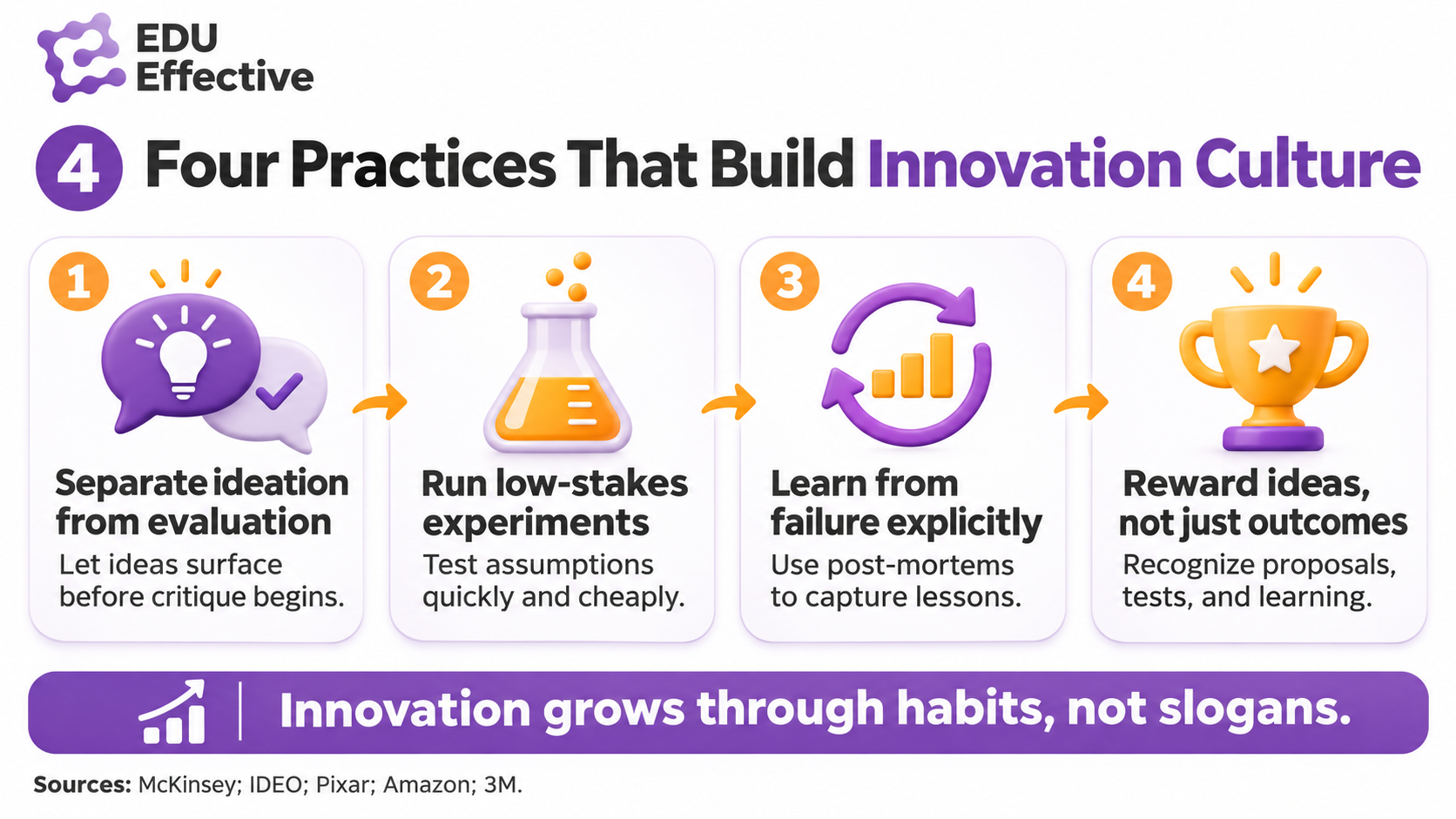
3. Learn From Failure Explicitly. Organizations that say they "embrace failure" but do not systematically learn from it are practicing tolerance of failure, not innovation culture. The mechanism that converts failure into organizational learning is the structured post-mortem: a rigorous conversation after a project ends that examines what happened, what was expected, where the gap was, and what the team would do differently.
Amazon, Pixar, and Netflix all have formal mechanisms for this. Pixar's Braintrust process involves regular structured critique of projects in development. The culture of critique is formalized and expected, which means it is not personal. McKinsey's research on innovation leaders found they build systematic feedback loops between experiments and decision-making — including documenting and sharing learning from projects that did not work.
4. Reward Ideas, Not Just Outcomes. Innovation culture breaks down when the only recognized output is a successful commercial outcome. This eliminates all of the intermediate steps — the proposals, the experiments, the failed attempts, the learning — that make successful outcomes possible.
3M's long-standing policy of allowing employees dedicated time for self-directed projects — the origin of the Post-it Note, developed by Spencer Silver and Art Fry over several years of internal experimentation — was a structural recognition that innovation comes from exploration, not just directed work.
Rewarding the process means visibly acknowledging proposals that were considered seriously even if not pursued, experiments that failed but generated useful data, and individuals who raised concerns that turned out to be correct. The Deloitte 2026 data shows that only 5% of organizations are making meaningful progress on the cultural changes required to support AI and innovation. In 95% of organizations, the gap between declared priority and rewarded behavior remains open.
The Leadership Behavior That Matters Most
The single largest determinant of innovation culture is the behavior of the leader in the room.
McKinsey's global C-suite research (8,000+ respondents over five years) identified five capabilities most critical for innovation leadership: adaptability, creativity, curiosity, comfort with ambiguity, and data fluency. These are learnable. They are also easy to undermine — a single dismissive response to a vulnerable contribution can undo months of trust-building.
BCG's vitality research finds that leading innovators are led by people who treat innovation as a leadership practice, not a strategy document. The ambition is set at the top. The portfolio of bets is actively managed. The talent capable of generating and executing new ideas is deliberately recruited, developed, and retained.
That last point carries particular weight right now. AI captured more than 80% of all venture capital investment in 2024. The BCG Vitality Index shows that AI-related topics appeared in earnings calls of top innovators nearly four times as often as among their peers. Organizations that do not develop AI-capable talent alongside human judgment will compound their innovation gap in the years ahead.
Where to Start
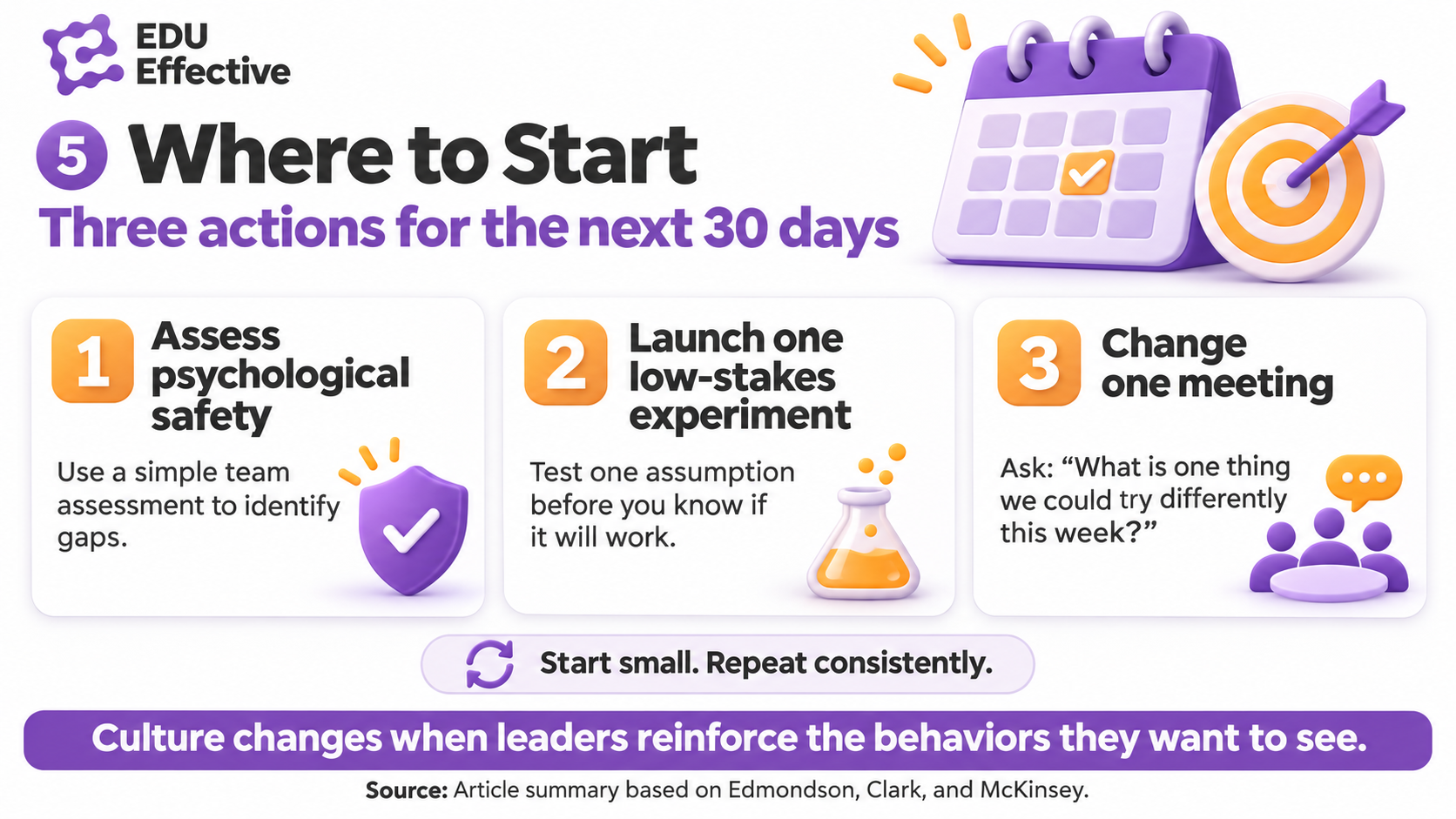
A culture does not change overnight. But it can be moved. Three starting points that research and practice support:
Run a psychological safety assessment on your team. Amy Edmondson's original scale provides one structured approach; Timothy Clark's 4 Stages of Psychological Safety model provides another. Understanding where the gaps are is the first step to addressing them.
Introduce one experiment in the next 30 days that is explicitly low-stakes and approved before you know whether it will work. Not a full pilot — a test of a specific assumption. Then review what you learned, regardless of outcome, in a team setting.
Change one meeting. If you run a weekly team meeting where ideas are rarely proposed, try running it with a standing item: "What is one thing we could try differently this week?" and commit to taking at least one suggestion seriously each time. The behavioral signal this sends compounds over months.
Innovation culture is not built by announcing it. It is built by demonstrating, repeatedly, that the organization values the behaviors that produce new ideas: curiosity, experimentation, candor, and the willingness to learn from what does not work as expected.
About EDU Effective Business School
The Effective MBA: Executive Management & Leadership is built around the decisions managers actually face every week. Runs on 15 minutes a day, completes in 10 months or less and is ASIC accredited.
Sources
- BCG — The Vitality Edge (July 2026, 3,500+ companies, ~10 million data points) https://web-assets.bcg.com/5f/85/58eed42c4a9d952c113ddcf60249/the-vitality-edge-july2026.pdf
- BCG — The CEO's Innovation Agenda in Uncertain Times (2026) https://www.bcg.com/publications/2026/the-ceos-innovation-agenda-in-uncertain-times
- BCG — Most Innovative Companies: Winning the Innovation Race (June 2025) https://www.bcg.com/press/26june2025-winning-the-innovation-race
- McKinsey — Taking Fear Out of Innovation https://www.mckinsey.com/capabilities/strategy-and-corporate-finance/our-insights/taking-fear-out-of-innovation
- McKinsey — What It Takes to Build 'Genius at Scale' (April 2026) https://www.mckinsey.com/capabilities/people-and-organizational-performance/our-insights/what-it-takes-to-build-genius-at-scale
- McKinsey Health Institute — Innovation Ignition (December 2024, ~30,000 employees, 30 countries) https://www.mckinsey.com/featured-insights/charts/innovation-ignition
- Deloitte — AI Cultural Debt, 2026 Human Capital Trends (9,000+ leaders, 89 countries) https://www.deloitte.com/us/en/insights/topics/talent/human-capital-trends/2026/ai-cultural-debt.html
- Edmondson, A. — Psychological Safety and Learning Behavior in Work Teams, Administrative Science Quarterly (1999) https://www.hbs.edu/