

Internet marketing crossed a historic threshold in 2026: total global advertising spend surpassed one trillion dollars for the first time, and digital channels now account for approximately 68.7% of that figure. Put simply, the majority of the world's marketing investment now flows through online channels — search, social media, email, video, content, and an expanding set of AI-powered platforms.
For any business operating in 2026, internet marketing is not a supplementary activity to consider alongside traditional advertising. It is the primary arena where customers are found, brands are built, and revenue is generated. Understanding how it works — and which channels actually deliver results — is foundational business knowledge.
What internet marketing is, precisely defined
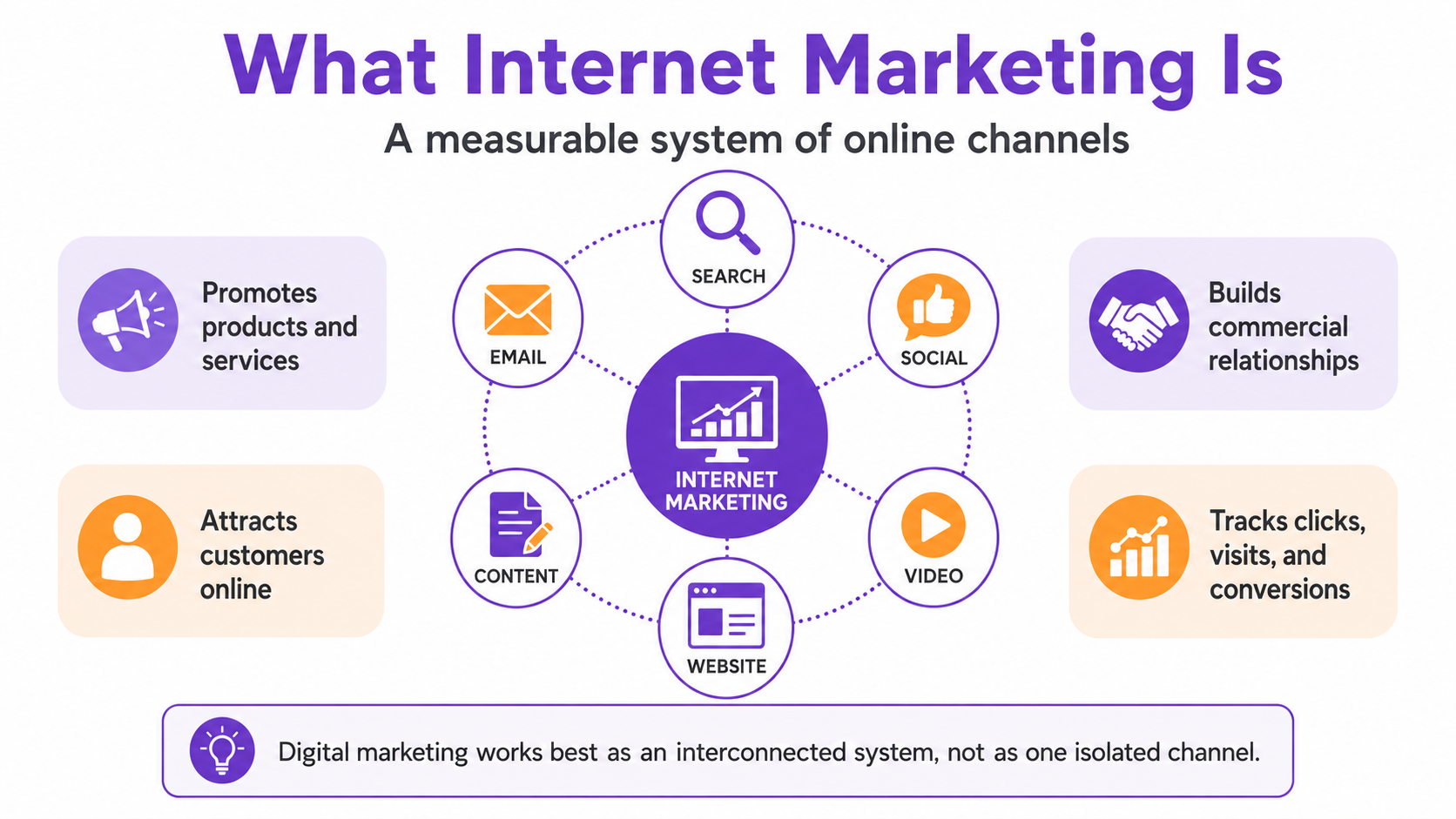
Internet marketing, also called online marketing or digital marketing, is the use of internet-based channels and technologies to promote products and services, attract customers, and build commercial relationships. It encompasses every form of marketing activity that occurs on or through the internet — from a Google search ad to a YouTube pre-roll to an email newsletter to a blog post that ranks in search results.
The defining characteristic of internet marketing compared to traditional offline marketing is measurability. Every click, impression, visit, and conversion can be tracked, attributed, and optimised in near real-time. This accountability has driven the dramatic shift in marketing budgets toward digital: marketing budgets now allocate an average of 72% toward digital initiatives, a figure that continues to rise year over year.
Internet marketing is not a single channel but a system of interconnected channels that, when coordinated effectively, compound each other's impact. A brand that is visible in search results, active on social media, and sending relevant emails to an engaged list is more than the sum of those parts.
The global scale of internet marketing in 2026
The numbers contextualise how significant internet marketing has become as a business infrastructure.
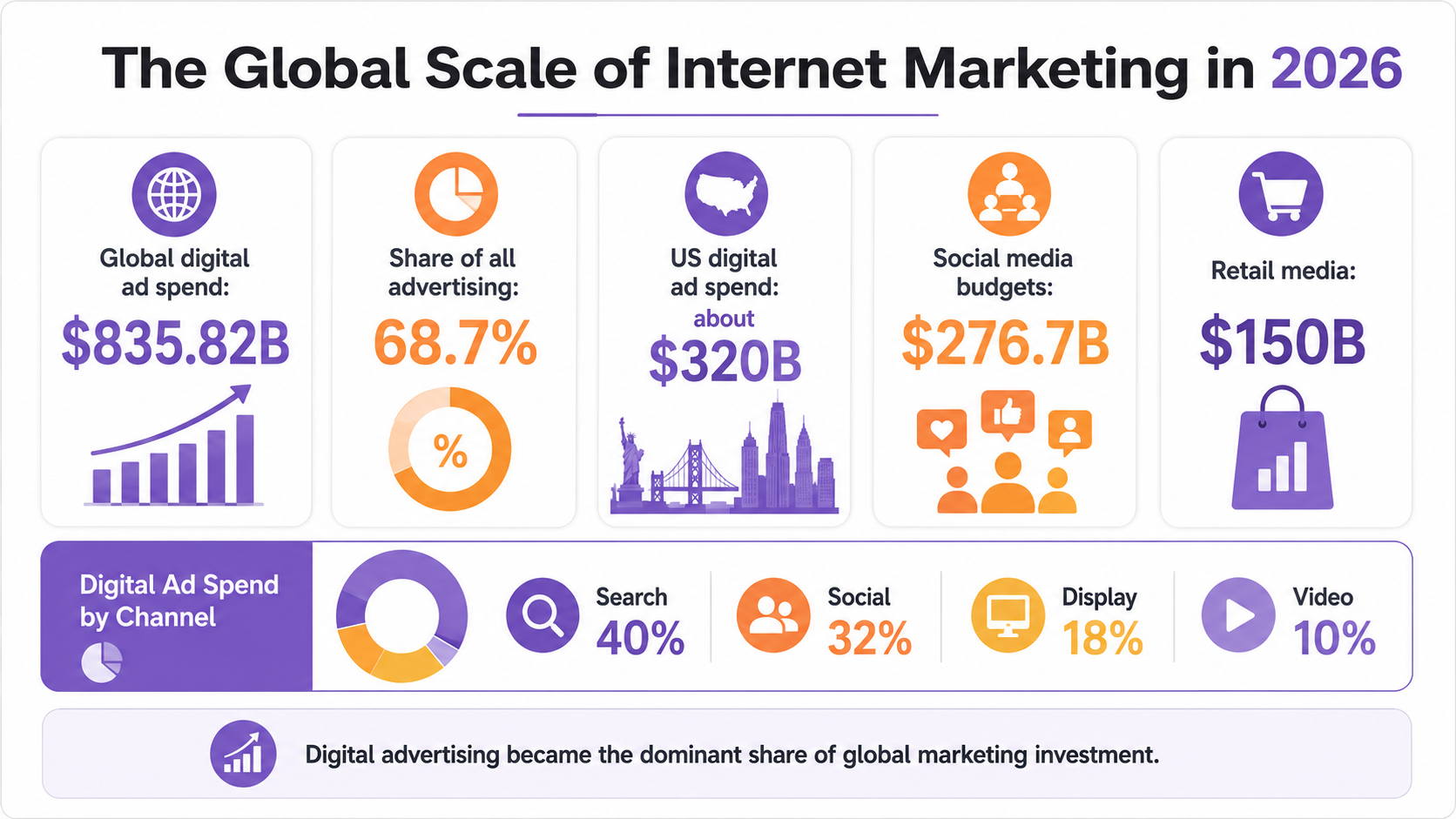
Global digital advertising spend reached approximately $835.82 billion in 2026, accounting for 68.7% of all advertising worldwide — making this the first year that total global advertising crossed one trillion dollars (MAGNA Global 2026 Forecast). The US alone accounts for roughly $320 billion in digital ad spend.
By channel, search advertising leads with approximately 40% of digital ad spending, followed by social media at around 32%, display at 18%, and video at 10%. Mobile captures 54% of digital advertising budgets globally, reflecting the reality that for most consumers in most markets, the smartphone is the primary digital device.
The email marketing channel, often underestimated, delivers $36 in return for every $1 invested — the highest ROI of any digital marketing channel, confirmed across multiple independent research streams. Organic search and SEO deliver the best overall ROI according to 49% of marketing professionals surveyed, with website, blog, and SEO being the single highest-ROI channel for 27% of B2B marketers.
Content marketing generates three times more leads than outbound marketing at 62% lower cost. Social media marketing budgets reached $276.7 billion in 2026. Retail media — advertising on e-commerce platforms like Amazon at the moment of purchase intent — represents $150 billion in global investment, making it one of the fastest-growing categories in digital advertising.
The main types of internet marketing and how each works
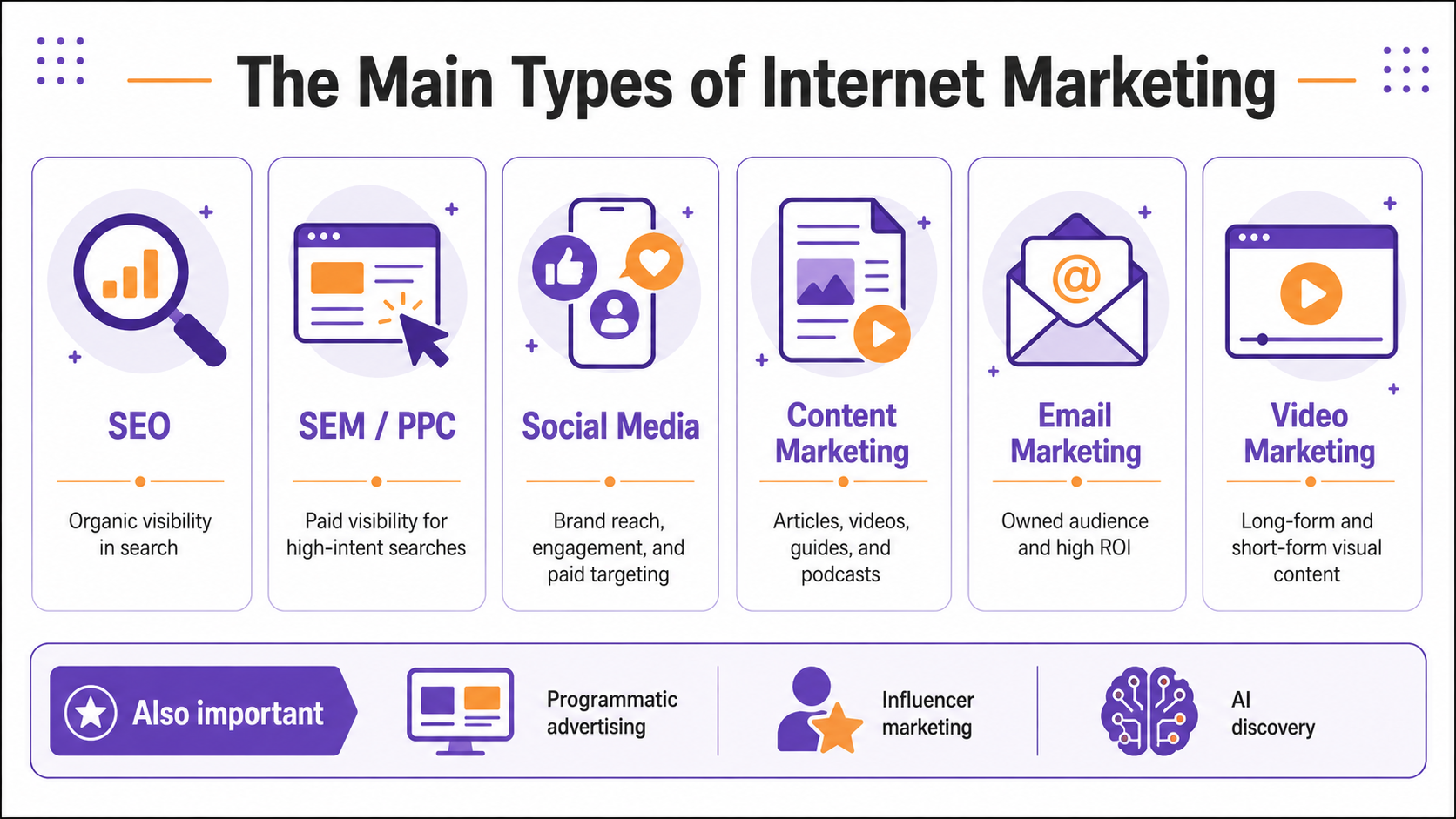
Search engine optimisation (SEO) is the practice of improving a website's visibility in organic — unpaid — search results. When someone searches for a product, service, or question on Google or Bing, the pages that appear are determined by complex algorithms that evaluate relevance, authority, and technical quality. SEO involves producing high-quality content that answers search queries, earning links from credible external sites, and ensuring the technical performance of a website meets the standards search engines require.
SEO takes time — typically 6–12 months to generate meaningful results — but its returns compound over time. A page that ranks in position one for a relevant search query generates traffic continuously without ongoing cost. In 2026, SEO has expanded to include optimisation for AI-powered discovery: an increasing share of user queries are now answered by AI assistants like ChatGPT, Gemini, and Perplexity, which surface content from the web. Being present in the sources these systems cite has become a new dimension of search visibility.
Search engine marketing (SEM) and pay-per-click advertising (PPC) place paid advertisements in search results and across display networks. Advertisers bid for the right to show their ads when users search for specific terms, paying a fee each time their ad is clicked. Google Ads dominates this category, with Google generating approximately $229 billion in search and display advertising revenue. SEM delivers immediate visibility and is particularly effective for capturing high-intent audiences — people who are actively searching for what you sell.
Social media marketing uses platforms including Instagram, LinkedIn, TikTok, Facebook, YouTube, and X (formerly Twitter) to build brand awareness, engage audiences, and drive traffic or conversions. The 4.9 billion global social media users make this a channel of unmatched reach. Social media marketing functions in two modes: organic (unpaid content, community management, and audience engagement) and paid (targeted advertising that reaches users matching specific demographic and behavioural profiles). The most effective social strategies combine both.
Content marketing is the creation and distribution of useful, relevant content — articles, videos, guides, podcasts, infographics — that attracts and retains a clearly defined audience. Rather than interrupting potential customers with advertisements, content marketing earns their attention by providing genuine value. Its strategic advantage is asset accumulation: a well-written article or video continues generating traffic and leads for years after it is published, compounding returns over time.
Email marketing remains one of the most effective channels in internet marketing despite being one of the oldest. With an average ROI of $36 per $1 spent, it consistently outperforms paid advertising on a cost-efficiency basis. Email works because it operates on an owned audience — a list of people who have specifically opted in to receive communications — rather than renting attention from a platform. Newsletters, promotional sequences, and automated lifecycle emails each serve different strategic purposes across the customer journey.
Video marketing has grown from a supplementary format to a dominant medium. Video now accounts for over 80% of all internet traffic, and 82% of consumers say they are more likely to purchase after watching a brand video. YouTube, with 90% of businesses using it as a marketing platform, is the primary home of long-form brand video. Short-form video on TikTok, Instagram Reels, and YouTube Shorts has become the fastest-growing advertising format. In 2026, AI video generation tools have made professional-quality video content accessible to organisations that previously lacked production budgets.
Programmatic advertising and display automates the buying and placement of digital advertising across websites and apps using AI-driven bidding systems. Programmatic advertising now accounts for approximately 46% of total digital ad spend and is expected to exceed $700 billion globally by 2028. It enables precise audience targeting at scale and real-time optimisation of placements and bids.
Influencer and creator marketing uses partnerships with individuals who have established audiences on social platforms to communicate brand messages through trusted human voices. The category has matured significantly — research shows 85% of people trust online reviews and peer recommendations as much as personal recommendations from friends, and creator content consistently outperforms brand-created content on engagement metrics.
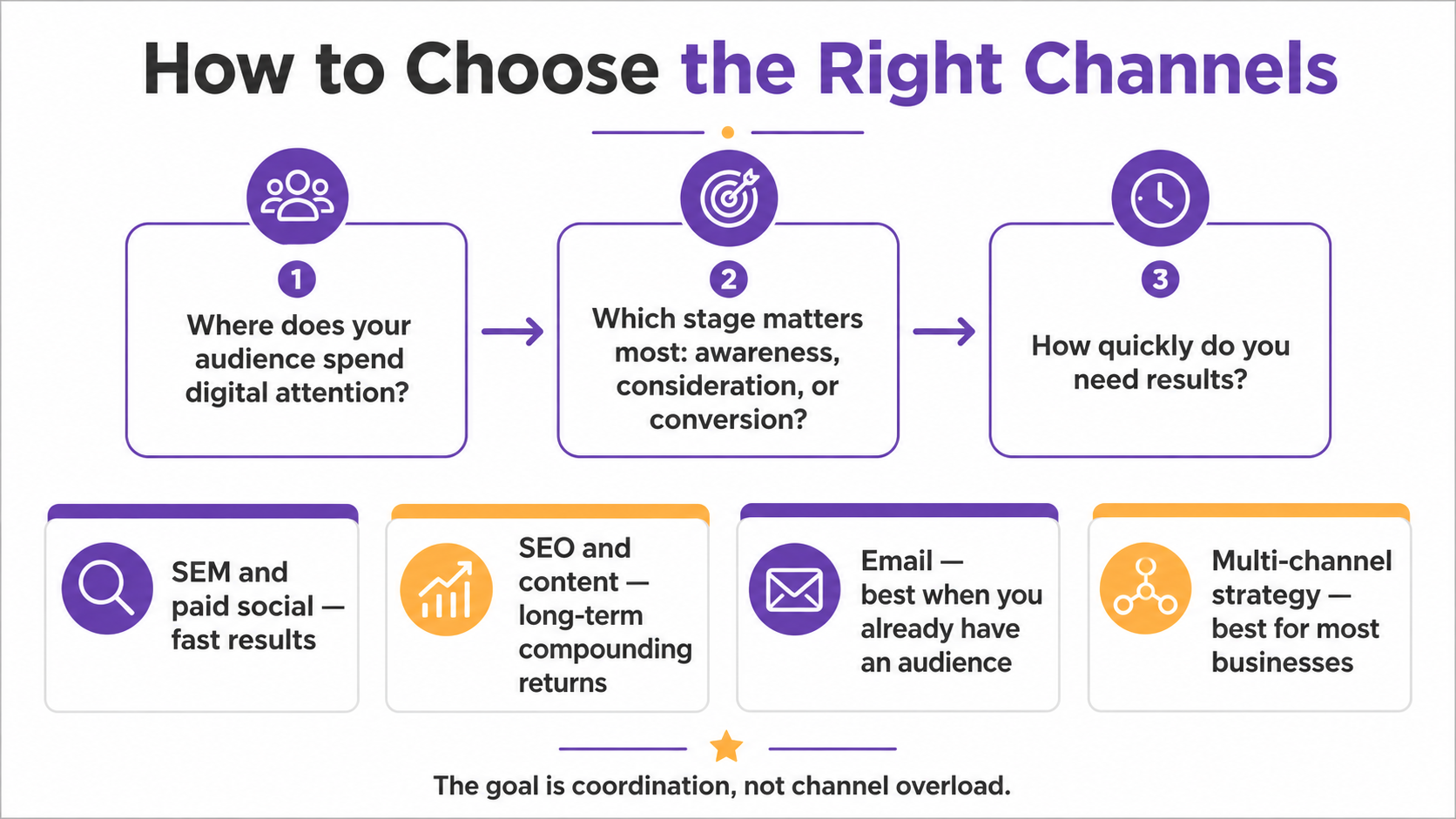
How to choose the right internet marketing channels for your business
The most common internet marketing mistake is channel proliferation without strategic prioritisation — spreading limited budget and attention across too many channels simultaneously, generating weak results across all of them.
The better approach starts with three questions: Where does your target customer spend their digital attention? What stage of the purchase journey are you trying to influence — awareness, consideration, or conversion? And what is your realistic time horizon for results?
If you need results quickly and have budget, paid search (SEM) and paid social reach high-intent audiences immediately. If you are building for the long term and want compounding returns, SEO and content marketing are the highest-leverage investments. Email is consistently valuable at every stage but requires an existing audience to send to — building that list is itself an internet marketing activity. Social media builds brand familiarity and community but rarely converts directly without supporting purchase infrastructure.
Most effective internet marketing strategies combine channels rather than betting on one. Research shows that 70% of businesses achieve better results from multi-channel strategies than from single-channel approaches. The channels chosen should reinforce each other: content marketing generates SEO traffic that builds an email list that nurtures leads that paid search captures at the moment of conversion intent.
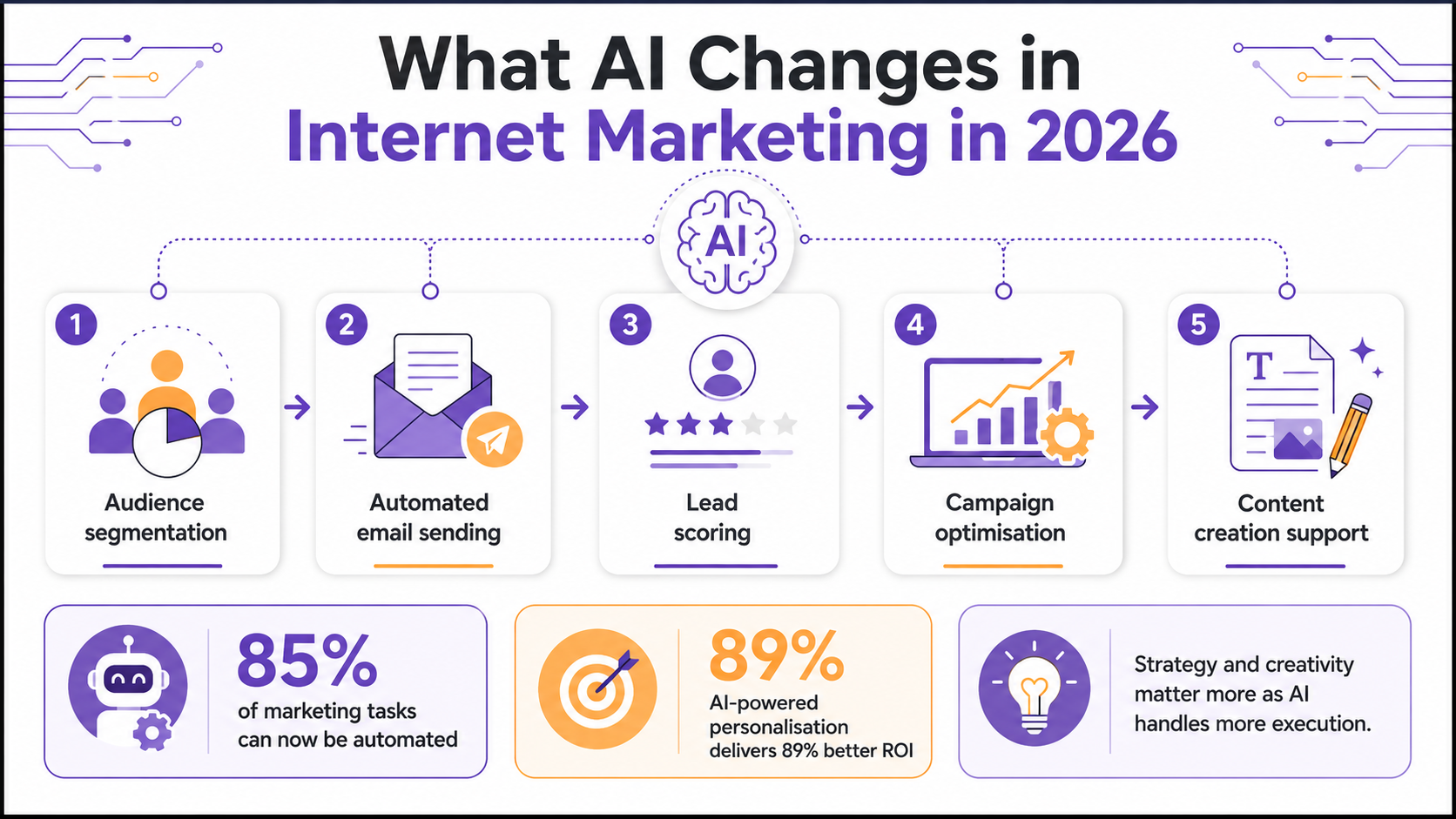
What AI changes about internet marketing in 2026
AI has become operational infrastructure for internet marketing rather than an experimental capability. Approximately 85% of marketing tasks can now be automated through AI — segmented email sending, lead scoring, dynamic audience segmentation, social media scheduling, data analysis, report generation, and a substantial share of content creation.
AI-powered personalisation delivers 89% better ROI according to marketers who use it systematically. AI-driven paid media bidding improves ROAS by 20–35% over manual campaign management. Generative AI tools now have 2.42 billion monthly active users, and AI-created content is being integrated into marketing workflows at virtually every major brand.
The practical implication is that the strategic and creative dimensions of internet marketing — deciding what to say to whom and why it matters to them — have become more valuable as AI handles the execution layer more efficiently. Channel expertise matters, but the ability to think clearly about customer value and translate that thinking into compelling communication is what differentiates effective internet marketing from automated volume.
At EDU Effective, our Effective MBA Online Marketing program develops the strategic thinking and practical channel knowledge needed to build and manage effective internet marketing in any business context. Explore our programs →
EDU Effective Business School — professional development for your long-term success.
All five Effective MBA programs are built on the same educational model — designed for working adults who need learning that fits real professional life:
- Effective MBA: Executive Management & Leadership
- Effective MBA: Applied Artificial Intelligence
- Effective MBA: Coaching, Leadership & Mentoring
- Effective MBA: Mastery in AI
- Effective MBA: Online Marketing
Every programme runs on 15 minutes a day, completes in 10 months or less, is ASIC accredited, and starts from €990.
These are professional programmes, not academic ones — built for working adults to apply what they learn directly in their own business, not to collect a scholarly credential.
Join more than 9,000 students in over 120 countries who are investing in their professional development and career success. Read the experiences of our graduates here.
Apply now — from €990 · Talk to a Study Advisor
Study with NO risk: 14-day money-back guarantee, no questions asked.
Sources
- PPC Chief — Digital Ad Spend Statistics 2026: $836B Market, 45+ Data Points https://ppcchief.com/digital-ad-spend-statistics
- Foursets — 600+ Digital Marketing Statistics 2026: Trends & Benchmarks https://www.foursets.com/blog/complete-digital-marketing-statistics
- Incremys — Digital Marketing 2026 Statistics: Key Figures to Know https://www.incremys.com/en/resources/blog/digital-marketing-statistics
- Fungies.io — Digital Marketing Market 2026: Complete Industry Analysis https://fungies.io/digital-marketing-market-analysis-2026-7/
- BizIQ — Digital Marketing Statistics 2026: Market Size, Spend, ROI https://biziq.com/blog/digital-marketing-statistics/
- AffNinja — Digital Marketing Statistics 2026: Facts vs. Myths Exposed https://affninja.com/digital-marketing-statistics/