
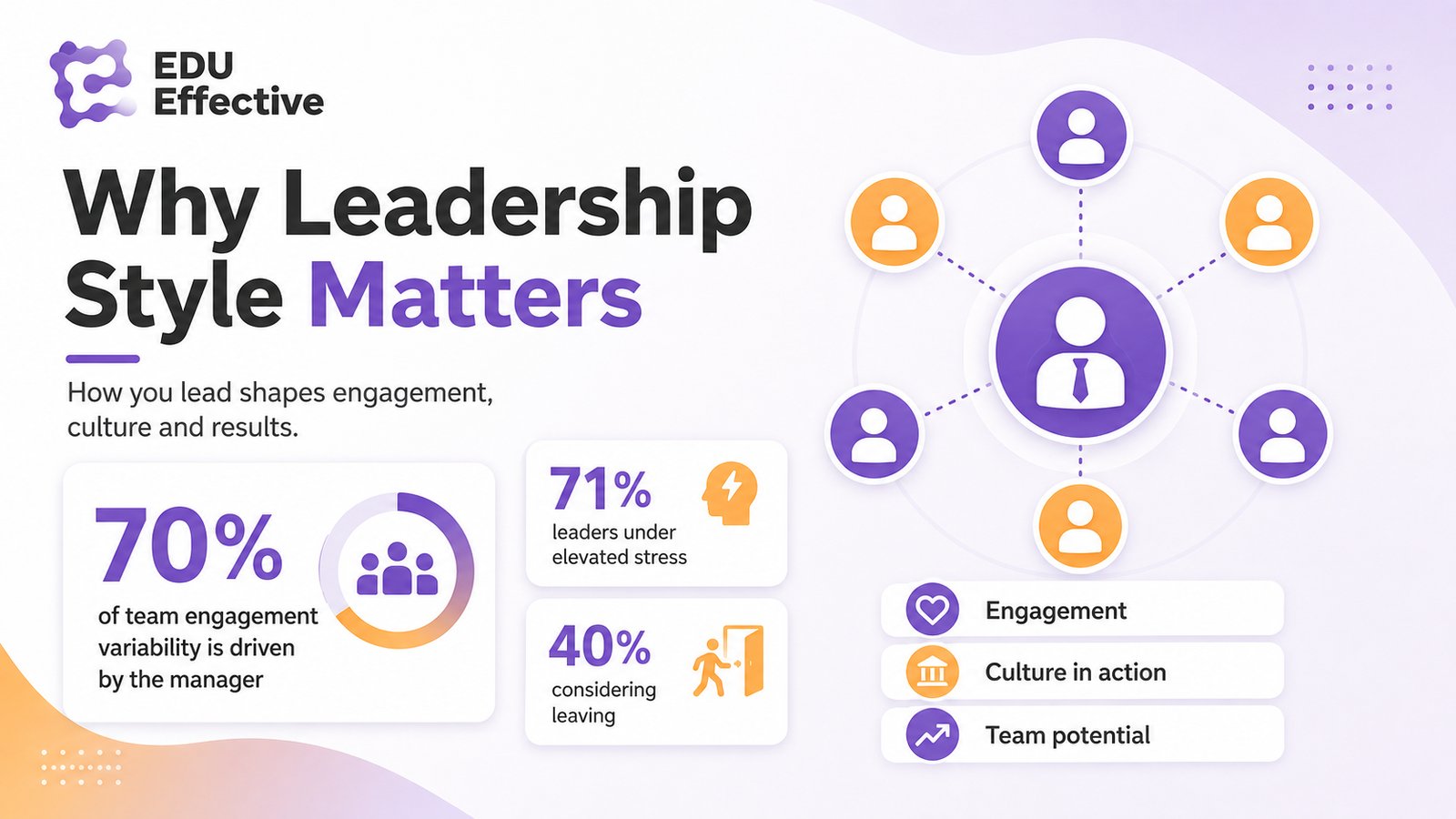

70% of a team's engagement variability is driven by its manager. Not by company culture, not by compensation, not by office perks — by the person who leads the team day to day. That single finding from Gallup's 2026 State of the Global Workplace report is probably the most important number in leadership research, because it makes the stakes of leadership style concrete: how you lead does not just affect your team's experience. It directly determines how much of their potential gets realised.
The concept of leadership style — the consistent patterns of behaviour through which a leader influences, directs, and develops people — has been studied for over a century. What has changed in 2026 is the complexity of what leaders are being asked to do simultaneously: navigate AI adoption, manage hybrid and remote teams, maintain psychological safety during organisational change, develop people in an environment of rapid skill disruption, and sustain their own performance under conditions of significant stress. DDI's Global Leadership Forecast 2025 found that 71% of leaders are already running at elevated stress levels, with 40% considering leaving their roles. The leadership pipeline is thinning at precisely the moment transformation is accelerating.
Understanding leadership styles — what they are, what research says about their impact, and when each is most effective — is not an abstract exercise. It is the foundation of deliberate, rather than accidental, leadership.
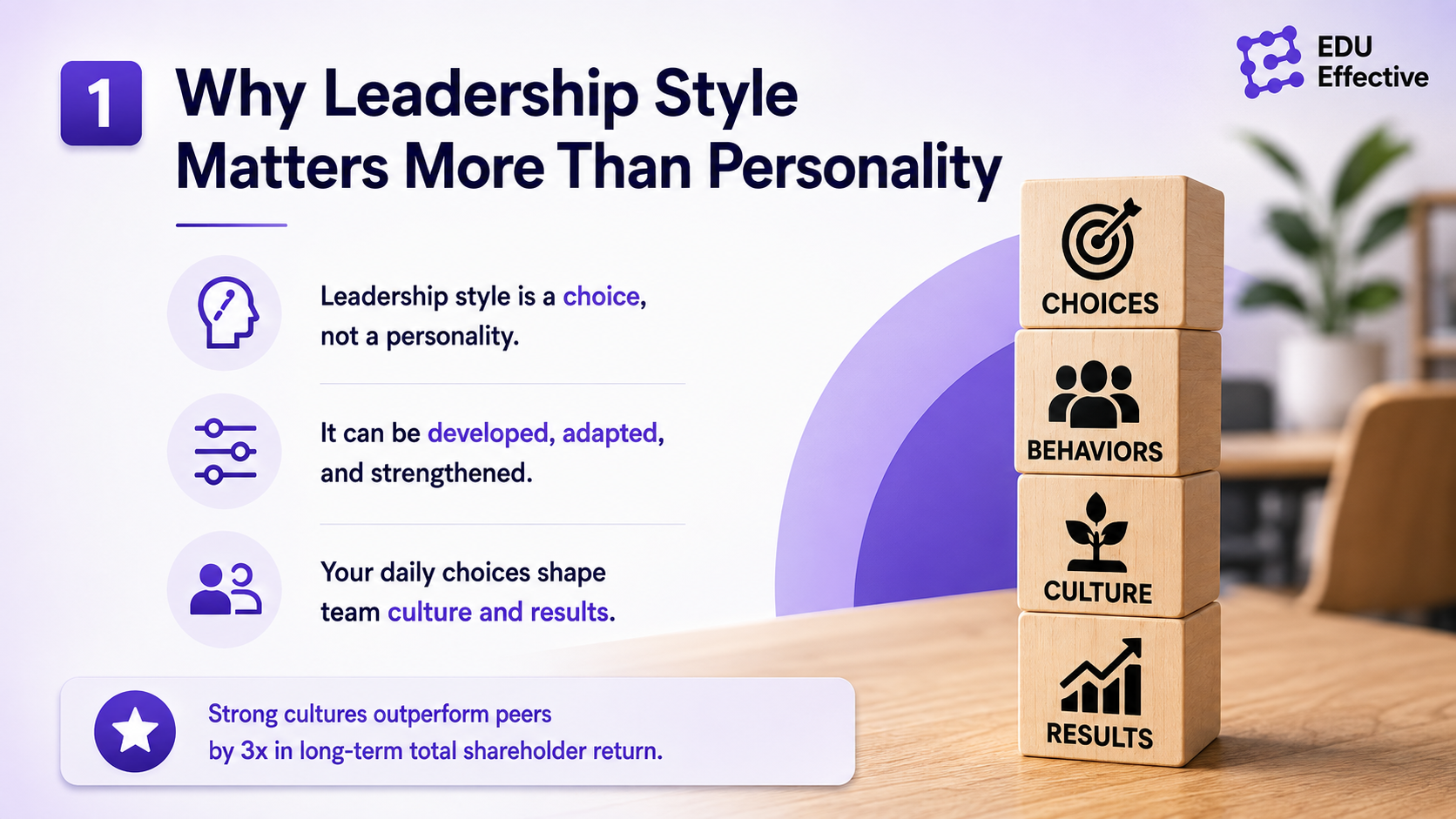
Why leadership style matters more than personality
The most common misconception about leadership style is that it is an expression of personality — that extroverts lead one way and introverts another, that confident people are authoritative and empathetic people are collaborative. This framing is both inaccurate and unhelpful, because it implies that style is fixed rather than developed.
Leadership style is better understood as a set of behaviours and choices about how to interact with people, make decisions, communicate expectations, and respond to performance — choices that can be made deliberately and that can be changed based on context. The most effective leaders in 2026 are not those who have found their "natural" style and stuck to it. They are those who have developed a repertoire of approaches and the situational judgement to know which one the moment requires.
McKinsey's research on organisations with strong cultures shows they outperform peers by three times in long-term total shareholder return. Culture is not something that happens independently of leadership — it is built, day by day, through the accumulated choices that leaders make about how they treat people, what they reward, what they tolerate, and what they model. Leadership style is culture in action.
The main leadership styles — what research actually says about each
Transformational leadership
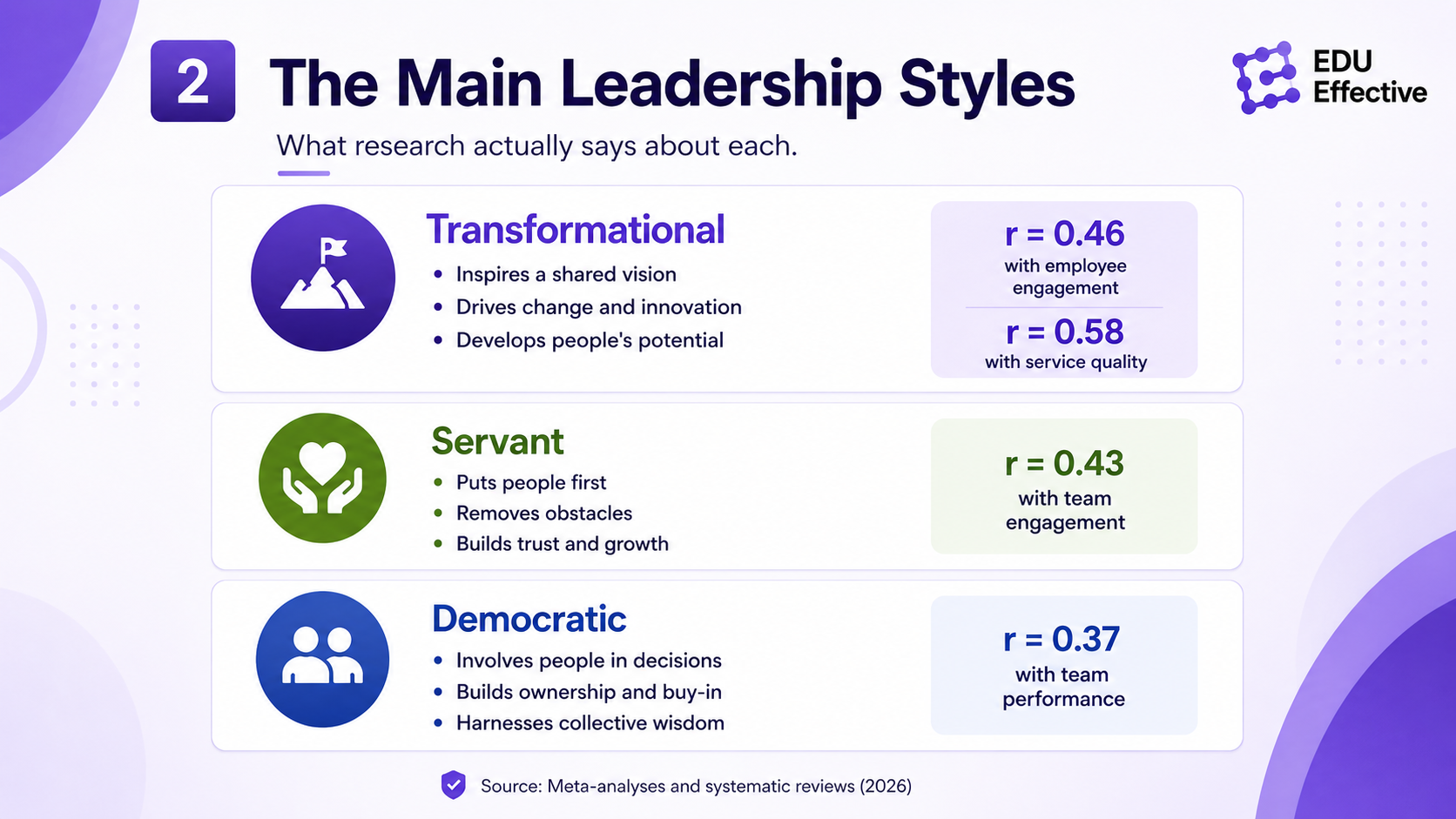
Transformational leadership is the most extensively researched leadership style in the academic literature, with studies consistently showing strong positive correlations with employee engagement, innovation, and organisational performance. Leaders in this mode focus on inspiring a shared vision, challenging the status quo, stimulating intellectual curiosity, and developing followers' own leadership capabilities.
Meta-analysis data shows a correlation of 0.46 between transformational leadership and employee engagement — the strongest relationship of any single style with this outcome. Transformational style demonstrates the strongest influence on service quality (r = 0.58) across industries, according to a systematic review of Scopus-indexed studies published in 2026.
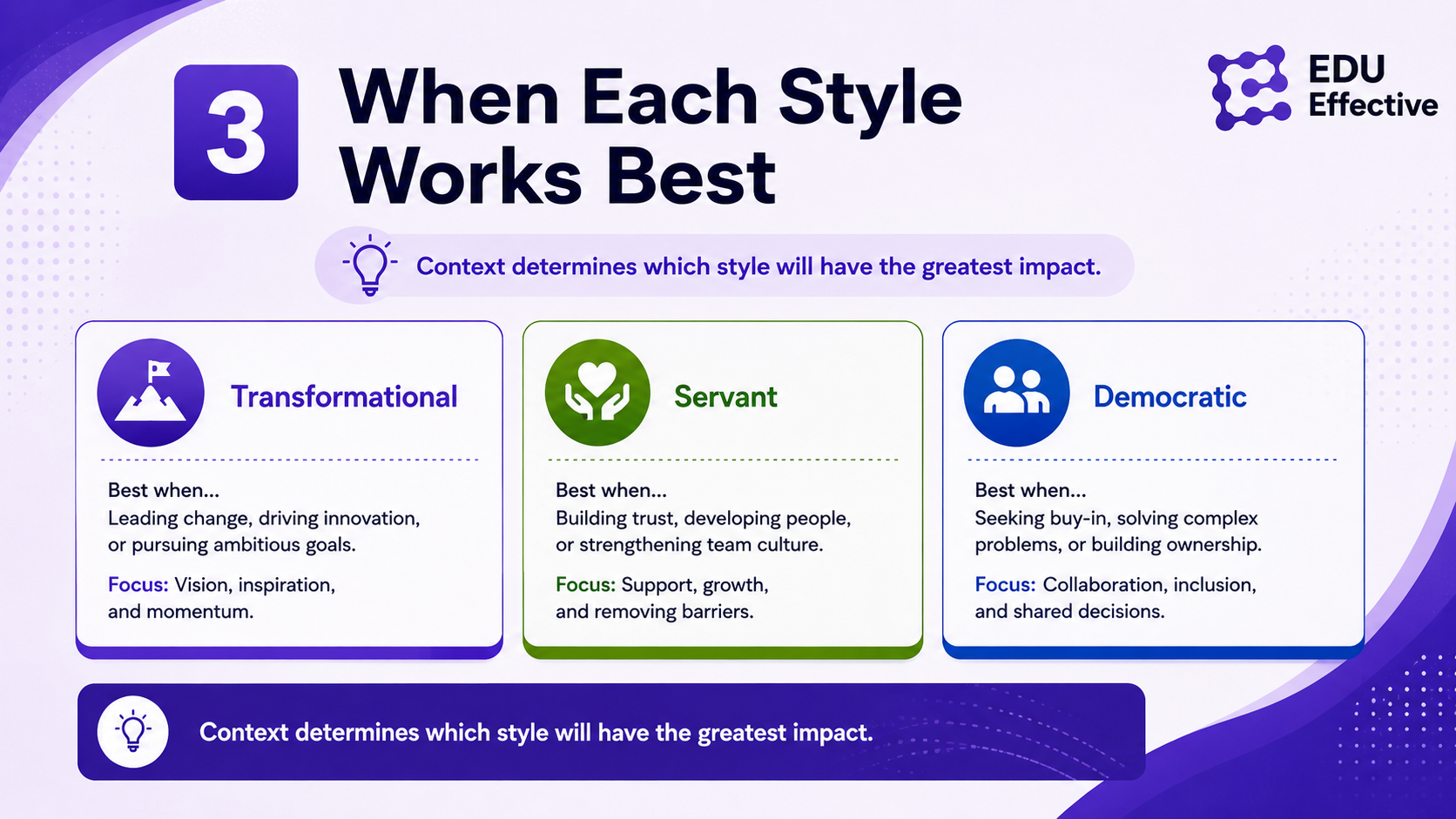
It works best in contexts requiring change, innovation, and high levels of motivation — organisations navigating digital transformation, teams pursuing ambitious growth objectives, or situations where energising people toward a new direction is the primary leadership challenge. Mary Barra at General Motors is a frequently cited current example, using a transformational approach to drive the company's electric vehicle transition.
The limitation worth knowing: transformational leadership is inspiring but demanding. It works less well in environments requiring operational precision and consistent routine, and it can exhaust both leaders and teams when applied without the structural support that makes ambition achievable.
Servant leadership
Servant leadership inverts the conventional hierarchy — the leader's primary role is to serve the needs of their team, removing obstacles, developing people's capabilities, and ensuring the conditions for others to perform at their best.
Research on servant leadership consistently shows the strongest impact on employee engagement among the three most studied styles. Servant leadership's correlation with team engagement sits at 0.43 in meta-analysis data, and it demonstrates particularly strong effects on trust, psychological safety, and retention in environments where people development is a primary objective.
In 2026, the servant leadership style has gained significant relevance in the context of hybrid and remote work. When physical proximity can no longer be relied on to create connection, leaders who actively focus on removing obstacles, listening, and investing in their people's development create the trust infrastructure that distributed teams require.
The limitation: servant leadership can be misread as permissiveness or a lack of direction. It requires that the leader is simultaneously clear about expectations and outcomes — the "servant" dimension describes how the leader supports people to achieve those outcomes, not a reluctance to hold people accountable.
Democratic leadership
Democratic leadership — also called participative leadership — prioritises collaboration, shared decision-making, and the active solicitation of team input before reaching conclusions. Satya Nadella's transformation of Microsoft's culture is the most frequently cited contemporary example, creating an environment of cross-functional collaboration in a complex matrix organisation.
Democratic leadership produces the strongest outcomes in environments where the quality of decisions is improved by diverse input, where team buy-in and ownership of outcomes is critical to implementation, and where the people in the room have genuine expertise worth drawing on. Decisions reached through genuine participation tend to have stronger commitment behind them, which matters considerably when execution requires discretionary effort.
The limitation: democratic leadership requires time. In conditions requiring rapid decision-making — a crisis, an emergency, a tight deadline — the collaborative process becomes a liability rather than an asset. It also works less well when team members lack the expertise to contribute meaningfully to the decision at hand.
Transactional leadership
Transactional leadership operates on a clear exchange: defined expectations, structured performance standards, reward for achievement, and consequences for underperformance. It is the most widely practised leadership style in large organisations, because it maps neatly onto formal performance management systems, clear job descriptions, and measurable KPIs.
It is effective at maintaining operational consistency, ensuring compliance with standards, and managing performance in environments where the work is well-defined and the success criteria are clear. Transactional leadership provides the scaffolding that allows organisations to function predictably at scale.
The limitation is significant in 2026's context: transactional leadership produces compliance, not commitment. Employees managed exclusively through a transactional model typically do what is required, not more. In environments where discretionary effort, creativity, and ownership of problems are required — which describes most knowledge work — transactional leadership alone is insufficient. Research shows it has a weaker correlation with employee engagement than transformational or servant approaches.
Coaching leadership
The coaching leadership style focuses on the long-term development of each team member as an individual — using questions rather than instructions, supporting people to develop their own problem-solving capabilities, and investing in their growth beyond the requirements of their current role.
Gartner research shows that 60% of employees are not getting the on-the-job coaching they need for skill development. This gap has significant performance consequences: coaching-led management produces measurably stronger skill development, higher engagement, and better retention than directive management — particularly for high-potential employees who have more options available to them.
In 2026, coaching leadership has become particularly important in two contexts: developing leaders who can navigate AI-driven transformation (which requires new capabilities rather than incremental improvement in existing ones) and managing younger workforce generations who consistently report that development opportunities are among their highest priorities in evaluating employers.
Autocratic leadership
Autocratic leadership — centralised decision-making authority with limited team input — is the style most associated with traditional hierarchical management. It produces the worst outcomes on engagement, innovation, and retention when applied as a default style in knowledge work environments.
Its appropriate use is narrow but real: genuine emergencies requiring immediate, unambiguous direction; situations where team members lack the expertise or information to contribute to decisions; and contexts where speed and consistency of execution matter more than buy-in. An emergency room director during a critical incident, or a crisis management leader in the first hours of a major incident, operates appropriately in an autocratic mode. A software development manager applying the same approach to product decisions day to day does not.
The concept that matters most in 2026: adaptive leadership
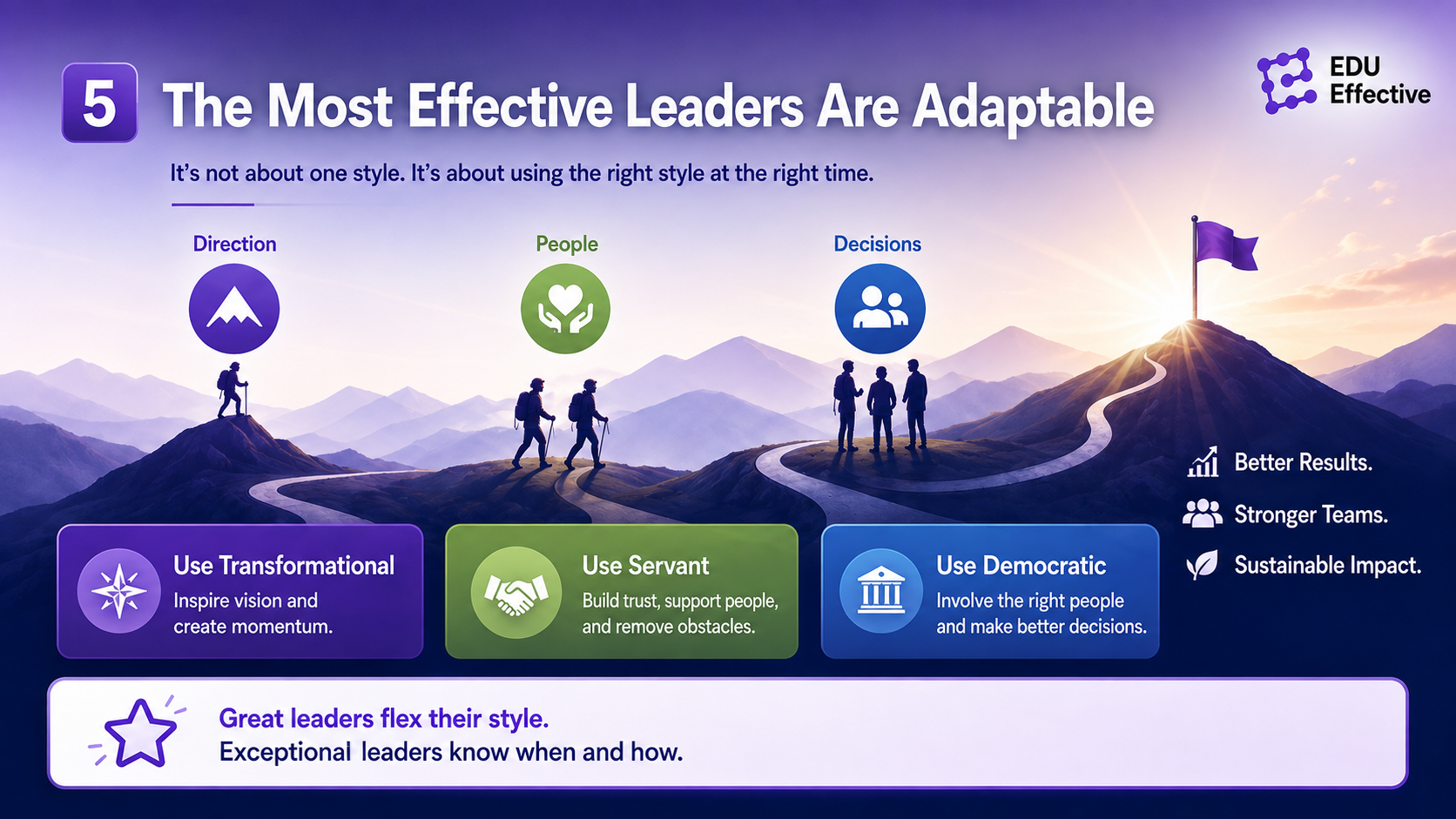
The most practically important leadership concept in 2026 is not any single style but the capacity to shift between styles fluidly based on what the situation requires. Research from McKinsey Health Institute found that employees whose leaders demonstrate high adaptability are three times more likely to report high engagement and four times more likely to report innovative behaviours.
Adaptive leadership means having a clear answer to two questions before any significant interaction with a team member or in a team setting: what does this person or situation actually need from me right now? And which of my available leadership behaviours best serves that need?
The answers vary. A team member new to a complex task needs coaching and clear direction, not democratic consultation. An experienced professional facing an ambiguous strategic problem benefits from collaborative exploration, not autocratic instruction. A team navigating significant organisational uncertainty needs servant-style stability and active obstacle removal, not a transformational vision speech. Getting this right requires both self-awareness about which styles come naturally and which require deliberate effort, and situational awareness about reading what a given moment actually demands.
DDI's 2026 research is instructive here: leaders who are most effective at navigating the current environment combine AI fluency — the ability to work with AI tools intelligently and critically — with the distinctly human capabilities of empathy, communication, and situational judgement. The "parallel intelligence" model, where human judgment and AI-generated insight combine, requires leaders who can read context that an AI system cannot assess: the emotional state of a team under pressure, the political dynamics behind a stakeholder concern, the difference between what someone says they need and what they actually need.
How to identify your current default style — and whether it is serving you
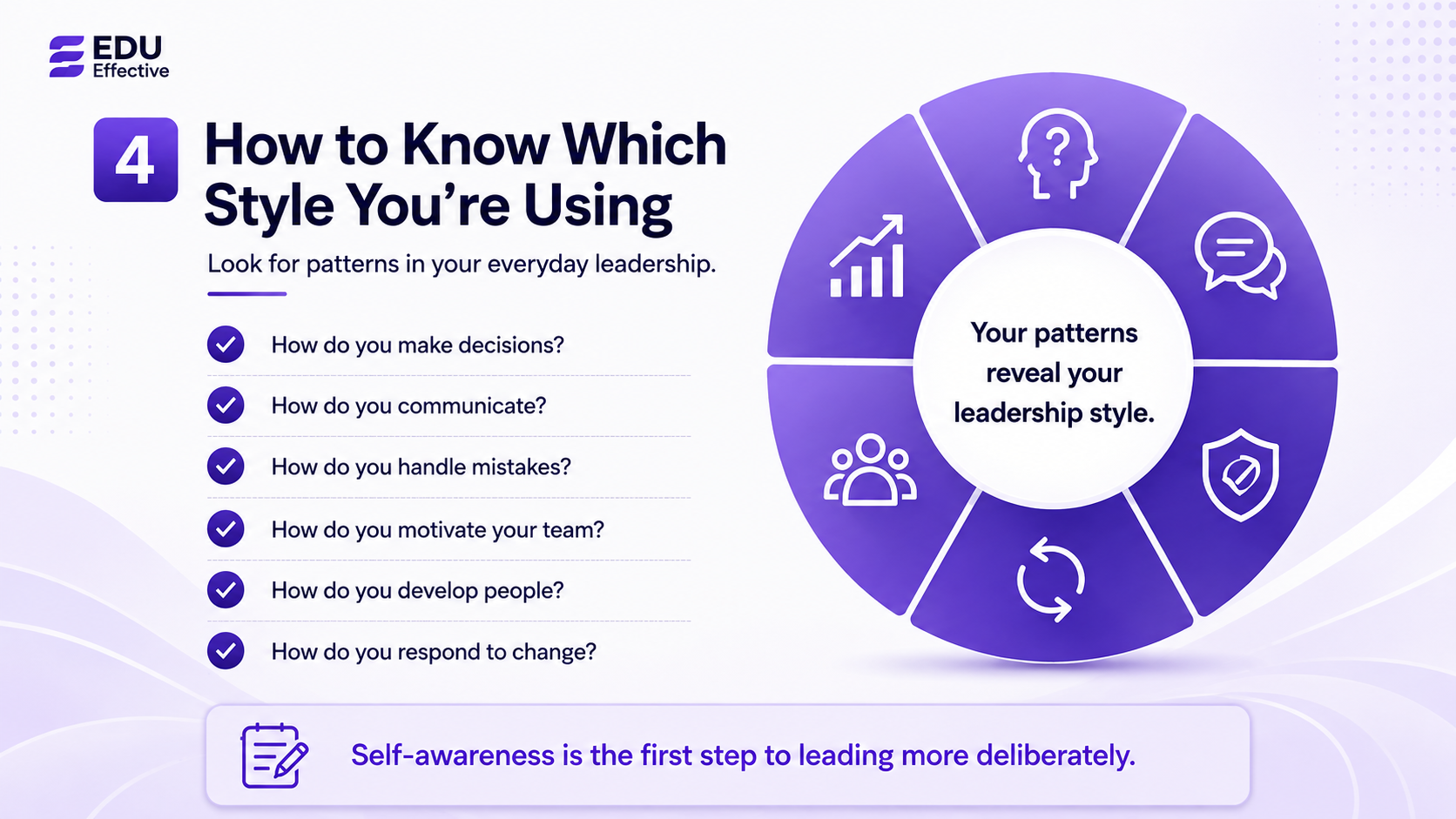
Most leaders have a dominant default style — the approach they revert to under pressure or when they have not thought deliberately about what a situation requires. Identifying that default honestly is the starting point for developing a broader repertoire.
Three diagnostic questions worth sitting with: When a team member underperforms, what is your first instinct — to direct, to coach, to consult, to require? When you face a significant decision under time pressure, who do you include in the process and why? When you are at your most stressed, how does your behaviour toward your team change?
The pattern in those answers reveals your default. It is not necessarily wrong — every default style has contexts where it is the most effective option. The goal is not to eliminate your default but to be able to move off it deliberately when another approach would serve better. Leaders who are genuinely adaptive have a larger behavioural range and clearer situational awareness than those who have simply found a style they are comfortable with and applied it consistently.
Ready to develop your leadership capabilities professionally?
If this article has confirmed that leadership style is a learnable, developable skill — not a fixed personality trait — the Effective MBA: Executive Management & Leadership and the Effective MBA: Coaching, Leadership & Mentoring at EDU Effective are both built around this premise.
Both programmes develop leadership theory and practice in depth — from the foundational frameworks to emotional intelligence, coaching techniques, situational leadership, and leading hybrid and remote teams. Content draws on insights from practitioners and thinkers at Google, Microsoft, McKinsey, Goldman Sachs, Netflix, and many more, alongside faculty from Harvard Business School, Yale, Stanford, Princeton, and Cambridge — drawn from a library of more than 24,000 videos, curated specifically for working professionals.
At EDU Effective, we build programs for professionals who want to work smarter — not just harder. Explore our programs →
EDU Effective Business School = professional development for your long-term success.
All best-selling Effective MBA programs are built for working adults: 15 minutes a day, 10 months or less, ASIC accredited, from €990.
These are professional programs, not academic ones — built for working adults to apply what they learn directly in their own business, not to collect a scholarly credential.
Join more than 9,000 students in over 120 countries around the world to further your personal development and career success.
Read the feedback and experiences of our students and the stories of our graduates here.
Apply now — from €990 · Talk to a Study Advisor
Study with NO risk: 14-day money-back guarantee, no questions asked.
Sources
- Gallup — State of the Global Workplace 2026 Report https://www.gallup.com/workplace/349484/state-of-the-global-workplace.aspx
- Gallup — Manager Impact on Employee Engagement https://www.gallup.com/workplace/236927/employee-engagement-drives-growth.aspx
- DDI — Global Leadership Forecast 2025: Leadership Trends 2026 https://www.ddi.com/blog/leadership-trends-2026
- McKinsey & Company — Organizational Culture and Performance: 4 Keys to Why It Matters https://www.mckinsey.com/capabilities/people-and-organizational-performance/our-insights/the-organization-blog/culture-4-keys-to-why-it-matters
- McKinsey Health Institute — Employee Resilience, Adaptability and Engagement Research https://www.mckinsey.com/mhi/our-insights
- ADP — Leadership Styles That Inspire in Today's Workforce (2026) https://www.adp.com/spark/articles/2026/07/the-leadership-styles-that-inspire-todays-workforce.aspx
- Forbes — Leadership Trends That Could Shape 2026 https://www.forbes.com/sites/sallypercy/2025/12/08/5-leadership-trends-that-could-shape-2026/
- Unleash / Gallup — State of the Global Workplace 2026: Three Essential Actions for HR Leaders https://www.unleash.ai/strategy-and-leadership/analysis/gallups-state-of-the-global-workplace-2026-report-three-key-decisions-for-hr-leaders