

Every B2B marketing team eventually faces the same budget conversation: LinkedIn or Google? Both take significant money to run well. Both promise pipeline. And for most companies, the honest answer is that they’re using both without a clear framework for how much to put where — or why.
This article cuts through the platform advocacy and looks at what the data actually shows about how each channel performs in B2B, where each one creates value, and how to decide what ratio makes sense for your specific situation.
The Core Difference: Intent vs. Identity
Before the numbers, the structural distinction matters.
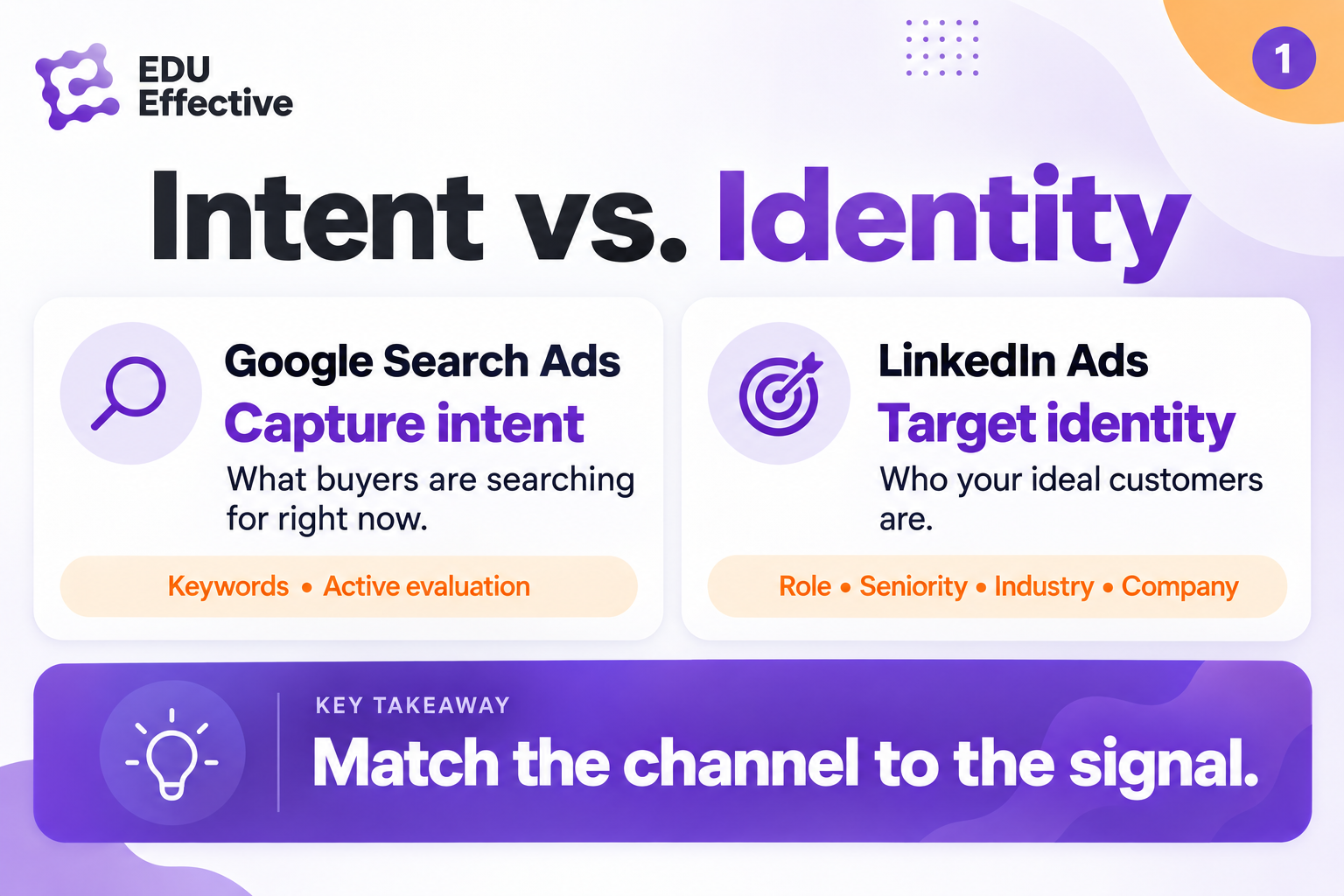
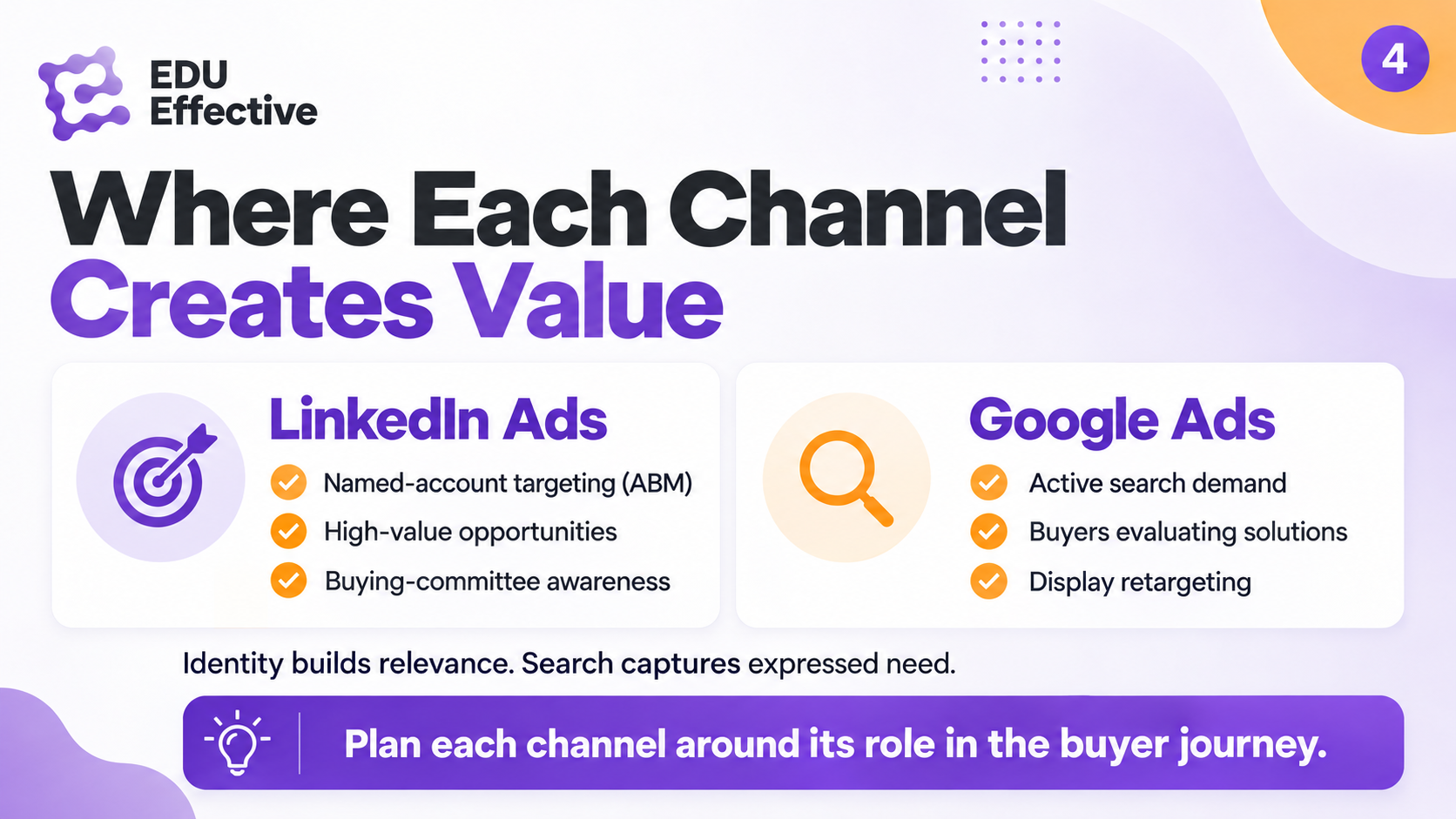
Google Search Ads capture intent. Someone types “enterprise HR software comparison” or “B2B data enrichment tool” into a search bar. They’re actively looking for something. You intercept that search at the moment of expressed need. The signal is behavioral: what the person is doing right now.
LinkedIn Ads target identity. You reach people based on who they are: job title, seniority level, company size, industry, function, even specific company names. The targeting is professional and demographic. The person may not be searching for anything right now — but they match your ideal customer profile precisely.
This distinction drives almost everything else about how the platforms perform. It explains why LinkedIn works better at certain stages of the buying journey and why Google is better at others. Neither platform is categorically superior for B2B — they operate on fundamentally different mechanisms.
What the Performance Data Shows
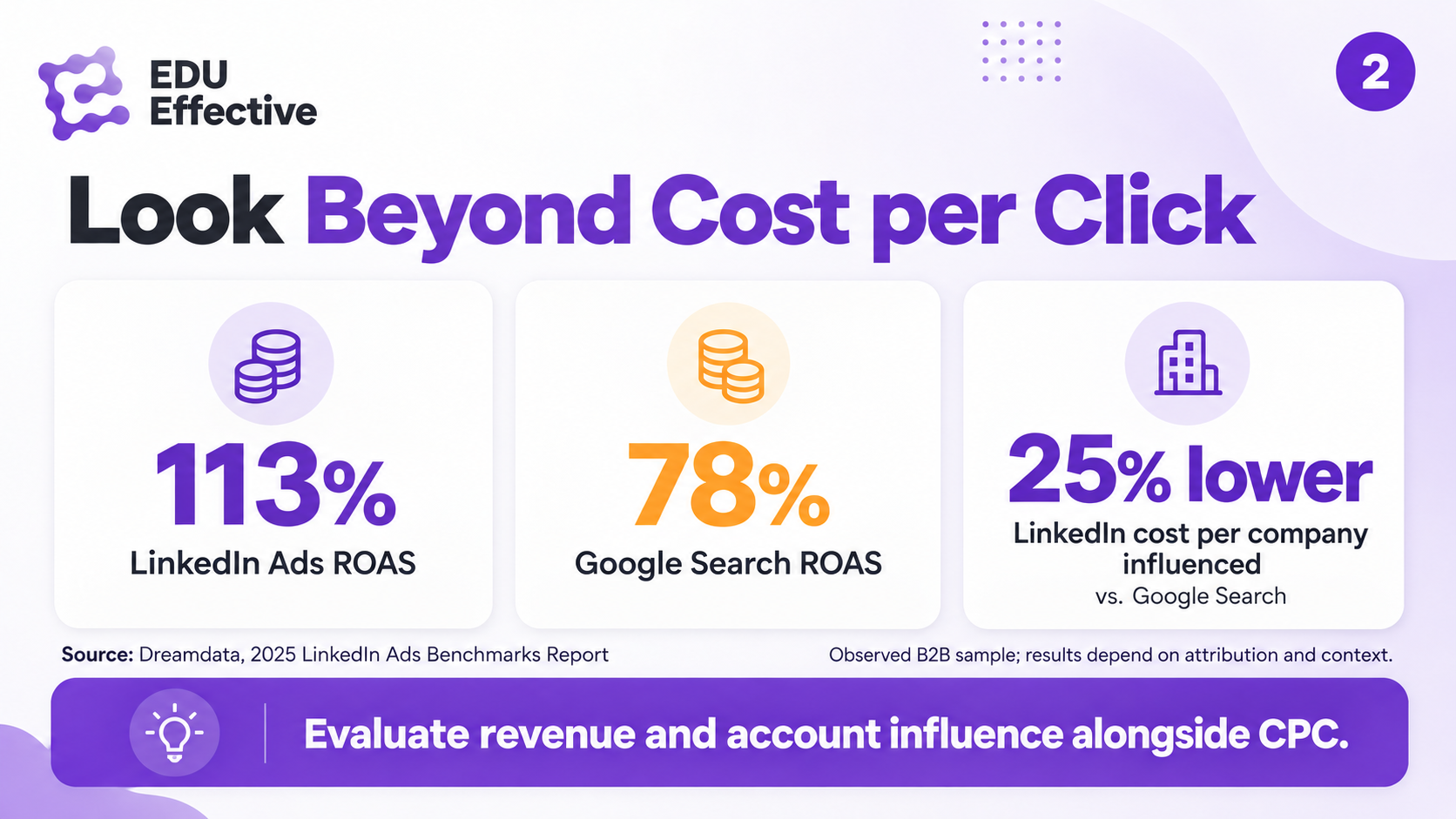
Dreamdata’s LinkedIn Ads Benchmarks Report — covering real B2B revenue data from companies using multi-touch attribution — found LinkedIn Ads delivering 113% ROAS versus 78% for Google Search and 29% for Meta. The same analysis found that despite LinkedIn’s higher cost-per-click, its cost per company influenced was lower than Google Search by 25% and lower than Meta by 70%.
For pipeline influence, LinkedIn is substantial even when it doesn’t get credit in last-touch attribution models: 29% of MQLs, 36% of SQLs, and 35% of new business deals had at least one LinkedIn Ads touch — more than either Google or Meta.
Factors.ai analyzed data from over 100 B2B marketing teams from Q3 2024 to Q3 2025 and found LinkedIn’s median ROAS at 1.8x versus Google’s 1.25x. Their analysis found LinkedIn-sourced deals averaging 28.6% higher contract value than Google-sourced deals. In a survey of 125+ marketing leaders, 71.9% said LinkedIn Ads leads align more closely with their ICP, and 52.3% said LinkedIn leads are more likely to be senior decision-makers.
One nuance worth naming: Factors.ai is a LinkedIn Marketing Partner that builds LinkedIn-focused analytics tools. Their data directionally aligns with Dreamdata’s independent analysis, but the framing is favorable to LinkedIn. The numbers are worth taking seriously; the editorial lens is worth accounting for.
The combined picture from both sources is consistent: for B2B, LinkedIn generates higher-quality pipeline at a lower cost-per-account, even though its surface-level cost metrics (CPM, CPC) look higher than Google’s.
The B2B Buyer Journey Context
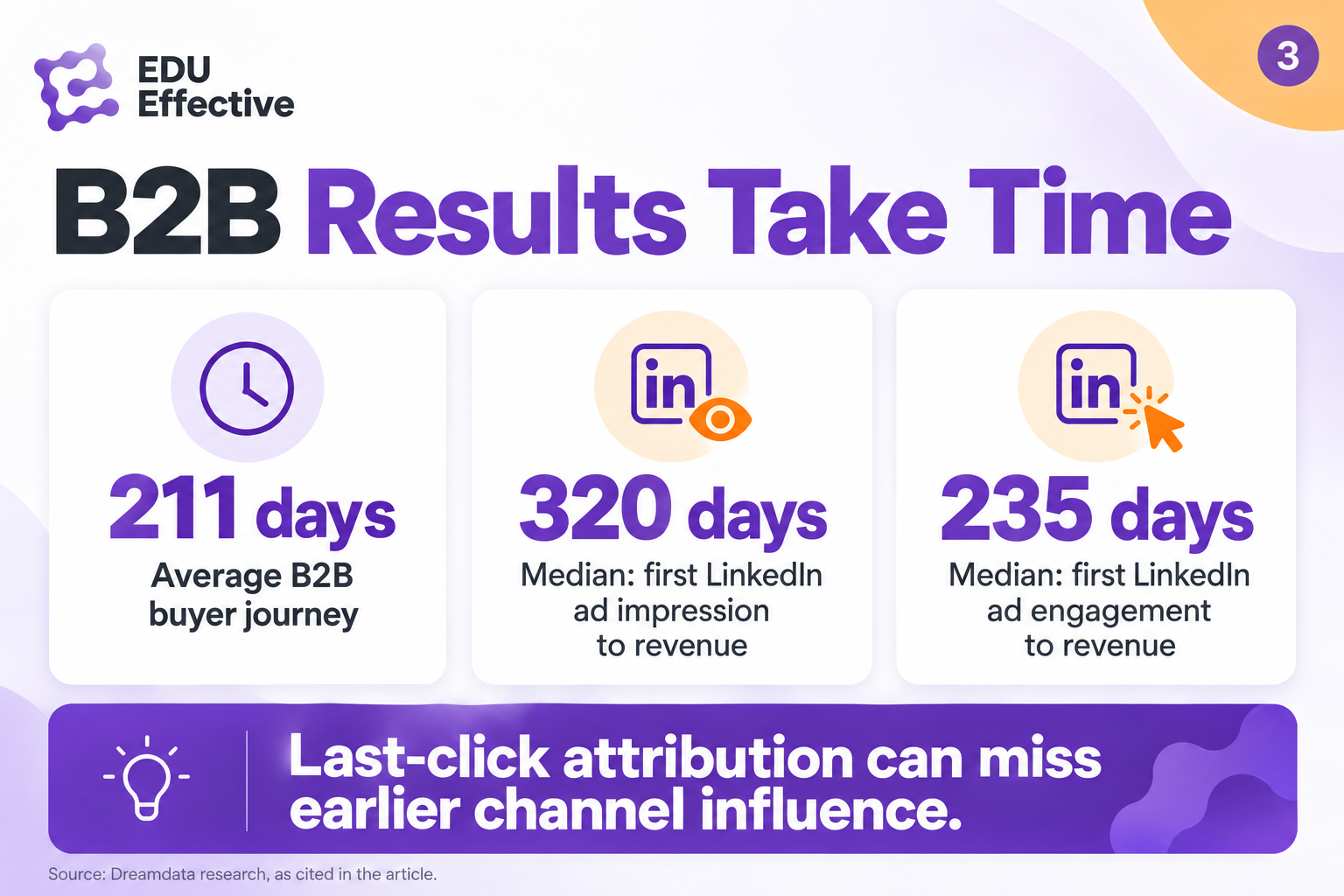
One finding from Dreamdata’s research fundamentally changes how these numbers should be read: the average B2B buyer journey is 211 days. Larger enterprise accounts take 49% longer. The longest bottleneck is MQL to SQL — over three months.
From LinkedIn’s first ad impression to revenue, the median is 320 days. From first ad engagement (like, click, comment), it’s 235 days.
This means attribution models that credit only the last click before conversion systematically undercount LinkedIn’s contribution. Google Search captures the end of the journey — the person searches when they’re close to a decision. LinkedIn influences the beginning and middle — awareness, education, relationship building with the buying committee. In a last-touch model, Google gets the credit; in a multi-touch model, LinkedIn’s contribution becomes visible.
For any B2B team still running last-touch attribution on channels with a 200+ day buyer journey, the budget allocation decisions being made are based on distorted data.
LinkedIn Ads: Where It Wins
Account-based marketing (ABM). LinkedIn’s ability to target by specific company name — combined with job title and seniority filters — makes it the primary tool for reaching the buying committee at named accounts. You can serve different messages to the CFO, the IT director, and the procurement manager at the same target company simultaneously. No other major platform offers this level of account-level precision.
High-ACV opportunities. The higher average contract value of LinkedIn-sourced deals (28.6% higher per Factors.ai) reflects the targeting quality. When you’re selling something that requires sign-off from a VP or C-suite, LinkedIn’s seniority targeting gets you in front of the right people more reliably than keyword-based search.
Building buying-committee relationships. B2B purchases typically involve 6-10 stakeholders. LinkedIn Thought Leader Ads — which amplify individual executive content to targeted audiences — build personal credibility alongside brand credibility. In long sales cycles, familiarity with the seller’s thinking influences decisions that happen months later.
Top-of-funnel in a defined ICP. If you can define your ideal customer by professional attributes — company size, industry, function, seniority — LinkedIn is the most efficient way to reach that population at scale. Google can’t target by professional identity; LinkedIn can’t be matched for it.
Google Ads: Where It Wins
Bottom-funnel intent capture. When a prospect types “B2B CRM for logistics companies” or “best project management software for agencies,” they are actively evaluating. This is the highest-intent moment in the buying journey. Google captures it; LinkedIn doesn’t. Missing this stage means competitors are visible when your target buyers are ready to buy.
Broad geographic or niche targeting. For B2B businesses serving specific regions, industries, or use cases, Google Search surfaces you at the moment of relevant need regardless of whether the searcher has a professional profile that matches your ICP filter. Some segments are easier to reach through intent than through identity.
Volume pipeline at lower CAC. For companies that need consistent lead volume — particularly in shorter sales cycles or lower ACV segments — Google Search often produces more volume at lower cost per acquisition than LinkedIn. The leads may be lower quality on average, but the volume advantage is real.
Retargeting. Google Display Network retargeting — reaching people who’ve already visited your site — is cost-effective and keeps you visible during the long B2B consideration period. LinkedIn retargeting exists but runs at significantly higher CPMs.
The Combined Effect
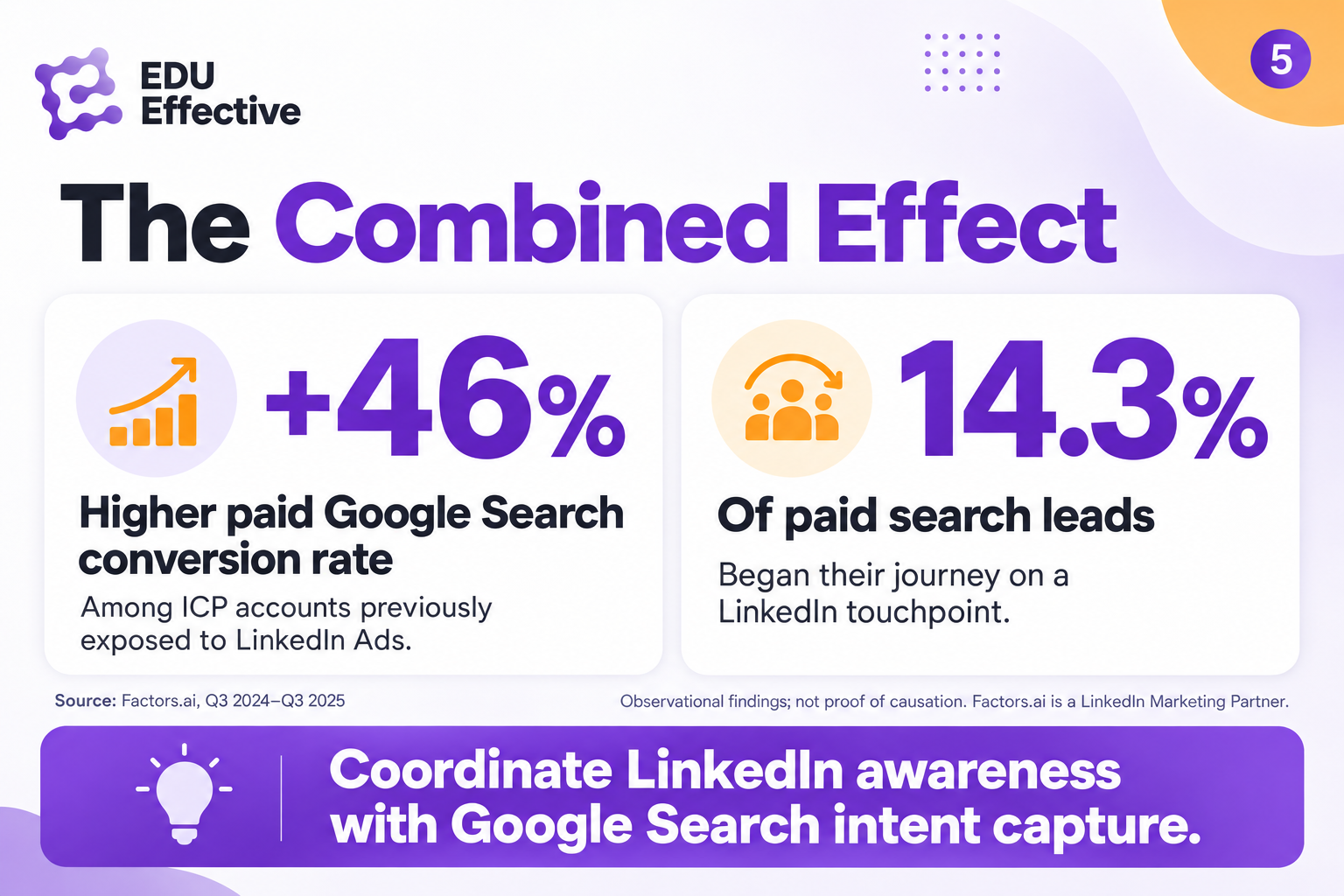
The most important finding in the Factors.ai analysis isn’t about one platform winning — it’s about how the platforms interact. ICP accounts exposed to LinkedIn Ads had a 46% higher conversion rate on paid Google Search. And 14.3% of paid search leads had begun their journey on a LinkedIn touchpoint.
This is the multi-touch reality of B2B buying: LinkedIn builds awareness and credibility with the right people; Google captures them when they come looking. Running only one channel means either missing the intent capture or failing to build the relationship that makes the intent-capture work.
The practical implication: LinkedIn and Google should be planned as a system, not as competing budget line items. The question isn’t which platform to choose — it’s how to sequence them across the buyer journey and how to allocate budget to maximize the combined effect.
How to Think About Budget Allocation
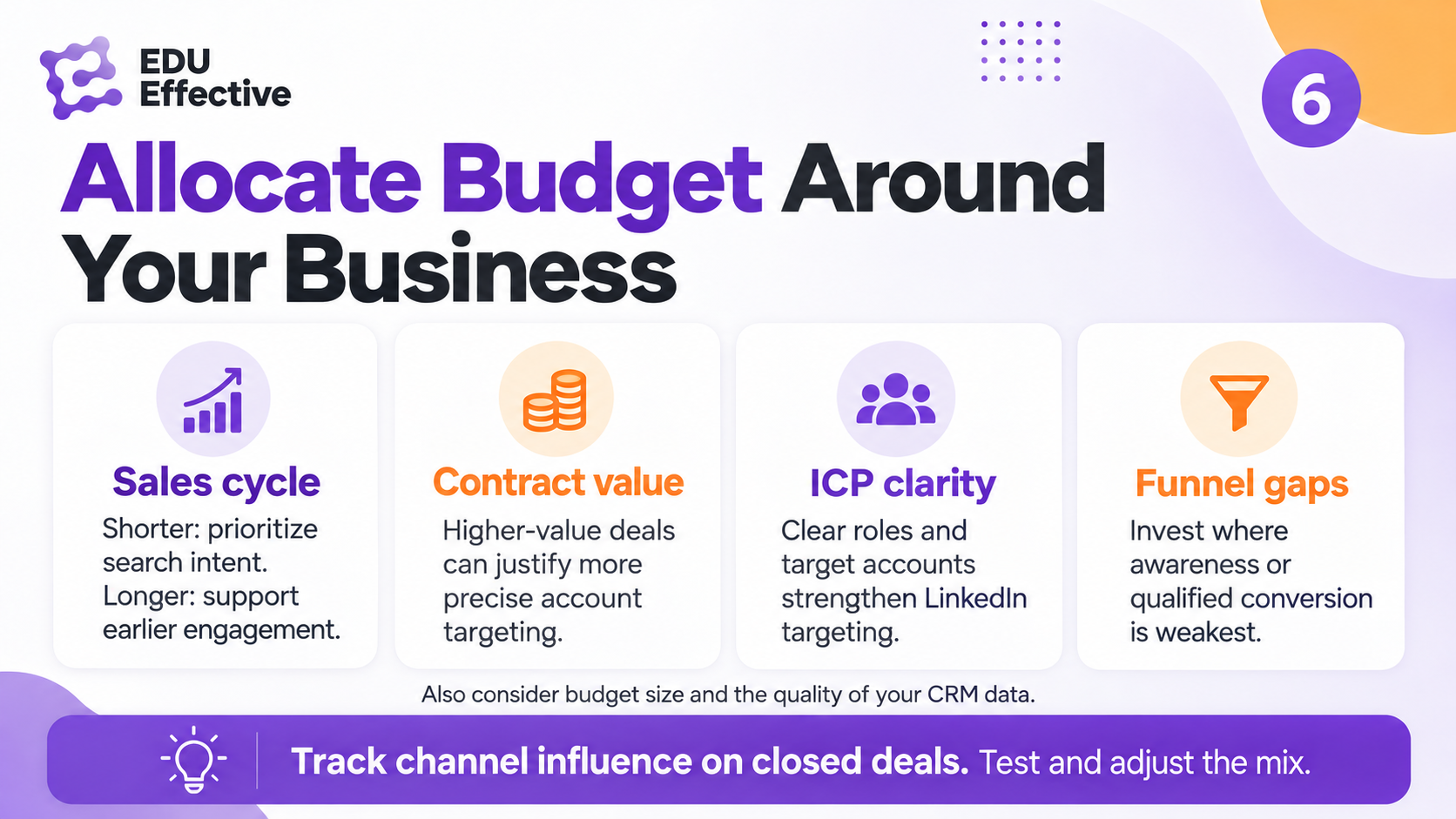
No formula works for every business. The variables that should drive the ratio:
Sales cycle length. If your average deal closes in under 60 days, Google Search captures most of that journey. If it’s 6-12 months, LinkedIn’s top-of-funnel influence is more decisive. Dreamdata’s 211-day average is a reasonable B2B benchmark, but varies significantly by segment and ACV.
Average contract value. LinkedIn’s higher CPM is more justifiable when the deal you’re closing is worth €50,000 than when it’s worth €5,000. The break-even math changes the recommendation materially.
ICP definition clarity. If you can define your ideal customer with precision by professional attributes, LinkedIn targeting efficiency is high. If your ICP is broad or defined primarily by behavioral signals (what people search for), Google may be more efficient.
Stage of the funnel you’re weakest in. If your top-of-funnel awareness is strong but prospects aren’t converting when they search, invest more in Google. If you’re generating search demand but your pipeline is thin and low-quality, invest more in LinkedIn to build relationships with the right buying committees.
Budget size. LinkedIn requires meaningful budget to work well — most practitioners suggest a minimum of €3,000-5,000 per month to generate statistically useful data. Below that threshold, Google Search at lower CPCs often produces better learning and pipeline at lower spend.
Platform-Specific Execution Factors
LinkedIn Ads that underperform almost always fail on one of three things: audience definition too broad (targeting by industry alone rather than industry plus seniority plus function), creative that looks like display advertising (LinkedIn users scroll past anything that feels like a banner), or offer mismatch (sending cold audiences directly to a demo request when they’ve had zero prior exposure to the brand).
LinkedIn Thought Leader Ads — running content from an individual executive’s profile rather than the company page — consistently outperform standard sponsored content in engagement. The format works because LinkedIn is a professional network; people engage with people more than with brands.
Google Search Ads in B2B underperform when keyword targeting is too broad (capturing research queries alongside buying queries and paying the same for both), when landing pages don’t match search intent precisely, or when bidding strategy is optimized for clicks rather than qualified pipeline. Smart Bidding with offline conversion data — feeding closed deal information back into Google’s optimization — is increasingly the standard for B2B teams generating real signal.
The Attribution Problem
Any comparison between the two platforms is only as good as the attribution model behind it. Last-touch attribution — still the default in many marketing teams — systematically favors Google and undersells LinkedIn. First-touch attribution does the reverse.
Multi-touch attribution — distributing credit across all touchpoints in the buyer journey weighted by influence — produces the most accurate picture of what each channel is actually contributing. It’s more complex to implement, but the Dreamdata data makes a strong case that without it, B2B teams are making budget decisions based on incomplete information.
For teams not yet running multi-touch attribution, a practical approximation: track which channels influenced deals that closed, not just which channel generated the original lead. CRM pipeline data often reveals LinkedIn’s influence even when form-fill attribution gives the credit to Google.
Key Takeaways
LinkedIn Ads and Google Ads operate on different mechanisms — professional identity targeting versus real-time intent capture — and they produce different value at different stages of the B2B buyer journey. Dreamdata’s benchmarks show LinkedIn delivering 113% ROAS versus 78% for Google Search, with lower cost-per-company-influenced despite higher surface-level CPCs. LinkedIn-sourced deals carry 28.6% higher average contract value per Factors.ai analysis. But Google remains essential for bottom-funnel intent capture — where prospects are actively searching and close to a decision. The 46% higher Google conversion rate among accounts previously exposed to LinkedIn confirms the two platforms compound each other. The right question isn’t which platform to choose. It’s how to sequence them across a 200+ day buyer journey — and whether your attribution model is giving you accurate data to make that call.
About EDU Effective Business School
The Effective MBA: Online Marketing connects marketing decisions to revenue rather than vanity metrics. Runs on 15 minutes a day, completes in 10 months or less and is ASIC accredited.
Sources
- Dreamdata — LinkedIn Ads Benchmarks Report https://dreamdata.io/blog/dreamdata-2025-linkedin-ads-benchmarks-report-highlights
- Factors.ai — LinkedIn Ads vs. Google Ads ROI Comparison https://factors.ai/blog/linkedin-ads-vs-google-ads-roi-comparison