
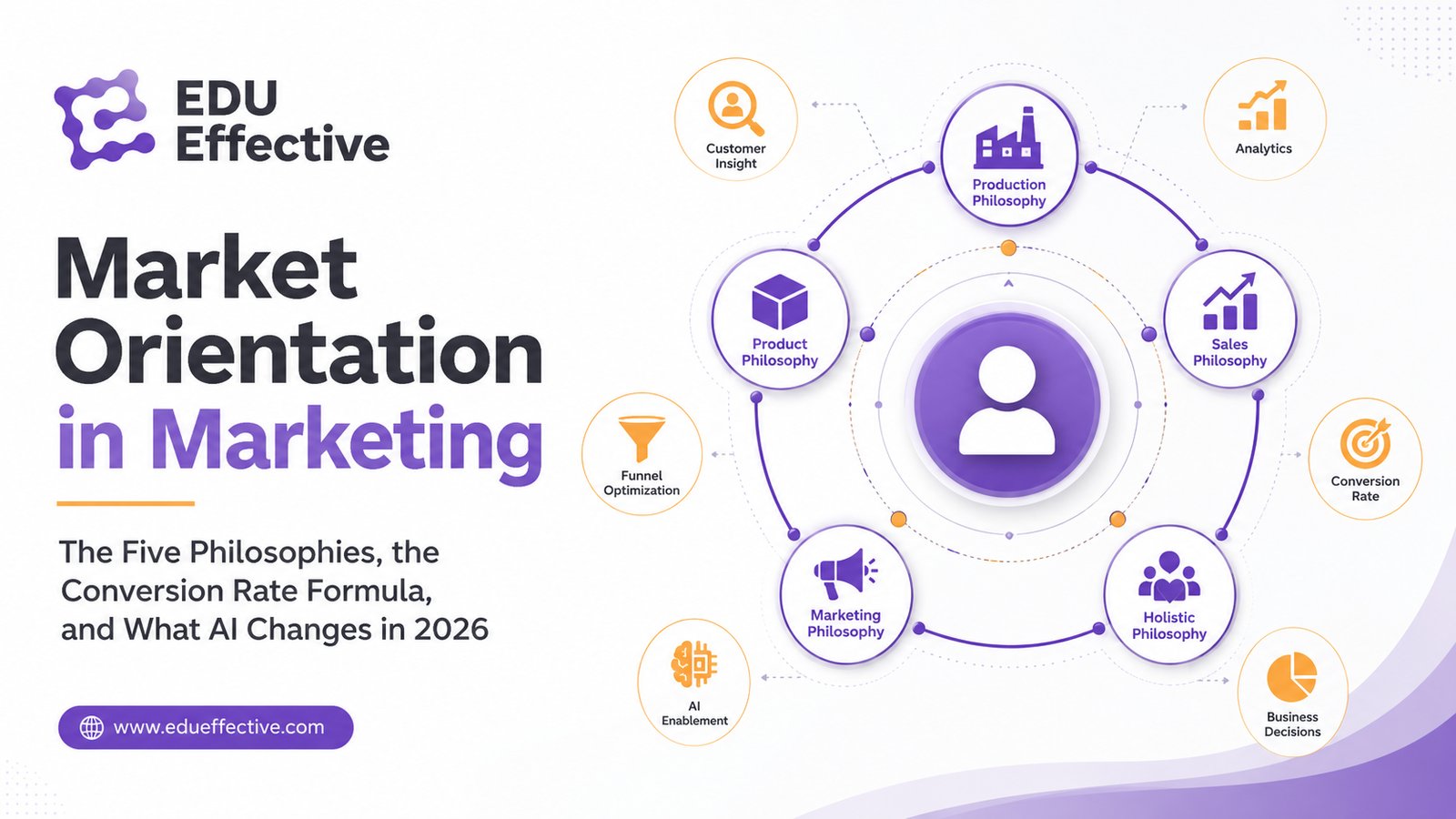

Most businesses describe themselves as customer-focused. Far fewer actually build their strategy around that claim. The gap between saying “the customer comes first” and structuring every operational and marketing decision around that principle is where the concept of market orientation lives — and where most companies quietly fall short.
Understanding marketing orientation means understanding the full spectrum of philosophies that shape how companies decide what to make, how to sell it, and what to measure. In 2026, with AI reshaping both what is possible and what customers expect, that spectrum matters more than it has in decades.
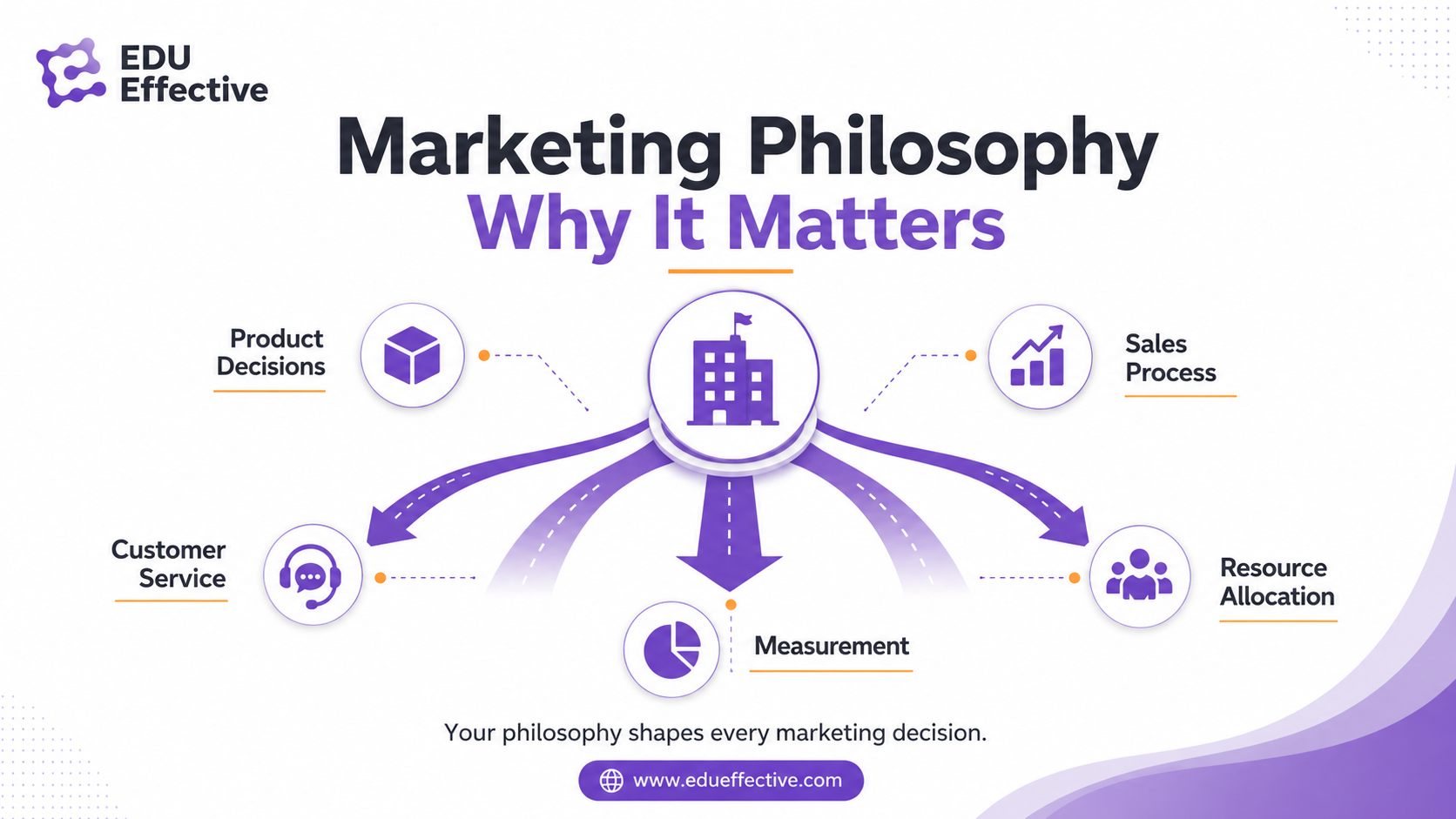
Marketing philosophy: what it is and why it matters
A marketing philosophy is the foundational belief that guides how a company approaches its market. It answers a prior question before any campaign, product decision, or pricing strategy: what are we actually trying to do here?
The answer to that question determines almost everything else. Companies operating under different marketing philosophies make systematically different decisions — about product development, sales process, customer service, measurement, and resource allocation. Two competitors in the same market with different underlying philosophies will build genuinely different businesses over time, even if their products are initially similar.
There are five marketing philosophies that have defined how companies operate, and understanding all five clarifies why market orientation is a distinct strategic choice rather than simply a synonym for “good marketing.”
The five marketing philosophies
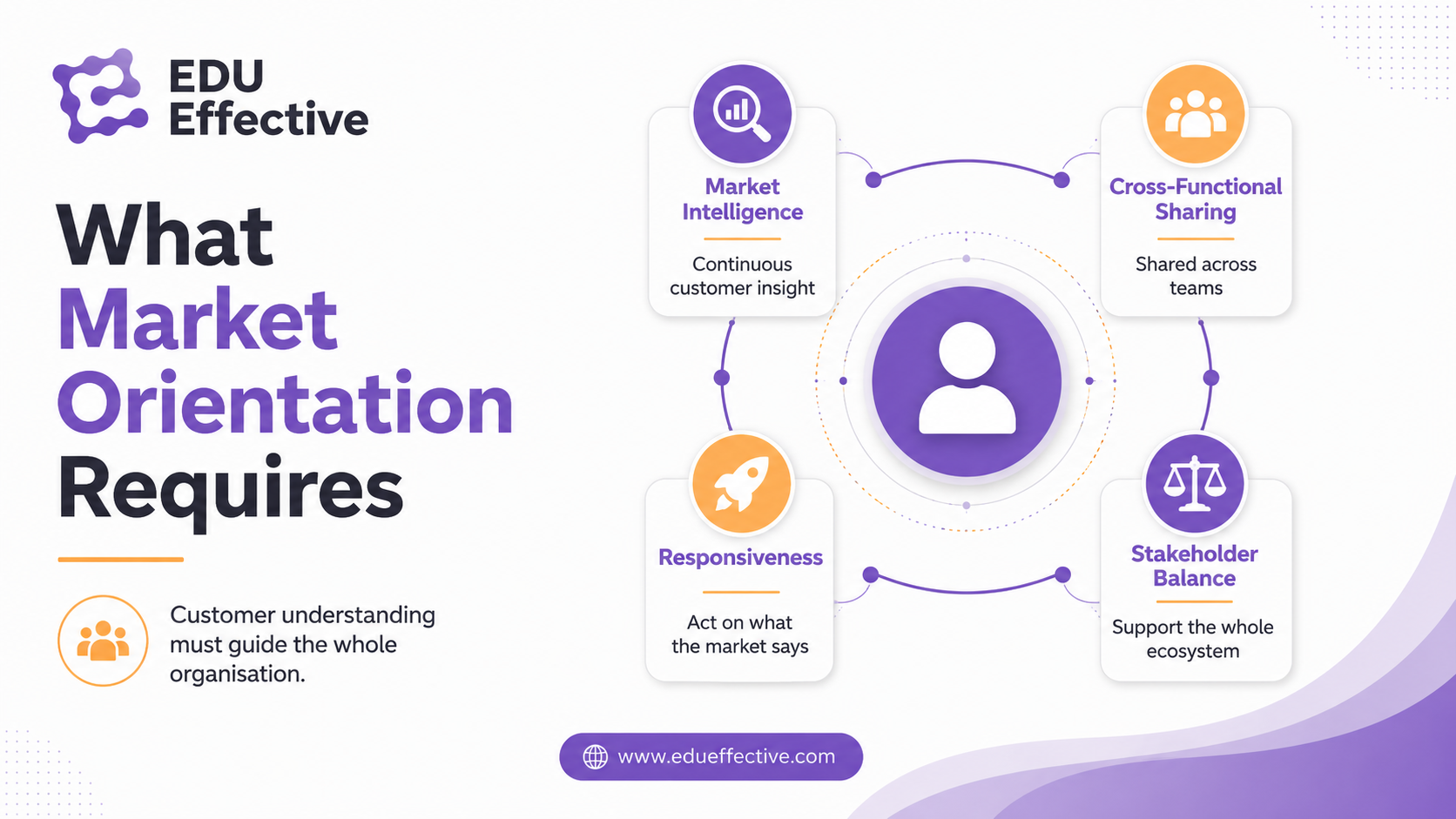
Production orientation is the oldest approach and remains prevalent in industries where cost and availability are the primary purchase drivers. The core assumption is that customers prefer products that are accessible and affordable. Companies operating under this philosophy focus on manufacturing efficiency, scale, and cost reduction. Technology hardware and commodity goods often follow this logic, where the difference between competitors is price and availability rather than differentiation.
Product orientation inverts the priorities. Rather than minimising cost, product-oriented companies maximise quality, features, and innovation. The assumption is that superior products create their own demand. This philosophy produces exceptional goods but carries a well-documented risk — companies can become so focused on engineering excellence that they lose sight of whether the market actually wants what they’re building. Apple’s early personal computers were technically sophisticated products that initially found only a narrow audience; it took a significant shift toward market orientation to produce the mass-market products that defined the company’s later growth.
Sales orientation operates on a more sceptical premise: customers don’t spontaneously buy, even good products. They need to be prompted, persuaded, and given a reason to act now. Sales-oriented organisations invest heavily in outbound activity, promotions, and conversion infrastructure. This philosophy can drive short-term revenue effectively but tends to underinvest in understanding what customers actually need over the long term. The relationship with the customer is transactional rather than sustained.
Marketing orientation — the philosophy this article is primarily about — starts from the customer and works backwards. Rather than building something and then finding customers for it, a market-oriented business begins by identifying unmet customer needs and builds its offer around satisfying them. This requires systematic market research, customer feedback loops, competitor awareness, and the organisational willingness to change products, messaging, and channels based on what the market actually signals.
Holistic marketing orientation extends the logic further. It treats the entire organisation — not just the marketing department — as responsible for the customer experience. Every function, from operations to HR to finance, is evaluated partly on its contribution to customer value. Holistic marketing also incorporates social responsibility and the broader societal implications of business decisions. It’s not a separate philosophy so much as a maturation of the marketing orientation concept, applied at full organisational scale.
What market orientation actually requires
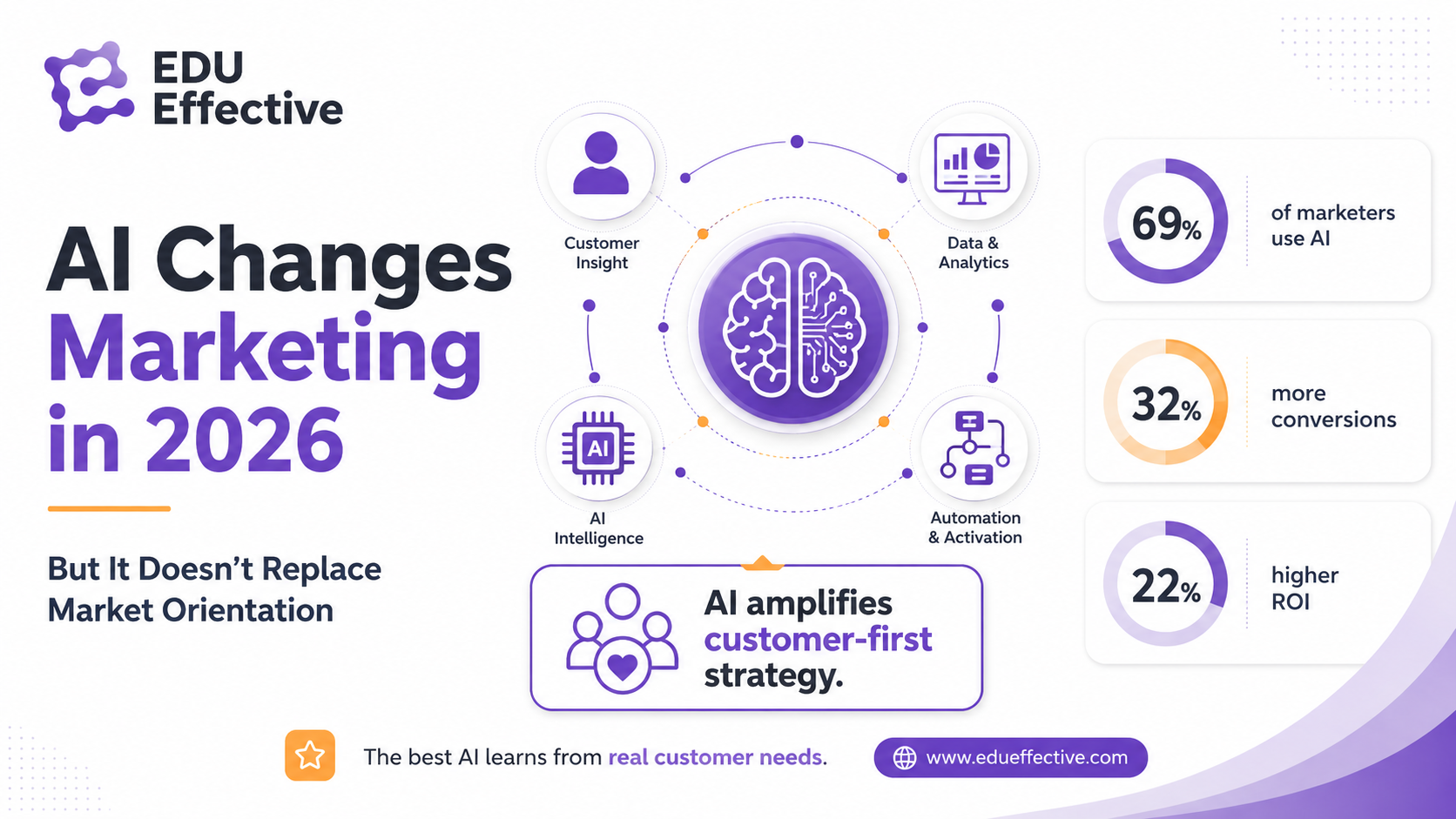
Market orientation is not a set of tactics. It’s an organisational posture — a decision to make customer understanding the primary input into every significant business decision.
In practice, this means four things operating simultaneously.
Genuine market intelligence: not occasional surveys or annual reviews, but continuous monitoring of customer behaviour, competitor moves, distributor signals, and macro trends. In 2026, this intelligence is increasingly generated by AI-powered tools that analyse behavioural data at a scale no human team could process manually. Organisations with 71% of their teams regularly using generative AI — a figure that now represents typical enterprise adoption — have access to customer insight that would have required months of research a decade ago.
Cross-functional dissemination of that intelligence: market insight that lives only in the marketing team is not market orientation. The findings need to reach product development, customer service, sales, and leadership — and those teams need to act on them.
Responsiveness: the willingness to change what you’re offering based on what the market tells you, even when that means abandoning investments or reversing decisions. Companies that gather customer data and then continue building the product they originally planned were never truly market-oriented.
Stakeholder balance: market orientation does not mean ignoring suppliers, distributors, employees, or competitors. Satisfying the end customer requires a functioning ecosystem around the product. A market-oriented company attends to the whole picture, not just the consumer end.
The seven core functions of marketing
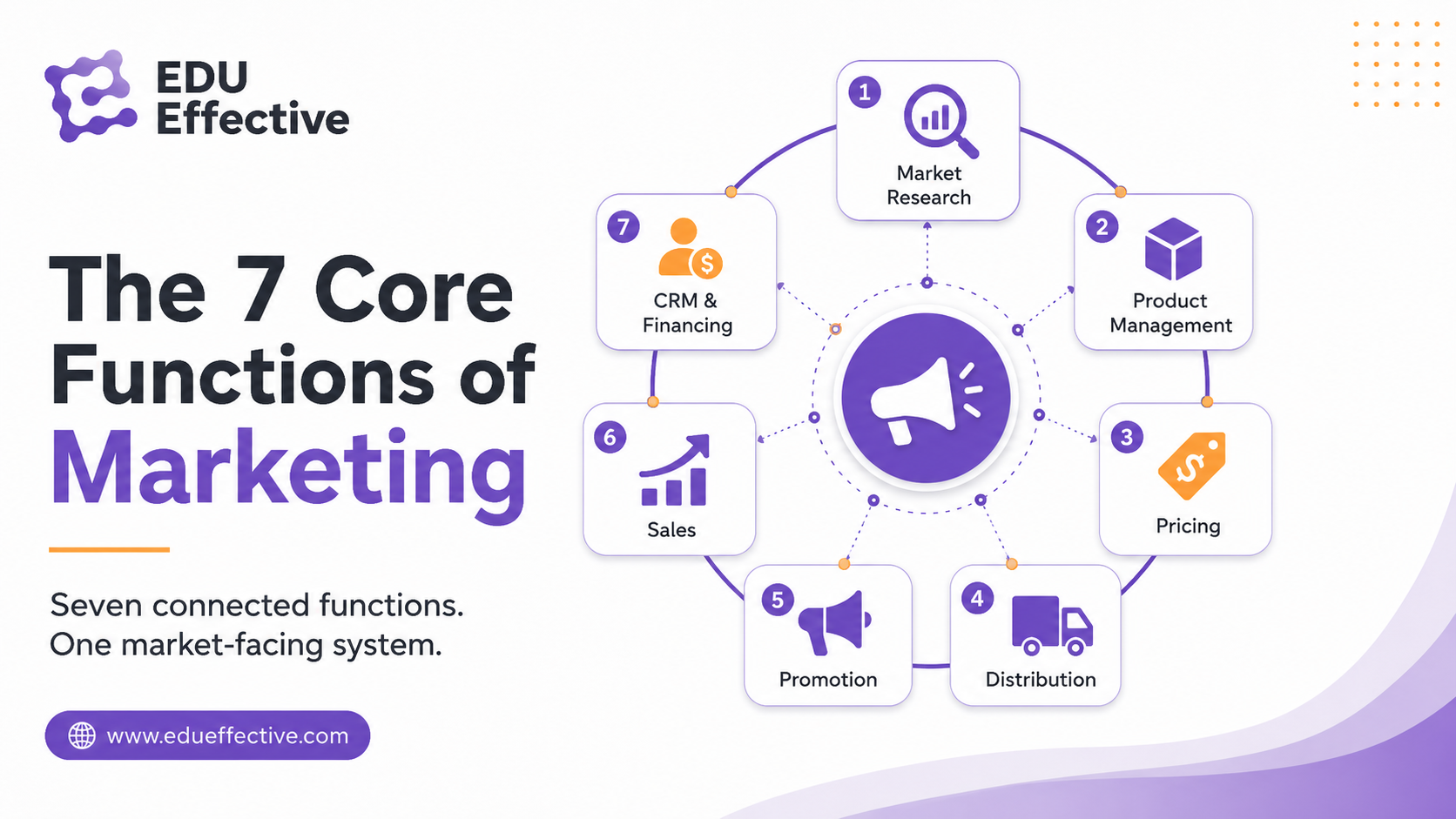
Regardless of which marketing philosophy a company adopts, marketing as a function performs seven core activities that determine how effectively the business connects with its market.
Market research and intelligence gathering identifies who customers are, what they need, and how the competitive landscape is evolving. This is the foundation of market orientation — without it, the philosophy has no inputs to work with.
Product and service management translates market intelligence into decisions about what to offer, how to position it, and how to evolve it over time.
Pricing determines the exchange value of the offer — not just in terms of revenue targets, but in terms of what the price signals to the customer about quality, positioning, and brand.
Distribution and channel management ensures the product reaches the customer through the right channels at the right time. In 2026, this includes decisions about which digital platforms, marketplaces, and direct channels to prioritise.
Promotion and communication covers the full range of activities that create awareness, generate interest, and drive consideration — from content marketing and paid media to social channels and email.
Sales converts interest into transactions, and in a market-oriented business, the sales process is informed by deep understanding of the customer’s decision journey rather than generic persuasion tactics.
Financing and customer relationship management supports the customer through the purchase and sustains the relationship after it — through post-sale service, loyalty programmes, and the ongoing dialogue that generates repeat business.
The conversion rate formula — and what it measures
No marketing philosophy succeeds without measurement, and the conversion rate is one of the most fundamental metrics for evaluating whether marketing activity is generating results.
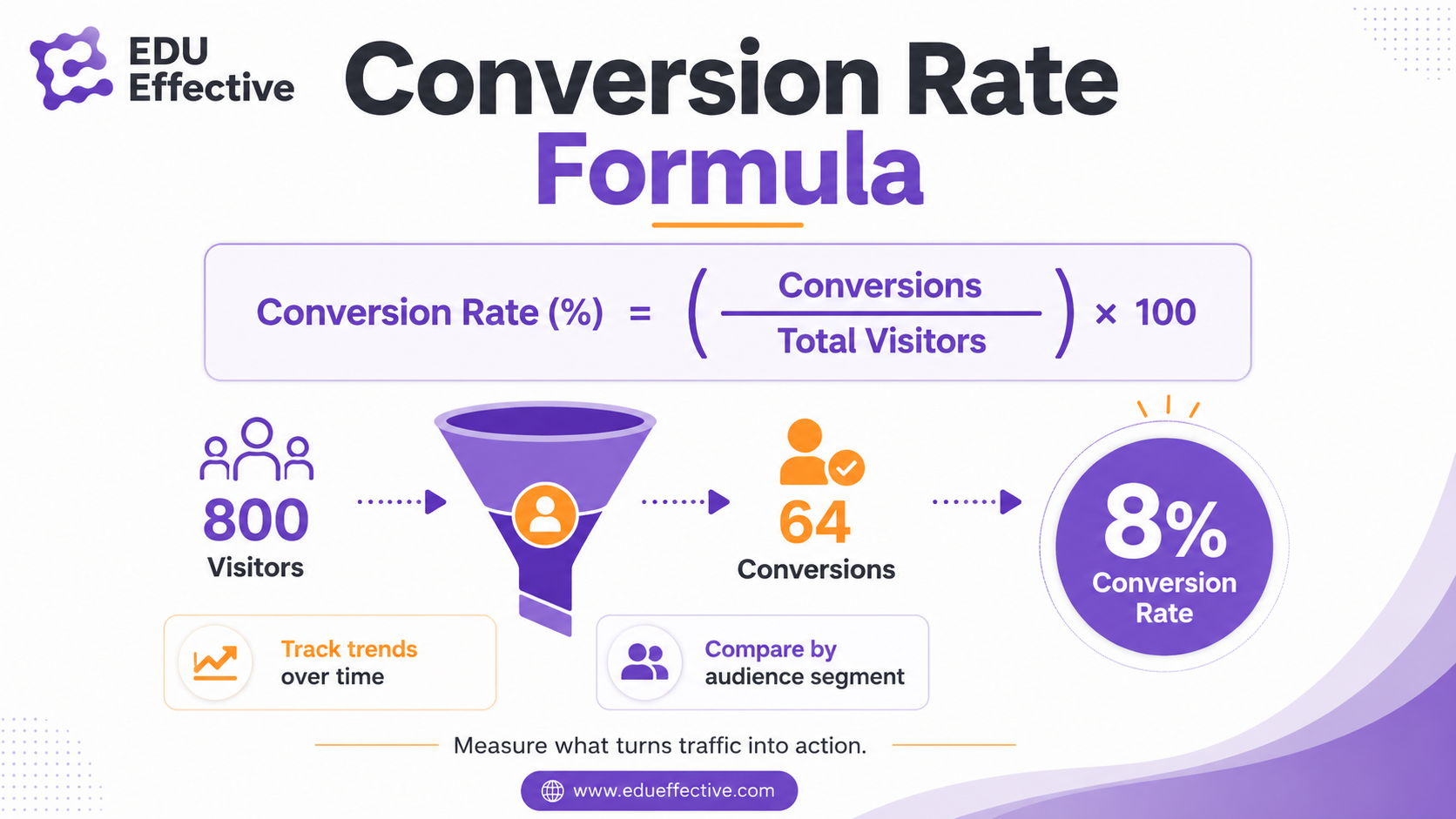
The conversion rate formula is:
Conversion Rate (%) = (Number of Conversions ÷ Total Visitors) × 100
In practice: if 800 visitors arrive at a landing page and 64 complete the desired action (a purchase, a sign-up, a download), the conversion rate is 8%. The formula applies across any defined conversion event — ad click to page visit, page visit to lead, lead to sale, free trial to paid subscription.
What makes conversion rate genuinely useful is not a single number but a trend over time and a comparison across segments. A 3% conversion rate on cold paid traffic is very different from a 3% conversion rate on warm email subscribers — the former suggests strong top-of-funnel performance, the latter suggests a nurturing problem.
In 2026, conversion rate optimisation has been substantially accelerated by AI. AI personalisation — dynamically adjusting content, offers, and calls to action based on individual user behaviour — now delivers a 15–25% conversion rate improvement on average, according to Salesforce 2025 benchmark data. AI-powered bidding in paid media (Google’s Smart Bidding, Meta Advantage+) improves return on ad spend by 20–35% versus manual approaches. These are not marginal improvements. They represent a fundamental shift in what a market-oriented company can achieve when it combines genuine customer intelligence with AI execution capability.
Market orientation in 2026: what AI changes — and what it doesn’t
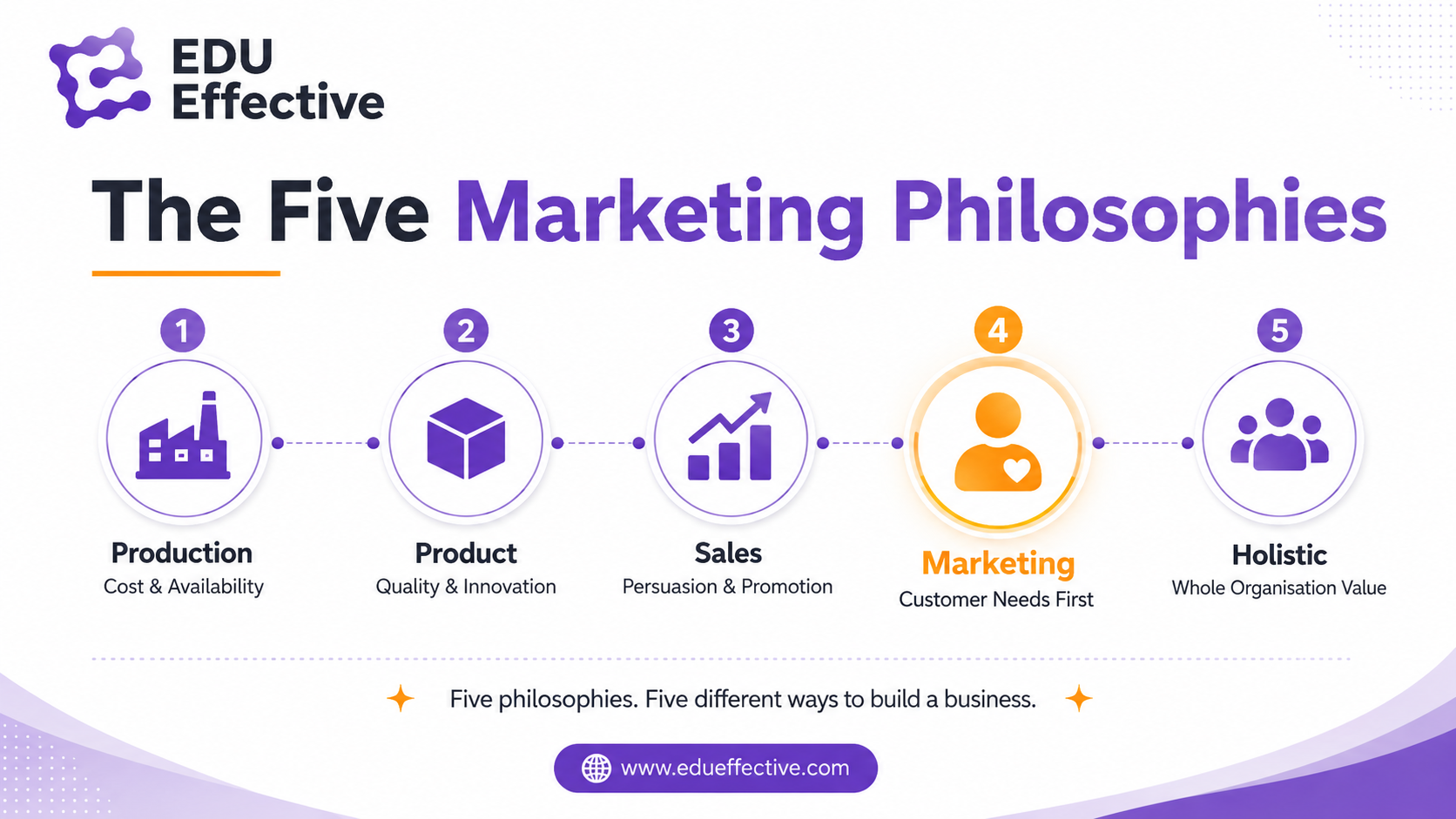
The AI marketing market reached $47.32 billion in 2025, with 69% of marketers reporting active AI integration in their operations. By 2026, AI now powers approximately 15% of all marketing activities. AI-driven campaigns are delivering 32% more conversions and 22% higher ROI than traditional methods, according to McKinsey benchmarks — and 40% of digital ads will be AI-generated by the end of 2026.
These figures are striking but should be read carefully. AI amplifies market orientation — it does not replace it. AI tools are most valuable when they are trained on genuine customer intelligence, optimised toward meaningful conversion goals, and deployed by teams that understand what the customer actually needs. AI applied to a fundamentally sales-oriented or product-oriented business will optimise the wrong thing faster.
The most important question a market-oriented business asks in 2026 is not “which AI tools should we adopt?” It’s “how do we ensure our AI systems are learning from genuine customer needs rather than proxy metrics that don’t translate to real satisfaction?” The answer to that question requires the same organisational discipline that market orientation has always demanded — customer-first thinking at every level of the business.
At EDU Effective, we build programs for professionals who want to work smarter — not just harder. Explore our programs →
EDU Effective Business School = professional development for your long-term success.
All best-selling Effective MBA programs are built for working adults: 15 minutes a day, 10 months or less, ASIC accredited, from €990.
These are professional programs, not academic ones — built for working adults to apply what they learn directly in their own business, not to collect a scholarly credential.
Join more than 9,000 students in over 120 countries who are investing in their professional development and career success.
Read the feedback and experiences of our students and the stories of our graduates here.
Apply now — from €990 · Talk to a Study Advisor
Study with NO risk: 14-day money-back guarantee, no questions asked.
Sources
- Madgicx — AI Marketing Statistics That Will Transform Your Strategy https://madgicx.com/blog/ai-marketing-statistics
- SQ Magazine — AI in Marketing Statistics 2026: ROI, Tools & Trends https://sqmagazine.co.uk/ai-in-marketing-statistics/
- OwlClaw Technologies — AI Marketing Benchmarks 2026: Automation ROI, CVR Lift & Cost Savings https://owlclaw.com/benchmarks/ai-marketing-benchmarks/
- Data-Mania — AI Marketing ROI Benchmarks 2026: Pipeline, CAC, Conversion & Payback Data https://www.data-mania.com/blog/ai-marketing-roi-benchmarks-2026/
- AI Digital — Conversion Marketing 2026: Strategies & Best Practices https://www.aidigital.com/blog/conversion-marketing
- Genesys Growth — AI Overviews: 50 Statistics Every Marketing Leader Should Know in 2026 https://genesysgrowth.com/blog/ai-overviews-trends-for-marketing-leaders
- ClickMinded — AI Marketing Statistics 2026 by Adoption, ROI, Use Case, and Risk https://www.clickminded.com/ai-marketing-statistics/