
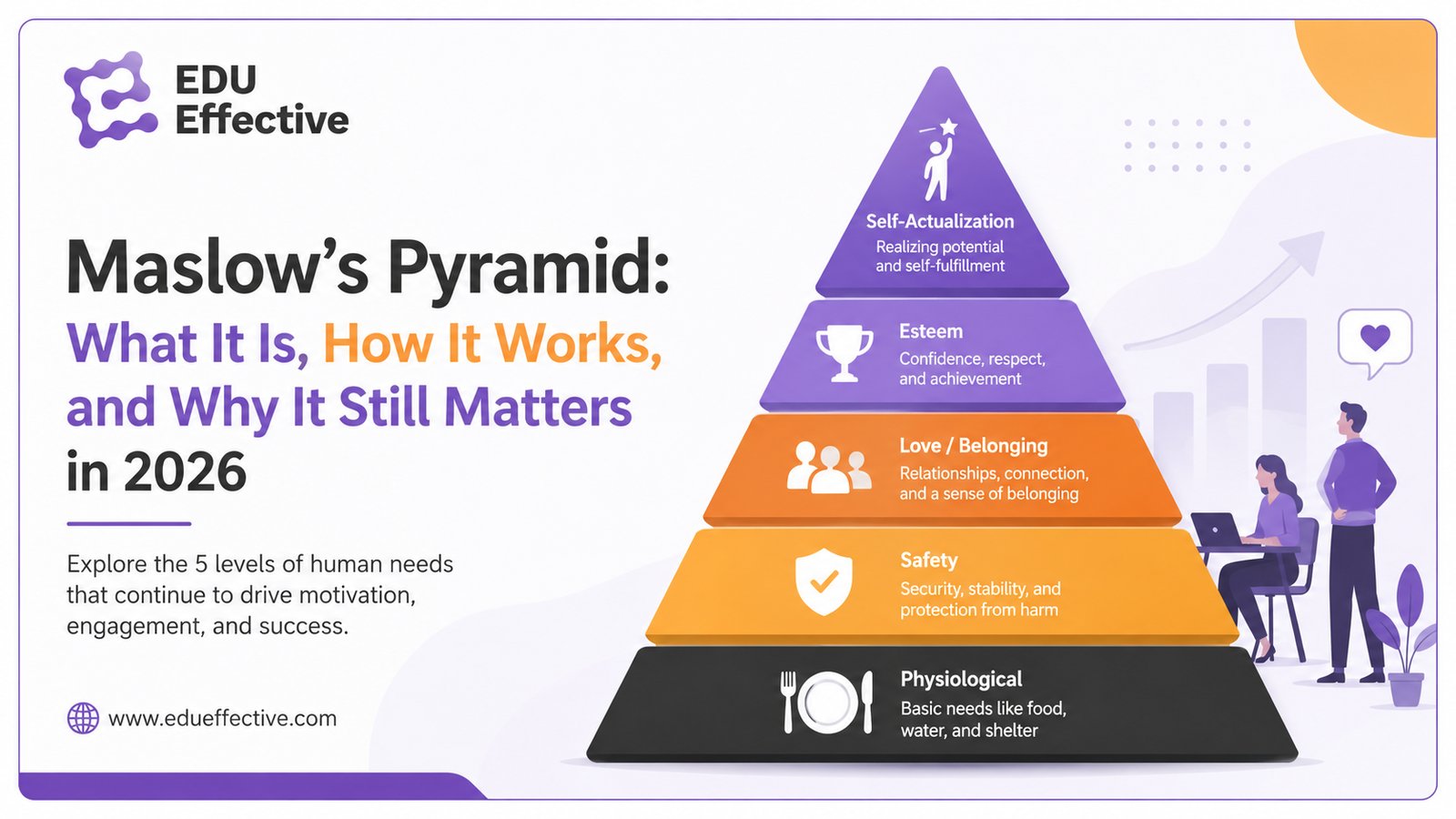

An 80-year-old theory about human needs is shaping how the most progressive organisations in the world design their employee experience in 2026. That might sound unlikely. But Abraham Maslow's hierarchy of needs — the pyramid almost everyone has seen in a psychology class or a management training — keeps proving its relevance precisely because the questions it asks never change: what do people need before they can give their best? And what happens when those needs go unmet?
In a world where remote and hybrid work have dissolved the traditional boundaries between work and home, where AI is restructuring entire job categories, and where burnout has become a defining challenge of organisational life, Maslow's framework offers a clearer map of human motivation than most modern alternatives. This article explains the model, examines it critically, and shows how it applies to real management decisions in 2026.
What Maslow's pyramid actually is
Abraham Maslow was an American psychologist who published his hierarchy of needs in 1943 in a paper titled "A Theory of Human Motivation." His central argument was that human needs are organised hierarchically — not randomly — and that more basic needs must be sufficiently satisfied before higher-level needs become meaningful motivators of behaviour.
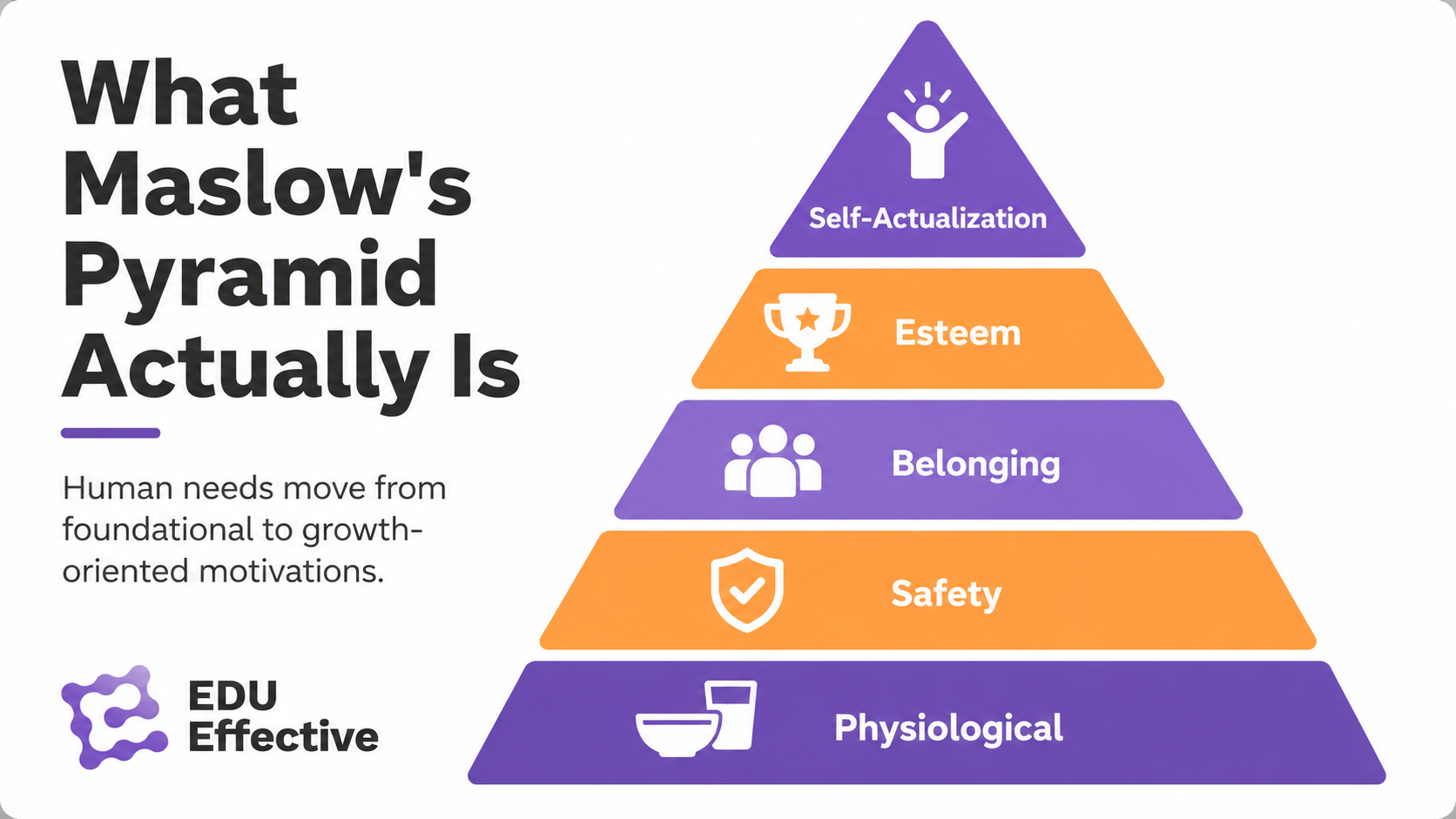
The model is typically represented as a five-level pyramid. The most fundamental needs form the wide base. Each ascending level represents a higher category of need, culminating in self-actualisation at the peak. Maslow argued that a person whose basic needs are unmet will focus almost entirely on meeting them — and will not be meaningfully motivated by recognition, community, or personal growth until those foundations are in place.
One frequently cited historical note: Maslow himself never drew a pyramid. The iconic pyramid visualisation was introduced by consulting psychologist Charles McDermid in 1960, seventeen years after Maslow's original paper. The pyramid is a useful teaching tool, but it implies more rigidity than Maslow's own writing intended. He described tendencies and patterns, not a mechanical sequence.
The five levels of Maslow's pyramid
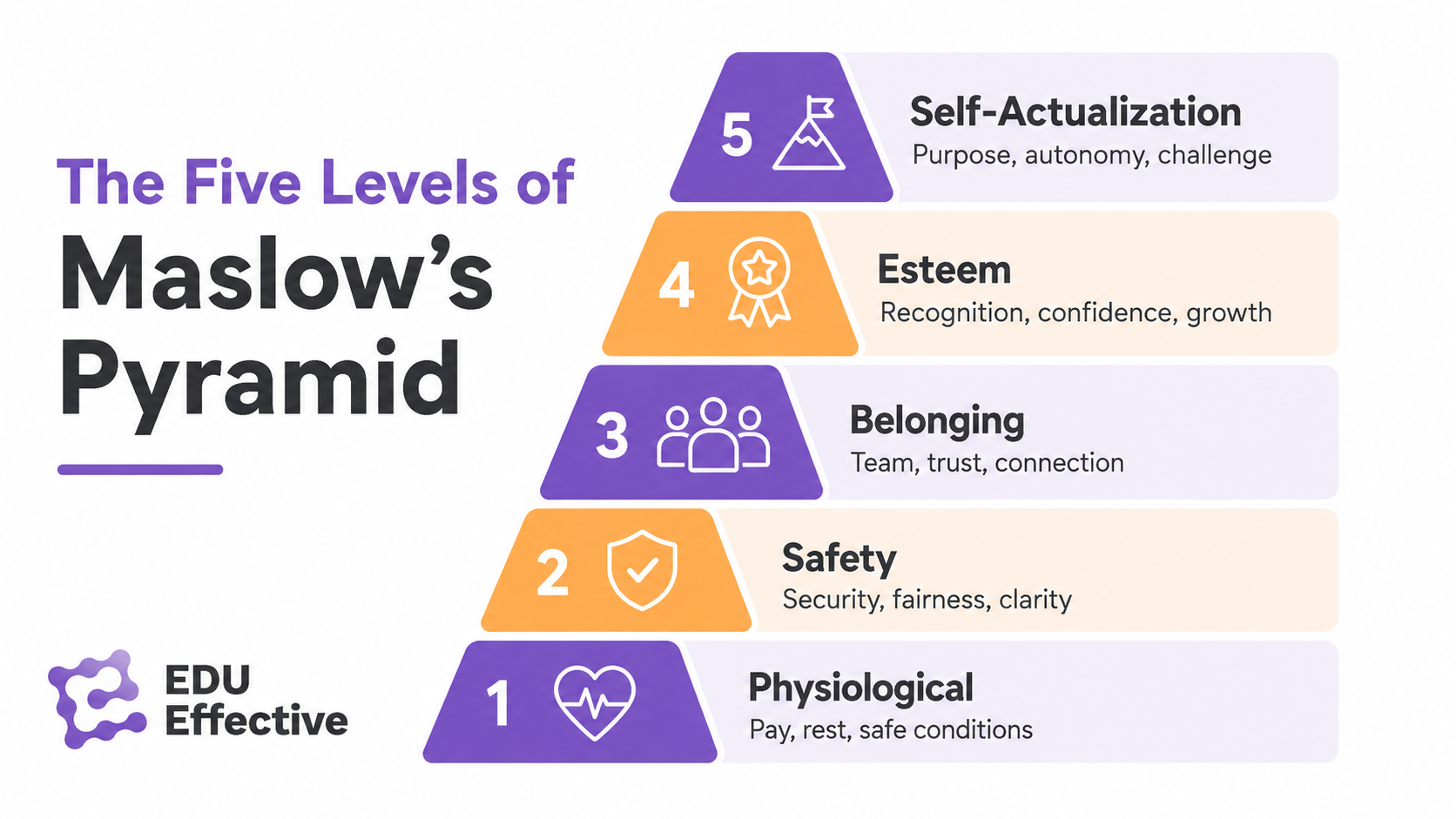
Physiological needs form the base — food, water, shelter, sleep, warmth, and the basic biological requirements for survival. In the workplace, this translates to wages sufficient to cover living costs, reasonable working hours that don't compromise health, and safe physical conditions. An employee who cannot afford their rent or is working in genuinely dangerous conditions will not be meaningfully engaged by purpose-driven leadership or recognition programmes. The foundation must be in place first.
Safety needs are about stability, predictability, and protection from harm — physical and psychological. At work, this means job security, clear contractual terms, protection from harassment and bullying, and the assurance that the rules are fair and consistent. In 2026, this level has acquired new dimensions. AI-driven displacement has heightened safety anxiety for workers in roles susceptible to automation. A team told their work may be automated within two years is not a team focused on self-actualisation. Addressing safety needs in the current environment requires honest, transparent communication about how AI is being used and what it means for specific roles — not reassuring platitudes.
Love and belonging needs reflect the human requirement for social connection, friendship, trust, and a sense of being part of something. In the workplace, this appears as team cohesion, collaborative culture, meaningful peer relationships, and the feeling of being genuinely accepted rather than merely tolerated. The shift to remote and hybrid work has created specific pressure on this level. Research on remote workers consistently shows that isolation and reduced social connection are the most commonly reported challenges — not workload, not technology, but the erosion of belonging. Leaders who want a high-performing distributed team must actively engineer belonging rather than assuming it will emerge.
Esteem needs operate on two tracks simultaneously. The first is internal: the need to feel competent, capable, and confident in one's work. The second is external: the desire to be recognised and respected by others. Both matter. An employee whose work is excellent but perpetually invisible will experience esteem deprivation regardless of their own confidence. And an employee who receives recognition they don't believe is deserved will not derive sustained motivation from it. At work, this level is addressed through meaningful feedback, clear performance expectations, acknowledgement of contributions, opportunities for advancement, and roles that carry genuine responsibility.
Self-actualisation sits at the apex — the need to reach one's full potential, to grow, to do meaningful work, to express oneself creatively, and to contribute to something beyond one's immediate circumstances. This is not a destination but a direction; Maslow described it as an ongoing pursuit rather than a state to be achieved. In the workplace, self-actualisation looks like challenging projects that stretch capability, autonomy to solve problems in novel ways, opportunities for professional development, and the sense that one's work genuinely matters. It is also where the most significant management failures occur — when talented, experienced people leave an organisation not because of pay or security, but because they stopped growing.
Why the pyramid is particularly relevant in 2026
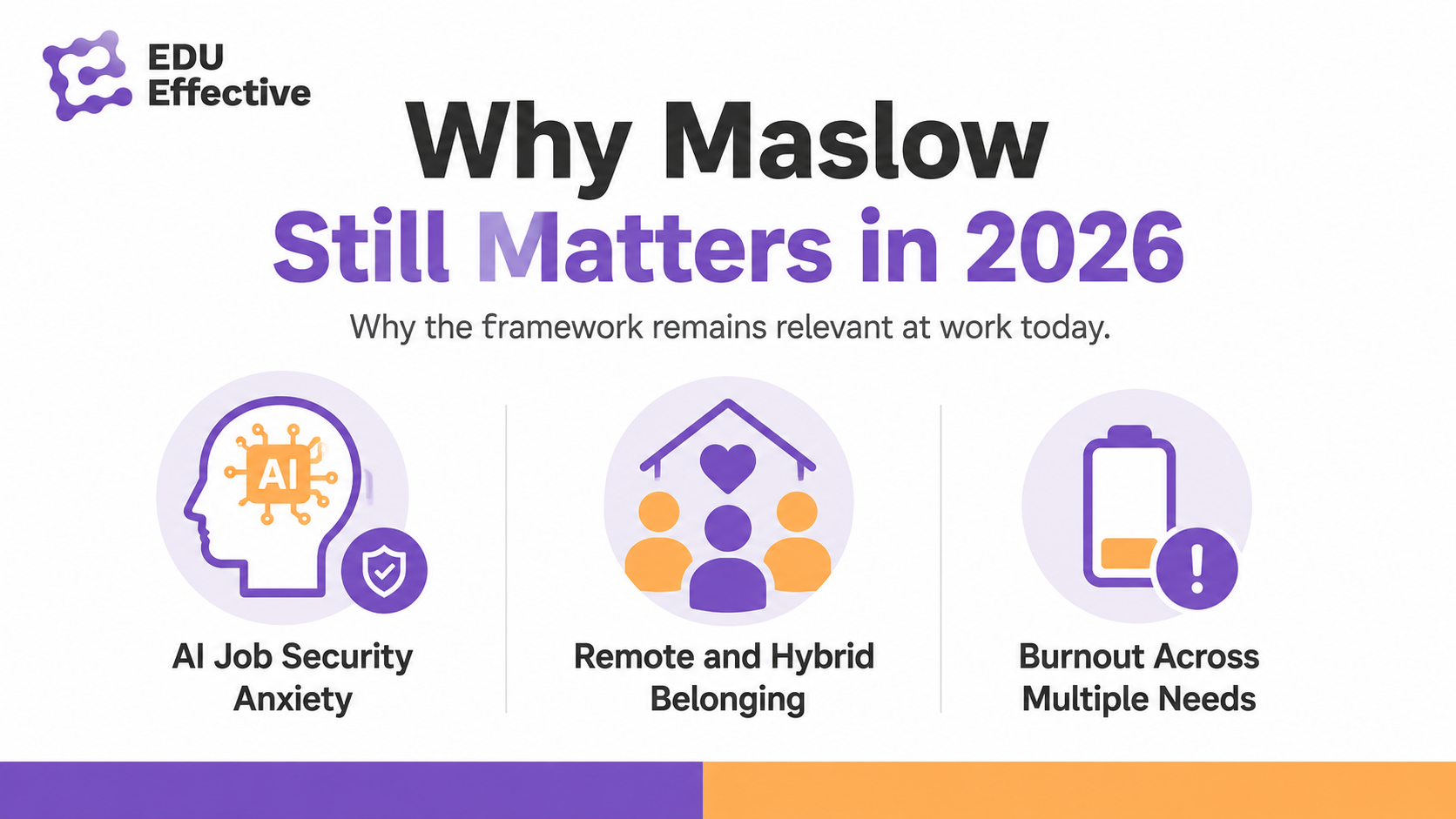
Three developments in the current working environment make Maslow's framework more analytically useful, not less.
AI and job security anxiety. The rapid automation of knowledge work tasks has elevated safety needs to a level of prominence they had not occupied in most professional sectors for decades. Research consistently shows that perceived job insecurity is one of the strongest predictors of disengagement, reduced discretionary effort, and turnover intention. Organisations navigating AI-driven transformation that fail to address their employees' safety needs — by being specific, transparent, and supportive about what is changing and what is not — will pay a significant performance cost.
Remote and hybrid work and belonging. The normalisation of distributed work has structurally weakened the mechanisms by which belonging was traditionally created: shared physical space, spontaneous social interaction, visible team culture. Leaders in 2026 cannot assume that belonging will simply emerge in distributed teams the way it did in offices. It requires deliberate design — structured connection moments, explicit inclusion practices, and individual attention to whether people feel genuinely part of the team or peripherally attached to it.
Burnout and the collapse of the hierarchy. One of the most consistent findings from workplace wellbeing research is that burnout typically involves the simultaneous erosion of multiple levels of the hierarchy — physiological needs disrupted by poor sleep and overwork, safety undermined by job insecurity, belonging damaged by isolation, esteem eroded by lack of recognition, and self-actualisation blocked by repetitive or meaningless work. Maslow's framework helps diagnose burnout more precisely than general wellness programmes tend to: it identifies which level of the hierarchy is under most pressure for a specific individual, enabling a more targeted response.
The legitimate criticisms of the model
Maslow's pyramid is useful. It is not infallible, and taking it seriously means understanding its limitations.
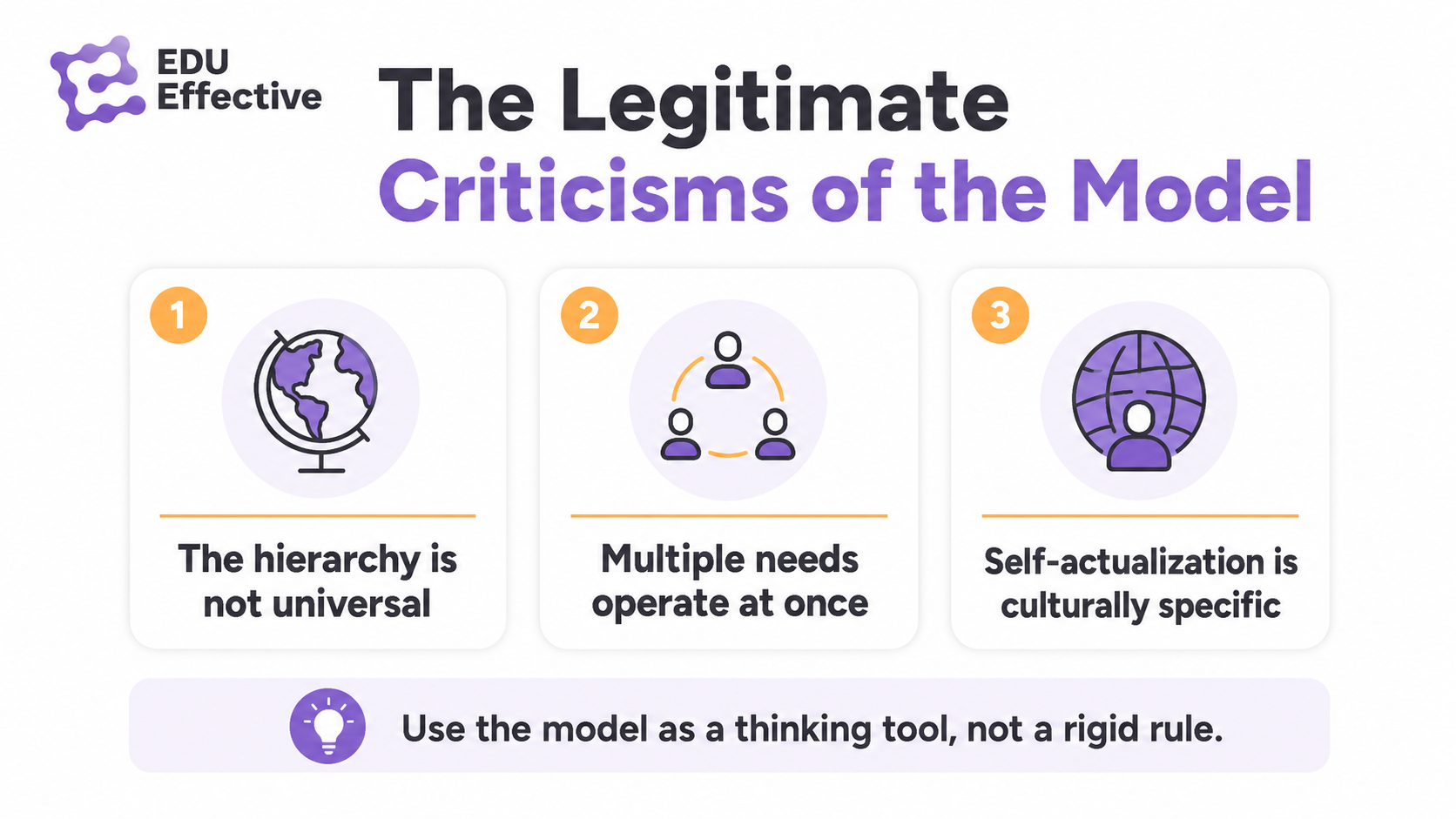
The strict hierarchy is empirically contested. Cross-cultural research suggests that the sequence of needs varies across societies. In some cultural contexts, belonging and social acceptance function as more foundational than individual safety. Maslow's original research was based largely on a Western, individualistic sample, and applying the model universally without cultural sensitivity can produce misleading conclusions.
Multiple needs operate simultaneously. Maslow's own later writing acknowledged that people pursue needs at several levels at the same time, rather than completing one level fully before moving to the next. The pyramid's visual implies sequential steps; the psychological reality is more fluid.
Self-actualisation is culturally specific. What counts as reaching one's potential is not universal. Different people, shaped by different cultural and social contexts, have genuinely different conceptions of growth, achievement, and meaning. A management approach that assumes everyone defines self-actualisation through individual career advancement will miss employees for whom community contribution, family, or craft mastery are the more meaningful forms of growth.
These criticisms do not invalidate the framework. They clarify its appropriate use: as a thinking tool that prompts the right questions, not as a prescriptive algorithm that automatically generates the right answers.
How effective managers use Maslow's pyramid in practice
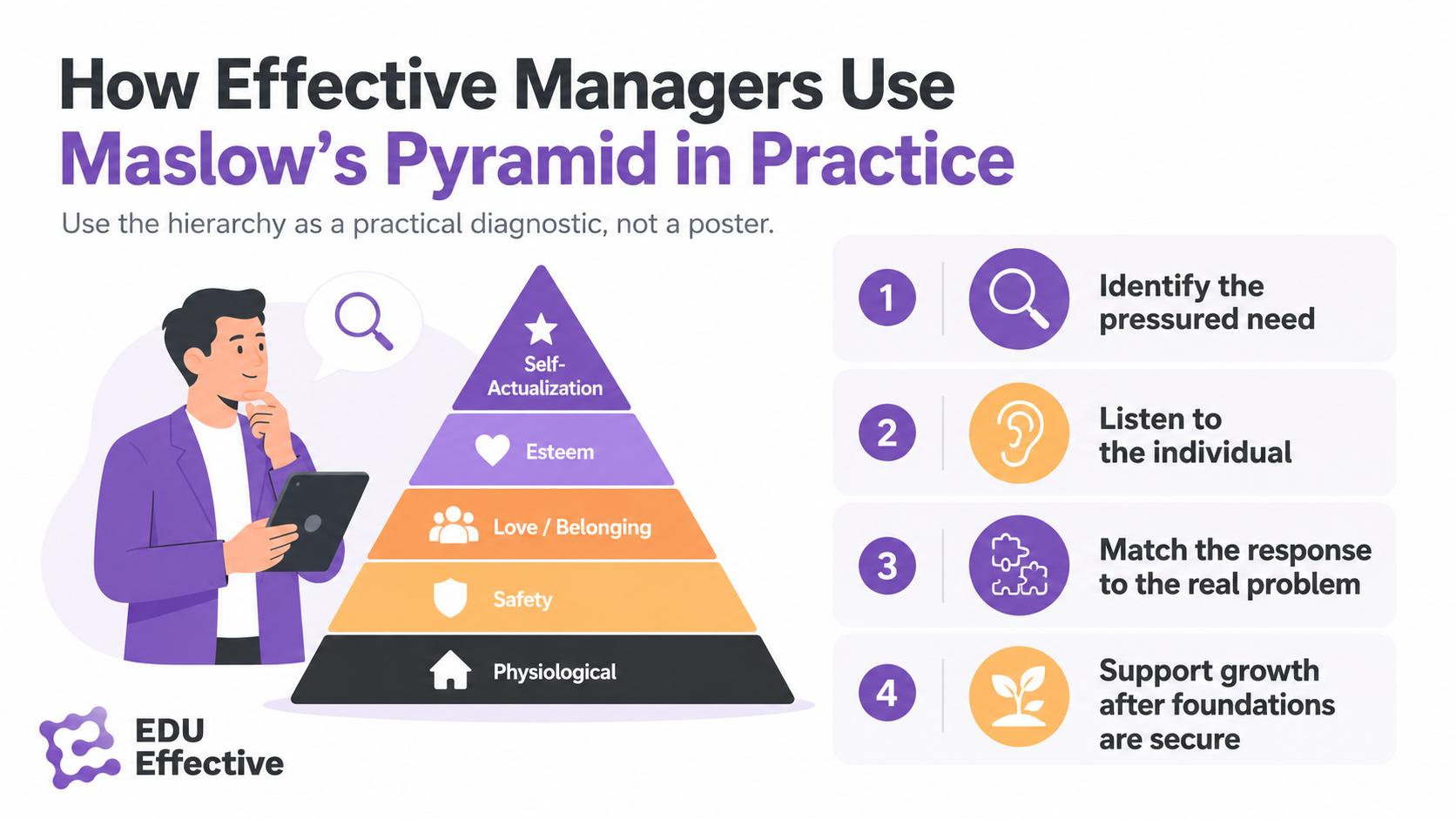
The practical value of Maslow's hierarchy is not in posting a pyramid on the break room wall. It is in the discipline of asking, for each member of your team and for your organisation as a whole, which level of the hierarchy is currently under the most pressure — and what that implies for management action.
A team facing redundancy fears is not best served by an off-site focused on purpose and meaning. An isolated remote worker who hasn't spoken to a colleague in a week will not be energised by a promotion opportunity. A high performer whose work has received no recognition in six months will not be retained by an incremental pay rise.
Maslow's framework works when it is applied specifically rather than generically. The most effective leaders use it as a diagnostic — listening carefully enough to their people to understand where each individual actually sits in the hierarchy, and responding to what they actually need rather than what it would be convenient for them to need.
At EDU Effective, our Effective MBA management and leadership programs develop the management frameworks and practical skills needed to build high-performing, motivated teams — grounded in both psychology and business reality. Explore our programs →
EDU Effective Business School = professional development for your long-term success.
All best-selling Effective MBA programs are built for working adults: 15 minutes a day, 10 months or less, ASIC accredited, from €990.
These are professional programs, not academic ones — built for working adults to apply what they learn directly in their own business, not to collect a scholarly credential.
Join more than 9,000 students in over 120 countries around the world to further your personal development and career success.
Read the feedback and experiences of our students and the stories of our graduates here.
Apply now — from €990 · Talk to a Study Advisor
Study with NO risk: 14-day money-back guarantee, no questions asked.
Sources
- Digital Workplace Group — Maslow's Hierarchy of Needs and the Digital Workplace https://digitalworkplacegroup.com/maslows-hierarchy-of-needs-and-the-digital-workplace/
- ACT-ON Group — Maslow's Hierarchy of Needs: A Tool for Employee Engagement https://actongroup.com/en/maslows-hierarchy-of-needs-understanding-needs-to-optimize-employee-engagement/
- FSM.How — Maslow's Hierarchy of Needs: A Guide to Employee Motivation https://fsm.how/human-resource-management/maslows-hierarchy-needs-employee-motivation/
- Panmore Institute — Addressing Maslow's Hierarchy of Needs in Telecommuting https://panmore.com/addressing-maslows-hierarchy-of-needs-in-telecommuting
- Indeed Career Advice — Maslow's Hierarchy of Needs: Applying It in the Workplace https://www.indeed.com/career-advice/career-development/maslows-hierarchy-of-needs
- HRDQ Store — Hierarchy of Needs: Motivating Employees with Maslow's Theory https://hrdqstore.com/blogs/hrdq-blog/hierarchy-needs-motivating-employees