

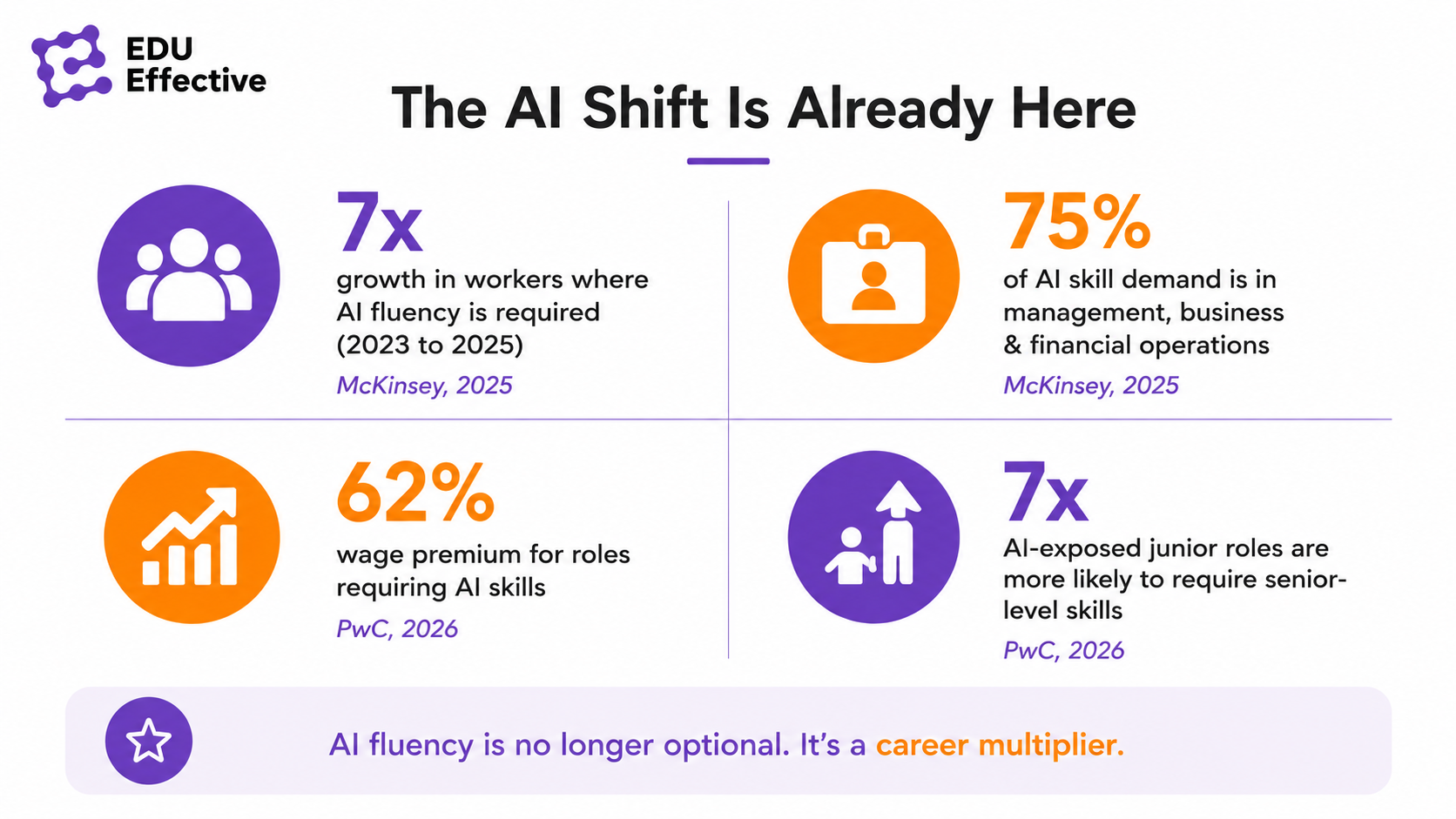
The number of workers in occupations where AI fluency is explicitly required has grown sevenfold in two years — from approximately one million in 2023 to seven million in 2025, according to McKinsey's workforce research. That growth is not concentrated in data science or software engineering. Three quarters of AI skill demand currently sits in three occupation groups: computer and mathematical roles, management, and business and financial operations. AI fluency has moved into the mainstream of professional work — and the managers and business professionals who are building it now are creating a structural advantage over those who are not.
PwC's 2026 Global AI Jobs Barometer — which analysed more than one billion job advertisements across 27 countries — found that roles requiring AI skills are growing almost eight times faster than the total jobs market, and command a 62% wage premium over comparable roles without them. At the entry level, AI-exposed junior roles are now seven times more likely to require skills traditionally associated with senior professionals — leadership, strategic judgement, stakeholder management. The traditional relationship between experience and seniority is being restructured by AI, and it is being restructured faster than most organisations have prepared for.
What AI fluency for business professionals actually means
There is a persistent misconception about what AI capability means for non-technical professionals. The assumption is that "learning AI" means learning to code, understanding machine learning algorithms, or developing data science expertise. For software engineers and data scientists, that is accurate. For managers, marketers, finance professionals, HR leaders, and general business professionals, it is not.
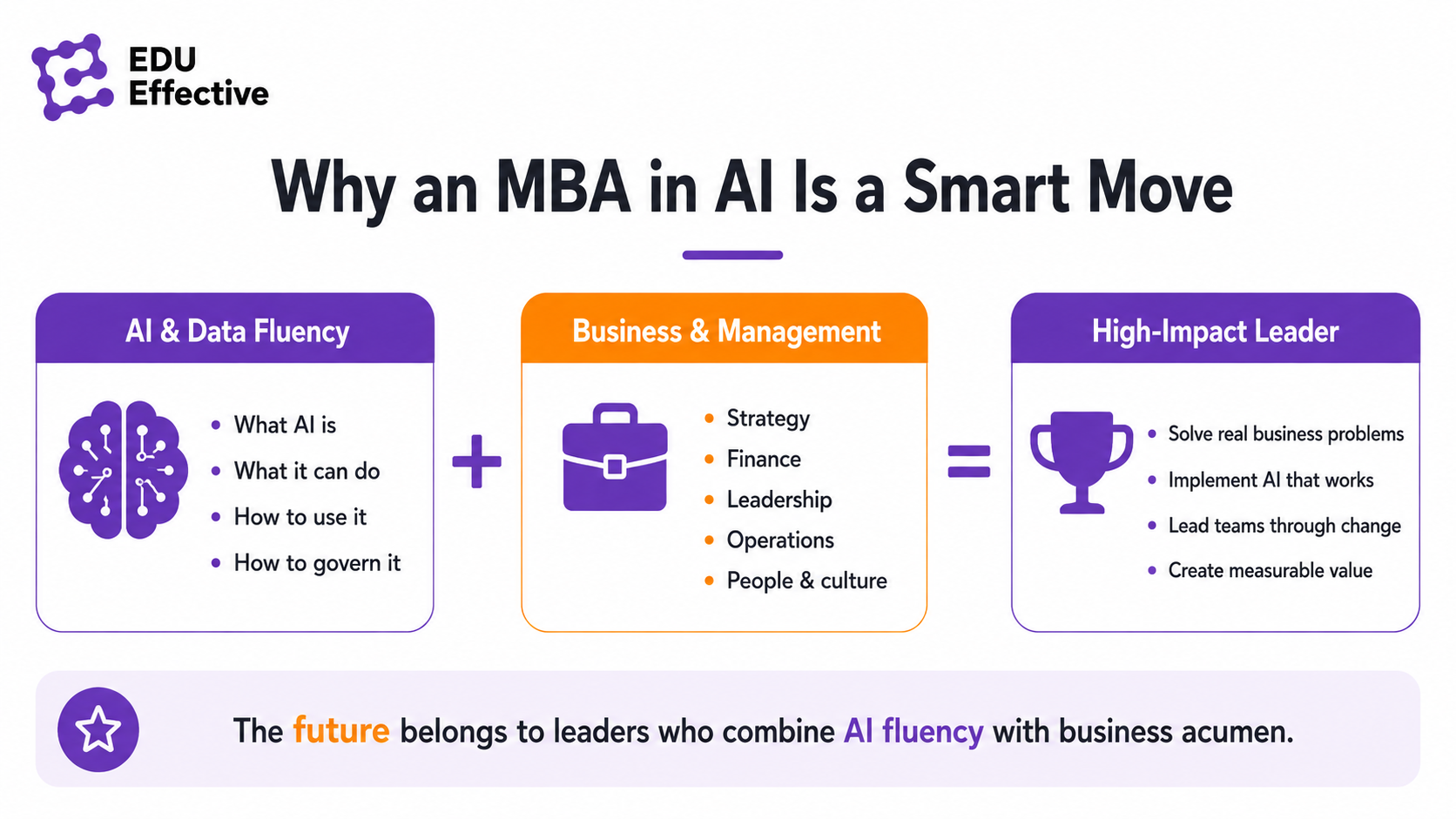
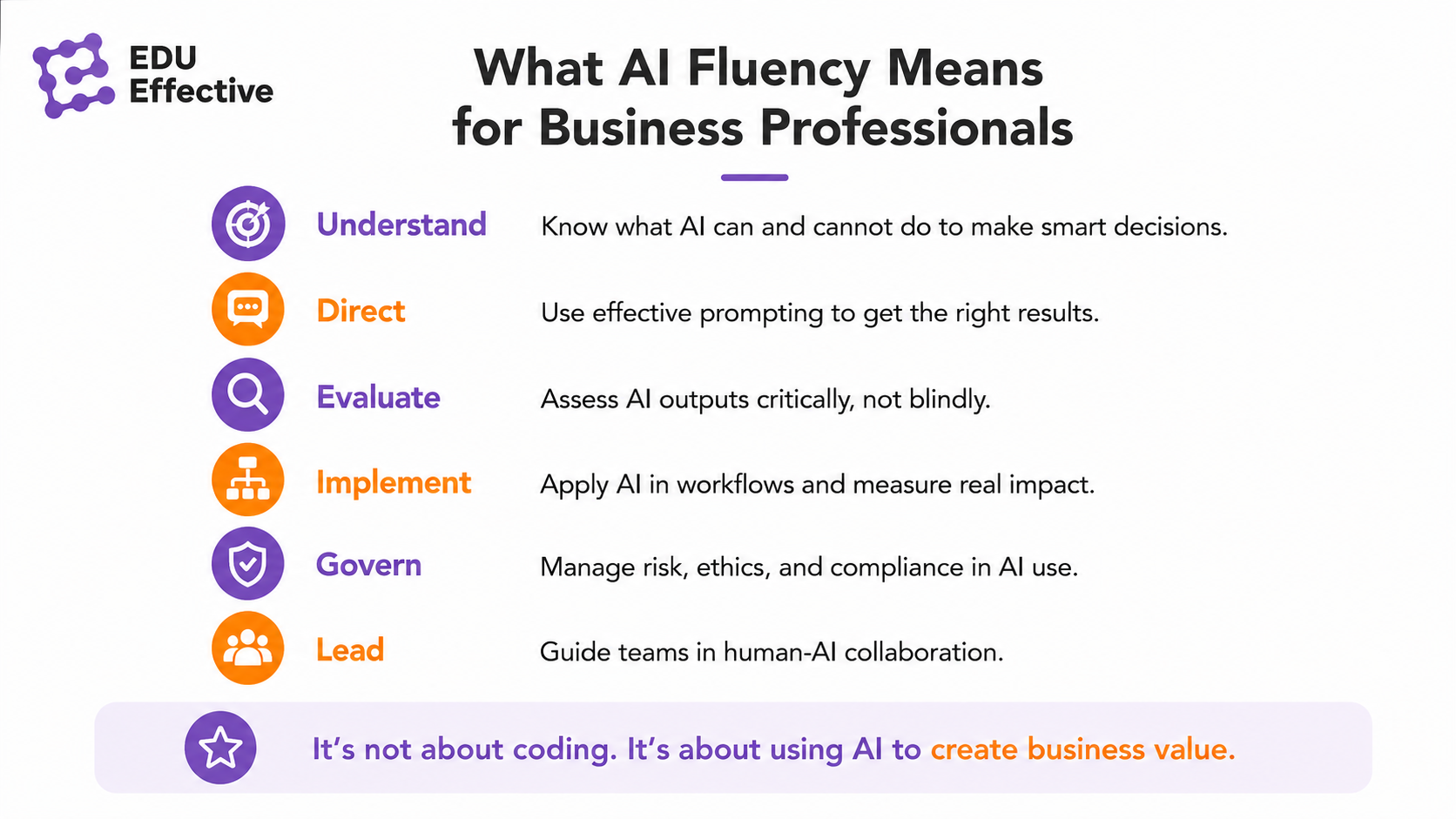
AI fluency for business professionals is a different and more accessible set of capabilities: understanding what AI systems can and cannot do well enough to make intelligent decisions about where to use them; knowing how to direct AI tools precisely through effective prompting; being able to evaluate AI-generated outputs critically rather than treating them as authoritative; understanding how to implement AI in specific workflows and measure whether it is producing value; and knowing how to govern AI use within a team or organisation — including the risk, ethical, and regulatory dimensions.
McKinsey's research on human skills in the age of AI identifies the specific capabilities required for effective human-AI collaboration: framing problems effectively for AI systems, overseeing AI outputs, interpreting results in context, managing exceptions, and knowing when to escalate decisions that AI cannot reliably make. These are not technical skills. They are professional and managerial skills that happen to operate at the interface between human judgement and AI capability.
Deloitte's 2026 survey of 3,235 global leaders found that 53% of organisations now cite educating the broader workforce to raise overall AI fluency as their number-one AI talent strategy. Only 34% of organisations are genuinely redesigning their businesses around AI. The gap between investment in AI tools and investment in the human capability to use them intelligently is one of the defining strategic gaps in business in 2026.
The two-track labour market PwC identified — and where business professionals sit
PwC's 2026 Global AI Jobs Barometer describes a specific structural shift in the labour market that has direct implications for how business professionals should think about their AI development.
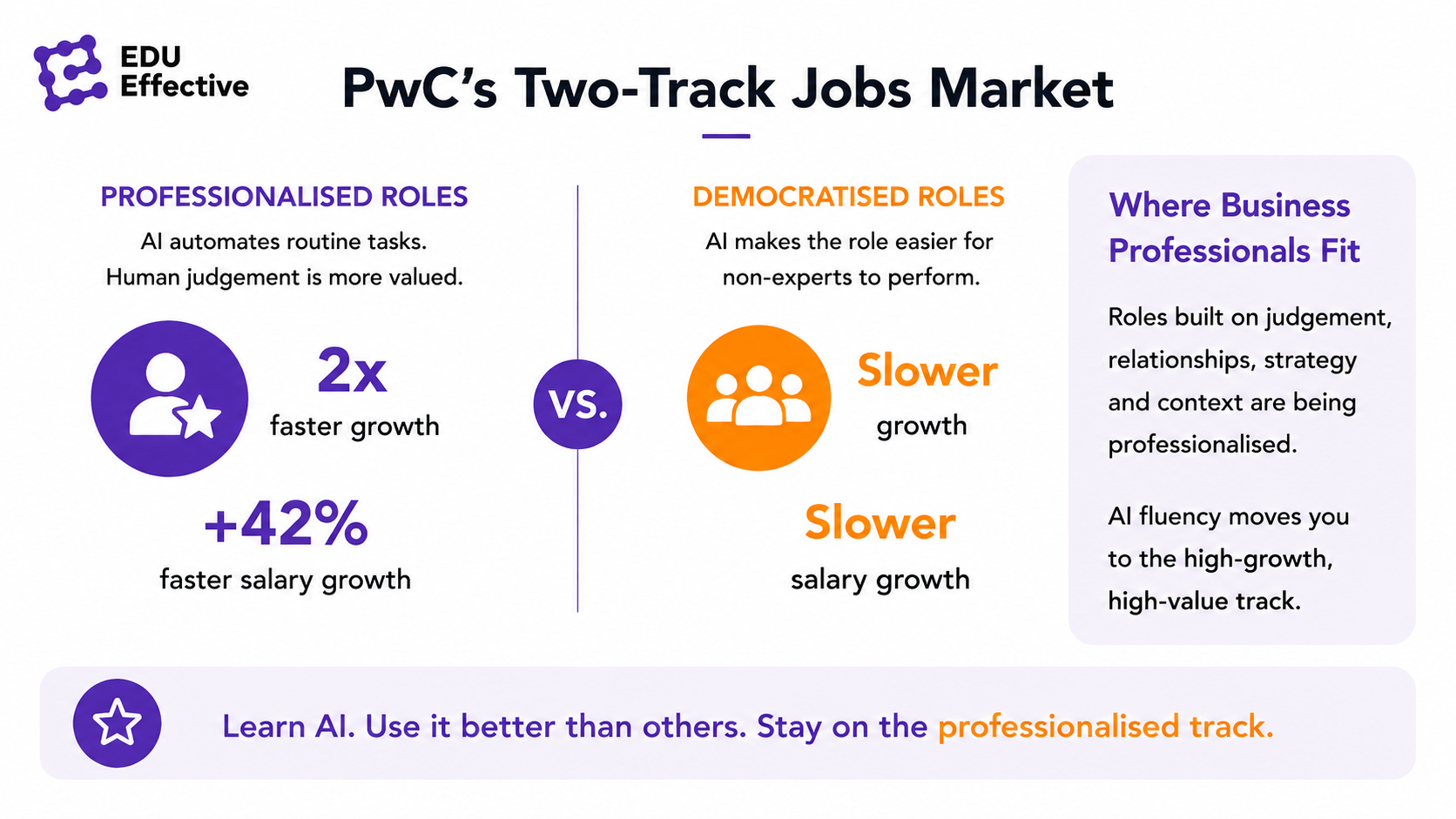
AI is creating what PwC calls a two-track jobs market. "Professionalised" roles — where AI automates routine tasks so that human judgement and expertise are more concentrated and more valued — are growing twice as fast as "democratised" roles, where AI makes the role itself easier for non-experts to perform. Professionalised roles are also seeing 42% faster salary growth than democratised roles.
The professionals whose roles are being "professionalised" by AI are those where the value of the role is rooted in judgement, relationships, strategy, and contextual understanding — all things AI augments rather than replaces. These include senior management, strategic planning, client relationship management, marketing strategy, business development, and human capital management. The professionals in these roles who develop genuine AI fluency — who can use AI to handle the routine cognitive work in their function, freeing capacity for the higher-value judgement-intensive work — are in the professionalised track. Those who do not are in a more exposed position.
The 62% wage premium for AI skills is the labour market's expression of this dynamic. The market is pricing the combination of professional expertise and AI fluency significantly above professional expertise alone — across functions, across industries, and across seniority levels.
Why an MBA in AI makes sense — the logic of combining business education with AI capability
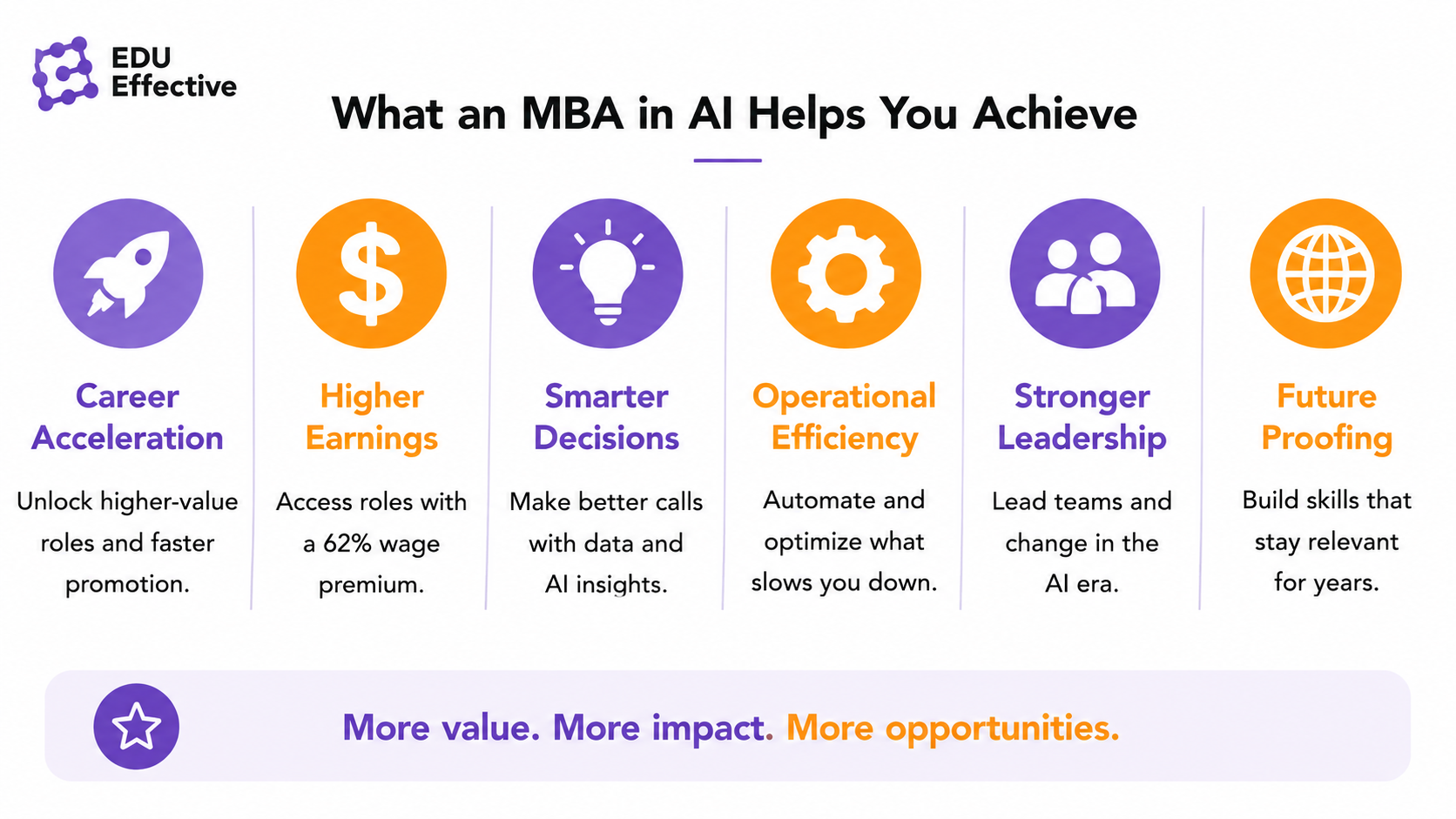
The most effective AI professionals in business contexts in 2026 are not those with the deepest technical AI knowledge. They are those who can operate at the intersection of two domains: genuine understanding of how AI works and what it can do, and genuine business and management capability — strategy, leadership, financial literacy, commercial thinking, and the interpersonal skills required to drive organisational change.
The reason this combination is valuable is straightforward: implementing AI in a business context is fundamentally a management challenge, not a technology challenge. The BCG 10-20-70 principle, identified in their AI implementation research, holds that 10% of AI initiative success comes from algorithm and model quality, 20% from data and technology infrastructure, and 70% from people — change management, capability building, workflow redesign, and embedding AI into how work actually happens. The 70% is a management problem. It requires people who understand both what AI can do and how organisations work, how to bring people through change, how to set governance frameworks, and how to measure commercial outcomes.
McKinsey's 2025 State of AI research found that the single biggest factor determining whether organisations see EBIT impact from AI is workflow redesign — not the quality of the AI tools deployed. Workflow redesign is a management and leadership discipline. The professionals who understand AI well enough to identify which workflows benefit from redesign, and who have the management capability to lead that redesign through an organisation, are the ones who are driving most of the value from AI adoption in 2026.
What an MBA in AI develops — the specific capabilities that matter
An MBA programme with genuine AI content — not AI theory taught as an academic subject, but applied AI capability built through practitioner content — develops a specific set of capabilities that maps directly to the business value of AI in 2026.
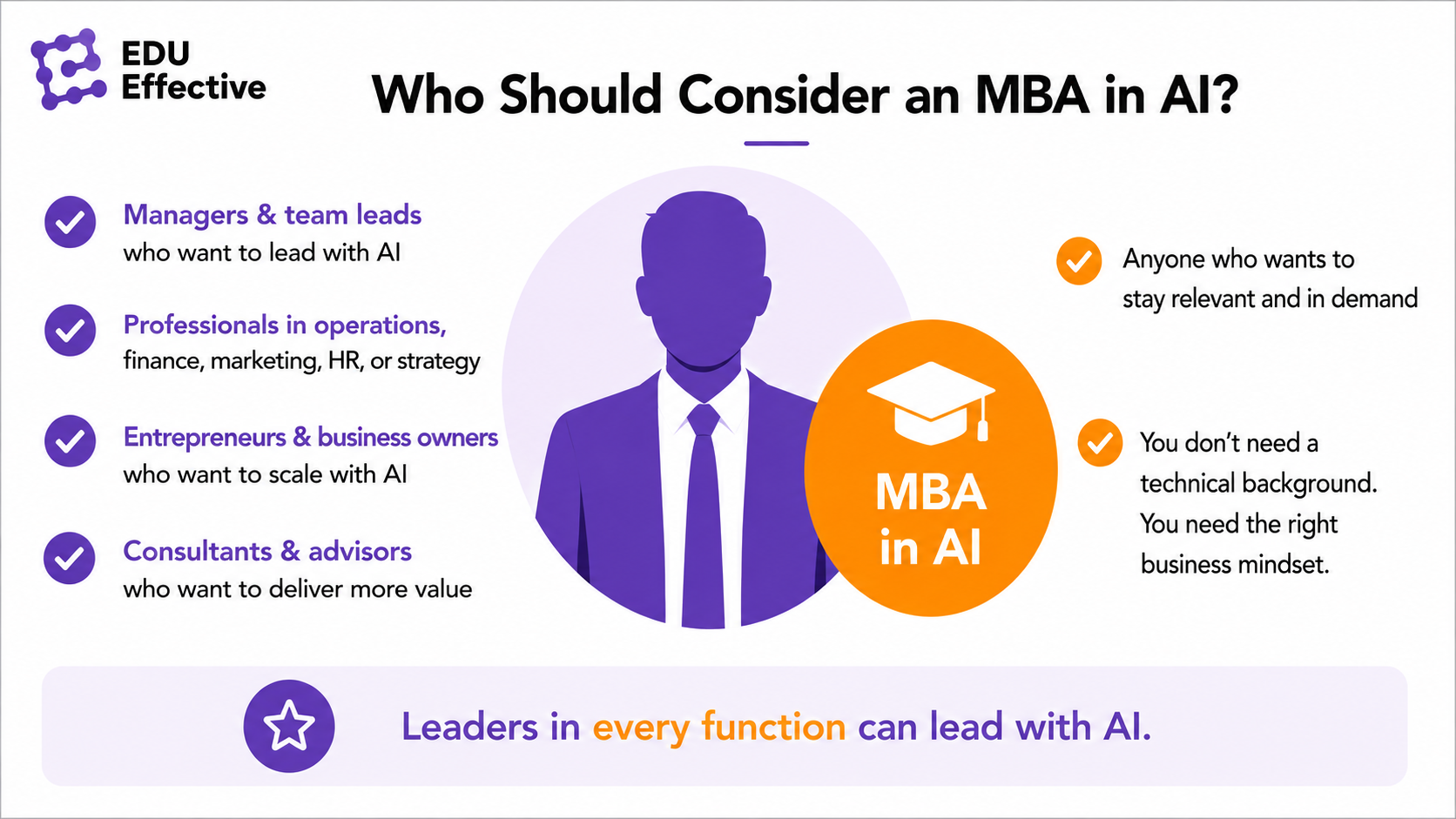
AI strategy and use case evaluation. The ability to look at a business function, identify where AI genuinely adds value versus where it is being applied because of trend rather than utility, evaluate the feasibility and ROI of specific AI use cases, and make defensible investment decisions about AI deployment. This is the capability that separates the 34% of organisations genuinely extracting value from AI from the 66% that are investing without proportionate return.
Prompt engineering and AI direction. The practical capability to direct AI tools precisely — to write prompts that produce useful outputs rather than generic ones, to iterate effectively, and to develop the intuition for what level of AI direction produces the best results for specific task types. Research consistently shows that the same AI tool, given a high-quality prompt versus a low-quality one, produces dramatically different outputs. Prompt quality is a learnable, high-return professional skill.
AI output evaluation. The critical capability to assess AI-generated outputs for factual accuracy, logical coherence, strategic soundness, and fitness for purpose — rather than treating AI output as authoritative. BCG's research on AI tool use found that consultants using AI on tasks outside its reliable capability range were 19 percentage points more likely to produce incorrect work. The ability to recognise where AI is reliable and where it is not is a professional capability with direct commercial consequences.
AI implementation and change management. Understanding how to introduce AI tools into a team or organisation in ways that are actually adopted — which requires change management, communication, training, and the creation of governance structures that make AI use consistent and accountable. Most AI implementations fail not because the technology does not work but because the human side of the implementation is underprepared. This is the 70% that determines whether AI produces commercial value.
AI governance and risk management. Understanding the risk dimensions of AI use — from bias and hallucination to regulatory compliance under the EU AI Act, data privacy, and reputational risk — and how to establish governance frameworks that allow an organisation to use AI at scale without unmanageable risk exposure.
The AI fluency gap — and the professional opportunity it creates
Only 1% of organisations consider themselves to have achieved AI maturity — where AI is fully integrated into their workflows and delivering consistent business outcomes, according to McKinsey's 2025 research. 92% of companies plan to increase AI investment over the next three years. The gap between investment intention and operational maturity is the defining business management challenge of 2026.
For individual professionals, this gap represents a specific and time-limited opportunity. The professionals who develop genuine AI fluency now — not theoretical understanding but practical, applied capability — are entering a period when that capability is simultaneously in very high demand and relatively scarce. The 62% wage premium reflects current scarcity. As AI fluency becomes more widely distributed across the professional population over the next three to five years, that premium will moderate. The professionals who build the capability now are building it at peak value.
22% of employers now cite AI proficiency as a basic expectation for most MBA-level roles, according to a 2026 survey of 500 managers involved in MBA hiring conducted by CSP Global. 45% of employers identify strategic thinking in an AI context as the most important growing skill for MBA-level professionals. The credential that signals this capability — and the programme that builds it — is increasingly specifically valued.
Applied AI and Mastery in AI — two programmes for different depths of development
EDU Effective offers two Effective MBA programmes that address AI capability at different levels of depth and application.
The Effective MBA: Applied Artificial Intelligence is designed for business professionals who need to develop practical AI fluency — the ability to use AI tools intelligently in their professional role, evaluate AI outputs critically, implement AI in specific business workflows, and make sound decisions about AI adoption. It covers AI strategy, prompt engineering, AI tools across business functions, implementation frameworks, and governance. No coding required. Content draws on practitioners at Google, Microsoft, Amazon, McKinsey, and many more.
The Effective MBA: Mastery in AI develops deeper AI capability for professionals who want to build comprehensive expertise — covering AI systems in greater depth, advanced implementation, agentic AI, AI-driven business transformation, and the strategic leadership of AI adoption across organisations. It is designed for professionals who want to become the person in their organisation who leads AI strategy, not just participates in it.
Both programmes are built on a library of more than 24,000 curated videos from AI practitioners and business leaders at the world's leading organisations — delivered in 15 minutes a day, completing in ten months or less, and accredited by ASIC. Content from faculty at Harvard Business School, Yale, Stanford, Princeton, and Cambridge, selected for immediate applicability to current business challenges.
At EDU Effective, Applied AI and Mastery in AI are built for the professional who understands that AI fluency is a business capability, not a technical specialisation — and who wants to build it without pausing a career to do it. Explore our programs →
EDU Effective Business School — professional development for your long-term success.
All five Effective MBA programs are built on the same educational model — designed for working adults who need learning that fits real professional life:
- Effective MBA: Executive Management & Leadership
- Effective MBA: Applied Artificial Intelligence
- Effective MBA: Coaching, Leadership & Mentoring
- Effective MBA: Mastery in AI
- Effective MBA: Online Marketing
Every programme runs on 15 minutes a day, completes in 10 months or less, is ASIC accredited, and starts from €990.
These are professional programmes, not academic ones — built for working adults to apply what they learn directly in their own business, not to collect a scholarly credential.
Join more than 9,000 students in over 120 countries who are investing in their professional development and career success. Read the experiences of our graduates here.
Apply now — from €990 · Talk to a Study Advisor
Study with NO risk: 14-day money-back guarantee, no questions asked.
Sources
- PwC — 2026 Global AI Jobs Barometer (1B+ job ads, 27 countries) https://www.pwc.com/gx/en/news-room/press-releases/2026/pwc-2026-ai-jobs-barometer.html
- PwC — 2026 AI Business Predictions https://www.pwc.com/us/en/tech-effect/ai-analytics/ai-predictions.html
- McKinsey & Company — Human Skills Will Matter More Than Ever in the Age of AI (January 2026) https://www.mckinsey.com/mgi/media-center/human-skills-will-matter-more-than-ever-in-the-age-of-ai
- McKinsey & Company — The State of AI https://www.mckinsey.com/capabilities/quantumblack/our-insights/the-state-of-ai
- McKinsey & Company — Superagency in the Workplace: Empowering People to Unlock AI's Full Potential https://www.mckinsey.com/capabilities/tech-and-ai/our-insights/superagency-in-the-workplace-empowering-people-to-unlock-ais-full-potential-at-work
- Deloitte — State of AI in the Enterprise 2026 (3,235 global leaders) https://www2.deloitte.com/us/en/insights/focus/cognitive-technologies/state-of-ai-and-intelligent-automation-in-business-survey.html
- BCG — AI at Work 2026: Navigating the Jagged Technological Frontier https://www.bcg.com/press/3june2026-ai-reshaping-jobs-faster-than-companies-reshaping-work
- World Economic Forum — Future of Jobs Report 2025 https://www.weforum.org/publications/the-future-of-jobs-report-2025/
- Gloat — AI Skills Demand in the U.S. Job Market 2026 https://gloat.com/blog/ai-skills-demand/