


The conversation about millennials has barely moved in a decade. They're still framed as the avocado-toast generation, perpetually young, perpetually broke, perpetually confused about whether to rent or buy. None of that describes who they actually are in 2026.
The oldest millennials are turning 45 this year. They're managing teams, running departments, sitting on boards, and raising teenagers. And as a group, they are the most learning-hungry generation in the workforce — spending more on professional development than Gen X, Gen Z, and Baby Boomers combined. If your business sells education, training, or professional growth in any form, this is your core market.
Who millennials are — the numbers that actually matter
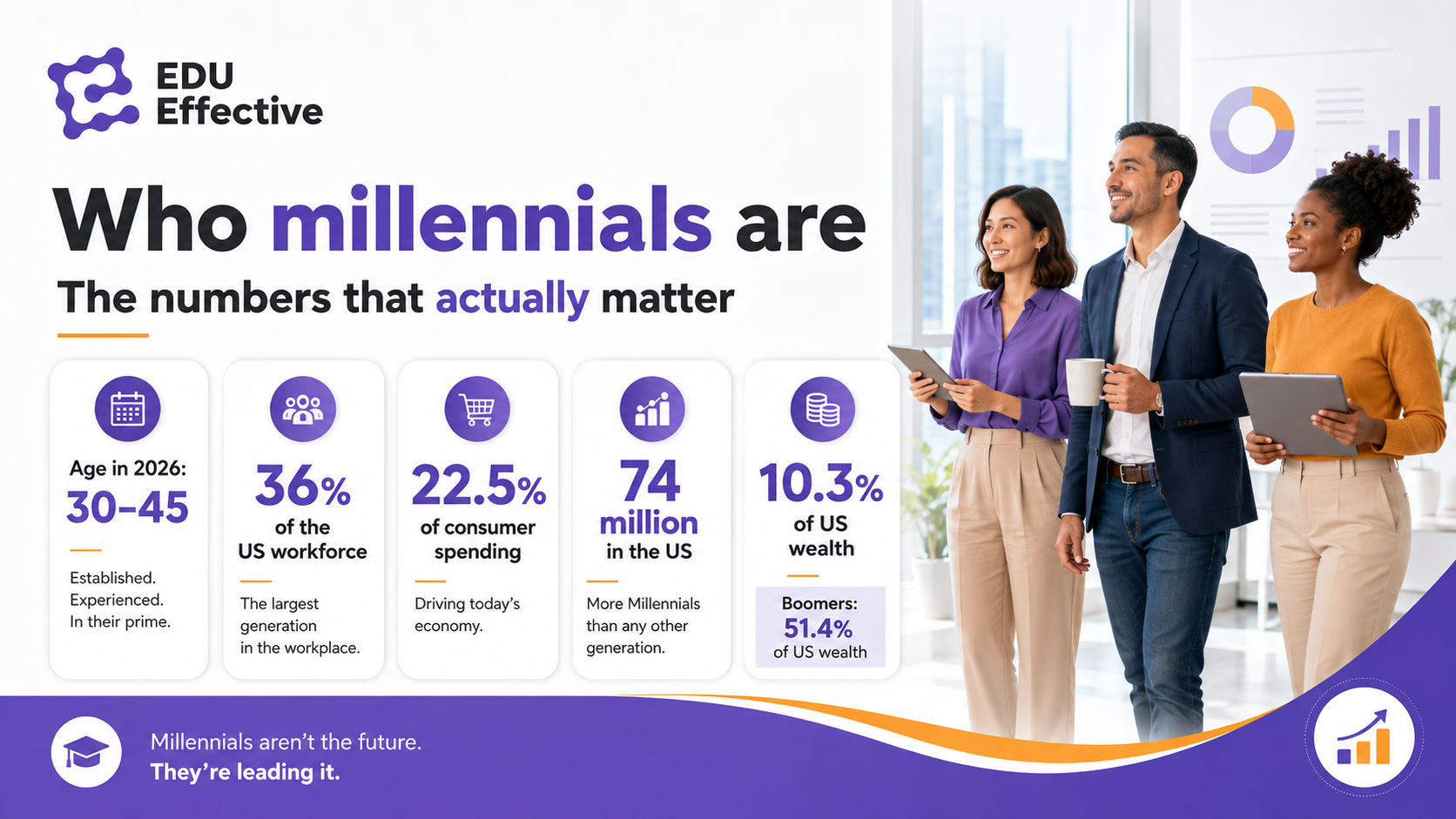
Millennials, or Generation Y, were born between 1981 and 1996, according to the Pew Research Center. In 2026, that places them between 30 and 45 years old — squarely in mid-career, not in early adulthood.
They make up approximately 36% of the US workforce, the largest share of any generation currently employed. Globally, they represent around 22.5% of consumer spending power, projected to surpass $10 trillion by 2030 as they reach their peak earning years. In the US, there are roughly 74 million of them — about 22% of the total population.
The figure that gets less attention but explains far more of their behaviour: millennials hold only around 10.3% of US wealth, compared to approximately 51.4% for Baby Boomers, despite being similar in size. A generation that entered the workforce during the 2008 financial crisis, carries significant student debt, and faces a housing market unlike anything their parents navigated doesn't spend the way older models predicted. They spend deliberately, prioritise value, and — perhaps most tellingly — tend to invest in experiences and personal growth over material accumulation.
The learning generation — and this is not a cliché
Here is where the data gets genuinely striking, and where millennials diverge most sharply from every other generation in the workforce.
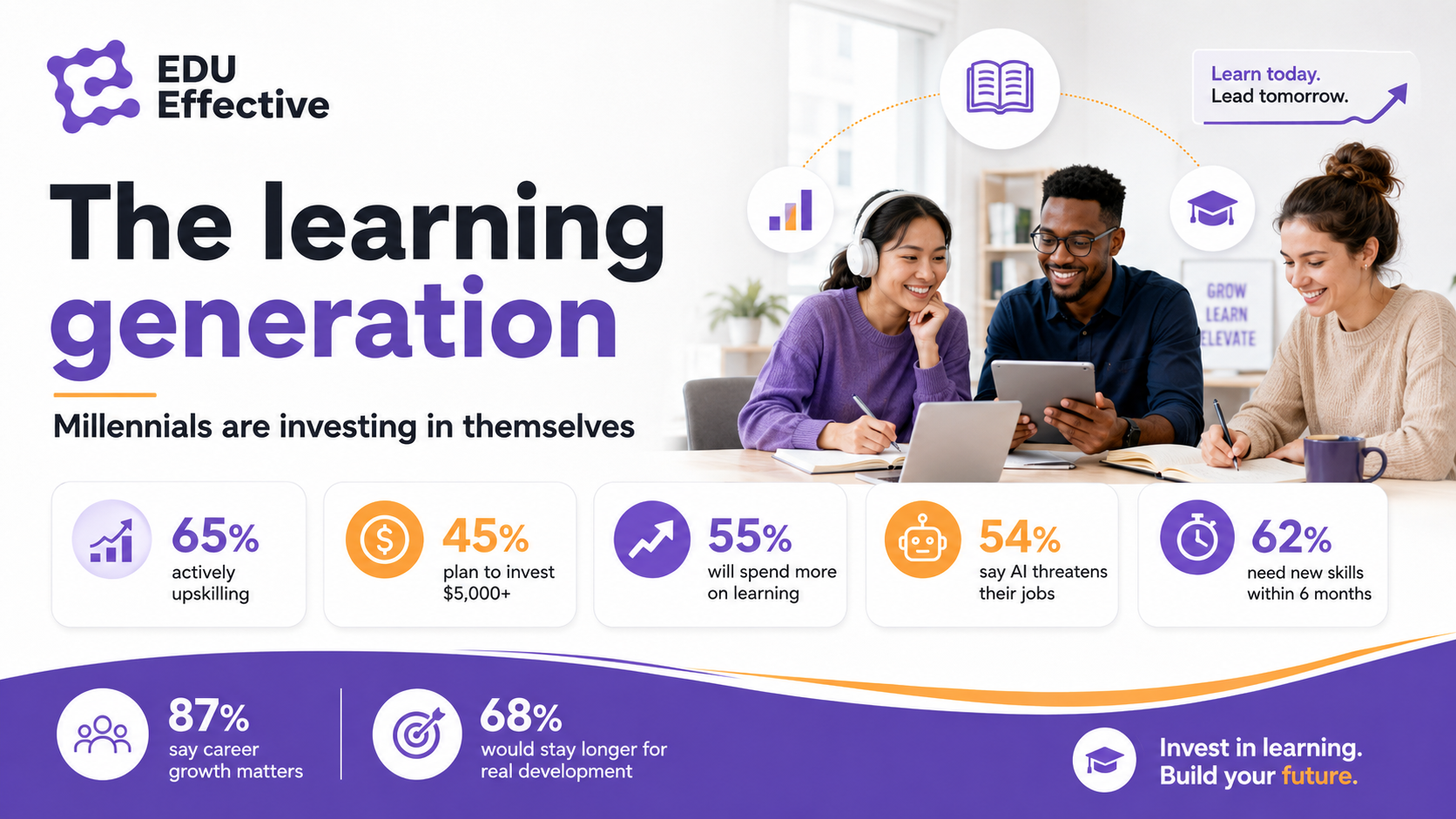
According to a 2025 edX survey of over 1,000 working adults, 65% of millennials are actively upskilling — the highest rate of any generation. 45% plan to invest more than $5,000 in professional development this year alone. 55% expect to spend more on learning and training in 2025 than they did in 2024.
The motivation behind this is partly economic anxiety. 54% of millennials believe AI poses a threat to their jobs, a significantly higher proportion than Gen Z at 39%. 62% say they will need to begin upskilling within the next six months just to maintain employment. This isn't abstract concern — it's a generation that has already lived through one major economic disruption and is determined not to be caught unprepared by another.
But the data from Deloitte's 2025 Gen Z and Millennial Survey — which surveyed more than 23,000 participants across 44 countries — adds an important layer. For millennials, learning and development consistently ranks among the top three reasons for choosing an employer, alongside work-life balance and career progression opportunities. 87% say professional development or career growth is very important to them. 68% say they would stay at a company for more than five years if it offered genuine career development.
This is not a generation waiting for someone to invest in them. It's a generation that will invest in themselves — and expects their employers to meet them halfway.
What actually defines how millennials work and buy
The standard trait lists — tech-savvy, collaborative, purpose-driven — are accurate enough but too abstract to be useful. Here is what actually matters for anyone managing, hiring, or marketing to this cohort.
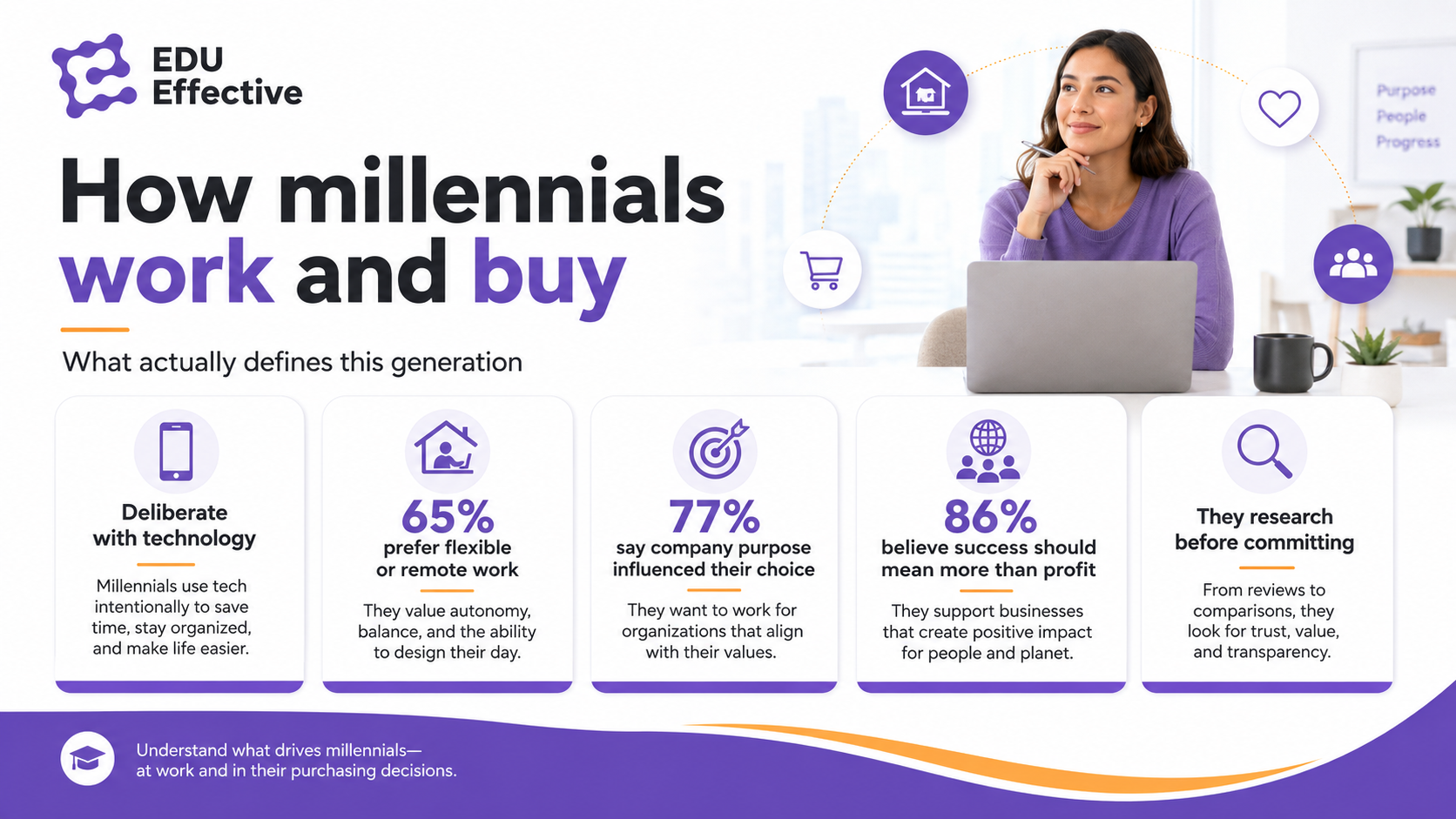
They adopted technology deliberately, not instinctively. Millennials got smartphones and social media as adults. They use digital tools purposefully rather than compulsively — a real distinction from Gen Z, who were shaped by those tools from childhood. This makes them effective with technology without being defined by it.
Flexibility is a non-negotiable. Around 65% prefer flexible or remote work arrangements. This isn't a preference — for many, it's a condition. The pandemic solidified what was already a strong tendency. Employers who treat flexibility as a perk rather than a baseline will struggle to attract and retain millennial talent.
Purpose is scrutinised, not just stated. Millennials drove the shift toward corporate social responsibility and purpose-driven branding in the first place. By now, they've been exposed to enough hollow mission statements that they've developed a sharp nose for authenticity. 77% say a company's purpose was part of why they chose to work there. 86% believe business success should be measured by more than profit.
They research before committing. Whether it's a product, a programme, or a job offer, millennials investigate thoroughly before deciding. Reviews, peer recommendations, and credible evidence of outcomes matter far more than polished marketing copy.
Millennials vs Gen Z: the distinction that matters for marketers
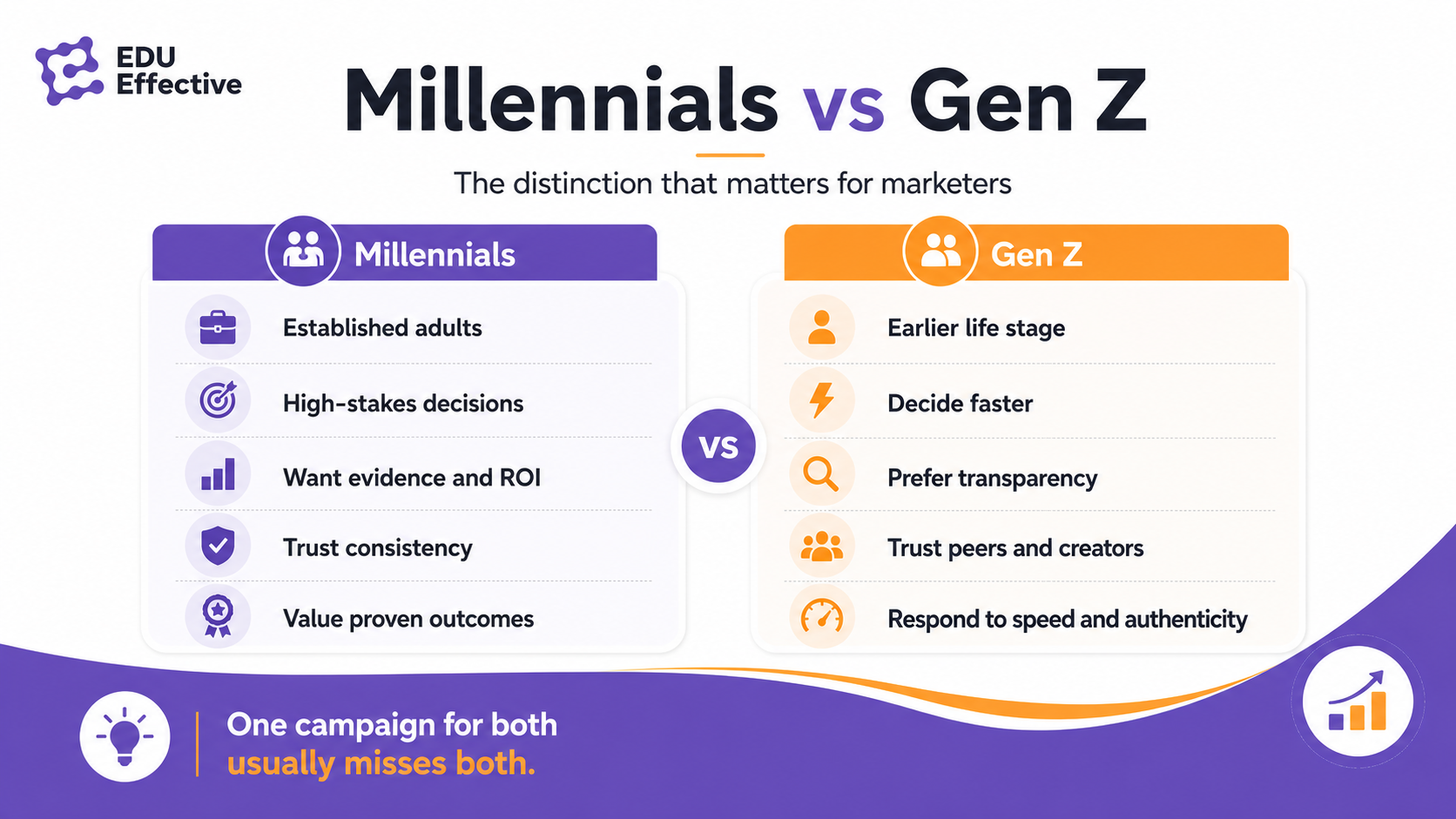
Treating millennials and Gen Z as interchangeable "digital generations" is one of the more expensive errors in contemporary marketing. They overlap in some values but diverge in ways that make a single campaign for both largely ineffective.
Millennials are established adults making high-stakes decisions — mortgages, career pivots, long-term financial planning, children's education. They respond to substance, proven track records, and value demonstrated over time. They trust brands that have shown up consistently, not brands that went viral last week.
Gen Z, currently between 14 and 29, are in a fundamentally different life stage. They reward speed, transparency — including the uncomfortable kind — and unpolished authenticity. They trust peer reviews and micro-creators over institutional brand voices. They decide faster and switch faster.
A millennial evaluating a professional development programme wants evidence: graduate outcomes, curriculum depth, real-world applicability, and honest trade-offs. A Gen Z prospect in the same funnel wants to know whether people they trust have used it and what they actually thought.
Both deserve tailored approaches. Neither benefits from being treated as "the young generation."
What this means for professional education specifically
The millennial upskilling surge isn't random. It's a response to a specific convergence: AI-driven job market disruption, accumulated career ambition, and a generation that already proved willing to invest in itself financially and in time.
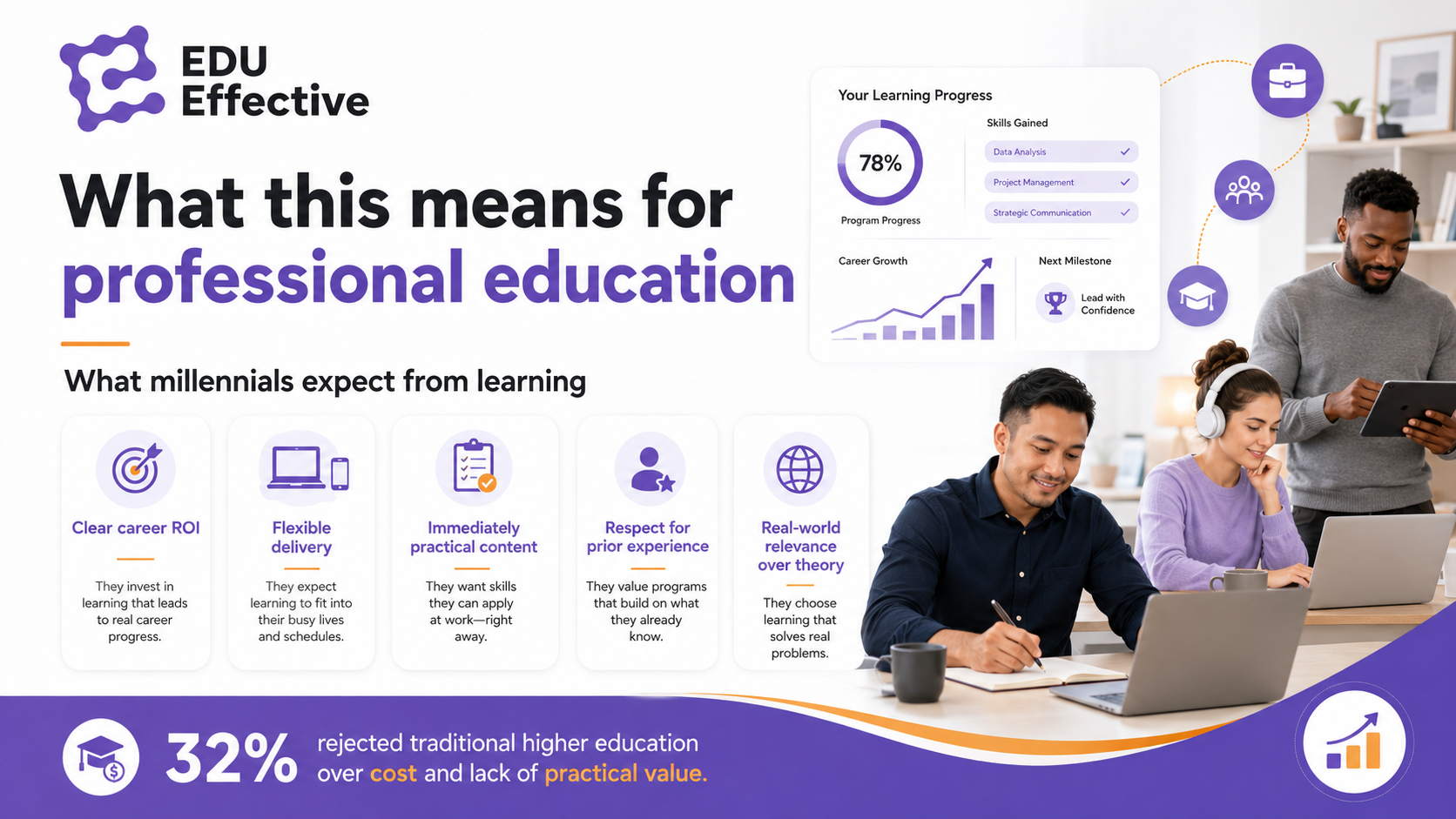
For education providers, this creates a clear profile. Millennials want programmes with demonstrable career ROI, flexible delivery that fits around established professional and family commitments, content that is immediately applicable rather than theoretical, and institutions that treat them as experienced adults bringing genuine prior knowledge to the room — not as blank slates to be filled.
The 32% of millennials who told Deloitte they decided not to pursue traditional higher education cited concerns about cost and, more pointedly, a scepticism about whether university education would give them enough practical experience to justify the investment. That's not anti-education sentiment. It's a high standard for what education should deliver. Meeting it is the real challenge — and the real opportunity.
At EDU Effective, we design programs for working professionals who need learning that fits real life and delivers real results.
EDU Effective Business School = professional development for your long-term success
All best-selling Effective MBA programs: Effective MBA: Executive Management & Leadership, Applied Artificial Intelligence, Coaching, Leadership & Mentoring, Mastery in AI, or Online Marketing, are based on the same educational model, which is beneficial for working adults: 15 minutes a day, 10 months or less, ASIC accredited, from €990.
These are professional programs, not academic ones — built for working adults to apply what they learn directly in their own business, not to collect a scholarly credential.
Join more than 9,000 students in over 120 countries around the world to further your personal development and career success.
You can read the feedback and experiences of our students and the stories of our graduates here.
The easiest way to start working on your personal development and success today:
Apply now — from €990 · Talk to a Study Advisor
Study with NO risk: 14-day money-back guarantee, no questions asked.
Sources
- RentCafe — Millennial Statistics: Everything You Need to Know About Generation Y
- WifiTalents — Millennials Workforce: Data Reports 2026
- Pew Research Center — Defining generations: Where Millennials end and Generation Z begins
- edX — Millennials Lead the Charge on Career Upskilling
- Deloitte Global — 2025 Gen Z and Millennial Survey
- Bank of America Workplace Insights — Gen Z, Millennials and the Meaning of Work