

Most managers negotiate constantly — and most of them don’t think of it that way. Budget conversations with the CFO. Resource requests across departments. Vendor contracts. Salary discussions with direct reports. Pushback on timelines from stakeholders. All of it is negotiation, and all of it produces better or worse outcomes depending on how it’s handled.
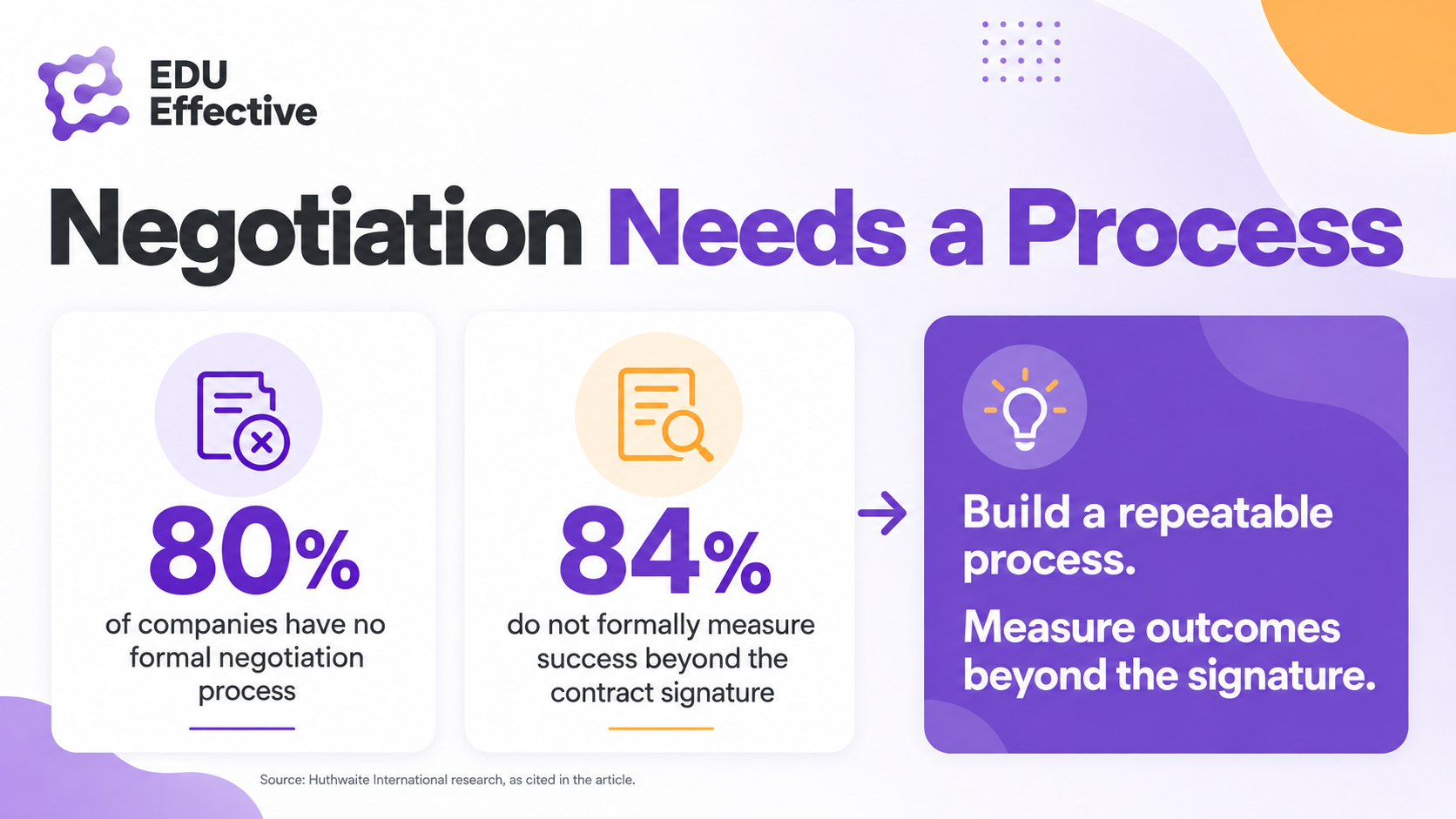
The uncomfortable data point: 80% of companies have no formal negotiation process, and 84% don’t formally measure success beyond the contract signature, according to Huthwaite International’s research. When there’s no process, individuals default to instinct — and instinct tends to be inconsistent, reactive, and easily influenced by whoever’s more comfortable in the room.
Negotiation skills are learnable. They’re also among the highest-leverage management capabilities — because a manager who negotiates effectively on budget, headcount, timelines, and contracts produces systematically better outcomes for their team than one who doesn’t, across every project they lead.
Why Negotiation Matters More Than Most Managers Realize
The assumption that negotiation is mostly a procurement or sales skill misses how often it appears in a general manager’s work.
Consider a single week: a conversation with HR about a compensation adjustment for a high-performer who has an external offer; a project scope discussion with a client pushing for deliverables outside the original agreement; a resource request to a peer whose team has capacity you need; a budget reforecast where you’re advocating for your team’s priorities against three other business units. Every one of those conversations has a structure, a dynamic, and an outcome that can be shaped — or left to chance.
Huthwaite International’s research found that companies with a systematic approach to sales and negotiation grew their bottom line 42.7% more than those without one. Businesses with no negotiation process saw an average net income decline of 63.3%. The gap is large because the effect compounds: every contract, every resource allocation, every partnership agreement produces a slightly better or worse outcome, and those small differences accumulate into material financial impact over time.
The Three Layers of Every Negotiation
Effective negotiators distinguish between three things that less effective negotiators conflate:
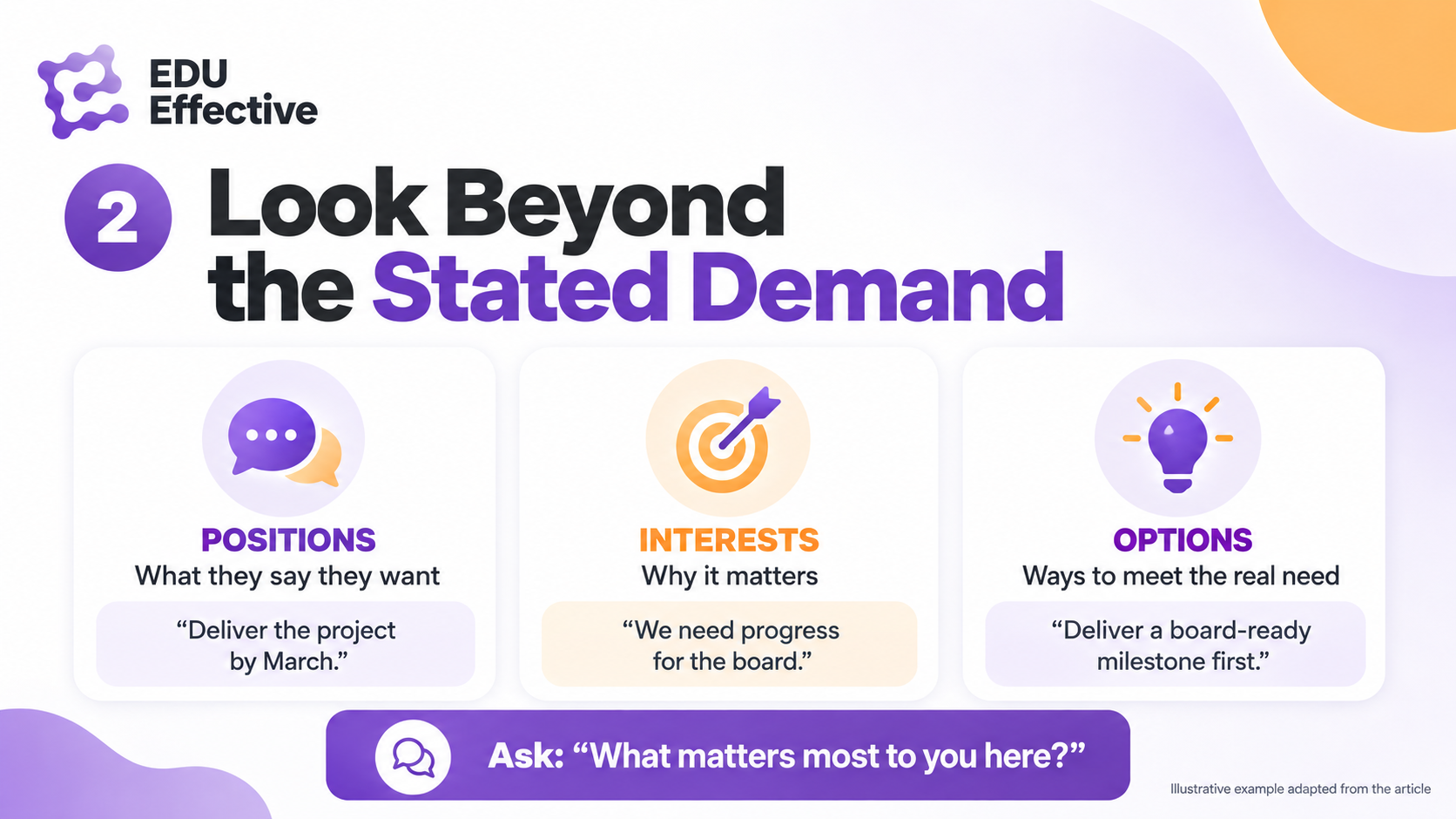
Positions are what people say they want. “We need a 20% price reduction.” “We need the project delivered by March.” These are the stated demands.
Interests are why they want it — the underlying needs, constraints, and motivations that the position is trying to address. The procurement team asking for 20% may actually need to hit a savings target this quarter; they might be flexible on timing or payment structure if it gets them there. The stakeholder asking for a March deadline may actually need a specific milestone ready for a board presentation — not necessarily the full project.
Options are the solutions that might satisfy the interests — not the positions — of both parties. The more options exist on the table, the more likely both parties can find an arrangement that genuinely works.
Most managers negotiate at the position level. They state what they want, the other party states what they want, and the conversation becomes a tug-of-war over a single dimension — usually price or time. Interest-based negotiation, developed by Roger Fisher and William Ury in their foundational work Getting to Yes at the Harvard Negotiation Project, reframes the conversation: instead of competing over positions, both parties explore what’s actually driving those positions and look for solutions neither side had initially considered.
In practice, this often starts with one question: “Help me understand what’s most important to you here.” That question alone changes the dynamic. It signals curiosity rather than combat. And the answer frequently reveals that the other party’s core concern isn’t the thing they led with.
Preparation: The Work That Happens Before the Room
85% of sales negotiators don’t establish what the other side wants upfront, and over 80% have no fallback plan, according to Scotwork’s survey research. These are the two most common preparation failures — and they’re both avoidable.
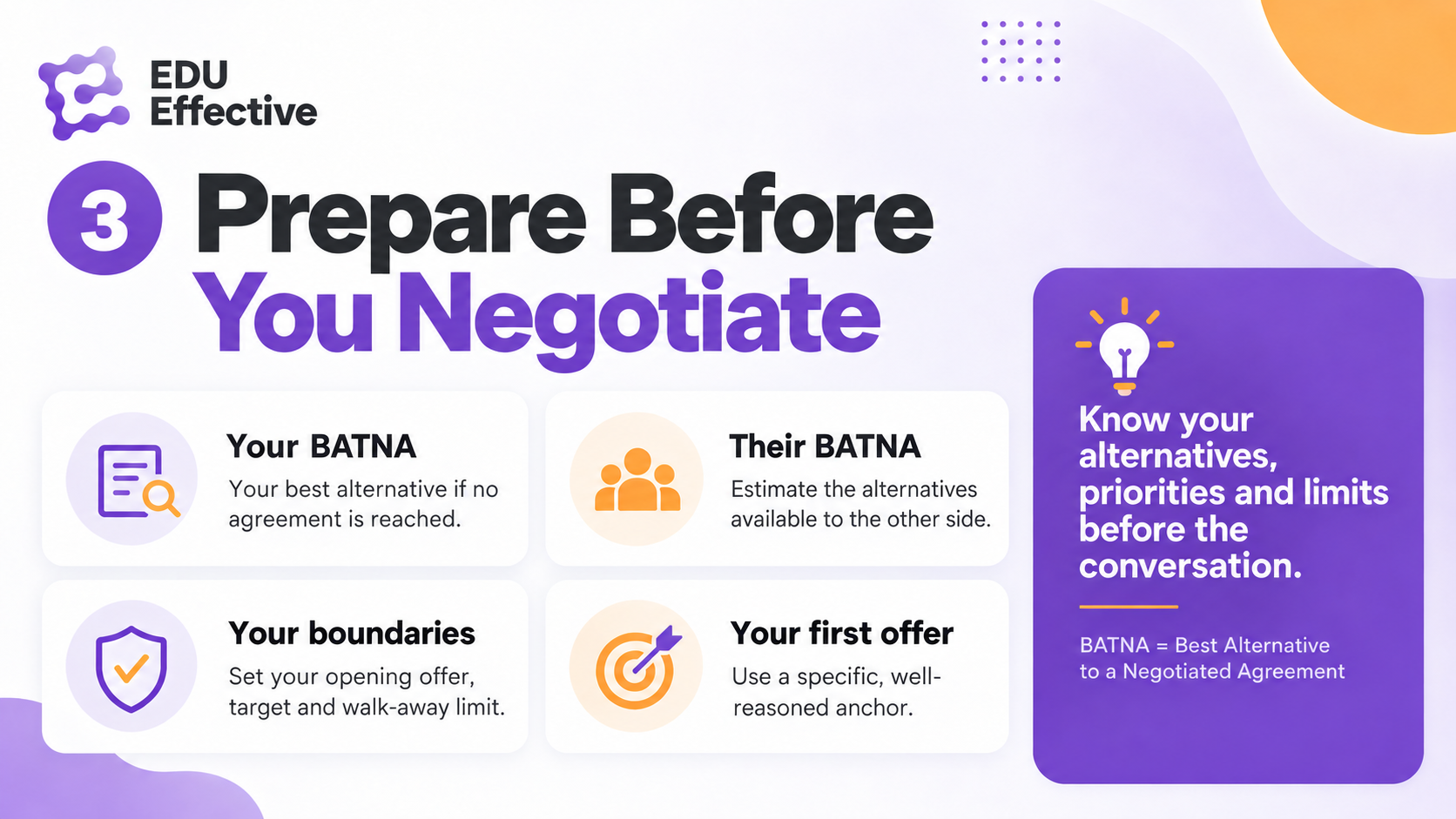
Know your BATNA. Your Best Alternative to a Negotiated Agreement is what you’ll do if this negotiation fails. It’s your walk-away point — and knowing it clearly determines how much pressure you can withstand and when walking away is actually the right decision. A manager who doesn’t know their BATNA often concedes more than necessary because they’re anxious about a failed negotiation without clarity on whether the failure actually matters.
Estimate their BATNA too. What happens to the other party if this negotiation doesn’t reach agreement? If their alternatives are weak, their position is weaker than it looks. If their alternatives are strong, you need to make this agreement compelling — not just acceptable.
Anchor first when you can. Research on anchoring is consistent: the first number put on the table disproportionately influences the final outcome. Cranfield University’s analysis found that up to 50% of outcome variance in negotiations may relate to the initial anchor. This doesn’t mean open with an extreme position — it means opening with a well-reasoned, specific number that frames the conversation around your range rather than theirs.
Know your settlement range. Your opening position, your target, and your walk-away point are three different numbers. Most managers are clear on their opening ask. Fewer have defined their real target and their genuine walk-away in advance. Without those two reference points, every concession feels like either holding firm or capitulating — with no framework for knowing which is which.
Four Negotiation Skills That Apply in Every Context
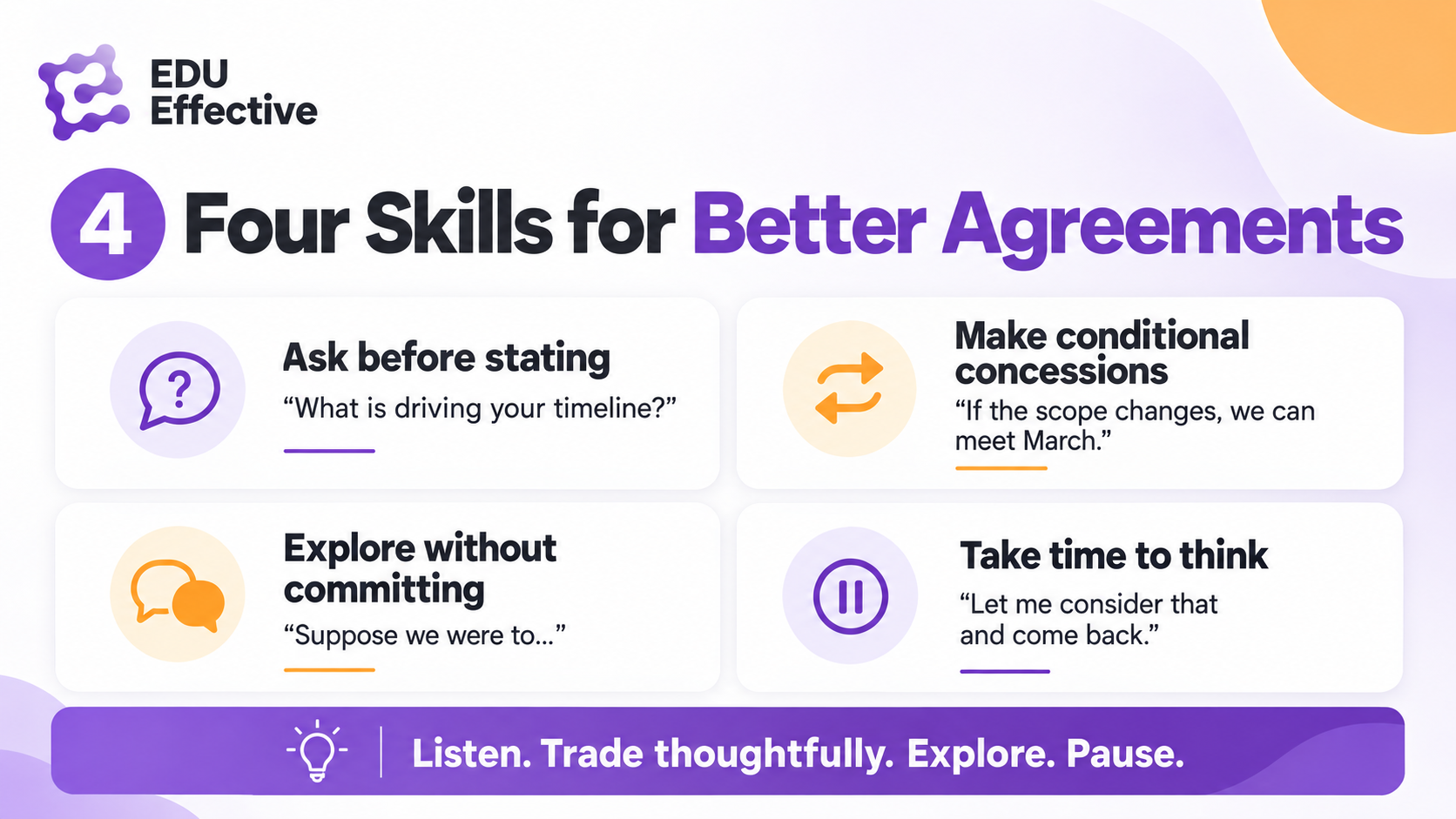
1. Asking Questions Before Making Statements
The instinct in high-stakes conversations is to present your case — argue your position, share your data, make the strongest pitch for what you want. The counterintuitive reality is that listening first is more powerful. The more you understand about what matters to the other party, the more precisely you can structure your proposal to address those concerns.
In practice: before presenting your position, ask two or three questions that surface the other party’s priorities, constraints, and concerns. “What’s driving the timeline on your end?” “What would make this an easy yes for you?” “What concerns do you have about the current proposal?” The answers aren’t just useful — the act of asking signals that you’re interested in a workable agreement, not just a win for your side.
2. Making Conditional Concessions
The most common concession mistake is giving something away without getting something in return. “We can do €50,000 instead of €60,000.” That’s a gift. It signals that there was room all along, it doesn’t create reciprocal movement, and it establishes a pattern where concession is one-directional.
Conditional concessions tie any movement to something in return: “If you can commit to a longer contract term, we can work on the pricing.” “If the scope comes down to X, we can hit the March deadline.” The condition doesn’t have to be a hard demand — it can be a question: “If we reduce the price, what can you do on volume?” The structure signals that every movement costs something and creates reciprocal pressure.
3. Signaling Without Committing
Effective negotiators use tentative language to explore options without being locked into them: “Suppose we were to...” “What if we explored...” “How would you feel about...” These phrases open space for creative options without creating commitments. They’re particularly useful when you want to test whether a creative structure might work without formally proposing it and being held to it.
This is distinct from being vague or evasive. The goal is to explore the solution space before narrowing to a specific proposal — not to obscure your actual position.
4. Knowing When to Pause
Scotwork’s research found that negotiators operating on their home ground claim 60% to 160% more value than the visiting party. Part of that advantage is comfort. Part is control over pace. A manager in a high-stakes negotiation who feels pressure to fill silence or respond immediately often concedes more than one who’s comfortable with pauses.
Asking for time to think is a legitimate and often underused move. “Let me consider that and come back to you tomorrow.” “I want to check one thing before I respond to that.” Pausing doesn’t signal weakness — it signals that you’re taking the conversation seriously enough to respond carefully.
Salary and Compensation Negotiations
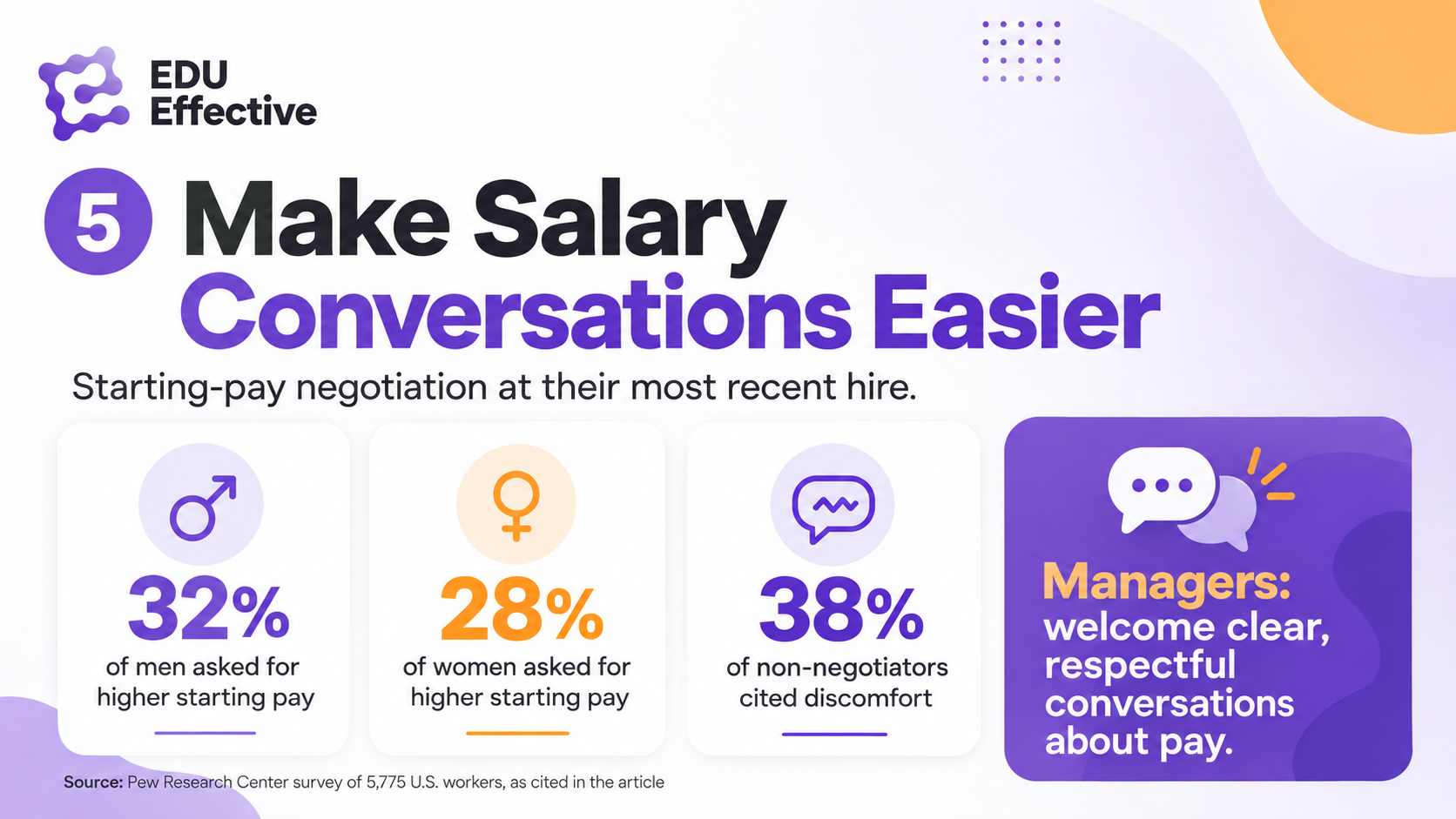
The Pew Research Center’s survey of 5,775 U.S. workers found that most people don’t negotiate their starting salary at all — only 32% of men and 28% of women asked for higher pay the last time they were hired. Among those who did ask:
- 28% got exactly what they asked for
- 38% got more than the initial offer, but less than they requested
- 35% got only the initial offer
The most cited reason for not asking: 38% didn’t feel comfortable. Among workers aged 18-29, 46% cited discomfort as the reason — compared to just 19% of workers over 65.
The discomfort is real. It doesn’t make it rational. 73% of employers expect candidates to negotiate, according to tryapt.ai research. 53% are open to negotiating entry-level pay. The asymmetry is striking: most employers anticipate the conversation; most candidates avoid it.
For managers overseeing compensation conversations with their own team, this data matters in the other direction. Employees who feel unable to negotiate are less likely to advocate for themselves — which means the manager who creates an environment where those conversations are welcomed, clear, and safe will retain talent that less accessible managers lose to offers they never had the chance to counter.
Negotiation in Internal Contexts
Most negotiation training focuses on external counterparts — clients, vendors, candidates. The conversations that affect managers’ day-to-day effectiveness most are often internal: budget allocations, headcount decisions, project priorities, timeline agreements with peer teams.
Internal negotiations have specific dynamics. Relationships are ongoing — you’ll work with this person again next quarter, which changes how aggressively you pursue your position. Formal authority is visible — if you’re negotiating with someone who has more organizational power, the pressure dynamics are different than in an arm’s-length commercial relationship. And the information is often shared — both parties know more about each other’s constraints and real priorities than external counterparts do.
The principles don’t change. Know your interests and theirs. Prepare your BATNA. Ask before you state. Make conditional concessions. What changes is the weight given to long-term relationship maintenance — because winning a resource allocation argument in a way that creates a lasting antagonist in a peer team is a poor trade.
Huthwaite’s research on complex negotiations found that average negotiation cycle times on large projects fell from 12-18 months to under eight weeks for 75% of deals after organizations introduced cross-functional collaboration and structured negotiation processes. The structural finding applies internally too: clarity of process reduces the time spent in ambiguous, uncomfortable conversations that drift without resolution.
What Managers Can Practice Now
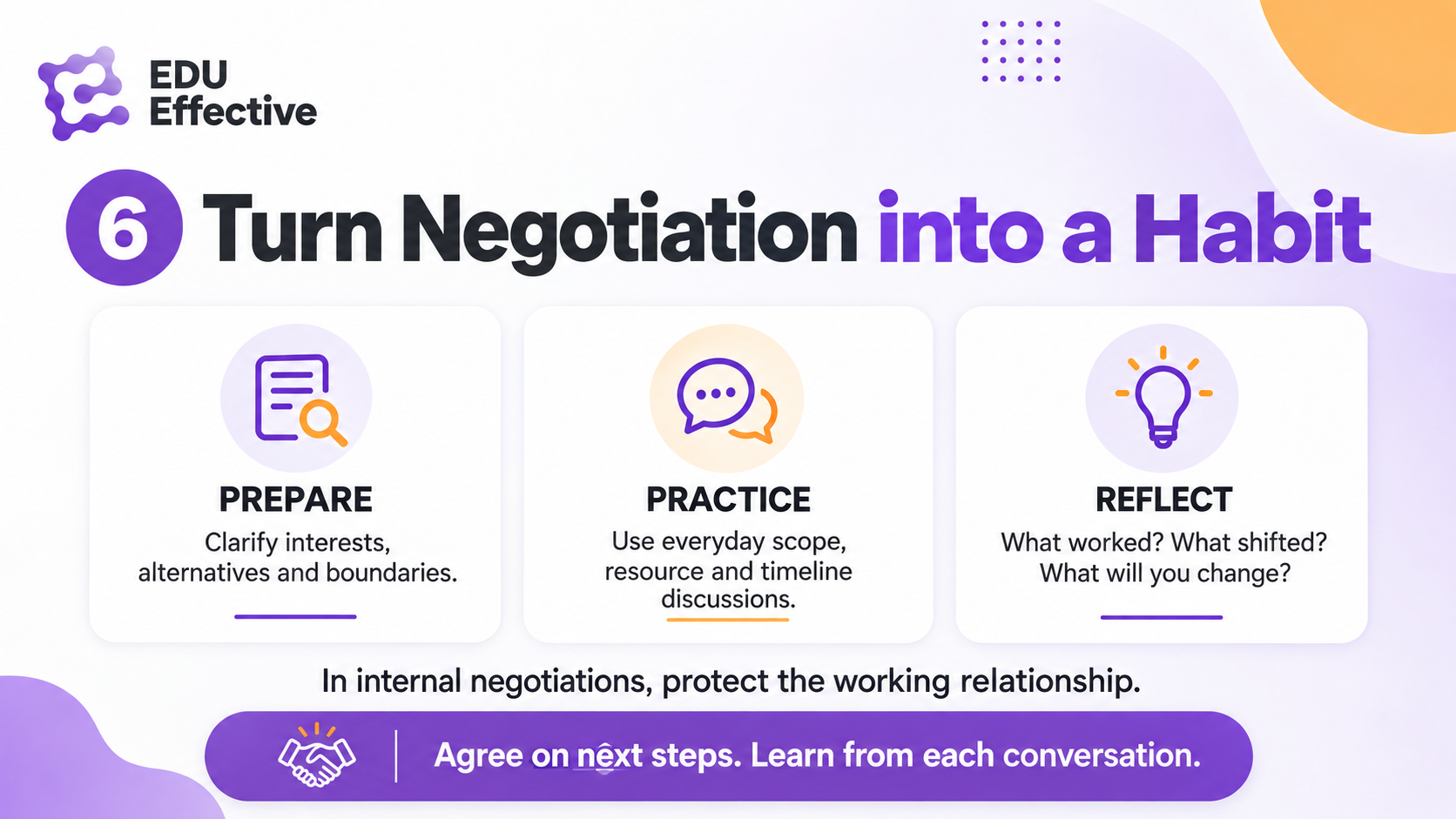
Negotiation skills improve with deliberate practice, not just exposure. A manager who negotiates frequently but never reflects on the dynamics, preparation quality, or specific moves used improves slowly. One who builds a reflection habit — what worked, what didn’t, what they would do differently — improves faster.
Three habits worth building:
Debrief every significant negotiation. What was their real interest? When did the conversation shift? What moved them — and what moved you? What would you change about your preparation? Five minutes of structured reflection after a significant conversation produces more development than any training seminar.
Prepare more than you think you need to. Research consistently shows that preparation is the highest-leverage variable in negotiation outcomes. Most managers treat it as optional. The ones who define their BATNA, estimate the other party’s BATNA, set their settlement range, and think through the likely dynamics before every significant conversation are the ones whose outcomes are consistently better.
Practice in lower-stakes contexts. The manager who only negotiates carefully in high-stakes situations never develops fluency. Treating everyday conversations — renegotiating a meeting time, discussing project scope adjustments, pushing back on a vendor on a routine contract — as practice opportunities builds the automatic patterns that matter when the stakes are high.
Key Takeaways
Negotiation skills are among the highest-leverage management capabilities — yet 80% of companies have no formal negotiation process and most managers rely on instinct rather than preparation. The skills that differentiate effective negotiators: separating positions from interests, knowing your BATNA before every conversation, anchoring first when you can, asking before stating, making conditional rather than unilateral concessions, and being comfortable with pauses. The Pew Research Center data on salary negotiation — where 38% of people cite discomfort as the reason for not asking — points to the core challenge: negotiation skill is as much about the psychological comfort to have the conversation as the tactical knowledge to conduct it well. Both improve with deliberate practice. The managers who invest in developing this capability systematically outperform those who don’t — across budget cycles, vendor relationships, team retention, and organizational influence.
About EDU Effective Business School
The Effective MBA: Executive Management & Leadership is built around the decisions managers actually face every week. Runs on 15 minutes a day, completes in 10 months or less and is ASIC accredited.
Sources
- Pew Research Center www.pewresearch.org
- Huthwaite International huthwaite.com
- Scotwork — Negotiation Statistics and Survey Data scotwork.co.uk