
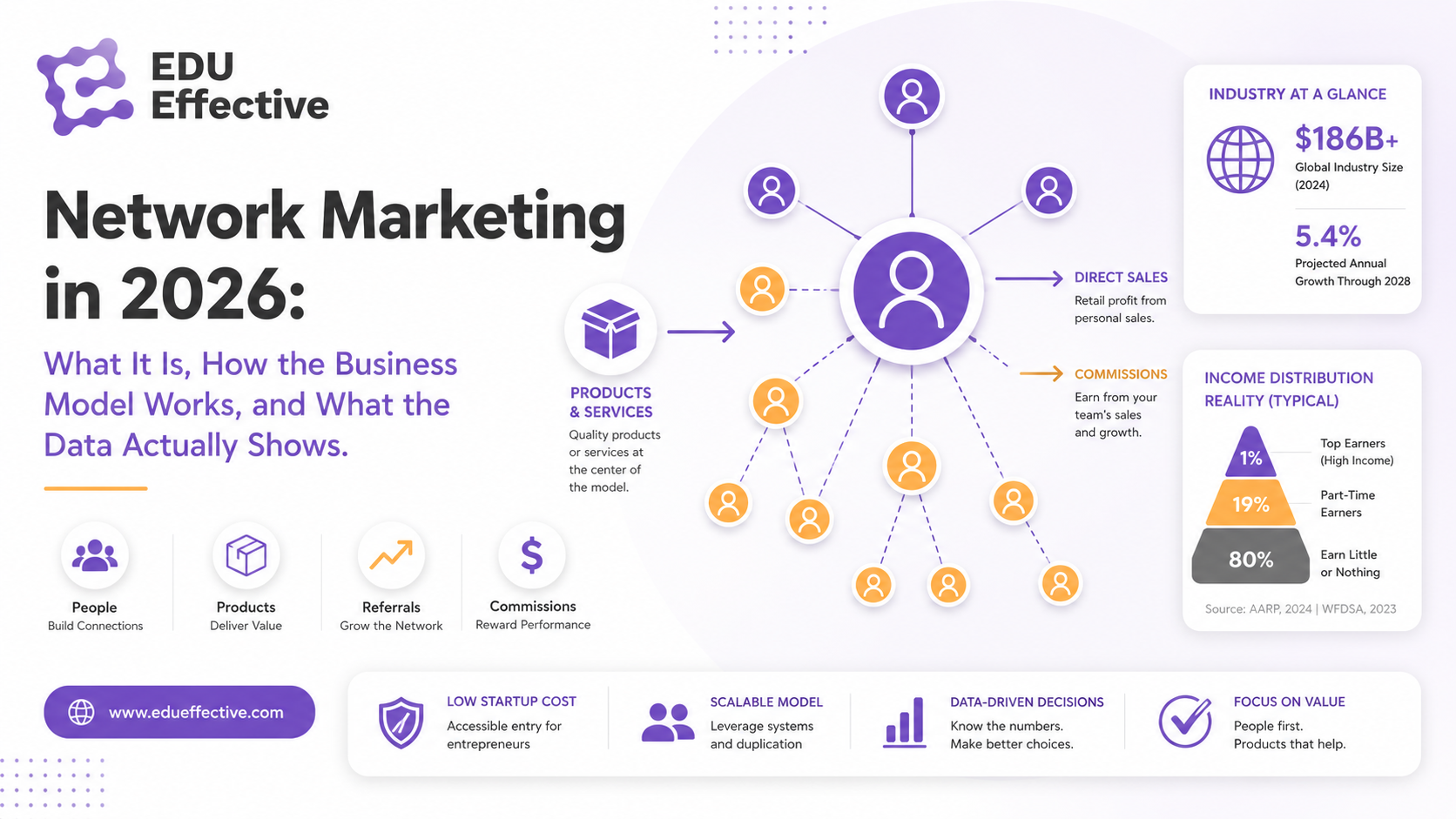

Network marketing generates stronger opinions than almost any other business model — enthusiasm from those who have built income through it, scepticism from those who have studied its income statistics. Both reactions are understandable. The model has genuine structural advantages over traditional distribution, a global industry worth over $164 billion in retail sales, and a participation rate that makes it one of the most widespread forms of self-employment on the planet. It also has a documented problem with income distribution that any honest overview needs to address directly.
Here is what network marketing actually is, how it works, what the industry looks like in 2026, and what to weigh before getting involved.
What network marketing is — and what makes it different
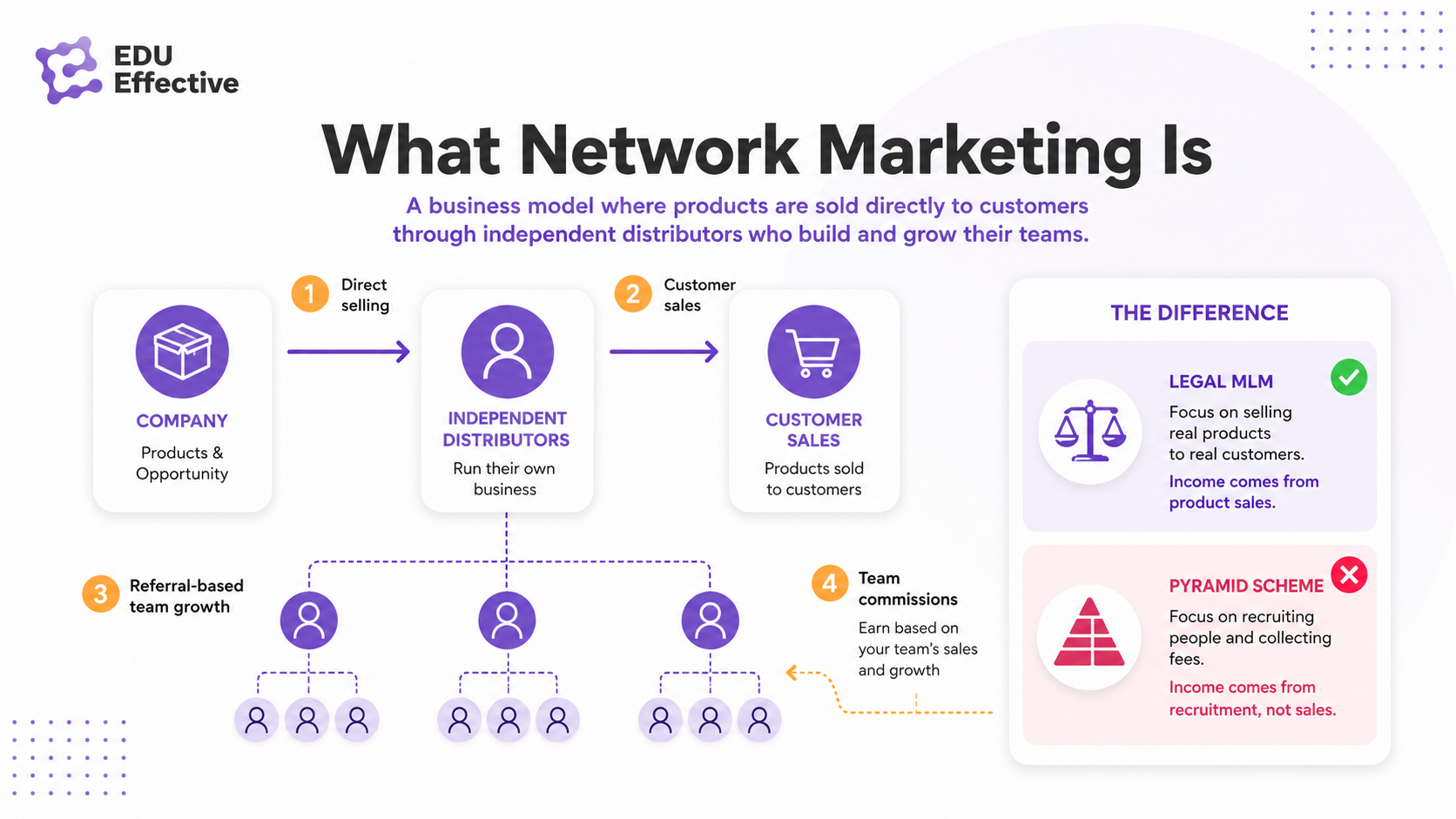
Network marketing — also known as multi-level marketing (MLM), direct selling, or referral marketing — is a distribution model in which a company sells products or services directly to consumers through a network of independent distributors, rather than through retail stores or traditional advertising channels.
The defining characteristic is the compensation structure. Distributors earn income in two ways: from selling products directly to end customers, and from commissions on the sales generated by other distributors they recruit into the network. This creates the multi-level structure that gives MLM its name — income can flow up through several levels of the network from the sales activity at the bottom.
From the company’s perspective, the model eliminates significant costs. Traditional retail margins, advertising spend, and distribution infrastructure are replaced by commissions paid directly to distributors. This is the source of the frequently cited claim that network marketing “removes the middleman” — though distributors themselves are, in effect, the new distribution layer.
The model is not a pyramid scheme, which is illegal in most jurisdictions. The legal distinction is meaningful: a legitimate network marketing company generates revenue primarily from actual product or service sales to end consumers. A pyramid scheme generates revenue primarily from recruitment fees, with little or no genuine product sales underlying the structure. Regulatory enforcement of this distinction has tightened across the US, EU, and Asia in recent years.
The global industry in 2026: scale, structure, and trends
The direct selling industry reported approximately $163.9 billion in global retail sales in 2024, the most recent comprehensive data available — representing a marginal increase over pre-pandemic levels. The industry operates across more than 170 countries with approximately 128 million people worldwide involved in direct selling, of whom around 87% work part-time.
The United States remains the world’s largest single market, generating $34.7 billion in annual direct selling retail sales — approximately 21% of global volume. Germany ranks second at $19.05 billion (12% of global sales), and China third at $15.55 billion (9%). Asia-Pacific as a region accounts for the largest share at approximately 40% of worldwide transactions, driven by health-conscious consumer behaviour and rising disposable incomes across China, India, and Southeast Asia.
By product category, services now account for the largest share of direct selling revenue globally at 38.4%, followed by wellness products at 30.7%, home and durables at 14.2%, personal care at 9.6%, and clothing and accessories at 4.7%. The health and wellness shift is the most significant structural trend in the industry over the past decade — traditional household products have given way to nutrition supplements, weight management products, and personal care lines with recurring consumption patterns.
The largest companies by revenue in 2026 include Amway (approximately $8.8 billion annually), Herbalife, Avon (now part of Natura & Co), Mary Kay, and eXp Realty — which has disrupted the real estate sector by applying a network marketing model to agent recruitment. EXP Realty recorded revenues of $4.6 billion, demonstrating that the model is expanding beyond traditional consumer goods into service categories.
How the network marketing business model works in practice
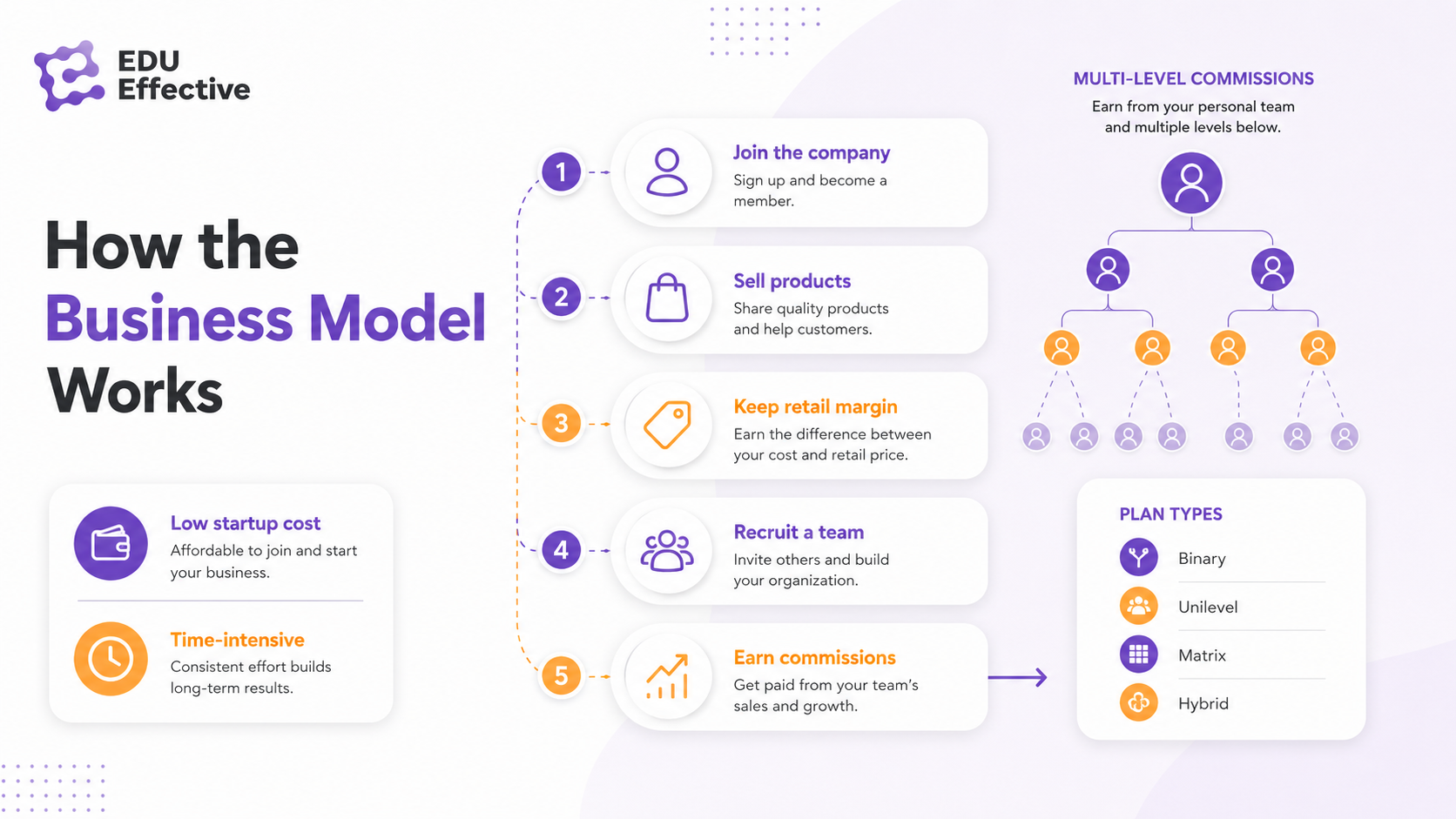
The operational mechanics are straightforward. An individual joins a network marketing company by registering as a distributor — typically for a modest fee and with an optional starter product package. They are then authorised to sell the company’s products at retail price, keeping the difference between the wholesale price they pay and the retail price they charge.
Simultaneously, they can recruit other distributors into the network. When those recruits make sales, the original distributor earns a percentage commission — and potentially earns percentages from the sales of distributors recruited by their recruits, down through several levels depending on the company’s compensation plan. The specific structure varies considerably between companies: some use binary plans (two legs), some use unilevel plans, others use matrix or hybrid structures. The compensation plan determines how income distributes across the network and should be studied carefully before joining any company.
Capital requirements are genuinely low compared to most forms of self-employment. There is typically no manufacturing, no retail lease, no significant inventory requirement, and no advertising budget. The primary investment is time — time to build customer relationships, time to recruit and support a team, and time to learn the products and company positioning.
The honest income picture — what the data shows
This is where any credible discussion of network marketing must be direct, because the statistics are unambiguous and routinely underemphasised by recruitment-focused content.
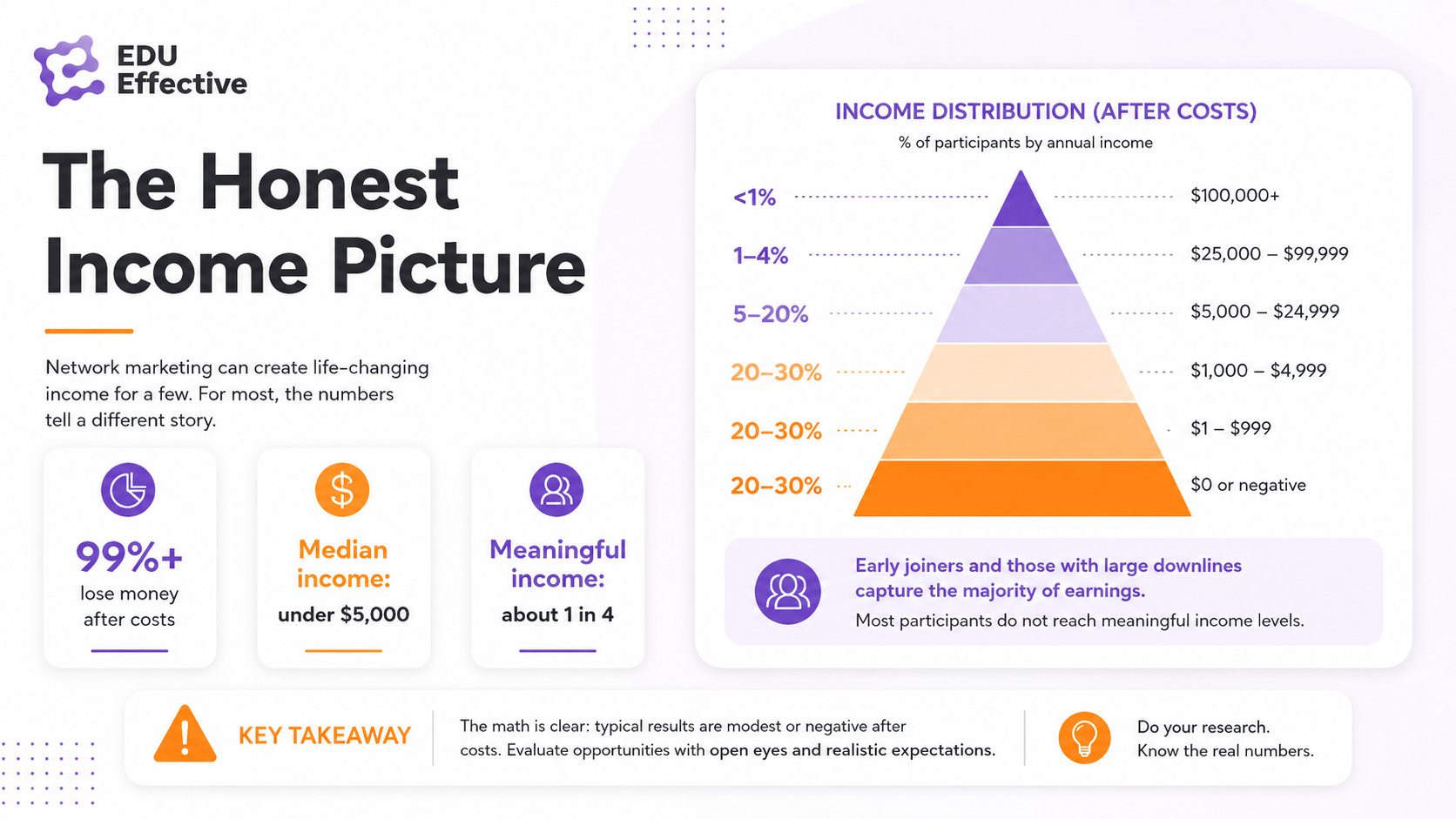
According to the US Federal Trade Commission, over 99% of people who join MLM companies lose money when costs are factored in. Separate DSA data indicates that only about one in four direct selling participants manage to generate meaningful income. The FTC’s analysis across multiple MLM companies found that the median annual income for participants is below $5,000, with a substantial proportion earning nothing or losing money on starter kits and product purchases.
The income concentration within most network marketing organisations is significant. The highest earners are overwhelmingly people who joined early, built large downlines before market saturation, and have compounding commission income from thousands of distributors below them. Joining a company that has already achieved scale in your market makes replicating that trajectory considerably harder.
This does not mean network marketing cannot generate income — the 128 million participants worldwide include many who earn meaningful supplemental income, and a smaller group who have built substantial businesses. It does mean that the proposition needs to be evaluated honestly against these base rates, not against the most successful examples that recruitment presentations typically showcase.

What makes network marketing work — when it works
The distributors who build sustainable income in network marketing share recognisable patterns. They typically start with genuine enthusiasm for the product itself — which makes customer acquisition natural rather than forced. They treat it as a business rather than a passive income source, dedicating consistent time to customer relationships and team support. They are selective about who they recruit, focusing on people with genuine interest in the product rather than maximising network size. And they operate in categories where the product creates recurring demand — health supplements, skincare, and other consumables that generate repeat purchases rather than one-time transactions.
In 2026, the distributors who are gaining the most traction are also building genuine audiences through content — blogs, social channels, and community platforms — rather than relying solely on personal outreach. The shift toward digital community building has changed how the most effective network marketers operate, and companies have invested significantly in digital tools and training to support this transition.
Geographic expansion remains an advantage of the model. Companies with international reach allow distributors to build networks across borders in ways that traditional sales roles rarely permit.

Network marketing vs. traditional marketing: the structural difference
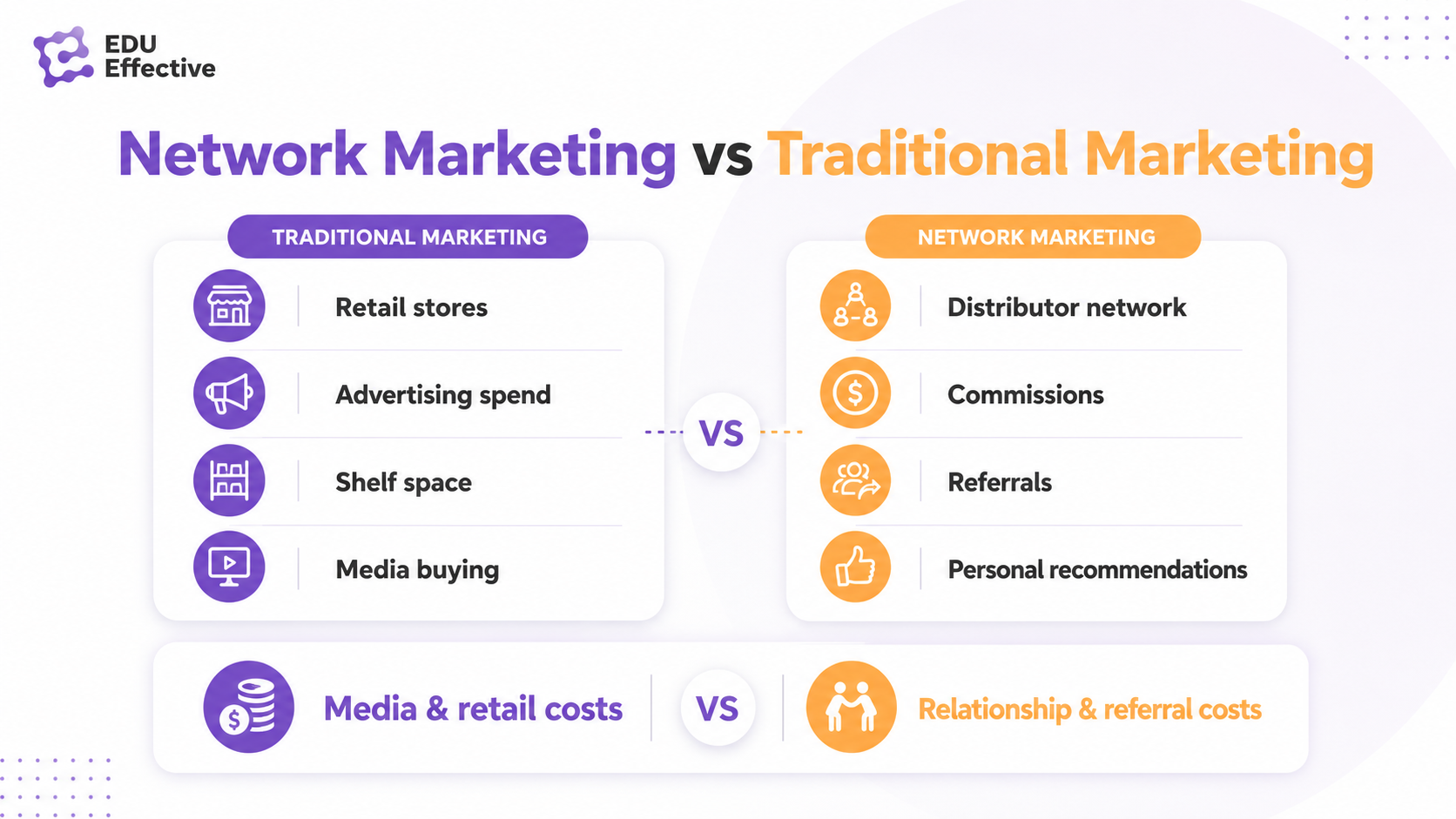
Traditional marketing moves products through retailers and distributors, with advertising budgets creating awareness and pull demand. Network marketing replaces both the retail layer and the advertising budget with a commission structure paid to the people doing the selling. Each model has a different cost distribution: traditional marketing pays for media and shelf space; network marketing pays for human relationships and referrals.
For brands in categories where personal recommendation is a powerful purchase driver — nutrition, beauty, wellness, financial products — the network marketing model can be cost-effective at scale. The challenge is managing the quality of those recommendations: a distributor network with high churn and poorly trained participants can damage brand perception as effectively as it builds it.

Before joining a network marketing company: what to verify
If you are evaluating a network marketing opportunity, the questions that matter most are: What percentage of the company’s revenue comes from product sales to genuine end consumers, versus from distributor fees and starter kits? What does the income disclosure statement show — and how many active distributors fall into each income bracket? What is the distributor retention rate after 12 months? How saturated is the company in your target market?
A company that can answer these questions clearly and whose income disclosure statement shows a significant proportion of distributors earning meaningful income is materially different from one that deflects with success stories and growth projections.
Network marketing is a legitimate business model with a significant global footprint and genuine income potential. It is also a model where the gap between the promise and the typical outcome is wider than in most forms of self-employment — and where understanding that gap before committing is the most important piece of due diligence you can do.
At EDU Effective, our Effective MBA business programs cover the full range of business models — including their economics, their incentive structures, and how to evaluate them critically. Explore our programs →
EDU Effective Business School = professional development for your long-term success.
All best-selling Effective MBA programs: Effective MBA: Executive Management & Leadership, Effective MBA: Applied Artificial Intelligence, Effective MBA: Coaching, Leadership & Mentoring, Effective MBA: Mastery in AI, or Effective MBA: Online Marketing, are based on the same educational model, which is beneficial for working adults: 15 minutes a day, 10 months or less, ASIC accredited, from €990.
These are professional programs, not academic ones — built for working adults to apply what they learn directly in their own business, not to collect a scholarly credential.
Join more than 9,000 students in over 120 countries around the world to further your personal development and career success.
You can read the feedback and experiences of our students and the stories of our graduates here.
Apply now — from €990 · Talk to a Study Advisor
Study with NO risk: 14-day money-back guarantee, no questions asked.
Sources
- PassiveSecrets — 45+ Shocking Network Marketing Statistics & MLM Facts (2026) https://passivesecrets.com/multilevel-network-marketing-statistics/
- RevenueMemo — Network Marketing Statistics for 2026: A Comprehensive Analysis https://www.revenuememo.com/p/network-marketing-statistics
- EpixelMLMSoftware — Top 100+ MLM & Network Marketing Industry Statistics & Facts for 2026 https://www.epixelmlmsoftware.com/blog/100-mlm-statistics-2019
- TrueList — 36 MLM Statistics to Know in 2026 https://truelist.co/blog/mlm-statistics/
- Accio — 100 Top Selling Network Marketing Companies 2026 https://www.accio.com/business/100-top-selling-network-marketing-companies
- US Federal Trade Commission — Multi-Level Marketing Businesses and Pyramid Schemes https://consumer.ftc.gov/articles/multi-level-marketing-businesses-pyramid-schemes