
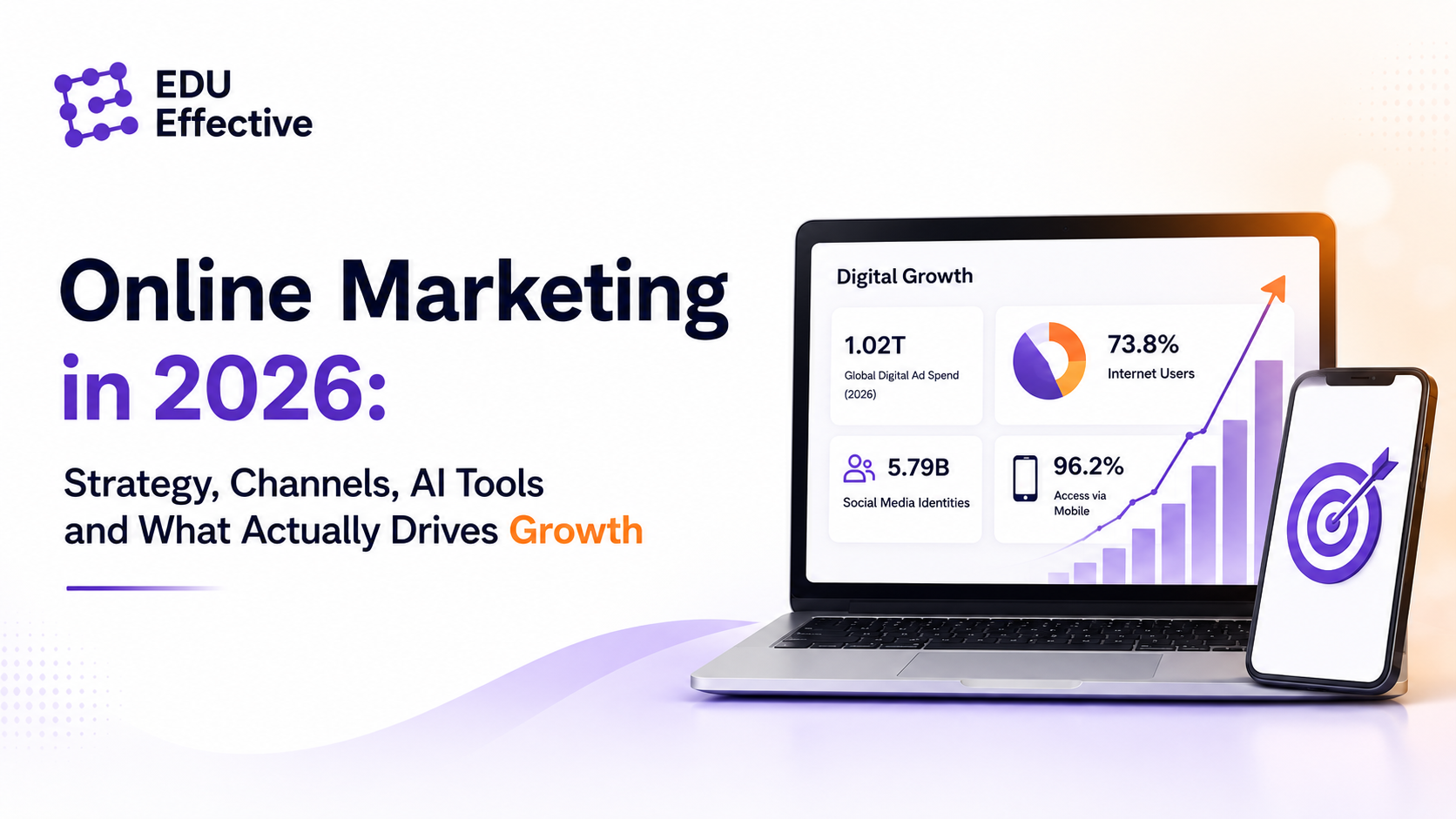

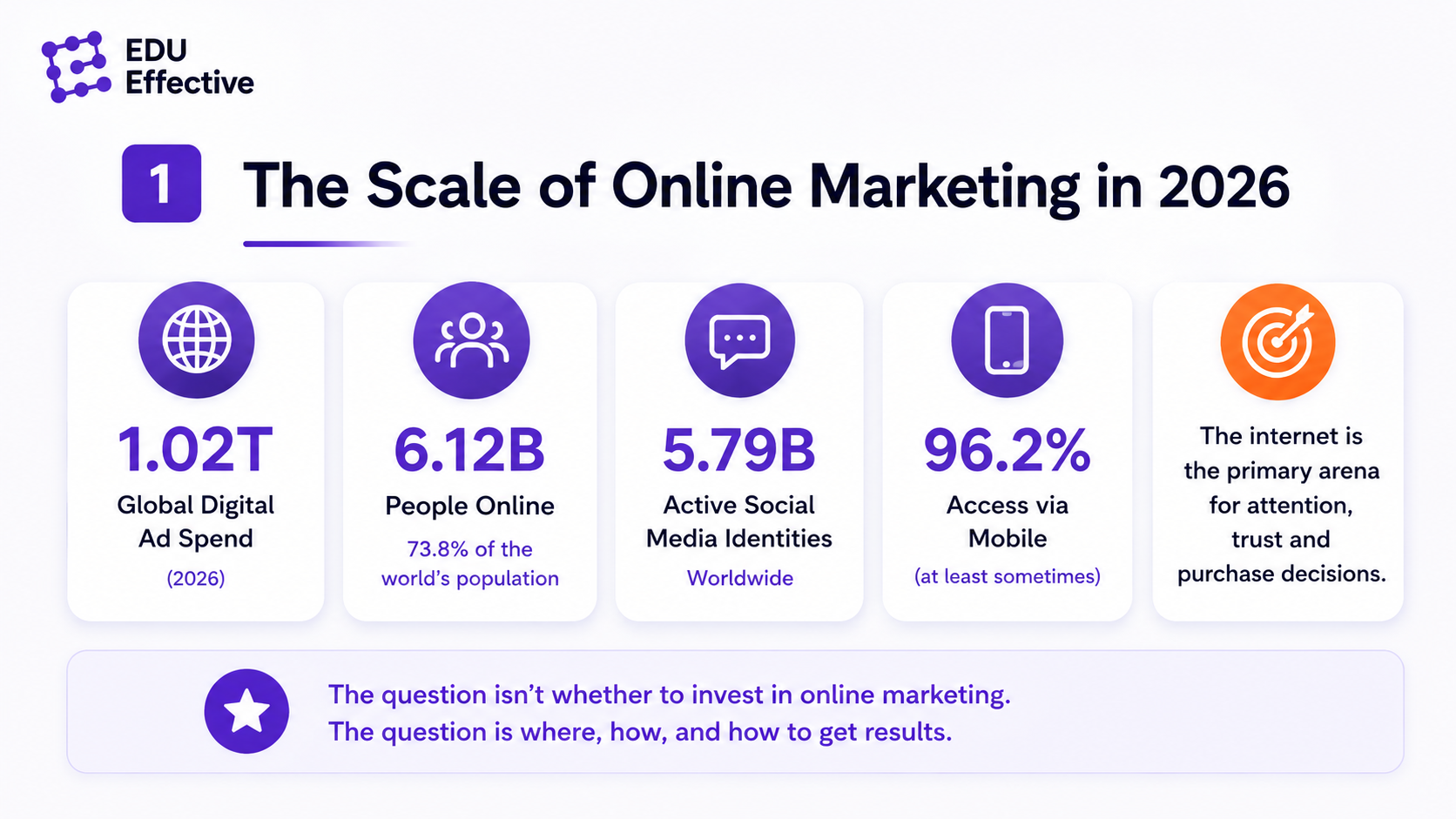
The scale of online marketing in 2026 is difficult to overstate. Digital advertising has crossed one trillion dollars globally. More than 6.12 billion people are online — 73.8% of the world's population. There are 5.79 billion active social media identities worldwide. And 96.2% of those internet users access everything through a mobile phone at least some of the time.
For any business trying to reach customers, build a brand, or generate revenue, the internet is no longer one channel among many. It is the primary arena where attention is won and lost, where trust is built or destroyed, and where purchase decisions are shaped — often before a customer ever contacts a company directly.
The question is not whether to invest in online marketing. The question is where to invest, how to measure results, and how to use the tools now available — particularly AI — to do it more intelligently than competitors who are spending the same budget less effectively.
What online marketing actually is
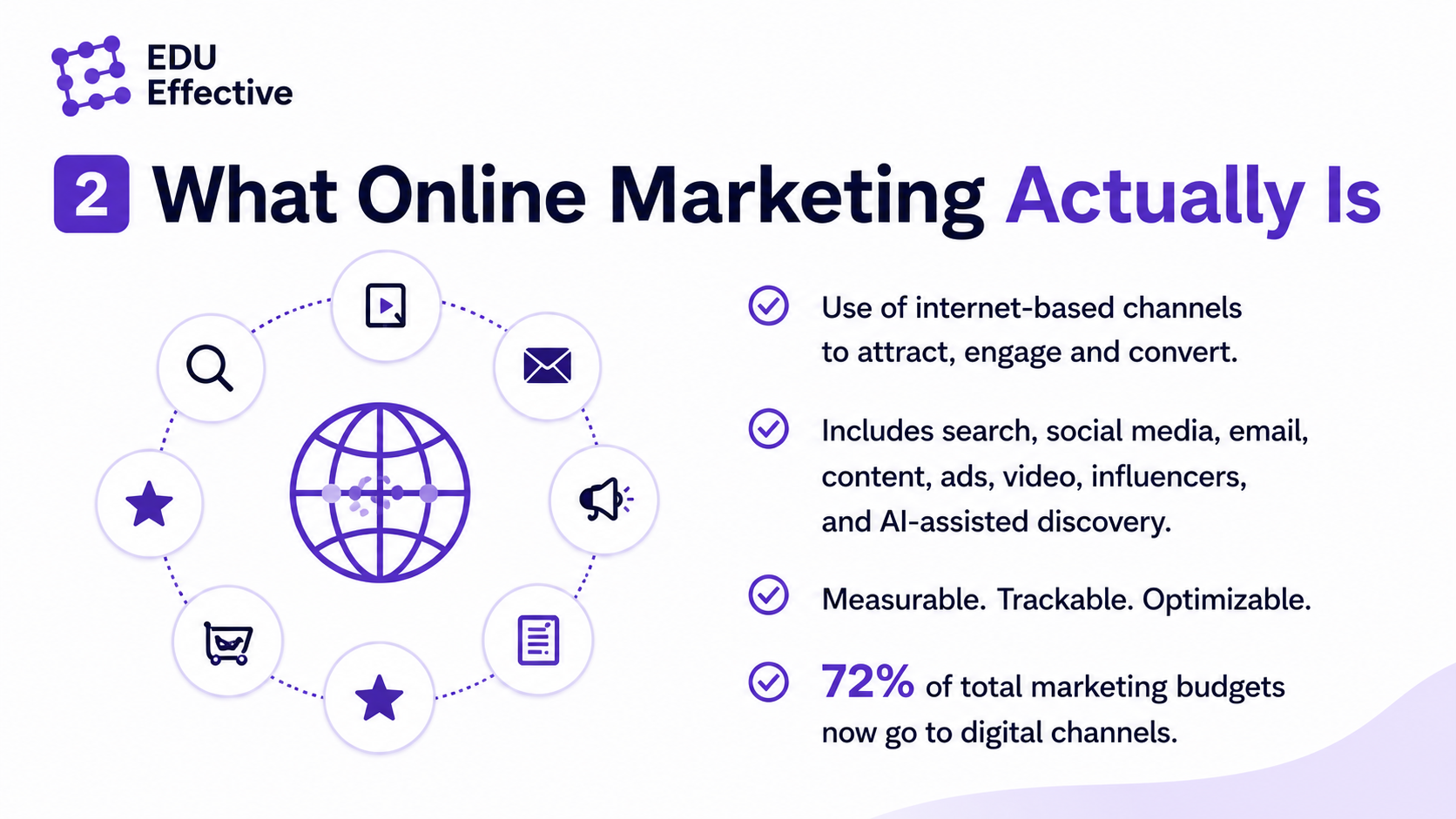
Online marketing is the use of internet-based channels and technologies to attract customers, communicate value, build brand relationships, and generate revenue. It encompasses every marketing activity that happens through or on the internet: search, social media, email, content, paid advertising, video, podcasts, influencer relationships, and the increasingly significant category of AI-assisted discovery.
The term is sometimes used interchangeably with "digital marketing." For practical purposes, both refer to the same discipline — the difference is primarily that "digital marketing" occasionally encompasses SMS and in-app advertising as well, while "online marketing" emphasises web-based activity specifically.
What distinguishes online marketing from traditional offline marketing is measurability and feedback speed. Every online marketing activity generates data: impressions, clicks, time on page, conversion rates, customer acquisition costs, lifetime value signals. This accountability has driven the dramatic shift in where marketing budgets go — 72% of total marketing budgets now flow to digital channels, a figure that continues to rise.
Marketing strategy: the foundation everything else depends on
Online marketing without strategy is expensive experimentation. The channels are so numerous, the tools so varied, and the metrics so abundant that it is entirely possible to be extremely busy across multiple platforms while generating little commercial result.
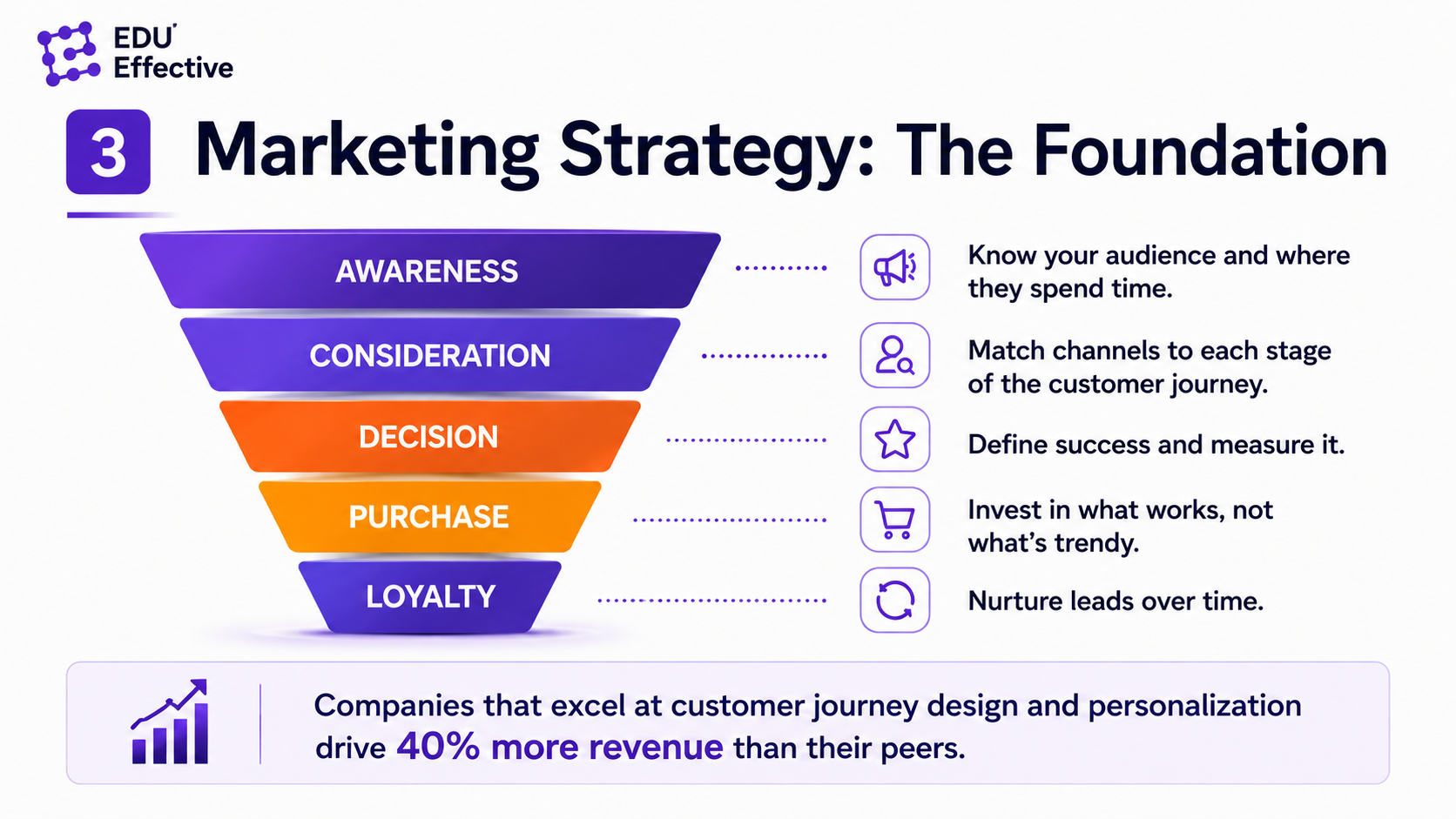
Strategy in online marketing means making deliberate choices: who the target customer is and where they spend their digital attention; what stage of the customer journey each channel is designed to influence; what success looks like and how it will be measured; and which channels deserve investment versus which ones are being pursued because they are fashionable rather than effective.
The customer journey — the sequence of stages from first awareness of a brand through consideration, decision, purchase, and repeat engagement — provides the structural framework for building a coherent marketing strategy. Different channels and tactics serve different stages. Social media and content marketing build awareness and familiarity. SEO and paid search capture intent at the consideration and decision stage. Email marketing and community engagement drive repeat purchase and loyalty. Understanding where each channel fits in this journey determines where budget and effort should go.
McKinsey's research consistently shows that companies excelling at customer journey design and personalisation drive 40% more revenue than peers — making strategic clarity about the journey one of the highest-ROI investments in online marketing.
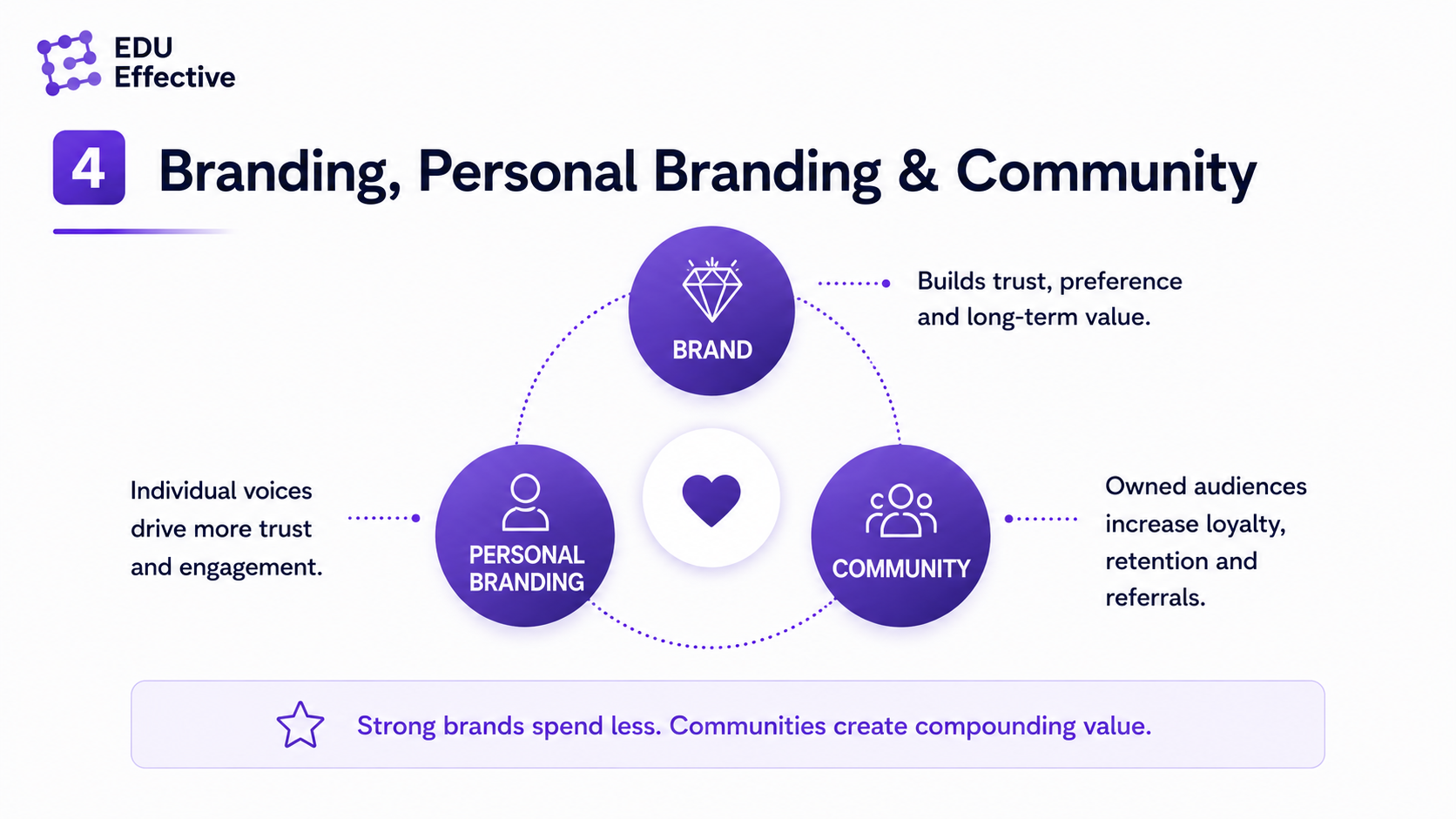
Branding, personal branding and community — the long-term assets
Online marketing can be divided into two broad categories: activities that produce immediate returns (paid advertising, promotions) and activities that produce compounding long-term returns (brand building, community, organic presence). The most durable competitive advantages in online marketing come from the second category.
Brand — the accumulated associations, trust, and preference that a company has built with its audience over time — determines how much any individual marketing activity costs and how effectively it converts. A strong brand reduces customer acquisition cost, increases conversion rates, improves retention, and commands price premium. The companies with the strongest brands spend less per customer acquired than those relying primarily on paid acquisition.
Personal branding has become particularly important in 2026 as trust has shifted from institutional to individual voices. Research consistently shows that content from individuals outperforms brand content on engagement. Leaders and professionals who build a credible personal presence — particularly on LinkedIn for B2B contexts — generate awareness and authority that no company page can replicate. LinkedIn drives over 80% of B2B social media leads and remains the dominant platform for professional relationship development and B2B brand credibility.
Community-building — creating an owned audience of engaged customers and prospects rather than renting attention from platforms — is one of the most strategically valuable investments available. Customers who participate in a brand community demonstrate measurably higher lifetime value, lower churn, and higher referral rates than those who interact only through transactional channels.
Social media marketing: where attention lives in 2026
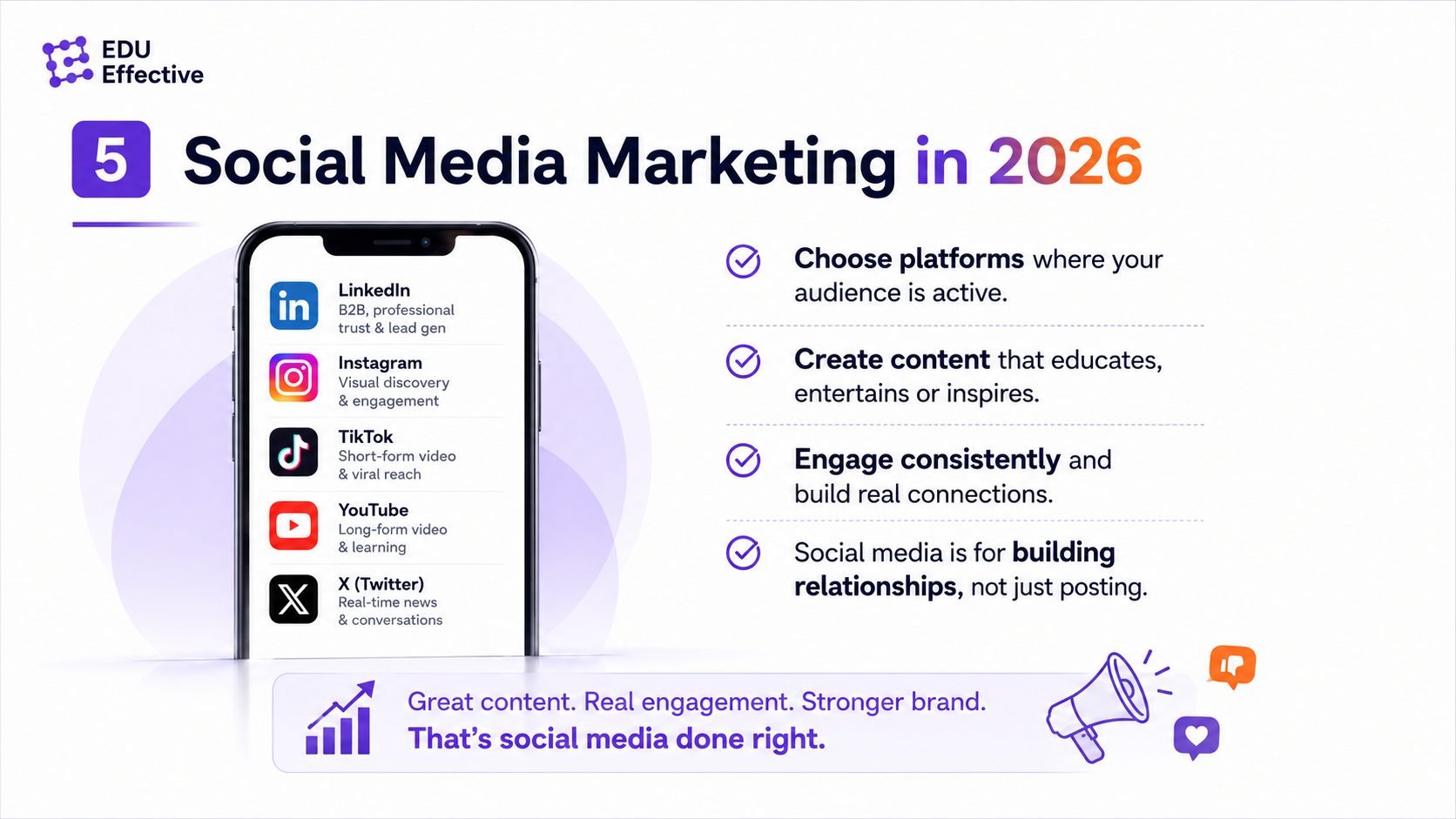
Social media is not a single channel but a diverse ecosystem of platforms, each with distinct user behaviours, content formats, and commercial mechanics. The 5.79 billion social media users worldwide are distributed across platforms that reward very different approaches.
Instagram and TikTok dominate short-form video and visual content, with brands running native checkout inside these platforms seeing conversion rate increases of 20–40% compared to link-based traffic. YouTube remains the primary platform for longer-form educational and product content. LinkedIn is the essential B2B and professional platform, where financial services brands see 45% higher engagement than on comparable platforms. Facebook, despite reduced cultural cachet, still reaches the broadest demographics and operates the most sophisticated paid social advertising infrastructure.
The dominant content format across platforms in 2026 is short-form video. Video content drives significantly higher engagement than static content across categories, and the ability to produce compelling short video — explaining a product, demonstrating expertise, sharing a perspective — has become a baseline marketing competency rather than a specialist skill. AI video tools have substantially reduced the production cost of professional-quality video content, making this format accessible to organisations that previously lacked production budgets.
AI-generated content is expected to account for 25% of branded social posts in 2026, as automation tools scale. The marketers capturing the most value are those using AI for efficiency — content ideation, drafting, formatting, scheduling — while preserving human authenticity and strategic judgement in what gets published and why.
Email marketing: the highest-ROI channel that consistently outperforms
Email marketing remains the highest-ROI channel in online marketing by a significant margin, delivering $36 for every $1 invested according to multiple independent research streams including Litmus and HubSpot. No paid channel consistently produces comparable returns.
The reason email outperforms on ROI is structural: it operates on an owned audience that has explicitly opted in, reaches subscribers directly without platform algorithm mediation, and enables personalisation at a depth that social advertising cannot match. Approximately 75% of marketers maintained or increased their email marketing investment in 2026, according to HubSpot's State of Marketing report — reflecting growing recognition of its commercial reliability relative to more volatile paid channels.
The most effective email marketing in 2026 is not broadcast — it is automated and personalised. Triggered email sequences that respond to specific customer behaviours (first purchase, cart abandonment, re-engagement thresholds, anniversary milestones) consistently outperform scheduled campaigns. Personalisation based on data customers have voluntarily shared — purchase history, stated preferences, engagement patterns — produces significantly better results than generic demographic targeting. Research from involve.me shows that personalised recommendations consistently outperform generic versions, leading to better engagement and higher average order values.
Email automation allows marketing teams to create the infrastructure of a relationship — a sequence of communications that builds trust, delivers value, and nurtures purchase intent — once, then deploy it at scale to every new subscriber who joins the audience.
Content marketing and SEO: the compounding organic channel
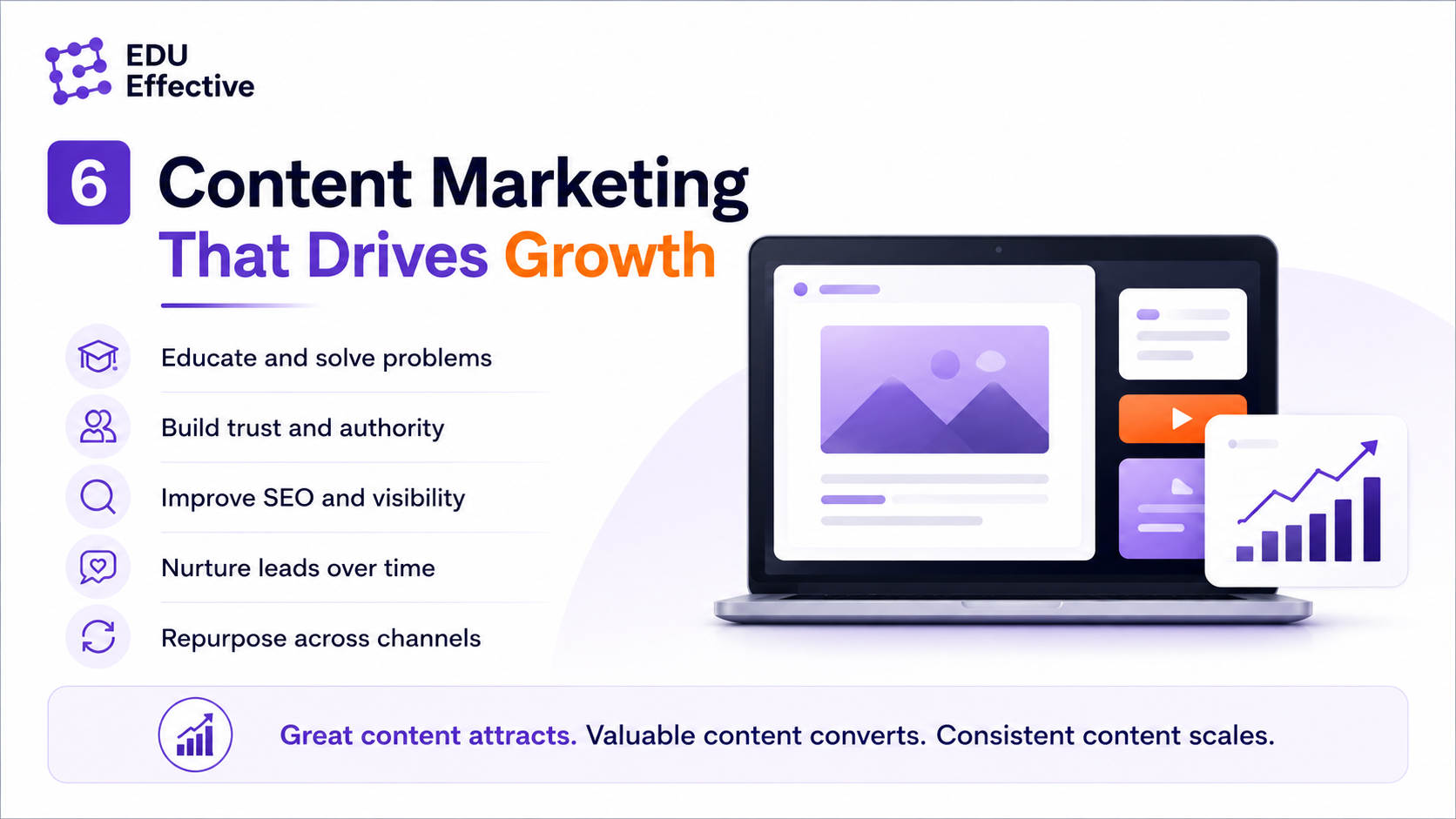
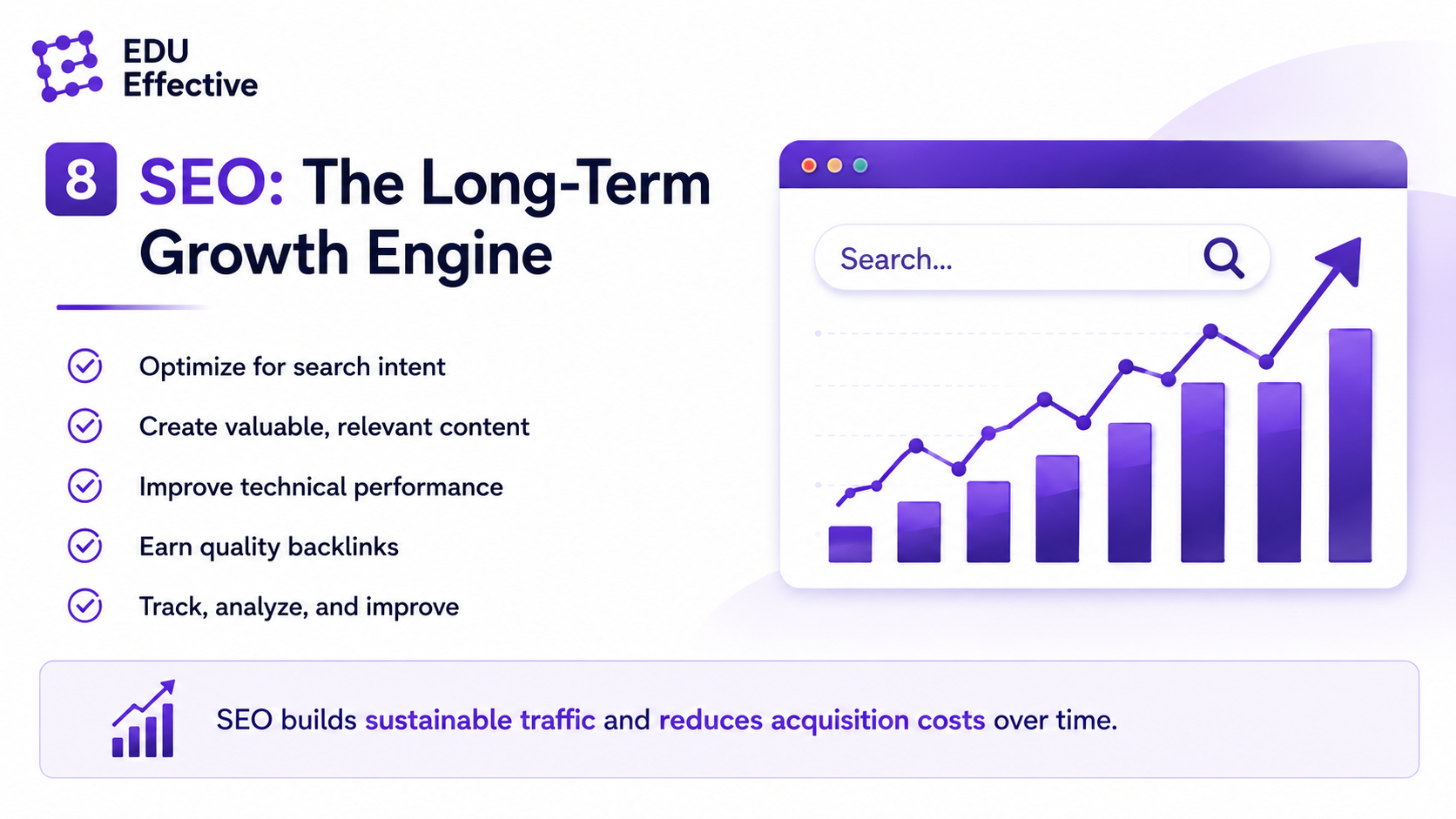
Content marketing — producing genuinely useful articles, guides, videos, tools, and other formats that answer the questions target customers are asking — is the primary mechanism for building organic search visibility and establishing topical authority that compounds over time.
SEO remains a foundational online marketing discipline, with 49% of marketing professionals identifying organic search as the single best-ROI channel, according to HubSpot research. A well-written piece of content that ranks for a relevant search query generates traffic continuously without ongoing cost — the opposite of paid advertising, which stops the moment the budget stops.
In 2026, content marketing and SEO have expanded to include a new dimension: generative engine optimisation (GEO). AI assistants — ChatGPT, Gemini, Perplexity, and others — are answering an increasing share of search queries directly, and the content they cite as sources generates AI referral traffic that converts at approximately 4.4 times the rate of traditional organic traffic. Gartner forecasts a 25% drop in traditional search traffic by 2026 as users accept synthesised answers. The content marketing teams that are adapting most effectively are building authoritative, specifically structured content that both ranks in search and earns citations from AI systems.
Almost 94% of marketers plan to use AI to support content creation in 2026, according to HubSpot's State of Marketing Report. The most effective approach uses AI for ideation, outlining, research acceleration, and formatting, while keeping human expertise, original perspective, and authentic voice at the core of the content itself.
Marketing analytics and data-driven decision-making
Online marketing's fundamental advantage over traditional marketing is measurability. But measurement is only valuable if it informs decisions — and in 2026, the gap between organisations that use data systematically and those that generate reports without acting on them is one of the primary drivers of performance divergence.
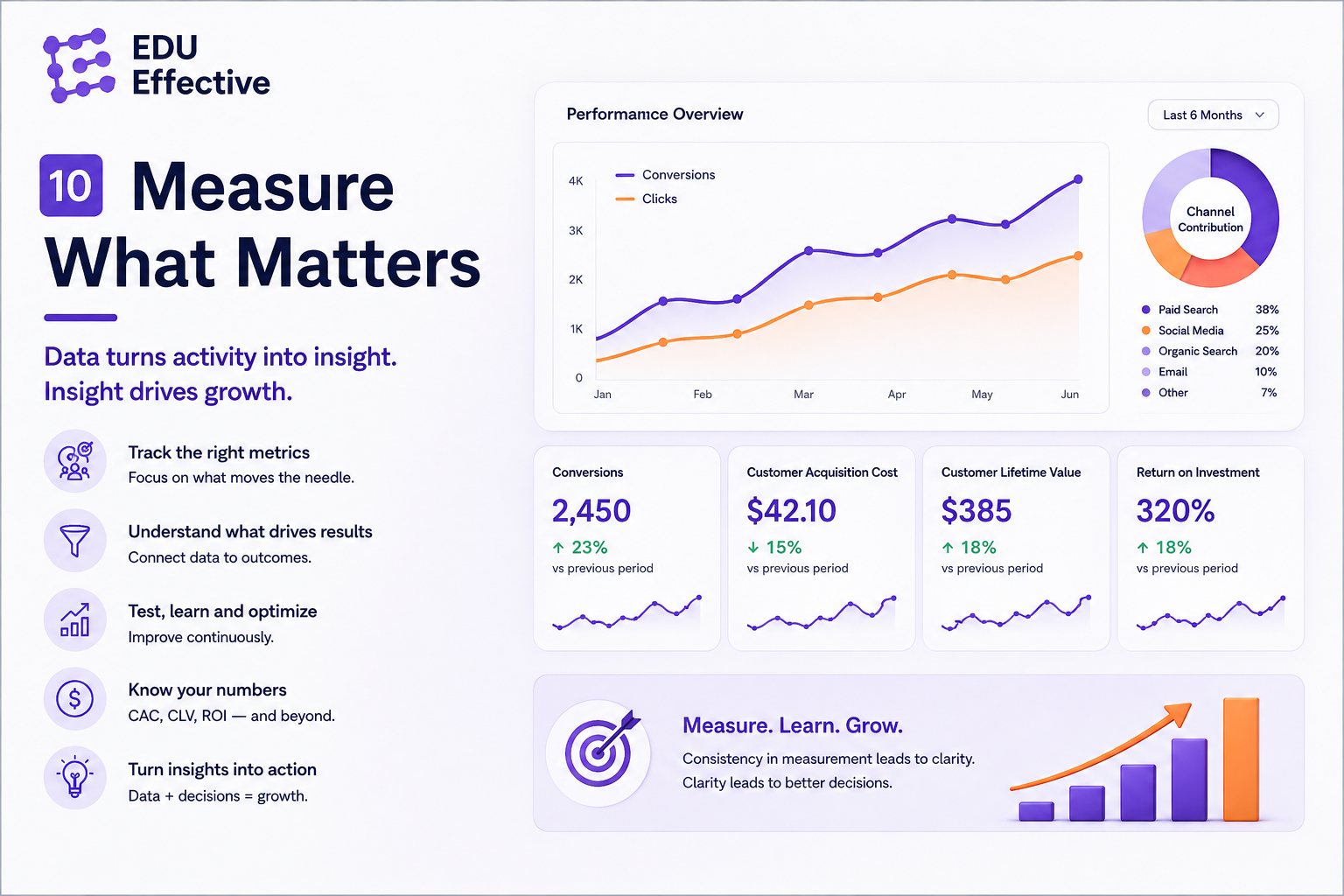
Marketing analytics at a strategic level means connecting marketing activity to business outcomes: tracking not just clicks and impressions but customer acquisition cost, customer lifetime value, marketing-attributed revenue, and return on marketing investment. These metrics connect what the marketing function does to what the business ultimately cares about — growth, margin, and competitive position.
Predictive analytics — using historical behavioural data and machine learning to anticipate future customer behaviour — has moved from enterprise-only capability to broadly accessible tool in 2026. Predictive models can identify which customers are likely to churn before they do, which prospects are most likely to convert, and which moments in the customer journey are the highest-leverage intervention points. Forrester's research shows that poor data quality reduces AI effectiveness by up to 40% — making data discipline not a technical issue but a marketing performance issue.
Podcast marketing: the underutilised long-form channel
Podcast marketing remains one of the most underutilised channels in online marketing relative to its effectiveness. Podcast audiences are among the most engaged and educated of any digital medium — they consume content for 30–60 minutes per episode, often during commutes or exercise when attention is undivided. The advertising recall and brand trust effects from podcast sponsorship consistently outperform equivalent spend on digital display advertising.
More significantly, branded podcasts — shows produced by an organisation around topics relevant to its target audience — build a depth of relationship with listeners that no other content format matches. A listener who spends 200 hours with a brand's podcast over two years has a different relationship with that brand than one who has seen 200 display ads. The challenge is production volume and distribution — both of which AI tools are significantly reducing the cost and complexity of in 2026.
AI in online marketing: from tool to infrastructure
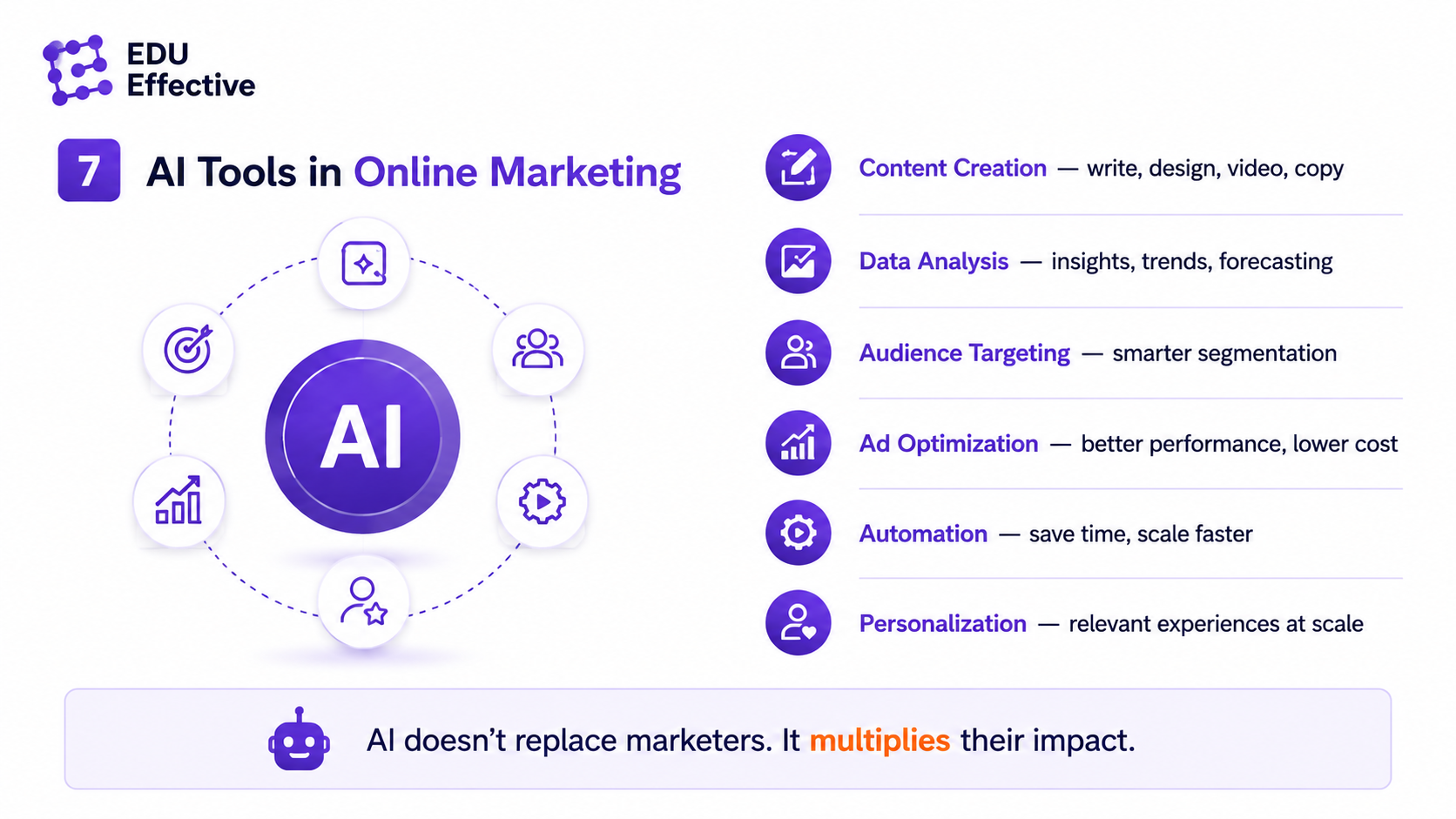
78% of marketers worldwide use AI tools in their daily workflow, according to HubSpot's 2026 State of Marketing report. 92% of Fortune 500 companies have integrated AI into at least one marketing process, according to Accenture research. AI in marketing has moved from experimental capability to operational infrastructure.
The marketing functions where AI delivers the most consistent value in 2026 are content creation and adaptation (drafting, reformatting, and personalising content at scale), campaign optimisation (automated bidding, audience segmentation, and creative testing), customer journey personalisation (real-time content selection based on behavioural signals), predictive analytics (churn prediction, CLV modelling, next-best-action recommendations), and performance reporting (automated dashboards and anomaly detection).
Gartner's 2026 marketing predictions show how AI agents and generative AI will continue to redefine channels, accelerate execution, and elevate the role of data. CMOs who modernise their data infrastructure, content governance, and operating models now will have structural advantages over those adapting reactively. The 67% of marketing AI implementations that fail do so primarily due to lack of clear business objectives — reinforcing that AI is an amplifier of good marketing strategy, not a substitute for it.
Ready to build your online marketing skills professionally?
If this article has clarified that online marketing in 2026 is a discipline of genuine breadth — connecting strategy, branding, social media, email, content, analytics, and AI into a coherent growth system — the Effective MBA: Online Marketing at EDU Effective is designed to build exactly these skills.
The programme covers all 10 dimensions of modern online marketing: strategic marketing and customer journey, branding, community and growth, principles of modern marketing, marketing analytics and data strategy, personal brand and audience growth, email marketing strategy and automation, podcast marketing and audience engagement, online marketing and AI strategy, customer strategy and predictive analytics, and strategic social media marketing. Content draws on insights from practitioners at Google, Microsoft, Amazon, LinkedIn, Meta, Nike, Mastercard, and many more — structured for immediate application.
At EDU Effective, we build programs for professionals who want to work smarter — not just harder. Explore our programs →
EDU Effective Business School = professional development for your long-term success.
All best-selling Effective MBA programs are built for working adults: 15 minutes a day, 10 months or less, ASIC accredited, from €990.
These are professional programmes, not academic ones — built for working adults to apply what they learn directly in their own business, not to collect a scholarly credential.
Join more than 9,000 students in over 120 countries who are investing in their professional development and career success.
Read the feedback and experiences of our students and the stories of our graduates here.
Apply now — €990 · Talk to a Study Advisor
Study with NO risk: 14-day money-back guarantee, no questions asked.
Sources
- Gartner — Marketing Trends 2026 https://www.gartner.com/en/articles/future-of-marketing
- Gartner — Mainstream Marketing Predicts 2026 https://www.gartner.com/en/documents/7295530
- McKinsey & Company — The State of AI 2025 https://www.mckinsey.com/capabilities/quantumblack/our-insights/the-state-of-ai
- HubSpot — State of Marketing Report 2026 https://www.hubspot.com/state-of-marketing
- Statista — Digital Advertising Worldwide 2026 https://www.statista.com/outlook/dmo/digital-advertising/worldwide
- Grand View Research — Digital Advertising & Marketing Market Size 2026 https://www.grandviewresearch.com/industry-analysis/digital-advertising-market-report
- Litmus — Email Marketing ROI: The State of Email 2026 https://www.litmus.com/blog/email-marketing-roi
- M+C Saatchi Performance — Key Performance Marketing Trends for 2026 https://www.mcsaatchiperformance.com/news/performance-marketing-trends-2026/
- Accenture — Pulse of Change (RESEARCH REPORT) https://www.accenture.com/us-en/insights/pulse-of-change
- World Economic Forum — Future of Jobs Report 2025 https://www.weforum.org/publications/the-future-of-jobs-report-2025/