

Every strategy rests on assumptions about the external environment. Interest rates stay manageable. Trade routes stay open. Regulations stay predictable. In 2026, every one of those assumptions is under pressure simultaneously — tariffs reshaping supply chains overnight, AI regulation rewriting compliance obligations across industries, antitrust enforcement reaching into the core business models of the world's largest companies, and ESG mandates hardening from voluntary commitments into legal requirements.
None of these forces are internal. You didn't create them and you can't control them. But you can see them coming — if you're using the right framework. That's what a PESTLE analysis is for.
PESTLE analysis definition: what it actually is
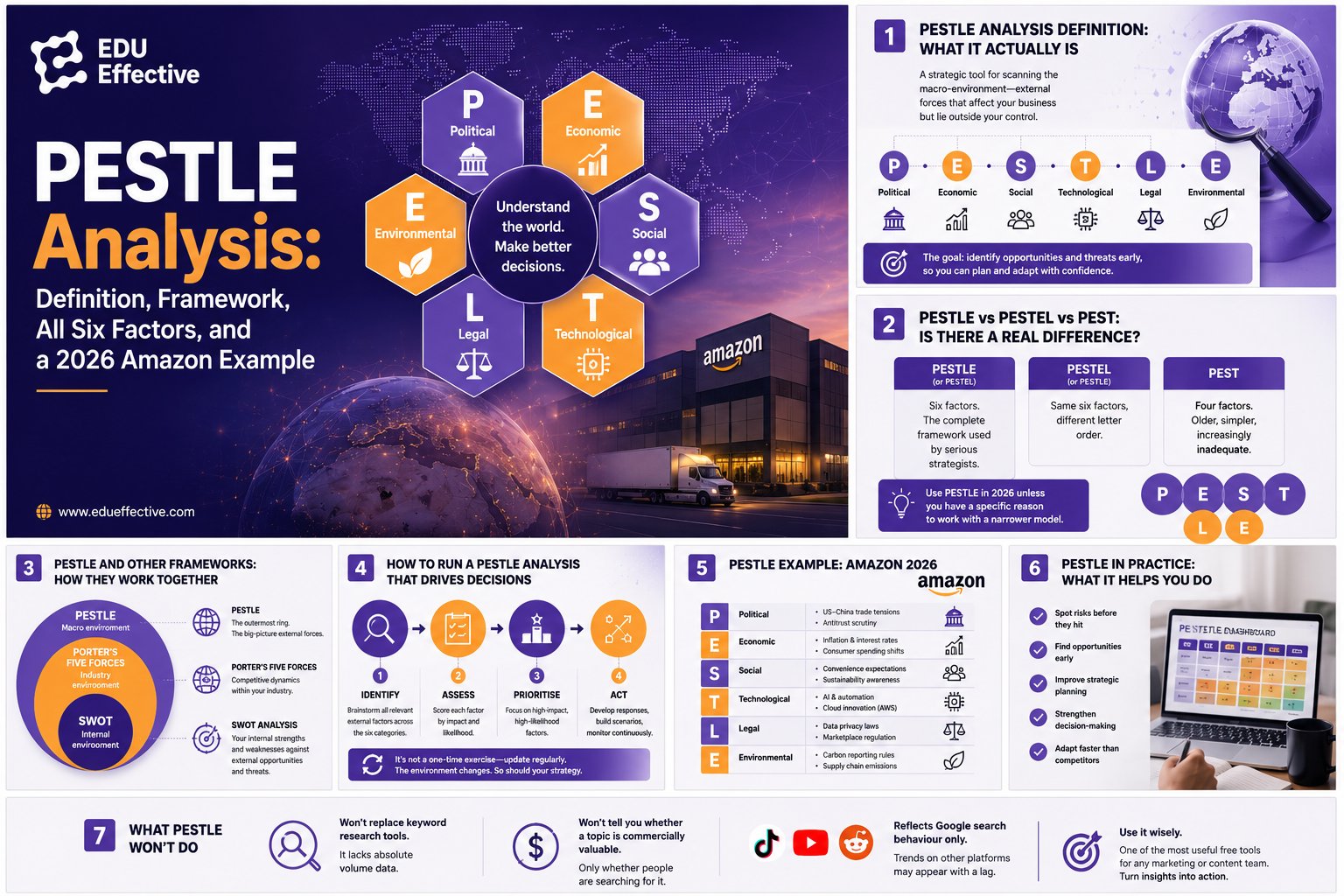
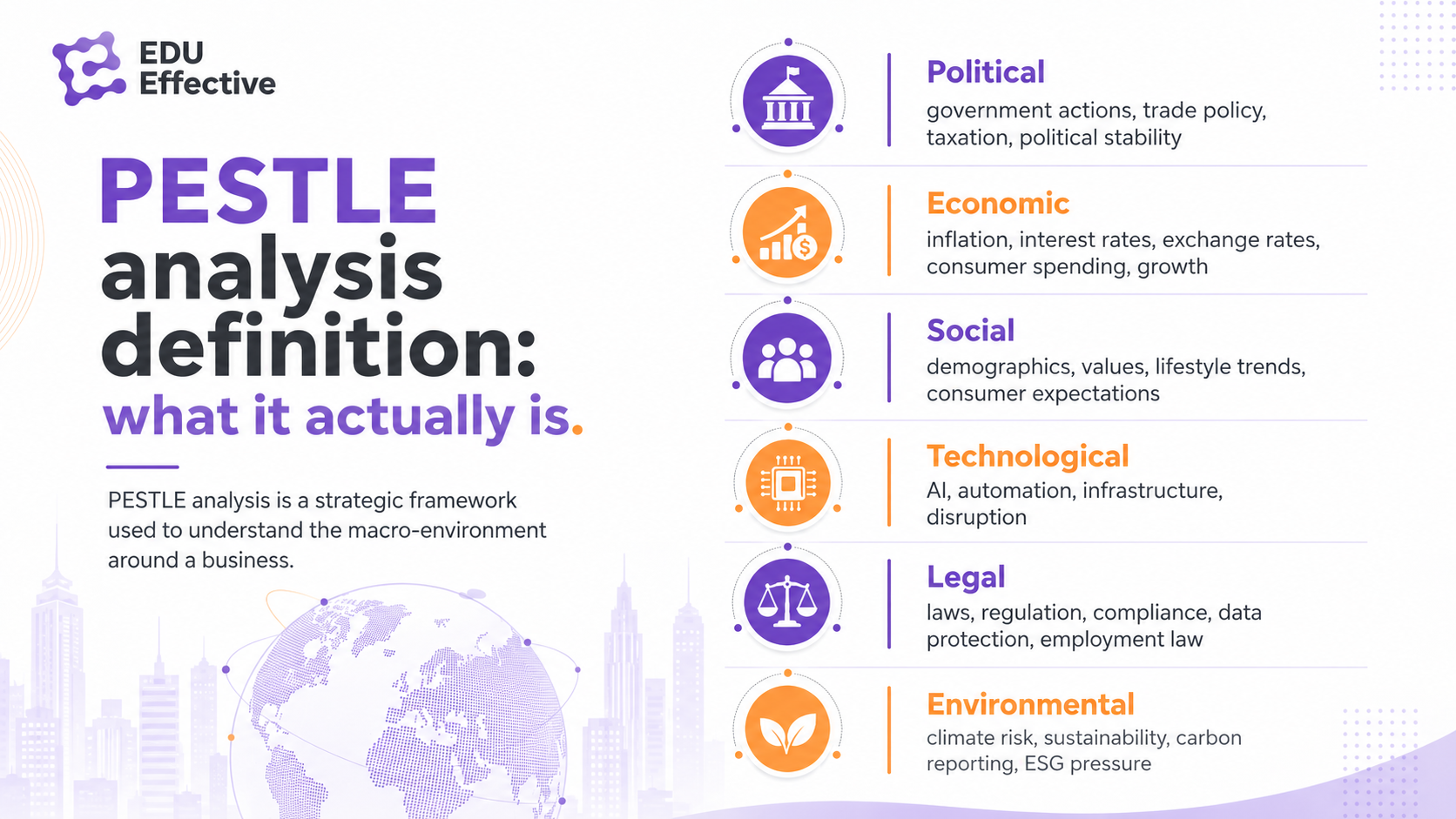
A PESTLE analysis is a strategic tool for systematically scanning the macro-environment around a business — the external forces that affect its performance but lie entirely outside its control. The framework organises those forces into six categories, each represented by a letter in the acronym:
P — Political. How government actions, trade policy, taxation, and political stability shape your operating environment. In 2026, this includes tariff structures, trade war dynamics, and the regulatory posture of governments toward specific industries or technologies.
E — Economic. The state of the broader economy and its direct effects on your business: inflation, interest rates, exchange rates, consumer spending power, and economic growth or contraction in your key markets.
S — Social. The demographic and cultural currents running through the markets you serve — shifting values, lifestyle trends, generational attitudes, population ageing, and evolving expectations around ethics, transparency, and brand purpose.
T — Technological. The pace and direction of innovation relevant to your industry: AI adoption, automation, digital infrastructure, data analytics capabilities, and the competitive disruption that new technologies enable or require.
L — Legal. The legislative and regulatory landscape — existing laws, incoming regulation, and anticipated legal risk. Data protection law, antitrust enforcement, employment legislation, consumer rights rules, and sector-specific compliance requirements all belong here.
E — Environmental. Climate-related risk, sustainability regulation, carbon reporting obligations, supply chain exposure to environmental constraints, and consumer and investor pressure around ESG performance.
The framework originated as the simpler PEST model — four factors — in Francis Aguilar's 1967 work Scanning the Business Environment. Legal and Environmental were added later as both became strategically decisive. Leaving them out today would mean ignoring two of the most disruptive forces in the current business environment, which is why PESTLE (or its identical twin PESTEL — just the last two letters swapped) is the version serious strategists use.
PESTLE vs PESTEL vs PEST: is there a real difference?
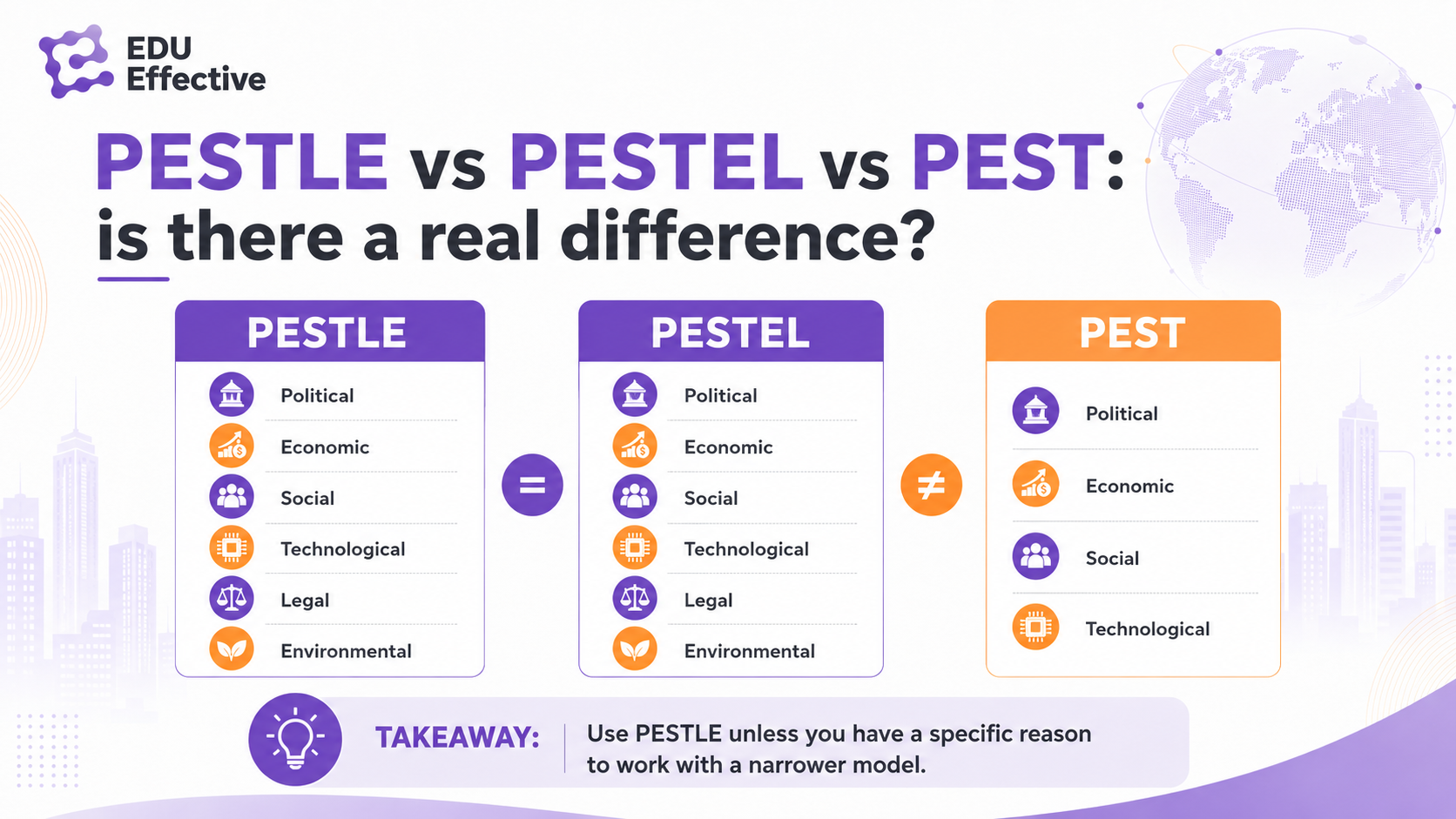
No practical difference between PESTLE and PESTEL — same six factors, same logic, different letter order. Pick whichever your organisation uses and be consistent.
PEST is the older four-factor version: Political, Economic, Social, Technological. It's simpler but increasingly inadequate. A PEST framework from 2024 that assumed a low interest rate environment is actively misleading in 2026. A PEST model that omits Legal analysis would miss the EU AI Act, GDPR enforcement actions, and active antitrust litigation that are reshaping strategy across multiple industries right now. Environmental factors — mandatory carbon reporting, plastic reduction mandates, supply chain ESG standards — now carry direct financial consequences for most global businesses.
The practical rule: use PESTLE unless you have a specific reason to work with a narrower model.
How the PESTLE model relates to other frameworks
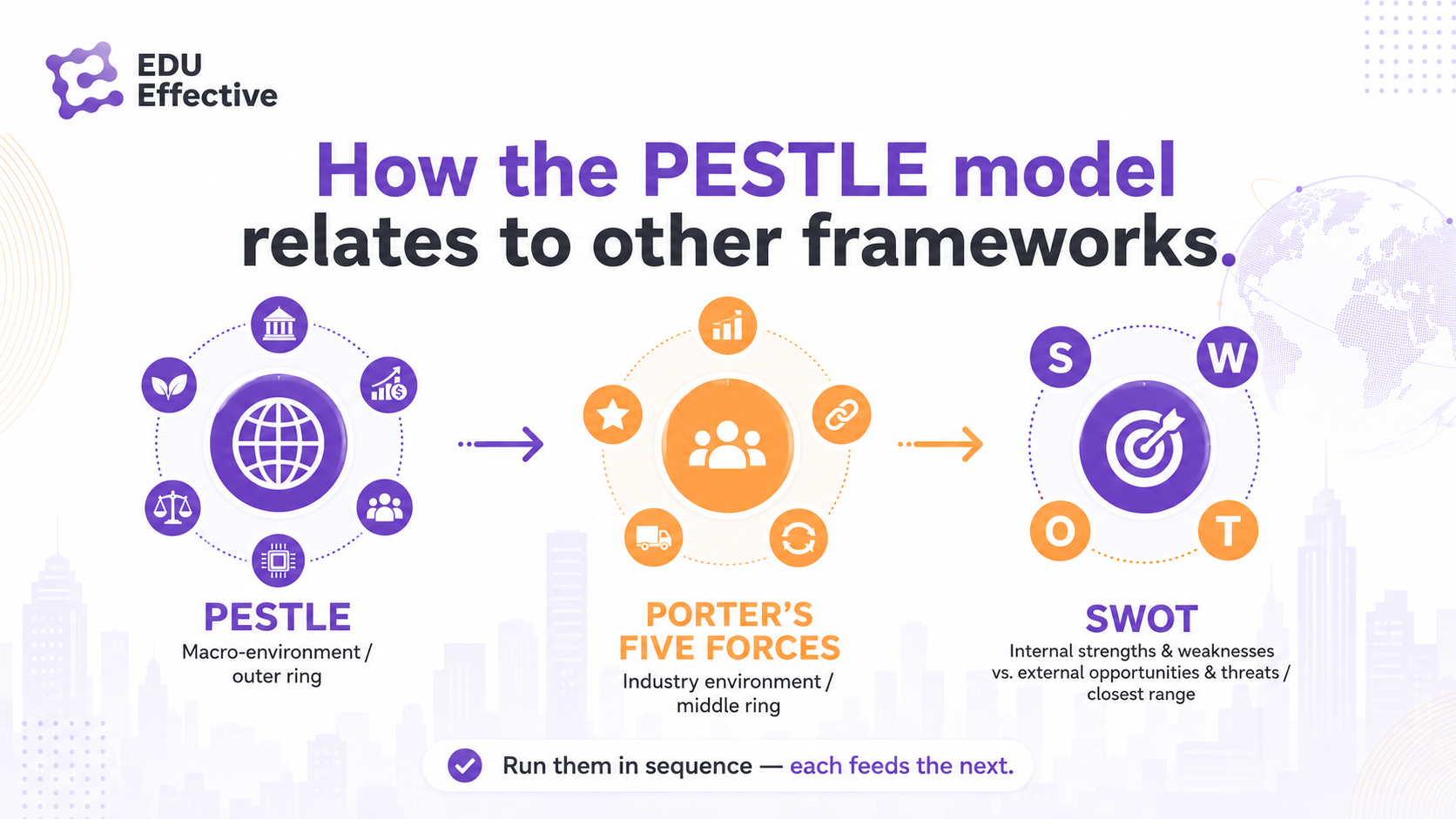
PESTLE handles the outermost ring of strategic analysis — the whole macro-environment your industry sits inside. It works best alongside two other frameworks that operate at different scales.
Porter's Five Forces examines the middle ring: competitive dynamics within your specific industry. Supplier power, buyer power, threat of new entrants, threat of substitutes, and competitive rivalry are all shaped by the macro-environment you map with PESTLE — but they require a separate, industry-specific analysis.
SWOT analysis operates at the closest range: your own organisation's internal strengths and weaknesses against external opportunities and threats. In practice, the opportunities and threats in your SWOT are largely populated by the most significant factors your PESTLE surfaces. Run them in sequence — PESTLE, then Porter's, then SWOT — and each feeds the next.
How to run a PESTLE analysis that produces decisions, not just lists
Most PESTLE analyses fail not because the framework is wrong but because they stop too early. Listing forty external factors with no sense of priority is a well-intentioned way to make no decision at all.
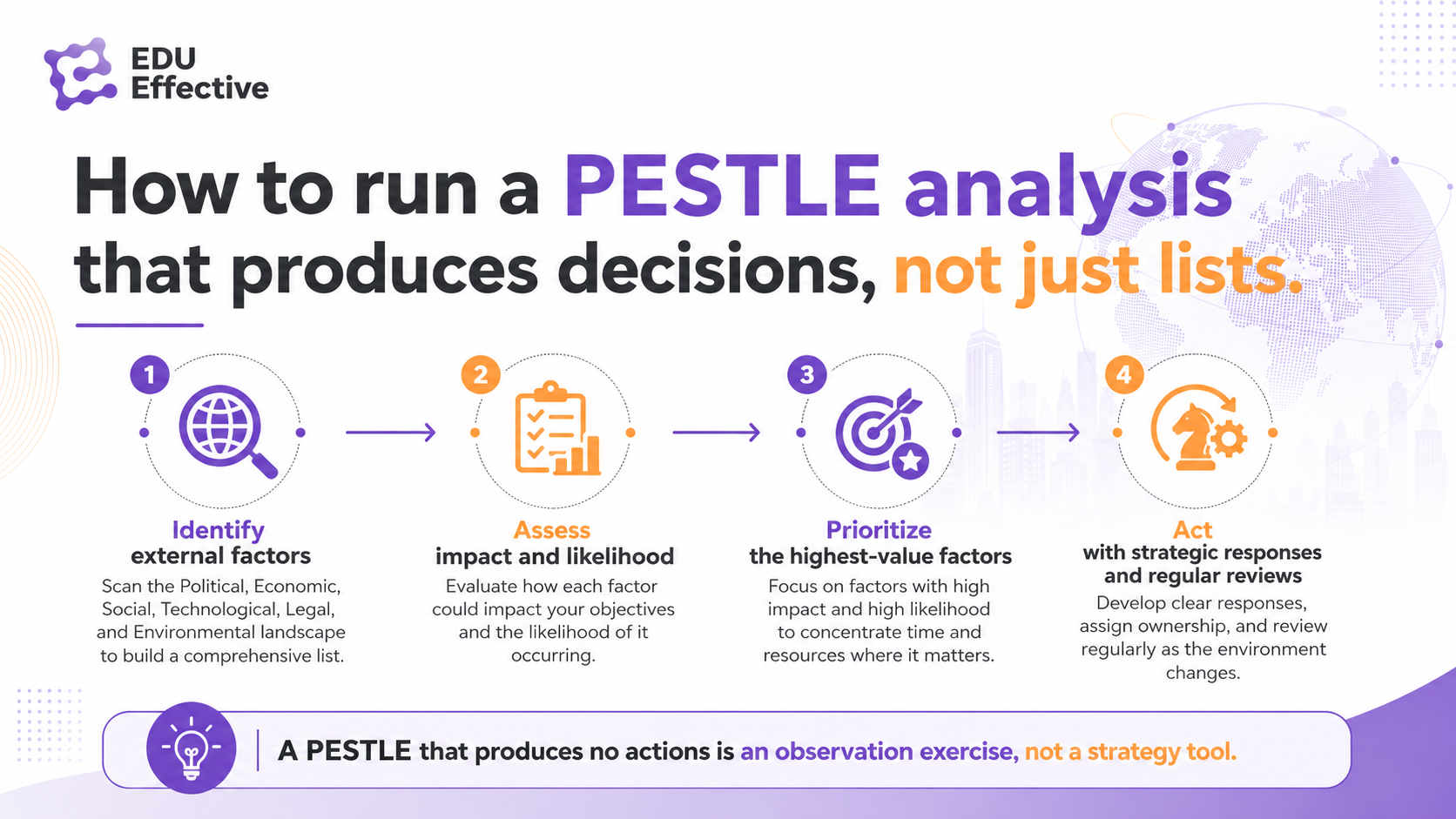
The version that produces strategic value has four stages.
Start by brainstorming every relevant external factor across all six categories. Specificity is everything here. "The economy" is useless. "A 15% increase in component import costs due to current tariff structures" is a factor you can act on.
Second — and this is where most analyses fall short — assess each factor by two dimensions: how significant its impact on your business would be, and how likely or imminent it is. High impact combined with high likelihood demands a contingency plan. Low impact combined with low likelihood is background noise. The factors in between require a judgement call about monitoring versus acting now.
Third, convert the highest-priority factors into strategic responses. Will you mitigate the risk? Hedge against it? Move early to capture an opportunity before competitors do? A PESTLE that produces no actions is an observation exercise, not a strategy tool.
Fourth, schedule regular reviews. A PESTLE is a snapshot of a moving environment. Quarterly reviews are a reasonable minimum. As Deckary's analysis of 80+ strategy engagements found, the framework's value depends entirely on current data — a PESTLE from 2024 built on assumptions about stable interest rates or predictable trade policy is actively misleading in 2026.
PESTLE analysis example: Amazon in 2026
Amazon is currently one of the clearest illustrations of the PESTLE framework in action — not because it's a convenient textbook case, but because every one of its six factors is generating active, visible strategic decisions right now.
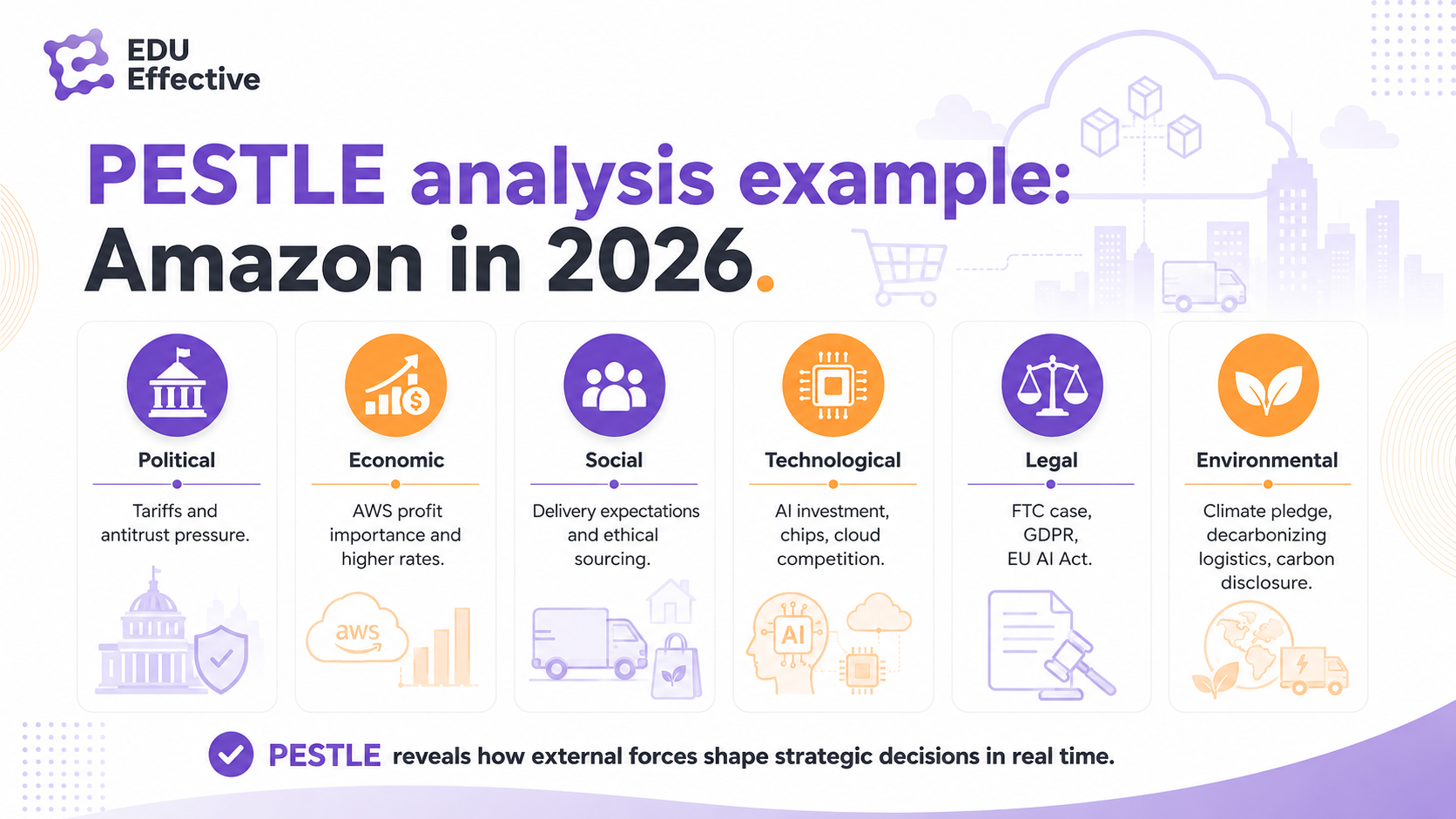
Political. Amazon faces antitrust enforcement on two continents. Its $2.5 billion settlement with the US Federal Trade Commission in 2025 over Prime subscription practices is the largest consumer protection settlement in FTC history. In the EU, separate proceedings over marketplace practices are ongoing. Trade policy matters directly to Amazon's third-party seller ecosystem: import tariffs raise the landed cost of goods for sellers, threatening the price competitiveness that is central to Amazon's consumer value proposition. Sustained tariff inflation pressures margins or forces price increases that can dampen demand — a direct political risk with economic consequences.
Economic. Amazon operates as a roughly $717 billion revenue business entering 2026. Its AWS cloud division continues to drive disproportionate profit margin, making AWS growth rates more strategically significant than its headline retail revenue figures. Higher interest rates have compressed the valuation multiples of growth-oriented technology businesses generally, affecting Amazon's equity position and cost of capital across major investment decisions.
Social. Consumer expectations around delivery speed, pricing transparency, and ethical sourcing continue to tighten. The expectation of same-day or next-day delivery — which Amazon largely created — is now a baseline requirement rather than a competitive differentiator in its core markets. ESG sentiment among both consumers and institutional investors is also influencing supplier selection and product assortment decisions at scale.
Technological. Amazon's AI investment is defining its current strategic period. AWS is the primary battleground, competing directly with Microsoft Azure and Google Cloud. Amazon's significant capital expenditure in data centre infrastructure and development of proprietary AI chips are direct responses to this competition. The energy demands of AI infrastructure simultaneously create new environmental pressures — a technology factor with direct environmental consequences.
Legal. Beyond the FTC settlement, Amazon faces a separate active FTC antitrust case alleging monopolisation of its online marketplace. A GDPR enforcement action resulted in a €746 million penalty that Amazon appealed and lost in 2025. The EU AI Act, which entered its application phases in 2024–2025, imposes compliance obligations on AI systems Amazon deploys across its platform and AWS services. Legal risk has become one of Amazon's largest strategic variables — a factor that barely registered a decade ago.
Environmental. Amazon has committed to the Climate Pledge — net zero carbon by 2040, a decade ahead of the Paris Agreement timeline. Meeting that commitment requires decarbonising an enormous logistics network, electrifying delivery fleets, and meeting mandatory carbon disclosure requirements across multiple jurisdictions. The energy-intensive data centre build-out for AI creates a direct tension between its AI ambitions and its environmental commitments, which is actively shaping infrastructure decisions.
The pattern across all six factors: Amazon cannot control any of these forces. But each one is visibly shaping operational, investment, and strategic decisions the company is making right now. That's a PESTLE analysis doing its job — not as a theoretical exercise, but as a live map of the terrain.
Three business contexts where PESTLE delivers most value
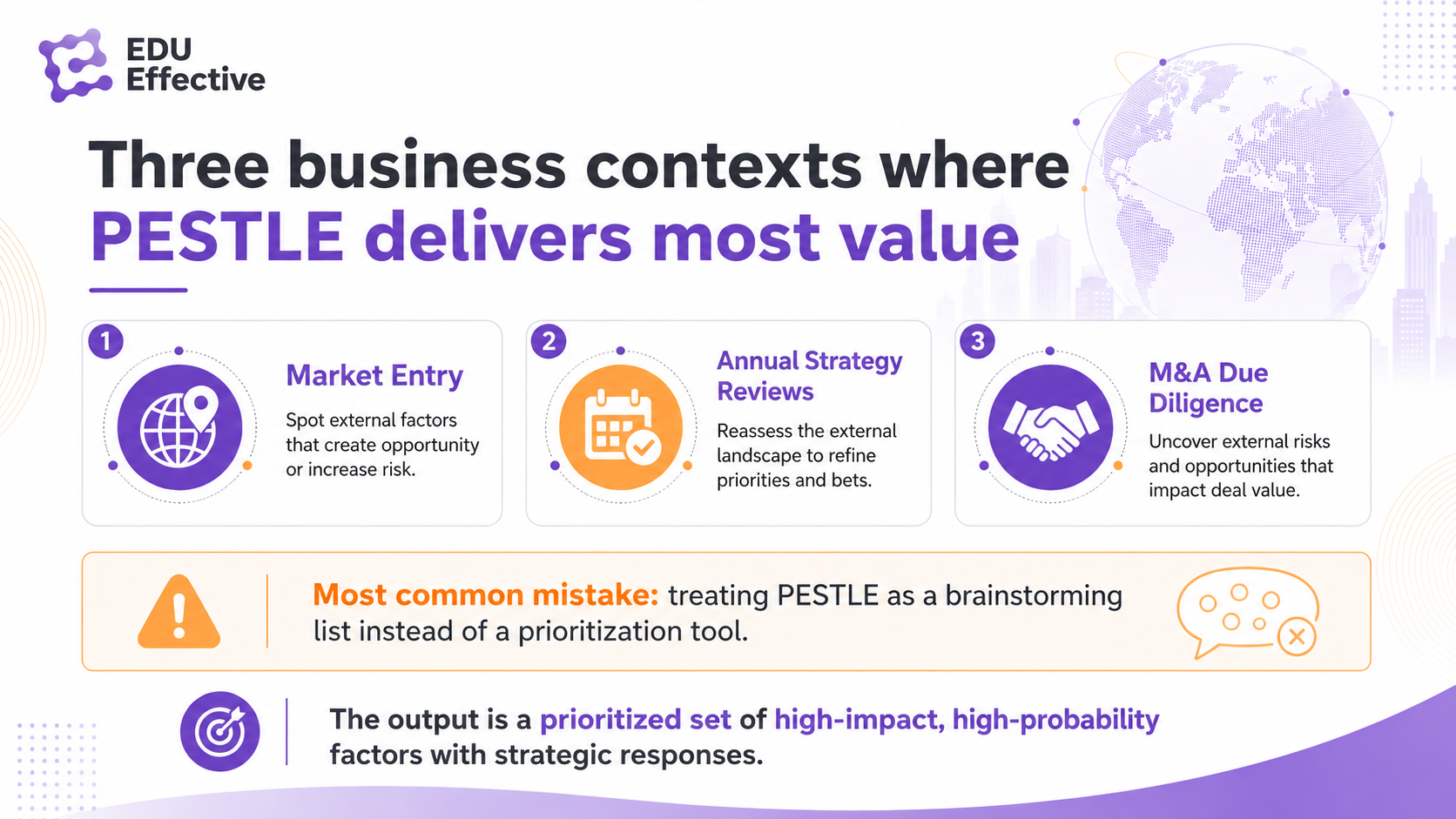
Market entry. Before entering a new geography, a PESTLE analysis surfaces political stability risk, regulatory requirements, economic conditions, and cultural considerations that determine whether entry is viable and what form it should take.
Annual strategy reviews. A PESTLE refreshed quarterly — or at minimum annually — ensures strategic plans are built on current external assumptions. A strategic plan built on 2022 assumptions about interest rates, trade policy, or AI regulation is operating on a false foundation in 2026.
M&A due diligence. Assessing a potential acquisition target requires understanding the macro-environment it operates in, not just its financial performance. Legal exposure, regulatory trajectory, and technological disruption risk in the target's sector all belong in a pre-acquisition PESTLE. As the Deckary analysis notes, this is one context where PESTLE surfaces interdependencies that ad hoc monitoring regularly misses — such as how the EU AI Act intersects with GDPR for companies using algorithmic decision-making.
The most common mistake
Treating PESTLE as a brainstorming list rather than a prioritisation tool. The six boxes are not the output. The prioritised set of factors that are both high-impact and high-probability — with specific strategic responses attached to each — is the output. Everything else is context.
At EDU Effective, our MBA and business programs teach strategic frameworks as tools for real decisions — applied to current business environments, not historical case studies. Explore our programs →
EDU Effective Business School — professional development for your long-term success
All best-selling Effective MBA programs are based on the same educational model, which is beneficial for working adults:
- Effective MBA: Executive Management & Leadership
- Effective MBA: Applied Artificial Intelligence
- Effective MBA: Coaching, Leadership & Mentoring
- Effective MBA: Mastery in AI
- or Effective MBA: Online Marketing
Every programme runs on 15 minutes a day, takes 10 months or less, is ASIC accredited, and starts at from €990.
These are professional programs, not academic ones — built for working adults to apply what they learn directly in their own business, not to collect a scholarly credential.
Join more than 9,000 students in over 120 countries around the world to further your personal development and career success.
You can read the feedback and experiences of our students and the stories of our graduates here.
Apply now — from €990 · Talk to a Study Advisor
Study with NO risk: 14-day money-back guarantee, no questions asked.
Sources
- Business Model Analyst — Amazon PESTLE Analysis (2026)
businessmodelanalyst.com/amazon-pestle-analysis/ - Deckary — PESTLE Analysis Examples: 4 Worked Templates by Industry
deckary.com/blog/pestle-analysis-examples - Asana — PEST Analysis: Definition, Steps, Examples + PESTLE [2026]
asana.com/resources/pest-analysis - McCracken Alliance — PESTLE Analysis: Framework, Examples, and Business Strategy
mccrackenalliance.com/blog/pestle-analysis-framework-examples-and-business-strategy