

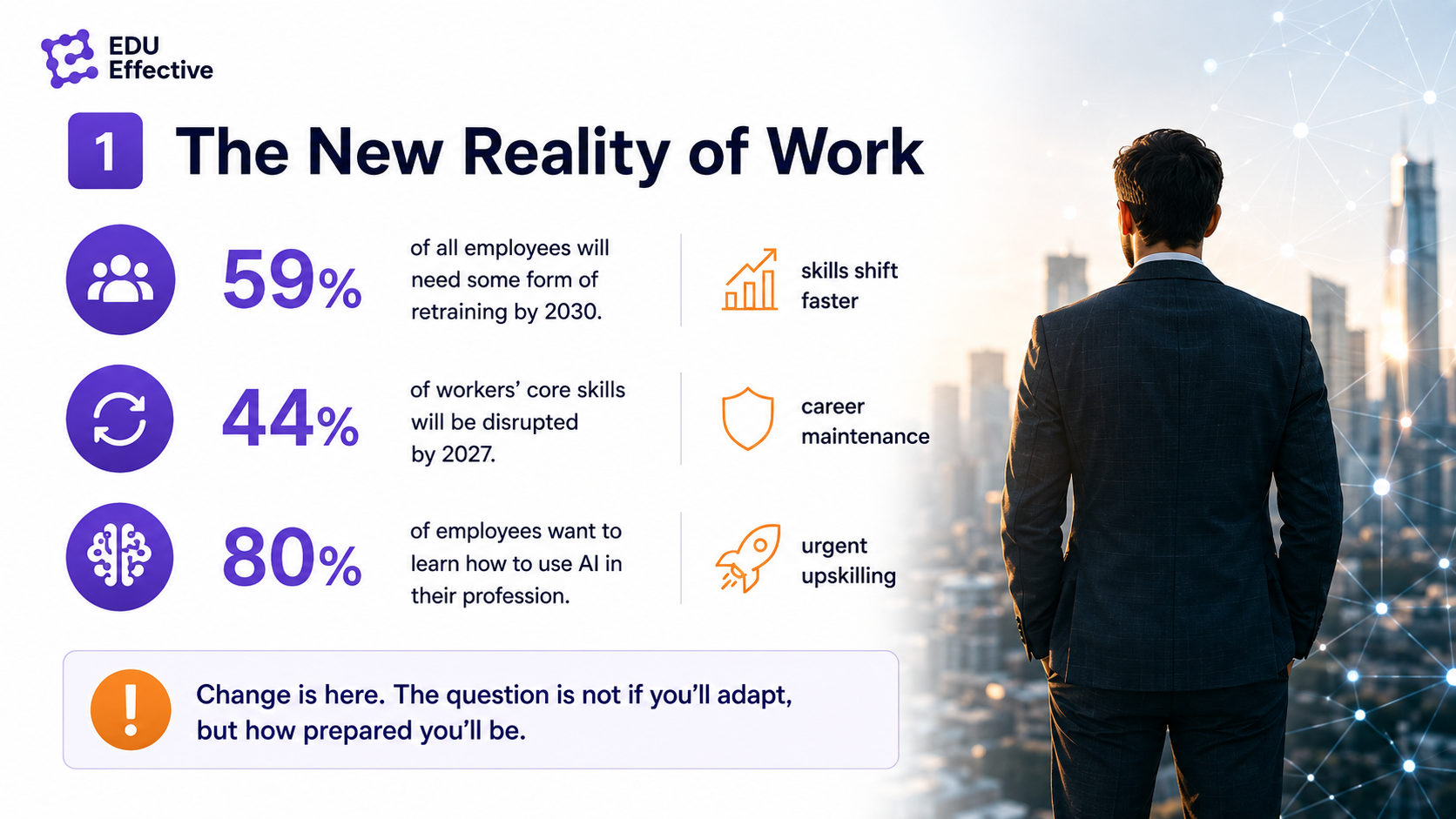
By 2030, 59% of all employees will need some form of retraining. The World Economic Forum estimates 44% of workers' core skills will be disrupted by 2027. And 4 in 5 employees — 80% of the workforce — want to learn how to use AI in their profession, making AI literacy the fastest-growing training priority of 2026.
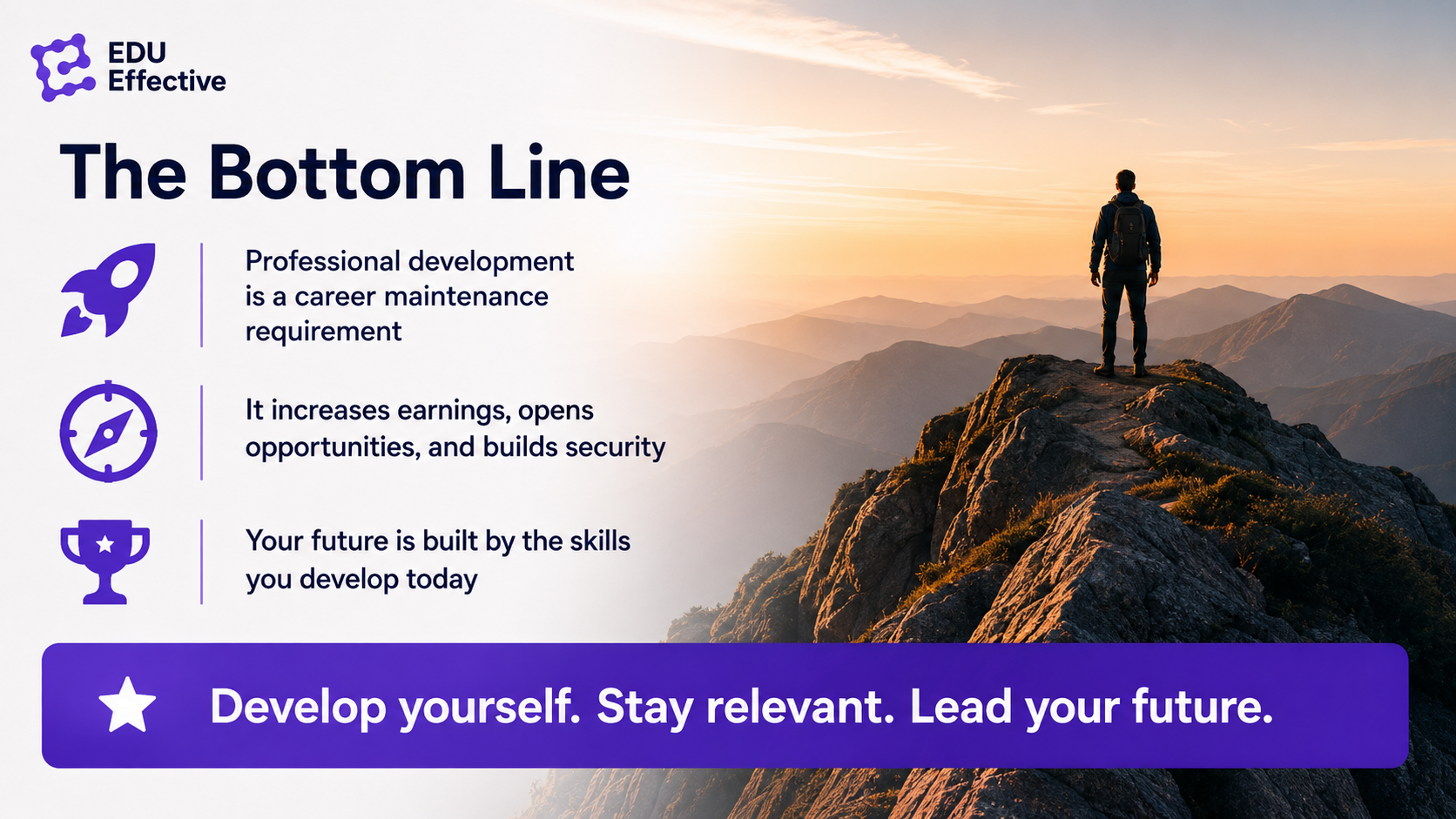
These are not distant projections. They describe what is already happening in most industries, in most roles, at most levels. The pace of change in what skills are valuable has accelerated to a point where professional development is no longer a career enhancement — it is a career maintenance requirement.
And yet: only 41% of US employees currently receive formal training. 60% say they have never had formal workplace training at all. The gap between what is needed and what is actually happening is wide, and the people on the wrong side of it will feel the consequences before they see them coming.
What professional development actually is
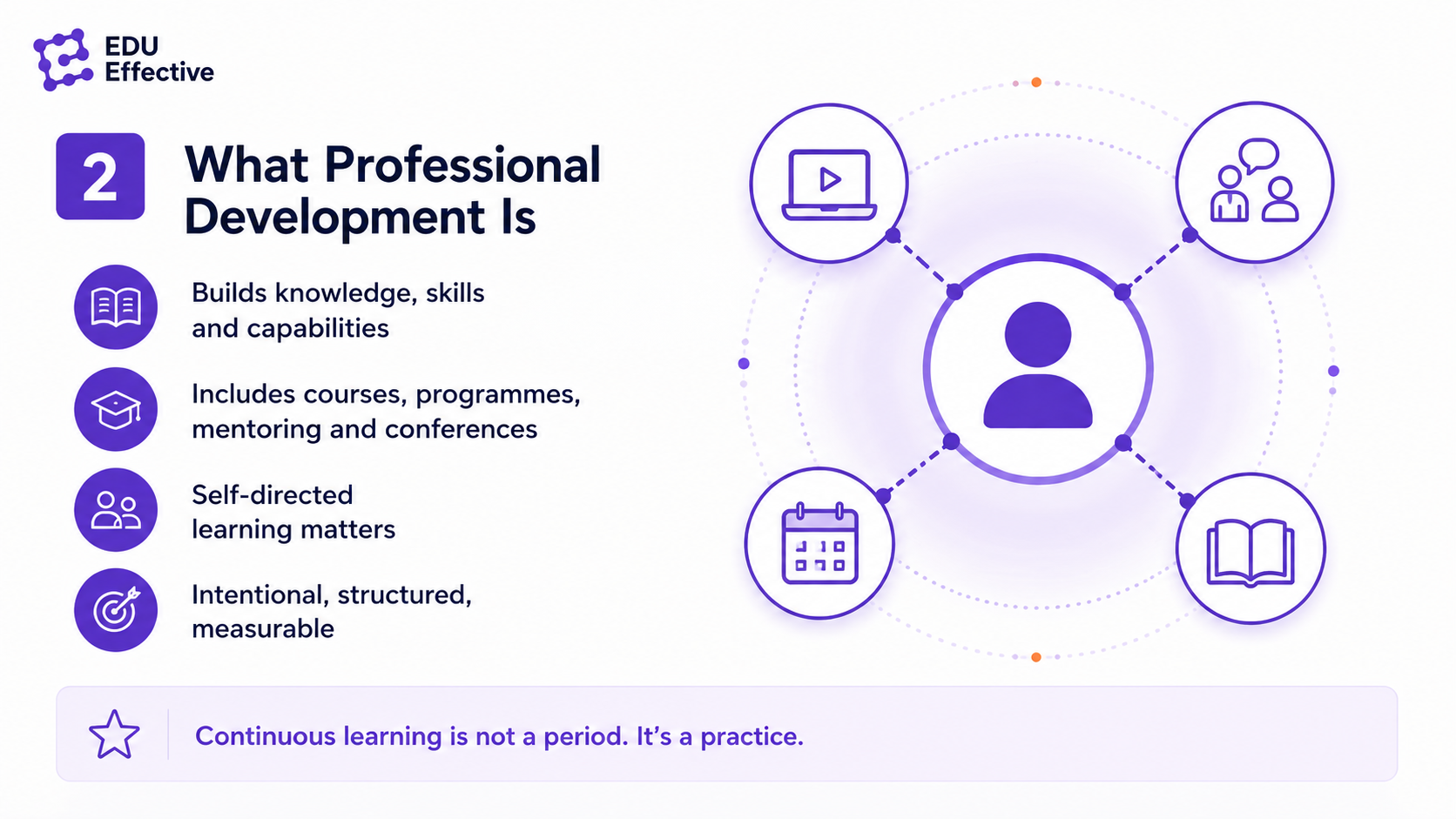
Professional development is any structured activity that builds knowledge, skills, or capabilities relevant to your work — and, by extension, to your career trajectory and long-term earning potential. It includes formal qualifications, online courses, professional programmes, mentoring relationships, industry conferences, and self-directed reading and practice.
What it is not is passively staying current. Reading industry news, attending the occasional webinar, or picking up skills informally on the job provides some benefit, but it is not the same as deliberate, structured learning with clear objectives and measurable outcomes. The distinction matters because the labour market increasingly rewards demonstrable, credentialed knowledge rather than assumed familiarity.
Professional development is also not a single event. The professionals who advance most consistently treat it as an ongoing practice — something built into the rhythm of work and life rather than something that happens during a dedicated period of study and then stops.
The career impact: what the data actually shows
The evidence on professional development's career impact is consistent across multiple research streams, and the magnitudes are significant enough to be commercially meaningful for individuals.
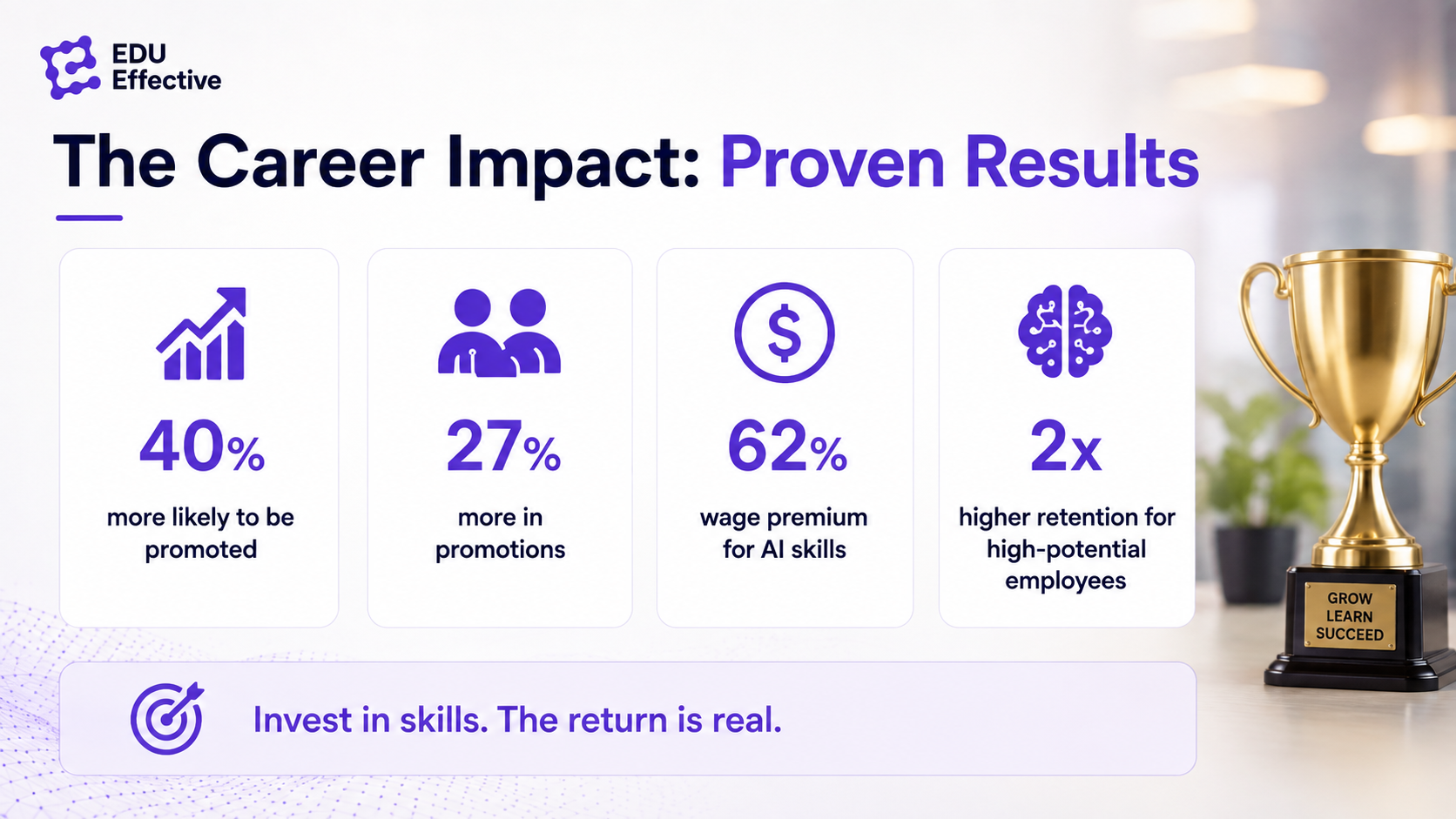
Employees with career development plans are 40% more likely to be promoted internally, according to LinkedIn research. Professionals with documented, varied skill portfolios earn 27% more in promotions, according to Glassdoor data. McKinsey research shows that companies with mentorship programmes have twice the retention rates for high-potential employees — which means that in organisations where professional development is embedded in the culture, the people who benefit from it stay, and those who don't find it elsewhere.
The wage premium data is particularly striking in 2026. PwC's Global AI Jobs Barometer found that workers with AI skills earn 62% more than comparable colleagues without them. Machine learning skills carry a 40% wage premium. The premium is not limited to technical roles — it applies across functions, including marketing, finance, HR, and general management. The skills that command the highest premiums are those that can be demonstrated and verified, not merely claimed.
Development opportunities also directly affect talent attraction. 71% of organisations with strong career development programmes report higher confidence in attracting talent, compared to 58% of those without. 28% of employees actively seek out companies known for their learning culture when evaluating job moves. In a tight talent market, professional development is not just a benefit — it is a competitive differentiator in employer branding.
The retention picture: why organisations that invest in development lose fewer people
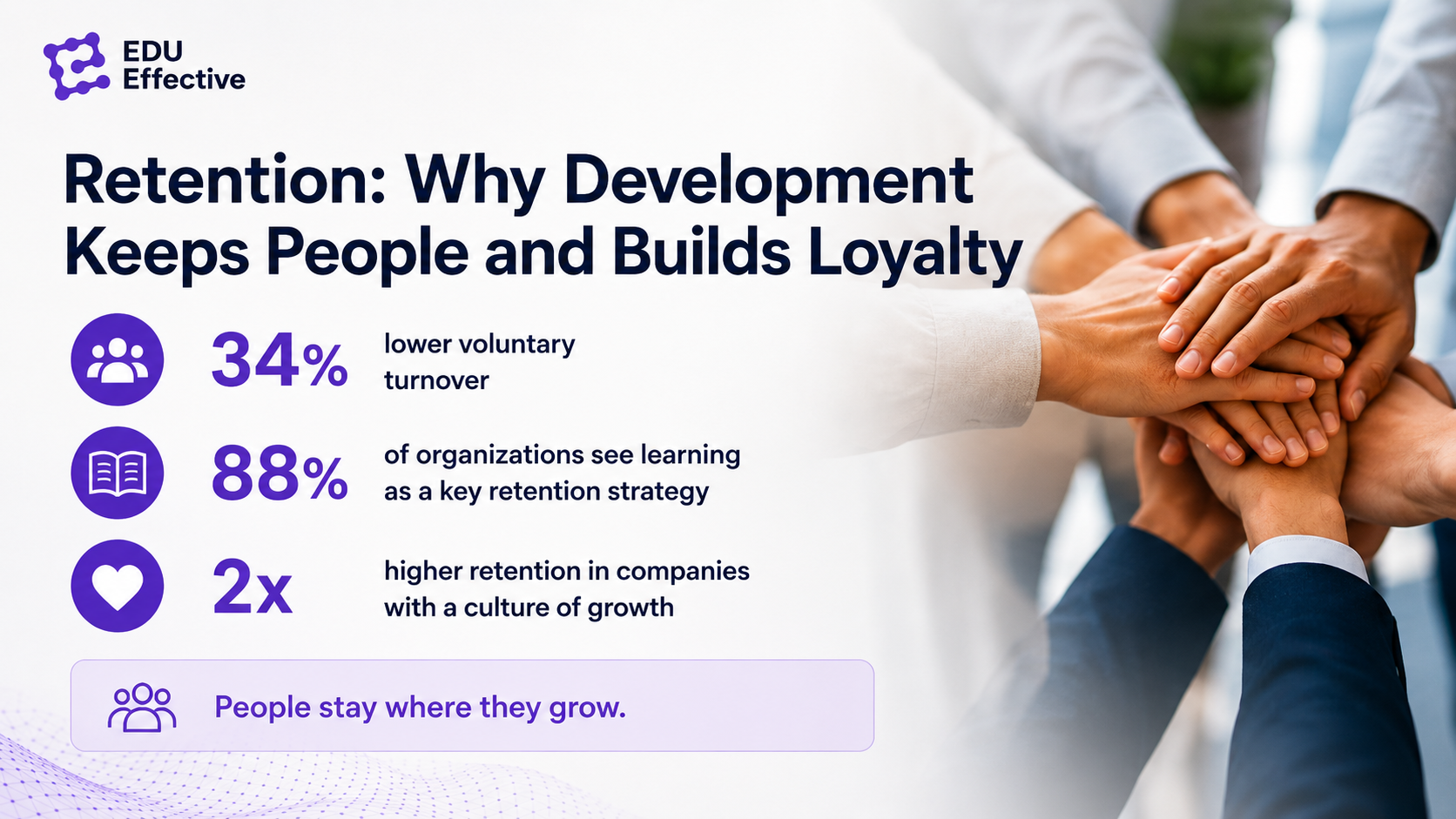
One of the most consistent findings in workforce research is the relationship between professional development and employee retention. Gallup's research shows that development programmes reduce voluntary turnover by 34%. LinkedIn's 2025 Workplace Learning Report found that 88% of organisations are concerned about employee retention — and that providing learning opportunities is the number one retention strategy those organisations are deploying.
The mechanism is straightforward: people who feel they are growing in their roles are less likely to leave them. People who feel stagnant are more likely to. 70% of employees who feel their career paths are well-defined report higher engagement. Companies that brand their internal learning as a culture of growth have twice the employee retention of those that do not.
This dynamic has implications for individual professionals as well as organisations. In an environment where companies are actively competing for people who are developing their skills, the professional who is visibly investing in their own growth is also signalling something to the labour market: that they are the kind of person who gets better. That signal has value — in promotion decisions, in salary negotiations, and in recruitment conversations.
The AI disruption context: why 2026 is a different moment
Professional development has always mattered. But the 2026 context gives it a specific urgency that did not exist five years ago.
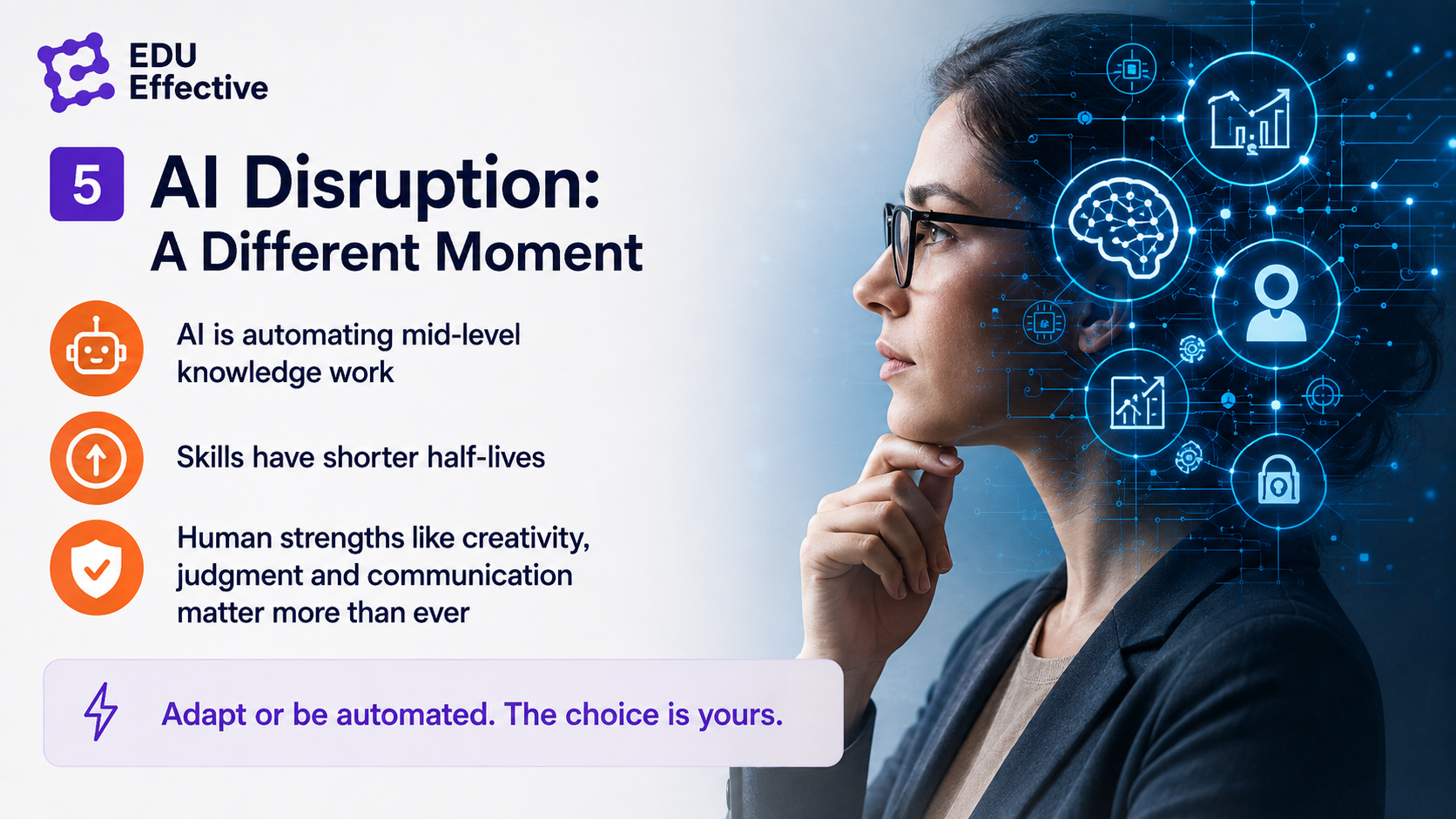
AI is restructuring the skill requirements of knowledge work at a pace that has no historical precedent. The roles being most affected are not entry-level clerical jobs but mid-level knowledge work — analysis, reporting, drafting, research, customer communication, project coordination. These are the roles that the current working professional population has built careers in and expects to continue building careers in.
The professionals who navigate this transition well will be those who understand the tools reshaping their field, can work alongside AI systems intelligently, and have deepened the distinctly human capabilities — strategic thinking, judgment, communication, relationship management, leadership — that AI amplifies but does not replace.
McKinsey reports that fewer than 40% of companies have a clear reskilling strategy, meaning most are opening positions their current workforce is not equipped to fill. The individuals who are investing in their own development — rather than waiting for their employers to provide it — are positioning themselves on the right side of that gap.
The time problem: the real barrier to professional development for working adults
The most common reason working professionals give for not investing in professional development is not cost and not motivation — it is time. A full-time job, family commitments, and a life that already has more demands than hours do not easily accommodate evening classes, weekend intensives, or months of formal study.
This is a real constraint, not an excuse. And it is why the format of professional development matters as much as the content.
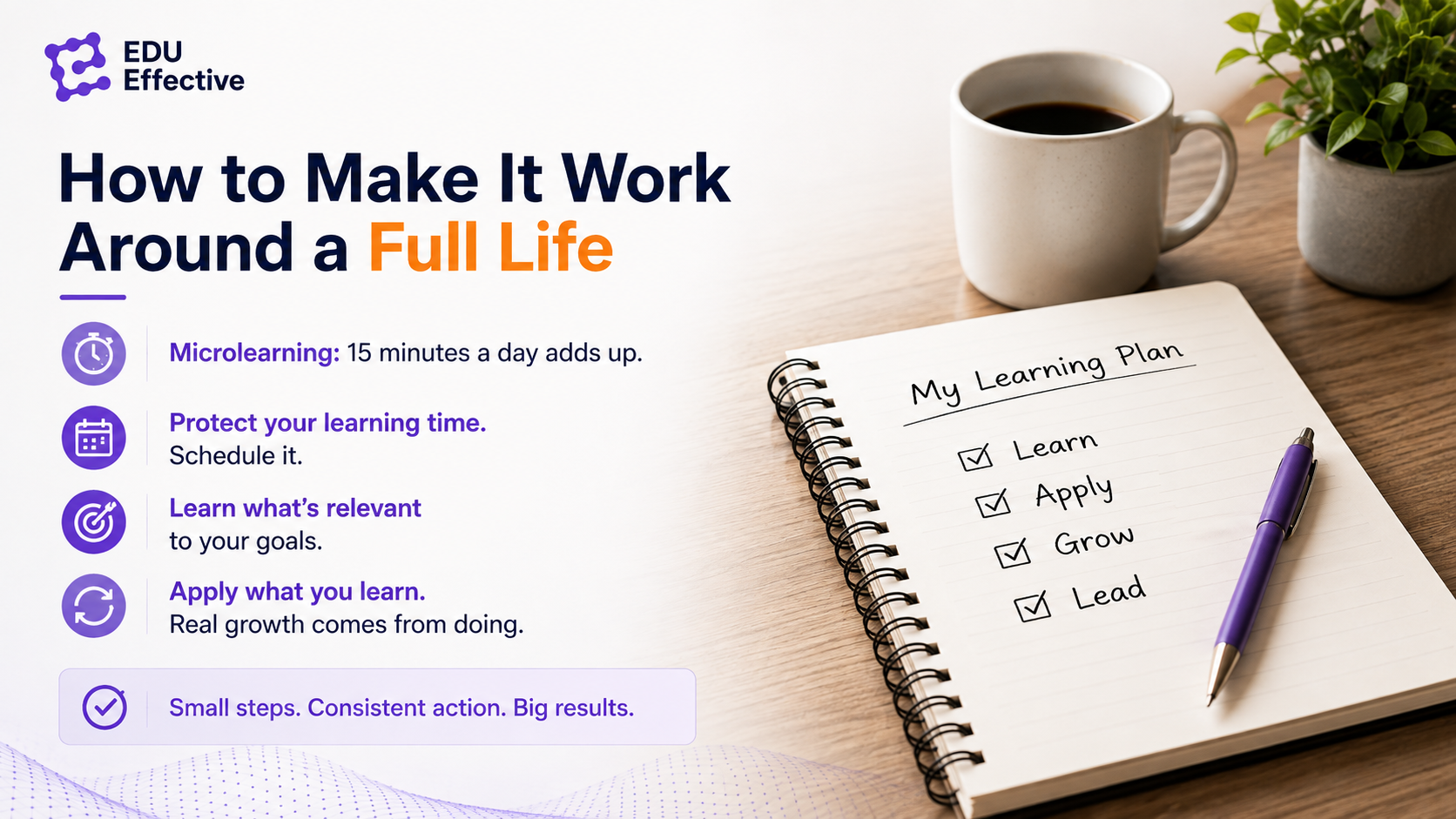
Research from IBM found that employees using microlearning — short, focused learning delivered in small, consistent daily sessions — experienced a 30% productivity boost compared to traditional training formats. Deloitte reported a 50% increase in information retention through the same method. Microlearning improves information retention by 25–60% over conventional lecture-based formats, and it does so because of how human memory actually works: spaced repetition, applied practice, and consistent reinforcement are more effective than concentrated blocks of information that fade quickly without reinforcement.
The practical implication: 15 minutes a day, consistently, compounds into meaningful professional development in a way that occasional intensive study does not. A commute, a coffee break, the twenty minutes before the day fully starts — these are not trivial amounts of time. Across ten months, they add up to an MBA-level qualification.
68% of professionals prefer microlearning modules, which improve knowledge retention by 50% over traditional methods, according to LinkedIn's Learning Report. The format is not a compromise on quality — it is a better-evidenced approach to adult learning for people whose lives do not pause while they study.
How EDU Effective's microlearning model works — precisely
The Effective MBA programmes at EDU Effective are built around a specific microlearning structure that translates directly into the research benefits described above.
Each day of study consists of a single daily block of approximately 15 minutes, structured in three parts. First, optional Daily Tips — a brief prompt for personal growth or reflection. Second, the core microlearning lesson: a 7–12 minute video taught by real instructors, not slides with voiceovers, covering the day's substantive content. Third, Practical Tips — application notes that connect the lesson directly to real work situations. Complete the block and two things happen: you receive a certificate for that day's block, and tomorrow's content unlocks. You can complete up to three blocks in a single day if you want to move faster.
Every sixth block, a recommended eBook or audiobook unlocks — material that goes deeper on the topic you just studied, available to read, listen to, or download as PDF or MP3 directly from your student account.
Thirty daily blocks make one module — roughly one month of study at the standard pace. Each module concludes with a graded test and a written action plan where you apply what you have learned to your actual work situation. Pass it and you receive a module certificate — usable on your CV or LinkedIn immediately, without waiting for the full programme to finish. This is deliberate: the Effective MBA is designed to produce applied results from the first month, not only at the end.
Ten modules complete the full programme. Finish all ten, sit the final knowledge test, and you receive your ASIC-accredited Effective MBA certificate — recognised by employers, immigration authorities, and professional bodies internationally.
The full structure is explained in detail in EDU Effective's own guide: How Studying at EDU Effective Works: Daily Block, Module, Full Process. And the research behind why this format works better than traditional alternatives is covered in Why You'll Remember More With Microlearning — and Grow Faster.
What professional development requires from you — and what it gives back
Professional development is not passive. It requires showing up consistently, even on days when other things compete for attention. It requires applying what you learn to actual situations rather than treating knowledge as an end in itself. And it requires choosing the right content — material that is current, taught by practitioners with real-world experience, and directly applicable to the work you are doing and the career direction you are building toward.
What it gives back is compounding. The skills you build in month one create the foundation for what you learn in month three. The credential you earn becomes the basis for the conversation you have six months later. The professional who has consistently invested in their development over five years is not just more skilled than the one who has not — they are in a structurally different position in the labour market, with different options, different earning potential, and a different relationship to the disruptions that affect everyone.
95% of respondents from leading companies identify leadership and management capability as the key driver of organisational success. The professionals who develop those capabilities — and who can demonstrate that development through accredited qualifications and applied experience — are the ones who get to lead.
At EDU Effective, we build programs for professionals who want to work smarter — not just harder. Explore our programs →
EDU Effective Business School = professional development for your long-term success.
All best-selling Effective MBA programs are built for working adults: 15 minutes a day, 10 months or less, ASIC accredited, from €990.
These are professional programmes, not academic ones — built for working adults to apply what they learn directly in their own business, not to collect a scholarly credential.
Join more than 9,000 students in over 120 countries who are investing in their professional development and career success.
Read the feedback and experiences of our students and the stories of our graduates here.
Apply now — €990 · Talk to a Study Advisor
Study with NO risk: 14-day money-back guarantee, no questions asked.
Sources
- PwC — 2026 Global AI Jobs Barometer https://www.pwc.com/gx/en/news-room/press-releases/2026/pwc-2026-ai-jobs-barometer.html
- McKinsey & Company — Skills reset for the AI age https://www.mckinsey.com/featured-insights/charts/skills-reset-for-the-ai-age
- DDI World — Global Leadership Forecast https://www.ddiworld.com/research/global-leadership-forecast
- IBM — Microlearning Productivity Research https://www.ibm.com/training
- McKinsey & Company — The State of AI https://www.mckinsey.com/capabilities/quantumblack/our-insights/the-state-of-ai
- LinkedIn — Workplace Learning Report https://learning.linkedin.com/resources/workplace-learning-report
- Deloitte — Human Capital Trends Report https://www2.deloitte.com/us/en/insights/focus/human-capital-trends.html
- World Economic Forum — Future of Jobs Report https://www.weforum.org/publications/the-future-of-jobs-report-2025/
- Gallup — State of the Global Workplace Report https://www.gallup.com/workplace/349484/state-of-the-global-workplace.aspx
- Fuel50 — 55 Upskilling and Reskilling Statistics for 2026 https://fuel50.com/blog/upskilling-and-reskilling-statistics
- Glassdoor — Workforce Insights & Salary Research https://www.glassdoor.com/research/