
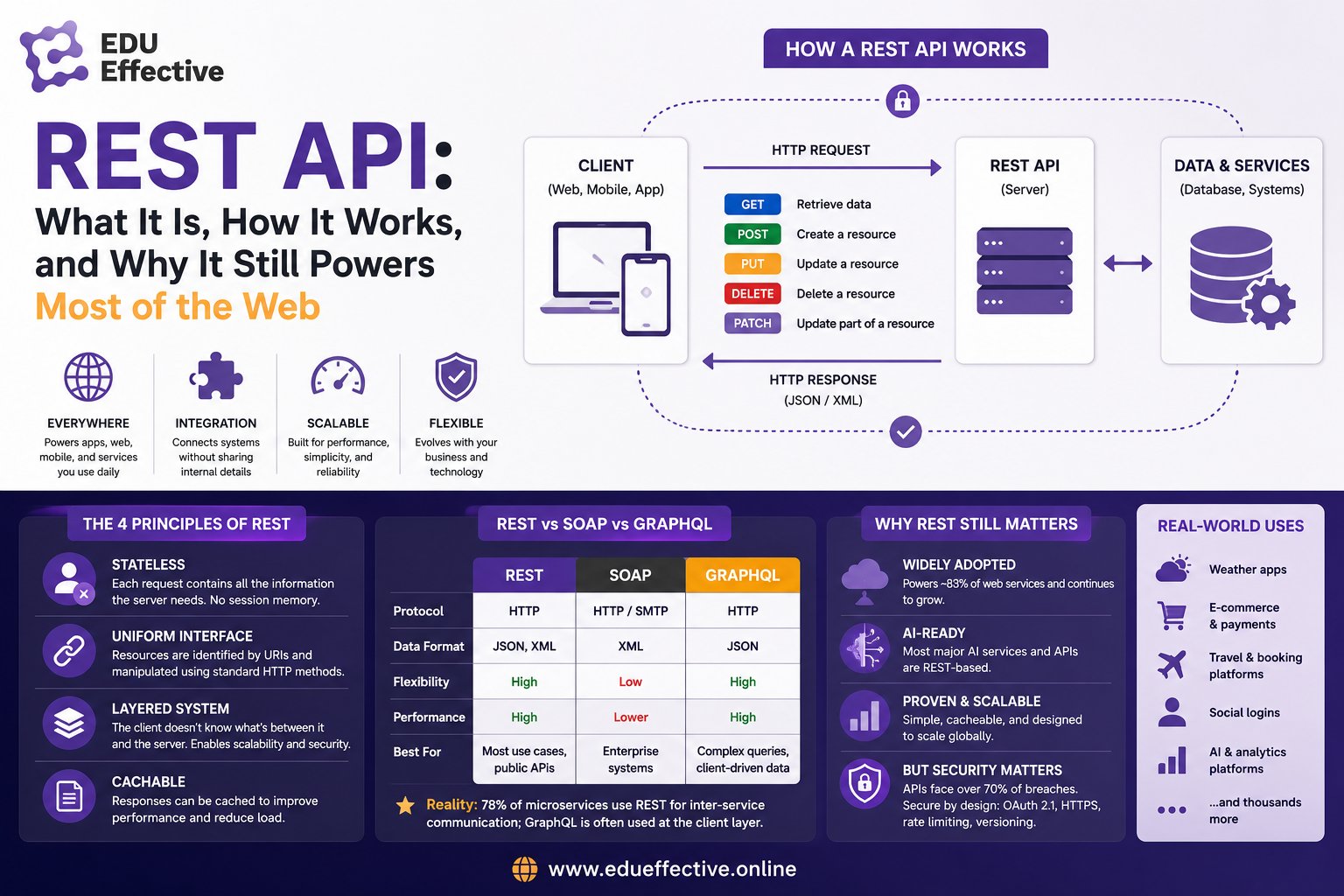

Every time you check the weather on your phone, pay for something online, or log into a platform using your Google account, a REST API is doing the heavy lifting behind the scenes. It's one of those technologies that's everywhere — and yet most people working in digital roles couldn't explain what it actually does.
That's worth fixing.
What an API is, before we get to REST
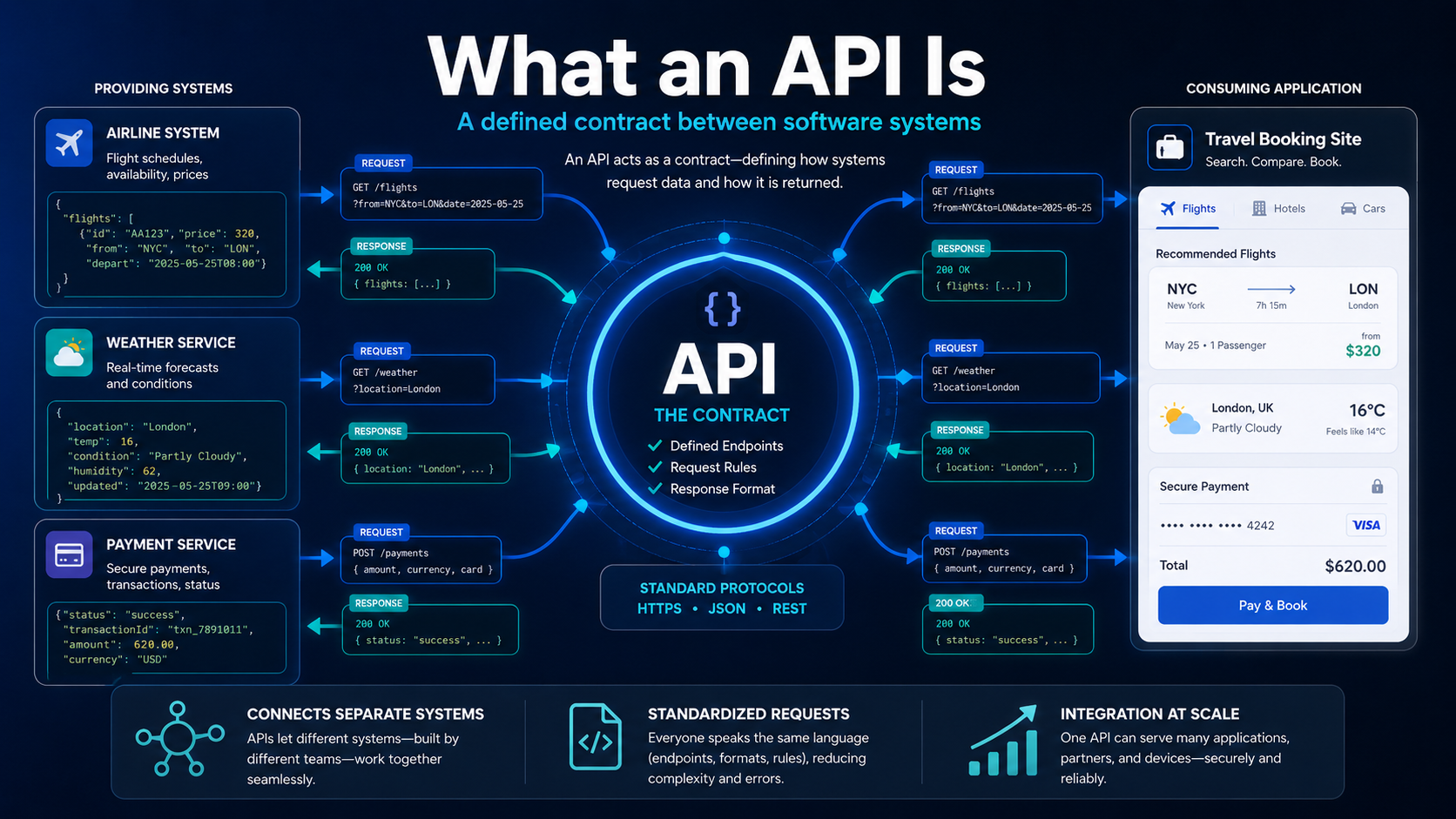
API stands for Application Programming Interface. The simplest way to think about it: an API is a defined contract that lets two separate software systems talk to each other without needing to know how the other one works internally.
When a travel booking site shows you live flight prices from a dozen airlines at once, it isn't running all those airlines' systems itself. It's calling their APIs — sending a standardised request, getting a standardised response, and displaying the result. No shared codebase, no system merger required.
APIs make integration possible at scale. That's why they've become the connective tissue of the modern digital economy.
What makes an API "RESTful"
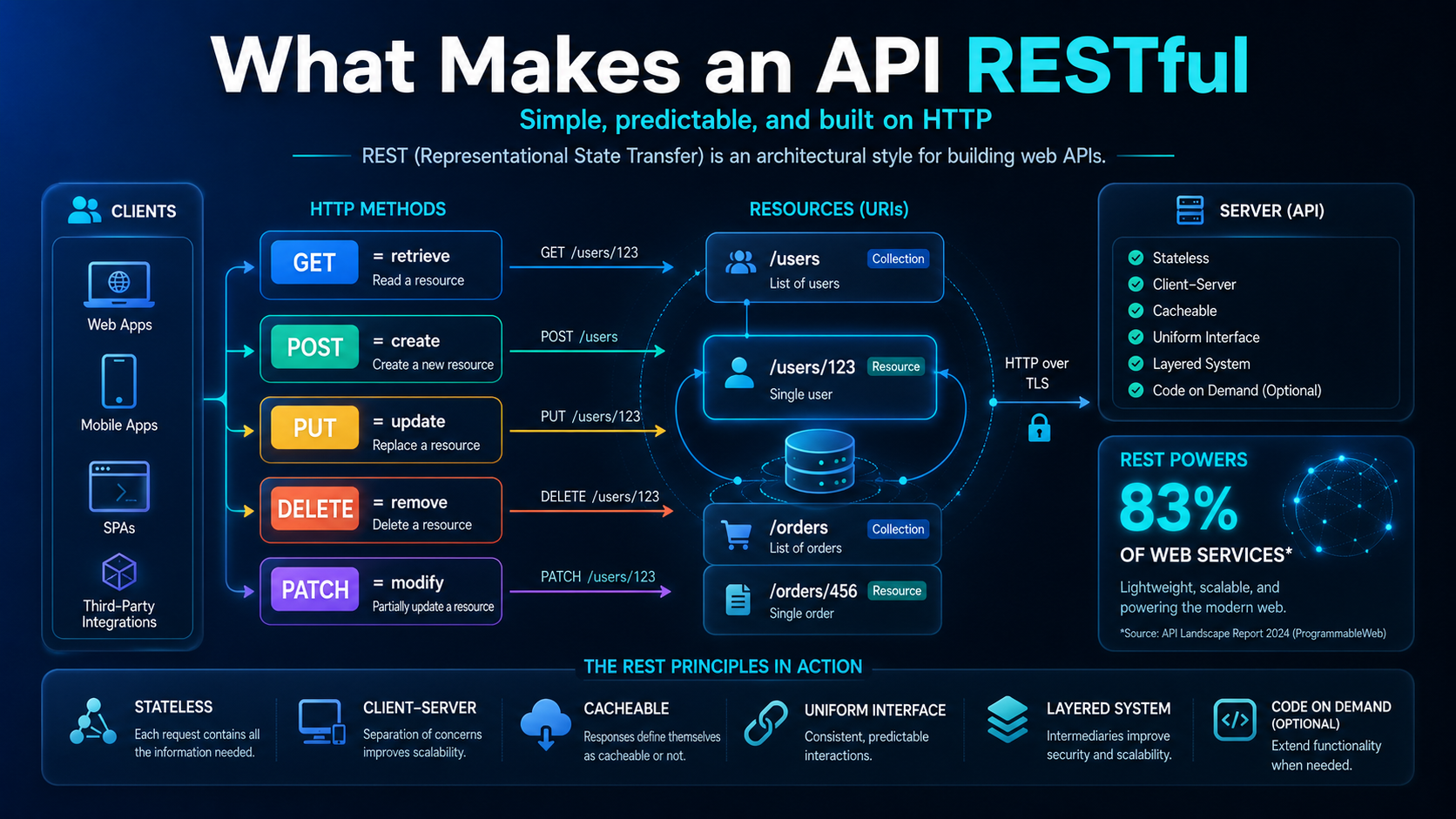
REST stands for Representational State Transfer. It's not a technology or a protocol — it's an architectural style, a set of constraints that, when followed, produce APIs that are predictable, scalable, and easy to work with.
REST APIs currently power around 83% of all web services — a dominance that has held up across the rise of microservices, cloud-native development, and even the current AI boom. Despite the emergence of alternatives like GraphQL and gRPC, REST continues to lead in usage and evolve alongside new specifications and extensions.
A REST API communicates over HTTP — the same protocol your browser uses to load web pages. It treats everything on the server side as a resource, and it manipulates those resources through a small set of standard operations:
GET retrieves data. POST creates something new. PUT updates an existing resource. DELETE removes it. PATCH modifies a specific attribute without replacing the whole thing.
That's deliberately it. The simplicity is a feature.
The four principles that define a REST architecture
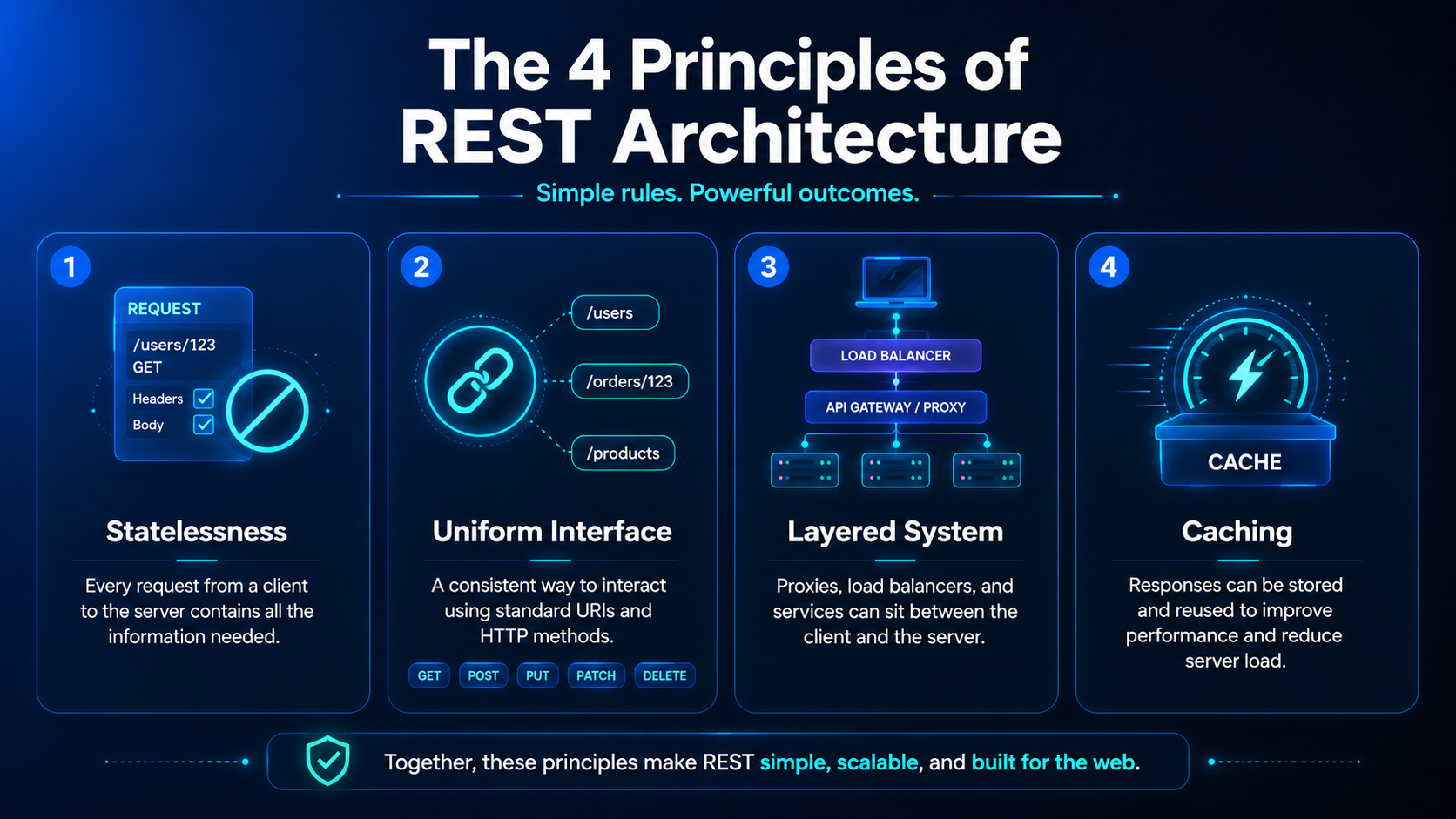
Statelessness is the most important one. Every request from a client to the server must contain all the information needed to process it — the server doesn't store session state between calls. This makes REST APIs highly scalable: any server in a cluster can handle any request, because nothing about the client's history is remembered.
Uniform interface means all resources are identified consistently — typically via a URI (Uniform Resource Identifier) — and all interactions follow the same HTTP verb patterns. This predictability is why developers can pick up a new REST API relatively quickly, even without deep documentation.
Layered system means the client doesn't need to know whether it's talking directly to a server or through a proxy, load balancer, or caching layer. Each layer only knows about the one immediately adjacent to it. This enables security, scalability, and flexibility to be added without breaking existing clients.
Caching allows responses to be stored and reused when the underlying data hasn't changed. This is why your browser remembers your recent searches, why streaming services can serve personalised recommendations fast, and why the same news article doesn't require a fresh database query every time someone opens it.
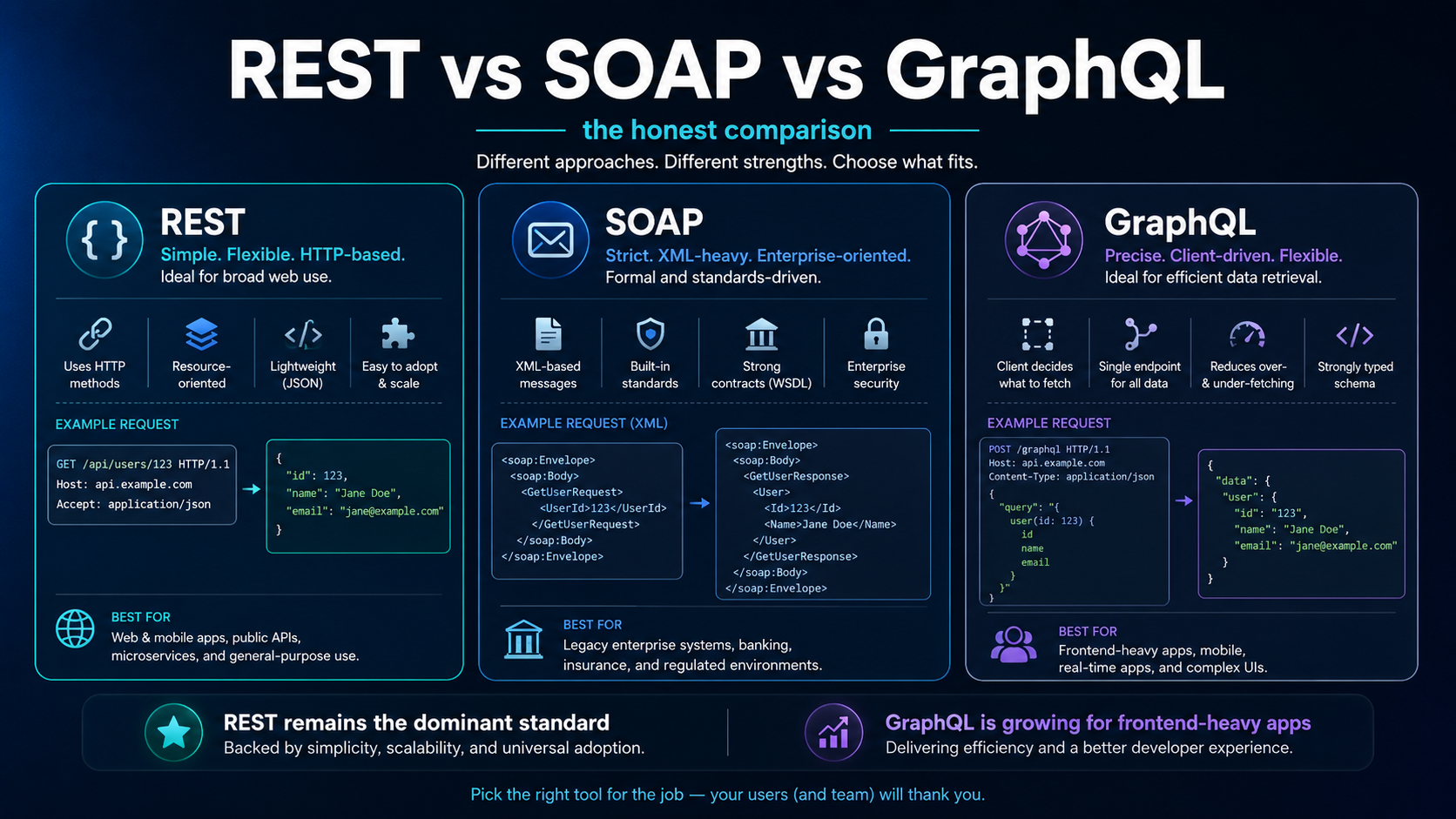
REST vs SOAP vs GraphQL — the honest comparison
REST's main historical competitor was SOAP (Simple Object Access Protocol), a more rigid, XML-heavy protocol favoured in enterprise environments where strict contracts and formal error handling matter more than flexibility. For building consumer-facing APIs that need to work across a wide range of clients and contexts, REST consistently wins on simplicity and performance.
The more current challenger is GraphQL, developed by Meta and released publicly in 2015. Nearly 25% of developers have shifted toward it to enhance data retrieval efficiency — particularly for frontend-heavy applications where over-fetching data is a real performance concern. GraphQL lets the client specify exactly which fields it needs, avoiding the problem of REST returning more data than necessary.
That said, the two aren't mutually exclusive. Around 78% of microservices architectures primarily use REST for inter-service communication, while GraphQL tends to be used for client-facing layers where precise data shaping matters. The choice depends on the use case, not on which is objectively superior.
Why REST still matters — even in an AI-driven landscape
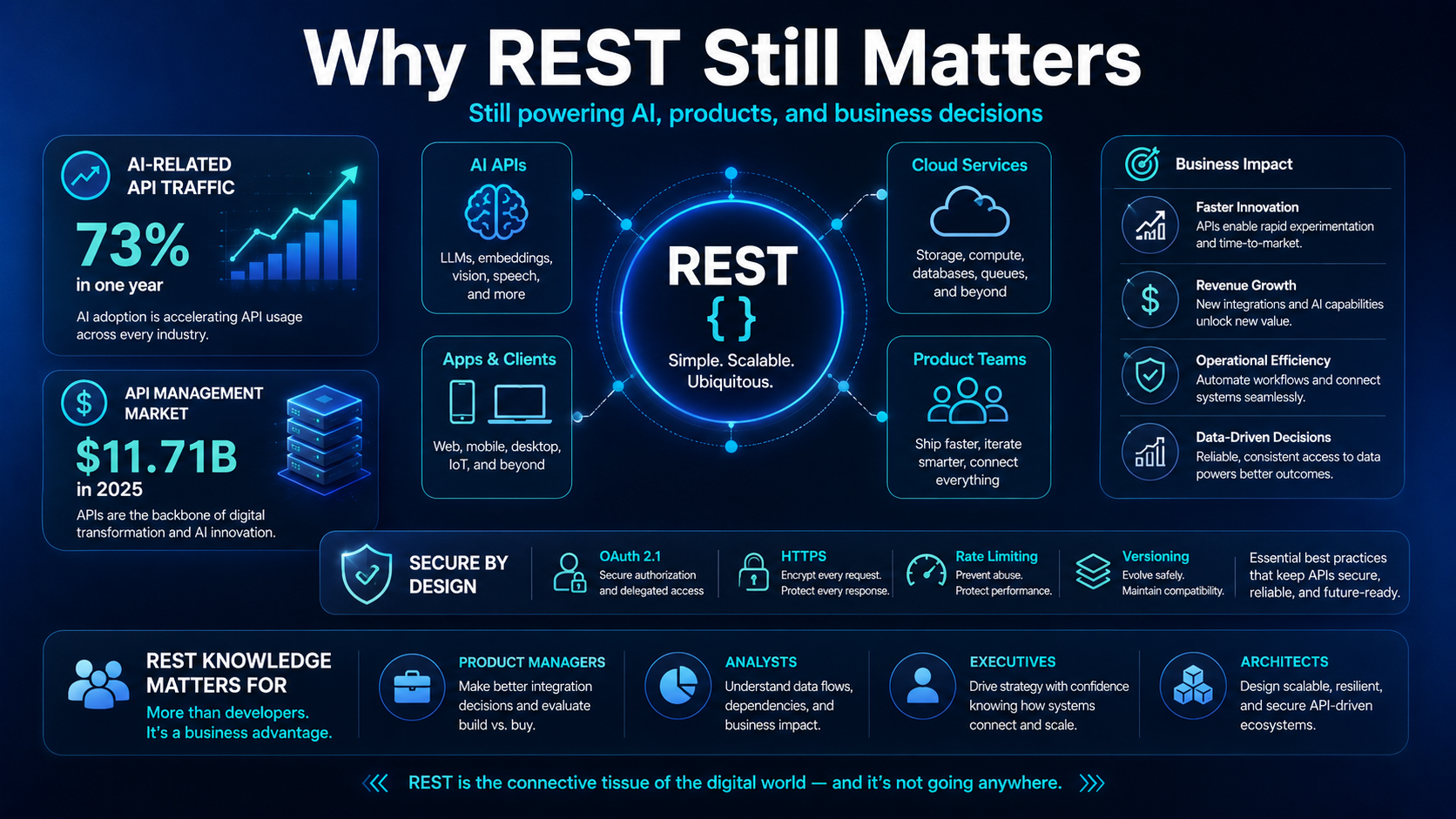
The vast majority of AI APIs being released today are themselves REST-based. When you call OpenAI's API, Anthropic's API, or any major AI service from an application, you're making REST calls. The protocol has absorbed the AI wave rather than being displaced by it. AI-related API traffic grew 73% in a single year on Postman's platform alone, and the API management market reached $11.71 billion in 2025.
Security, however, deserves a clear-eyed look. APIs now face over 70% of today's cybersecurity breaches, according to a 2024 industry report. Proper authentication (OAuth 2.1 is now the standard), HTTPS enforcement, rate limiting, and API versioning aren't optional extras — they're foundational to any production REST implementation.
What this means for non-developers
You don't need to write a REST API to benefit from understanding how it works. Product managers who understand REST make better decisions about what's technically feasible. Business analysts who understand API structures can work more effectively with engineering teams. Executives who understand why APIs are strategic infrastructure — rather than just a technical detail — make better technology investments.
API users are no longer just developers and engineers. The user base is diversifying rapidly to include executives, architects, directors, and product managers. The understanding is spreading — because the decisions that depend on it are spreading too.
At EDU Effective, we build programs for professionals who want to understand the technology landscape — not just manage it. Explore our programs →
EDU Effective Business School — professional development for your long-term success
All five best-selling Effective MBA programs are built on the same educational model — designed for working adults who need learning that fits real professional life:
- Effective MBA: Executive Management & Leadership
- Effective MBA: Applied Artificial Intelligence
- Effective MBA: Coaching, Leadership & Mentoring
- Effective MBA: Mastery in AI
- Effective MBA: Online Marketing
Every programme runs on 15 minutes a day, completes in 10 months or less, is ASIC accredited, and starts from €990.
These are professional programmes, not academic ones — built for working adults to apply what they learn directly in their own business, not to collect a scholarly credential.
Join more than 9,000 students in over 120 countries who are investing in their professional development and career success. Read the experiences of our graduates here.
Apply now — from €990 · Talk to a Study Advisor
Study with NO risk: 14-day money-back guarantee, no questions asked.
Sources
- SQ Magazine — API Usage Statistics
sqmagazine.co.uk/api-usage-statistics/ - TechTarget — What's next for APIs? 4 API trends for 2025 and beyond
techtarget.com/it-infrastructure/tip/Whats-next-for-APIs-4-API-trends-for-2025-and-beyond - Postman — State of the API Report
postman.com/state-of-api/ - Nordic APIs — Shift to AI Exploded API Usage
nordicapis.com/shift-to-ai-exploded-api-usage-in-2024/ - Moldstud — Top REST API Trends
moldstud.com/articles/p-top-rest-api-trends-to-watch-in-2025-how-to-stay-ahead-of-the-curve - JSON Console — REST API vs GraphQL: Statistics, Trends & Performance Comparison
jsonconsole.com/blog/rest-api-vs-graphql-statistics-trends-performance-comparison-2025 - TestDino — API Testing Statistics: Market Size, Tool Adoption & Industry Trends
testdino.com/blog/api-testing-stats