

Search is changing faster than most marketing teams are tracking. For years, the goal was simple: rank on page one of Google. Now the first result your audience sees might not be a link to your website at all — it might be a paragraph generated by an AI that doesn't mention you anywhere.
That shift is real, it's measurable, and it has direct implications for how you approach SEO in 2025 and beyond. The good news is that the fundamentals of creating authoritative, useful content still matter. They just need to work harder and aim at a different target.
What the Data Actually Shows
Start with a number that most marketing teams haven't fully processed yet.
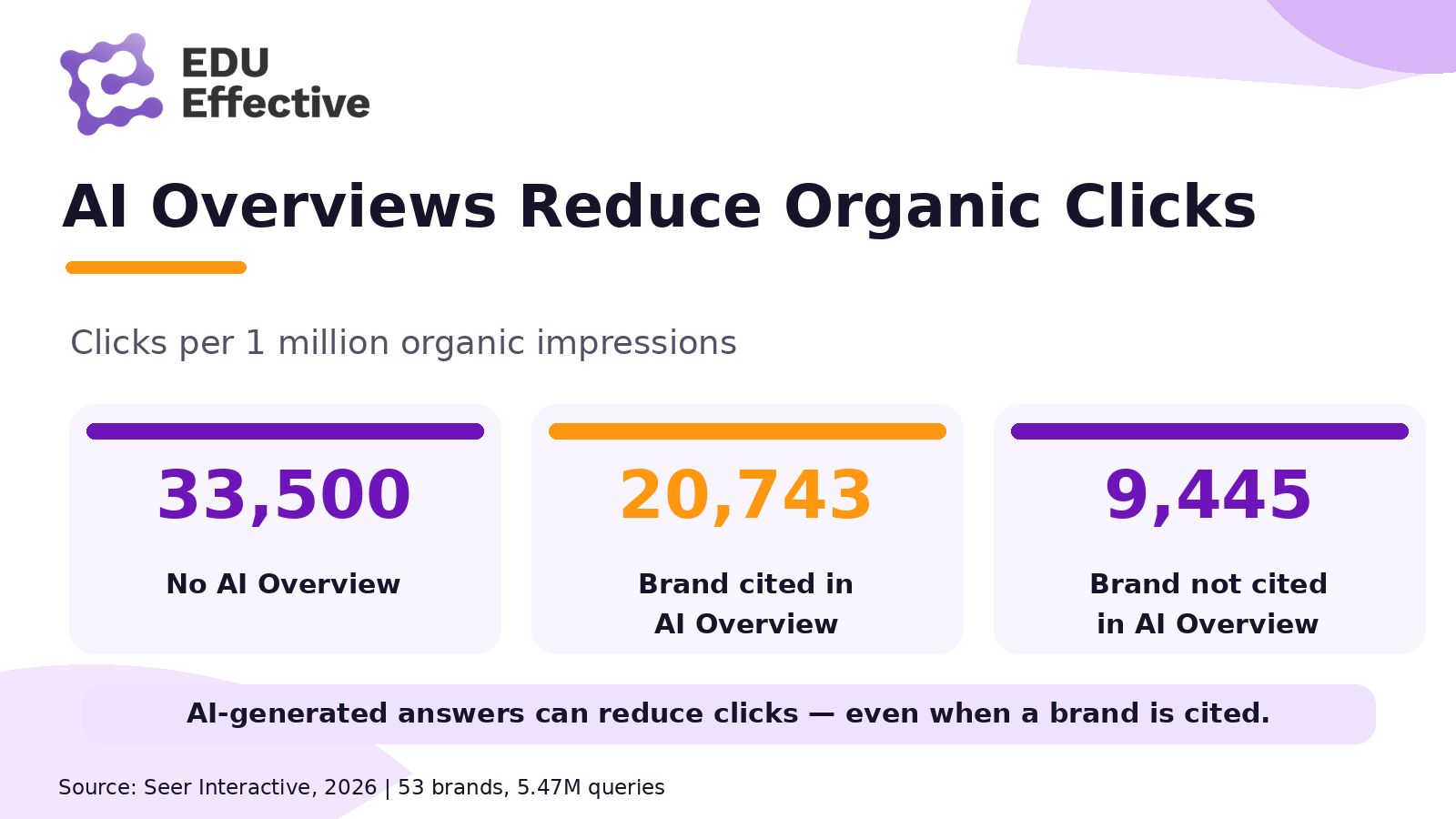
Research from Seer Interactive published in early 2026, covering 53 brands, 5.47 million queries, and 2.43 billion organic impressions across January 2025 to February 2026, shows that when Google shows an AI Overview above organic results, clicks per million organic impressions drop from approximately 33,500 to just 9,445 for brands not cited in the Overview. For informational queries specifically, the organic CTR decline reached 67%.
The same study found that brands cited inside the AI Overview fared better — roughly 20,743 clicks per million impressions — but still 38% fewer than queries where no AI Overview appeared at all. The pattern is consistent: AI Overviews reduce clicks to source websites, with the steepest cuts hitting informational content.
Corroborating data from Search Engine Land's analysis of one million keywords in 2026 shows that queries without AI Overviews actually held steady or improved in CTR over the same period. The drop is specific to queries where Google generates a summary response, not a general decline in organic search performance.
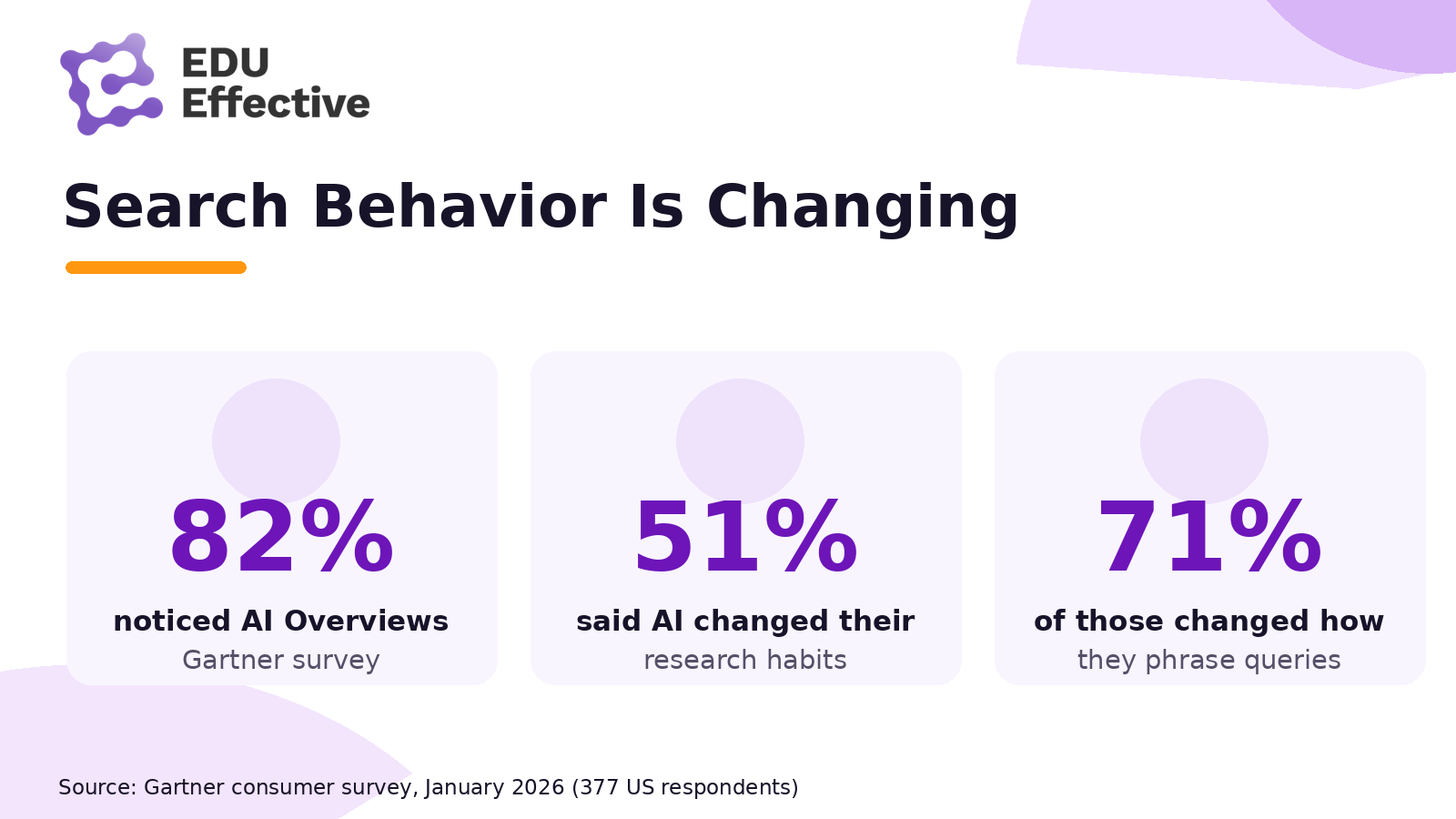
A parallel finding from Gartner's January 2026 consumer survey (377 US respondents) complicates the picture: 82% of users noticed AI Overviews in results, but more than two-thirds continued past them and didn't treat the AI summary as a final answer. 31% said AI summaries actually prompted them to research more product options. That means AI Overviews are reshaping search behavior in ways that raw CTR numbers alone don't capture.
The picture that emerges: Google is still dominant in driving organic traffic to websites, but the way Google serves results is fundamentally changing — and the change directly reduces clicks even when you rank well.
Why AI Overviews Change the Game
To understand what's happening, it helps to know how AI Overviews work. When Google detects that a query has a clear informational answer, it generates a direct response at the top of the page using content scraped from multiple sources. The user gets the answer. They often don't click through to those sources.
This affects some query types much more than others. Informational queries — "what is," "how does," "explain," "define" — are most exposed. Transactional queries — "buy," "compare," "best [product] for [use case]" — are less affected, because there's no clean AI-generated answer that replaces a purchase decision.
Gartner's January 2026 survey also found that 51% of consumers say their research habits have already changed because of generative AI tools. Of those, 71% changed how they formulate queries: 38% now use more specific terms, 26% write full questions, and 26% use conversational phrasing. This is a behavioral shift that affects keyword strategy, not just click rates.
For B2B and content marketing teams, this means the traditional SEO playbook — write a comprehensive guide targeting an informational keyword, earn backlinks, rank on page one — now delivers significantly less traffic even when it succeeds on its own terms. A blog post that ranks first for a query with an AI Overview active is getting materially fewer clicks than it would have two years ago.
The response is not to abandon organic search strategy. The data shows that queries without AI Overviews held roughly flat in CTR. The response is to understand which of your target keywords trigger AI Overviews and build a content strategy that accounts for both traditional SEO and what's now being called AI visibility.
GEO: Generative Engine Optimization
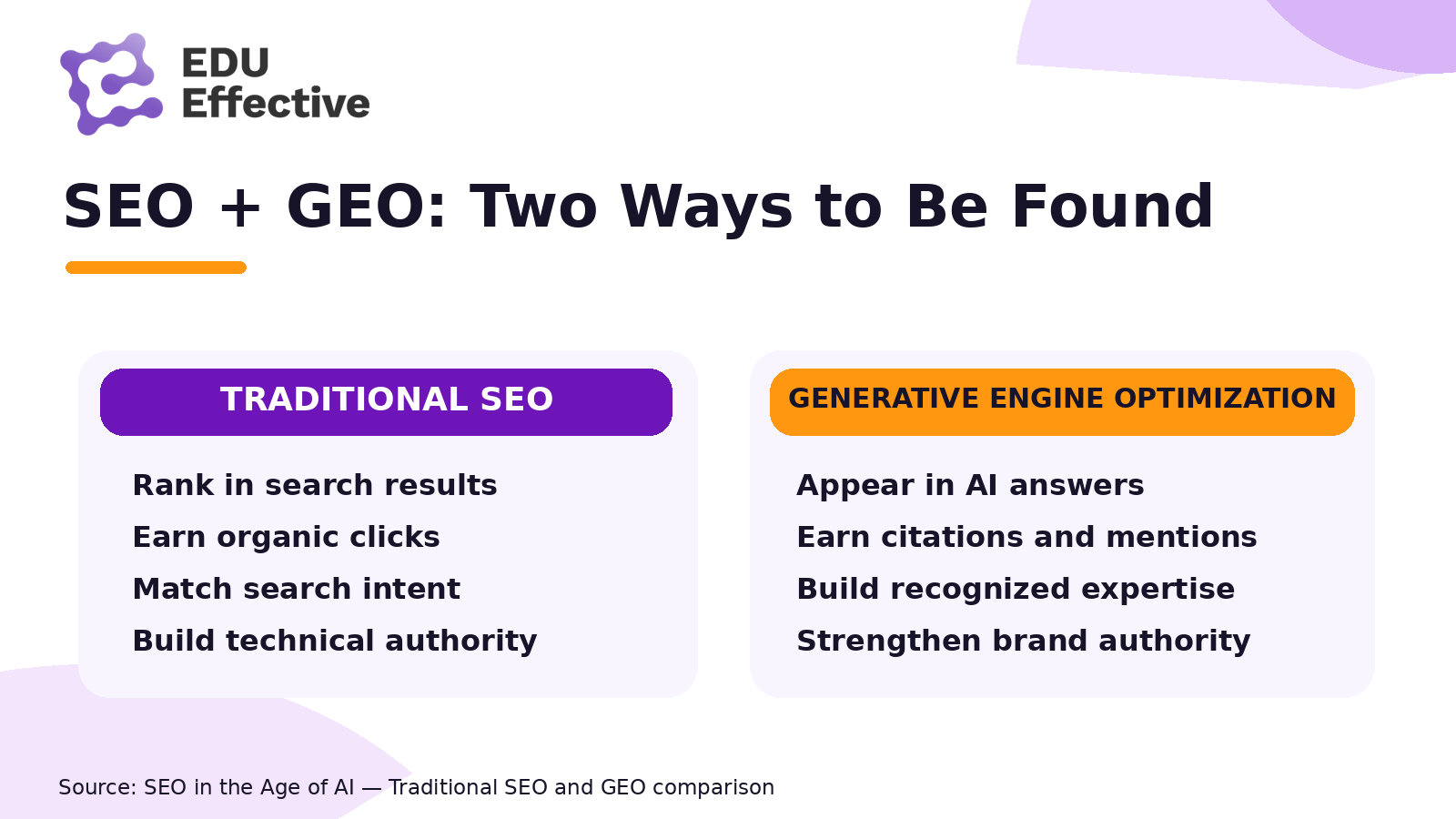
The marketing industry is coalescing around a term for the new discipline: Generative Engine Optimization, or GEO. Where SEO optimizes for ranking in a list of blue links, GEO optimizes for inclusion in AI-generated answers — getting your content cited, paraphrased, or referenced when an AI summarizes a topic.
The two practices overlap substantially but differ in emphasis.
Gartner's 2024 prediction — that by 2026, 25% of search queries could shift toward AI-driven interfaces — was directionally correct, though behavior is proving more nuanced than the headline suggested. The same research house found in January 2026 that only about a third of consumers consider AI chatbots as effective as search engines for learning new information. The transition is real but slower and more fragmented than early projections assumed.
The structural differences between traditional SEO and GEO:
Traditional SEO prioritizes: keyword density and placement, backlink volume and authority, page speed and technical signals, matching query intent with page content.
GEO prioritizes: being cited as an authoritative source in AI-generated summaries, appearing in the knowledge base that AI models draw on, building entity authority so your brand is recognized as credible on specific topics, and earning brand mentions across platforms and publications — not just links.
Both matter. Neither is sufficient alone.
What High-Performing SEO Teams Are Doing Differently
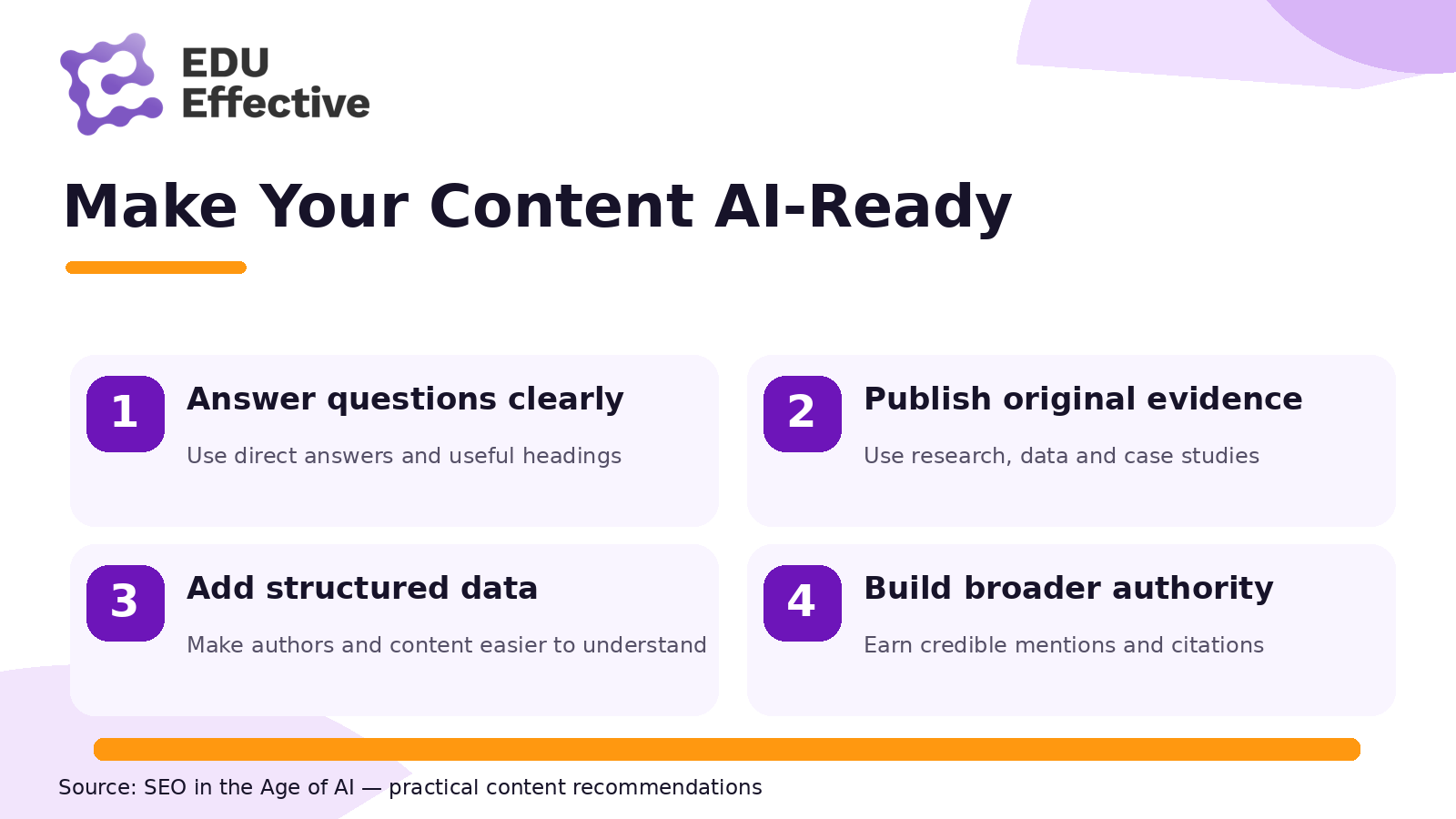
The shift to AI-powered search doesn't make content quality less important — it makes it more important. AI systems have to decide which sources to trust. The signals they use overlap significantly with what made content rank well before: depth, accuracy, external references, author credibility, and topical consistency over time.
Here's what the digital marketing teams adapting fastest are doing in practice.
Structuring content for AI extraction. AI systems parse content by looking for clear, direct answers to the questions implicit in a query. That means leading with a concise summary rather than building to a conclusion, using descriptive H2 and H3 headings that function as standalone statements, and including FAQ sections that address the specific phrasing users search for. The content still needs to be substantive — AI systems deprioritize thin content — but the structure needs to serve extraction, not just reading.
Adding original data and primary research. Content that cites aggregator blogs and secondary sources looks identical to every other piece on the same topic. Content that includes original survey results, proprietary analysis, or firsthand case studies gives AI systems something worth quoting. It also builds the kind of authority that earns citations over time. If your team doesn't have proprietary data, commissioning even a small original survey can differentiate your content significantly.
Implementing structured data. JSON-LD schema markup — particularly Article, FAQ, Author, and Organization schema — helps both Google and AI crawlers understand what your content is about and who produced it. It's a technical investment that pays dividends in both traditional search and AI-generated results. Most companies have significant gaps here.
Allowing AI crawlers access. Some sites have blocked GPTBot, Anthropic's crawler, and similar AI-specific bots in their robots.txt files. If that's true for your site, you're excluded from the training data and real-time retrieval systems those engines use. Whether to allow or block is a legitimate strategic choice — but it should be a deliberate decision, not a default left over from a generic privacy concern.
Building brand presence across platforms. AI systems don't just crawl your website. They draw on the broader information environment — mentions in industry publications, discussions on Reddit, podcast appearances, citations in other articles. A brand that exists only on its own website is harder to corroborate as an authority than one that appears consistently across multiple credible sources. Thought leadership content placed in relevant publications, active presence in professional communities, and genuine participation in industry conversations all contribute to this.
Testing your AI visibility regularly. Prompt ChatGPT, Perplexity, and Gemini with queries central to your business. What comes up? Is your brand mentioned? Are competitors mentioned instead? This kind of audit takes 30 minutes and tells you more about your current AI visibility than most analytics dashboards.
The Keyword Strategy Adjustment
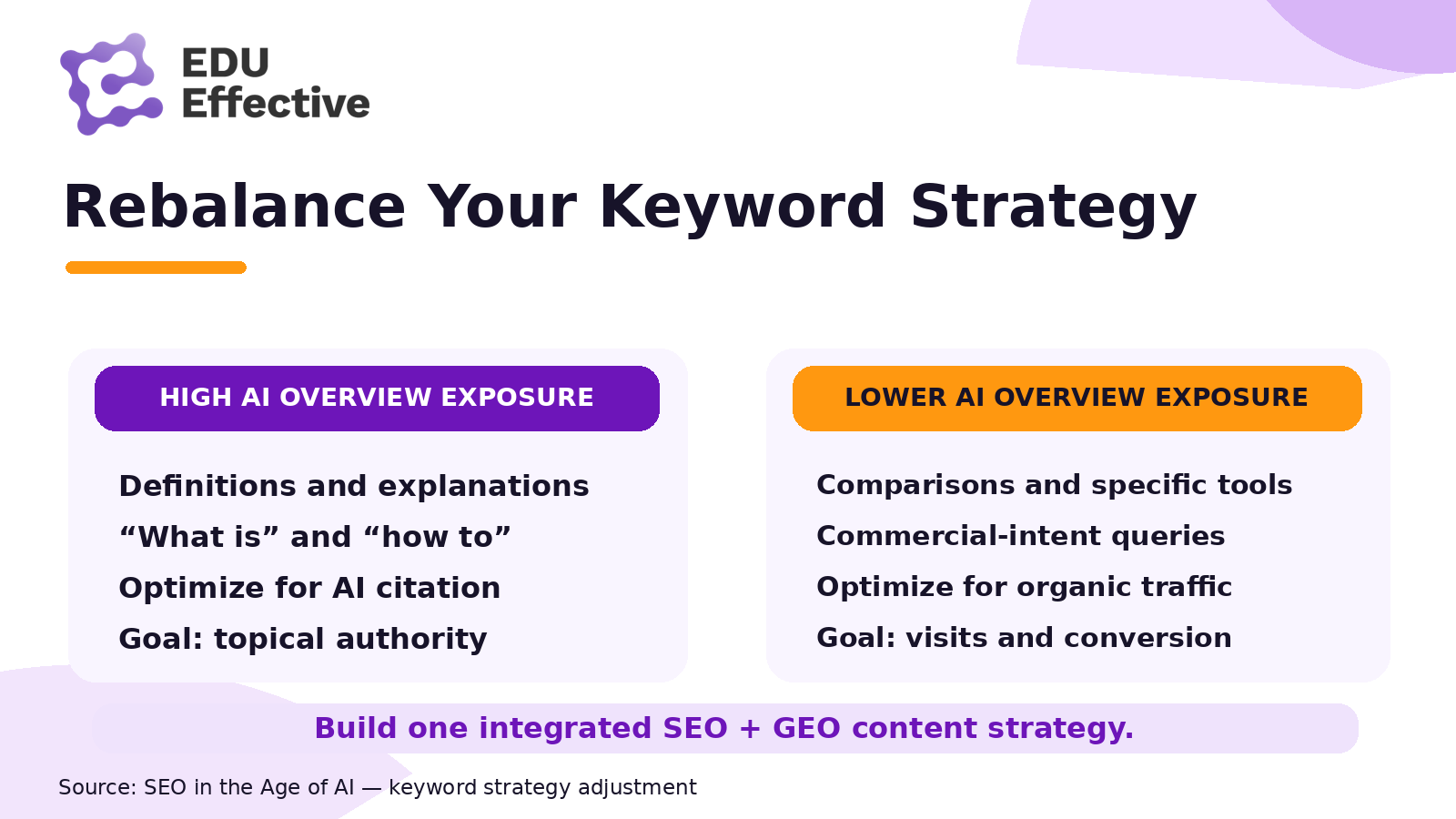
For keyword research, the practical implication of AI Overviews is to separate your target keywords into two buckets.
High AI Overview exposure: informational queries, definition and explanation queries, "how to" queries for widely covered topics. These still drive brand awareness and qualify audiences, but you should expect lower click-through rates. Content targeting these queries should be designed to be cited in AI summaries — GEO optimization — and to build topical authority, not primarily to drive direct traffic.
Lower AI Overview exposure: comparison queries, best-of queries, tool-specific queries, queries with commercial intent, highly specific long-tail queries. These still behave more like traditional SEO. A query like "best MBA program for working professionals" is unlikely to be satisfactorily answered by an AI Overview — it requires specificity, personalization, and trust that direct content provides better than a summary.
The content marketing teams that will outperform in the next two years are those building integrated strategies: topical authority content designed for AI citation, conversion-intent content designed for traditional SEO traffic, and consistent brand presence across the broader information environment that AI systems reference.
What Stays the Same
In the middle of a significant transition, it's worth naming what hasn't changed.
Content quality still matters. AI systems favor content that is accurate, specific, well-sourced, and genuinely useful. Content that existed primarily to rank for keywords with thin substance has always been fragile — AI makes that fragility more visible faster.
Technical SEO still matters. Page speed, mobile optimization, crawlability, clean URL structures — these are prerequisites for any form of search visibility. AI crawlers have the same basic requirements as Google's traditional crawler.
Authority and trust still matter. Links from credible sources, consistent authorship, citations from recognized publications — these signals translate to the AI era. The mechanism is different; the underlying logic is the same.
The SEO teams that treat AI search as a separate problem to solve after they've "done" traditional SEO will end up doing twice the work. The teams that integrate GEO thinking into their core content strategy from the start — structuring for extraction, building entity authority, earning citations, monitoring AI visibility — are building something more durable.
Search is changing. The brands that adapt early have a window before the market adjusts. That window is open now.
About EDU Effective Business School
The Effective MBA: Online Marketing connects marketing decisions to revenue rather than vanity metrics. Runs on 15 minutes a day, completes in 10 months or less and is ASIC accredited.
Sources
- Seer Interactive — AIO Impact on Google CTR: 2026 Update (53 brands, 5.47 million queries, 2.43 billion impressions) https://seerinteractive.com/insights/aio-impact-on-google-ctr-2026-update
- Search Engine Land — What 1 million keywords reveal about AI's impact on search (2026) https://searchengineland.com/what-1-million-keywords-reveal-about-ais-impact-on-search-481474
- Gartner — Gartner Survey Finds Only One-Third of Consumers Say GenAI Rivals Search Engines (January 2026) https://www.gartner.com/en/newsroom/press-releases/gartner-survey-finds-only-one-third-of-consumers-say-genai-rivals-search-engines-marketers-must-optimize-for-both-ai-driven-and-traditional-search
- Gartner — Gartner Predicts Search Engine Volume Will Drop 25% by 2026 Due to AI Chatbots (February 2024) https://www.gartner.com/en/newsroom/press-releases/2024-02-19-gartner-predicts-search-engine-volume-will-drop-25-percent-by-2026-due-to-ai-chatbots-and-other-virtual-agents