
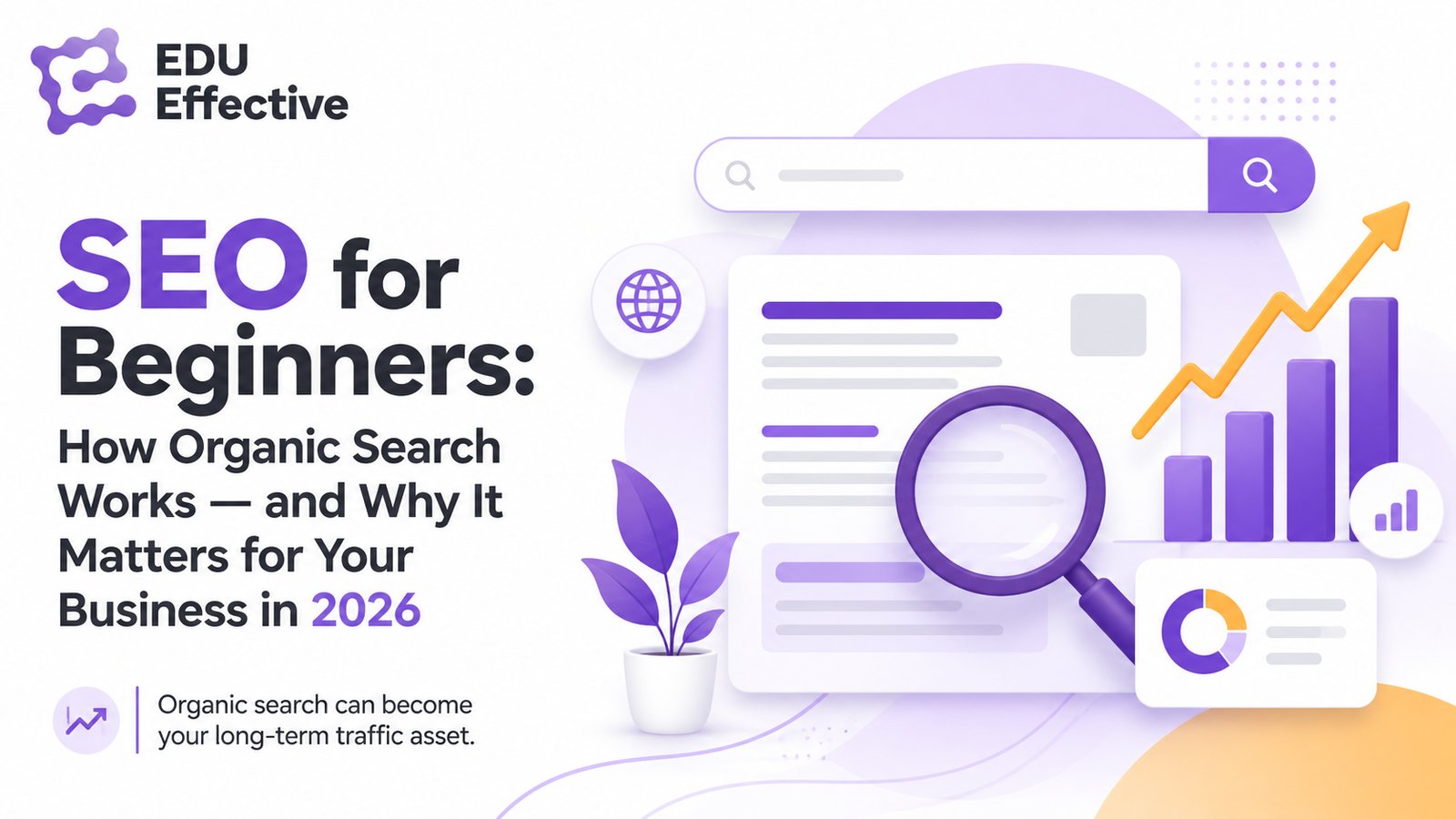

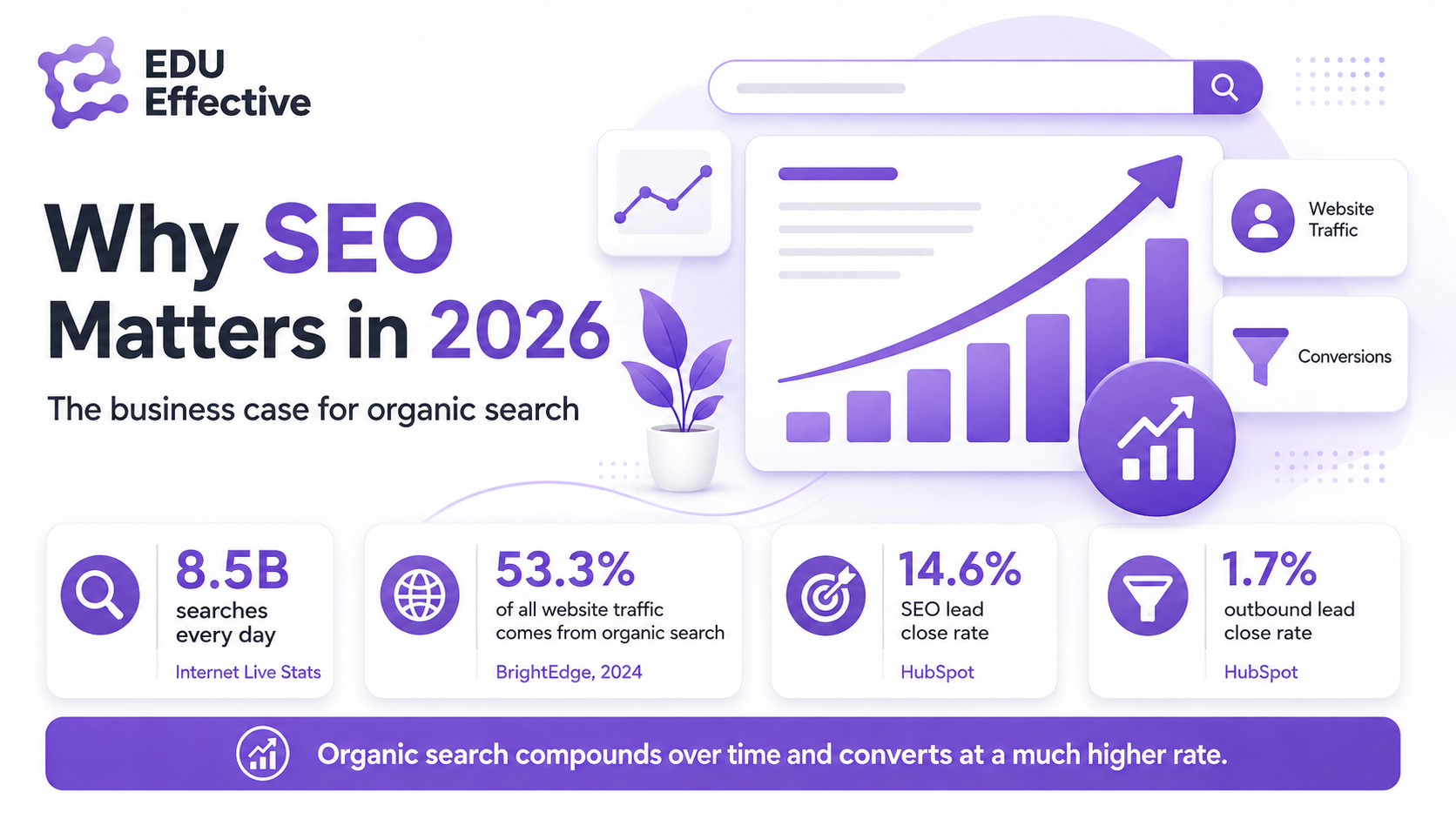
Google processes approximately 8.5 billion searches every day, according to Internet Live Stats. Organic search — the unpaid results that appear below any advertisements in a search engine results page — drives 53% of all website traffic globally — a figure consistently confirmed across BrightEdge's multi-year research programme tracking billions of sessions across thousands of domains, most recently reconfirmed at 53.3% in their 2024 analysis. And SEO leads close at a rate of 14.6%, compared to just 1.7% for outbound marketing leads, according to HubSpot research.
These three numbers establish the commercial logic of search engine optimisation as clearly as any marketing metric can. More than half of all website traffic arrives through organic search — without any ongoing advertising spend. The people who find a business through organic search convert to customers at nearly nine times the rate of people reached through outbound marketing. That is not a marginal performance difference. It is a structural advantage that compounds over time as SEO investment accumulates.
For any professional working in marketing, running a business, or managing a digital presence, understanding how SEO works — not at a technical depth, but at a strategic level — is one of the most practically valuable pieces of marketing knowledge available in 2026.
What SEO is — and what it is actually trying to achieve
Search engine optimisation is the practice of improving a website's visibility in unpaid search engine results — so that when people search for terms relevant to your business, your content appears prominently and earns clicks.
The goal of SEO is not to manipulate search engines. It is to make content that genuinely serves the needs of searchers — and to present it in ways that search engines can find, understand, and evaluate as trustworthy and relevant. When these two things align, the content ranks well. When they do not align — when content is technically accessible but not genuinely useful, or when it is useful but technically inaccessible — SEO performance suffers.
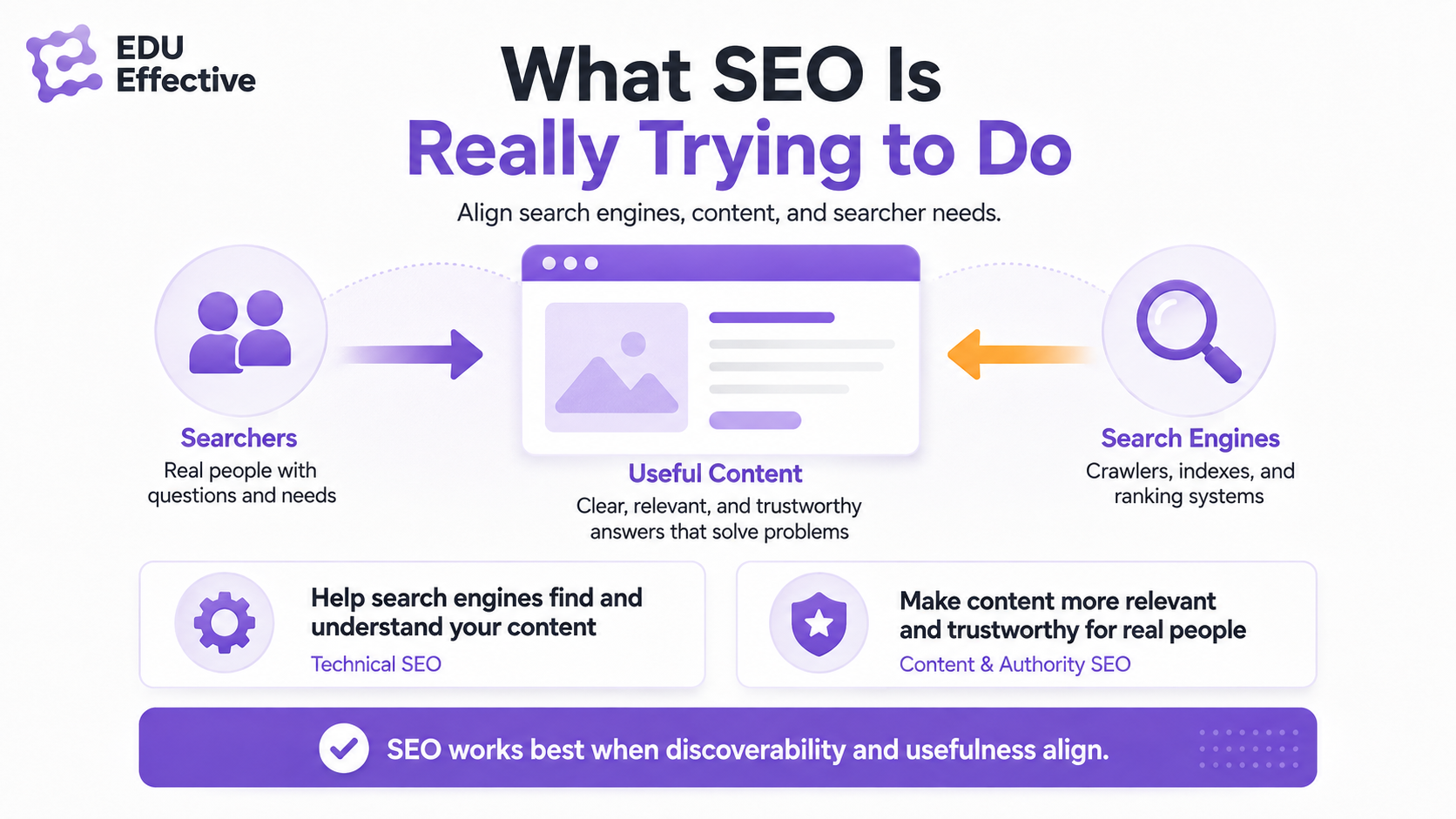
Understanding this alignment is the foundation of SEO strategy. Every technical and content decision in SEO serves one of two objectives: helping search engines find and understand your content (technical SEO), or making your content genuinely more relevant and trustworthy for the people searching for it (content and authority SEO).
How search engines work — the three-step process
Before optimising for search engines, it is useful to understand what they actually do. Google and other search engines operate through a three-stage process that determines which content appears for which searches.
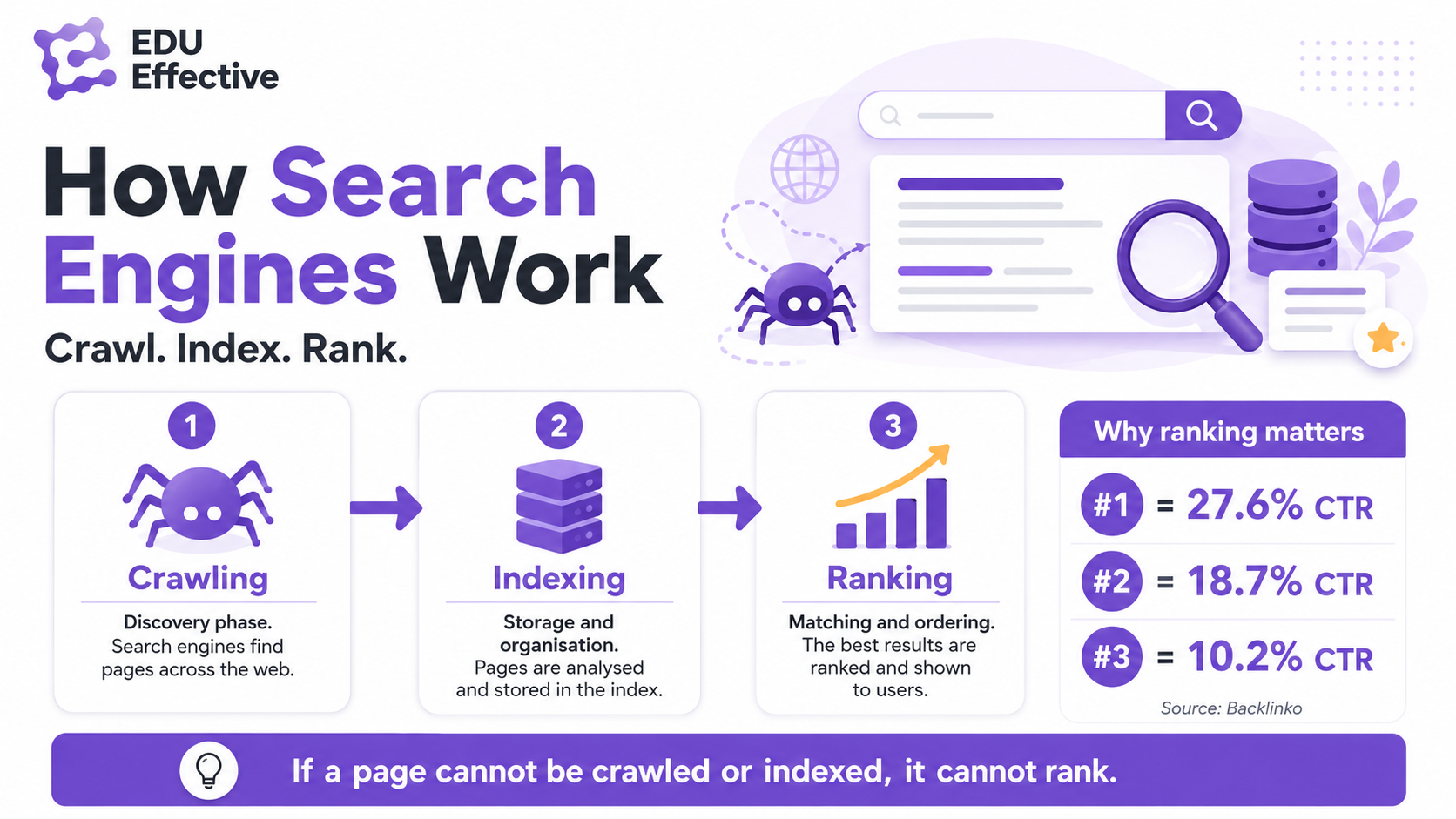
Crawling is the discovery phase. Search engines deploy automated programmes called crawlers (or spiders) that follow links across the web, discovering pages and collecting information about their content. A page that search engines cannot crawl — because it is blocked by robots.txt, behind a login, or not linked from anywhere else on the web — cannot be indexed or ranked, regardless of how good its content is. The practical implication: any page you want to rank needs to be discoverable and crawlable.
Indexing is the storage and organisation phase. Once a page is crawled, search engines analyse its content — the text, images, structure, metadata, and signals about its purpose and quality — and add it to the index: the database of pages that can appear in search results. Indexed pages become eligible to rank; non-indexed pages do not appear in results at all.
Ranking is the matching and ordering phase. When a user types a search query, the search engine reviews its index for pages relevant to that query and ranks them in order of relevance and quality, displaying the most appropriate results for that specific searcher in that specific context. The ranking algorithms consider hundreds of signals — the content's relevance to the query, the page's technical performance, the authority and trustworthiness of the website, and the searcher's context including location and search history.
The first position in Google's organic results earns approximately 27.6% of all clicks for a given search, according to Backlinko's large-scale analysis of 4 million Google search results — the most widely cited CTR benchmark in SEO research. The second position earns approximately 18.7%. The third earns approximately 10.2%. By page two, the majority of searches result in no clicks at all. This concentration of traffic in top positions explains why ranking matters and why the difference between position one and position five can be commercially significant even for similar search volumes.
The three pillars of SEO: technical, content, and authority
SEO strategy in 2026 rests on three interdependent pillars, each of which is necessary and none of which is sufficient on its own.
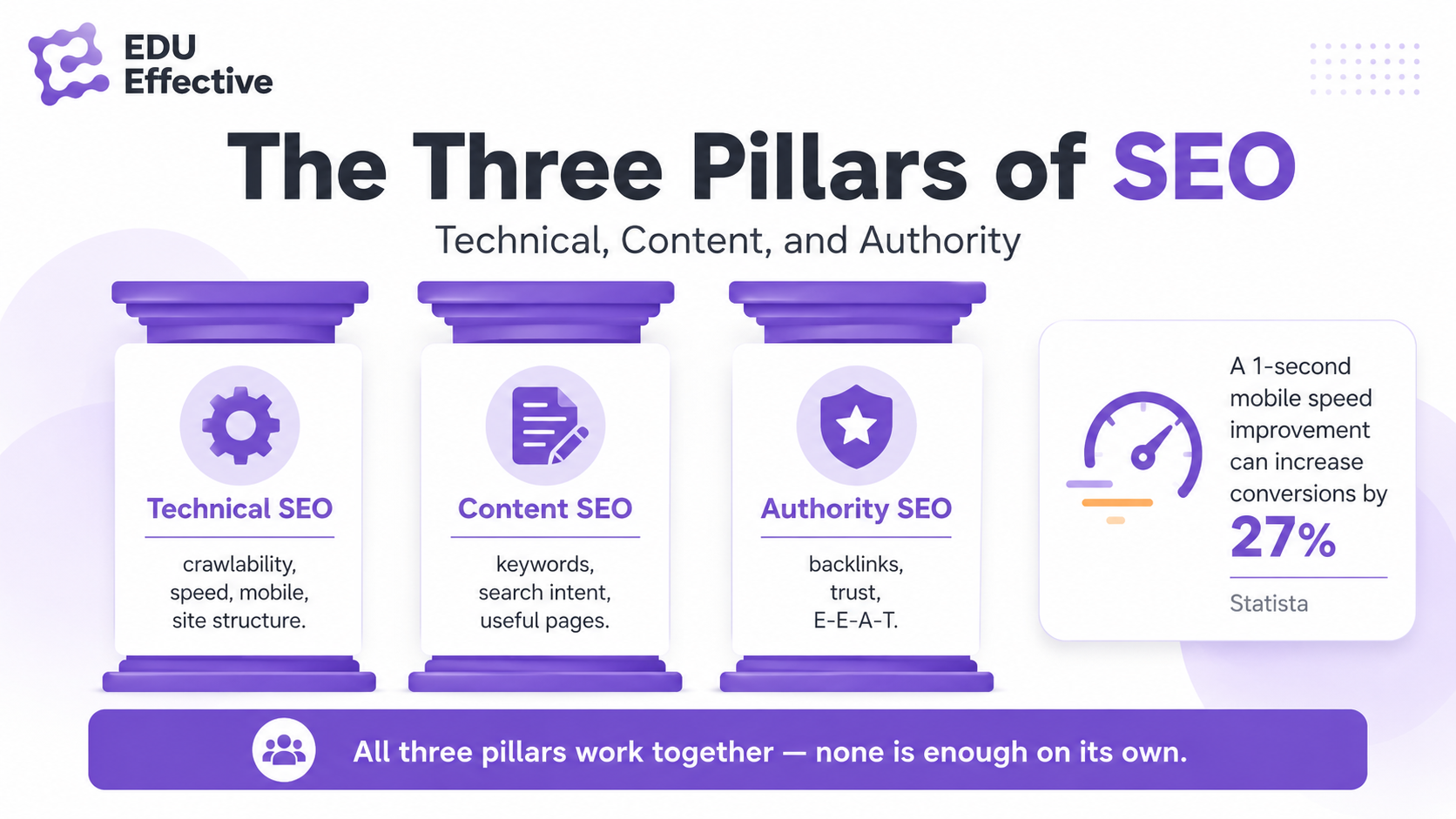
Technical SEO ensures that search engines can find, crawl, and correctly understand your content. It covers the structural and performance foundations of a website: page loading speed, mobile optimisation, clear URL structure, proper use of HTML tags, sitemap configuration, robots.txt management, HTTPS security, and the absence of technical errors that prevent crawling or indexing. A website with excellent content but poor technical foundations will consistently underperform its potential in organic search.
Core Web Vitals — Google's set of measurable user experience signals covering loading performance, visual stability, and interactivity — have been a confirmed Google ranking factor since 2021. In 2026, page speed remains one of the most consistently impactful technical SEO factors: a one-second improvement in mobile page speed increases conversions by an average of 27%, according to Statista research. Technical SEO is not optional or secondary — it is the infrastructure that makes every other SEO investment more effective.
Content SEO creates the pages that match the search intent of your target audience. The fundamental unit of content SEO is the alignment between a specific piece of content and a specific keyword or set of keywords that represents a genuine information need in your target market. Content that precisely addresses what searchers are looking for — at the right depth, in the right format, with genuine expertise — earns rankings. Content that is superficial, generic, or misaligned with search intent does not.
Keyword research — the process of identifying the specific terms and questions your target audience searches for — is the foundation of content SEO. It involves understanding not just what words people search, but what they are trying to accomplish when they search them: are they looking for information (informational intent), comparing options (navigational or comparative intent), or ready to purchase (transactional intent)? Content optimised for the wrong intent — answering a purchase question with an informational article, or providing brand information when the searcher wants a comparison — consistently underperforms regardless of its technical quality.
Authority SEO builds the signals that tell search engines your website is trustworthy and credible. The most important of these signals are backlinks — links from other websites to your content. Google treats backlinks as editorial endorsements: a link from a respected, relevant website to your content signals that your content is worth recommending. The quantity, quality, and relevance of backlinks pointing to your domain is one of the strongest signals Google uses to assess authority — and it is the hardest to build quickly, which is why SEO is often described as a long-term investment.
The authority pillar also encompasses E-E-A-T — Experience, Expertise, Authoritativeness, and Trustworthiness — Google's framework for evaluating content quality and source credibility. In 2026, E-E-A-T signals are particularly significant for content in categories where incorrect information could harm readers: health, finance, legal, and other "Your Money or Your Life" topics where Google applies heightened quality standards.
Keywords: the bridge between searchers and content
Keyword strategy is often where beginners start their SEO learning — and where the most common mistakes are made.
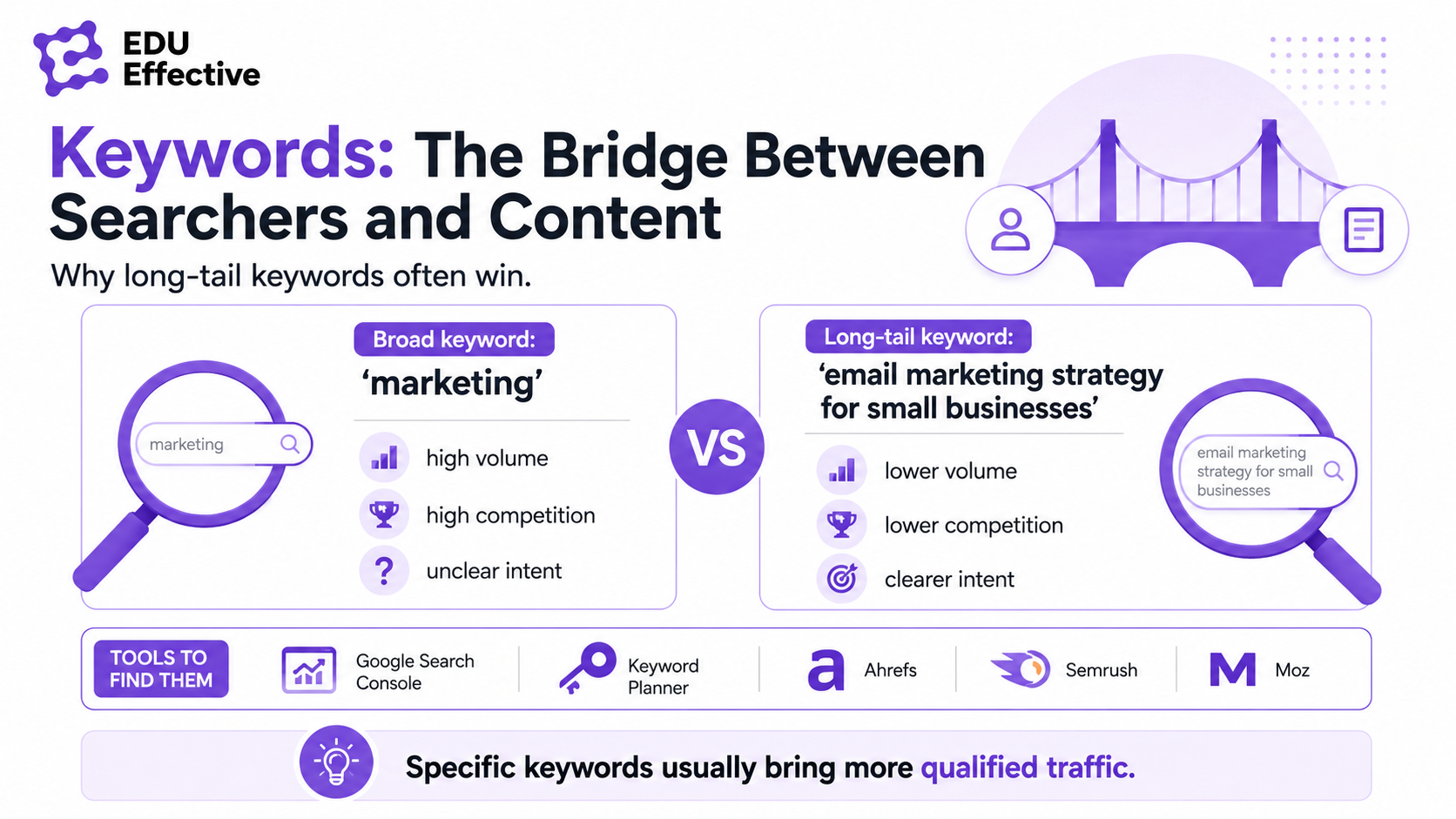
The most common mistake is targeting keywords that are too broad. "Marketing" has enormous search volume. It also has enormous competition — established brands, major publications, and specialist sites competing for the same positions — and very diffuse search intent: someone searching for "marketing" might be a student, a business owner, a job seeker, or a researcher. Broad keywords are rarely the right starting point for a new SEO programme.
Long-tail keywords — more specific, longer phrases — are where most successful SEO strategies build initial traction. "Email marketing strategy for small businesses" has lower search volume than "email marketing," but its search intent is much clearer, its competition is typically lower, and the person searching for it is much closer to being a potential customer. A body of content that ranks well for many long-tail keywords consistently generates more qualified traffic than a single broad keyword even at equivalent total volume.
Keyword research tools — including Google Search Console (free), Google Keyword Planner (free with a Google Ads account), Ahrefs, Semrush, and Moz — provide data on search volume, keyword difficulty, and related terms that allow marketers to make informed decisions about which keywords to target. The most effective keyword research combines tool data with genuine understanding of what your target audience actually needs — which is why SEO expertise and marketing expertise are inseparable.
On-page SEO: optimising individual pages
On-page SEO covers the specific elements of each page that can be optimised to improve its relevance and clarity for both search engines and users.
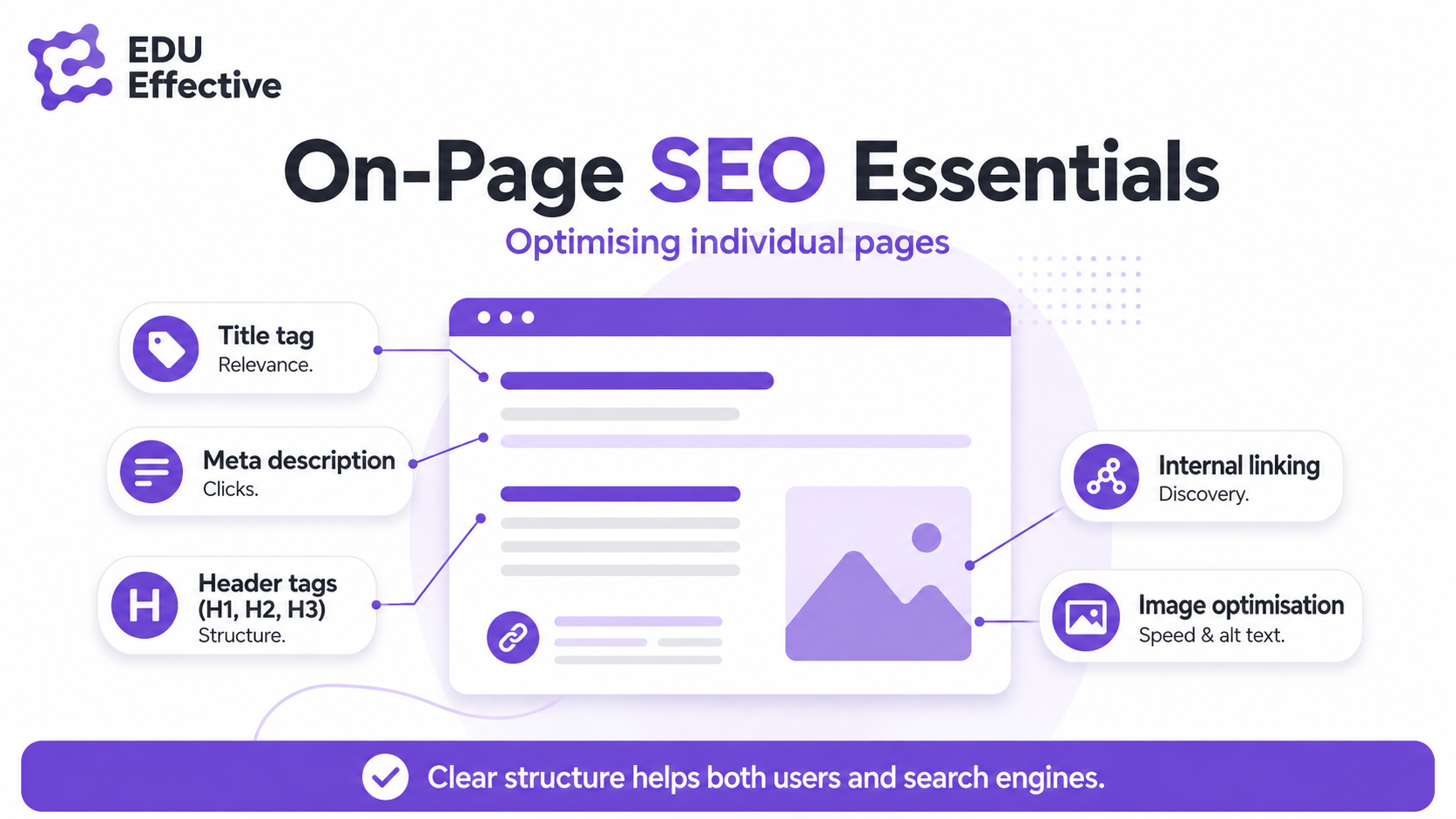
Title tags are the text that appears as the clickable headline in search results. They are one of the most direct signals of page relevance that search engines use, and they significantly influence click-through rate from the search results page. An effective title tag includes the primary keyword, communicates the content's value to the searcher, and is typically under 60 characters.
Meta descriptions are the short summaries that appear under the title tag in search results. They do not directly influence ranking but significantly influence click-through rate — and therefore the actual traffic a well-ranked page generates. An effective meta description includes relevant keywords, accurately describes the page's content, and includes a clear reason for the searcher to click.
Header tags (H1, H2, H3) provide the structural hierarchy of a page's content. The H1 is the page's primary heading and should reflect the primary keyword clearly. Subsequent headers organise the content into sections that help both readers and search engines understand the page's structure and the relationship between its parts.
Internal linking — links from one page on your website to another — serves two purposes in SEO: it helps crawlers discover pages throughout your site, and it signals the topical relationships between your content, helping search engines understand which pages are most authoritative on which topics.
Image optimisation involves ensuring images load quickly (through compression and appropriate formats), include descriptive alt text (which helps search engines understand image content and improves accessibility), and are named with descriptive file names rather than default strings like "IMG_4782.jpg."
SEO in 2026: the AI search transformation
SEO in 2026 is navigating its most significant structural change since mobile-first indexing: the rise of AI-generated search summaries that answer queries directly on the results page, reducing the number of users who click through to source websites.
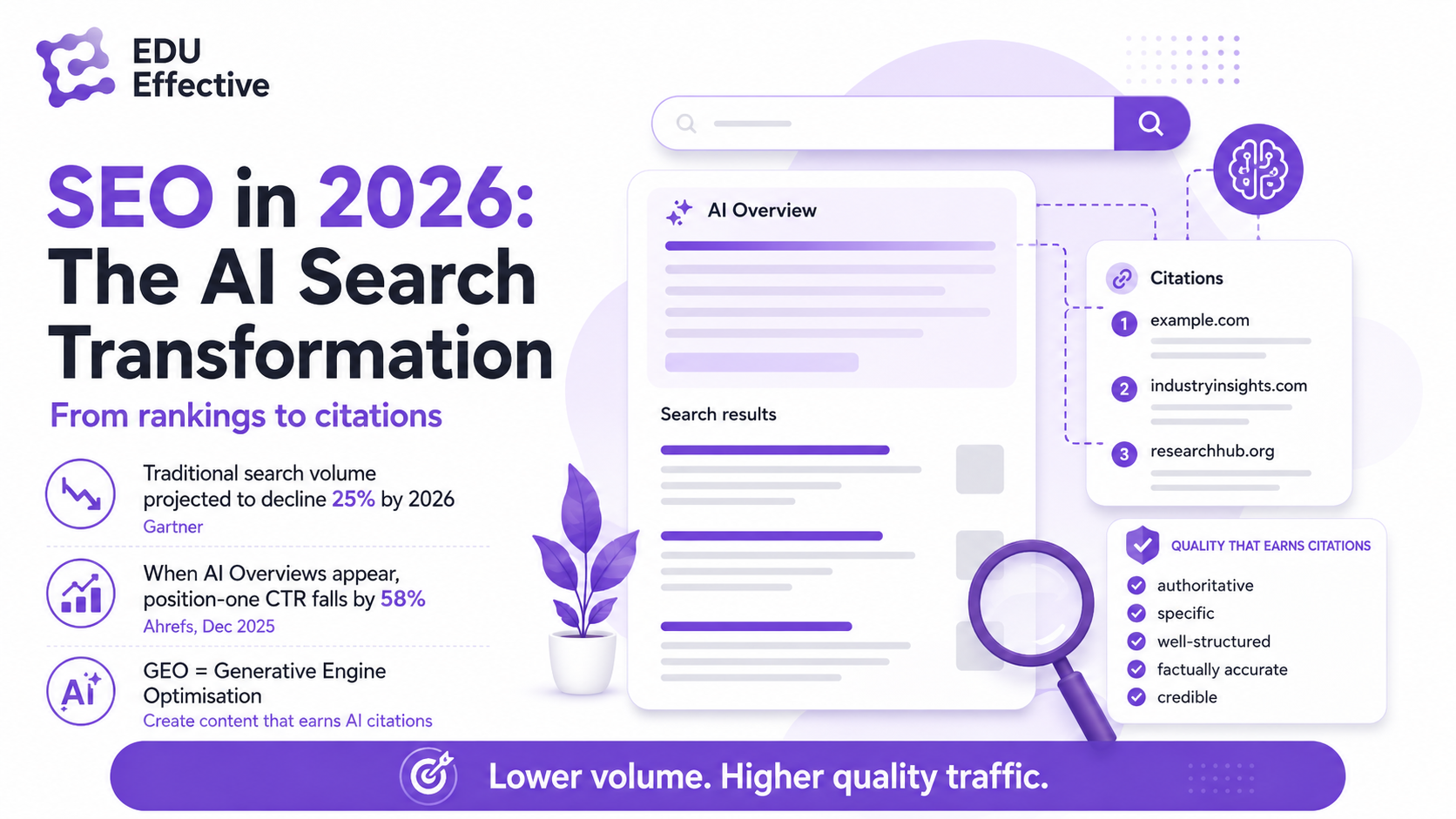
Gartner projected a 25% decline in traditional search engine volume by 2026 as AI absorbs more informational queries. Google AI Overviews now appear in a significant proportion of searches, and when an AI Overview is present, the click-through rate for even position-one organic results falls by 58%, according to Ahrefs' updated analysis of 300,000 keywords published in December 2025.
The strategic response is Generative Engine Optimisation (GEO) — the emerging discipline of creating content that earns citations in AI-generated search summaries rather than just rankings in traditional blue-link results. The content that earns citations from AI systems shares characteristics with the content that has always ranked well in traditional SEO: it is authoritative, specific, well-structured, factually accurate, and clearly attributed to credible sources. The E-E-A-T principles that Google has emphasised for years are the same principles that determine whether AI systems cite your content as a source.
The transition also creates a specific opportunity. Users who click through to a website from an AI-generated answer — arriving because the AI cited the site as a reliable source — demonstrate significantly higher engagement and conversion rates than typical organic search visitors, because they arrive with more context and higher confidence in the site's credibility. Lower volume but higher quality is the emerging pattern of AI-influenced SEO traffic.
How long does SEO take — and what results can you expect
The most common question from SEO beginners is how quickly results appear. The honest answer is that meaningful organic search traffic from a new SEO programme typically takes three to six months to begin materialising and nine to twelve months to demonstrate clear return on investment. This timeline varies based on the competitiveness of the target keywords, the technical health of the website, the quality and volume of content produced, and the strength of the existing backlink profile.
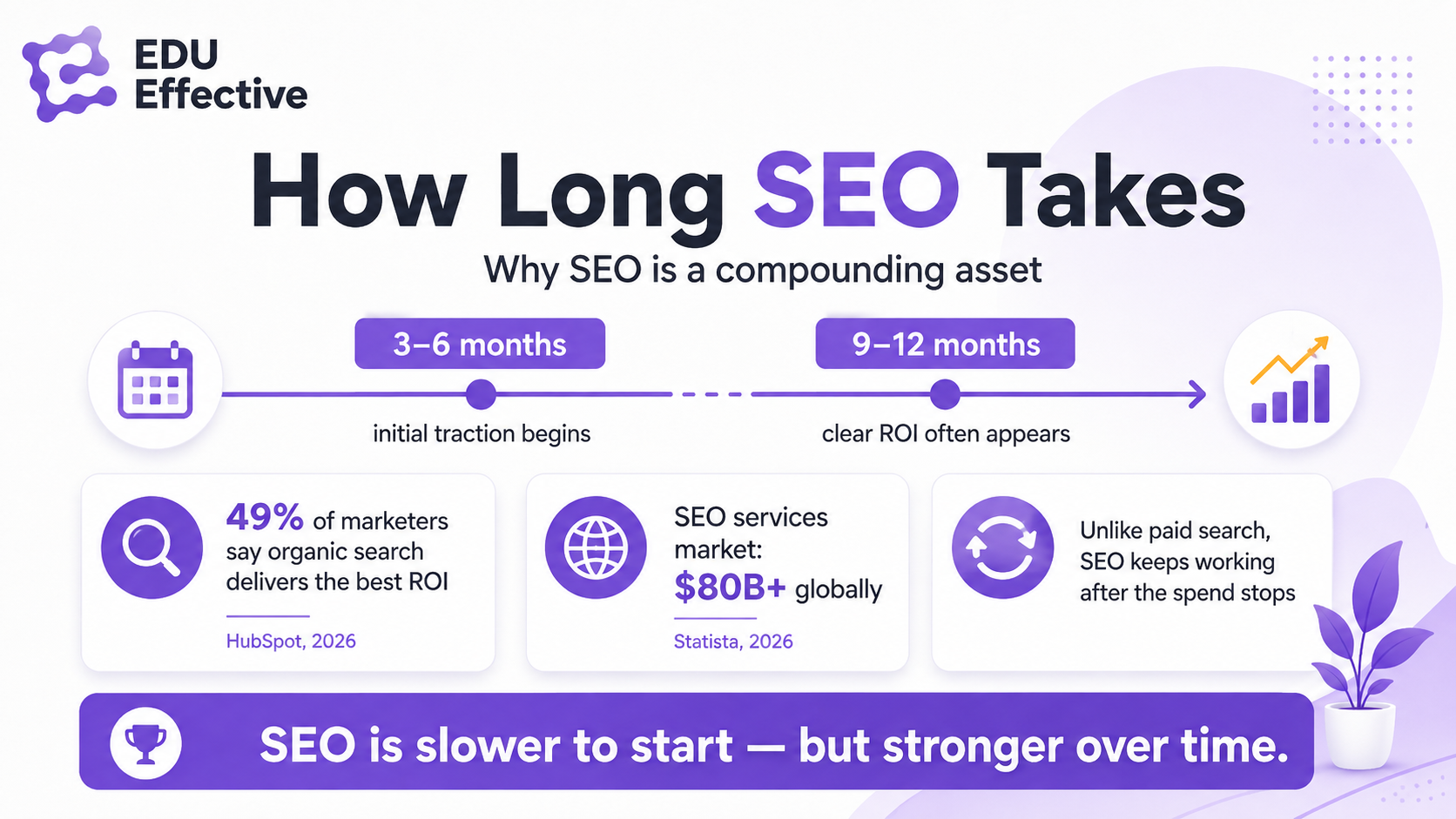
The reason SEO takes time is structural, not arbitrary. Google builds trust in websites through accumulated signals over time — consistent publishing, growing backlink profiles, sustained user engagement signals. These signals cannot be created overnight regardless of investment level. The same characteristic that makes SEO slow to produce initial results makes it valuable once established: a strong organic position, once built, continues to deliver traffic without ongoing advertising spend. Unlike paid search, which stops the moment the budget stops, SEO is an asset that compounds.
49% of marketers report that organic search delivers the best ROI of any marketing channel, according to HubSpot's State of Marketing 2026. The SEO services market reached over $80 billion globally in 2026, according to Statista — reflecting sustained commercial confidence in the channel's long-term value. For a broader view of how SEO fits into the wider marketing mix, this connects directly to how content marketing strategy and SEO converge in 2026 — and why Generative Engine Optimisation requires the same foundational content quality that has always determined which pages earn organic rankings and which do not.
At EDU Effective, the Effective MBA: Online Marketing covers SEO alongside the full range of digital marketing disciplines — from keyword strategy and content marketing to email marketing, social media, and analytics. Content draws on practitioners from Google, HubSpot, and many more, delivered in 15 minutes a day, applicable to your current role from day one. Explore the programme →
Related articles
Online Marketing in 2026: Strategy, Channels, AI Tools and What Actually Drives Growth
Content Marketing Strategy in 2026: What Works, What Has Changed
Personal Branding on LinkedIn in 2026: Why It Matters and How to Build It
EDU Effective Business School — professional development for your long-term success.
All five best-selling Effective MBA programs are built on the same educational model — designed for working adults who need learning that fits real professional life:
Effective MBA: Executive Management & Leadership
Effective MBA: Applied Artificial Intelligence
Effective MBA: Coaching, Leadership & Mentoring
Effective MBA: Online Marketing
Every programme runs on 15 minutes a day, completes in 10 months or less, is ASIC accredited, and starts from €990.
These are professional programmes, not academic ones — built for working adults to apply what they learn directly in their own business, not to collect a scholarly credential.
Join more than 9,000 students in over 120 countries who are investing in their professional development and career success. Read the experiences of our graduates here.
Apply now — from €990 · Talk to a Study Advisor
Study with NO risk: 14-day money-back guarantee, no questions asked.
Sources
BrightEdge — Digital Channel Performance Research: Organic Search at 53% of All Website Traffic (Multi-year research programme, billions of sessions, thousands of domains; reconfirmed at 53.3% in 2024 analysis)
https://www.brightedge.com/resources/research-reports/channel_share
Backlinko — Google Click-Through Rate Study: #1 Organic Result Earns 27.6% of All Clicks (Large-scale analysis of 4 million Google search results — most widely cited CTR benchmark in SEO)
https://backlinko.com/google-ctr-stats
HubSpot — State of Marketing Report 2026: SEO Leads Close at 14.6% vs. 1.7% for Outbound; 49% of Marketers Say Organic Search Delivers Best ROI
https://www.hubspot.com/state-of-marketing
Gartner — Gartner Predicts Search Engine Volume Will Drop 25% by 2026 Due to AI Chatbots and Virtual Agents (press release, February 2024)
https://www.gartner.com/en/newsroom/press-releases/2024-02-19-gartner-predicts-search-engine-volume-will-drop-25-percent-by-2026-due-to-ai-chatbots-and-other-virtual-agents
Statista — SEO Services Global Market Size: $80+ Billion in 2026; Mobile Page Speed Conversion Data
https://www.statista.com/topics/1020/seo/
Internet Live Stats — Google Search Volume: 8.5 Billion Searches Per Day
https://www.internetlivestats.com/google-search-statistics/
Ahrefs — AI Overviews Reduce Clicks by 58%: Updated Study Using December 2025 Data (300,000 Keywords, Google Search Console Aggregate Data)
https://ahrefs.com/blog/ai-overviews-reduce-clicks-update