

The anxiety is understandable. Every few weeks a new report lands with a headline about millions of jobs automated, hundreds of tasks obsolete, entire categories of work disappearing. For working professionals trying to plan a career, the noise is genuinely hard to parse.
So let’s be specific about what the data actually says — and what it means for anyone trying to stay relevant in a labor market that is shifting faster than any previous generation had to navigate.
What the Research Actually Shows
The World Economic Forum’s Future of Jobs Report is the most comprehensive primary source available for this question. It surveyed over 1,000 companies across 55 economies, covering approximately 14 million workers across 22 industries.
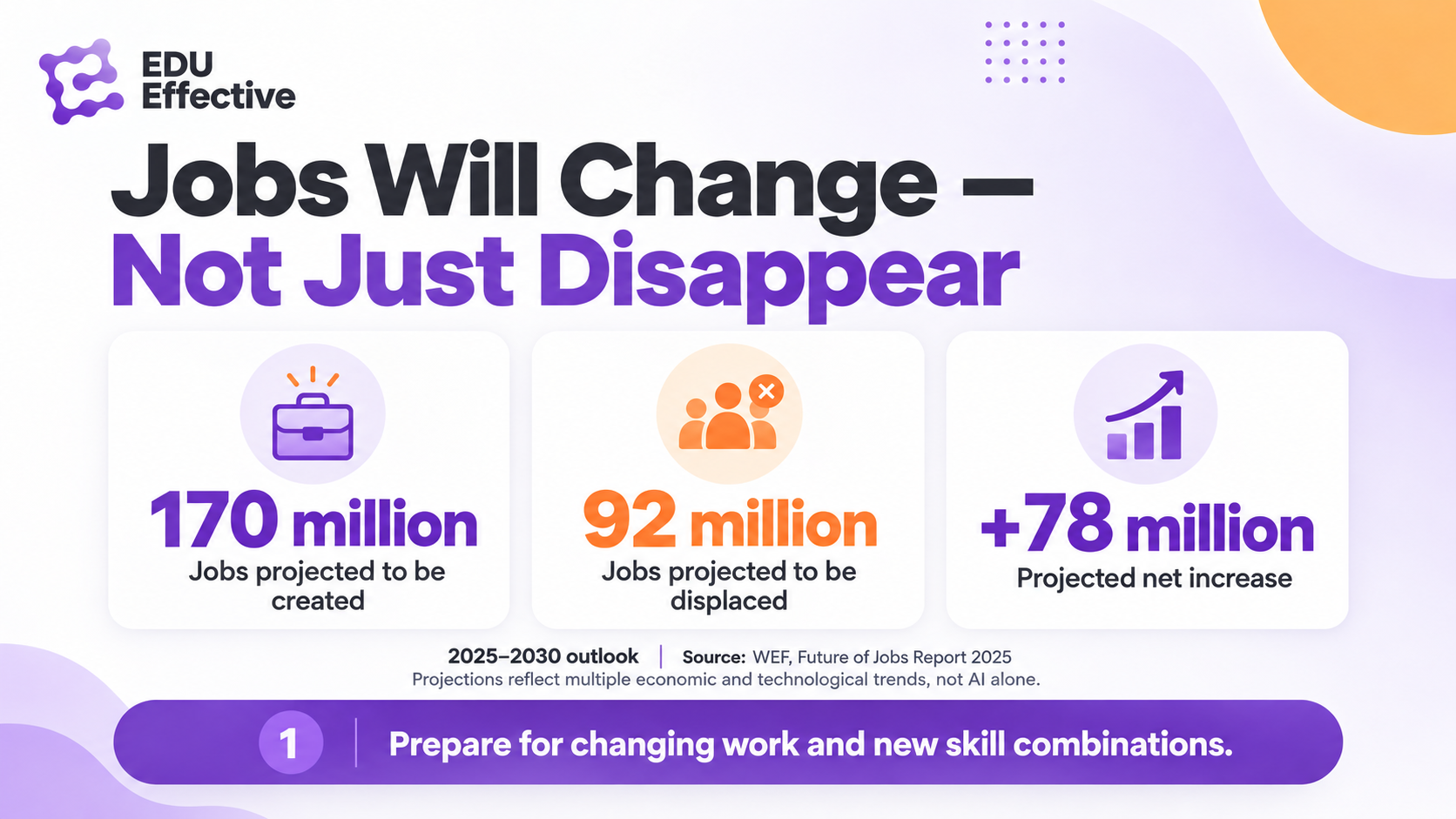
The headline numbers: 170 million new jobs are projected to be created by 2030, while 92 million will be displaced. Net gain: 78 million jobs. Total labor market churn: 22% of all roles.
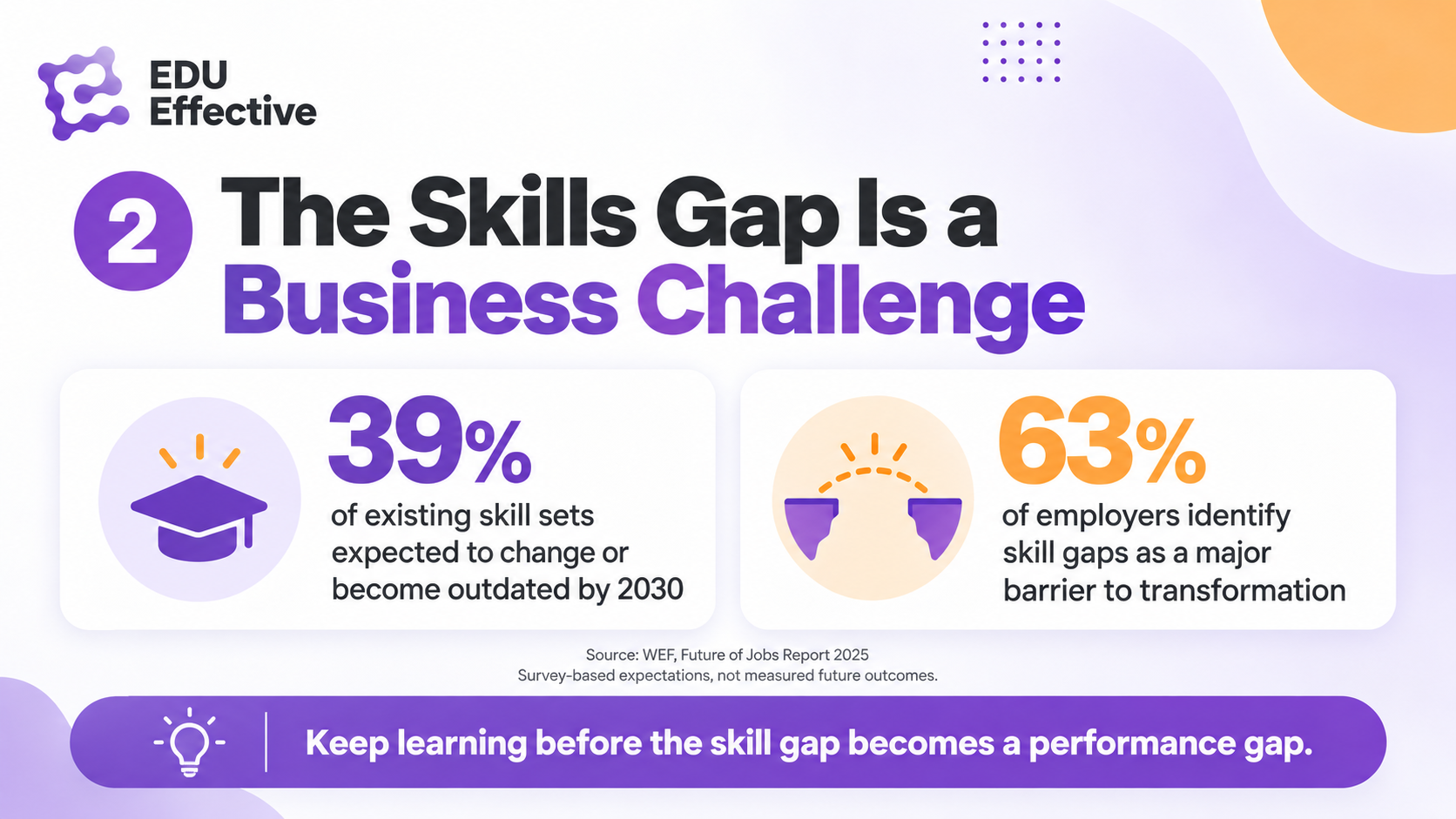
Nearly 40% of skills currently required on the job are expected to change by 2030. 63% of employers name the skills gap as the primary barrier to preparing their organizations for what is coming.
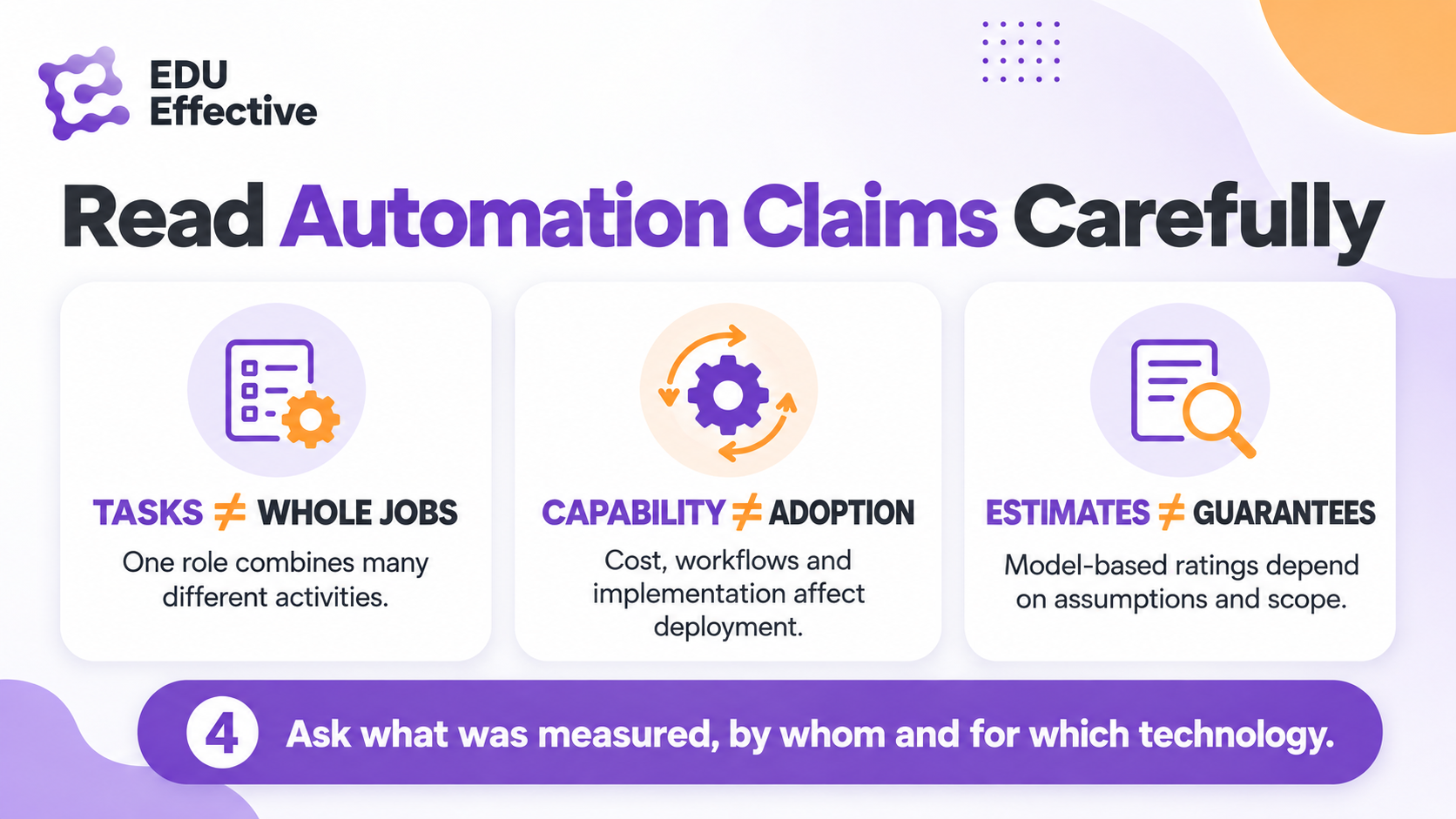
McKinsey Global Institute’s report, Agents, Robots, and Us, adds another data point: 57% of US work hours could technically be automated by today’s AI and robotics. In practice, about 12% of job tasks have actually been automated so far — limited by adoption timelines, cost trade-offs, and the genuine difficulty of redesigning workflows around AI outputs.
The gap between 57% technical potential and 12% realized automation is where the real story lives. Technical capability and practical deployment are not the same thing. They may converge over time, but the timelines are slower than the headlines suggest.
What Is Growing — and What Is Falling
The WEF report provides direct rankings of skills employers expect to grow and decline between 2025 and 2030.
The fastest-growing skill category is AI and big data — with over 90% of employers in most major industries expecting its importance to increase. Networks and cybersecurity is second. Technological literacy is third.
But right alongside those technology skills, and equally prominent in the report’s findings, are skills of a very different kind: creative thinking, resilience, flexibility, and agility, curiosity and lifelong learning, leadership and social influence, and analytical thinking. These appear across industries, across geographies, and across seniority levels.
What is declining? Manual dexterity, endurance, and precision shows the steepest net decline — the first time in the WEF’s history of tracking this data that physical abilities have gone negative. Reading, writing, and mathematics in their basic form show a small but real decline. Dependability and attention to detail and quality control are falling relative to their rankings.
The pattern is clear. Routine and rule-based skills — whether physical or cognitive — face the highest substitution pressure. Human-centered, adaptive, and judgment-intensive skills are rising.
The Skills That AI Genuinely Cannot Replicate
The WEF’s report included a notable methodological addition: an analysis of over 2,800 individual skills, with each assessed by GPT-4o for its own estimated substitution capacity. The results are instructive not because AI’s self-assessment is the final word, but because of what the assessment revealed.
None of the 2,800+ skills was rated as having “very high” AI substitution potential. 69% were rated as having very low or low substitution potential. 28.5% were rated moderate.
The skills with no substitution potential — rated as essentially irreplaceable by AI — fell into three categories: empathy and active listening, sensory processing (the physical and perceptual judgment that comes from being present in an environment), and manual dexterity, endurance, and precision.
Higher substitution potential appeared in data mining, machine learning applications, reading, writing, and mathematics at the basic level, and multilingualism.
The McKinsey analysis found that about 72% of skills appear in both automatable and non-automatable work — which means the question is not which jobs disappear, but which capabilities within every job become more or less valuable. Eight transferable human skills were identified as durable across the shift: communication, management, operations, problem-solving, leadership, detail orientation, customer relations, and writing at a complex level.
Four Skills Worth Building Deliberately
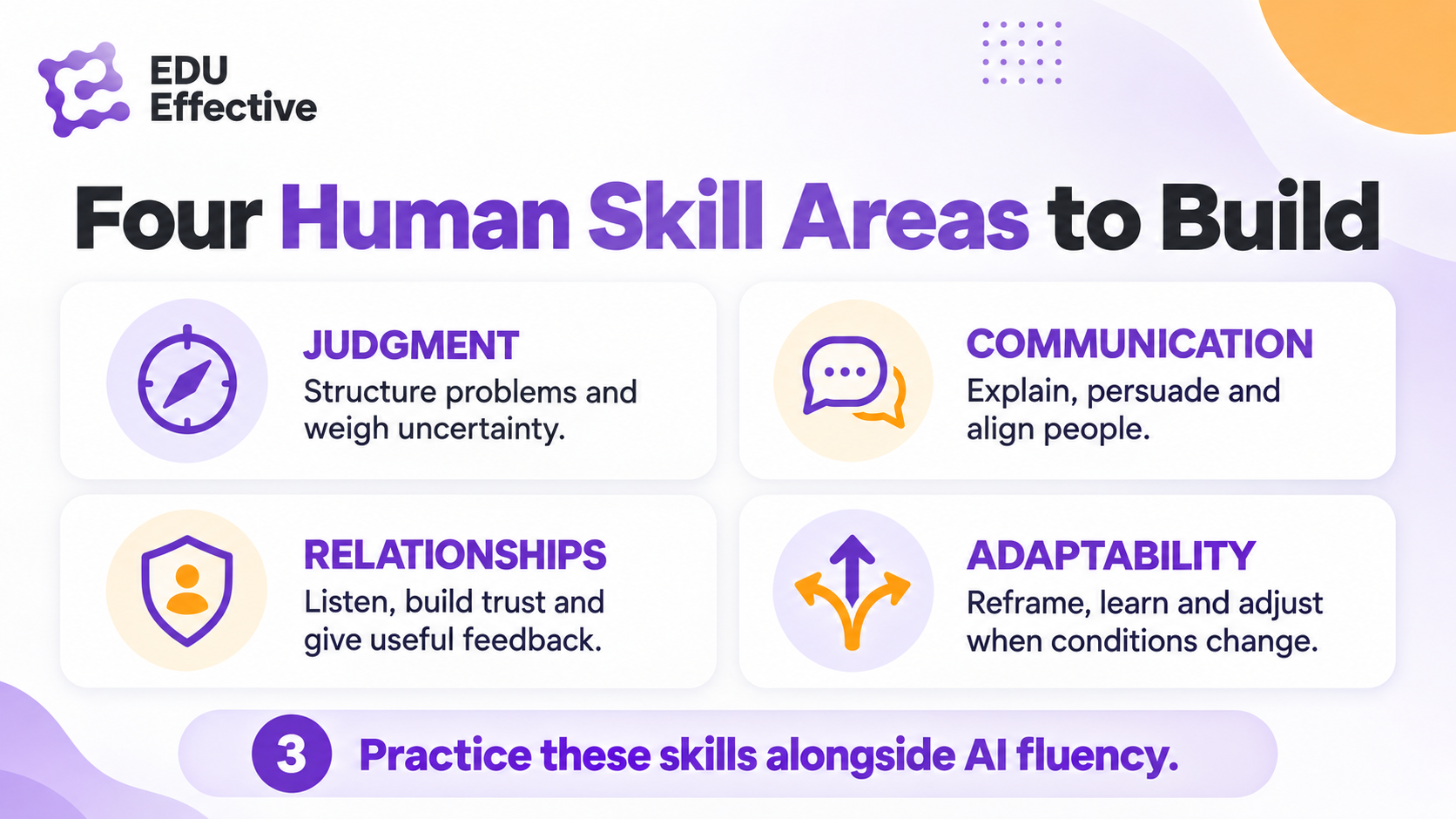
Based on the convergent findings across these primary sources, four skill areas deserve priority attention for any working professional planning beyond the next two years.
Judgment Under Uncertainty. AI tools are effective at processing information and generating outputs. They are poor at deciding what to do when the situation is ambiguous, the stakes are high, and the relevant data is incomplete. That is exactly the condition in which most significant management decisions are made.
Analytical thinking remains the top-ranked core skill in the WEF report — not AI proficiency, not technical literacy, but the capacity to structure a problem, identify what information matters, weigh competing considerations, and reach a reasoned conclusion. This is the cognitive infrastructure that makes every other skill more effective.
The practical implication: practice making decisions explicitly. Write out your reasoning. Identify what you assumed, what you knew, what you were uncertain about. Revisit outcomes. This is not academic — it builds the judgment that AI currently cannot simulate convincingly.
Communication That Changes Minds. The McKinsey analysis identifies communication as one of the eight durable human skills — but not the kind of communication that produces adequately-written emails. The kind that persuades, builds trust, navigates resistance, and aligns people around a shared direction.
AI tools can draft text. They cannot read a room, pick up on the hesitation beneath a stated agreement, or adjust in real time to an audience that is not following the argument. The ability to communicate complex ideas clearly to people who are skeptical, busy, or hold different frames of reference is a human competitive advantage that compounds over a career.
Relationship-Building and Trust. Empathy and active listening registered as having no AI substitution potential in the WEF analysis. This is not sentiment — it is recognition that economic relationships, leadership effectiveness, and organizational performance are all built on interpersonal trust, and trust is built through human interactions that no current model can replicate.
The professionals who will be most valuable in 2027 and beyond are not those who understand AI the best. They are those who can combine AI capability with the relational skills that turn technical output into aligned action. Those skills include the ability to coach, mentor, negotiate, give feedback that lands well, and build the kind of working relationships that make teams perform.
Adaptability as a Practice. Resilience, flexibility, and agility appear prominently in the WEF growth list — not as personality traits but as operational capabilities. The ability to reframe when a plan fails, shift direction without losing effectiveness, and maintain performance under uncertainty is increasingly what separates strong performers from adequate ones.
The operative word is “practice.” Adaptability is not a fixed trait. It develops through deliberately taking on situations that require it: new projects outside your domain, roles that involve ambiguity, challenges that require learning on the job. The WEF also lists curiosity and lifelong learning as a rising skill — which is another way of saying that the capacity to keep developing is itself now a professional requirement.
The AI-Fluency Question
The McKinsey analysis found that demand for AI fluency rose approximately sevenfold in roughly two years, from around 1 million to 7 million US workers, based on analysis of over 11 million job postings.
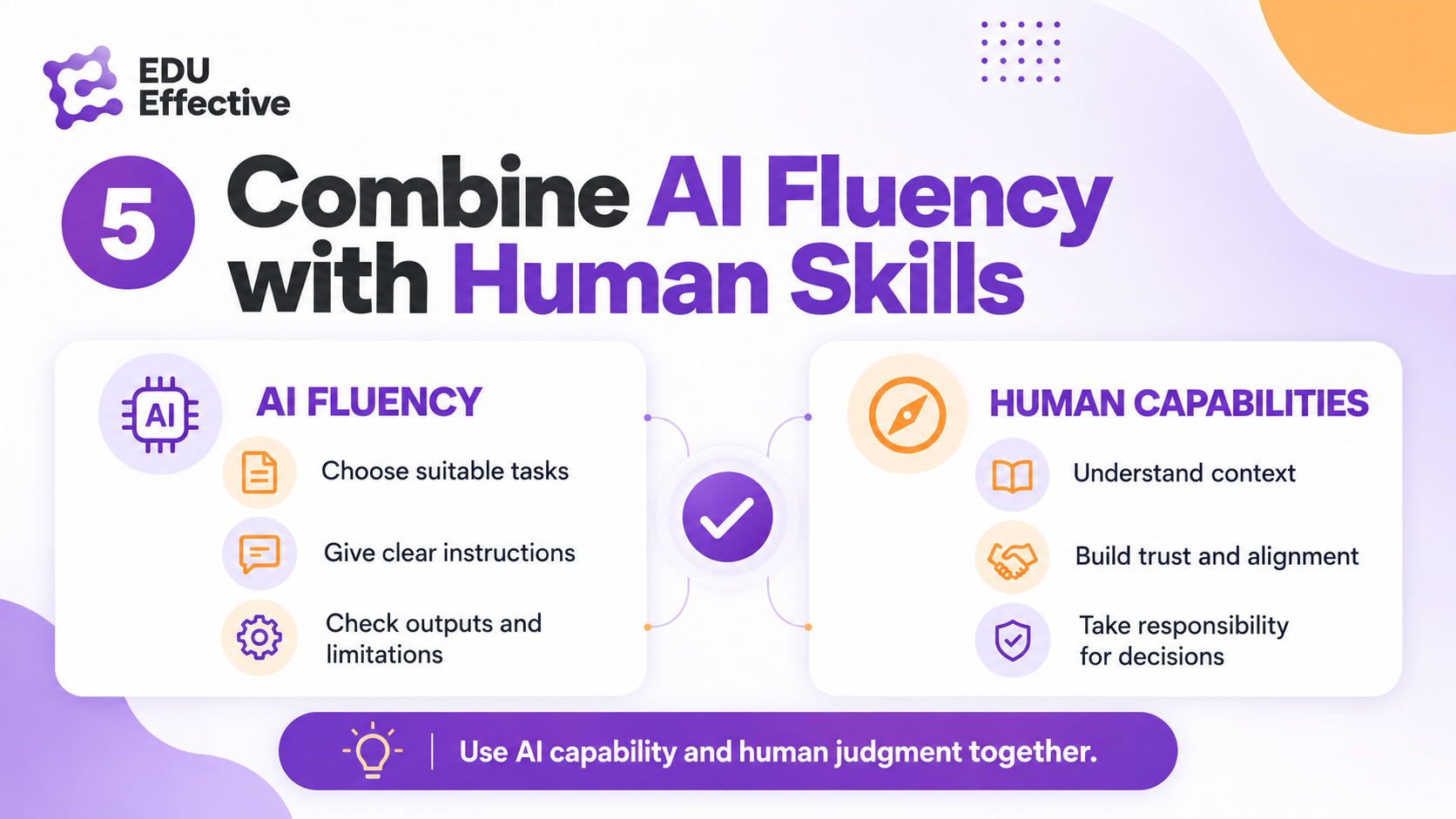
This does not mean every professional needs to become an AI engineer. It means that AI literacy — knowing what these tools can do, how to direct them effectively, where they fail, and how to verify their outputs — is becoming a baseline expectation rather than a specialist skill.
The professionals most at risk are not those with low technical skills. They are those with high technical skills in tasks that AI can now perform — combined with limited depth in the human skills that AI cannot. A data analyst who can also communicate findings, navigate organizational politics, and influence decisions is substantially more valuable than one who can only run the analysis.
AI fluency and human skills are complements, not substitutes. The combination is what creates advantage.
What This Means in Practice
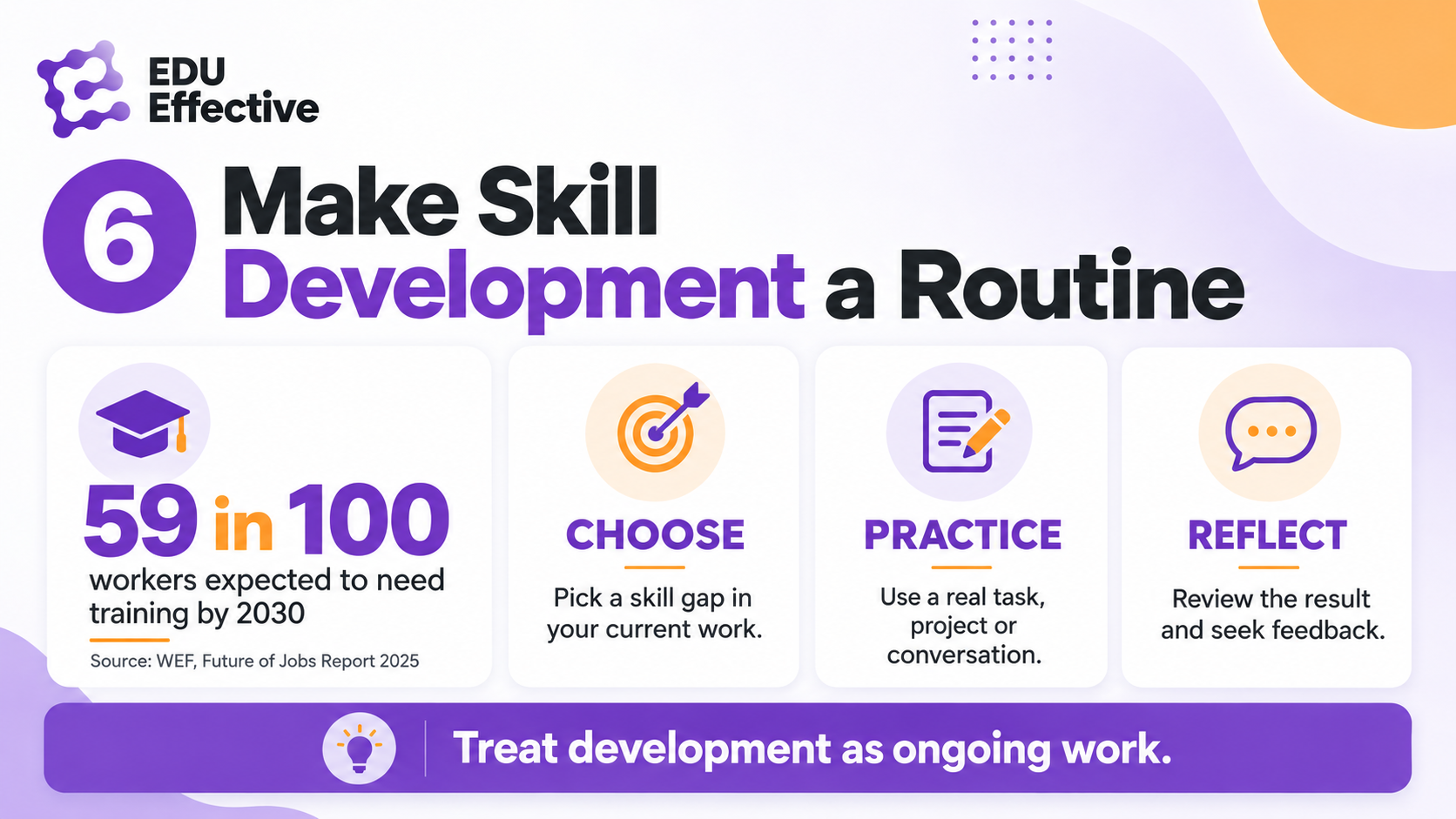
The WEF estimates that 59 of every 100 workers will need reskilling or upskilling by 2030. 11 of those 59 are unlikely to receive it — projecting over 120 million workers at medium-term risk of redundancy due to the skills gap.
The organizations preparing well are not the ones replacing people with AI as fast as possible. They are the ones — 77% of employers in the WEF survey — that plan to upskill their workforces. Almost half plan to move staff from AI-exposed roles into other parts of the business.
The individuals preparing well are those who treat skill development as an ongoing operational priority, not a one-time credential event. The specific areas the data supports: judgment and analytical thinking, communication and persuasion, empathy and relationship management, and the adaptive capacity to keep learning in a labor market that will keep changing.
The tools will keep improving. The skills that make those tools valuable — and that those tools cannot provide themselves — are the ones worth building now.
About EDU Effective Business School
The Effective MBA: Applied Artificial Intelligence turns AI capability into decisions a manager can defend. Runs on 15 minutes a day, completes in 10 months or less and is ASIC accredited.
Sources
- World Economic Forum — Future of Jobs Report 2025 (press release, January 2025; survey of 1,000+ companies, 55 economies, ~14 million workers) https://www.weforum.org/press/2025/01/future-of-jobs-report-2025-78-million-new-job-opportunities-by-2030-but-urgent-upskilling-needed-to-prepare-workforces/
- World Economic Forum — Future of Jobs Report 2025, Chapter 3: Skills Outlook (including GPT-4o skill substitution analysis of 2,800+ skills) https://www.weforum.org/publications/the-future-of-jobs-report-2025/in-full/3-skills-outlook/
- McKinsey Global Institute — Agents, Robots, and Us: Skill Partnerships in the Age of AI (November 2025) https://www.mckinsey.com/mgi/overview