

Online Marketing Series — Part 1 of 8
There are now 5.66 billion active social media users worldwide. The average person switches between nearly seven different platforms every month. And social ad spending is on track to reach $317 billion globally in 2026, growing roughly 11% annually through 2030.
Those numbers are not an argument for doing more on social media. They are an argument for being much clearer about what you are actually doing there and why.
Professional brands — companies selling to other businesses, or to career-focused adults — face a specific challenge. The platforms that dominate social media by volume are not always the ones where their audience is making decisions. The content formats that go viral are not always the ones that build trust with a buyer who is evaluating a serious purchase. The social media strategy that works for a consumer product is not the same one that works for a B2B services firm, an executive education provider, or a consulting practice.
This article maps what the data actually shows about social media for professional brands going into 2027 — which platforms are worth investing in, which content formats are delivering results, and where most organizations are still leaving significant value on the table.
The Platform Picture in 2026: Who Goes Where
Start with where your audience actually is, not where the most people are.
LinkedIn has 1.3 billion members across 200 countries. Seventy million company profiles. Nearly 70% of users engage with brand content at least weekly. B2B marketers ranked it their most-used platform in 2025, and 82% of B2B marketers rate LinkedIn as their most valuable social platform overall. For any brand selling to other businesses or to working professionals, this is not optional territory — it is the primary ground.
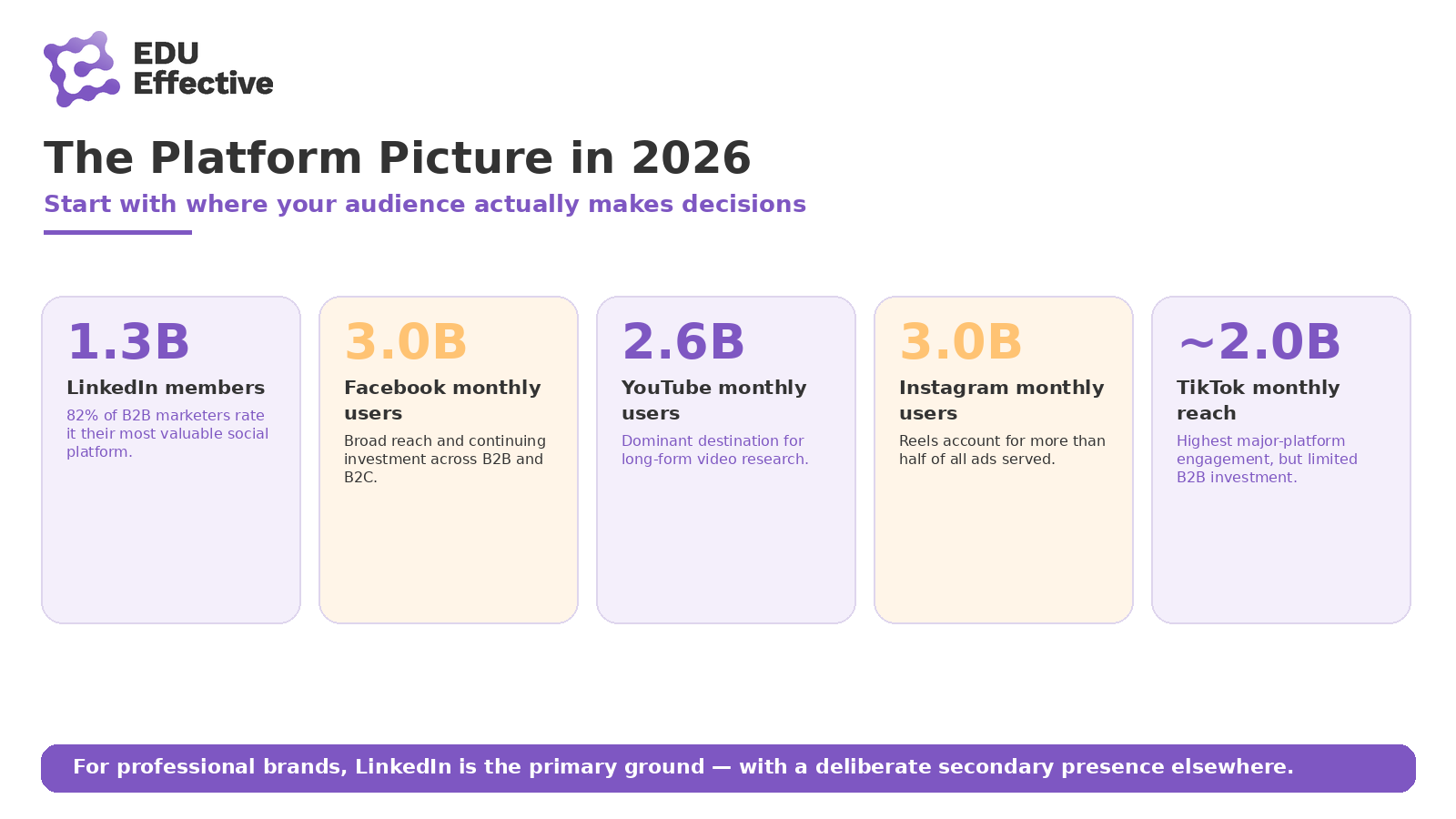
That said, LinkedIn is not the only channel that matters. Facebook still reaches roughly 3 billion monthly users and remains the platform most marketers plan to invest in across both B2B and B2C in 2025, according to HubSpot. YouTube has 2.6 billion monthly users and remains the dominant destination for long-form video research. Instagram sits at approximately 3 billion monthly users, with Reels accounting for more than half of all ads served on the platform in 2025.
TikTok is growing fast — engagement on the platform rose 49% year over year to a 3.70% rate in 2025, the highest of any major platform. Its monthly reach is approaching 2 billion. For most professional B2B brands, however, only 8% of B2B marketers planned TikTok investment in 2025. The audience skews younger and the content culture is difficult to translate for high-value B2B decisions.
The newer platforms are worth tracking but not yet strategic priorities for most professional brands. Threads passed X in mobile daily active users in January 2026 (141.5M versus 125M). Bluesky crossed 42 million users. Reddit reached 116 million daily active users in 2025, up 19% year over year, with US ad revenue growing 30.9%. For niche professional communities, Reddit can be valuable. For broad brand reach in the professional space, it remains secondary.
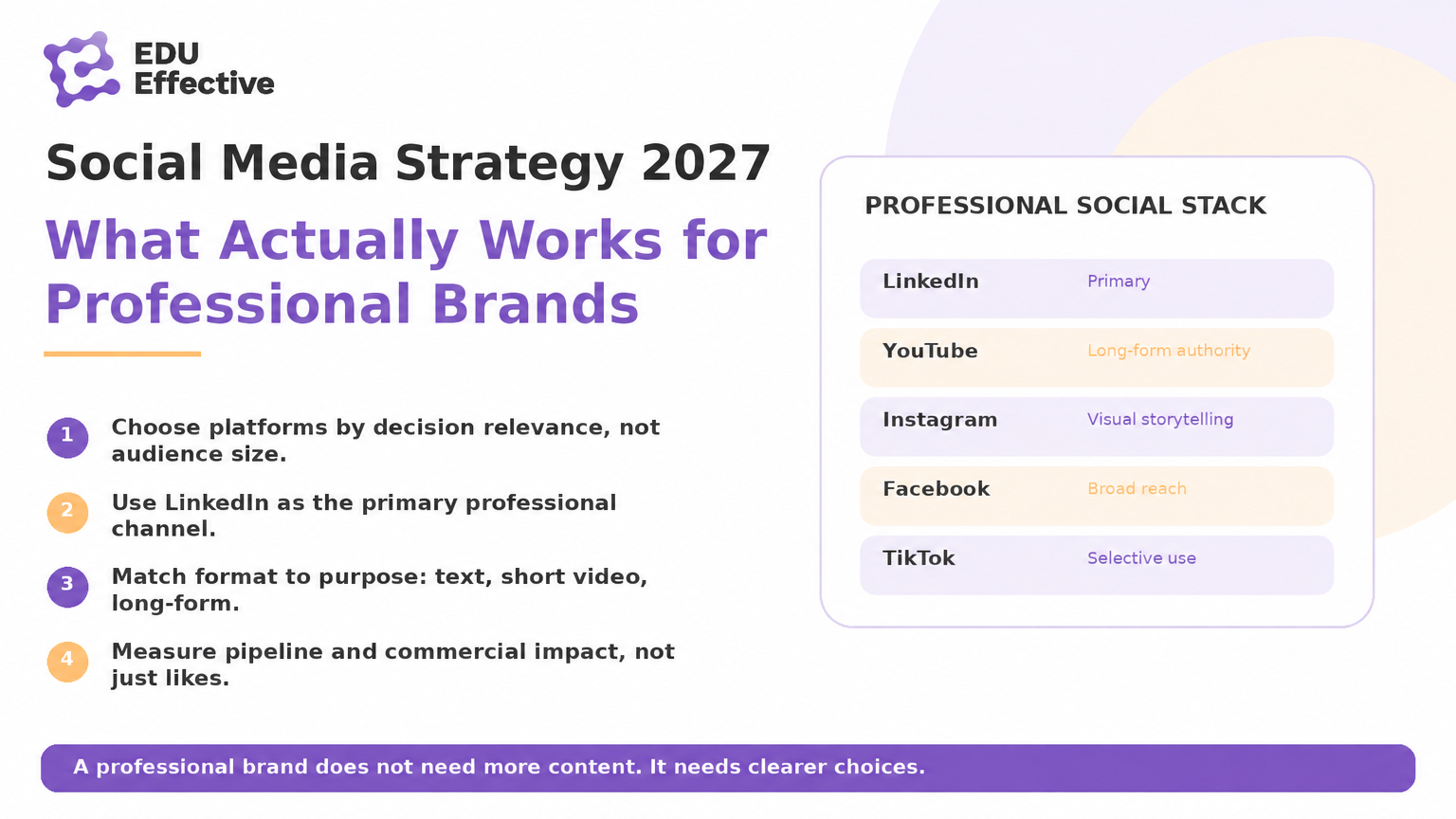
The practical implication: a social media strategy for a professional brand in 2027 is primarily a LinkedIn strategy with deliberate secondary presence elsewhere, calibrated to where that specific audience makes decisions.
What Content Actually Works on LinkedIn
The data here is counterintuitive and frequently ignored.
Text posts drive more LinkedIn engagement than images, video, user-generated content, or influencer content — outperforming all of them, according to Sprout Social’s 2026 analysis. For a platform that increasingly favors rich media, this finding reflects something real about how LinkedIn users actually behave: they are reading, thinking, and forming professional judgments. A well-written text post that demonstrates genuine expertise consistently outperforms a polished graphic with a surface-level observation.
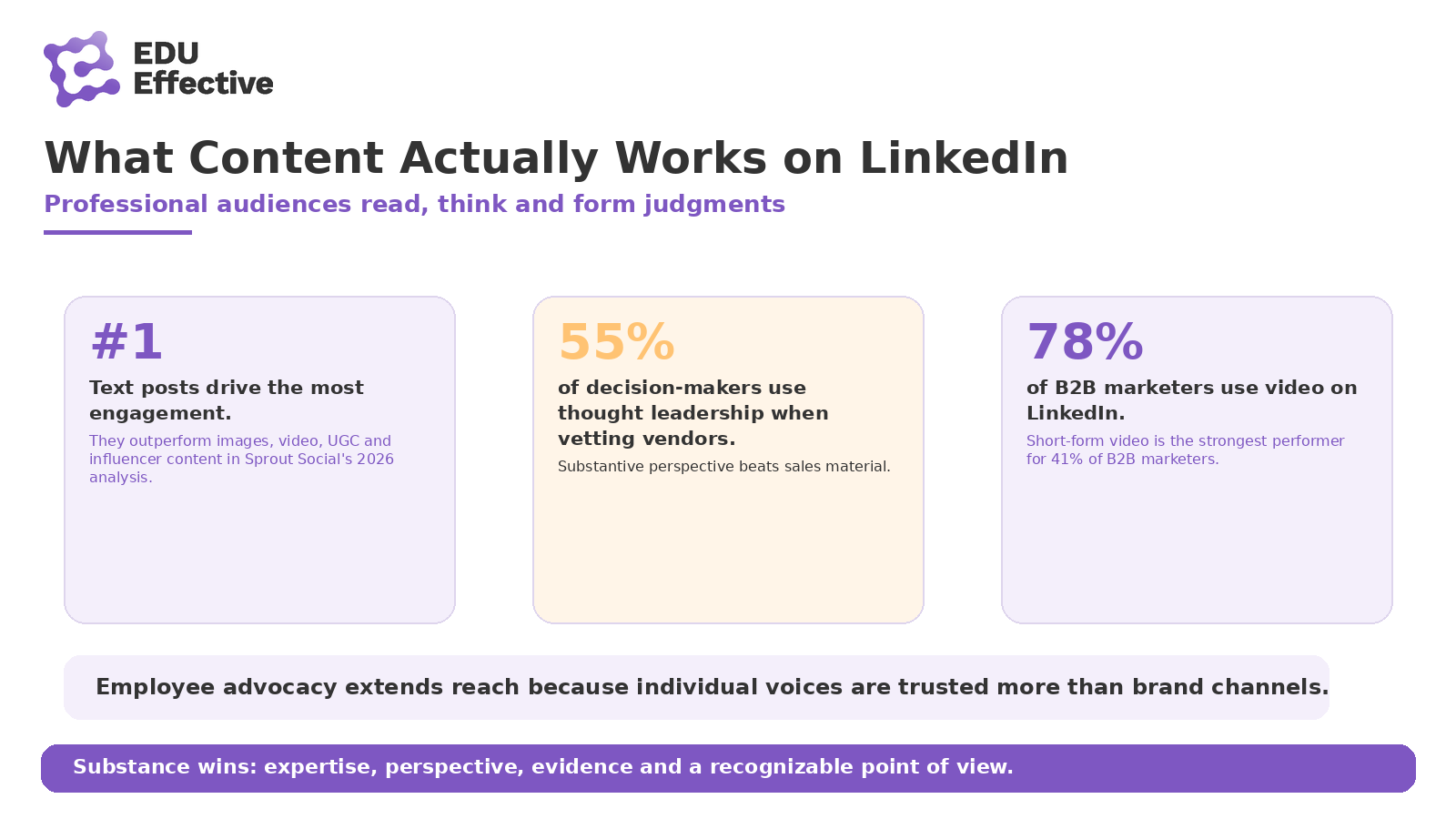
What text posts cannot do is show authority at scale or reach people outside your immediate network. That is where thought leadership content becomes structurally important. The 2025 Edelman-LinkedIn B2B Thought Leadership study found that 55% of decision-makers use thought leadership content when vetting vendors. Not sales material — substantive perspective on problems they are actually trying to solve. The brands that produce this consistently build durable pipeline in ways that are difficult to replicate through advertising alone.
Video is the second major format worth investing in. 78% of B2B marketers use video as part of their LinkedIn strategy, and more than half plan to increase investment, according to LinkedIn’s 2025 B2B Marketing Benchmark. Short-form video delivers the highest ROI of any video format for B2B marketers — 41% cite it as their strongest performer. The threshold for “short-form” in a professional context is different from consumer social: 90 seconds to 3 minutes is the effective range for an executive audience, versus 15-30 seconds on TikTok.
Employee advocacy is underused and systematically undervalued. A 2025 analysis across organizations using structured employee advocacy programs found that organic reach from employee-shared content typically outperforms brand page content by a significant margin. The reason is straightforward: individual voices are trusted more than brand channels, and LinkedIn’s algorithm gives preferential treatment to personal profiles. Brands that build systematic programs — giving employees ready-to-share content with minimal friction — amplify their organic reach without proportional budget increases.
The B2B Social Selling Gap
Social selling is where the distance between what most companies say they do and what they actually do is largest.
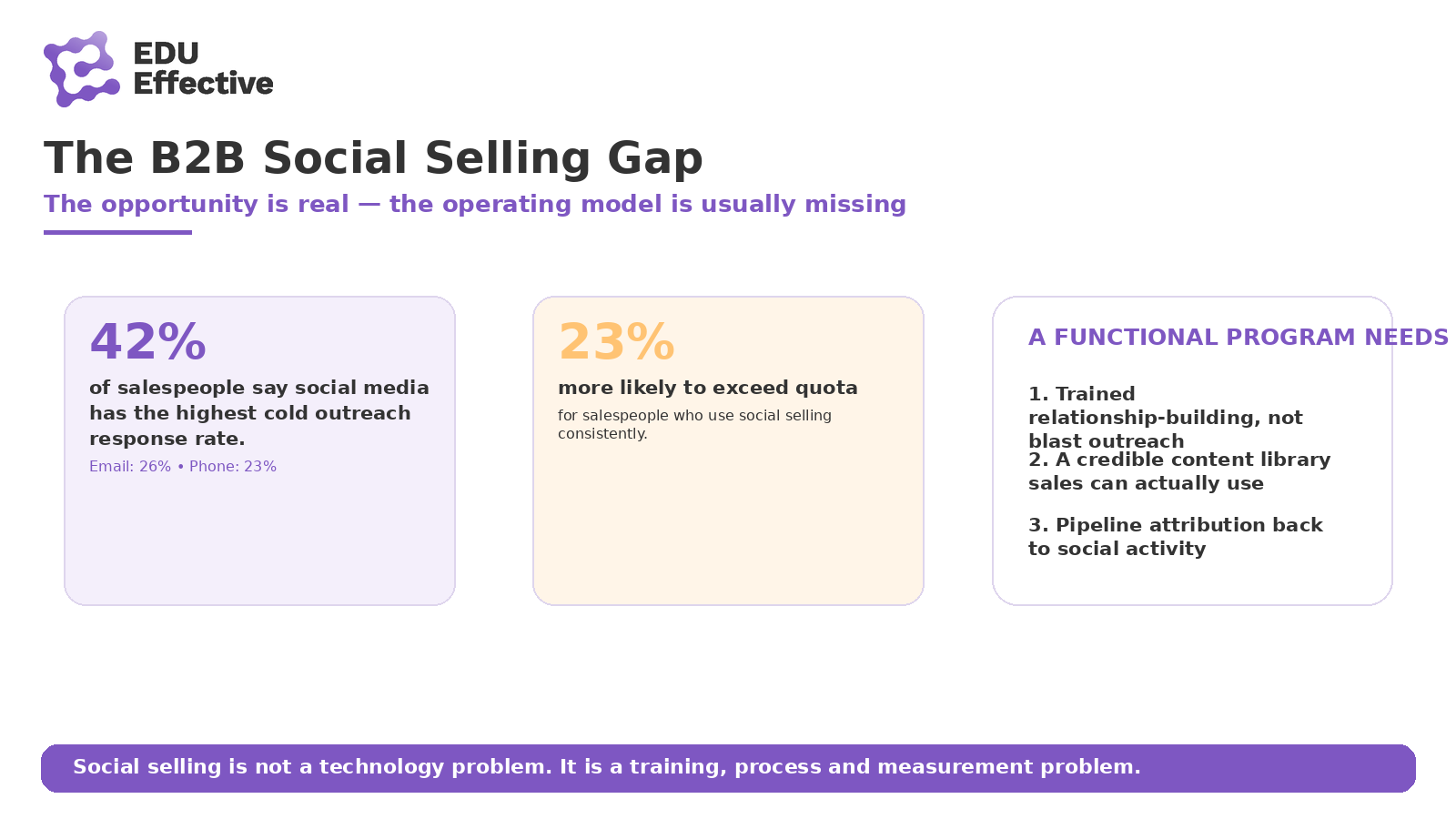
42% of salespeople say social media gets the highest cold outreach response rate of any channel — higher than email (26%) or phone (23%), according to HubSpot’s State of Sales 2025. Organizations using social selling consistently outperform those that don’t. Salespeople using social selling are 23% more likely to exceed quota.
Despite this, most organizations have no systematic social selling program. Individual salespeople do some version of LinkedIn outreach on their own, with no shared playbook, no training, no measurement, and no connection to marketing content. The result is inconsistent and usually underperforms what a structured approach would deliver.
A functional social selling program has three components: a trained team that knows how to use LinkedIn for genuine relationship-building rather than blast outreach; access to a library of credible content to share and reference in conversations; and measurement that tracks pipeline attribution back to social activity. Most organizations have none of these in place. Some have the content library without the training. Very few have the measurement.
For marketing managers and commercial leaders, the gap is tactical but significant. Social selling is not a technology problem — LinkedIn Sales Navigator exists and works well. It is a training and process problem, and it is one of the more reliable sources of B2B lead generation available at relatively low marginal cost once the program is running.
Video Strategy: Where to Invest and Where Not To
Video is the format that generates the most confusion in professional brand strategy. The data is clear at a high level — 85% of people say a brand video has influenced a purchase decision, and 89% say video quality affects how credible a brand seems — but the implications for execution vary significantly by platform and objective.
For LinkedIn, short-form video (90 seconds to 3 minutes) is the right investment. It performs well natively, and LinkedIn’s algorithm has favored it increasingly since 2024. The content that works: executive commentary on industry developments, client case study narratives, behind-the-scenes process explanations. The content that does not work: polished brand films that feel like ads, talking heads with no concrete point, and anything that requires sound to make sense (most LinkedIn video is watched without audio).
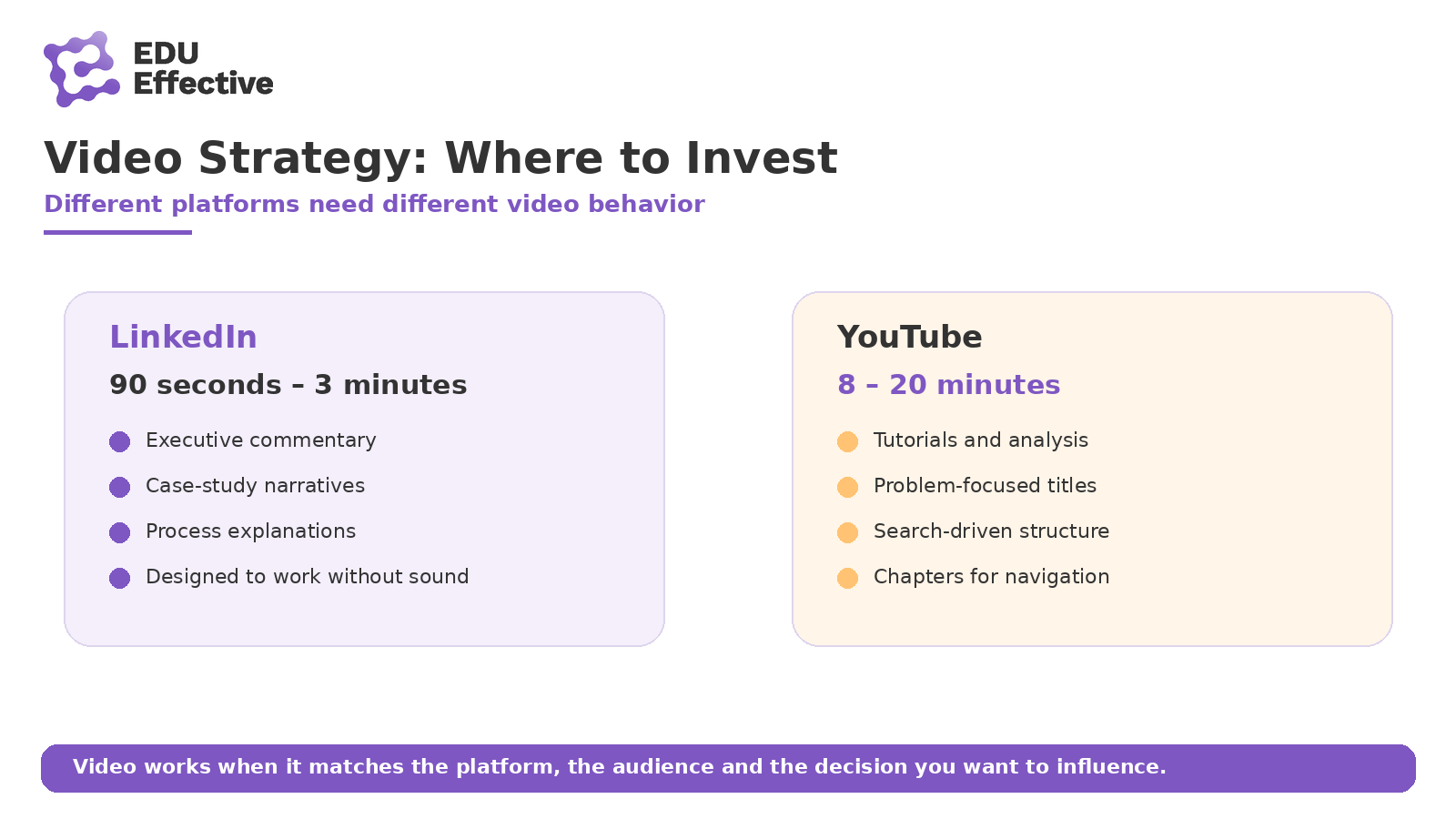
For YouTube, longer-form is appropriate — 8 to 20 minutes for tutorial, analysis, or in-depth perspective content. YouTube is a search platform more than a social one, which changes how content should be structured: keyword-focused titles, specific problem-focused subjects, and chapters that let viewers navigate directly to what they need. For professional education brands, course previews, instructor introductions, and student experience narratives perform well.
The digital video advertising market is projected to grow from $140 billion in 2025 to $189 billion in 2026. That growth is real, but it does not mean every brand should shift its budget toward video advertising. Video advertising works when there is supporting organic content that gives credibility to the ad’s claims. Brands that run video ads without an organic video presence typically see lower conversion rates than brands that have built familiarity through organic content first.
AI in Social Media Strategy: What Has Actually Changed
AI tools have changed the production side of social media significantly — content drafting, image generation, scheduling optimization, and audience targeting have all become faster and cheaper. What has not changed is the underlying decision about what to produce and why.
The brands that are winning on social media in 2026 are not the ones that produce more content more efficiently. They are the ones that produce more useful content with a consistent and recognizable voice. AI tools accelerate volume; they do not solve for relevance. A brand that was producing generic content now produces generic content faster. A brand that had a clear perspective and genuine expertise now has more capacity to publish that perspective consistently.
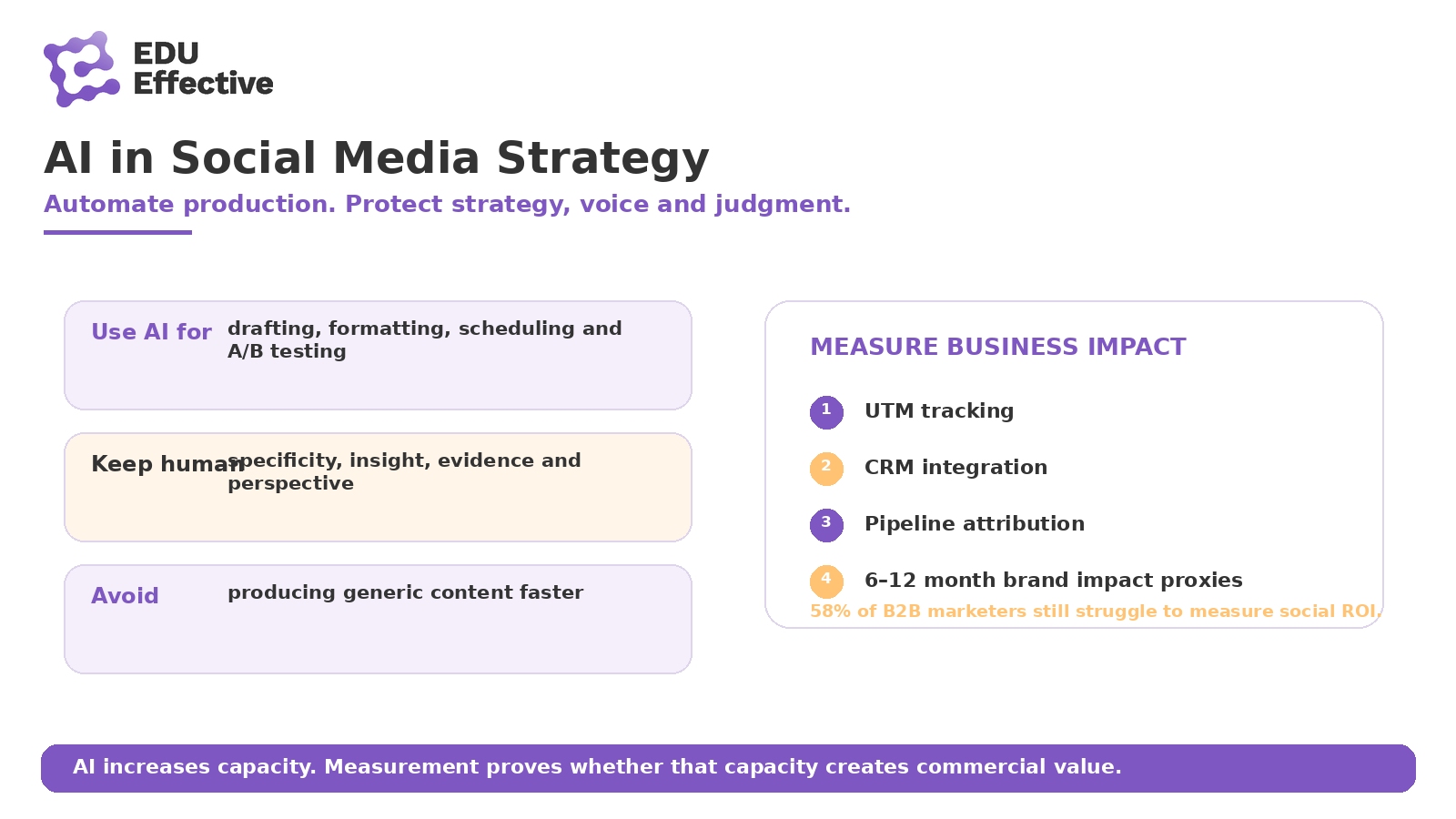
For professional brand managers, the practical implication is to invest AI tools in the production and distribution layer — drafting, formatting, scheduling, A/B testing — while protecting the strategy and voice layer from automation. The things that make content valuable to a professional audience — specificity, genuine insight, evidence, perspective — are the things AI is worst at and that human judgment must supply.
The measurement side has also changed. Social ROI attribution is still the top measurement challenge cited by B2B marketers — 58% say they struggle to measure it. But the tooling has improved, and brands that build proper UTM tracking, integrate their CRM with social data, and measure pipeline attribution rather than just engagement metrics are increasingly able to make the case that social is driving real commercial outcomes. That conversation with leadership has gotten easier, not harder, for brands that do the measurement work properly.
What a Realistic Social Media Strategy Looks Like in 2027
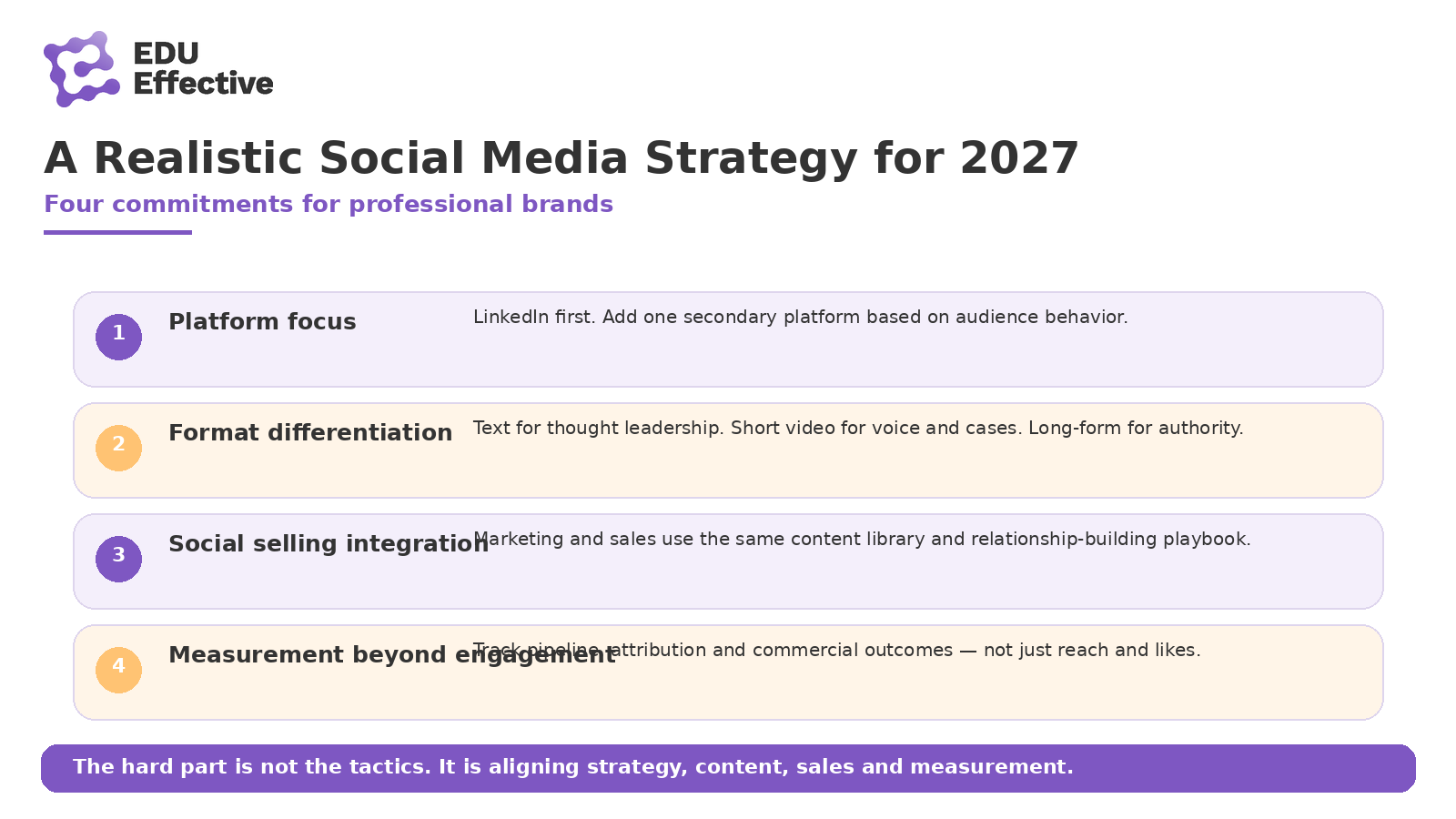
A professional brand’s social media strategy in 2027 should be built around four commitments:
First, platform focus. LinkedIn is the primary channel. One secondary platform — YouTube for long-form video, Instagram for visual storytelling, or another based on where your specific audience actually spends time — is appropriate. Trying to maintain active presence on five or six platforms simultaneously is a resource allocation problem, not a reach strategy.
Second, content differentiation by format. Text posts for thought leadership and perspective. Short-form video for case studies, process explanation, and executive voice. Long-form YouTube content for in-depth tutorials and brand authority. Each format has a different function and should not be treated interchangeably.
Third, social selling integration. Marketing and sales should operate from the same content library, with sales teams trained to use social platforms for genuine relationship-building, not mass outreach. The pipeline results from integrated programs are consistently better than siloed approaches.
Fourth, measurement that goes beyond engagement. Reach and likes are inputs, not outcomes. A social strategy worth investing in should be able to show attribution to pipeline, and brand marketing investments should have proxies for awareness impact that connect to commercial results over a 6-12 month horizon.
None of this is complicated in principle. What makes it difficult is that it requires organizational alignment between marketing strategy, content production, sales practice, and measurement infrastructure. That alignment is where most social media programs fail — not in the individual tactics.
Where EDU Effective Comes In
The Effective MBA: Online Marketing program covers exactly this territory: platform strategy, content marketing, social selling, paid social, video production, and analytics. It is built for marketing professionals and managers who need practical command of the full digital marketing stack, including social media that connects to commercial outcomes rather than just reach metrics.
About EDU Effective Business School
The Effective MBA: Online Marketing connects marketing decisions to revenue rather than vanity metrics. Runs on 15 minutes a day, completes in 10 months or less and is ASIC accredited.
Sources
- Sprout Social — 120+ Social Media Marketing Statistics for 2026 (2026) https://sproutsocial.com/insights/social-media-statistics/
- LinkedIn / Edelman — B2B Thought Leadership Impact Study 2025 (cited via DSMN8) https://dsmn8.com/blog/b2b-social-media-statistics/
- HubSpot — State of Sales Report 2025 (cited via DSMN8) https://dsmn8.com/blog/b2b-social-media-statistics/
- HubSpot — State of Marketing Report 2026 https://www.hubspot.com/state-of-marketing
- Gartner — Consumer trust survey data (cited via DSMN8) https://dsmn8.com/blog/b2b-social-media-statistics/
- LinkedIn — B2B Marketing Benchmark 2025 https://www.linkedin.com/business/marketing/blog/marketing-collective/2025-b2b-marketing-benchmar-the-video-influence-effect-starts-with-trust