

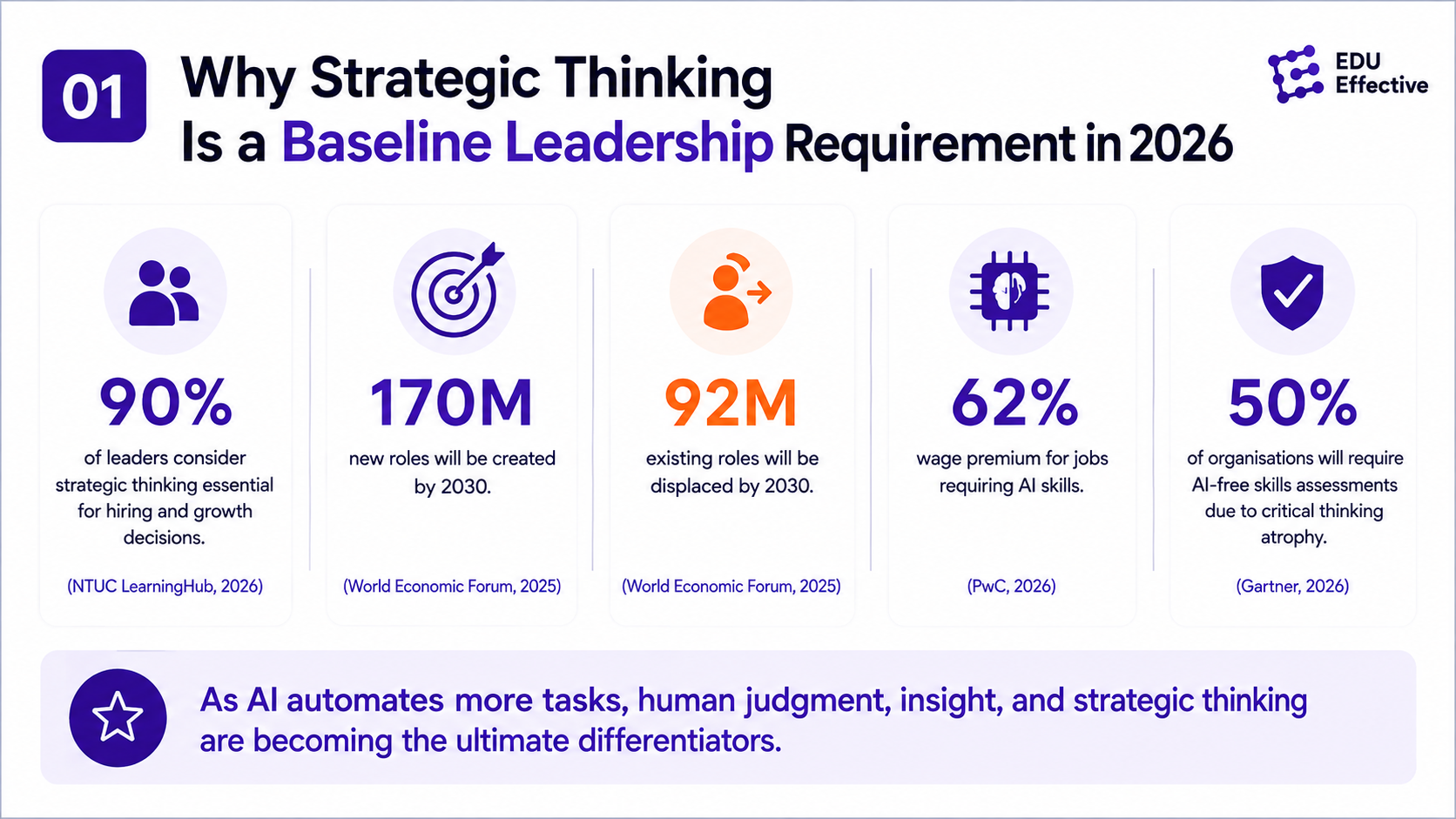
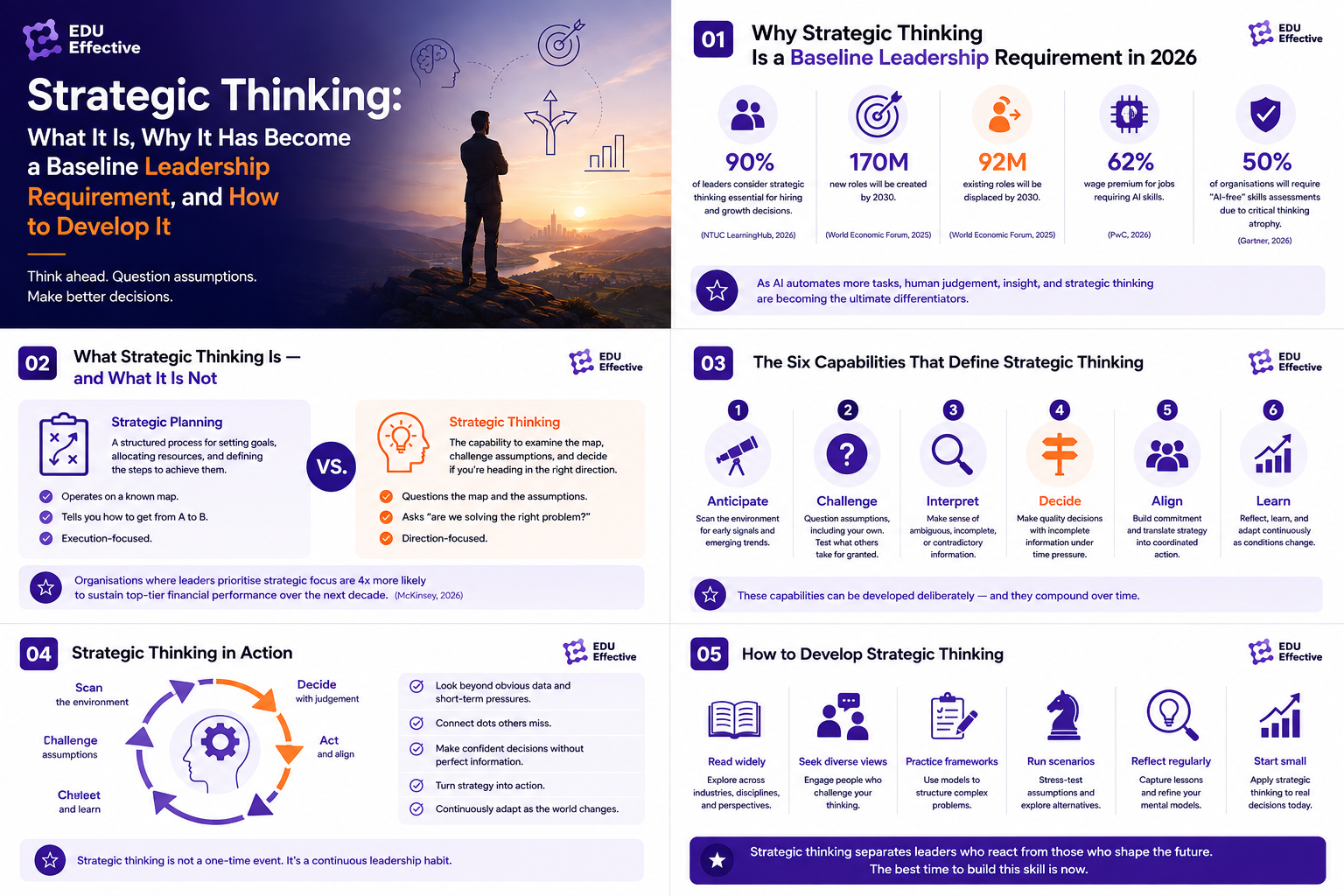
90% of business leaders now consider strategic thinking — specifically strategic analysis and problem-solving — essential for hiring and growth decisions, according to a 2026 NTUC LearningHub survey of senior leaders globally. That figure represents a significant shift from a decade ago, when strategic thinking was considered primarily a C-suite competency. In 2026, organisations expect it at every leadership level.
The reason is structural. AI is handling an increasing share of the analytical and operational work that previously absorbed most management bandwidth — processing data, generating reports, optimising routine decisions. What remains irreducibly human is the judgement required to decide which questions to ask, which signals to act on, how to interpret information that is ambiguous, and how to make consequential decisions without complete data. These are the capabilities that define strategic thinking — and their value is rising precisely as AI makes the lower-level work they inform more efficient.
Gartner's top strategic predictions for 2026 include a striking signal: the atrophy of critical thinking skills due to over-reliance on generative AI will push 50% of global organisations to require "AI-free" skills assessments. The ability to think strategically and independently — without offloading judgement to a machine — is becoming a differentiator rather than a given.
What strategic thinking actually is — and what it is not
Strategic thinking is frequently conflated with strategic planning, and the conflation matters because they are fundamentally different activities that produce different outcomes.
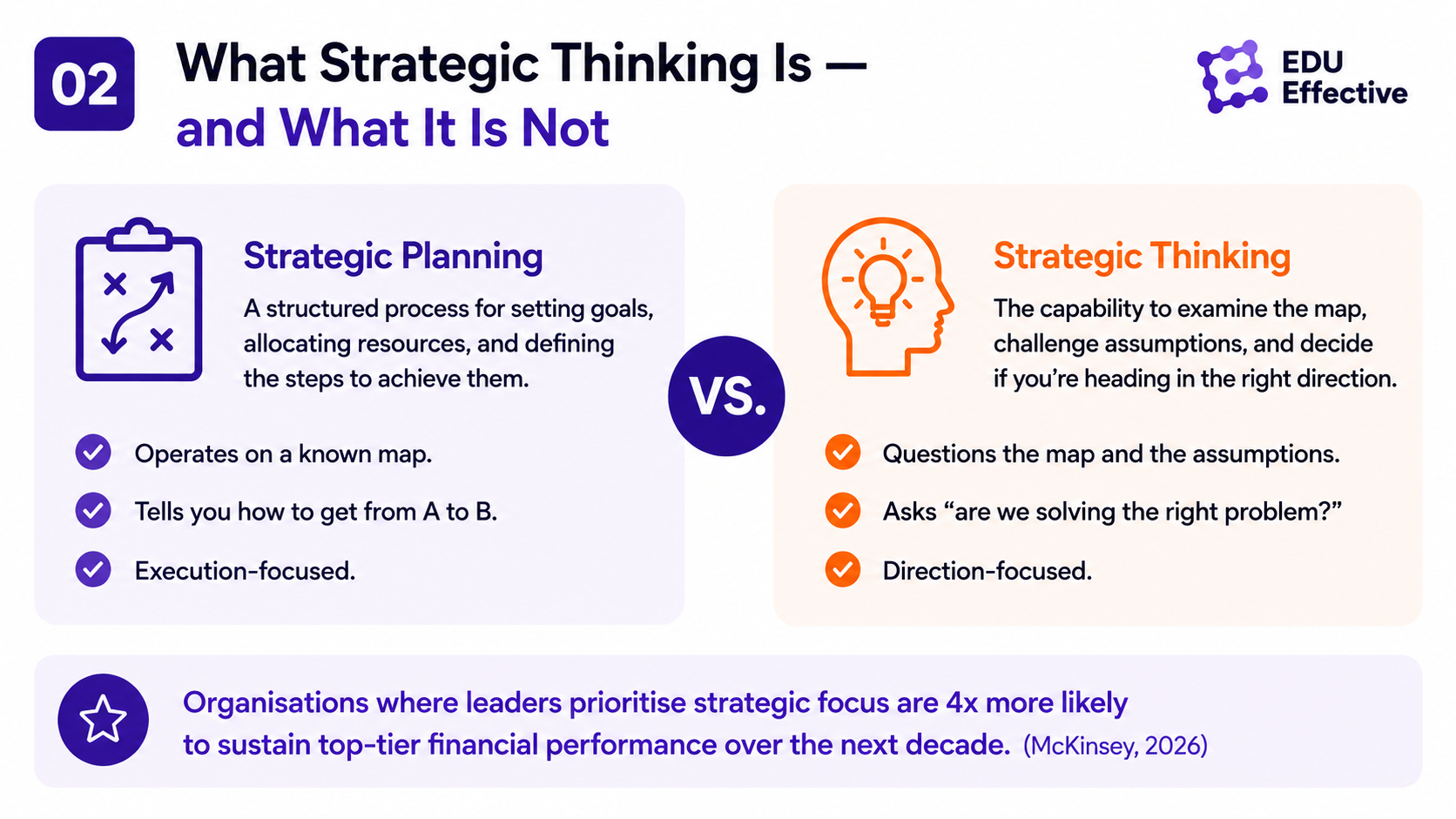
Strategic planning is a structured process for setting goals, allocating resources, and defining the steps to achieve predetermined objectives. It operates on a known map — it tells you how to get from where you are to where you have decided to go. Done well, it is essential. Done without strategic thinking, it produces detailed plans built on unexamined assumptions about a future that may look nothing like the map.
Strategic thinking is the prior capability — the ability to examine the map itself, challenge its assumptions, identify what it is missing, and consider whether you are heading in the right direction before committing to the route. It is what allows a leader to ask "are we solving the right problem?" before investing significant resources in solving the problem in front of them. McKinsey's State of Organizations 2026 research found that organisations are four times more likely to maintain top-tier financial performance over the next decade when their leaders prioritise this kind of disciplined strategic focus — choosing where to compete and where to divest, rather than spreading resources too thin across everything.
Strategic thinking is not the same as being smart, experienced, or analytically capable — though it draws on all three. It is a specific set of mental habits and practices that can be deliberately developed, applied consistently, and improved over time.
The six capabilities that define strategic thinking
Research involving more than 20,000 executives identified six specific capabilities that allow leaders to navigate uncertainty effectively: the abilities to anticipate, challenge, interpret, decide, align, and learn. Each is distinct and each can be developed.
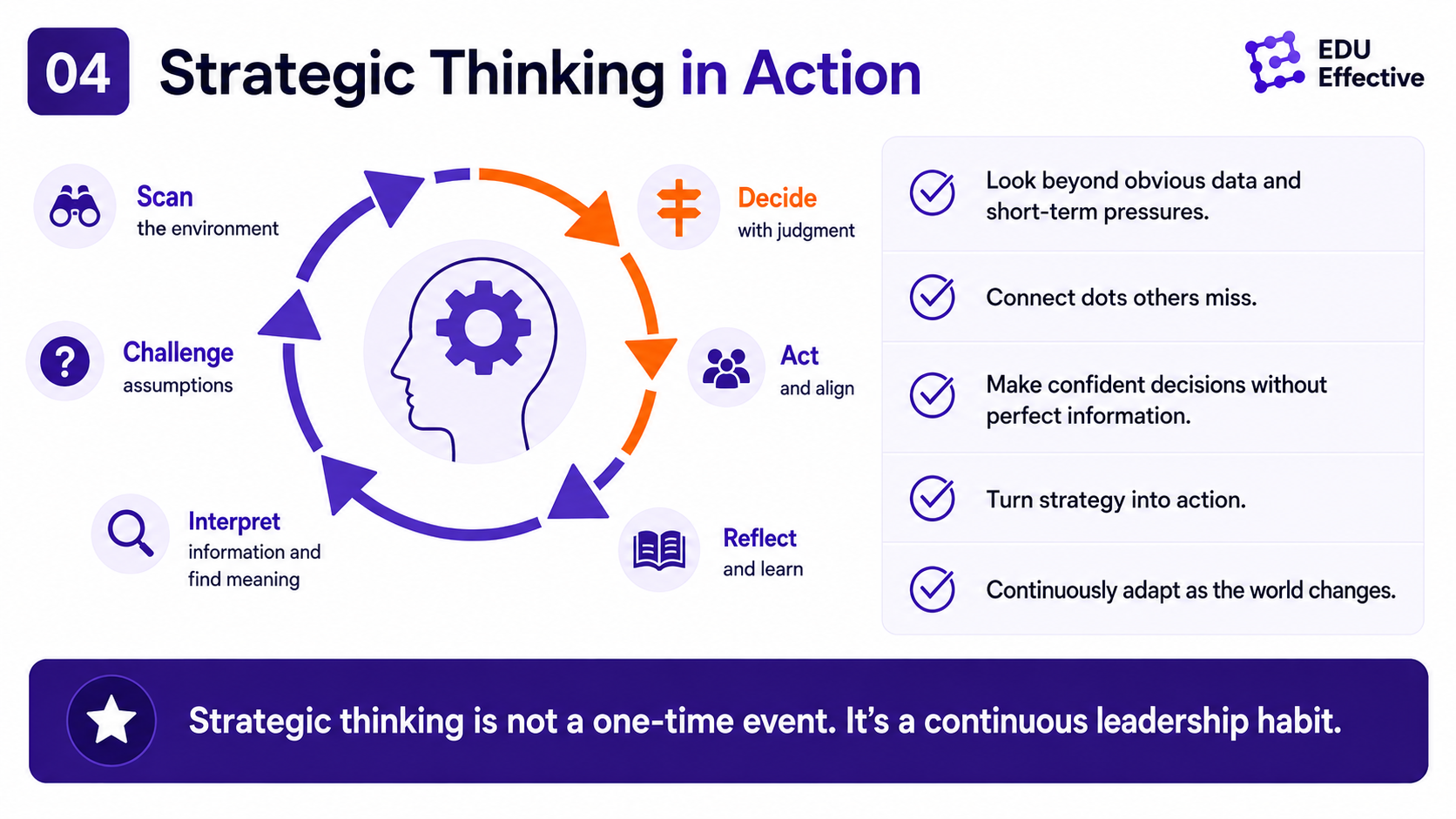
Anticipate — scanning the environment for emerging signals before they become obvious trends. Most managers are good at responding to what has already happened. Strategic thinkers develop the habit of looking for what is happening at the periphery of their awareness: the customer behaviour that does not fit the pattern, the competitor move that seems inconsequential, the regulatory shift that is still in early stages, the technology adoption curve that is accelerating faster than the consensus expects.
The practice of environmental scanning — deliberately seeking out information from outside your industry, your function, and your existing mental models — builds this capability over time. A manager who reads only their industry's trade publications sees only what their competitors see. A manager who also follows adjacent industries, reads broadly across disciplines, and actively seeks out perspectives that challenge their existing assumptions develops the peripheral vision that strategic thinking requires.
Challenge — questioning assumptions, including your own. The most damaging strategic assumptions are the ones that are so widely shared they are no longer recognised as assumptions. "Our customers will always value X." "The regulatory environment will remain stable." "Our competitive advantage is defensible for the foreseeable future." Strategic thinkers make a habit of surfacing and interrogating these hidden assumptions — asking "what would have to be true for our strategy to fail?" before investing in its execution.
Interpret — making sense of ambiguous, incomplete, or contradictory signals. The information available in complex environments is never clean or complete. Multiple sources point in different directions. The same data can be read as evidence for opposing conclusions. Strategic thinkers resist the temptation to resolve this ambiguity prematurely — to pick the interpretation that confirms their existing view and stop looking. They hold competing explanations open simultaneously until there is enough evidence to distinguish between them.
Decide — making quality decisions with incomplete information under time pressure. This is the capability that most separates strategic thinkers from sophisticated analysts. Analysis can be extended indefinitely; decisions have to be made. The strategic thinker knows when enough analysis has been done to make a decision at an acceptable level of confidence, which criteria matter most for the specific decision at hand, and which aspects of the decision are genuinely consequential versus which feel important but are not. McKinsey's research found that companies with mature strategic thinking frameworks achieve 43% faster decision-making while maintaining significantly higher decision quality — not because they decide with less information, but because they know which information actually matters.
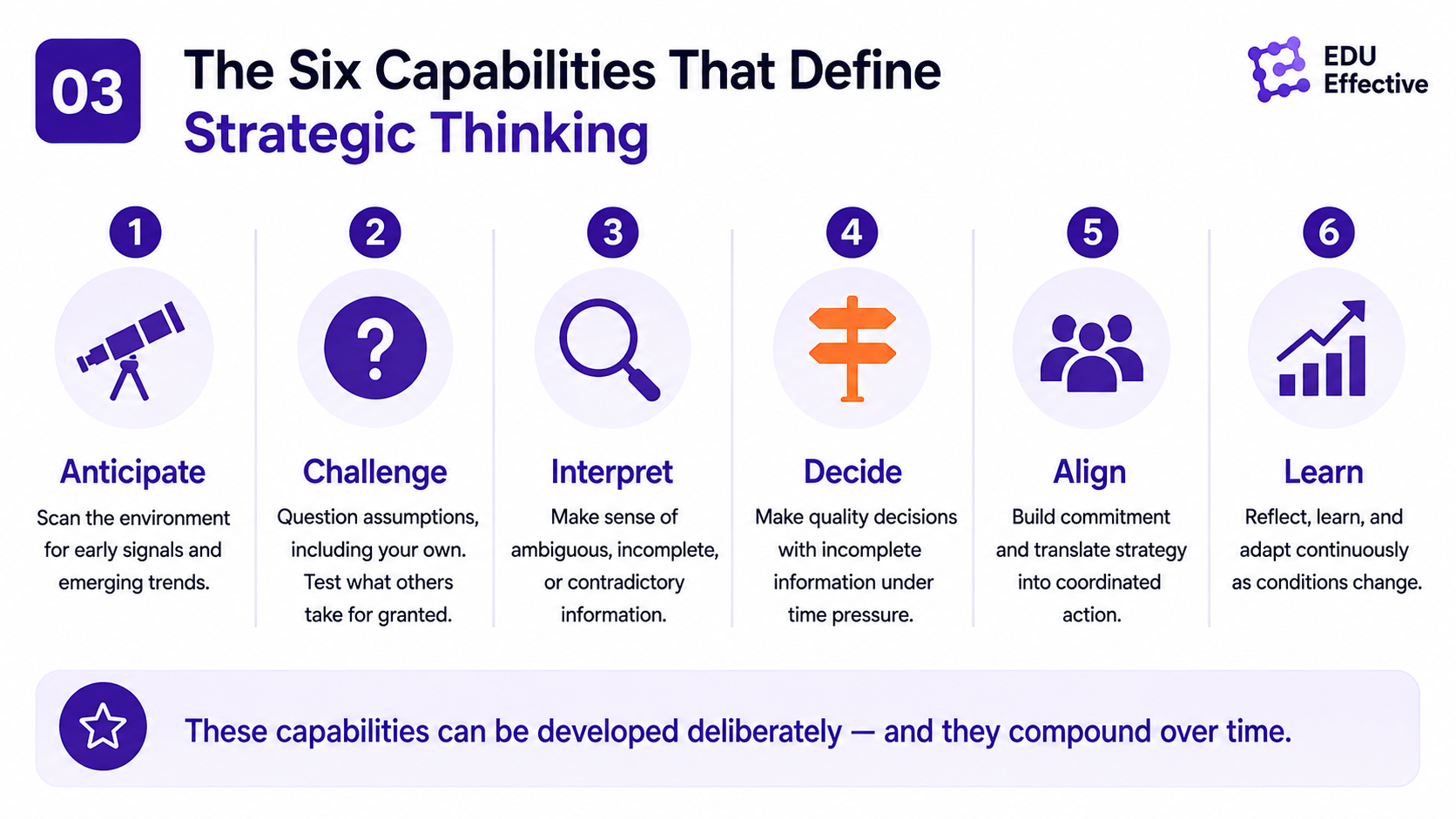
Align — building the understanding and commitment across diverse stakeholders that transforms a decision into coordinated action. A strategy that is not aligned around is not a strategy — it is a document. Strategic thinkers invest in creating the shared understanding of direction, rationale, and priority that allows an organisation to move coherently rather than in competing directions. This requires communication clarity, the ability to translate complex strategic logic into accessible terms for different audiences, and the political intelligence to understand which stakeholders need to be aligned first.
Learn — extracting insight from outcomes and adjusting accordingly. Strategic thinking is not a one-time event but a continuous cycle. The strategic thinker treats both successes and failures as data sources — asking not just "what happened?" but "why?" and "what does this tell us about the assumptions our strategy was based on?" Organisations that institutionalise this learning — through structured after-action reviews, regular strategy reviews that genuinely interrogate assumptions rather than just updating projections — build a compounding capability that improves with each cycle.
Strategic thinking and AI: a new dynamic in 2026
The relationship between strategic thinking and AI in 2026 is more complex than either "AI makes strategic thinking obsolete" or "AI has nothing to do with strategic thinking." The reality is more specific and more practically important.
AI significantly extends the analytical capabilities available to strategic thinkers. Data synthesis that previously required weeks of analyst time now takes hours. Scenario modelling that required specialist expertise is increasingly accessible through AI tools. Environmental scanning that was limited by human bandwidth can now cover far more ground with AI assistance.
But AI also introduces new strategic risks that require human strategic thinking to manage. Gartner's prediction about critical thinking atrophy is a direct response to the observed tendency of AI-assisted analysis to narrow the range of options considered, reinforce existing mental models, and produce outputs that feel definitive but embed the assumptions of the data they were trained on. The strategic thinker's ability to challenge assumptions — specifically including the assumptions embedded in AI-generated outputs — has become more, not less, important.
The effective use of AI in strategic thinking requires what McKinsey's research calls "decision intelligence": the ability to use AI-generated analysis as input to human judgement rather than as a substitute for it. This means understanding what assumptions are baked into the AI's recommendations, what the model cannot know or account for, and where human contextual knowledge and ethical judgement need to override or supplement the algorithmic output.
McKinsey's State of Organizations 2026 report found that organisations succeeding with AI strategy are those where leaders understand the technology well enough to ask the right questions of it — not those where AI tools are treated as black boxes that produce answers to be implemented. This is strategic thinking applied to AI adoption itself.
The three-horizon model: how strategic thinkers hold time
One of the most practically useful mental models in strategic thinking is the three-horizon framework, originally developed by McKinsey and widely used in organisational strategy. It addresses one of the most common failures in management thinking: the tendency to operate entirely in the present.
Horizon 1 is the current business — the activities that generate revenue and value today, which require consistent execution, optimisation, and protection. Most management attention naturally gravitates here because the consequences of failures in Horizon 1 are immediate and visible.
Horizon 2 is the emerging business — initiatives that are building future capabilities, market positions, or revenue streams that will become core to the business in two to three years. These require investment and management attention before they deliver returns, which makes them structurally under-prioritised by organisations focused on current performance.
Horizon 3 is the future business — options and experiments on capabilities or market positions that might become significant beyond the three-year horizon. These are typically small in scale, high in uncertainty, and easy to eliminate under budget pressure — but they are where the next generation of core business comes from.
Strategic thinkers hold all three horizons simultaneously — making decisions in Horizon 1 with awareness of their implications for Horizons 2 and 3. Organisations that focus exclusively on Horizon 1 consistently find themselves outpaced by competitors who invested in Horizons 2 and 3 while they were optimising for the present.
How to develop strategic thinking in practice
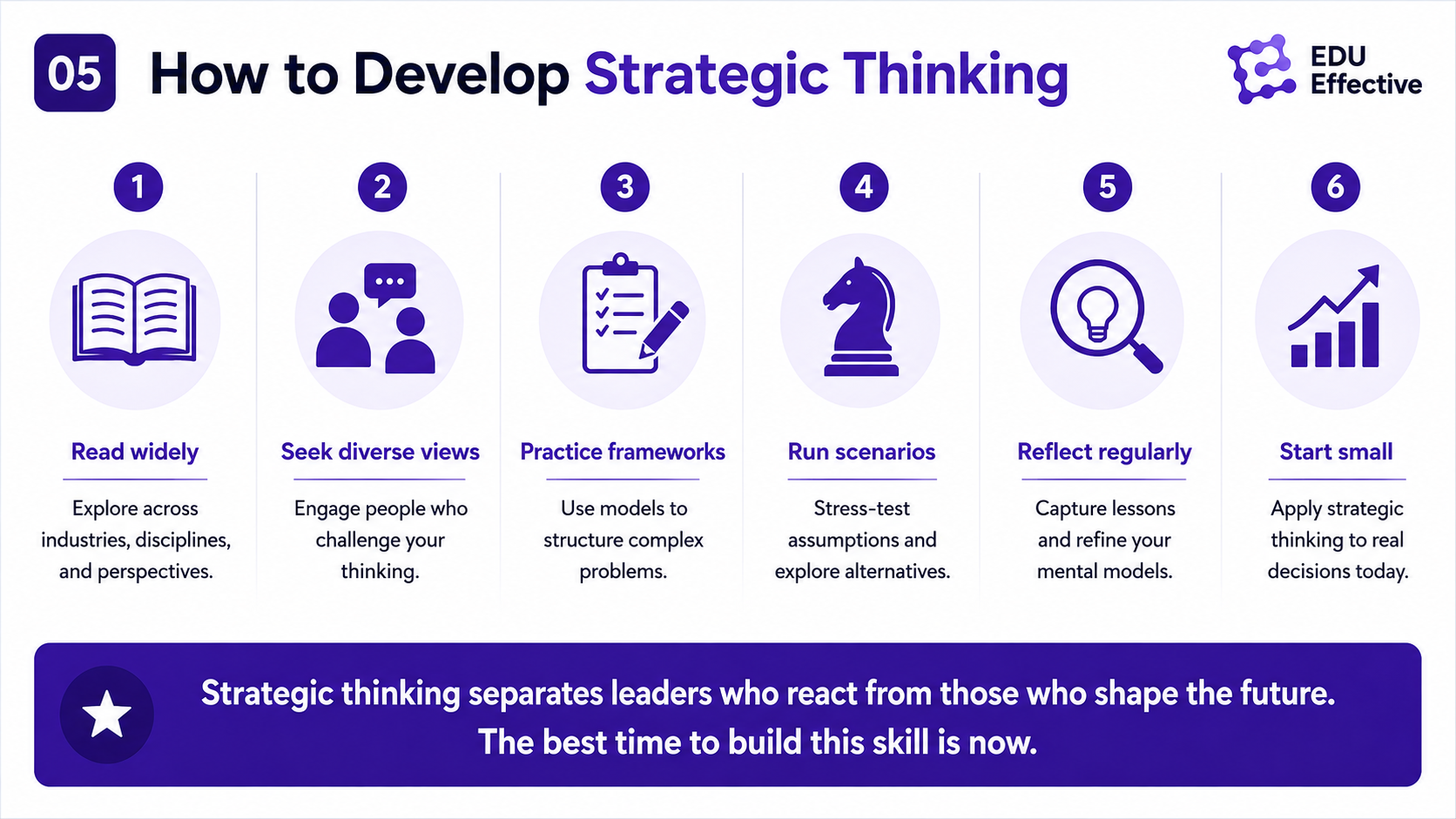
Strategic thinking is not primarily developed through reading about strategic thinking. It is developed through specific practices applied consistently over time.
Broaden your information diet deliberately. Spend time each week reading outside your industry and function. The connections between apparently unrelated developments — a regulatory shift in a different sector, a technology adoption pattern in a different geography, a consumer behaviour change in a different category — are often where the most valuable strategic insights originate. Strategic thinkers are, among other things, excellent pattern recognisers across large domains of information.
Practise working at the level above your current role. Deliberately take on thinking that addresses the challenges of the function or organisation above your current position. What would you do differently if you were responsible for the business unit rather than the team? What would change if you were setting the organisational strategy rather than executing your department's plan? This habitual elevation of perspective is one of the most direct ways to build strategic thinking capability.
Make your assumptions explicit before making decisions. Before committing to a significant course of action, write down the assumptions it depends on. Which of those assumptions are you most confident in? Which are you least confident in? What evidence would you need to see to change your view on the weakest ones? This practice both improves decision quality and builds the habit of assumption-questioning that strategic thinking requires.
Use scenario planning for consequential decisions. Rather than planning for the most likely future, build two or three materially different scenarios and think through how your decision would perform in each. What is your strategy's greatest vulnerability? Under what conditions does it fail? Scenario planning is not about predicting the future — it is about building the flexibility and awareness that allows you to respond intelligently when the future turns out different from what you expected.
Seek out and engage with contradictory evidence. The natural tendency of the human mind is confirmation bias — attending to evidence that supports existing beliefs and discounting evidence that challenges them. Strategic thinkers counteract this by actively seeking the case against their current view: who disagrees with this strategy and why? What would the most credible critic of this plan say? What evidence would cause us to change direction?
Ready to develop your strategic thinking professionally?
At EDU Effective, the Effective MBA: Executive Management & Leadership develops strategic thinking alongside decision-making, financial literacy, and the full range of capabilities that distinguish strategic leaders from tactical managers. Content draws from practitioners at Google, McKinsey, Goldman Sachs, Amazon, and many others — curated from a library of more than 24,000 videos for immediate application in your role. Explore the programme →
EDU Effective Business School — professional development for your long-term success.
All five best-selling Effective MBA programs are built on the same educational model — designed for working adults who need learning that fits real professional life:
- Effective MBA: Executive Management & Leadership
- Effective MBA: Applied Artificial Intelligence
- Effective MBA: Coaching, Leadership & Mentoring
- Effective MBA: Mastery in AI
- Effective MBA: Online Marketing
Every programme runs on 15 minutes a day, completes in 10 months or less, is ASIC accredited, and starts from €990.
These are professional programmes, not academic ones — built for working adults to apply what they learn directly in their own business, not to collect a scholarly credential.
Join more than 9,000 students in over 120 countries who are investing in their professional development and career success. Read the experiences of our graduates here.
Apply now — from €990 · Talk to a Study Advisor
Study with NO risk: 14-day money-back guarantee, no questions asked.
Sources
- McKinsey & Company — The State of Organizations 2026
mckinsey.com/capabilities/people-and-organizational-performance/our-insights/the-state-of-organizations - McKinsey & Company — Strategic Decision-Making Speed and Quality Research
mckinsey.com/capabilities/strategy-and-corporate-finance/our-insights - McKinsey & Company — Three Horizons Framework
mckinsey.com/capabilities/strategy-and-corporate-finance/our-insights/enduring-ideas-the-three-horizons-of-growth - Gartner — Top Strategic Predictions for 2026: Critical Thinking Atrophy
gartner.com/en/newsroom/press-releases/2025-10-21-gartner-unveils-top-predictions-for-it-organizations-and-users-in-2026-and-beyond - Gartner — Strategic Predictions for 2026: AI's Underestimated Influence
gartner.com/en/articles/strategic-predictions-for-2026 - PwC — 2026 Global AI Jobs Barometer: Judgement, Leadership and Adaptability
pwc.com/gx/en/news-room/press-releases/2026/pwc-2026-ai-jobs-barometer.html - World Economic Forum — Future of Jobs Report 2025
weforum.org/publications/the-future-of-jobs-report-2025/ - DDI — Global Leadership Forecast 2025: Strategic Thinking as Core Competency
ddiworld.com/research/global-leadership-forecast