
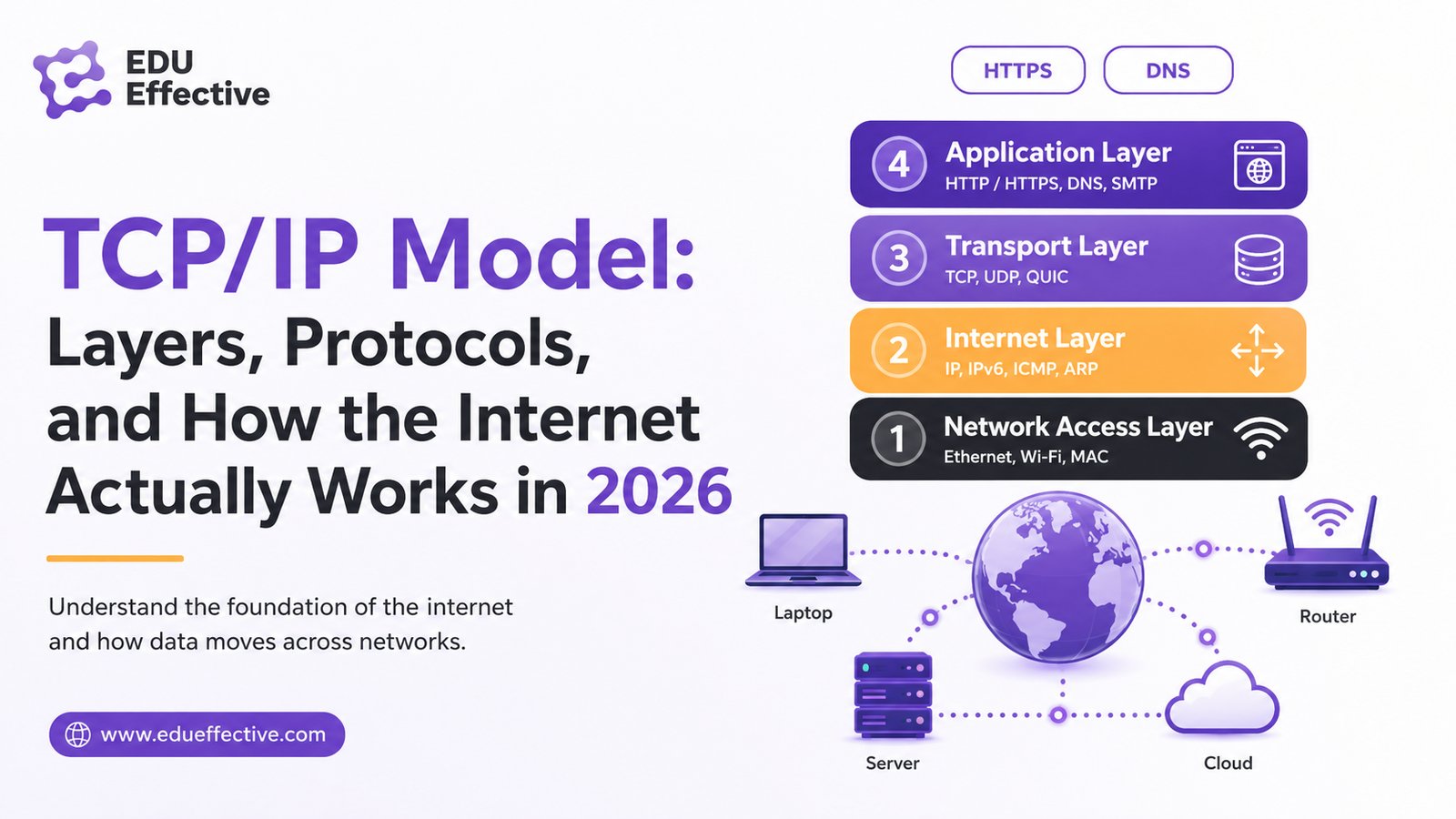

Every time you open a browser, send an email, stream a video, or call a colleague over VoIP, a set of protocols built in the 1970s is handling the transmission. The TCP/IP model — Transmission Control Protocol / Internet Protocol — is the foundational architecture that makes internet communication possible. It was not designed for the world we live in now, and yet it runs almost all of it.
Understanding how TCP/IP works is not just knowledge for network engineers. For anyone working in technology, digital business, or cybersecurity in 2026, knowing what happens between “I clicked send” and “the message arrived” is genuinely useful — both for making better technical decisions and for understanding why certain things break.
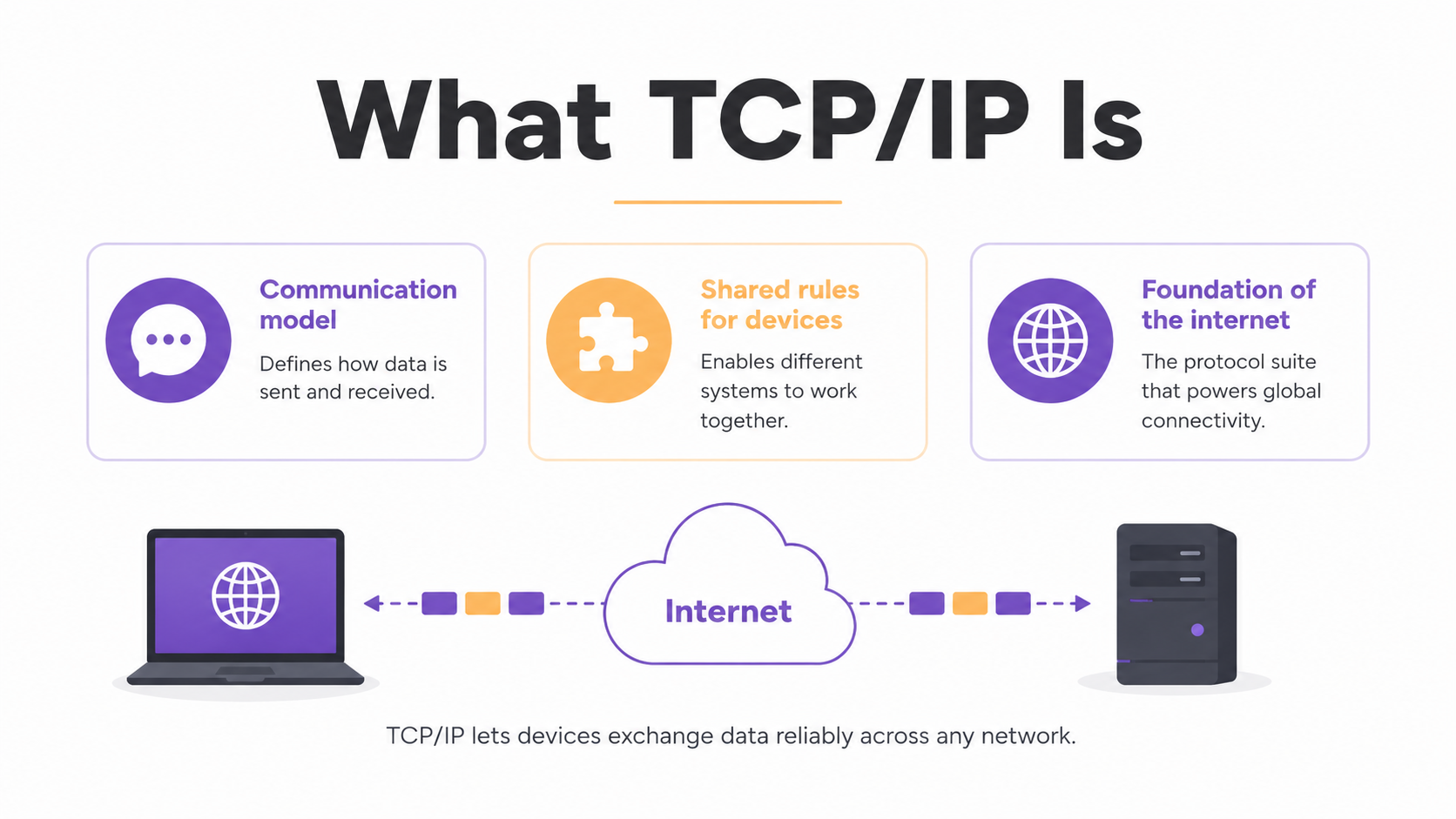
What TCP/IP is — the precise definition
TCP/IP is a suite of communication protocols that governs how data is transmitted across interconnected networks. The name refers to its two most important protocols: TCP (Transmission Control Protocol), which manages reliable delivery of data between applications, and IP (Internet Protocol), which handles addressing and routing — ensuring each packet knows where it is going and how to get there.
The model was developed in the early 1970s by Vint Cerf and Bob Kahn for the US Department of Defense's ARPANET project. It became the standard for internet communication in 1983 when ARPANET switched entirely to TCP/IP, and it has been the backbone of the internet ever since. No other protocol suite has come close to displacing it, though significant evolution is happening at the transport layer in 2026 — more on that below.
TCP/IP is not a single protocol but an entire protocol suite — a collection of interoperating protocols that together enable the full range of internet communication. HTTP, HTTPS, DNS, SMTP, FTP, and dozens of other protocols you use daily are all built on top of the TCP/IP foundation.
The TCP/IP model layers: what they are and what each does
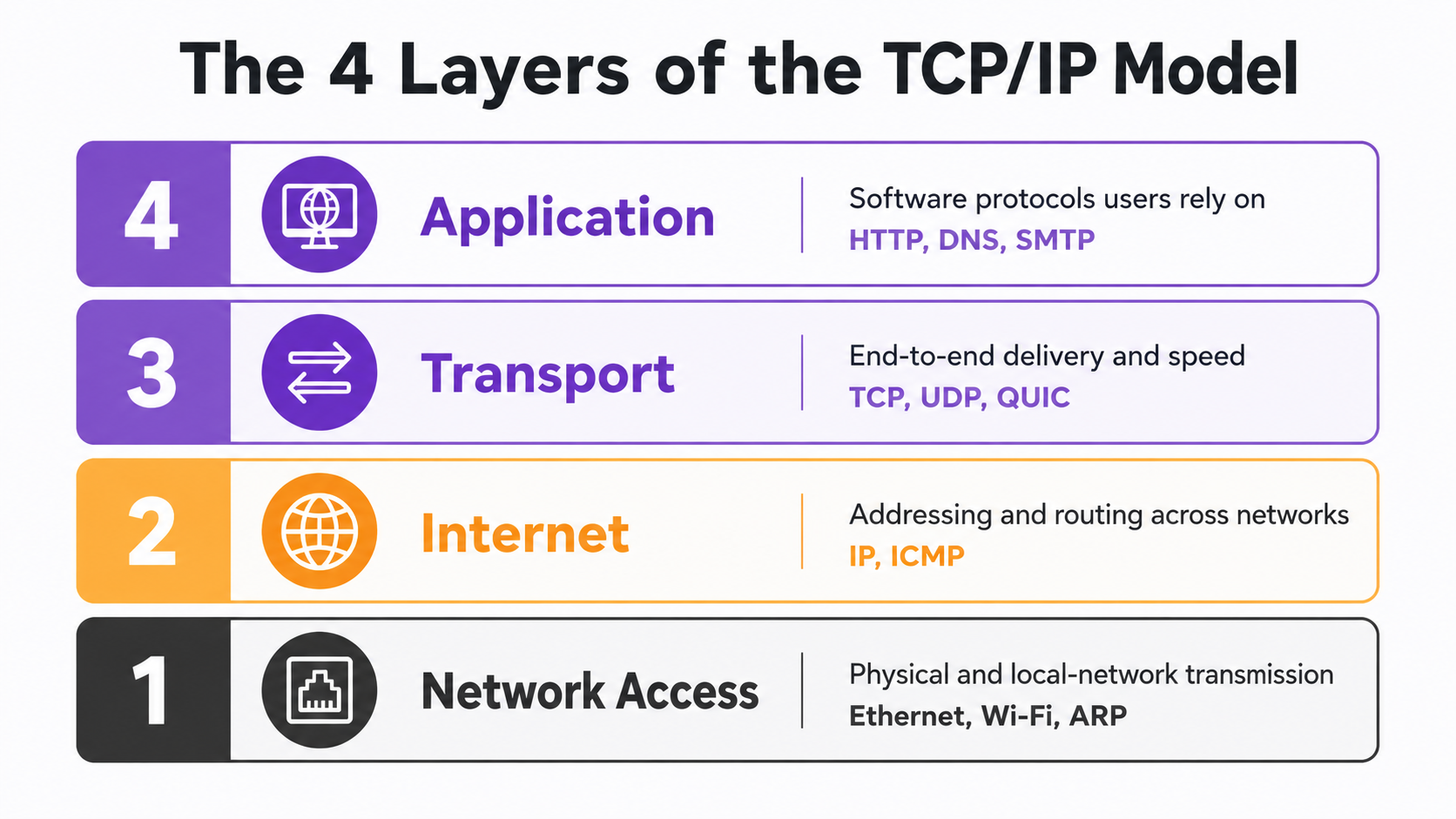
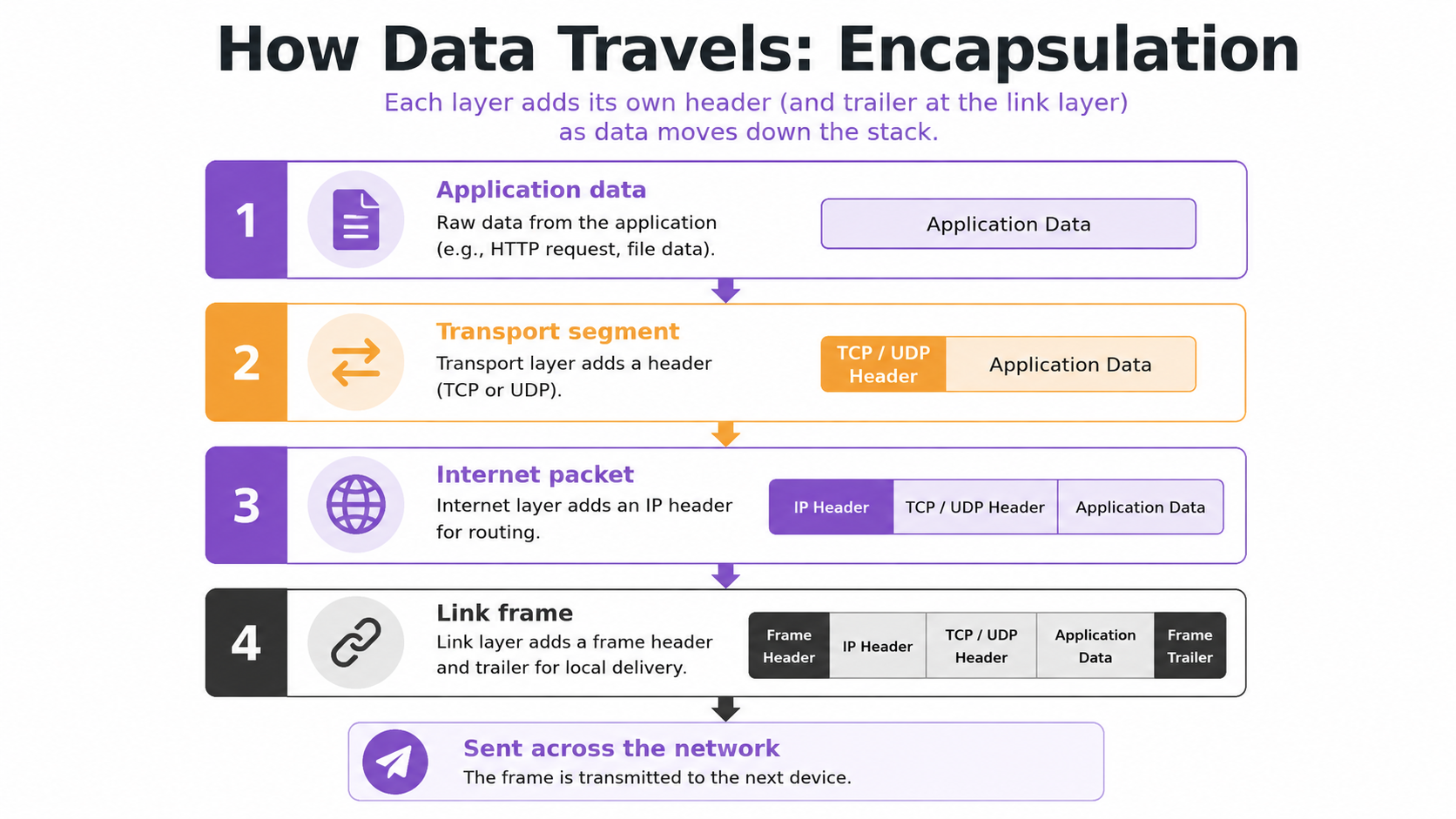
The TCP/IP model organises network communication into four distinct layers. Each layer has a defined responsibility. When data is sent, it passes down through all four layers on the sending device, travels across the network, then passes back up through all four layers on the receiving device — each layer adding or stripping the information it needs at its level.
Layer 1: Network Access Layer (also called Link Layer or Network Interface Layer)
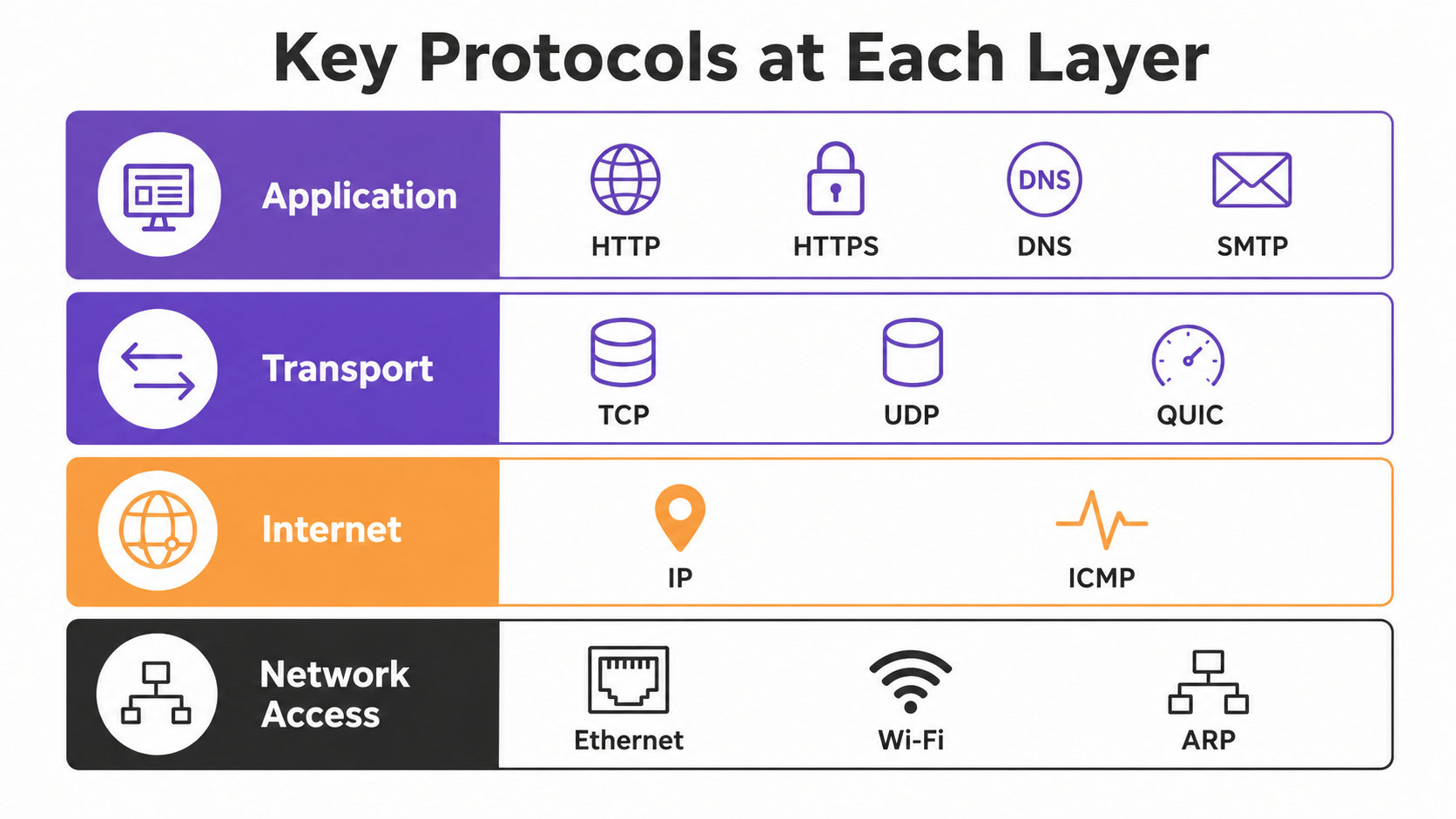
This is the bottom layer — the closest to physical hardware. It handles the transmission of data between devices on the same local network, managing the physical connection: Ethernet cables, Wi-Fi radio signals, fibre optic connections, network interface cards, and the MAC addressing system that identifies individual hardware devices on a local network.
The Network Access Layer is where protocols like Ethernet and Wi-Fi (802.11) operate. It defines how bits of data are placed onto a physical medium and retrieved from it. Without this layer, no data moves at all.
In 2026, the physical evolution at this layer is being driven by Wi-Fi 7 (802.11be) deployment, which delivers theoretical maximum speeds of 46 Gbps — approximately 4.8 times faster than Wi-Fi 6 — and 5G network infrastructure expansion, which is enabling TCP/IP communication over cellular connections with latency approaching wired network performance.
Layer 2: Internet Layer
The Internet Layer handles logical addressing and routing — the mechanism by which data finds its way from a source device across multiple interconnected networks to a destination device. This is the layer where IP (Internet Protocol) operates.
Every device on the internet is assigned an IP address — a unique numerical identifier that functions like a postal address. When data is sent, the Internet Layer packages it into packets, each labelled with the source and destination IP address. Routers — the devices that connect networks — read these addresses and forward each packet toward its destination, making path decisions at every hop.
The Internet Layer also contains ICMP (Internet Control Message Protocol), which handles diagnostic and error messages — including the “ping” utility used to test network connectivity — and ARP (Address Resolution Protocol), which maps IP addresses to physical MAC addresses on local networks.
The major 2026 development at this layer is IPv6 adoption. IPv4, which uses 32-bit addresses allowing approximately 4.3 billion unique addresses, has been exhausted for years — organisations have been operating on various workarounds. IPv6 uses 128-bit addresses, providing approximately 340 undecillion unique addresses — enough for every conceivable device. Google reached 50% IPv6 traffic in April 2026, and several major countries have crossed 51% IPv6 adoption thresholds, with some reaching 75%. IPv6 is no longer a future consideration — it is the present operational reality for significant portions of internet traffic.
Layer 3: Transport Layer
The Transport Layer manages end-to-end communication between applications. It receives data from the Application Layer above it, breaks it into smaller chunks called segments, and handles the reliability, flow control, and error-checking that ensures data arrives correctly and in order.
This is the layer where two fundamental protocols operate: TCP and UDP.
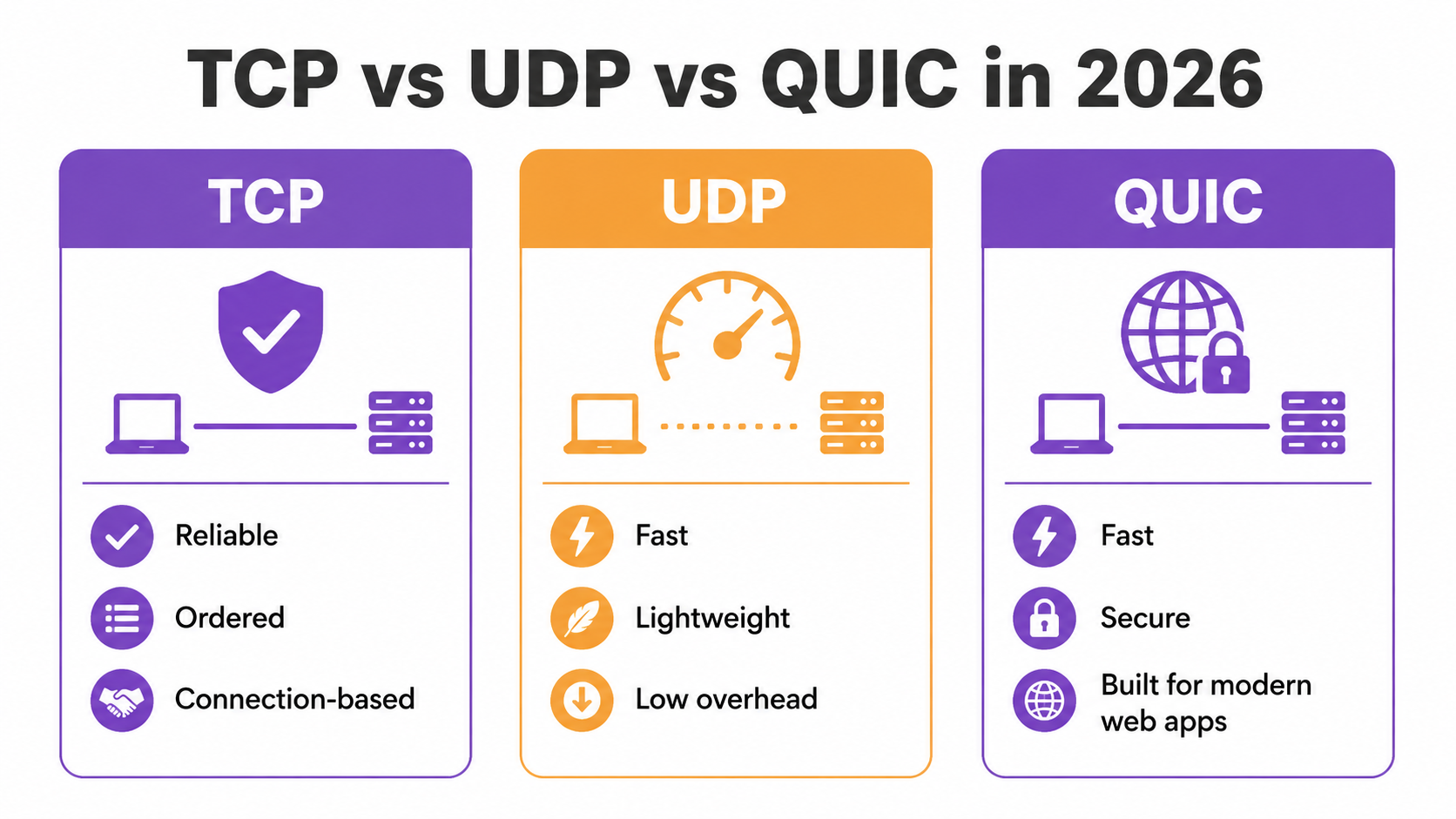
TCP (Transmission Control Protocol) establishes a reliable, ordered connection between two endpoints before any data is sent. It performs a “three-way handshake” — SYN, SYN-ACK, ACK — to establish the connection, then ensures every segment is acknowledged by the receiver, retransmitting any that are lost. TCP is used wherever reliable delivery matters: web pages, emails, file transfers, database queries.
UDP (User Datagram Protocol) is the alternative. It sends data without establishing a connection first, without acknowledgement, and without error recovery. This makes it faster and lower-latency than TCP — but unreliable. UDP is used where speed matters more than perfect delivery: live video streaming, VoIP calls, online gaming, DNS queries, and real-time sensor data from IoT devices.
The most significant development at this layer in 2026 is QUIC — Quick UDP Internet Connections. Originally developed by Google and standardised by the IETF as the transport for HTTP/3, QUIC runs over UDP but reimplements TCP's reliability, congestion control, and flow control at the application level — with critical improvements. QUIC establishes connections in 0-1 round trips versus TCP's 2-3, eliminates the head-of-line blocking problem that affected TCP, and handles connection migration seamlessly (critical for mobile users switching between networks). As of mid-2026, HTTP/3 (which runs over QUIC) accounts for approximately 35–39% of web traffic by CDN measurement — Meta reports approximately 75% of its traffic now runs on QUIC/HTTP/3. This is the most significant change to internet transport protocol architecture in decades.
Layer 4: Application Layer
The Application Layer is the topmost layer — the one that interfaces directly with software applications. It defines the protocols that govern specific types of communication between applications, determining how data should be formatted, exchanged, and presented for use by the end application.
This is the layer most people interact with indirectly every day, through the applications those protocols power. Key Application Layer protocols include:
HTTP and HTTPS — the protocols for web browsing, where HTTPS adds TLS encryption for secure transmission. HTTP/3, the latest version, operates over QUIC rather than TCP.
DNS (Domain Name System) — translates human-readable domain names (www.example.com) into IP addresses. Without DNS, every internet request would require typing a numerical IP address.
SMTP (Simple Mail Transfer Protocol) — handles the sending of email between mail servers.
FTP and SFTP — File Transfer Protocol and its secure variant, used for transferring files between clients and servers.
SSH (Secure Shell) — encrypted protocol for secure remote access to servers and network devices.
DHCP (Dynamic Host Configuration Protocol) — automatically assigns IP addresses to devices joining a network, eliminating the need for manual configuration.
TCP/IP vs OSI: understanding the relationship
The OSI (Open Systems Interconnection) model is a conceptual framework with seven layers — Physical, Data Link, Network, Transport, Session, Presentation, and Application — developed by the ISO in 1984, about a decade after TCP/IP.
OSI provides a more granular theoretical model and is widely used in networking education and documentation to discuss protocols precisely. TCP/IP is the model that actually runs the internet.
The mapping between the two is approximate: OSI's Physical and Data Link layers correspond to TCP/IP's Network Access layer; OSI's Network layer corresponds to TCP/IP's Internet layer; OSI's Transport layer corresponds to TCP/IP's Transport layer; and OSI's Session, Presentation, and Application layers all map to TCP/IP's Application layer.
Network professionals typically use OSI terminology when discussing specific protocol behaviour in detail, and TCP/IP when discussing real implementation. Understanding both frameworks — and their relationship — is foundational networking knowledge.
Why TCP/IP still matters in 2026
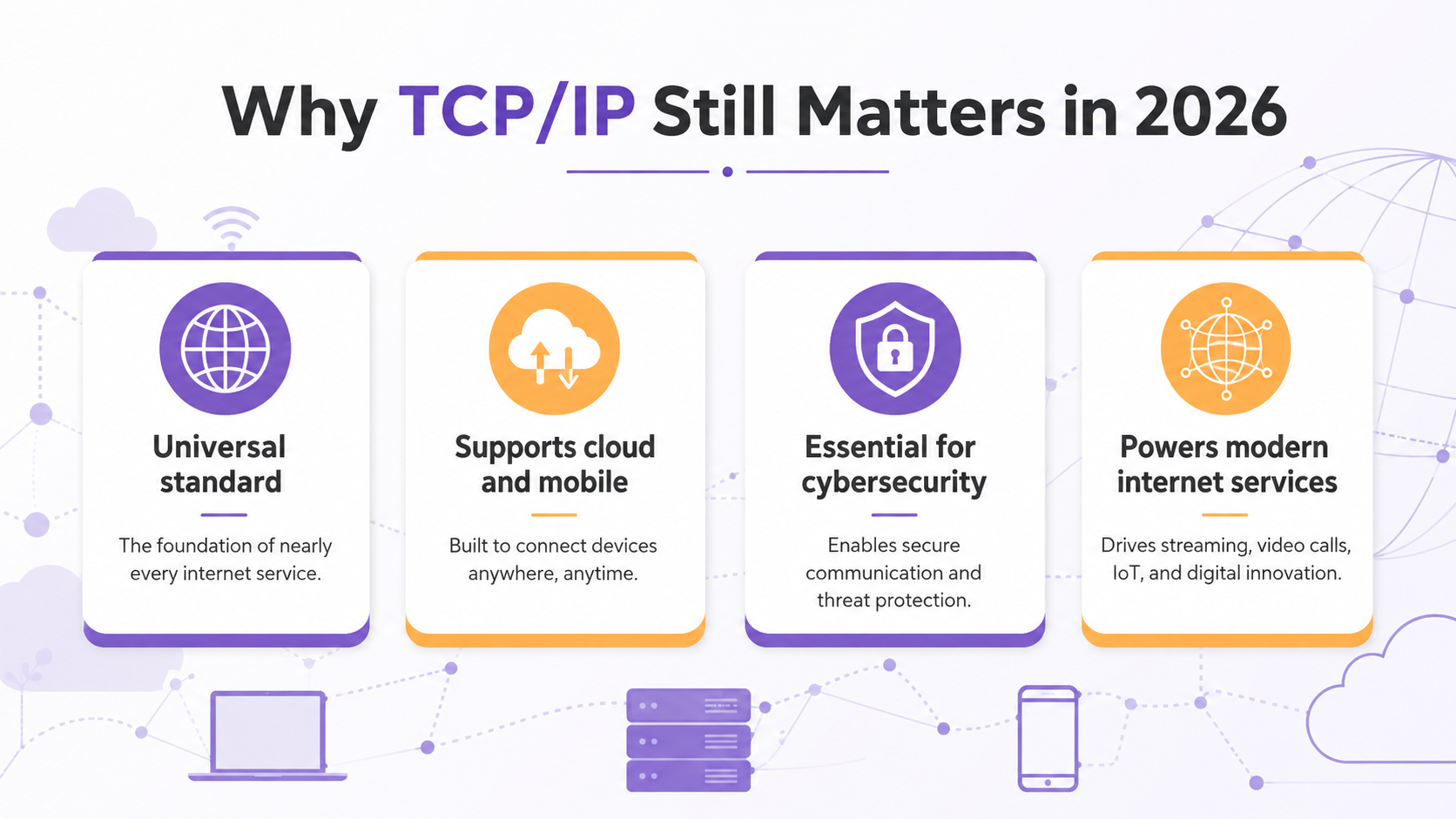
TCP/IP is 50 years old. It was designed for a world of large mainframes and academic research networks — not for streaming 4K video to billions of smartphones simultaneously, nor for AI inference requests hitting data centres hundreds of times per second, nor for IoT devices numbering in the tens of billions.
And yet it handles all of it. The reason is that TCP/IP's layered architecture is inherently extensible. New protocols can be built on top of or alongside existing ones without replacing the entire stack. QUIC did not replace TCP/IP — it evolved the transport layer while leaving everything else in place. IPv6 did not replace the internet model — it extended the addressing space within the existing framework. HTTP/3 did not change how routing or physical transmission work — it changed how application data is transported.
This layered, modular design is the engineering insight that has kept TCP/IP relevant across five decades of technological change. Understanding it clarifies why internet technology evolves the way it does — layer by layer, protocol by protocol, rather than through wholesale replacement.
At EDU Effective, our Effective MBA programs build the foundational knowledge professionals need to understand and navigate digital infrastructure — from business strategy to technical fundamentals. Explore our programs →
EDU Effective Business School = professional development for your long-term success
All best-selling Effective MBA programs:
- Effective MBA: Executive Management & Leadership,
- Effective MBA: Applied Artificial Intelligence,
- Effective MBA: Coaching, Leadership & Mentoring,
- Effective MBA: Mastery in AI,
- or Effective MBA: Online Marketing,
are based on the same educational model, which is beneficial for working adults:
These are professional programs, not academic ones — built for working adults to apply what they learn directly in their own business, not to collect a scholarly credential.
Join more than 9,000 students in over 120 countries around the world to further your personal development and career success.
You can read the feedback and experiences of our students and the stories of our graduates here.
The easiest way to start working on your personal development and success today:
Apply now — from €990 · Talk to a Study Advisor
Study with NO risk: 14-day money-back guarantee, no questions asked.
Sources
- Skills for Everyone — TCP/IP Model Layers and Protocols You Must Know in 2026 https://www.skillsforeveryone.com/articles/tcp-ip-model-layers-and-protocols
- Calmops — HTTP/3 and QUIC Protocol: Next-Generation Transport 2026 https://calmops.com/network/http3-quic-protocol/
- APNIC Blog — Google hits 50% IPv6 https://blog.apnic.net/2026/04/28/google-hits-50-ipv6/
- Medium / Sohail Codes — The Network Protocol That Will Replace TCP/IP https://medium.com/@sohail_saifii/the-network-protocol-that-will-replace-tcp-ip-a861a7a6af5e
- Cloudflare — What is TCP/IP? https://www.cloudflare.com/learning/ddos/glossary/tcp-ip/