
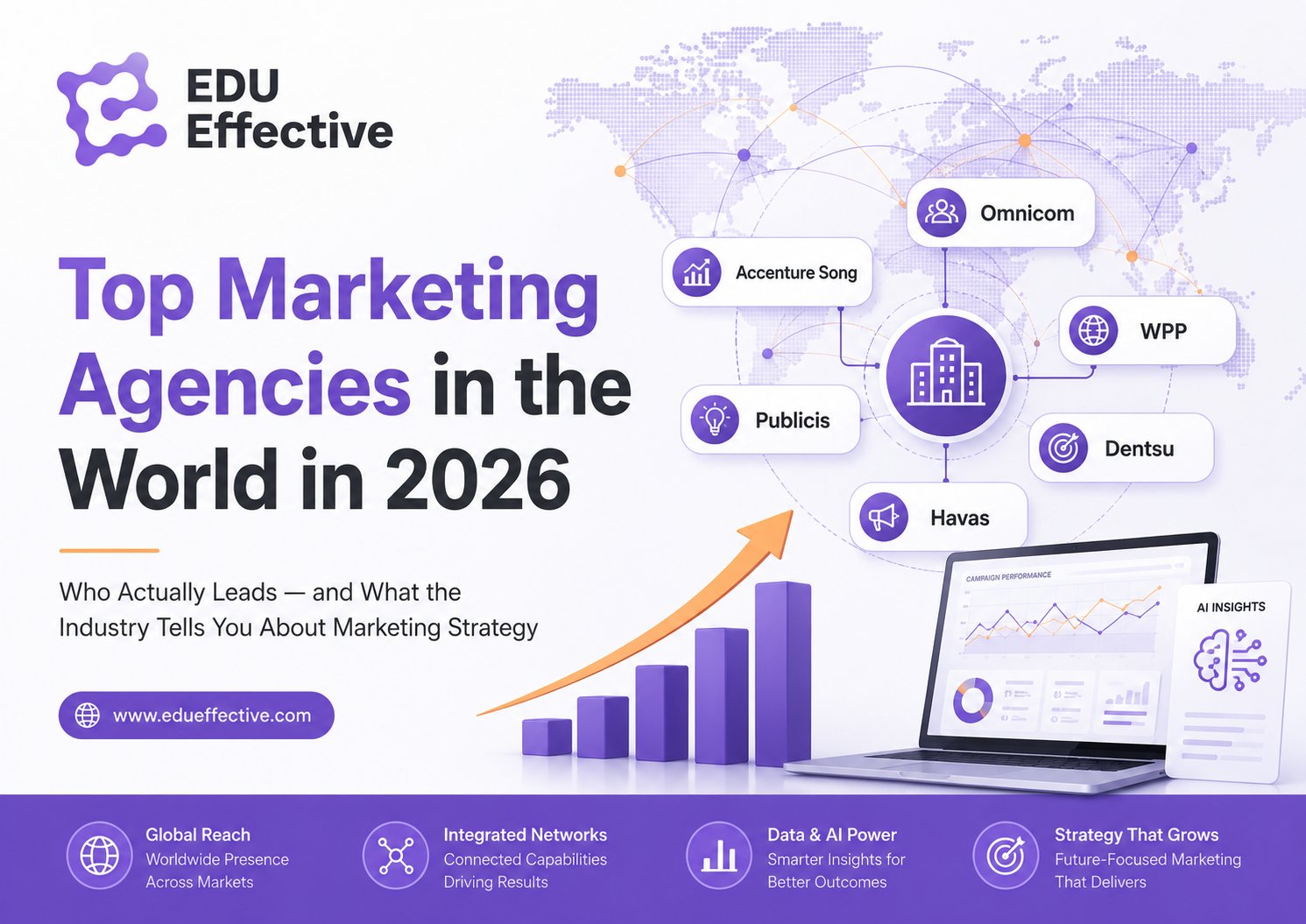

Ask any marketer to name the top advertising agencies in the world and you'll get a familiar list: Ogilvy, BBDO, McCann, Leo Burnett. The names have the weight of decades behind them. What's harder to see — and more strategically interesting — is who actually owns them, how the industry is being restructured right now, and what that tells you about where marketing is heading.
In 2026, the agency landscape has been redrawn more dramatically than at any point in the last thirty years. Understanding who leads the market isn't just trivia. It's a case study in how industries consolidate under competitive pressure, how AI is forcing structural change on legacy organisations, and what the difference between brand equity and business performance actually looks like in practice.
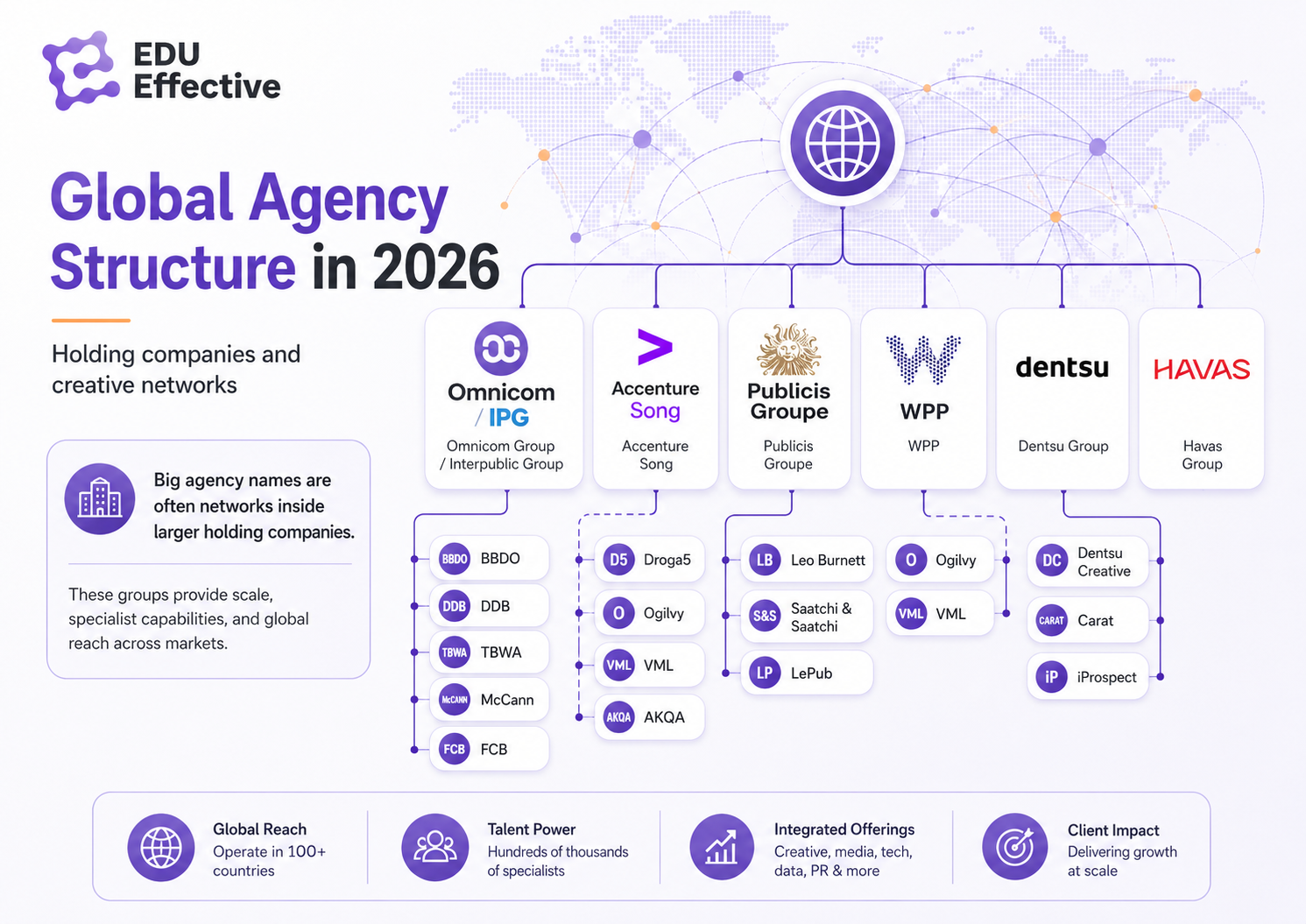
The structure of the global marketing industry: holding companies and creative networks
Most of the famous agency names are not independent companies. They are creative networks owned by holding groups — large parent corporations that acquire agencies, pool their back-office functions, and cross-sell services to clients.
This structure matters for understanding any top-10 list. When you hire "Ogilvy" or "BBDO" or "DDB," you are hiring a network inside a holding company. The holding company's financial performance, strategic direction, and management decisions directly affect the agency's resources, culture, and leadership stability.
In 2026, the five dominant holding groups are:
Omnicom (including the former Interpublic Group) is now the world's largest marketing organisation after completing its acquisition of IPG in November 2025 — the largest takeover in advertising history at approximately $9 billion in an all-stock deal. The combined group generates over $25 billion in revenue and houses more than 1,500 agencies including BBDO, DDB, TBWA, McCann, FCB, and Mediabrands. Omnicom shareholders own approximately 60.6% of the combined entity.
Accenture Song is the most instructive name on any list of top marketing companies, because it doesn't fit the traditional category. The marketing arm of a global consulting firm, Accenture Song generates approximately $20 billion in revenue — placing it second globally in scale, ahead of every traditional agency holding group except the newly merged Omnicom. It owns creative shop Droga5 and is built around generative AI-led marketing services at enterprise scale. The fact that a consulting firm now rivals legacy agency groups tells you more about the direction of the industry than any award ranking.
Publicis Groupe generates approximately €14.5 billion in revenue and has been the most aggressive winner in the current market. Publicis grew organic revenue 4.5% in Q1 2026 and won roughly twice as many new business pitches as its nearest rival. Its network includes Leo Burnett, Saatchi & Saatchi, LePub, and Publicis Sapient. Most significantly, Publicis won Coca-Cola's North American media account — estimated at around $700 million in annual spend — directly from WPP in 2026.
WPP generates approximately £13.55 billion in revenue and is currently undergoing the most turbulent restructuring in its history. Its Elevate28 strategy under CEO Cindy Rose targets £500 million in annual savings, involves consolidating Ogilvy, VML, and AKQA into integrated units, and has included multiple rounds of layoffs. Revenue from WPP's top 25 clients fell 9.4% in Q1 2026, and the loss of both Coca-Cola's North American business and the $1.7 billion Mars global media account to Publicis has intensified pressure on the business. Its GroupM media buying unit has been rebranded WPP Media.
Dentsu generates approximately ¥1.1 trillion in net revenue and is the dominant force in Japan and across the Asia-Pacific region. Its network includes Dentsu Creative, Carat, and iProspect. Dentsu's APAC strength and its data capabilities in AI-driven media buying make it a serious competitor in markets where the Western holding groups are weaker.
Havas operates independently after spinning off from Vivendi, making it the most agile of the major groups. Smaller than its peers but strategically mobile, Havas has pursued an active acquisitions strategy and differentiates on speed and integration.
What the creative rankings show: Cannes Lions 2026
Revenue scale tells you who is winning commercially. Creative rankings tell you something different — which networks are producing the kind of work that shapes culture and builds brand equity.
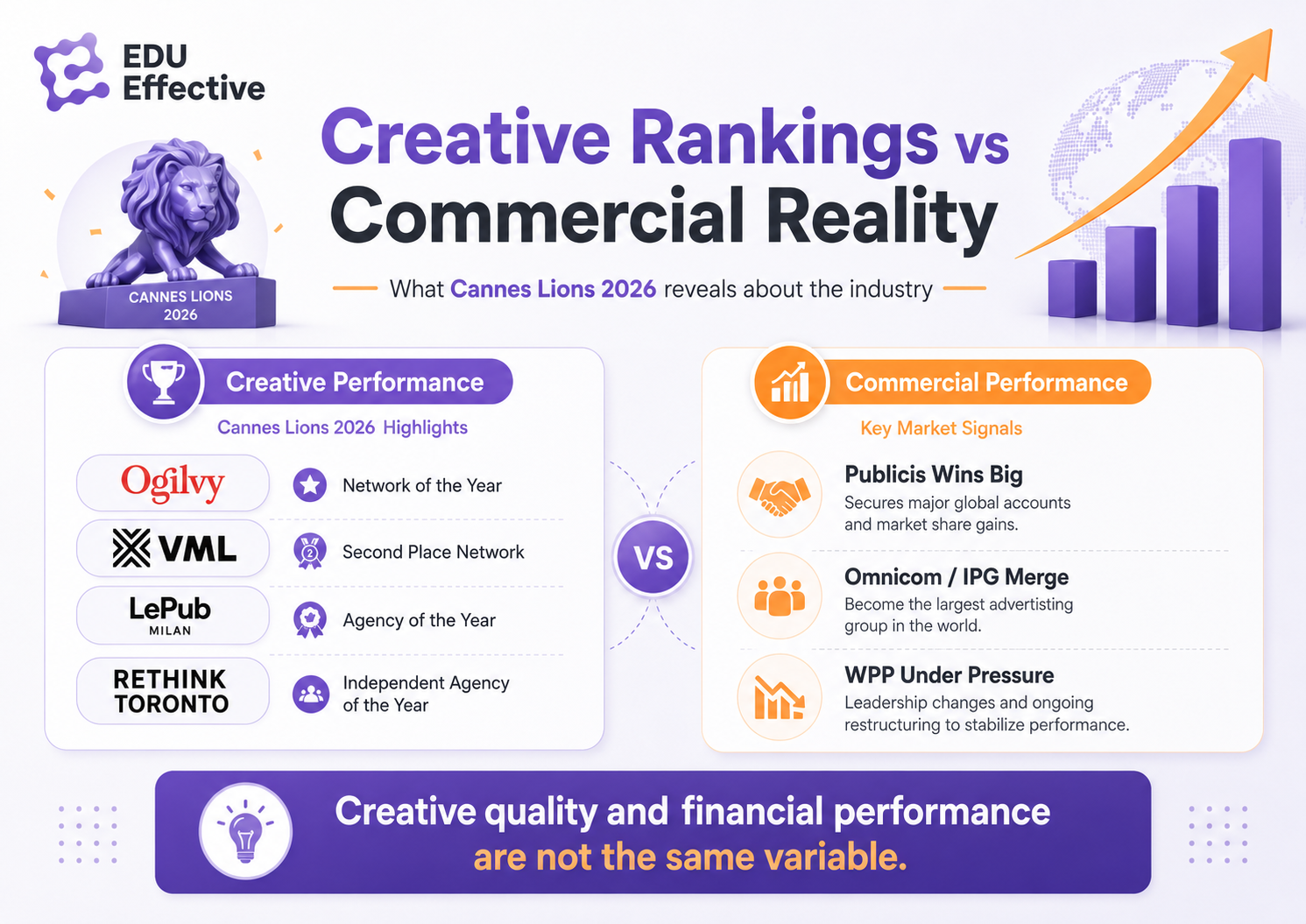
At Cannes Lions 2026, held in June, WPP's Ogilvy was named Network of the Year with 81 Lions including three Grand Prix awards. WPP's VML took second place. LePub Milan (part of Publicis) won Agency of the Year. Rethink Toronto won Independent Agency of the Year.
The pattern is instructive: even as WPP struggles commercially and undergoes painful restructuring, its creative networks continue to produce the industry's most recognised work. Creative quality and financial performance are not the same variable — and any ranking that conflates them will mislead you.
The ten names that actually matter in 2026
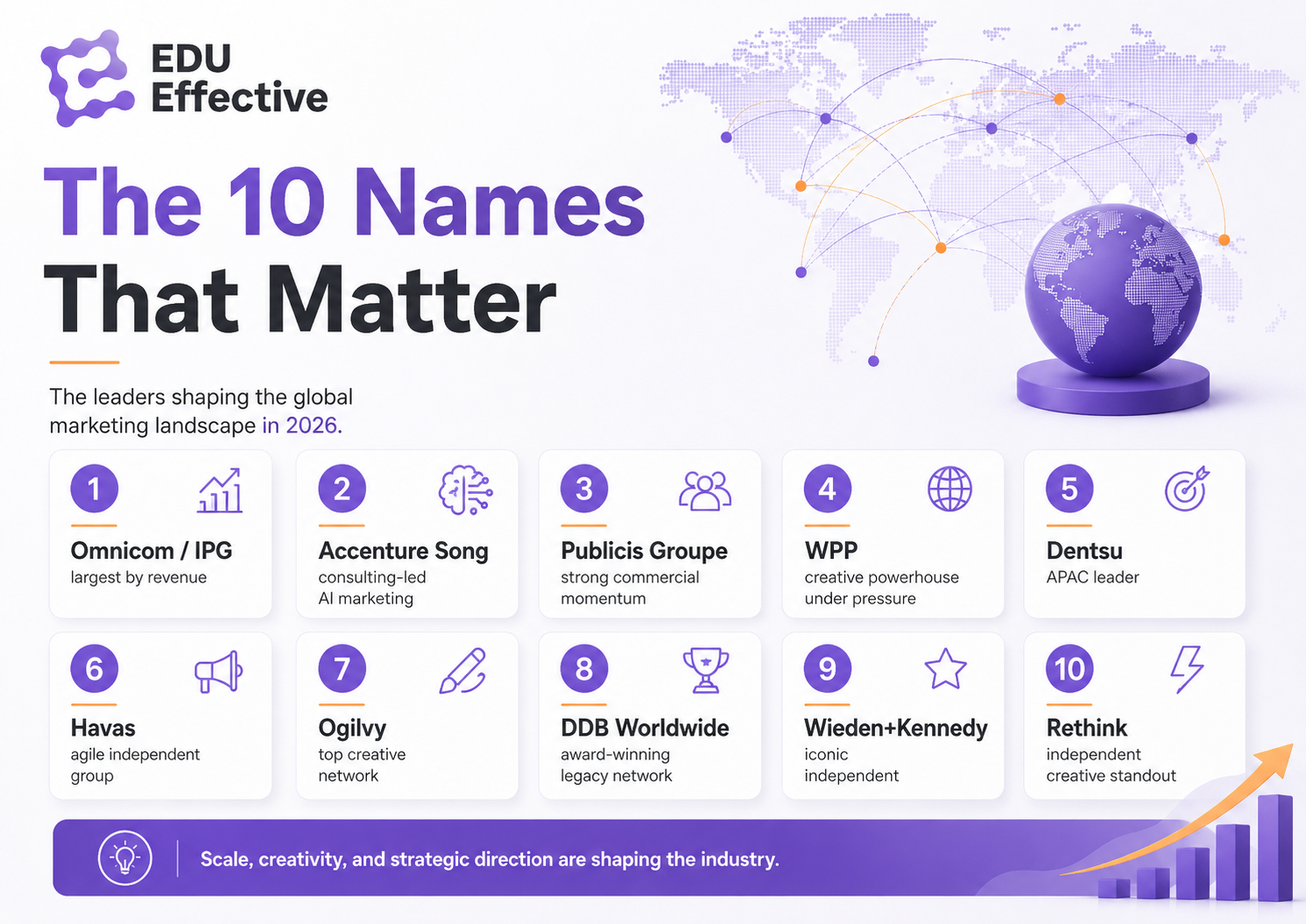
Rather than a list of agencies you might never work with, here are the ten organisations that genuinely define the global marketing landscape — organised by what makes each one distinctive.
Omnicom / IPG — The largest marketing organisation in the world by revenue. Houses BBDO (consistently among the most-awarded creative networks globally), DDB (Cannes Network of the Year 2025), TBWA, McCann, and FCB. Clients include Apple, McDonald's, and PepsiCo.
Accenture Song — The world's second-largest marketing company and the clearest signal of where the industry is going. Owns Droga5. Built on AI-powered marketing transformation for enterprise clients. Not an ad agency in any traditional sense.
Publicis Groupe — The most commercially successful traditional holding group in 2025-2026. Owns Leo Burnett, Saatchi & Saatchi, LePub, and Publicis Sapient. Winning major accounts from competitors through its integrated data and creativity offer.
WPP — Owns Ogilvy (Cannes Network of the Year 2026), VML, AKQA, and GroupM/WPP Media. Undergoing significant restructuring but retaining the strongest creative awards performance in the industry.
Dentsu — Dominant in Japan and APAC. Strong data and media capabilities. Owns Dentsu Creative, Carat, and iProspect.
Havas — The most agile of the major groups, operating independently post-Vivendi.
Ogilvy (WPP network) — The named network with the strongest creative performance in 2026. Founded by David Ogilvy in 1948, now operating across 131 countries with over 20,000 people.
DDB Worldwide (Omnicom) — Cannes Network of the Year 2025. One of the most enduring creative networks in the industry.
Wieden+Kennedy — The most famous genuinely independent creative agency in the world. Created Nike's "Just Do It" and continues to produce culturally significant work without holding-company ownership. A benchmark for what independence can sustain.
Rethink — Canadian independent, named Independent Agency of the Year at Cannes 2026. The kind of specialist independent that can outperform on creativity without the scale of a global network.
What AI is doing to the agency business — right now
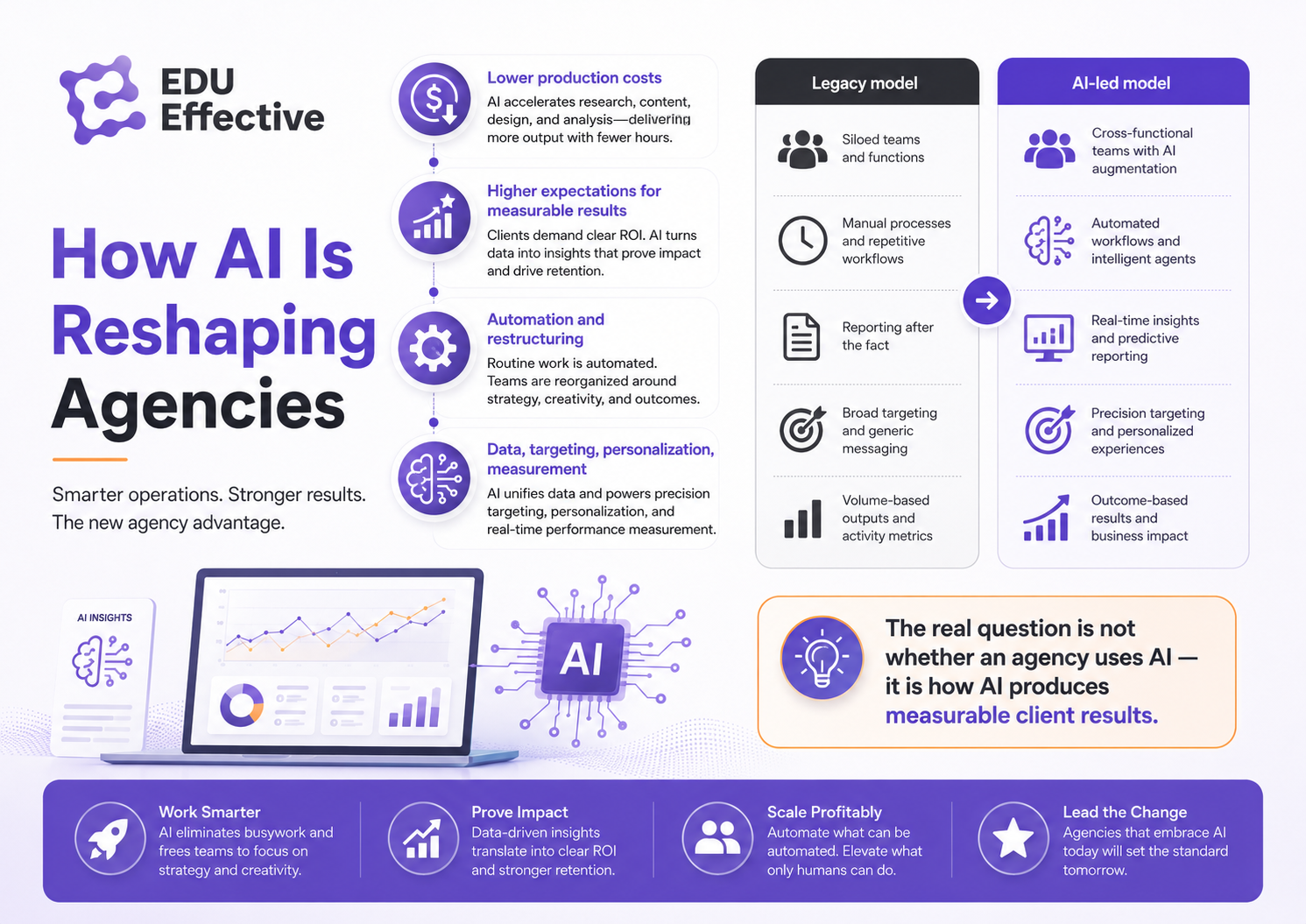
The restructuring happening at WPP, and the rise of Accenture Song, are both expressions of the same underlying force: AI is compressing the cost of producing certain kinds of marketing work and raising the bar on what agencies need to deliver to justify their fees.
WPP's Elevate28 strategy explicitly targets AI and automation as the primary driver of its £500 million savings target. Its WPP Open AI platform is central to its pitch to clients. But clients are judging the results, not the intention — and losing Coca-Cola and Mars to Publicis in the same year suggests those results have not yet been compelling enough.
Publicis, by contrast, has invested heavily in data infrastructure through Epsilon and Marcel (its AI platform) and is winning clients on the basis of measurable performance outcomes. The agencies winning in 2026 are those that can combine creative thinking with AI-driven precision in targeting, personalisation, and measurement.
For any company evaluating marketing agencies in 2026, the right question about AI is not "does this agency use AI?" — everyone does. It's "how does this agency use AI to produce measurable results for clients at my scale, in my category?"
The honest answer for most businesses: the top 10 is not your list
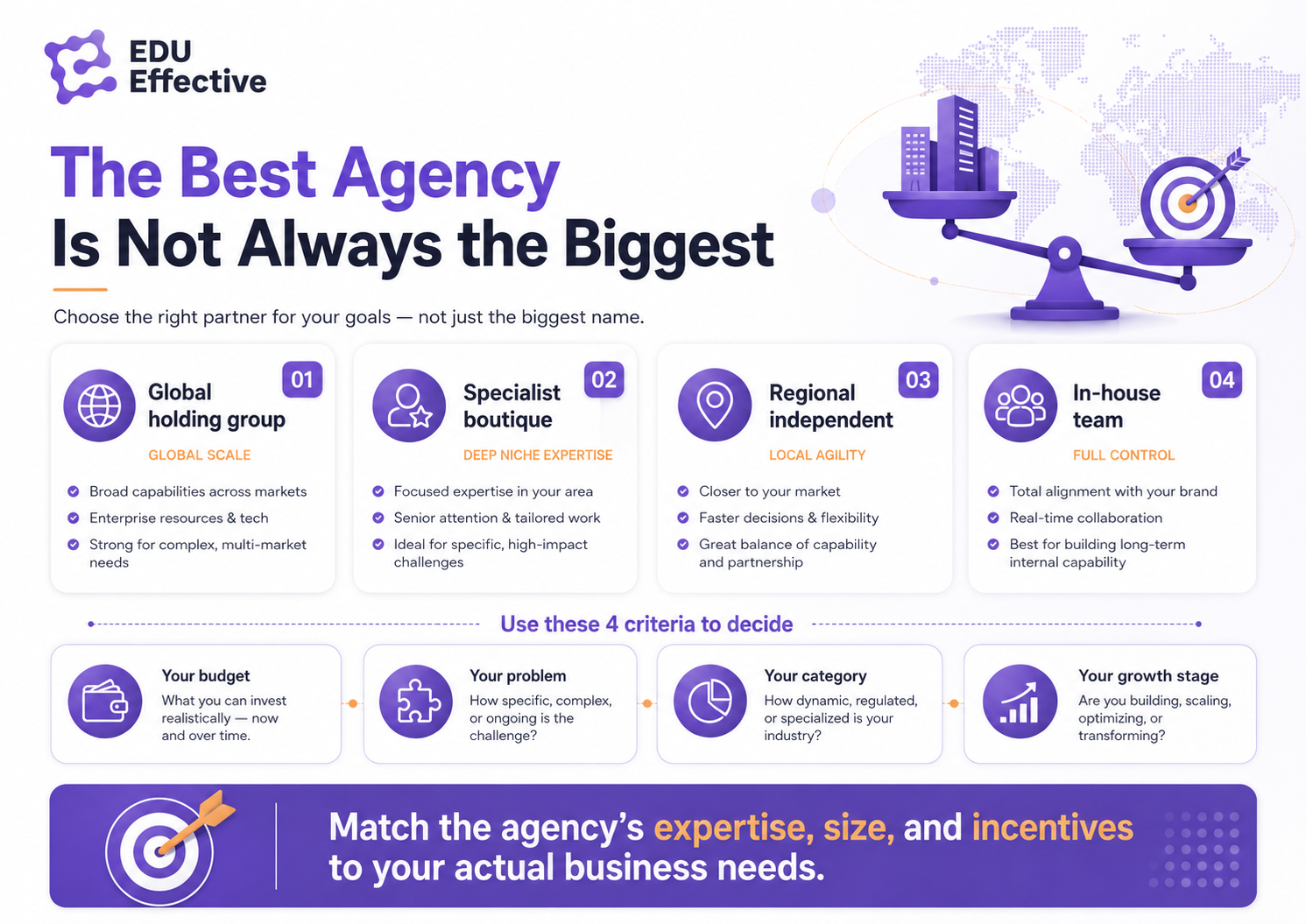
The global marketing firms described above exist to serve global brands with global budgets. Coca-Cola, Apple, McDonald's, Google, Ford. If you are reading this as a business owner, marketing director, or founder of a growing company, the probability that you should hire Omnicom or WPP is very low.
The more useful frame is this: the marketing firm that is genuinely best for your business is the one whose expertise, size, and incentives actually match your problem. That might be a specialist boutique with deep experience in your sector. It might be a strong regional independent — the kind that wins creative awards without holding-company infrastructure behind it. It might be an in-house team you build yourself.
The structural dynamics of the global marketing industry — consolidation at the top, AI disruption throughout, creative quality concentrated in named networks — provide a useful map for understanding how marketing actually works at scale. Applying that understanding to your own decisions, at your own scale, is the skill that matters.
At EDU Effective, we build programs for professionals who want to work smarter — not just harder. Explore our programs →
EDU Effective Business School = professional development for your long-term success.
All best-selling Effective MBA programs are built for working adults: 15 minutes a day, 10 months or less, ASIC accredited, from €990.
These are professional programs, not academic ones — built for working adults to apply what they learn directly in their own business, not to collect a scholarly credential.
Join more than 9,000 students in over 120 countries who are investing in their professional development and career success.
Read the feedback and experiences of our students and the stories of our graduates here.
Apply now — from €990 · Talk to a Study Advisor
Study with NO risk: 14-day money-back guarantee, no questions asked.
Sources
- Exchange4media — WPP set to trim several hundred jobs globally by 2026-end https://www.exchange4media.com/advertising-news/wpp-set-to-trim-several-hundred-jobs-globally-by-end-of-2026-156399.html
- AI Certs News — Marketing Agency Layoffs Surge as WPP Pursues AI Efficiency Drive https://www.aicerts.ai/news/marketing-agency-layoffs-surge-as-wpp-pursues-ai-efficiency-drive/
- Mission Media Asia — WPP Leadership Restructuring: New Strategy 2026 https://missionmedia.asia/wpp-leadership-restructuring-2026/
- eMarketer — WPP cuts outlook amid client losses and slower ad growth https://www.emarketer.com/content/wpp-cuts-outlook-amid-client-losses-slower-ad-growth-outlook
- Ad Age — WPP plans to cut hundreds more jobs this year as its restructuring continues https://adage.com/agencies/aa-wpp-plans-hundreds-more-layoffs-by-end-of-2026/
- Media-Marketing.com — WPP to eliminate several hundred more jobs by the end of the year https://www.media-marketing.com/en/news/wpp-to-eliminate-several-hundred-more-jobs-by-the-end-of-the-year/