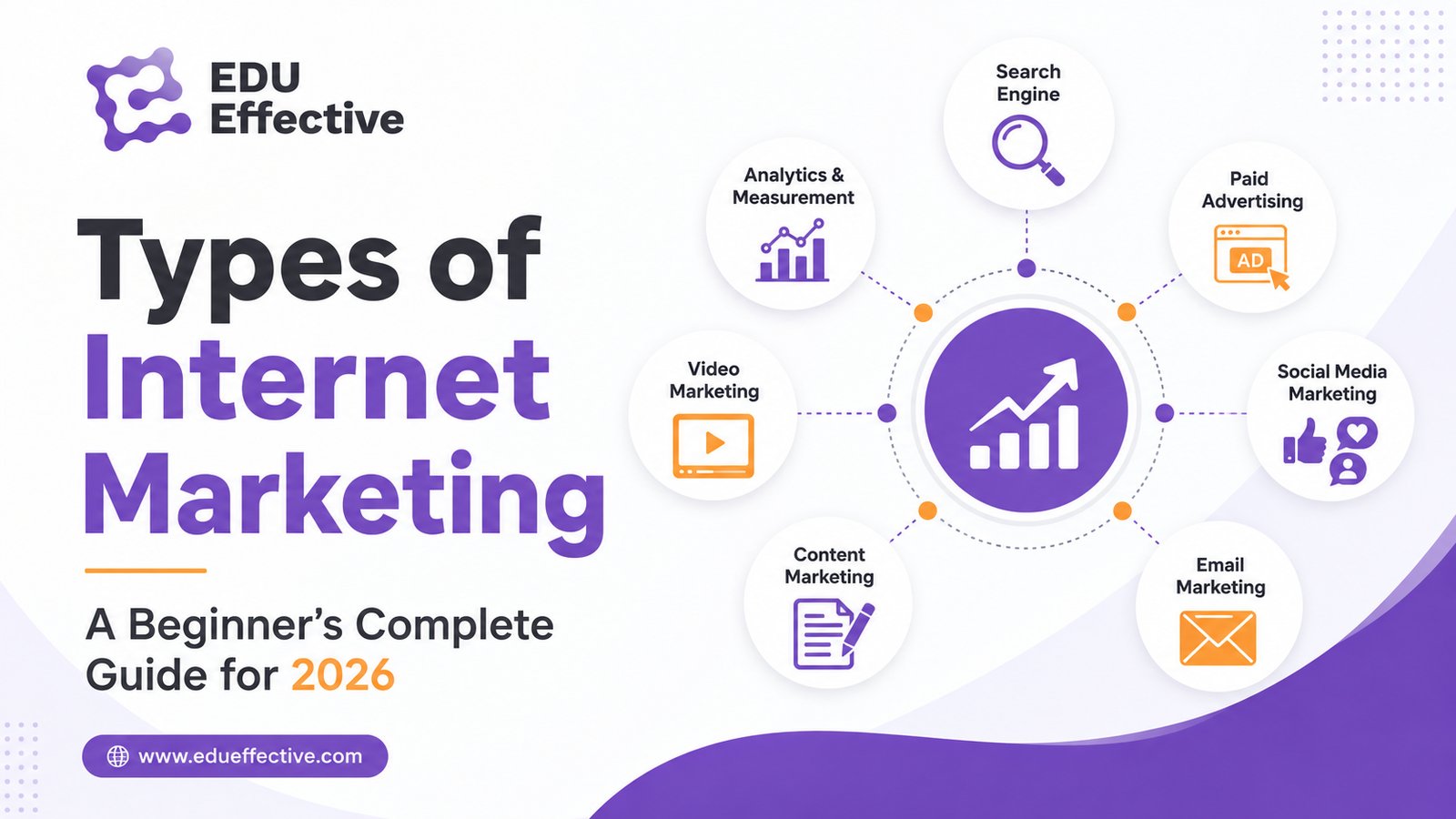

If you are starting out in internet marketing, the sheer volume of channels, strategies, acronyms, and competing advice can make the whole thing feel overwhelming before you've even begun. SEO, SEM, PPC, content marketing, email funnels, social media algorithms, AI-generated ads — each one seems to demand a different specialism and a different budget.
Here is what nobody tells beginners clearly enough: you do not need to master all of it. You need to understand what each type of internet marketing does, choose the two or three that fit your situation, and build from there.
This guide covers every major form of internet marketing in plain language, explains what each one is genuinely good for, and gives you the framework to decide where to start.
What internet marketing actually is
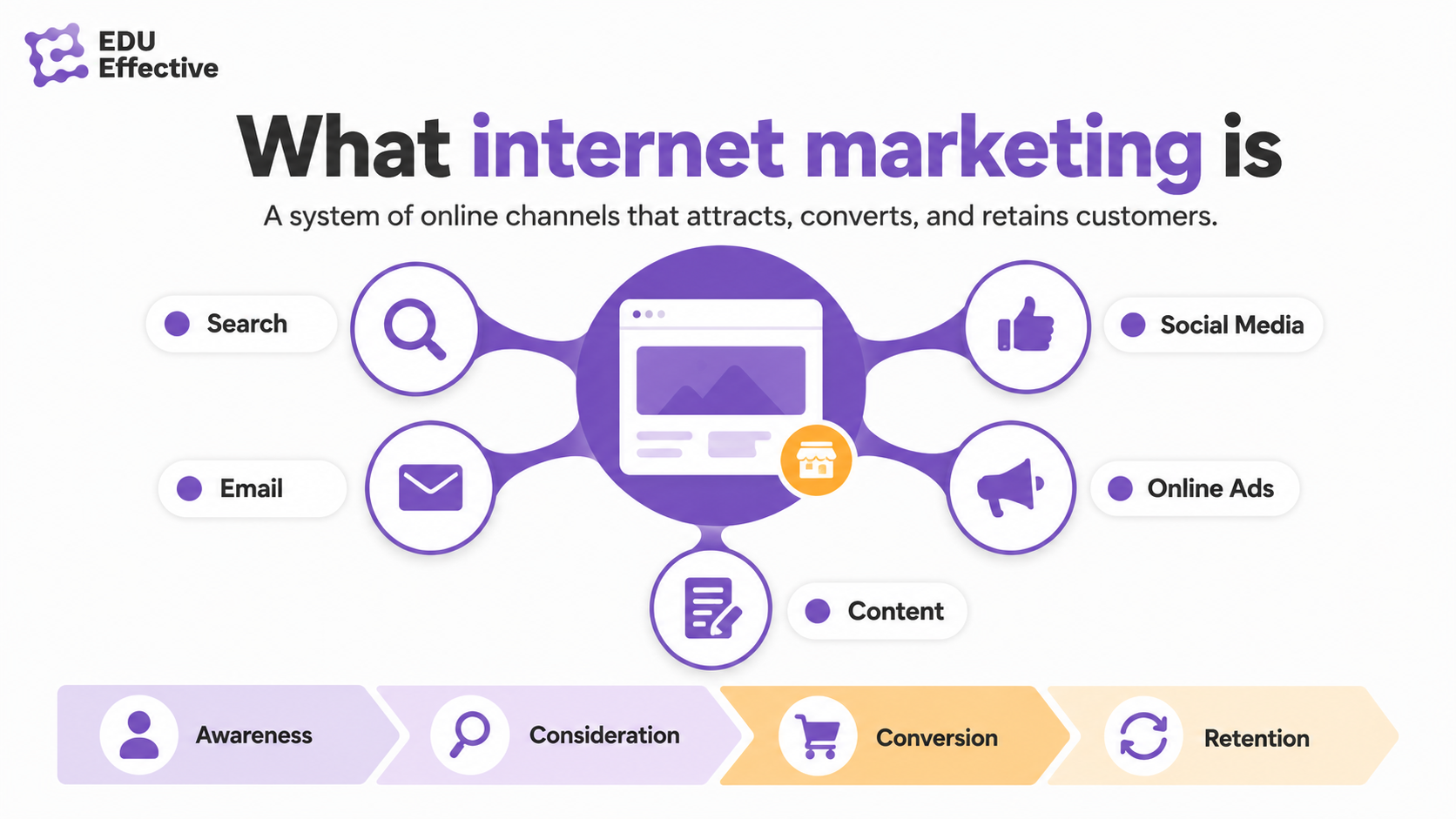
Internet marketing is the use of online channels to promote a product or service, attract customers, and build commercial relationships. It includes every marketing activity that happens through a website, search engine, social media platform, email, or online advertising network.
The reason internet marketing has become the dominant form of marketing — digital channels now account for approximately 68.7% of all global advertising spend — is measurability. Every internet marketing activity generates data: how many people saw it, how many clicked, how many bought. That data allows for continuous improvement in a way that offline marketing rarely permits.
For beginners, the most important thing to understand is that internet marketing is a system, not a single tactic. Different types of internet marketing serve different purposes along the customer journey — from making potential customers aware you exist, to helping them evaluate your offer, to converting them into buyers, to keeping them as repeat customers. Choosing channels without understanding where they fit in that journey is the most common beginner mistake.
The main types of internet marketing — explained clearly
1. Search Engine Optimisation (SEO)
SEO is the practice of making your website appear in unpaid search results when people search for terms related to your product or service. When someone searches "best accounting software for freelancers" and your website appears on the first page of Google, that is SEO at work.
It works through three mechanisms: producing content that matches what people search for (content relevance), earning links from other respected websites (authority), and ensuring your site loads quickly and is technically clean (technical SEO).
SEO is the highest-ROI channel for 49% of marketing professionals and the single best-performing channel for 27% of B2B marketers. The catch for beginners: it takes time — typically 6 to 12 months before significant results appear. This makes it a long-term investment, not a quick fix. If you need results in weeks, SEO is not your first move.
In 2026, SEO has expanded beyond Google. AI assistants — ChatGPT, Gemini, Perplexity — now answer millions of queries by surfacing content from the web. Being cited by these systems has become a new dimension of search visibility called GEO (Generative Engine Optimisation), and it follows many of the same principles as traditional SEO: clear, authoritative, well-structured content on specific topics.
2. Pay-Per-Click Advertising (PPC) and Search Engine Marketing (SEM)
PPC advertising places paid ads in search results and across online platforms. You bid for the right to appear when users search for specific terms, and you pay each time your ad is clicked. Google Ads is the largest platform for search-based PPC; Meta Ads (Facebook and Instagram) dominates social PPC.
For beginners, PPC has one critical advantage over SEO: it delivers immediate traffic. You can have ads running and visitors arriving the same day you launch a campaign. It also gives you complete control over your targeting — the exact search terms, geographic locations, demographics, and device types your ads appear for.
The disadvantage is cost. When the campaign stops or the budget runs out, the traffic stops too. PPC is renting attention; SEO is owning it. Most effective internet marketing strategies use both: PPC for immediate reach and testing, SEO for building long-term organic traffic.
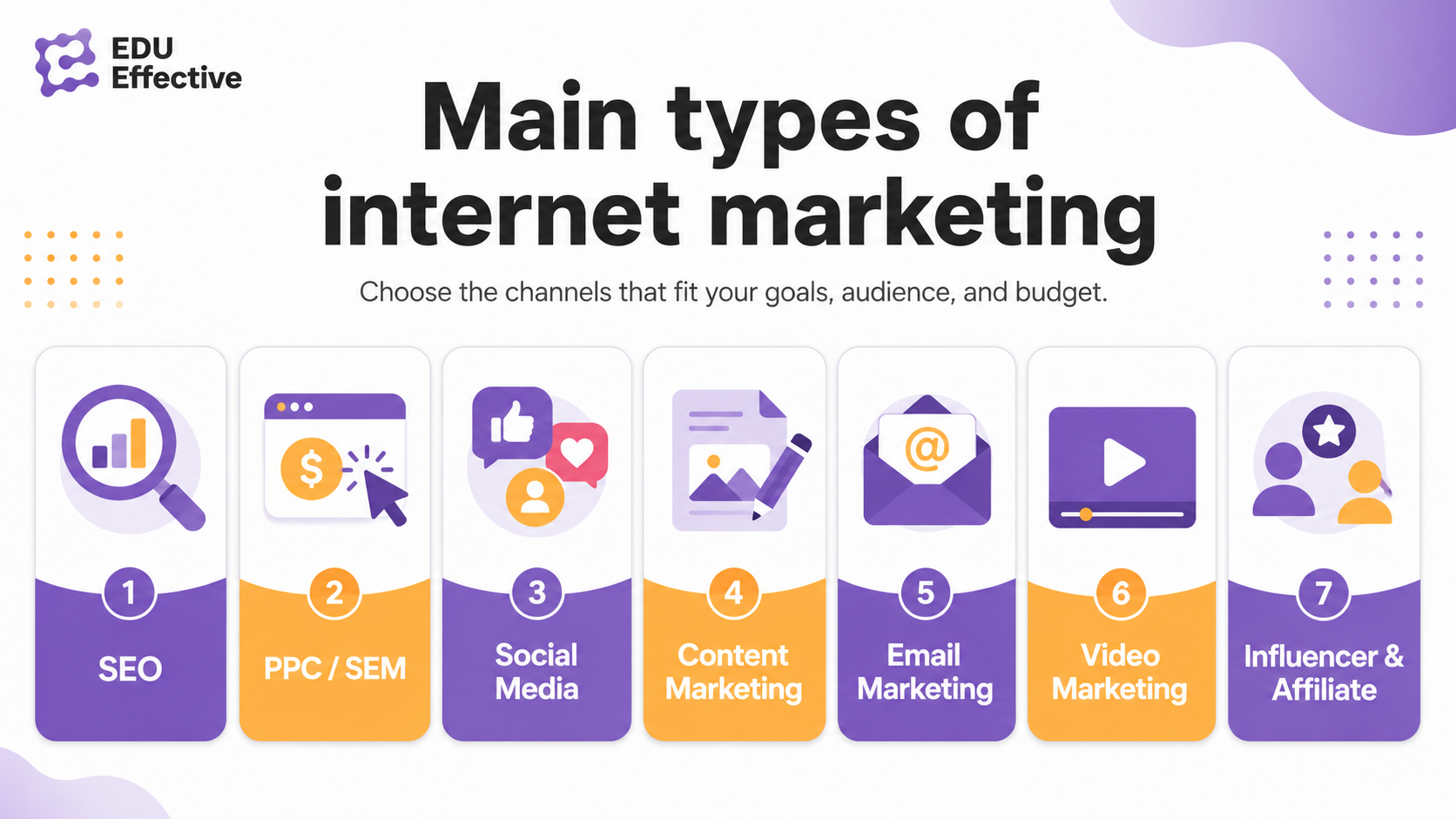
3. Social Media Marketing
Social media marketing uses platforms — Instagram, LinkedIn, TikTok, Facebook, YouTube, X (formerly Twitter), Pinterest — to build brand awareness, engage audiences, and drive traffic or sales. With 4.9 billion social media users globally, these platforms offer reach that no other channel matches.
For beginners, the most important decision in social media marketing is which platform to prioritise. The answer depends entirely on your audience and your content type, not on which platform is currently most talked about.
LinkedIn is the dominant platform for B2B and professional services — it drives 80% of B2B social media leads. Instagram and TikTok work better for consumer brands where visual content and short video perform well. Facebook still has the largest overall user base and the most sophisticated ad targeting in the social category. YouTube is essential for any brand where video explanation, demonstration, or education adds value.
Social media marketing operates in two modes. Organic social involves posting content, engaging with followers, and building a community without paid promotion — slower and less predictable, but free. Paid social involves running targeted advertisements to reach audiences beyond your existing followers — faster and more scalable, but requires budget.
4. Content Marketing
Content marketing is the creation and distribution of useful content — articles, guides, videos, podcasts, infographics, whitepapers, case studies — that attracts and retains an audience by providing genuine value rather than direct selling.
The logic behind content marketing is straightforward: people who encounter your business through helpful content they actively sought out are more qualified prospects than people who were interrupted by an advertisement. Content marketing generates three times more leads than outbound marketing at 62% lower cost.
For beginners, the most common form of content marketing is blog publishing — writing articles that answer questions your target customers are asking. When combined with SEO, a well-written article can continue attracting relevant visitors for years after it was published. This compounding effect is what makes content marketing one of the highest long-term ROI activities available.
Content marketing is a commitment, not a campaign. Publishing one article and expecting results is unrealistic. The businesses that succeed with it publish consistently over months and years, building topical authority that search engines and AI systems both reward.
5. Email Marketing
Email marketing involves sending commercial messages to a list of people who have given you permission to contact them. It remains, by a significant margin, the highest-ROI channel in internet marketing — delivering $36 for every $1 spent.
The power of email marketing lies in the direct, unmediated relationship it creates. Unlike social media, where an algorithm determines who sees your posts, email reaches your subscribers directly in their inbox. Unlike search, where you compete for visibility, email works on an audience that has already opted in to hear from you.
For beginners, building an email list should start as early as possible — even before you have a product to sell. Offering something of value in exchange for an email address (a useful guide, a discount, access to exclusive content) is the standard mechanism for list growth.
Email works across several formats: newsletters that share updates and useful information on a regular cadence; automated welcome sequences that introduce new subscribers to your brand; promotional emails that announce offers or launches; and re-engagement sequences that bring inactive subscribers back.
6. Video Marketing
Video now accounts for over 80% of all internet traffic, and 82% of consumers say they are more likely to purchase after watching a brand video. For any product or service that benefits from demonstration, explanation, or storytelling, video marketing is one of the most effective available formats.
YouTube remains the primary platform for long-form video, with 90% of businesses using it as a marketing channel. Short-form video — TikTok, Instagram Reels, YouTube Shorts — has become the fastest-growing content format globally, with documented ability to increase sales conversion rates by up to 80%.
For beginners, video marketing does not require a production studio. Smartphone cameras in 2026 produce video quality that is entirely adequate for most marketing purposes. The content matters far more than the production value. Authentic, specific, useful video consistently outperforms highly polished content that says nothing distinctive.
7. Influencer and Affiliate Marketing
Influencer marketing uses partnerships with individuals who have established audiences to communicate brand messages through a trusted human voice. Affiliate marketing is a related form where individuals or publishers promote your products and receive a commission for each sale or lead they generate.
Both forms leverage the trust that an audience has built with a person or publisher. Since 85% of people trust online recommendations as much as personal recommendations from friends, this trust is commercially significant.
For beginners, both channels are more accessible than they might appear. Micro-influencers — people with audiences of 5,000 to 50,000 who are deeply engaged with a specific niche — often deliver better conversion rates than celebrity accounts at a fraction of the cost, and many are open to product-for-content arrangements rather than cash fees.
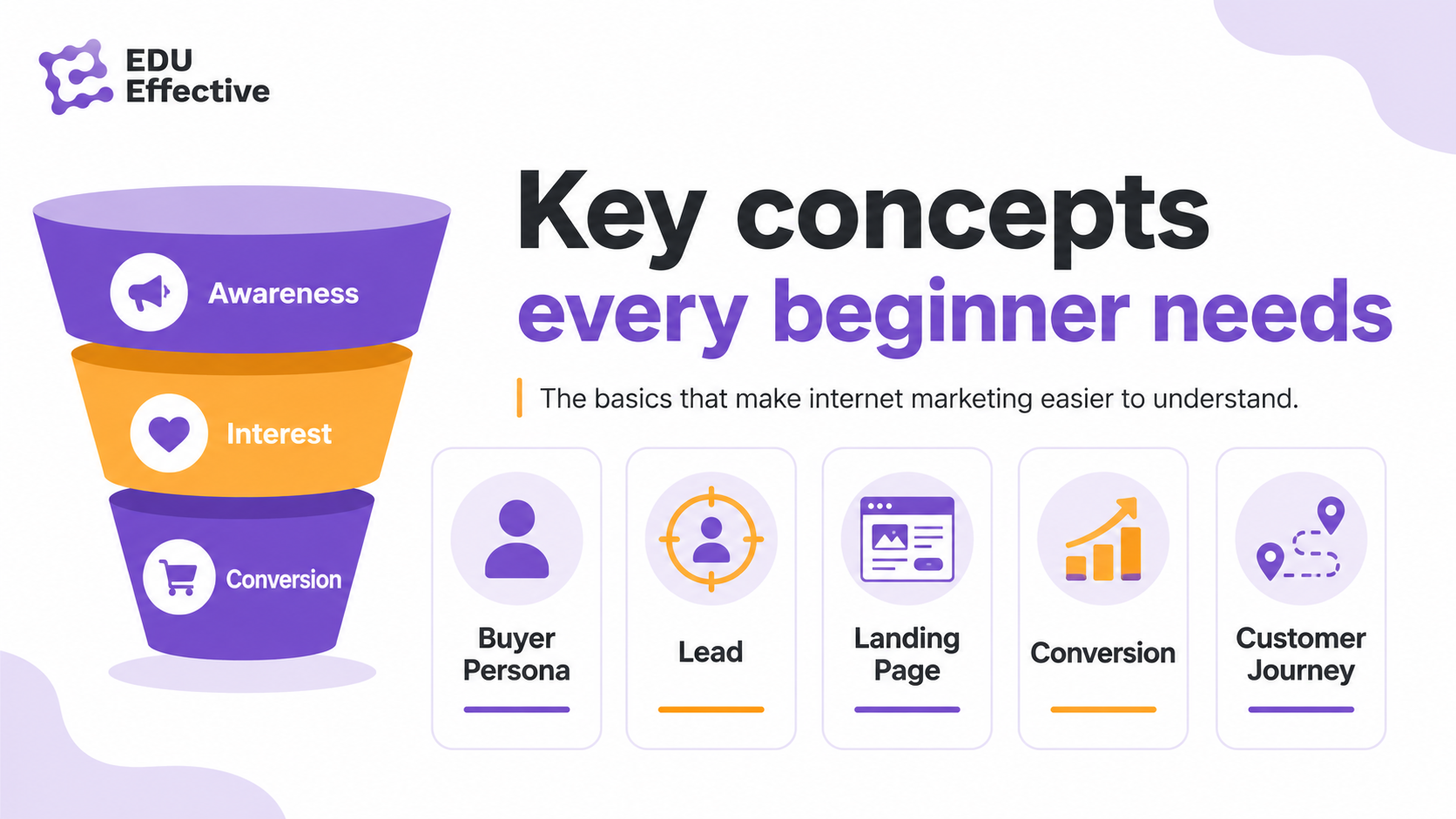
The key concepts every beginner needs to understand
Buyer persona — a detailed profile of your ideal customer. Every internet marketing decision works better when anchored in a specific person: who they are, what they need, where they spend time online, what language they use when they describe their problems.
Customer journey and marketing funnel — the stages a customer moves through from first becoming aware of your brand to making a purchase. Different types of internet marketing serve different stages. Social media and content marketing build awareness at the top of the funnel. SEO and PPC capture intent in the middle. Email and retargeting convert at the bottom.
Lead — a potential customer who has shared their contact information with you. Capturing leads — typically through email opt-ins on landing pages — is a central goal of most internet marketing activity because it converts anonymous website visitors into identifiable prospects you can nurture.
Landing page — a focused web page designed to achieve a specific conversion goal: capturing an email address, driving a sign-up, or completing a purchase. Landing pages perform better than general website pages for conversion because they eliminate distraction and focus the visitor's attention on a single action.
Conversion — any defined action a visitor takes that represents progress toward a business goal: subscribing to an email list, requesting a demo, completing a purchase. Conversion rate optimisation (CRO) is the practice of improving what percentage of visitors complete these actions.
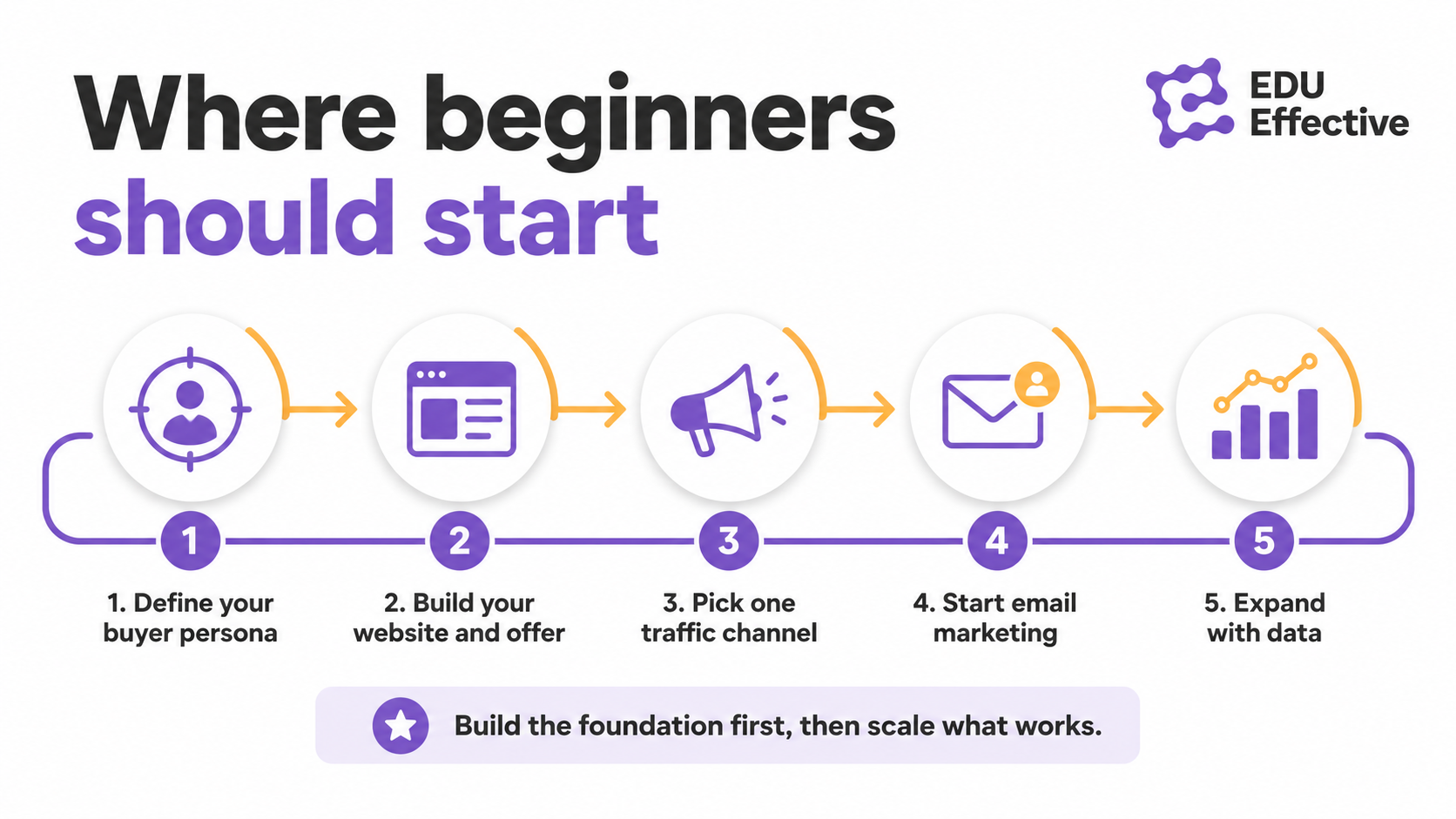
Where to start: a practical sequence for internet marketing beginners
If you are starting from zero, trying to launch every channel simultaneously is a reliable way to make slow progress everywhere. A more effective sequence:
Start by defining your buyer persona and understanding where they already spend time online — this determines which channels are worth your initial investment.
Build the foundation first: a functional website, a clear value proposition, and a way to capture email addresses. Before driving traffic anywhere, make sure the destination converts.
Pick one traffic channel and go deep. For most businesses, this is either SEO and content (if you have time but limited budget and are targeting long-term growth) or paid search or paid social (if you have budget and need results faster).
Add email marketing from day one. It costs almost nothing to set up and the list you build becomes one of your most valuable long-term assets.
Expand to additional channels once you have measurable results from the first. Every channel you add without a working foundation dilutes your effort.
At EDU Effective, we build programs for professionals who want to work smarter — not just harder. Explore our programs →
EDU Effective Business School = professional development for your long-term success.
All best-selling Effective MBA programs are built for working adults: 15 minutes a day, 10 months or less, ASIC accredited, from €990.
These are professional programs, not academic ones — built for working adults to apply what they learn directly in their own business, not to collect a scholarly credential.
Join more than 9,000 students in over 120 countries around the world to further your personal development and career success.
Read the feedback and experiences of our students and the stories of our graduates here.
Apply now — from €990 · Talk to a Study Advisor
Study with NO risk: 14-day money-back guarantee, no questions asked.
Sources
- Foursets — 600+ Digital Marketing Statistics 2026: Trends & Benchmarks https://www.foursets.com/blog/complete-digital-marketing-statistics
- PPC Chief — Digital Ad Spend Statistics 2026: $836B Market, 45+ Data Points https://ppcchief.com/digital-ad-spend-statistics
- Incremys — Digital Marketing 2026 Statistics: Key Figures to Know https://www.incremys.com/en/resources/blog/digital-marketing-statistics
- BizIQ — Digital Marketing Statistics 2026: Market Size, Spend, ROI https://biziq.com/blog/digital-marketing-statistics/
- AffNinja — Digital Marketing Statistics 2026: Facts vs. Myths Exposed https://affninja.com/digital-marketing-statistics/