

Every website you visit. Every app you use on your phone. Every checkout process, booking system, streaming dashboard, and AI-powered interface. All of it was built by web programmers — and in 2026, with digital infrastructure expanding faster than the talent pool that builds it, the profession has never been more consequential or more financially rewarding.
But "web programmer" covers an enormous range of roles, skills, and specialisations. What a frontend developer does day to day is fundamentally different from what a backend engineer works on — and both are different again from the work of a full stack developer. Understanding these distinctions is the starting point for anyone considering the field, hiring for it, or working alongside people who do it.
What web programming is — and what it's not
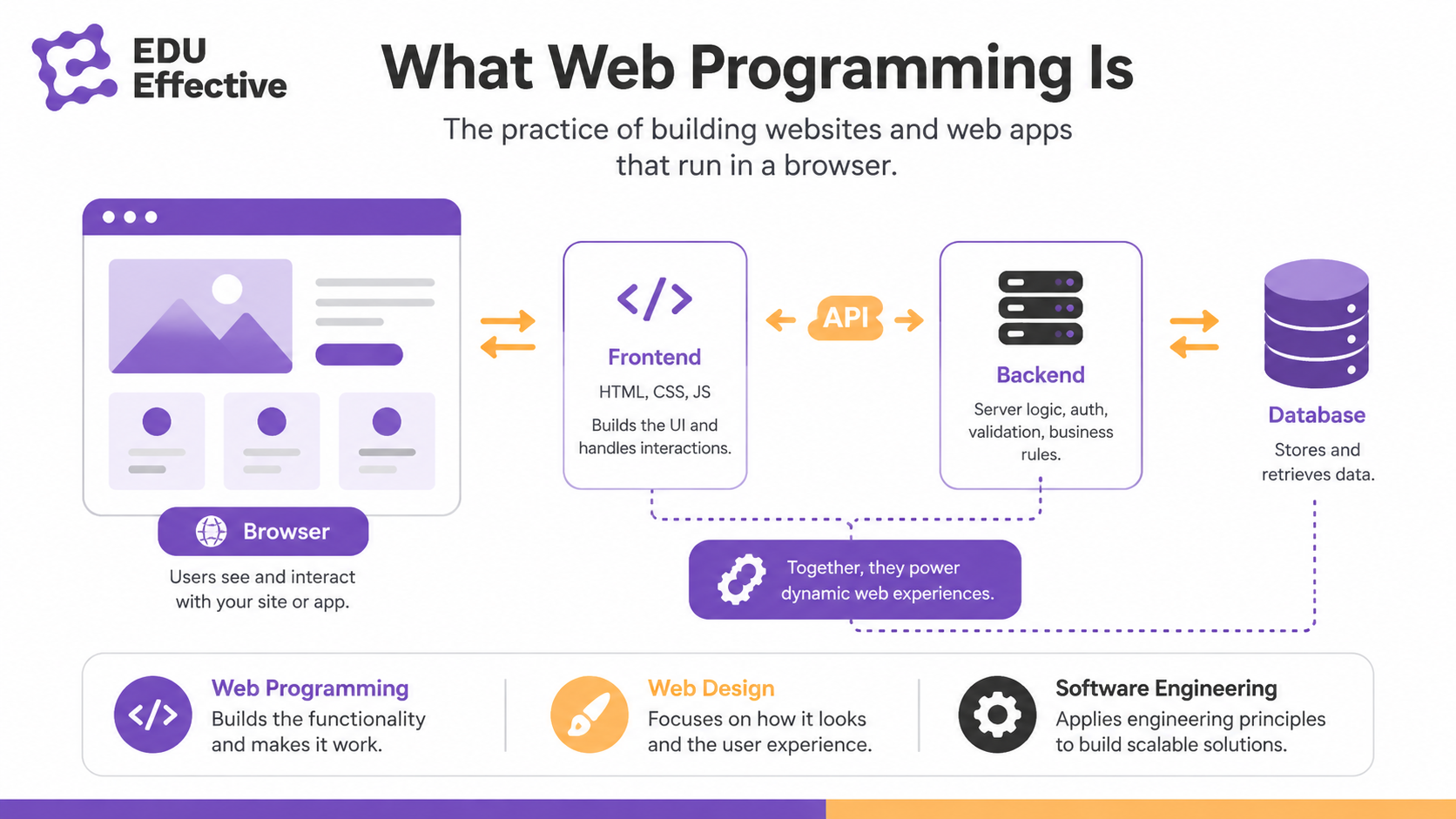
Web programming is the practice of building the systems and interfaces that make websites and web applications work. It covers everything from the visual layout a user sees on screen, to the server logic that processes their data, to the database that stores it, to the security systems that protect it.
It's worth distinguishing web programming from two adjacent terms that are often used imprecisely.
Web design focuses on the visual and experiential aspects of a site — colour, typography, layout, user flow, and aesthetic decisions. It's primarily a design discipline, though designers who also know HTML and CSS increasingly bridge into development work.
Software engineering is a broader field that includes web development but extends to desktop applications, embedded systems, mobile apps, data infrastructure, and operating systems. All web programmers are software engineers of a kind, but not all software engineers work on the web.
Web programming specifically describes development that runs in or through browsers — front-facing interfaces, server-side logic that powers them, and the APIs that connect the two.
The two layers every website runs on
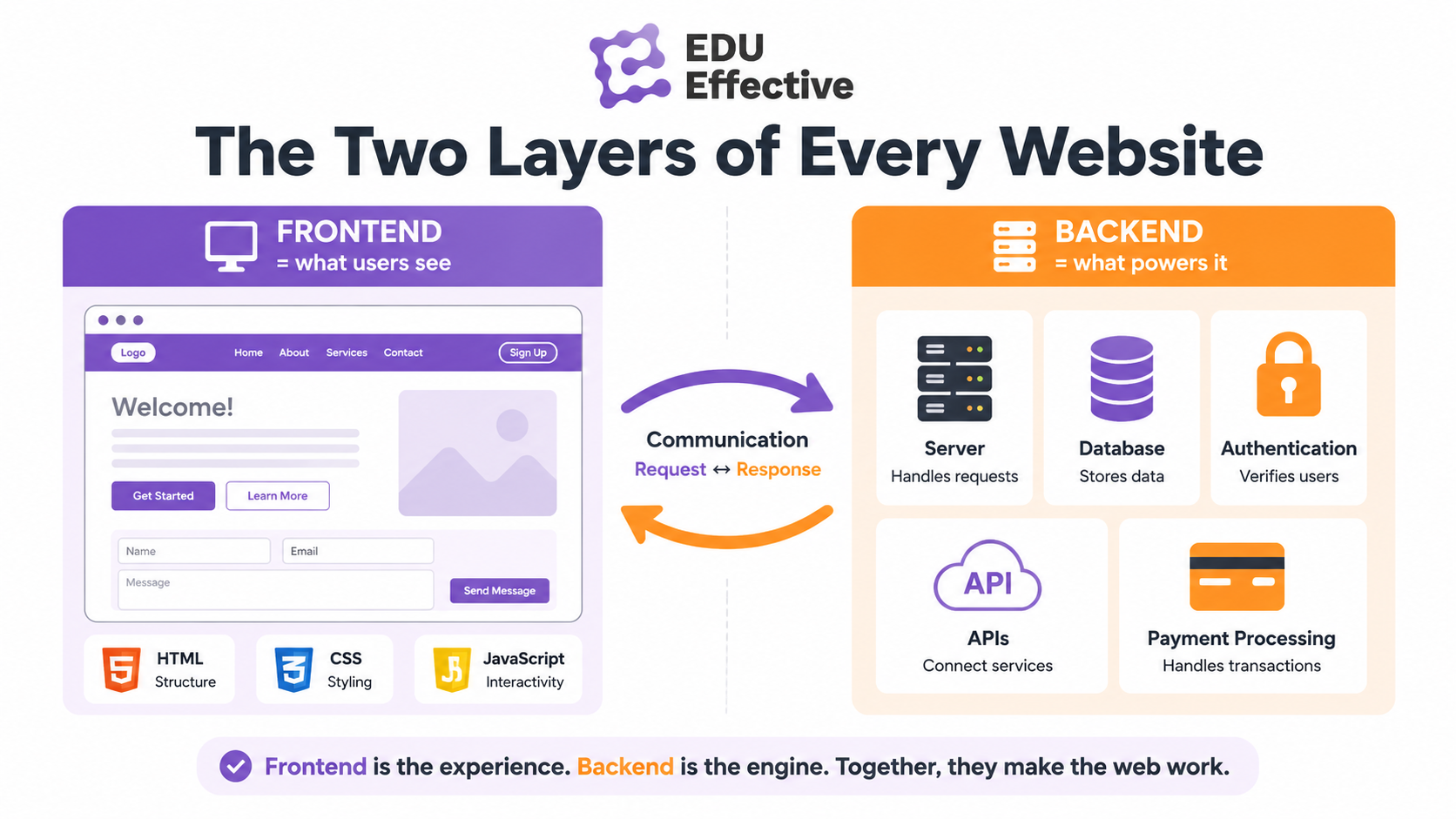
Every website, regardless of its complexity, consists of two distinct layers. Understanding them is foundational to understanding web programming roles.
Frontend — also called the client side — is everything the user sees and interacts with. The buttons, navigation, images, animations, forms, and dynamic content updates that happen in real time as a user interacts with a page. Frontend development creates the interface; it's built primarily with HTML (structure), CSS (visual presentation), and JavaScript (interactivity and logic). Modern frontend work also involves frameworks — React, Vue, Next.js, and Angular are the most widely used — which provide structure for building complex, component-based interfaces efficiently.
Backend — the server side — is invisible to the user but essential to the site's operation. It handles the application logic: what happens when a user submits a form, how data is retrieved from a database, how authentication is verified, how payments are processed. Backend developers work in languages including Python, Java, Node.js, PHP, Ruby, Go, and increasingly Rust. They build APIs that the frontend calls, maintain databases, and manage server infrastructure and security.
Neither layer works without the other. A beautifully built frontend with no backend is a static page with no real functionality. A perfectly engineered backend with no frontend is infrastructure nobody can use. The two must communicate precisely — and building that communication is where much of the practical complexity of web programming lives.
The web programmer job description: three core roles
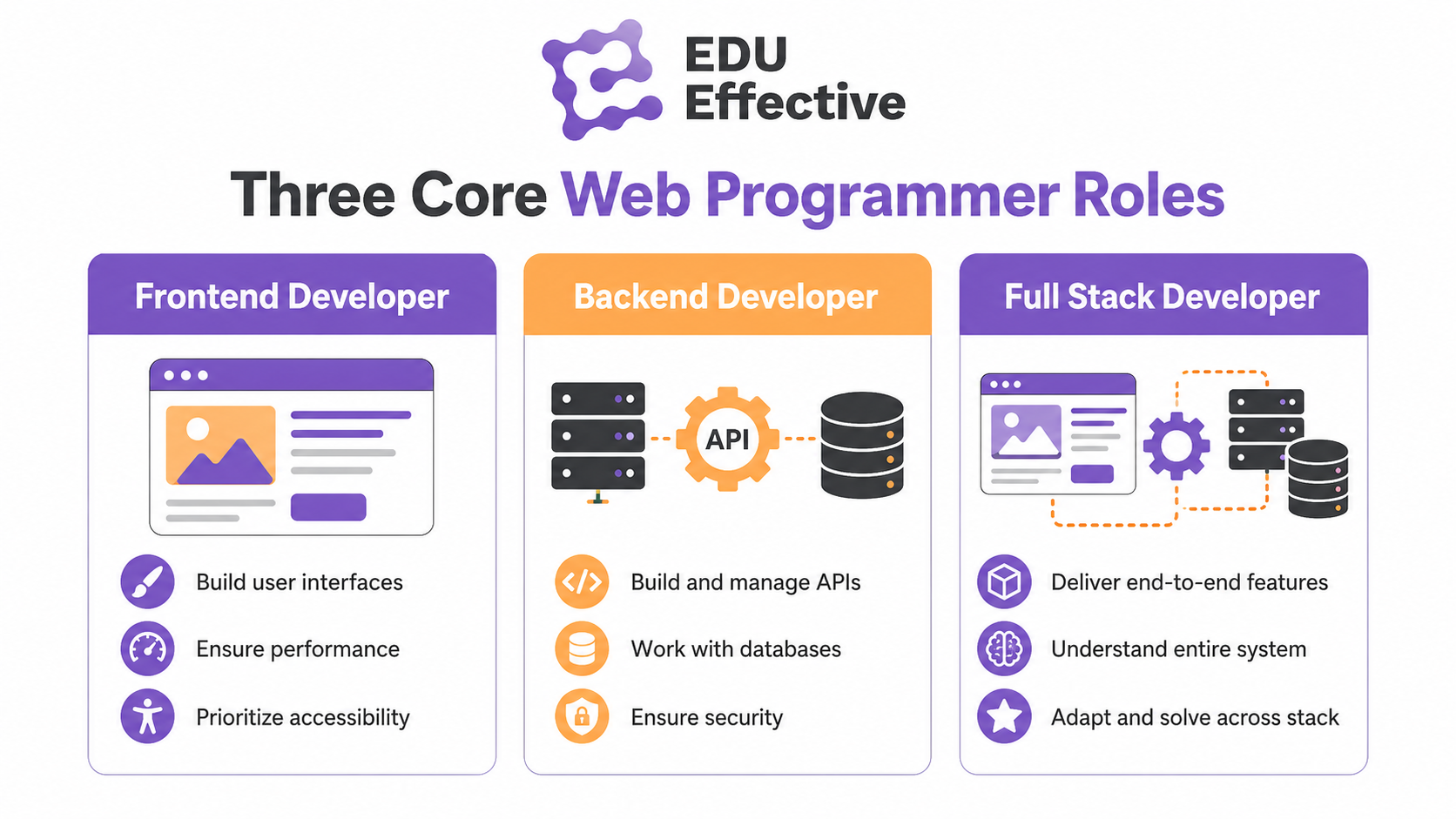
Frontend developer. Responsible for translating designs into functional, responsive web interfaces. Core responsibilities include implementing visual layouts in HTML and CSS, writing JavaScript to handle user interactions, integrating with backend APIs to display live data, optimising page performance, and ensuring accessibility standards are met.
In 2026, the frontend role has become significantly more technically demanding. React Server Components, edge rendering, performance budgeting, and the integration of AI-powered UI elements have pushed frontend engineering into territory that, a decade ago, would have been considered backend or infrastructure work. The notion that frontend is "easier" than backend has largely dissolved in practice.
Backend developer. Responsible for the server-side systems that power the application. Core responsibilities include designing and maintaining databases, building and documenting APIs, writing application logic, managing authentication and authorisation, and ensuring the security and performance of server infrastructure.
Backend development in 2026 increasingly involves cloud platform expertise — AWS, Google Cloud, Azure — and DevOps capabilities including containerisation (Docker, Kubernetes) and CI/CD pipeline management. Developers who combine strong backend skills with cloud and AI integration capabilities are among the most sought-after profiles in the current market.
Full stack developer. A developer capable of working competently across both frontend and backend. Full stack developers are particularly valuable in smaller teams and startups, where the efficiency of having one person own an entire feature end to end — from database schema to user interface — outweighs the depth specialisation that larger teams can afford.
The full stack developer is not necessarily a master of both domains; they are typically strong in one and proficient in the other. What distinguishes them is the ability to understand how the full system fits together and to work effectively across that entire surface.
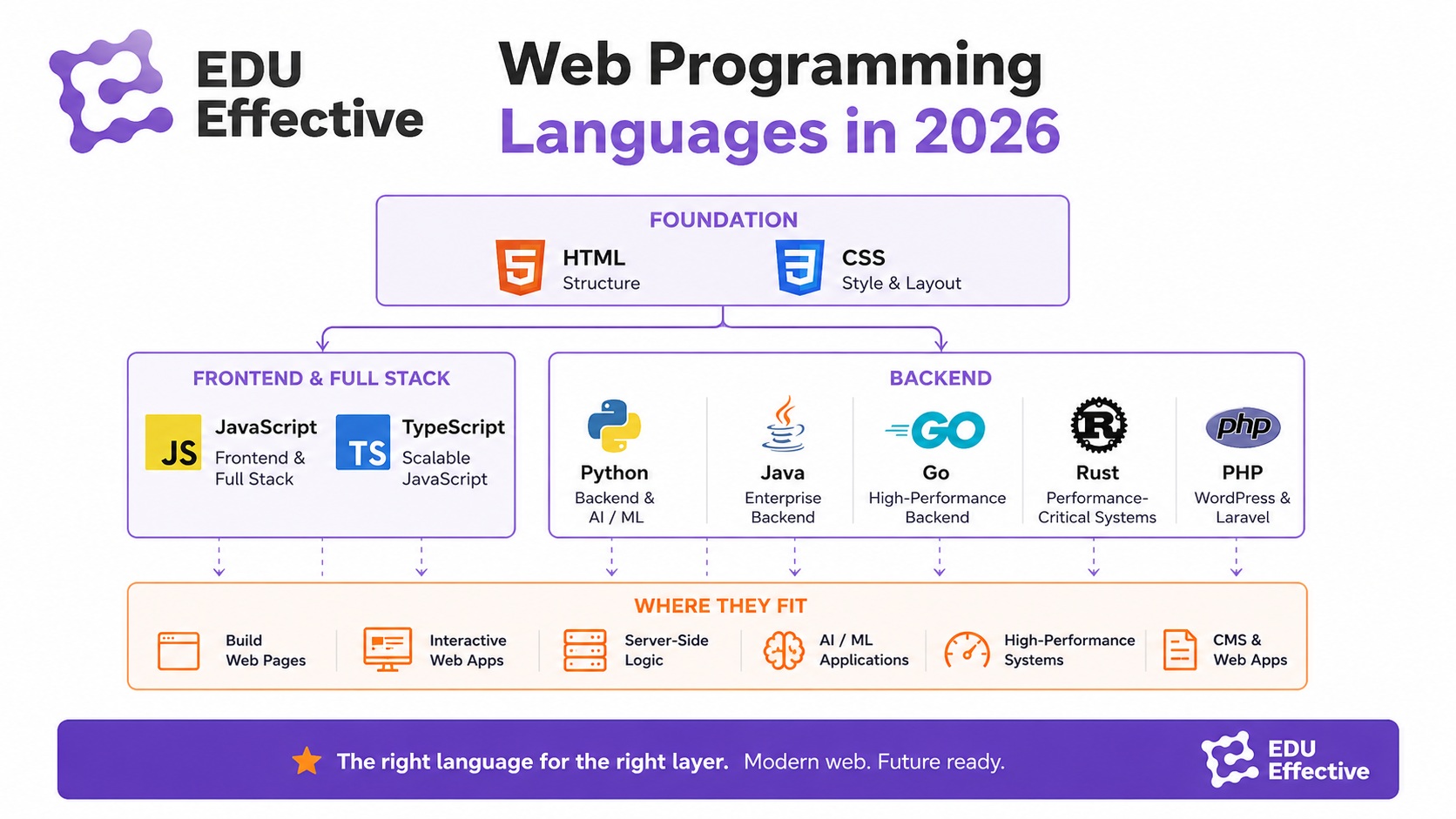
What programming languages web developers work with in 2026
Every web programmer needs a working knowledge of HTML and CSS — the structural and presentational languages of the web. These are not programming languages in the traditional sense, but no web developer can function without them.
Beyond that baseline, language choice depends on specialisation.
JavaScript remains the only programming language that runs natively in the browser, making it indispensable for all frontend work. Its reach has expanded dramatically — Node.js brought JavaScript to the server side, and frameworks like Next.js blur the traditional frontend/backend boundary by rendering components on the server and delivering them to the client. TypeScript, a typed superset of JavaScript, has become the professional standard for serious frontend and full stack work.
Python is the dominant backend language for AI integration, machine learning, and data-intensive applications, as well as a strong general-purpose backend option via Django and FastAPI. Any web developer working on AI-powered applications in 2026 will encounter Python.
Java and its ecosystem remain prevalent in enterprise backend systems, where stability, tooling maturity, and the Spring Boot framework make it a reliable choice for large-scale applications.
Go (Golang) has emerged as a high-performance backend language for systems where speed and concurrency matter — APIs serving high traffic loads, microservices architectures, and cloud-native applications. Go developers are among the highest-paid specialists in the current market.
Rust is gaining adoption for performance-critical web infrastructure and WebAssembly applications. Jobs are fewer but salaries are notably higher due to the scarcity of qualified candidates.
PHP continues to power a substantial share of the web — WordPress alone runs approximately 43% of all websites globally — and through the Laravel framework remains actively used in professional web development.
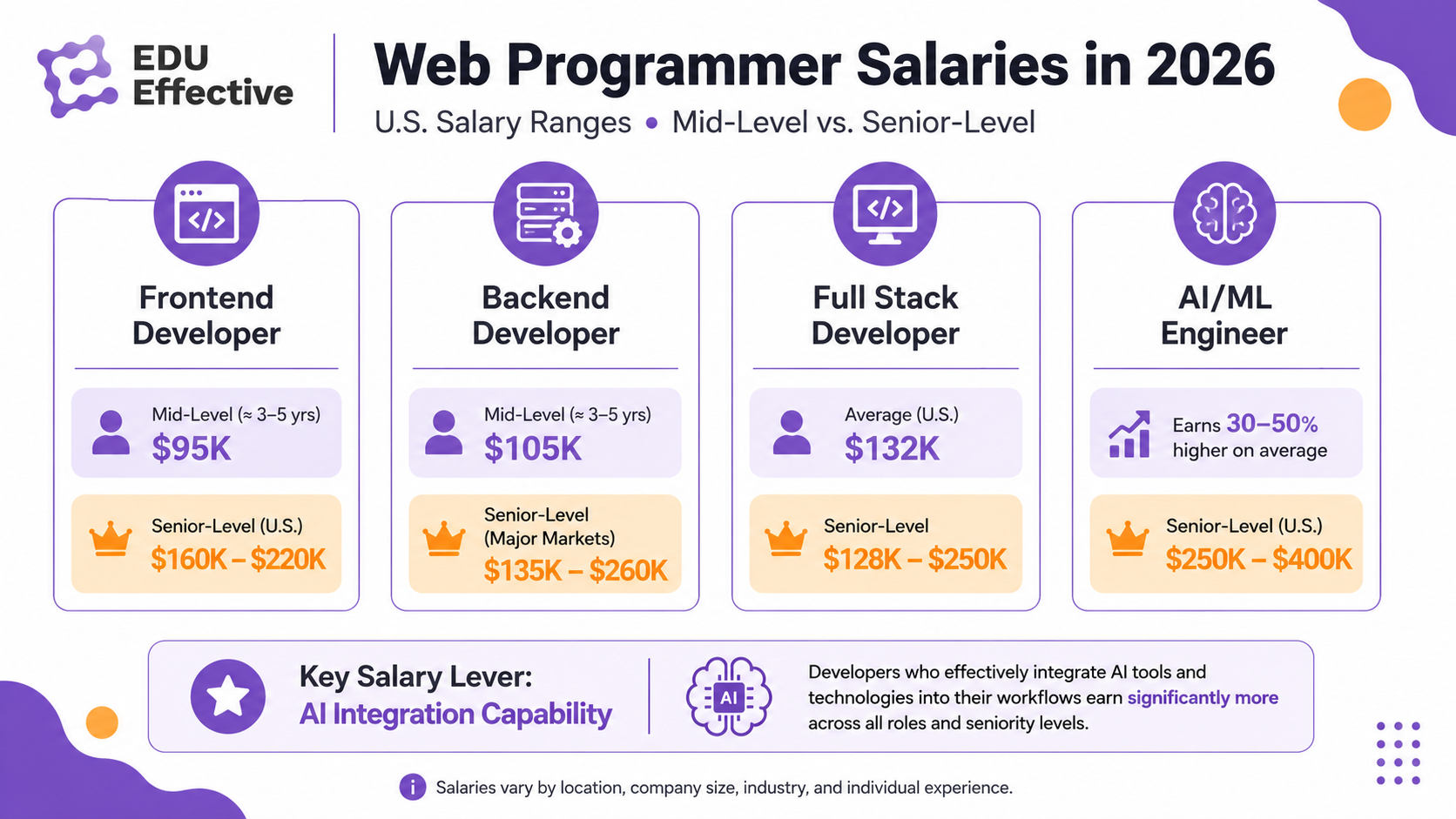
Salaries for web programmers in 2026 — the real numbers
The web developer job market in 2026 is characterised by a salary rebound after a stagnant 2025, driven by continued demand for digital infrastructure and a deepening premium on AI-adjacent skills.
Global averages mask significant variation by role, experience, location, and technology stack, but the broad benchmarks from current compensation data are:
Frontend developers — average around $95,000 globally at mid-level. Senior frontend specialists in US tech markets earn $160,000–$220,000, with React, Next.js, and TypeScript expertise commanding the upper end.
Backend developers — average around $105,000 globally at mid-level. Senior backend engineers with cloud platform expertise earn $135,000–$185,000, rising to $185,000–$260,000 at senior levels in major markets.
Full stack developers — average around $132,000 in the US (Glassdoor, 2025 data). Senior full stack roles range from $128,000 to $250,000 depending on stack, company size, and location.
AI/ML engineers — the outlier in the market. Salaries run 30–50% higher than comparable general developer roles, with senior AI engineers at major technology companies earning $250,000–$400,000 in total compensation. The premium reflects genuine scarcity — 68% of organisations report critical understaffing in AI and machine learning engineering.
The most significant salary lever in 2026 is AI integration capability. Developers who can build AI-powered features — integrating LLM APIs, building RAG systems, implementing vector database queries, and creating streaming AI interfaces — are commanding a material premium over developers with comparable general skills. This is the highest-return area of specialisation currently available to web programmers.
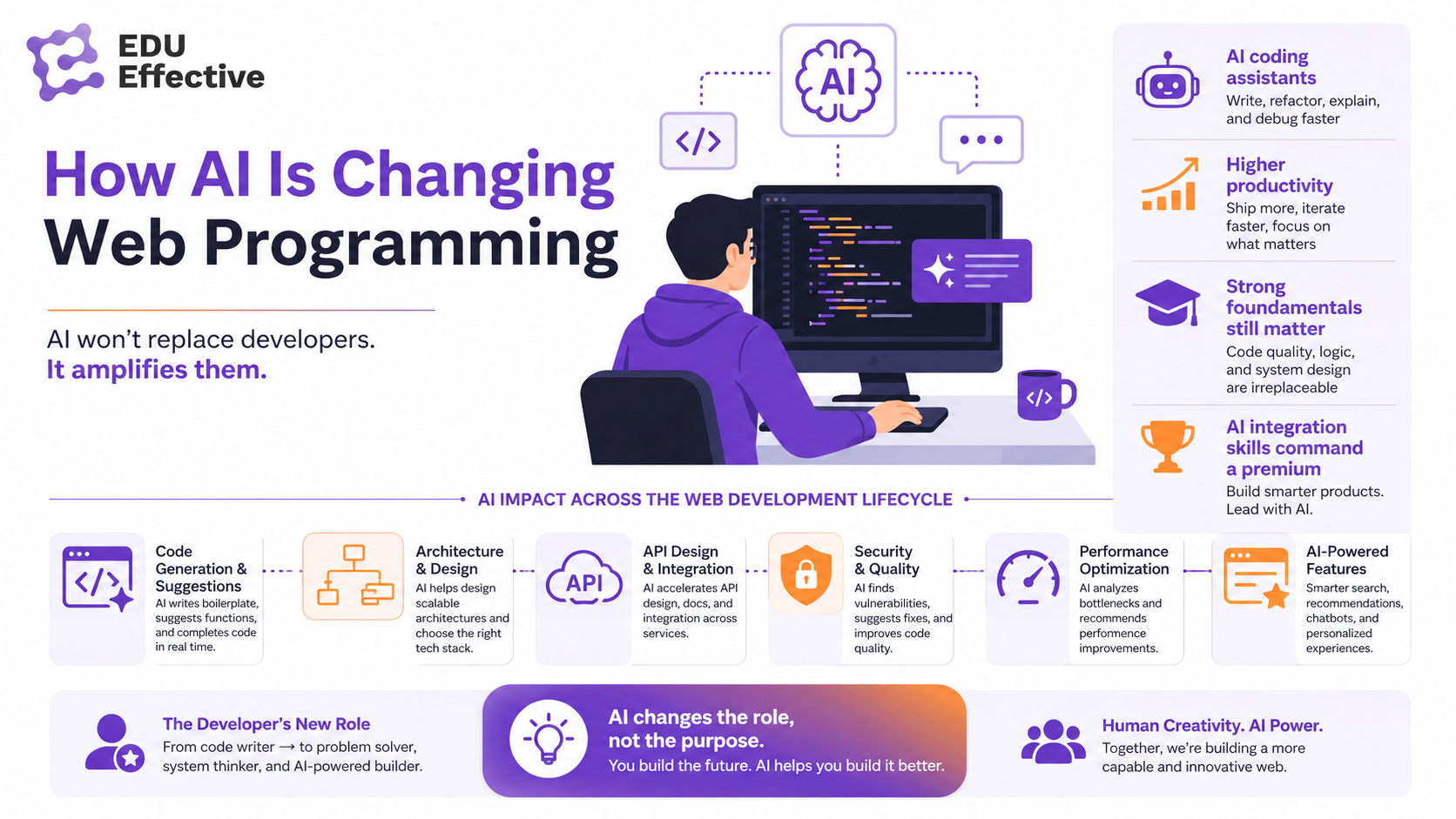
How AI is changing the web programmer's role
The honest answer to "will AI replace web programmers?" is: no, but it's changing what the job looks like at every level.
AI coding assistants — GitHub Copilot, Cursor, and similar tools — now handle routine code generation, boilerplate, and documentation tasks that previously consumed significant developer time. Entry-level tasks that a junior developer would have spent days on can be scaffolded in minutes. This has raised the competency floor: junior developers who rely on AI for tasks they don't deeply understand will struggle to progress, while those who use AI tools to multiply their own capabilities are more productive than any previous generation of early-career developers.
At the senior level, AI is automating routine work and shifting human attention to higher-order problems: system architecture, API design, security, performance optimisation, and the integration of AI capabilities into products. The developers who thrive in this environment combine strong fundamentals — understanding why things work, not just how — with fluency in AI tooling and the judgment to deploy it effectively.
Web development remains one of the most financially rewarding and structurally resilient career paths in the technology sector. The role is evolving; it isn't disappearing.
At EDU Effective, we build programs for professionals who want to work smarter — not just harder. Explore our programs →
EDU Effective Business School = professional development for your long-term success.
All best-selling Effective MBA programs are built for working adults: 15 minutes a day, 10 months or less, ASIC accredited, from €990.
These are professional programs, not academic ones — built for working adults to apply what they learn directly in their own business, not to collect a scholarly credential.
Join more than 9,000 students in over 120 countries who are investing in their professional development and career success.
Read the feedback and experiences of our students and the stories of our graduates here.
Apply now — from €990 · Talk to a Study Advisor
Study with NO risk: 14-day money-back guarantee, no questions asked.
Sources
- daily.dev Recruiter — Developer Salary Benchmarks 2026: What Technical Roles Actually Pay https://recruiter.daily.dev/resources/developer-salary-benchmarks-2026-technical-roles-pay/
- Scalify — Full-Stack Developer Salary: The Complete 2026 Breakdown https://www.scalify.ai/blog/full-stack-developer-salary-complete-2026-breakdown
- SpiderDesign — How Much Can a Web Developer Earn in 2026? Salary Guide by Role & Location https://spiderdesign.me.uk/how-much-can-a-web-developer-earn-in-2026-salary-guide-by-role-location
- Edoxi — Web Developer Salary Trends in 2026 https://www.edoxi.com/studyhub-detail/web-development-salary-trends
- CodeWebStack — Web Developer Salary Guide & Career Trends in 2026 https://codewebstack.com/web-developer-salary-guide/
- SpiderDesign — Is Web Development High Paying? Salary Breakdown, Roles & Career Paths for 2026 https://spiderdesign.me.uk/is-web-development-high-paying-salary-breakdown-roles-career-paths-for