


Digital transformation is one of the most used and least understood phrases in business. Ask ten executives what it means and you’ll get ten different answers — some about technology infrastructure, some about culture change, some about AI adoption, some about customer experience. All of them partly right, none of them complete.
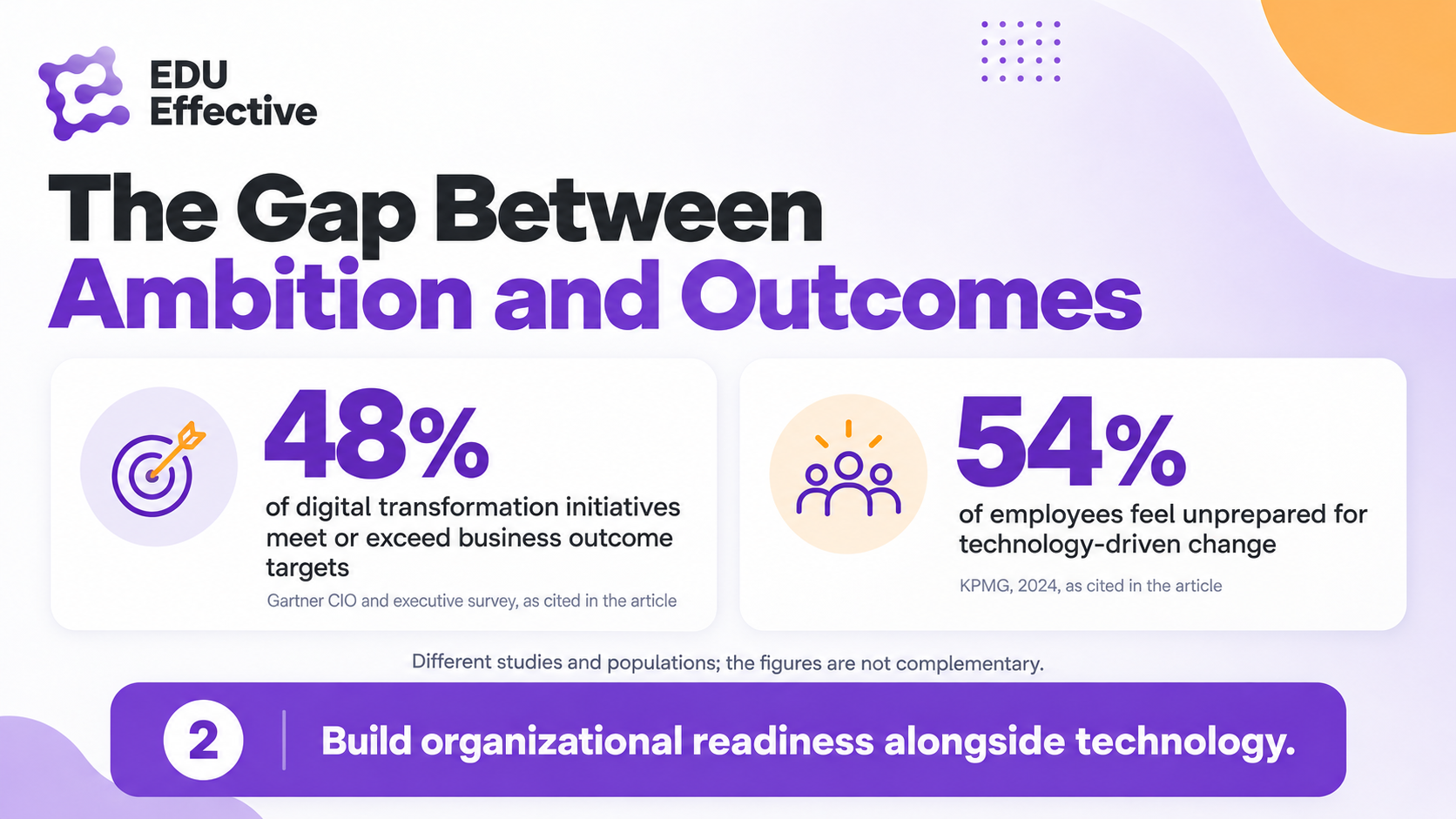
The definitional confusion is not harmless. Organizations that treat digital transformation as a technology project fail at far higher rates than those that treat it as a strategic and organizational change. Gartner’s annual survey of more than 3,100 CIOs and 1,100 executives found that only 48% of digital transformation initiatives meet or exceed their business outcome targets. For most companies, that means the majority of transformation spend produces outcomes below expectation.
Understanding what a digital transformation strategy actually is — and what separates the 48% that succeed from the 52% that don’t — is one of the most valuable things a senior manager or executive can develop clarity on right now.
What Digital Transformation Actually Means
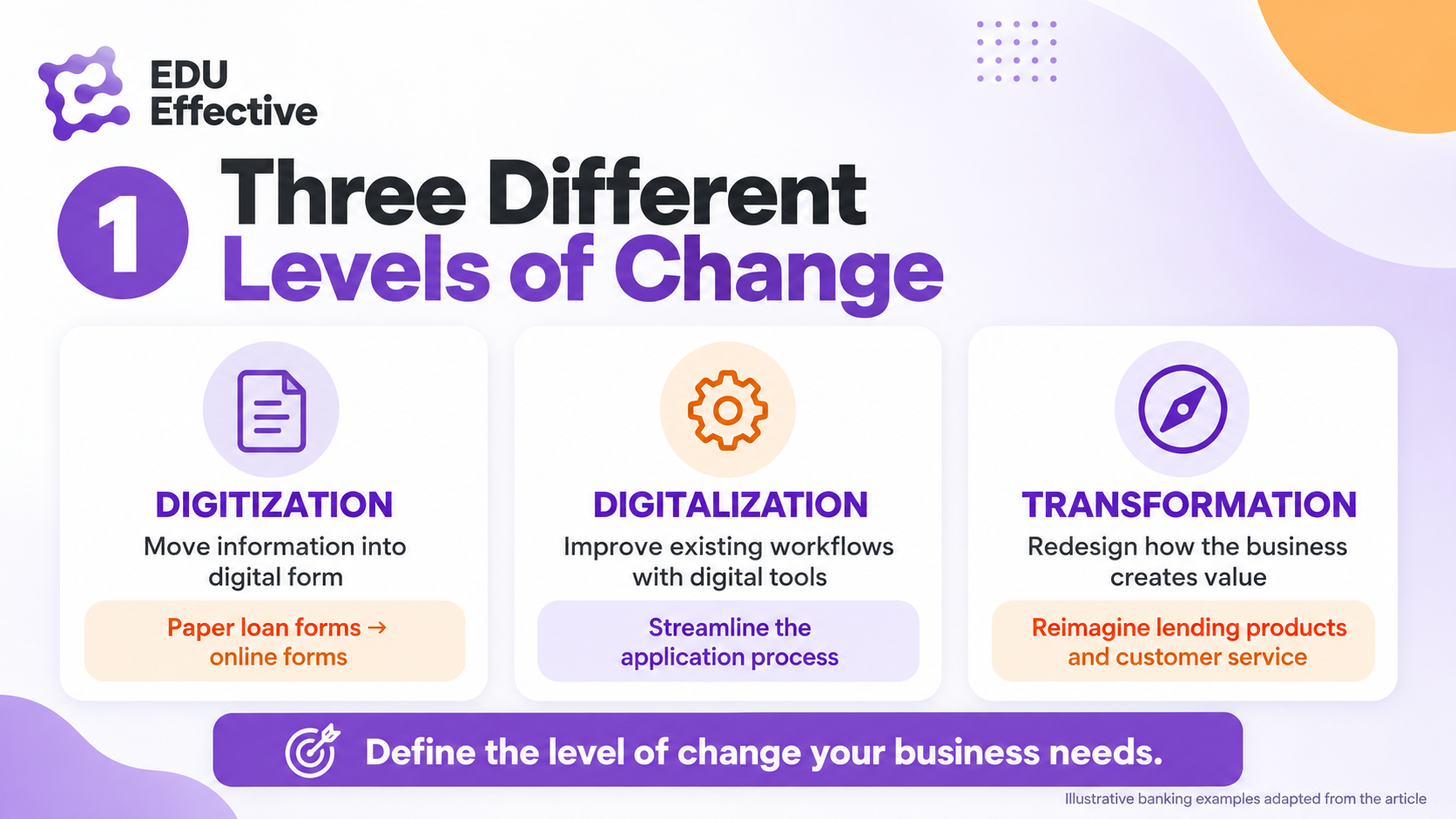
A working definition: digital transformation is the process of integrating digital technology into all areas of a business in ways that fundamentally change how it operates and delivers value to customers — and doing so in a way that’s strategically intentional rather than reactive to vendor offerings or competitive pressure.
Three words in that definition do heavy lifting.
Fundamentally is the first. Digital transformation is not digitization — moving paper processes to software — or digitalization — using digital tools to improve existing workflows. It’s a structural change in how the business operates. A bank that moves its loan applications from paper forms to an online portal has digitized. A bank that uses AI to assess creditworthiness in real time, offers fully automated lending products, and uses behavioral data to proactively serve customers has transformed.
Strategically intentional is the second. The difference between a company that’s transformed and a company that’s bought a lot of software is whether the technology investments are aligned with a coherent direction about where the company is going and how technology helps it get there. Most failed transformations aren’t technology failures — they’re strategy failures dressed as technology implementations.
Value to customers is the third. The endpoint of transformation isn’t operational efficiency or technology modernization. It’s delivering more value — faster, more personalized, at lower friction — than was possible before. The internal systems matter only insofar as they enable that.
Why the Failure Rate Is So High
McKinsey’s research found success rates as low as 31% in earlier analyses — and even the more optimistic Gartner figure of 48% means slightly more than half of transformation initiatives fall short. The causes are well-documented:
Technology without strategy
The most common failure pattern: an organization buys a platform, hires an implementation partner, and runs a project — without having answered the prior strategic question of what problem they’re actually solving and why digital technology is the right answer to it. Technology vendors are skilled at selling solutions. They’re less likely to tell you whether the solution addresses your real bottleneck.
Underestimating organizational change
54% of employees feel unprepared for technology-driven change, according to KPMG’s research. Digital transformation always requires behavioral change — people doing their jobs differently, adopting new tools, relearning workflows that felt comfortable. Organizations that treat transformation as a systems project and tack on change management at the end consistently underperform those that lead with the human dimension.
No clear KPIs
McKinsey’s analysis found that companies with clear KPI targets are twice as likely to succeed in digital transformation. Yet the same research found that fewer than 50% of corporate strategies even identify data and analytics as critical to enterprise value, per Gartner. You can’t manage what you don’t measure — and you can’t transform effectively toward a goal you haven’t defined.
Poor communication of the change story
McKinsey found that clearly communicating the desired outcome before launch makes transformation success 3.5 times more likely. And organizations without a clear change story are 3.1 times less likely to succeed. Most transformation programs have a strategy document and a project plan. Far fewer have a compelling narrative that answers the question every employee is actually asking: what does this mean for me, and why should I believe it’s worth the disruption?
Scaling failure
The pilot-to-scale gap is where most transformation value is lost. Deloitte’s State of Generative AI survey — covering 2,773 director-to-C-suite respondents across 14 countries — found that more than two-thirds expect only 30% or fewer of their AI experiments to be fully scaled within three to six months. Successful pilots that never scale produce anecdotes, not transformation.
The Components of an Actual Digital Transformation Strategy
A digital transformation strategy is not a technology roadmap. It’s a set of strategic choices about where and how digital capability creates competitive advantage — with a plan for building the organizational and technical foundation required to realize it.
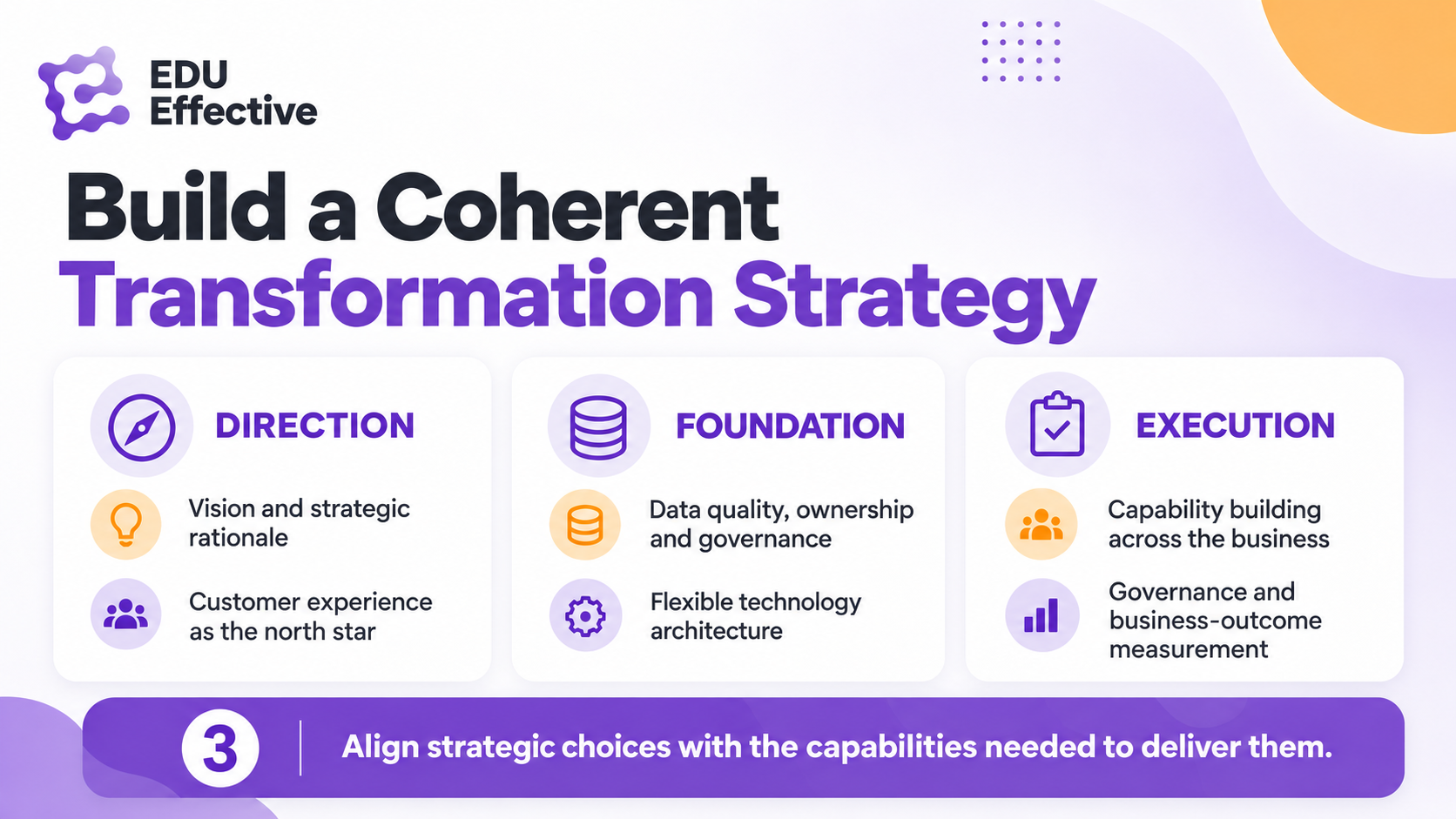
The components that distinguish strategies that produce results:
Vision and Strategic Rationale
What does the transformed organization look like, and why does transformation create competitive advantage that matters in your specific market? This is the strategic case — not “we need to modernize our technology” but a specific claim about how digital capability will change the company’s competitive position.
Without this, transformation becomes a series of disconnected improvement projects. With it, every technology decision can be evaluated against a coherent direction.
Customer Experience as the North Star
The most durable digital transformations are oriented around the customer. McKinsey’s research found that customer-experience-focused transformation can raise customer satisfaction by 20-30% and generate 20-50% economic gains. The organizations that achieve those numbers start from the customer journey — where is friction highest, where is the experience weakest, where does digital capability create value the customer actually feels — and work backward to the systems and processes required.
Organizations that start from internal efficiency and work forward to the customer often build systems that are more efficient but not materially better from the customer’s perspective.
Data and Analytics as Infrastructure
Digital transformation without a data strategy is renovation without plumbing. Data — its collection, quality, governance, and accessibility — is the raw material that makes AI applications, personalization, operational optimization, and informed decision-making possible.
Gartner found that fewer than 50% of corporate strategies identify data and analytics as critical to enterprise value. For organizations trying to transform, that gap is structural. You can implement the best AI tools available and produce poor results if the underlying data is fragmented, inconsistent, or inaccessible across systems.
The data strategy question isn’t just technical — it’s organizational. Who owns data quality? How are data definitions standardized across business units? Who has access to what, under what governance conditions? These are management decisions before they’re technology decisions.
Technology Architecture Decisions
The technology choices in a transformation strategy aren’t primarily about which vendor to select — they’re about architecture principles: cloud-first or cloud-smart, build vs. buy, best-of-breed vs. integrated suite, API-driven integration vs. monolithic systems.
These choices have long-term implications. Organizations that build on rigid, integrated legacy systems find subsequent change expensive and slow. Organizations that build on modular, API-accessible architectures can swap components, integrate new capabilities, and scale faster. The choice made during transformation constrains the options available for the next five to ten years.
Capability Building Alongside Technology
Only 14% of EMEA CIOs in Gartner’s survey prioritize building technology capability beyond their IT departments. That’s the gap: organizations invest in technology and leave the human capability lagging. A CRM implementation where the sales team doesn’t understand how to use the data it generates, or an AI tool where the analyst team can’t evaluate its outputs critically, produces a fraction of its potential value.
The most effective transformation programs run capability building in parallel with technology deployment — not as an afterthought, but as an equal workstream. AI literacy, data fluency, and digital process thinking distributed across business functions are what make technology investments compound rather than depreciate.
Governance and Measurement
The transformation strategy needs a measurement framework that goes beyond the project plan’s milestones. What are the business outcomes — revenue, cost, customer satisfaction, speed, quality — that transformation is expected to move? What are the leading indicators that will tell you whether you’re on track six months before the lagging indicators confirm it?
McKinsey found that embedding KPIs into long-term workflows increases the likelihood of transformation success sevenfold. Most organizations track project completion. The ones that succeed track business outcomes — and are willing to adjust their approach when the indicators show they’re off track.
What Successful Transformers Do Differently
McKinsey’s analysis of successful vs. unsuccessful transformations identified the factors with the strongest predictive power:
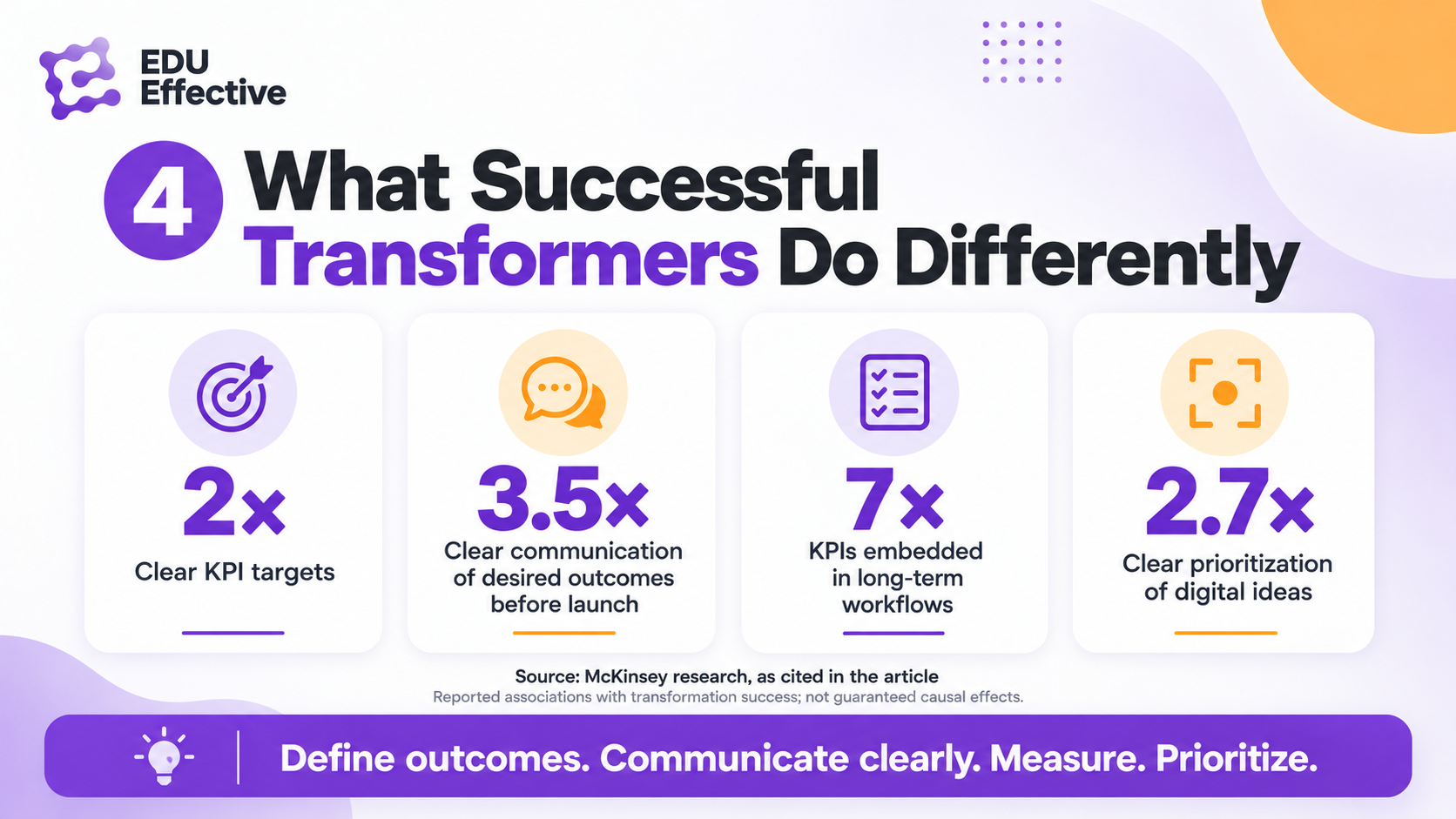
They define clear outcomes before selecting technology. The question “what should we build?” comes after the question “what outcomes are we trying to achieve and why?” This sounds obvious and is routinely ignored.
They communicate the change story relentlessly. Not a launch announcement — an ongoing narrative that explains the direction, celebrates early wins, acknowledges what’s hard, and keeps the strategic rationale visible as the work progresses. 3.5x higher success rate for organizations that communicate the desired outcome clearly before launch.
They measure what matters. Not project milestones — business outcomes. Organizations that embed KPIs into operating rhythms and use them to make real-time adjustments succeed at 7x the rate of those that don’t.
They prioritize ruthlessly. McKinsey found that clearly prioritizing digital ideas makes success 2.7 times more likely. Transformation programs that try to do everything typically make progress on nothing. The organizations that succeed pick two or three high-leverage areas, go deep, prove value, and use those wins to fund the next phase.
They treat organizational change as the hard part. The technology almost always works. The people, processes, and culture are where transformation stalls. The best transformation leaders spend as much time on the human system as on the technology system.
The Role of AI in Digital Transformation Now
Two years ago, generative AI was a peripheral consideration in digital transformation strategy. It’s now central. 78% of organizations plan to increase overall AI spending in the next fiscal year, per Deloitte. Nearly three-quarters say their most advanced generative AI initiative is meeting or beating ROI expectations — and 20% report returns of 31% or more.
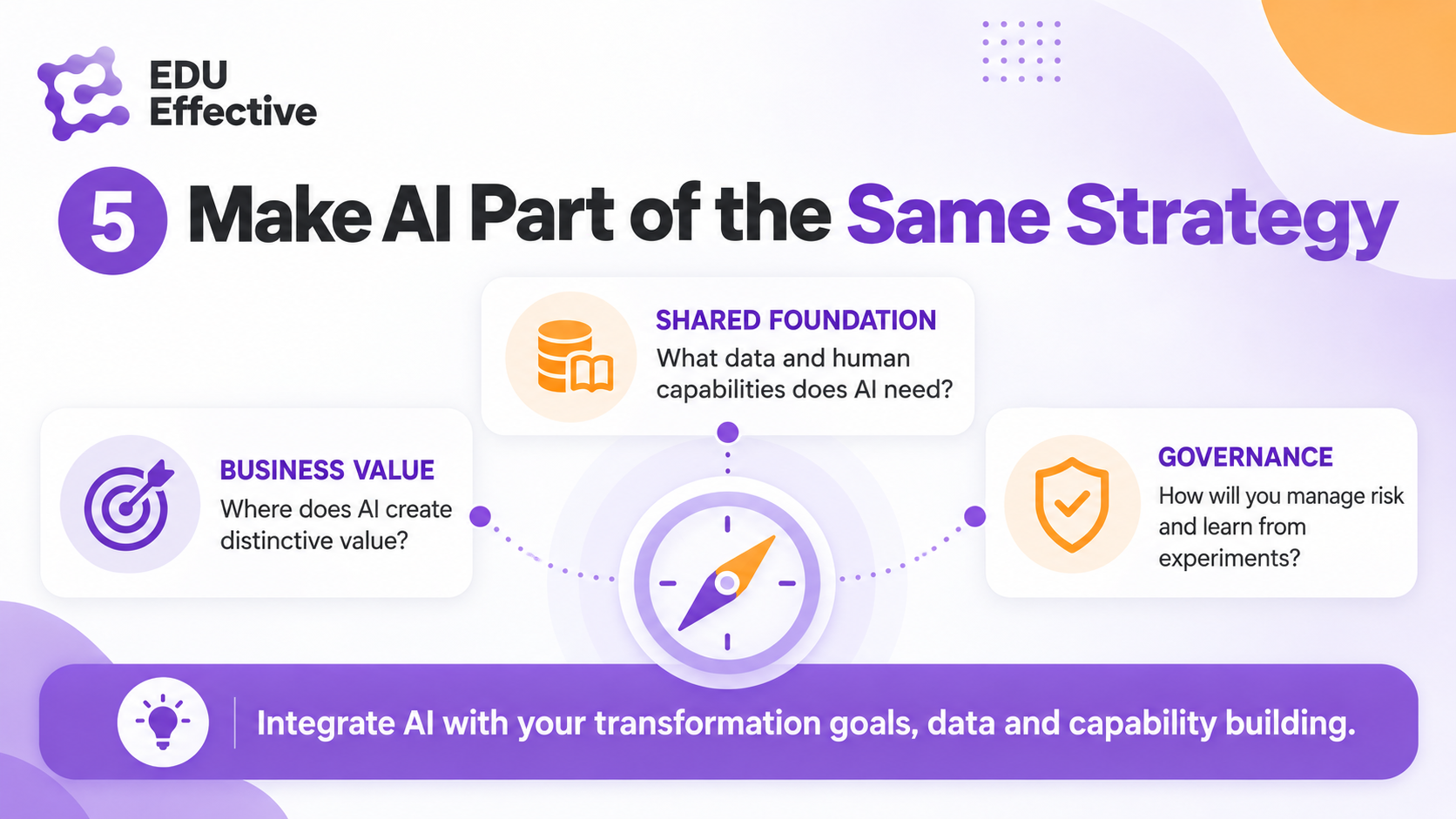
The implication for transformation strategy: AI is not a separate initiative. Organizations that run a “digital transformation program” and an “AI program” in parallel — with separate governance, separate data infrastructure, separate capability building — are building redundant architectures and missing the compound effect of integration.
A coherent transformation strategy now needs to answer: where does AI create the most distinctive value in our specific business model? How do we build the data infrastructure that makes AI applications useful? How do we develop the human capability to deploy, manage, and improve AI systems? And how do we govern AI use in ways that manage risk without strangling the experimentation needed to find what works?
A Framework for Getting Started
For organizations in early or mid-transformation, the practical starting point isn’t a technology audit. It’s three strategic questions:
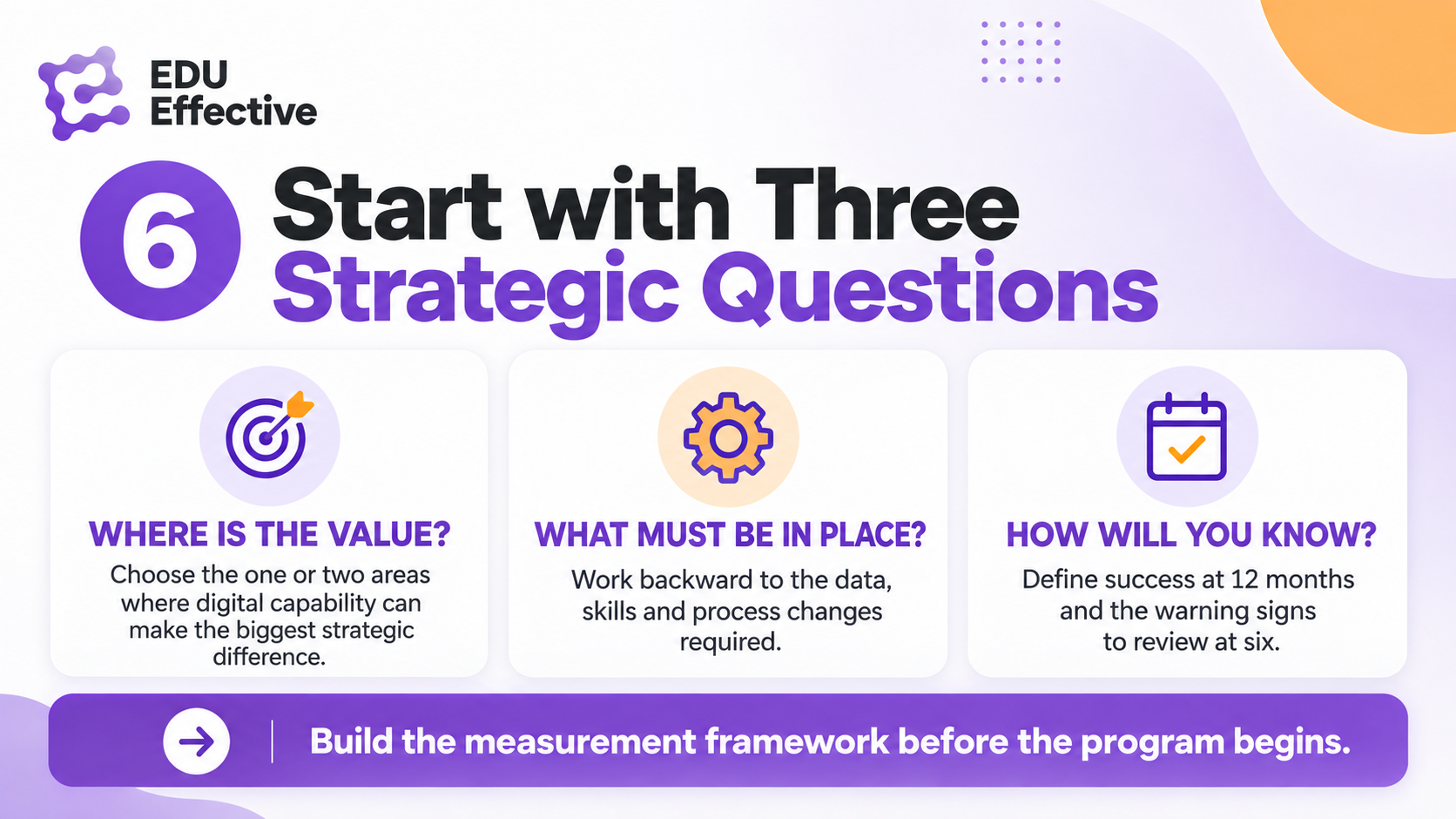
Where does digital capability create the most distinctive value in our business model? Customer experience, operational efficiency, product innovation, go-to-market speed — choose the one or two areas where the gap between current state and digital-enabled state is largest and most strategically material.
What data and organizational capabilities are prerequisite to that value? Work backward from the strategic outcome to the data infrastructure, talent, and process changes required. This is where most transformation plans reveal their gaps — the stated ambition and the prerequisite investment don’t match.
What does success look like in 12 months, and how will we know if we’re off track at six? Build the measurement framework before the transformation program, not after. The organizations that succeed are the ones willing to be honest about early signals and adjust before they’ve spent three years heading in the wrong direction.
Key Takeaways
Digital transformation strategy is not a technology roadmap — it’s a set of deliberate choices about where digital capability creates competitive advantage, backed by investment in data infrastructure, organizational capability, and change management. Only 48% of transformations meet their business outcome targets, per Gartner, because most fail at the strategic and organizational layer, not the technical one. The success factors are consistent: clear KPIs (2x more likely to succeed), communicated change story (3.5x), embedded measurement (7x), ruthless prioritization (2.7x). AI is no longer a separate initiative — it’s now core to what transformation means. 78% of organizations plan to increase AI spending in the next fiscal year. The organizations that will extract value from that investment are the ones that have answered the strategic questions first.
About EDU Effective Business School
The Effective MBA: Applied Artificial Intelligence is built for managers who need to put AI to work in real operations, not in theory. Runs on 15 minutes a day, completes in 10 months or less and is ASIC accredited.
Sources
- Gartner — CIO and Technology Executive Survey https://www.gartner.com/en/information-technology
- Deloitte — State of Generative AI in the Enterprise https://www.deloitte.com/us/en/what-we-do/capabilities/applied-artificial-intelligence/content/state-of-generative-ai-in-enterprise.html
- McKinsey & Company — Unlocking Success in Digital Transformations https://www.mckinsey.com/capabilities/people-and-organizational-performance/our-insights/unlocking-success-in-digital-transformations
- KPMG — Technology and the Workforce: Transformation Readiness https://kpmg.com/xx/en/home/insights.html