

MBA stands for Master of Business Administration — the world's most widely recognised postgraduate business qualification, and one of the most searched professional development topics globally. More than 200,000 MBA degrees are awarded annually in the United States alone. In 2026, 37% of employers intend to increase their MBA hiring, according to GMAC's Corporate Recruiters Survey. Median starting salaries for MBA graduates reached $125,000 globally, up from $115,000 the prior year.
And yet the question "is an MBA worth it?" is asked more frequently in 2026 than at any point in the past decade — because the MBA landscape has fractured. There is no longer a single answer. There is an enormous range of programmes, formats, costs, and outcomes, all operating under the same three-letter acronym. A two-year full-time programme at Wharton and a 15-minute-a-day professional MBA completed alongside a full-time job are both MBAs — and they serve fundamentally different purposes for fundamentally different people.
Understanding what an MBA is, what different types actually deliver, and how to determine which — if any — is right for your situation is worth spending time on before committing either two years of your life or €80,000 of your money.
What MBA means — and what the qualification covers
Master of Business Administration is a postgraduate degree that develops knowledge and skills across the core disciplines of business: strategy, management, finance, marketing, operations, leadership, and organisational behaviour. The intent is to produce professionals who can think across business functions rather than within a single specialisation — who understand how decisions in marketing affect finance, how operational choices affect competitive position, how leadership affects organisational performance.
The MBA emerged from American universities in the early 20th century — Harvard Business School launched its programme in 1908 — as a way to apply systematic management science to industrial organisations. It spread globally through the second half of the 20th century and became the dominant global credential for business leadership roles, particularly in North American and European professional markets.
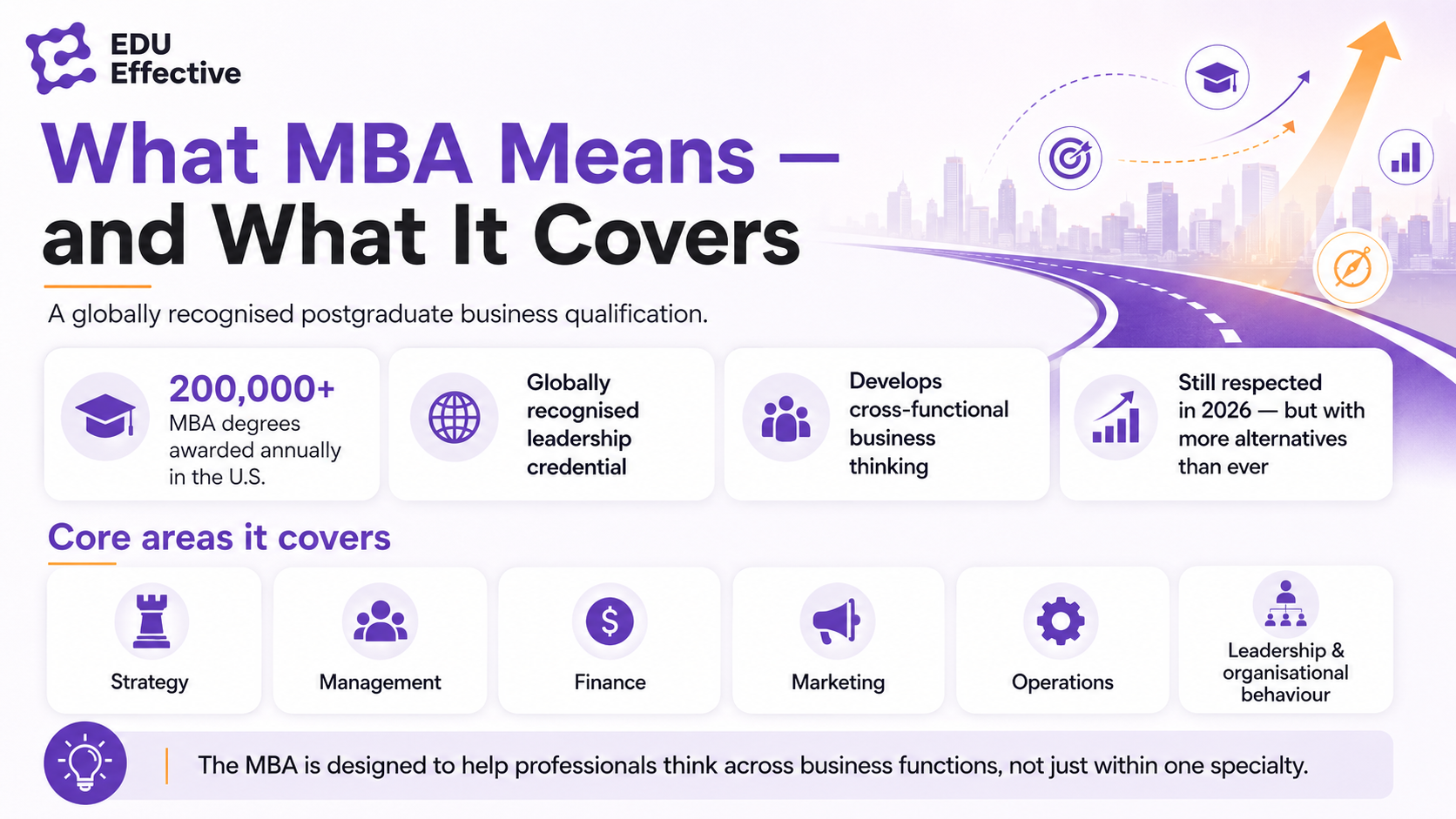
In 2026, the MBA is simultaneously stronger than ever — the credential is globally recognised, widely respected, and associated with significant career outcomes — and more contested than ever, because AI and skills-based hiring have introduced credible alternatives to the full academic qualification for specific career objectives.
The different types of MBA — and what each is actually for
Not all MBAs are equivalent, and the type of MBA programme matters significantly for both the experience it provides and the outcomes it produces.
Full-time MBA — a two-year immersive programme, typically residential, requiring students to leave their careers for the duration. The primary advantages are depth of peer learning, access to on-campus recruitment pipelines at elite firms, and the network built through intensive shared experience. This is the format that produces the $192,000 starting salaries at McKinsey, BCG, and Bain — and the one that costs $100,000 to $200,000 in tuition plus two years of foregone income. It is optimised for career pivots into management consulting, investment banking, and other fields where the prestige signal of a top-ranked institution genuinely opens specific doors. For professionals targeting those specific outcomes, at specific firms, it may justify its cost. For most others, the ROI is substantially weaker.
Part-time MBA — the same academic content delivered over three to four years alongside full-time employment, typically through evening and weekend classes. It reduces foregone income but extends the commitment period and adds the complexity of managing work, study, and life simultaneously for years at a time. Part-time MBA graduates typically remain in their current organisations during study, which reduces the career pivot optionality that makes full-time programmes most valuable.
Executive MBA (EMBA) — designed for senior professionals typically with ten or more years of experience, conducted intensively at weekends or in periodic residential blocks. It builds peer networks among already-senior professionals and provides strategic and leadership development for those already in leadership roles. Costs are typically comparable to or higher than full-time programmes.
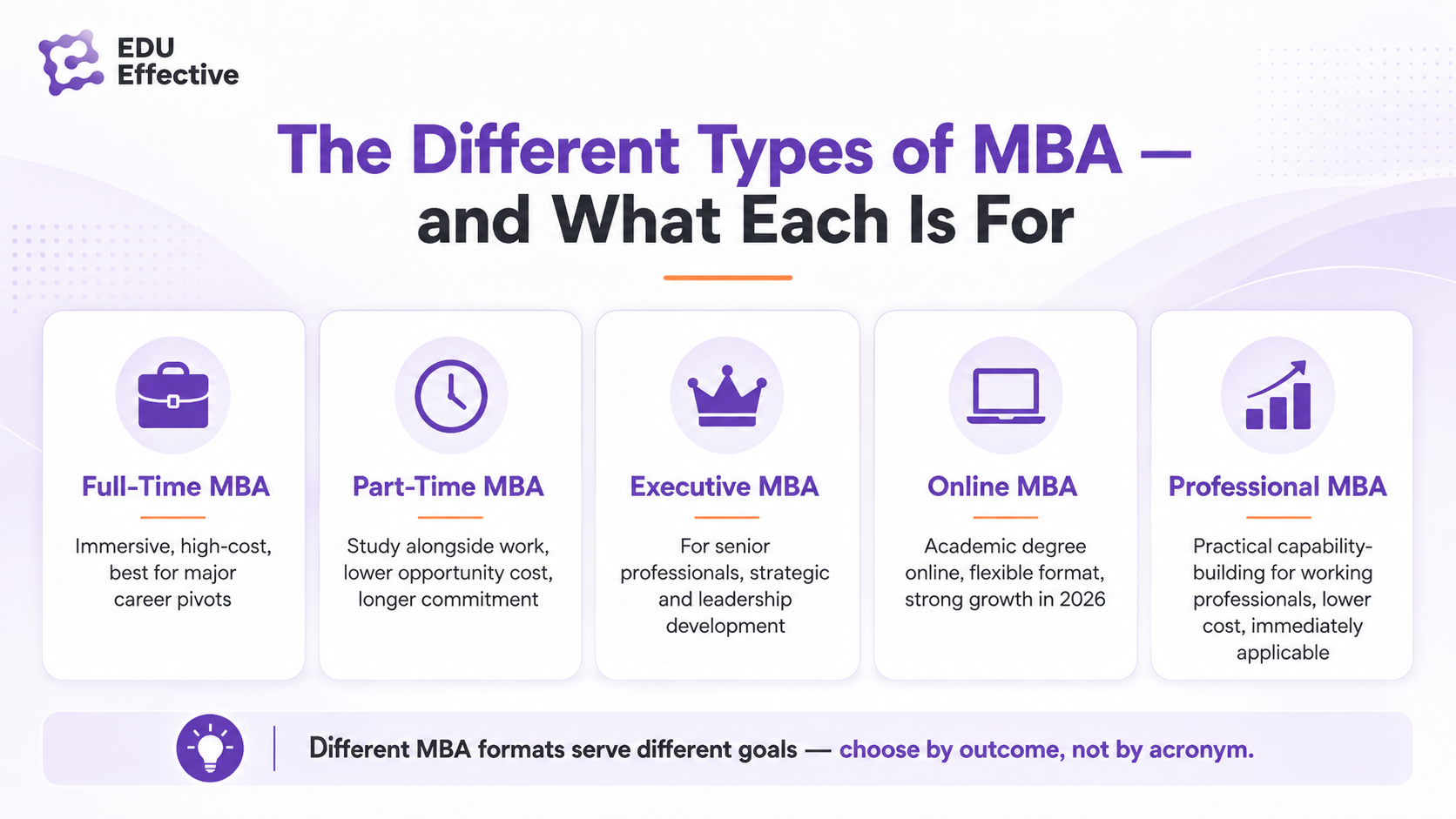
Online MBA — an academic programme delivered entirely online, from accredited universities, typically at lower cost than residential equivalents. Online MBA graduates from accredited programmes report median salary increases of 30 to 50% within three years, according to current market data. They represent the fastest-growing MBA format in 2026, driven by improvements in digital learning platforms and growing employer acceptance of online credentials.
Professional MBA programmes — a distinct category that is often confused with academic online MBAs but operates on a different philosophy. Professional MBA programmes are built around the immediate applicability of skills to current work rather than the accumulation of an academic credential. They are typically shorter, lower-cost, and structured for working professionals who need to build specific business capabilities — leadership, AI fluency, marketing, coaching — without the time or financial commitment of an academic qualification. EDU Effective's Effective MBA programmes are in this category.
The distinction matters because the two types serve different objectives. An academic MBA — whether full-time, part-time, or online — produces an academic qualification recognised within the formal educational credential system. A professional MBA produces demonstrable, immediately applicable capabilities and a professionally accredited credential recognised by employers. Choosing between them should be determined by what you actually need rather than by which sounds more impressive.
What an MBA actually develops — the core competencies
Regardless of format, the MBA is designed to develop a consistent set of business competencies. Understanding what these are is the most direct way to assess whether an MBA addresses what you actually need.
Strategic thinking — the ability to analyse competitive environments, identify strategic options, evaluate their trade-offs, and make defensible decisions about direction. This is typically developed through case study analysis, strategic frameworks, and the application of business theory to real organisations.
Financial literacy — the ability to read and interpret financial statements, understand the mechanics of corporate finance, evaluate investment decisions, and speak fluently with finance professionals about business performance. MBA-level financial literacy is one of the most consistently valued competencies for professionals moving into general management roles.
Leadership and management — developing the human capabilities required to build and lead teams, manage performance, navigate conflict, communicate across organisations, and drive results through other people rather than through individual contribution. This is the area where professional MBA programmes and academic MBA programmes converge most directly in their content, and where the gap between credential type and actual competency development is smallest.
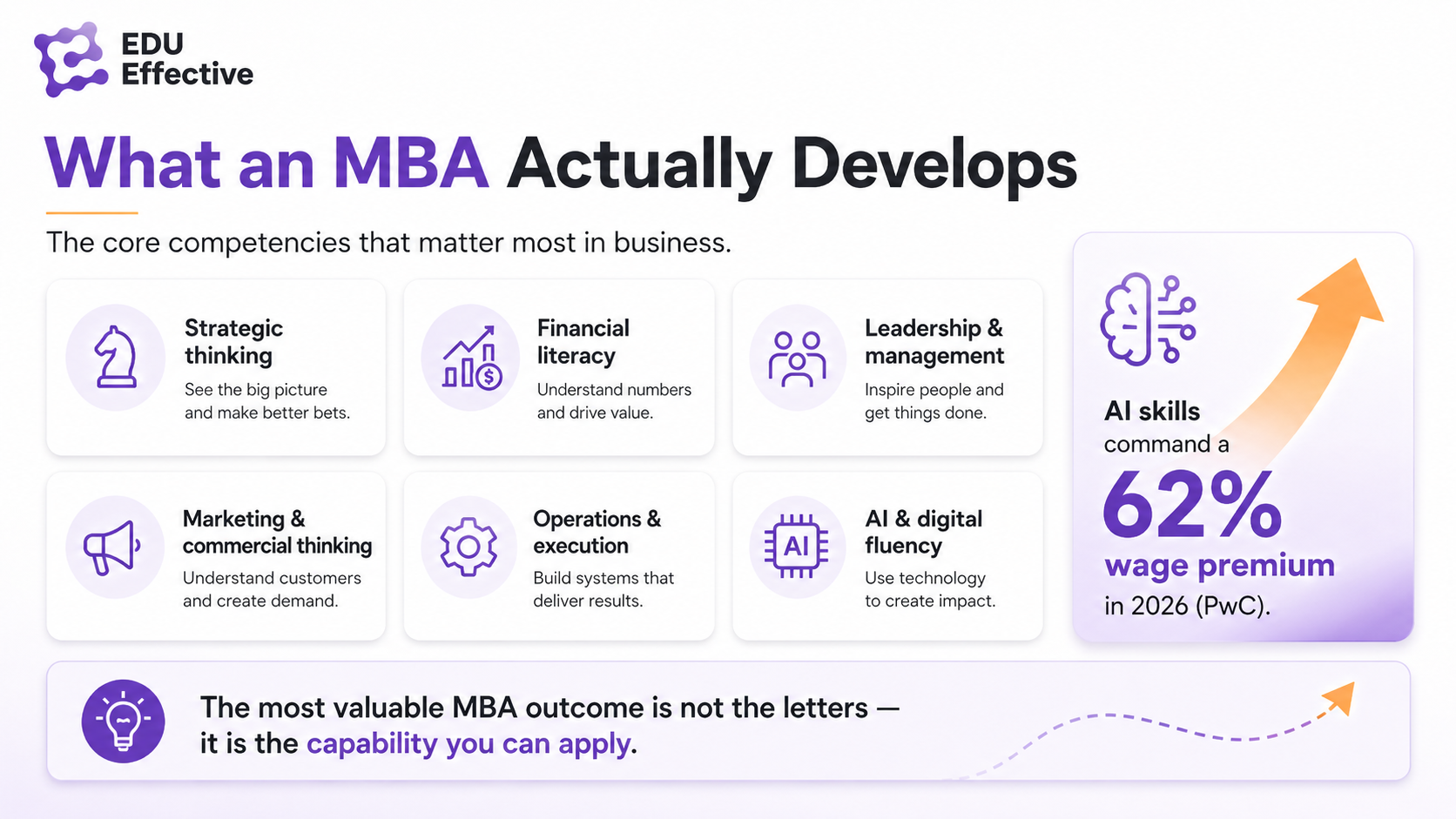
Marketing and commercial thinking — understanding how markets work, how customers make decisions, how brands are built, and how commercial growth is generated. Combined with digital and AI literacy, this has become one of the most in-demand business competencies in 2026.
Operations and execution — understanding how organisations deliver products and services efficiently, how processes are designed and improved, and how strategic decisions translate into operational reality.
AI and digital fluency — not traditionally part of the MBA curriculum but now increasingly central to it, particularly in professional programmes designed for 2026 relevance. PwC's 2026 Global AI Jobs Barometer found that AI skills command a 62% wage premium over comparable roles — making AI literacy one of the highest-return competency investments available to any professional.
Is an MBA worth it — for you, specifically
The question "is an MBA worth it?" cannot be answered in the abstract. It depends entirely on what you are trying to achieve, what your current situation is, and which type of MBA you are considering.
An MBA is most worth it if: you are targeting a specific career outcome — management consulting at a top-tier firm, investment banking, or a senior leadership role in a large organisation — where the credential and network of a specific institution genuinely matter for access. In these cases, the full-time programme at a highly-ranked school with strong on-campus recruitment represents the most direct path to the outcome.
An MBA is less clearly worth it if: you are seeking to develop specific business competencies — leadership, AI fluency, marketing, coaching, strategic thinking — without targeting those specific institutional career outcomes. In this case, the cost and time commitment of a full academic programme are difficult to justify relative to a professional programme that delivers the same competency development at a fraction of the cost and in a format that does not require pausing a career.
A professional MBA is most worth it if: you are a working professional who wants to build demonstrable business capabilities, earn an internationally accredited credential, and apply what you learn directly to your current role — while continuing to earn a salary and without accumulating significant debt. The Effective MBA programmes at EDU Effective are built for exactly this situation.
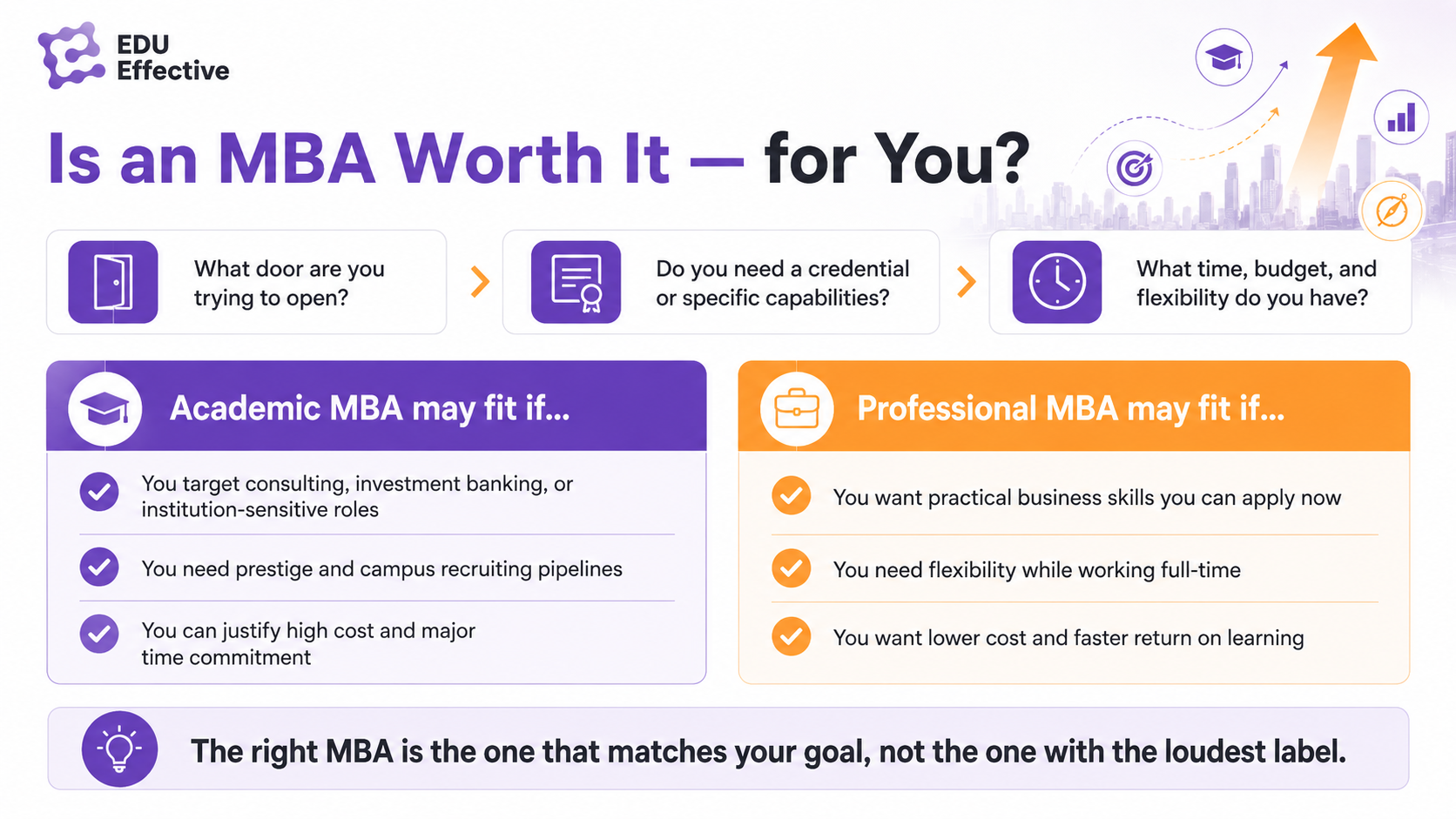
The honest test is this: what door are you trying to open, and does the specific MBA type you are considering open it? If the answer is a specific employer in a specific sector that screens for a specific institution — the academic credential matters. If the answer is building your leadership capability, understanding AI, developing your marketing skills, or advancing in your current organisation — the competency matters more than the credential type, and a professional programme delivers that competency more efficiently.
What employers actually want in 2026
The employer perspective on MBA hiring in 2026 is more nuanced than either "MBAs are essential" or "MBAs are obsolete."
GMAC's Corporate Recruiters Survey found that 37% of employers intend to increase their MBA hiring — a positive signal. But the same research consistently shows that what employers value in MBA graduates is the competency development, not the credential in isolation. Employers rank communication skills, leadership potential, strategic thinking, and problem-solving above the institution's ranking when evaluating MBA graduates for most roles.
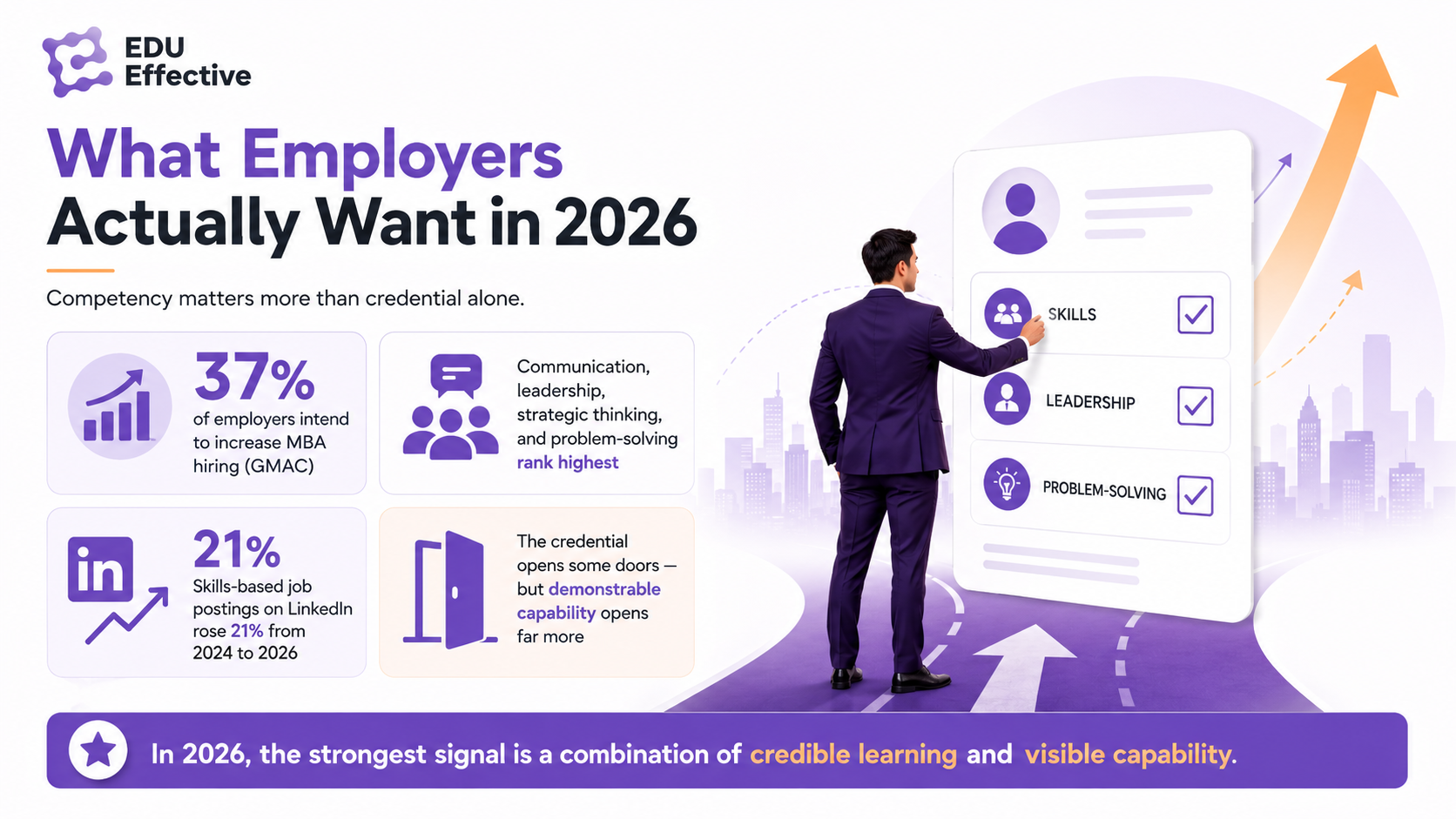
Skills-based hiring — evaluating candidates on demonstrable capabilities rather than formal credentials — has accelerated significantly across industries. LinkedIn data shows a 21% increase in job postings that explicitly list skills rather than credentials as requirements between 2024 and 2026. This trend does not make credentials irrelevant — it makes competency demonstration more important than credential possession in an increasing range of hiring decisions.
The implication for anyone considering an MBA is straightforward: the credential opens doors in specific institutional contexts. The competencies it develops open doors everywhere else. A professional who has developed genuine leadership, strategic thinking, and AI fluency — and can demonstrate those competencies through their work and a professionally accredited qualification — is competitive for most management and leadership roles regardless of whether their qualification came from a business school or a professional programme.
The alternative worth knowing about
One of the most consequential shifts in professional education in 2026 is the growing credibility of professionally accredited qualifications as alternatives to academic MBAs for professionals who are not targeting those specific institutional career outcomes.
The Effective MBA at EDU Effective is designed for professionals in exactly this position. It develops leadership, management, AI, marketing, and coaching capabilities through a library of more than 24,000 curated videos — content from practitioners at Google, McKinsey, Amazon, LinkedIn, Netflix, Goldman Sachs, and many others, alongside faculty from Harvard Business School, Yale, Stanford, Princeton, and Cambridge — delivered in 15 minutes a day, completed in ten months or less, and accredited by ASIC, whose accreditation is recognised internationally by employers, immigration authorities, and professional bodies.
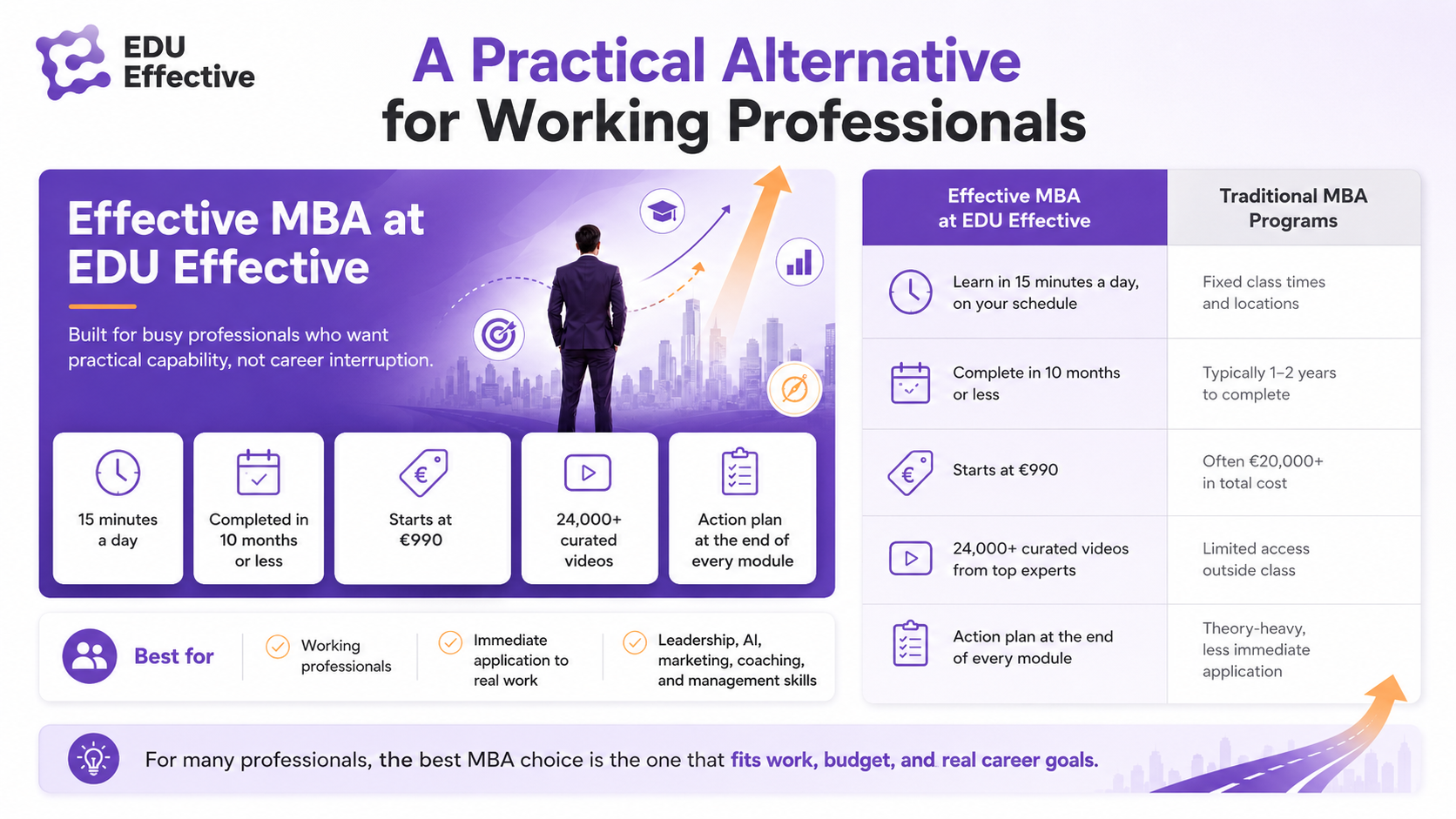
The cost starts at €990 — compared to €30,000 to €80,000 for most academic MBA programmes. The format fits around a working life rather than requiring one to be paused. And the curriculum is built for immediate application: every module ends with an action plan where the student applies what they have just learned to their actual work situation.
For professionals asking "is an MBA worth it?" — the honest answer is: it depends on which MBA, and for what purpose. The question worth asking alongside it is: what specific capabilities do I need to build, and which programme delivers them most efficiently, given my time, budget, and career objectives?
At EDU Effective, we have built the Effective MBA specifically for working professionals who need to develop real business capabilities — in a format that fits around a real working life. Explore our programs →
EDU Effective Business School — professional development for your long-term success.
All five Effective MBA programs are built on the same educational model — designed for working adults who need learning that fits real professional life:
- Effective MBA: Executive Management & Leadership
- Effective MBA: Applied Artificial Intelligence
- Effective MBA: Coaching, Leadership & Mentoring
- Effective MBA: Mastery in AI
- Effective MBA: Online Marketing
Every programme runs on 15 minutes a day, completes in 10 months or less, is ASIC accredited, and starts from €990.
These are professional programmes, not academic ones — built for working adults to apply what they learn directly in their own business, not to collect a scholarly credential.
Join more than 9,000 students in over 120 countries who are investing in their professional development and career success. Read the experiences of our graduates here.
Apply now — from €990 · Talk to a Study Advisor
Study with NO risk: 14-day money-back guarantee, no questions asked.
Sources
- GMAC — Corporate Recruiters Survey: MBA Hiring Intentions and Salary Data https://www.gmac.com/market-intelligence-and-research/research-library/employment-outlook/2026-corporate-recruiters-survey-report
- GMAC — Graduate Management Education Trends https://blog.gmac.com/gmac-advisor/2025-top-10-trends-in-graduate-business-school-research
- PwC — 2026 Global AI Jobs Barometer https://www.pwc.com/gx/en/news-room/press-releases/2026/pwc-2026-ai-jobs-barometer.html
- LinkedIn — Workplace Learning Report: Skills-Based Hiring Trends https://learning.linkedin.com/resources/workplace-learning-report
- US Bureau of Labor Statistics — Education Pays: Earnings and Unemployment Rates by Educational Attainment https://www.bls.gov/emp/chart-unemployment-earnings-education.htm
- McKinsey & Company — Reimagine learning and development for the AI age https://www.mckinsey.com/capabilities/people-and-organization/our-insights/the-organization-blog/reimagine-learning-and-development-for-the-ai-age