

You’ve heard about prompt engineering. Maybe someone on your team mentioned it in passing, or you saw it listed as a “must-have skill” somewhere. The phrase sounds technical — like it belongs to developers, not managers.
It doesn’t. Understanding prompt engineering is quickly becoming one of the most practical management skills of the decade. Not because you need to write code. Because the quality of your conversations with AI tools determines the quality of the output you get — and that output is increasingly shaping business decisions, communications, and strategies across every function.
This article explains what prompt engineering actually is, which techniques produce measurable results, and how working professionals can start using it today.
What Prompt Engineering Actually Means
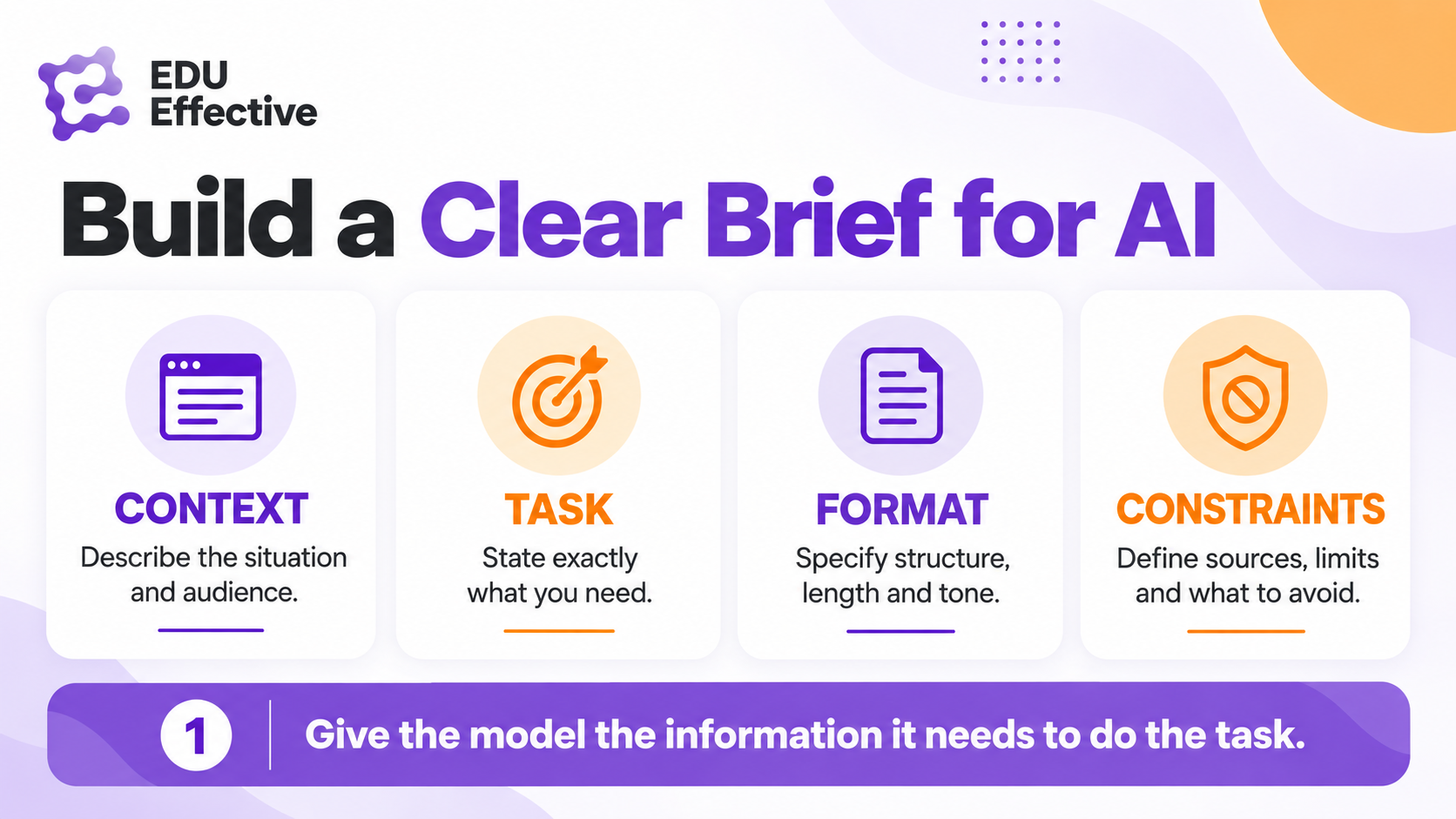
Prompt engineering is the practice of designing inputs — questions, instructions, context — to get useful, accurate, and relevant outputs from large language models (LLMs) such as ChatGPT, Claude, or Gemini.
The word “engineering” is slightly misleading. It implies calculation and exactness. In practice, prompt engineering is closer to skilled communication: knowing how to frame a question, what context to include, and which structure helps the model reason correctly rather than pattern-match to something irrelevant.
Think of it this way. You can ask a new analyst: “Write me a market report.” You’ll get something. Or you can say: “Write a 500-word market analysis of the European edtech sector for Q3 2026, focused on the adult professional learning segment. Use data where available. Structure it as: context, key trend, one risk, one opportunity. Avoid speculative claims.” You’ll get something far more useful from the same person, with the same knowledge.
AI models work the same way — except the difference in output quality is often much larger. Research published in September 2025 in the arxiv preprint “The Prompt Engineering Report Distilled” (covering studies from 2022 through 2025) found that on certain reasoning tasks, switching from a baseline prompt to a structured chain-of-thought approach raised accuracy from under 20% to over 78%. That is not a marginal improvement. That is the difference between a tool that works and one that doesn’t.
Why This Is a Management Skill, Not a Developer Skill
The moment AI tools became accessible to non-technical users — through interfaces like ChatGPT, Claude.ai, Microsoft Copilot, or Google Gemini — prompt engineering stopped being a niche skill confined to machine learning teams.
Today, managers use AI tools to draft communications, analyze documents, summarize research, prepare meeting briefs, generate first drafts of strategies, and stress-test their own thinking. Every single one of those tasks is a prompt. How well those tasks are done depends almost entirely on how well the prompt is written.
LinkedIn’s Skills on the Rise 2026 report names prompt engineering and large language models among the fastest-growing skill areas in demand globally, under the category of AI model development and deployment. The trend is consistent: organizations that started deploying AI tools two or three years ago are now realizing their results depend less on which model they chose and more on whether their people know how to use it.
The Core Techniques — With Evidence
Not all prompting strategies are equal. Research across dozens of studies gives a clear picture of what actually works.
Zero-Shot Prompting
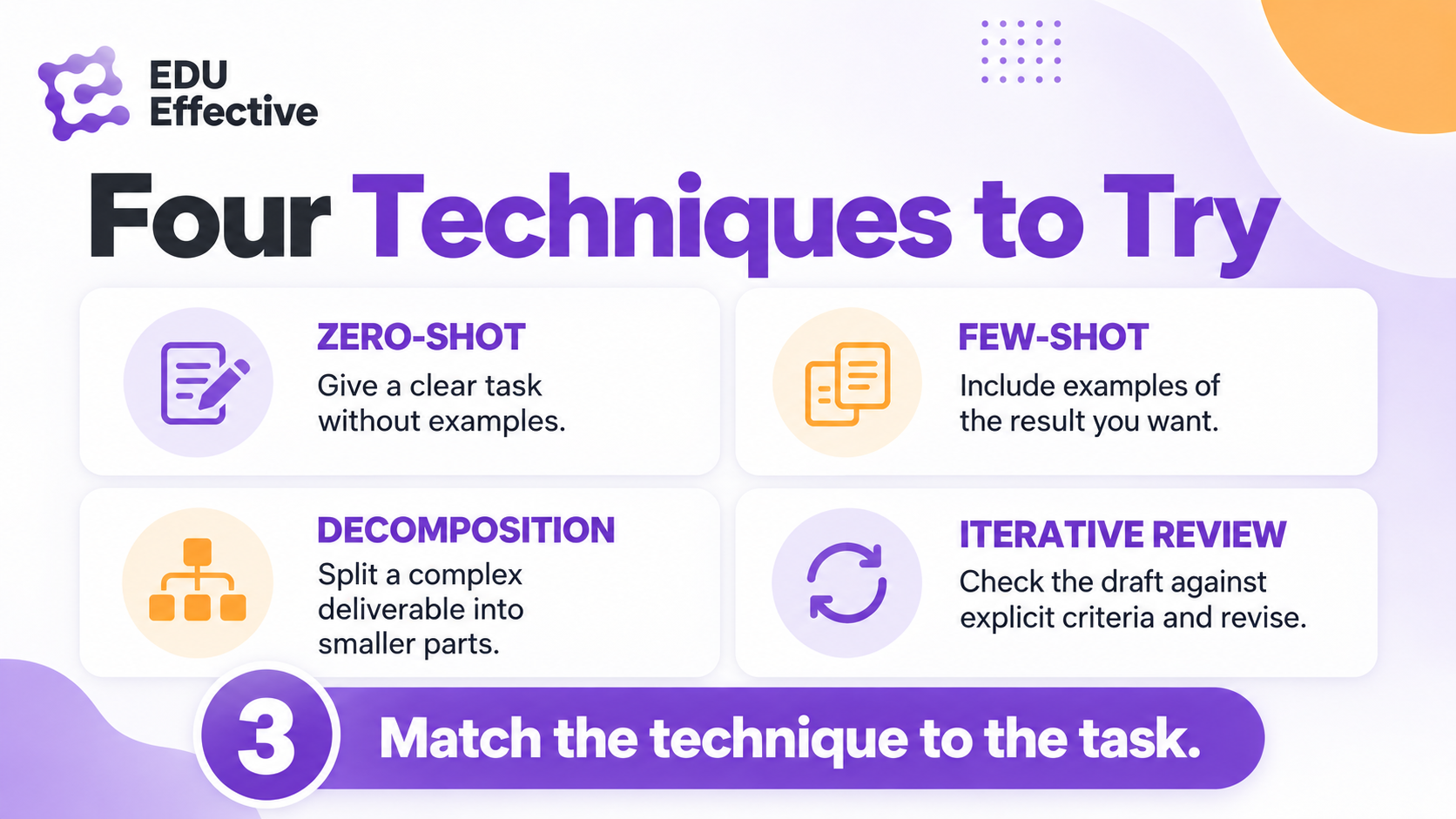
You ask the model to complete a task with no examples. Simple, fast, effective for straightforward requests. Works well when the task is clear and common enough that the model has seen it before in training. The limitation: for novel, domain-specific, or multi-step tasks, the model fills in the blanks with generic patterns rather than precise reasoning.
Few-Shot Prompting
You include two to five examples of the task done correctly before asking the model to complete a new instance. The performance gains here are documented and significant. One 2024 study (Hu et al.) showed F1 score — a standard accuracy metric — rising from 0.288 to 0.676 on a clinical named-entity recognition task when examples were included. Another study (Ono et al., 2024) found that adding 20 examples to a histopathology classification prompt raised accuracy from 40% to 90%.
There’s a subtlety worth noting: the same research found that using diverse examples, rather than similar ones, gave a 12.9% additional performance gain. And simply changing the order of examples shifted accuracy by 5.5 to 10.5 percentage points. The examples you choose and how you arrange them matter.
Chain-of-Thought Prompting
Instead of asking the model to jump straight to an answer, you instruct it to reason step by step. The simplest version adds the phrase “Let’s think through this step by step” to a prompt. Kojima et al. found that this zero-shot chain-of-thought approach raised accuracy on the MultiArith arithmetic benchmark from 17.7% to 78.7%. Wei et al. saw similar results on the GSM8K dataset, with accuracy rising from 17.9% to 56.9% when few-shot chain-of-thought examples were provided.
Why does this work? Because complex tasks require intermediate steps. When you force the model to show its reasoning, errors become visible and correctable — and the model itself is less likely to make them in the first place.
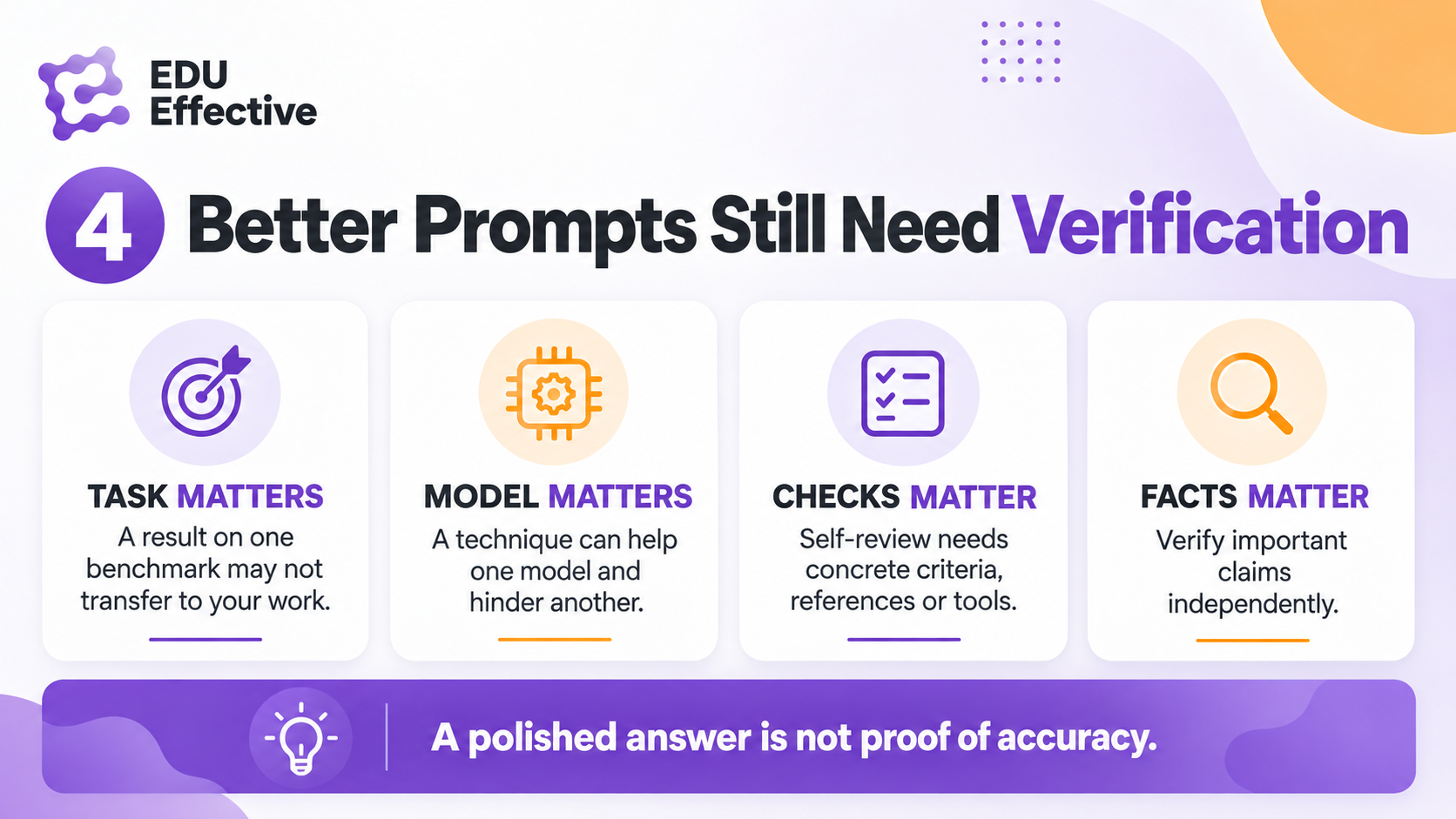
One important caveat from the same research: combining chain-of-thought prompting with advanced reasoning models like o1-preview on cognitive tasks actually reduced accuracy by up to 36.3% in some studies (R. Liu et al.). More sophisticated prompting is not always better. Context matters.
Role Prompting
You assign the model an identity: “You are an experienced HR director reviewing a job description for bias.” This works in some contexts. Kong et al. found that role-play prompting raised reasoning accuracy from 53.5% to 63.8% on the AQuA benchmark. However, later studies found no significant gain from expert personas on harder reasoning tasks (Basil et al.; Zheng et al.). Use it selectively — it helps most for communication-style tasks, less so for pure reasoning.
Self-Criticism and Iterative Refinement
You ask the model to review and improve its own output. Madaan et al. found that self-refine prompting improved task performance by 5 to 40%, roughly 20% on average. Reflexion (Shinn et al.) raised coding pass rates from 80.1% to 91.0% on the HumanEval benchmark.
Again, a caveat: Huang et al. found that asking a model to self-correct without any external reference or tools provided no improvement on math tasks. The technique works best when the model has something concrete to check against.
Decomposition
For complex tasks, break the problem into smaller parts. Least-to-Most prompting (Zhou et al.) decomposed a compositional language task and raised accuracy from 16.2% to 99.7%. The principle transfers directly to management work: instead of asking “write a business case for this project,” you ask first for an executive summary, then for supporting data, then for a risk section — each step informed by the previous output.
What Good Prompts Have in Common
Across all techniques, the highest-performing prompts share five characteristics.
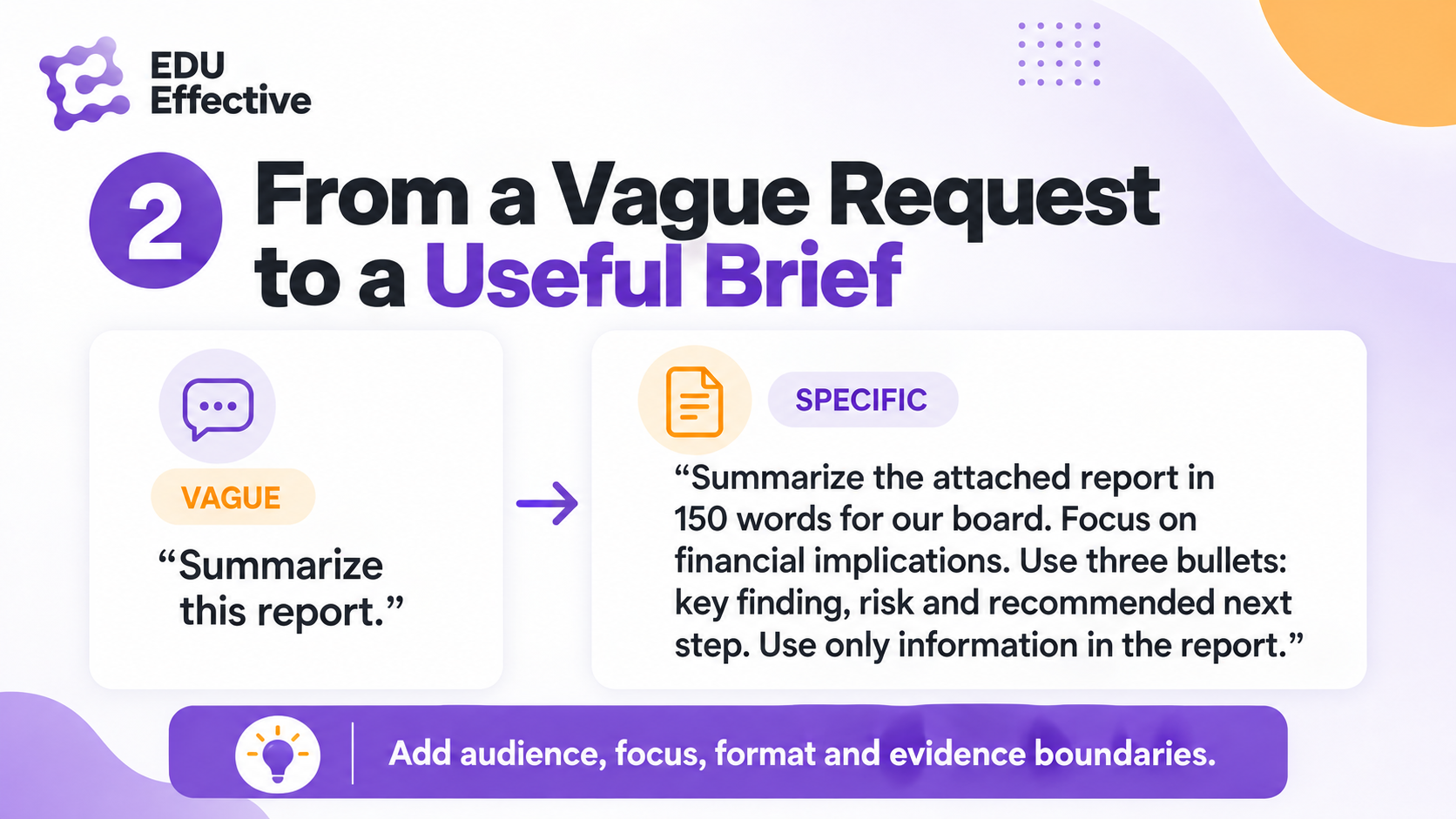
Specificity over generality. “Summarize this report” produces a generic summary. “Summarize this report in 150 words for an executive audience unfamiliar with the topic, focusing on financial implications” produces something you can actually use.
Context before task. The model doesn’t know your industry, your audience, or your constraints unless you say so. Front-loading context consistently improves output quality.
Format specification. Tell the model exactly what format you want: bullet points, numbered list, table, running prose, a specific word count. Models fill format ambiguity with defaults that rarely match your needs.
Role or perspective. When relevant, specify the frame: “as a CFO reviewing this for board presentation” or “as a skeptic looking for weaknesses in this argument.”
Iteration, not one-shot. One study (Laban et al.) found that performance dropped from 90% to 65% when a task was split across underspecified conversational turns. The lesson is not to avoid iteration — it’s to make each turn specific and complete rather than fragmentary.
Common Mistakes That Cost You Output Quality
Vague instructions. “Make it better” tells the model nothing. Better in what dimension? Shorter? More professional? More data-driven?
No context about the audience. A summary for a board member needs different framing than one for a technical team. Without that information, the model guesses.
Accepting the first output without refinement. The first output is a draft. Asking the model to “make this more direct,” “remove jargon,” or “add a concrete example for each point” typically adds significant value.
Overcomplicated prompts for simple tasks. Chain-of-thought instructions slow down simple requests and can introduce unnecessary hedging. Match the technique to the complexity of the task.
Assuming accuracy without verification. AI models can state incorrect facts confidently. The same research review noted that LLM-generated article summaries were five times more likely to contain overgeneralizations than human-authored ones (Peters and Chin-Yee). For any output where factual accuracy matters, verify independently.
The Career Case for Learning This Now
Glassdoor data (as of late 2026) puts the median total pay for a dedicated prompt engineer role at $133,000 in the US, with senior practitioners at major technology firms reaching $216,000. Google lists median total pay for these roles at $260,000; Meta at $240,000. That is the specialist track.
The broader point is different. Prompt engineering is not a role most working professionals will hold. It is a skill that makes every role more effective. An HR manager who can extract structured insight from 50 CVs in 20 minutes has a different workday than one who cannot. A financial analyst who can stress-test a projection with a well-crafted AI prompt works faster and catches more edge cases. A marketing manager who can iterate on campaign copy through structured prompts produces more in less time.
LinkedIn puts prompt engineering in the same cluster of rising skills as large language models and AI deployment. The organizations pulling ahead on AI productivity are not the ones with the best models. They are the ones with people who know how to use them.
A Practical Starting Framework
If you want to build this skill deliberately, start here.
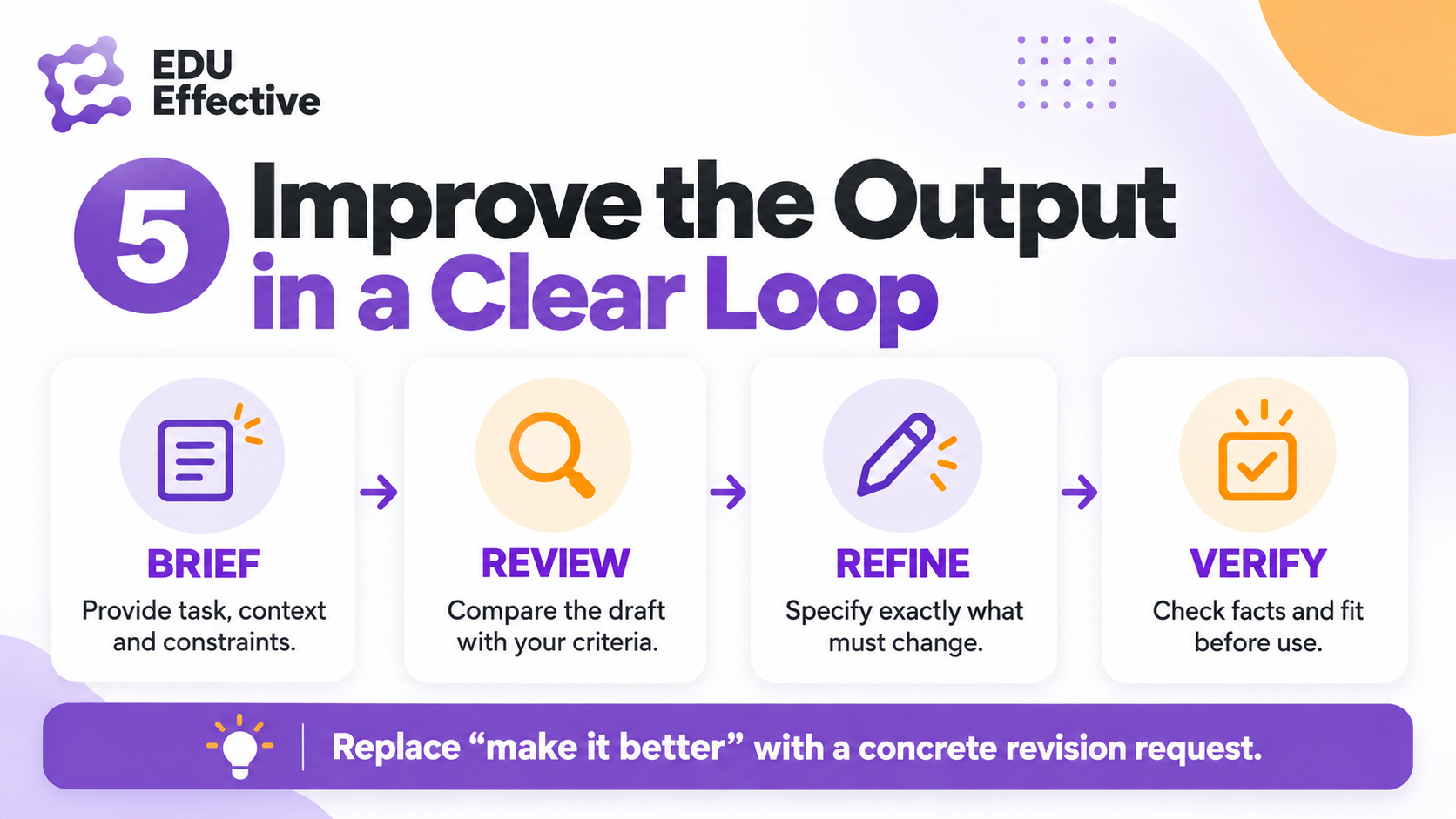
Pick one task you do repeatedly — a weekly report summary, a draft email to a client, a competitive analysis. Write three different prompts for the same task. Vary the specificity, the format instruction, and the context you provide. Compare the outputs.
Then add one technique: either few-shot examples (paste in two previous versions you were happy with) or a chain-of-thought instruction (“reason through this step by step before writing the final version”). Compare again.
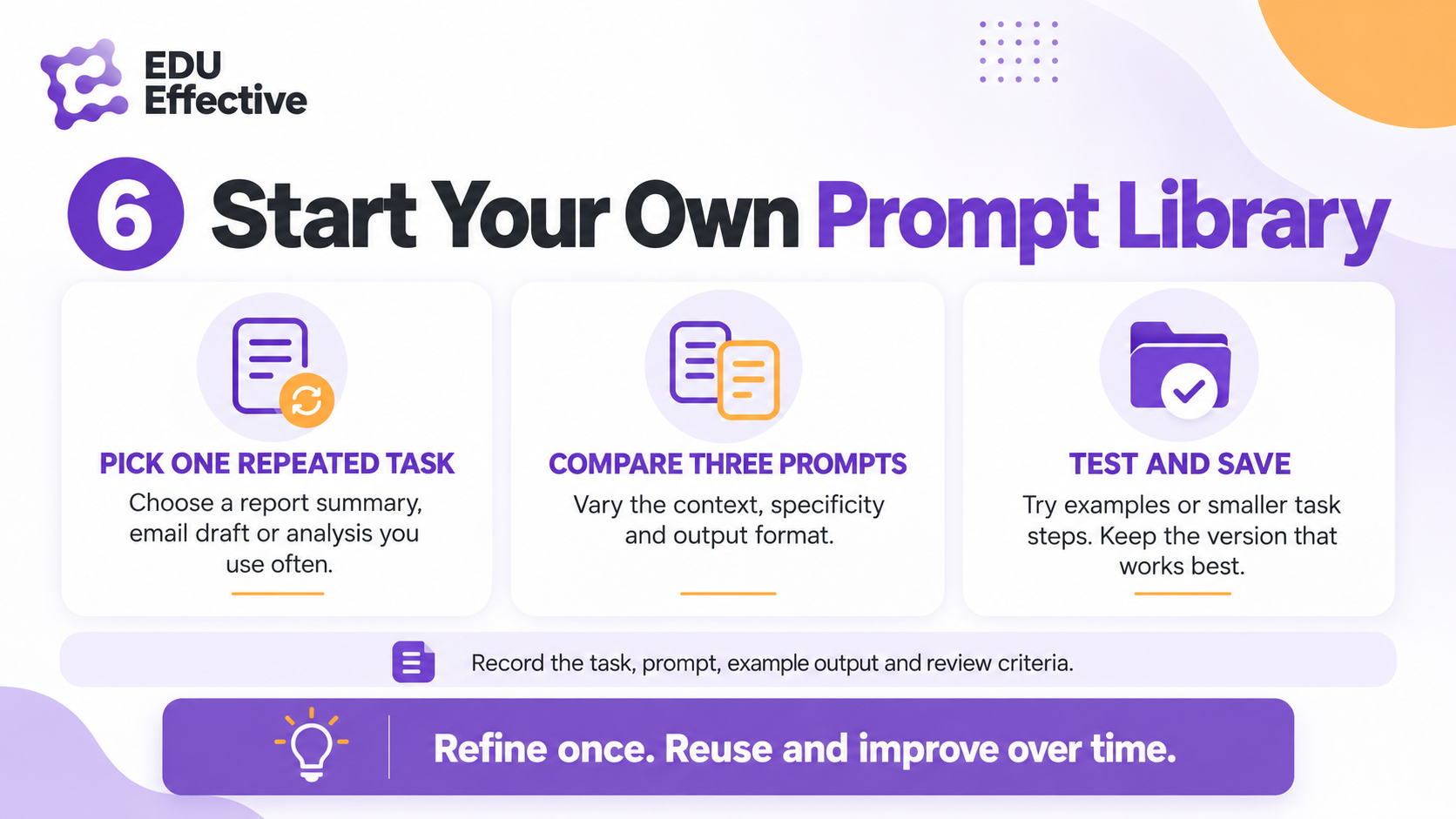
Within a week, you will have a personal library of prompts that consistently produce useful output for your most common tasks. That library compounds — each prompt you refine saves time on every future use.
Why This Belongs in Every Manager’s Toolkit
AI tools are not going to become easier to use just because time passes. They will become more powerful — which means the gap between someone who knows how to direct them and someone who doesn’t will grow, not shrink.
Prompt engineering is how you close that gap. It is the skill that converts a generic AI interaction into a productive one. The techniques are learnable, the research is clear on what works, and the barrier to starting is low.
The question is not whether this matters for your work. It does. The question is when you start treating it seriously.
About EDU Effective Business School
The Effective MBA: Applied Artificial Intelligence turns AI capability into decisions a manager can defend. Runs on 15 minutes a day, completes in 10 months or less and is ASIC accredited.
Sources
- The Prompt Engineering Report Distilled — compilation of prompt engineering research https://arxiv.org/abs/2509.11295
- LinkedIn Skills on the Rise 2026 https://news.linkedin.com/2026/Skills-on-the-rise-2026
- Glassdoor — Prompt Engineering Salary Data (2026) https://www.glassdoor.com/Salaries/prompt-engineer-salary-SRCH_KO0,15.htm